AI in Healthcare: Redefining the Future of Healthcare

Join our Newsletter!

Featured Posts

Support Is One Click Away

Home

AI in Healthcare: Redefining the Future of Healthcare

AI in healthcare

AI in Healthcare: Redefining the Future of Healthcare

Can you imagine a scenario of walking into a hospital where doctors are assisted by intelligent machines which can predict diseases, suggest treatments and even monitor your health in real time? Sounds futuristic, doesn’t it? Have you ever pondered how artificial intelligence is transforming the future of healthcare? Well, that’s precisely where AI in healthcare stands out! Interested to know more about this unique combination of AI and healthcare? Let us learn more about it! 

Want to deploy AI solutions that drive smarter medical decisions and improve patient experiences? At Mindpath Tech, we provide healthcare software development services designed to make technology work seamlessly for your organization.

Role of AI in Healthcare

AI in healthcare refers to the use of artificial intelligence to assist doctors and nurses in hospitals and clinics. These programs look at a lot of medical data such as test results and scans and find patterns which can help in detecting health problems of patients early. They can even help in suggesting the best treatments based on each patient’s health history. Not only this, but AI is also used to carry out routine tasks like setting appointments or checking records, so that staffs can get more time to care for patients. 

The benefits of AI are being used in many parts of healthcare. It is helping doctors to read X-rays and scans so that health problems can be spotted earlier. Intelligent robots will assist doctors to perform surgery with ease. AI assists researchers in discovering new drugs at a quicker rate by analyzing vast amounts of information. Even patients can use AI-based apps to monitor their health and receive reminders about taking medications or adhering to treatment regimens. 

According to a Grandview’s Market Research Survey, the worldwide AI in healthcare market was valued at more than 26 billion dollars in 2024, and it’s expanding very quickly. Experts predict that it can expand by as much as 39% annually until 2030. Why? Because more clinics and hospitals want to work faster, make fewer errors, and help patients feel better sooner. 
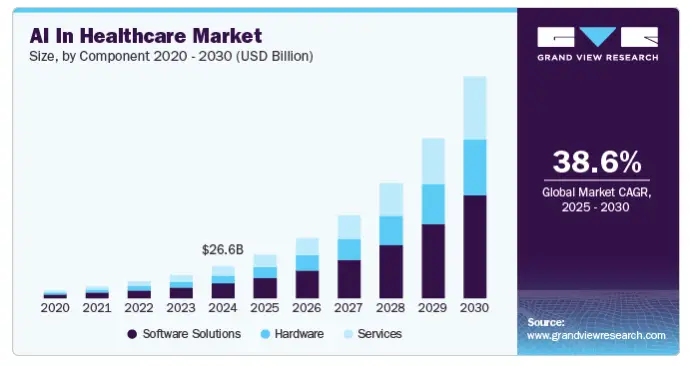
AI in Healthcare - Market
Source: www.grandviewresearch.com

Benefits of AI in Healthcare

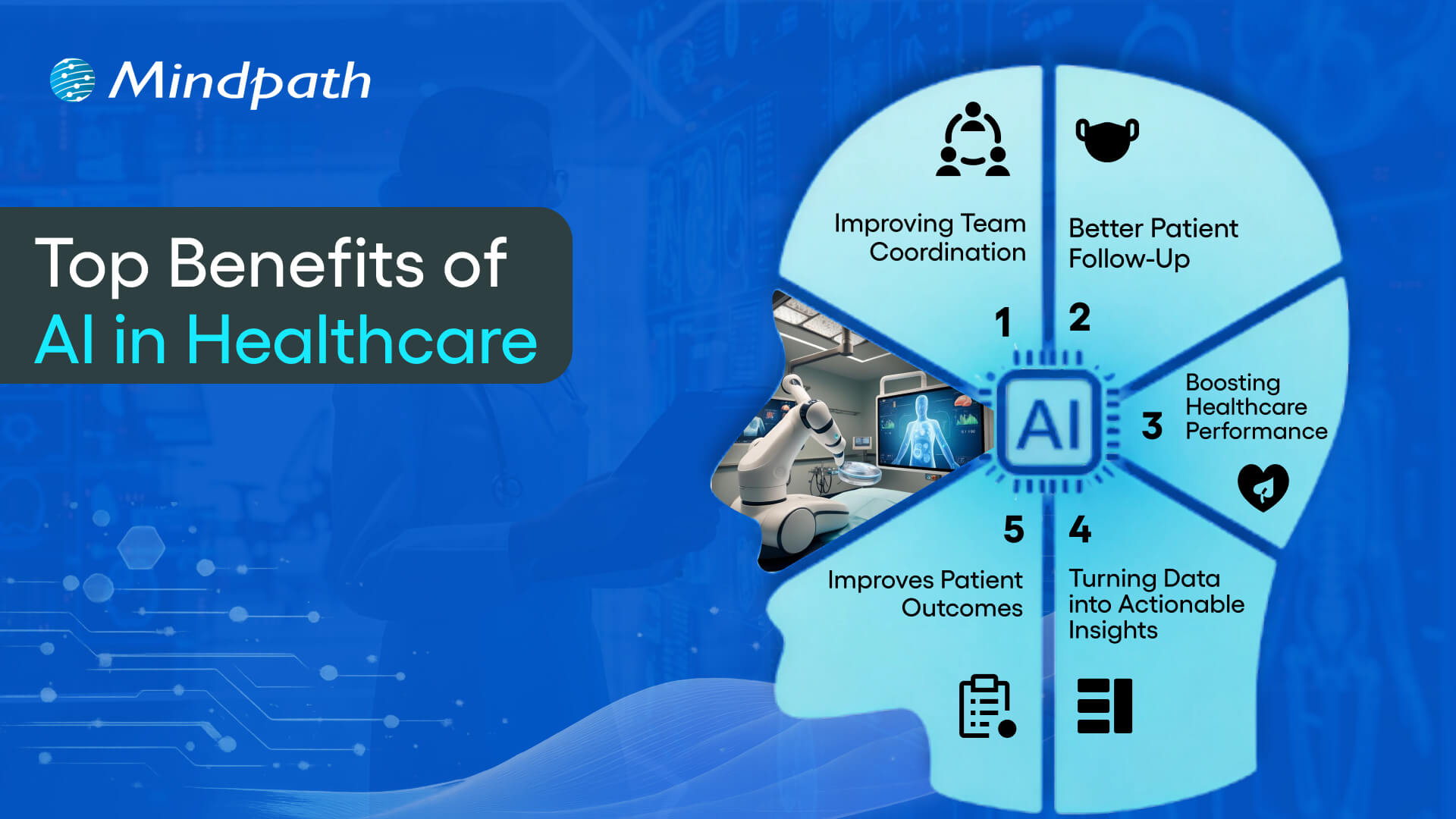
Hospitals nowadays are challenged with providing quicker and improved care with fewer resources. Technologies such as AI are assisting them in doing it more effectively. following are some advantages of AI in Healthcare that is important to know: 
Top Benefits of AI in Healthcare

1. Improving Team Coordination

AI for healthcare facilitates easier sharing of critical patient information among doctors and nurses. It consolidates everything into a single place to enable teams to communicate with each other easily and quickly. This translates to quicker decisions, improved treatments, and more efficient teamwork. AI for hospitals enables various departments to communicate with one another, which is crucial during emergencies. When everybody has the proper information at the right moment, patients receive their care on time without confusion or delays. 

2. Better Patient Follow-Up

AI assists hospitals in tracking patients and ensuring that they do not miss any important check-ups. By identifying potential health problems early, AI facilitates doctors to act early and administer the appropriate care. This ensures that patients are treated on time and follow-ups are handled more efficiently. Hospitals can track patients more efficiently with AI, resulting in improved long-term care and healthier patients. AI consulting services can guide hospitals in selecting the right tools and workflows for patient monitoring.

4. Boosting Healthcare Performance

AI in medical field enables healthcare systems to achieve significant objectives, referred to as the quadruple aim. The aims prioritize better patient care, low healthcare expenses, facilitation of medical staff, and enhanced overall health. Thanks to AI, hospitals can individualize care, minimize waiting times, and optimize the entire process. This results in improved patient outcomes, reduced expenses, and a healthier, less stressful medical team.  

5. Turning Data into Actionable Insights

Hospitals can use AI to gather and organize a lot of data from various sources. This enables doctors and nurses to make quick and easy decisions. By making all that information useful, medical teams are able to provide patients with more accurate and timely care. This streamlines the process, eliminates errors, and ensures that patients receive the proper treatment based on current information available. 

6. Improves Patient Outcomes

Patients receive faster and more precise treatment with the use of AI in healthcare. It assists doctors in identifying health issues earlier and making the correct decision on treatment without wasting time. This results in quicker admissions, reduced hospital stays, and improved recovery. Everything goes more smoothly, and patients are more comfortable. By making the care process more efficient, this technology promotes improved health outcomes and allows hospital staff to spend more time in taking care of patients. 

Looking to understand which programming languages are best for developing AI solutions? Explore our blog on AI Programming Languages to gain practical insights to get started.

Let us now look at some of the real-world AI in healthcare examples that show how this technology is being used to improve patient care, speed up diagnosis, and support medical teams in everyday hospital tasks: 

Real World AI in Healthcare Examples

These artificial intelligence examples in healthcare highlight how hospitals are using AI to improve diagnosis, speed up treatment, and support better decisions. Each example shows the positive impact of AI in daily medical practice: 

1. Faster MR Scans

AI accelerates MRI image acquisition, allowing radiology departments to manage more patients more effectively. AI enhances image quality, reduces scanning time, and increases patient comfort, particularly for patients who are anxious or experience pain during the test. 

2. Smarter CT scans 

AI helps ensure patients are correctly positioned for CT scans, reducing errors and improving image quality. It also enhances image reconstruction, supporting better diagnostics while helping radiology teams work more efficiently with consistent and clear results. 

3. Assist in Image Reading for Radiologists

AI assists radiologists by highlighting areas of interest in medical images and supporting segmentation tasks. This allows them to focus on deeper analysis and make quicker, more confident decisions, ultimately improving both workflow and patient care. 

4. Better Teamwork in Cancer Care

AI brings together data from radiology, pathology, genomics, and health records to give a clear view of a patient’s condition. This helps care teams make faster, more informed decisions to guide personalized treatment and improve outcomes. 

5. Guiding Doctors in Surgery

AI helps doctors during minimally invasive procedures by quickly analyzing CT images and sharing results across teams. It supports accurate planning and guidance, helping physicians work more efficiently and make timely decisions for better patient care. 

6. Simplifying Ultrasound Measurements

AI streamlines ultrasound by automating measurements, reducing manual effort and variability. It ensures fast, consistent results, allowing healthcare professionals to focus on clinical judgment while enhancing diagnostic accuracy and improving the experience for both patients and staff. 

7. Remote Cardiac Patient Monitoring

AI-powered analysis of remote ECG recordings enables early detection of heart rhythm disturbances like atrial fibrillation. This allows clinicians to provide faster, more efficient care, enhancing patient outcomes by offering timely and proactive cardiac treatment outside the hospital setting. 

Wondering how healthcare organizations can implement AI effectively and achieve better patient outcomes? Read our blog on the role of AI consultant explains how expert AI consulting can guide healthcare providers in overcoming challenges, and unlocking the full potential of advanced technologies.

Ready to Embrace the Future of Healthcare with AI?

AI is revolutionizing healthcare by simplifying operations, enhancing diagnosis accuracy, and facilitating quicker, more tailored treatment. By automating mundane tasks, AI enables healthcare workers to spend more time on patient care, leading to better overall outcomes. With its ability to process large volumes of data, AI also facilitates proactive interventions, minimizing errors and enhancing efficiency in hospitals globally.  

At Mindpath, we offer healthcare software development services with expertise in using the latest AI technology to develop innovative solutions for medical facilities. Our tailored AI-powered platforms enhance hospital efficiency, provide smooth patient care, and enable medical staff to make informed decisions with ease. Learn how Mindpath can assist in revolutionizing your healthcare practice with innovative solutions designed specifically for you. 
Frequently Asked Questions

1. Is AI in healthcare safe and reliable for patient treatment?

AI in healthcare is designed to support medical professionals, not replace them. When properly implemented and monitored, AI systems improve accuracy and reduce human errors. However, final medical decisions are always made by qualified doctors to ensure patient safety and ethical care standards.

2. How can small clinics benefit from AI in healthcare?

AI in healthcare is not limited to large hospitals. Small clinics can use AI for appointment scheduling, patient monitoring, medical record management, and diagnostic support. These tools help reduce administrative workload, improve efficiency, and deliver faster, more personalized care without requiring large infrastructure investments.

3. Does AI increase the cost of healthcare services?

While initial implementation may require investment, AI often reduces long-term operational costs. By automating routine tasks, minimizing diagnostic errors, and improving efficiency, healthcare providers can save resources. Over time, this can make services more affordable while maintaining high-quality patient care.

4. Can AI help in preventing diseases before they become serious?

Yes, AI systems can analyze patient history, lifestyle data, and test results to detect early warning signs. This enables doctors to take preventive measures sooner. Early detection reduces complications, supports proactive treatment, and improves overall health outcomes for patients.

5. How does AI impact patient privacy and data security?

Healthcare organizations use strict data protection measures when implementing AI systems. Advanced encryption, secure servers, and compliance with healthcare regulations help safeguard patient information. Proper governance and monitoring ensure that sensitive medical data remains confidential and protected from unauthorized access.

Related Post

Discover the top 7 tools for managing remote development teams, boosting collaboration, communication, and productivity.
Discover key factors for choosing the right Node.js development company. Learn how Mindpath ensures success!

Related Post

digital transformation for businesses

Do you think about your company’s future and ask yourself what digital transformation for businesses means? If so, you’re not alone! Many business owners and leaders are trying to figure out how they will continue to be relevant and competitive in a world that is constantly changing. Digital transformation is changing how you work, how you serve and support customers, and how your team grows. So why is it so important?

Digital transformation for businesses impacts every area of a business, from routine activities to strategic targets. It allows you to work smarter, make better decisions, and respond rapidly to changing customer demands. Adopting digital tools and an alternative mindset can help businesses maximise productivity and create new opportunities. Understanding the process is a prerequisite to helping your business flourish in today’s environment. In this blog, you’ll discover how.

Implementing digital transformation in your business can be challenging; you need expert guidance. Partnering with Mindpath will help you in exploring personalized strategies that will reshape your business. Contact us to start your transformation journey.

What is Digital Transformation?

Digital transformation is the use of modern technology across all areas of a business to change how it works inside and how it connects with customers. It can involve updating old systems, adding new tools, and finding better ways to get work done. Companies take this step to keep up with industry changes and market trends. It is a serious shift in how work is planned and delivered every day.

The digital transformation process requires the involvement of people at every level, from leaders to staff. It is not a single project but an ongoing effort, as technology and business needs keep evolving. Companies must stay open to new ideas and improvements to remain competitive. Digital transformation helps an organization stay prepared and flexible in a fast-changing world. It is a commitment to keep moving forward.

Curious which technologies can give small businesses a competitive edge? Explore emerging technologies for small businesses to see the innovations driving digital transformation.

Why is Digital Transformation Important?

Digital transformation is important because it helps companies keep up with changes in their industry and meet customer needs in new ways. It improves how businesses work by using smarter tools and systems, which makes daily tasks more organized and efficient. Focusing on digital transformation for small businesses can help smaller companies compete with bigger ones and stay prepared for what’s next.

One big reason companies choose digital transformation is to replace outdated manual work with better technology. This makes daily tasks easier and helps the whole company run more smoothly. According to digital transformation McKinsey research, 68% of people said they transform their operations mainly to modernize how they work. A clear plan helps every company adapt and stay ready for what comes next.

What are the 4 Types of Digital Transformation?

There are different ways a company can approach digital transformation depending on its goals and needs. Here are four main types of digital transformation every business should know about:

4 types of digital transformation

1. Domain Transformation

Domain transformation happens when a company enters a new market beyond its usual industry. This is often made possible by advanced digital transformation technologies.

2. Cloud Transformation

Cloud transformation moves data and systems to the cloud for better access and storage. Companies can choose public, private, or hybrid models for flexibility.

3. Business Model Transformation

Business model transformation means changing how a product or service is delivered by using modern digital tools. It’s a smart move within any digital transformation framework.

4. Business Process Transformation

Business process transformation improves how work gets done inside the company. It’s a big step in digital transformation for business success.

Benefits of Digital Transformation for Businesses

Digital transformation helps companies improve how they work and respond to changing demands. Below are some of the main benefits it can offer:

1. Cost Savings

One of the biggest advantages of digital transformation for businesses is saving money by removing outdated processes. With better systems in place, companies can spot problems sooner and use resources more wisely.

2. Better Customer Experiences

When processes run smoothly and technology is up to date, customers enjoy faster service and better support. Digital transformation for businesses also makes it easier to adapt based on customer feedback.

3. Support for Sustainability

Modern tools help companies design products and processes that use less energy and fewer materials. This cuts down waste and supports long-term environmental goals.

4. Faster Processes and Higher Productivity

When companies use smart tools and automation, everyday tasks become quicker and more accurate. This gives employees more time to focus on work that adds real value instead of getting stuck on repetitive jobs.

5. Valuable Data Insights

Digital transformation for businesses makes it easier to collect useful data and turn it into insights that help leaders make better choices. This way, different departments can understand trends and work together with clear, reliable information.

6. New Business Models

Following a clear digital transformation roadmap lets companies create fresh ways to reach customers and stay ahead in the market. New ideas and flexible services open the door to growth and higher revenue.

7. Strong Profit and Growth Potential

Companies that have a solid digital transformation strategy often see steady profit growth because they work more efficiently and serve more people. It also helps them expand into new areas over time.

8. Strong Competitive Edge

Digital transformation for businesses helps them stand out with fresh ideas and unique services. Companies that keep innovating stay ahead of the competition and handle change more easily.

9. Quick Adaptation to Change

Digital transformation for businesses gives them the tools to adjust plans when the market changes suddenly. This helps keep things running smoothly and protects the company’s future.

10. Simple Compliance and Regulations

Smart systems help track the right data to meet industry rules and quality standards. This makes it easier to share reports and pass audits without extra stress.

What are the 5 Main Areas of Digital Transformation?

Every successful digital transformation covers key parts of a business to make sure changes bring real value. Here are the five main areas of digital transformation that companies focus on:

5 main areas of digital transformation

1. Business Model

Digital transformation often means rethinking how a business makes and delivers its products or services. Companies may find new ways to earn revenue using online platforms or new technologies. This helps them stay competitive and reach more people.

2. Customer Experience

Customer experience means using technology to make every interaction better for your customers. This could be through faster service, easier online tools, or more personal communication. The goal is to keep customers happy and loyal to your business.

3. Operations

Improving operations means making everyday work run more smoothly with digital tools. Automation and better systems help teams save time and avoid mistakes. This keeps the business running efficiently and ready for growth.

4. Technology

Every digital transformation depends on using the right technology, like cloud services, AI, or smart data tools. These tools help companies collect information, solve problems, and create new ideas. Staying updated with technology is key to long-term success.

5. Workforce

Employees need the skills to work well with new digital systems. Companies should train their teams and encourage learning new things regularly. This builds a flexible workforce that can handle changes and keep the business moving forward.

Real-world Examples of Digital Transformation

Knowing about real Digital transformation examples makes it easier to understand how technology can truly change a business. Here are some real-world cases that show what’s possible when companies embrace digital transformation.

Real World exmaples of Digital Transformation

1. Tailored Customer Rewards

Starbucks uses AI in its app to create rewards and suggestions that feel personal to each customer. This digital approach keeps customers happy and loyal to the brand.

2. Personalized Product Fit

Nike’s SNKRS app and foot scan tool help customers find shoes that fit perfectly. This smart use of technology makes shopping easier and gives Nike useful data for better designs.

3. On-Demand Entertainment

Netflix changed how people enjoy movies by moving from renting DVDs to streaming online. This gave people freedom to watch what they want, when they want, without late fees.

4. Cloud-Based Service Models

Adobe transformed from selling boxed software to offering cloud subscriptions like Creative Cloud and Document Cloud. This makes their tools easier to use and keeps customers updated with the latest features.

5. Interactive Buying Experience

Audi introduced Audi City, a digital showroom where people explore cars using large screens and virtual tools. This makes the car-buying process modern, fun, and more convenient in small spaces.

Ready to Future-Proof Your Business?

Digital transformation for business helps you stay competitive, meet customer needs, and grow in a fast-changing world. Using AI and business technology together lets you work smarter, adapt quickly, and make better choices every day. Embracing this change now opens the door for fresh ideas and keeps your company strong in any market.

At Mindpath, we empower you to develop a clear approach to digital transformation by bridging people, processes, and technology. Our experts will guide you through every step of the journey and will ensure your team is employing the best tools to drive ongoing digital transformation. Let’s make your organization agile, productive, and ready for growth using intelligent digital solutions tailored specifically to you.

Frequently Asked Questions

1. How can a business know if it is ready for digital transformation?

A business is ready when it clearly understands its goals, current challenges, and areas that need improvement. Readiness also depends on leadership support, willingness to adopt change, and having a plan to train employees and integrate new technologies into daily operations.

2. What are the common mistakes businesses make during digital transformation?

Many businesses focus only on technology and ignore people and processes. Lack of clear strategy, poor communication, and resistance to change often lead to failure. Successful transformation requires alignment between teams, continuous learning, and a well-defined roadmap that guides every step.

3. How long does digital transformation typically take to show results?

Digital transformation is an ongoing process rather than a one-time project. Some improvements, like automation or process optimization, may show results quickly, while larger changes in business models or customer experience can take months or even years to deliver full value.

4. Is digital transformation only relevant for large enterprises?

Digital transformation is equally important for small and medium-sized businesses. It helps them compete with larger organizations by improving efficiency, reducing costs, and enhancing customer experiences. Even small changes, such as adopting cloud tools or automation, can create meaningful impact.

5. How can businesses measure the success of digital transformation?

Success can be measured through key metrics such as improved productivity, faster processes, customer satisfaction, and revenue growth. Businesses should track both operational and strategic outcomes to understand how well digital initiatives are contributing to overall performance and long-term goals.

Explore how digital transformation reshapes businesses, boosts efficiency, enhances customer experiences, and drives sustainable growth for success.
AI in Decision Making

Do you know that 75% of leaders believe that AI gives them a major edge when it comes to making smart decisions? That’s a big number, isn’t it? Through this, we get an idea of how much trust today’s decision makers are placing in AI. If you ever thought about how AI can help in better business decisions, you are not alone. Today, AI in decision-making has developed into a legitimate, trusted resource for leaders embracing the opportunity to work with greater clarity and confidence.

Artificial intelligence is becoming more prevalent in various industries today to aid in planning, minimize uncertainty, and achieve increased efficiency. It is assisting teams with understanding the needs of customers, forecasting demand, and many other areas. AI is quickly becoming a valuable business partner in day-to-day decision-making. Pretty fascinating, right? In this blog, we will review practical implementations and the advantages of using artificial intelligence in decision-making. So, let us dive in!

Ready to elevate your decision-making with AI? Discover how Mindpath’s advanced AI solutions can transform your business strategies and drive success. 

What is AI Decision Making?

Artificial intelligence decision-making refers to computer systems that support intelligent decision-making based on data. Think of it as a super advanced program to assess large volumes of data (i.e., numbers, text, images, sensors, etc.) and determine the best action. These systems process information and provide intelligent actions following rules or models, including sophisticated models like neural networks. AI systems can also learn from previous decisions and improve performance over time through machine learning.

Unlike conventional methods that require human effort for collecting, cleaning, and analyzing information, AI can take any combination of messy and complicated input and not get confused with too many opinions or fatigued by too many details. AI moves quickly, doesn’t miss patterns, and continually learns. This makes artificial intelligence a useful mechanism for businesses that deal with enormous amounts of data and need to make clean decisions quickly and accurately.  

Curious about bringing AI into your business but unsure how to begin? Read our blog: Is Your Business Ready for AI?

Benefits of AI in Decision Making

Using AI for decision-making is becoming a key part of how modern businesses operate. With AI adoption on the rise, it’s important to understand what makes this technology so valuable in today’s decision-making process.  

1. Boost Productivity

AI works like a nonstop helper that gives decision makers quick answers and useful insights. It saves time by handling data and helps people focus on bigger tasks. With decision maker AI, you can get more done without working extra hours.

2. Lower Risks

AI benefits help in spotting problems early by studying past data and finding patterns. It can warn decision makers about things like fraud or sudden changes in the market. This helps businesses act early and avoid big mistakes.

3. Make Faster Decisions

AI looks at data quickly and gives answers in real time, helping businesses respond fast. It saves time by doing the hard work of sorting and studying information. This helps decision makers act faster and stay ahead in a fast-moving market.

4. Improve Efficiency

AI helps speed up tasks by collecting and studying data without delays. It shows decision makers the right information fast and helps fix weak spots in the process. This means teams can work better and get more done every day.

5. Ensure Consistency

AI follows the same rules every time, which helps make decisions fairer and steadier. It removes personal bias and uses data to guide choices in the same way for everyone. This helps businesses build trust and keep their work smooth and reliable.  

Curious to know how AI can enhance your e-commerce strategy and give your business a competitive edge? Read our detailed blog on how AI in e-commerce is transforming the future.

Real World Use Cases of AI in Decision Making

Real-world use cases of AI in decision-making highlight how this technology supports smarter choices in everyday business. Many industries are using AI to handle complex tasks, spot patterns, and guide important decisions with greater confidence.

1. Sales

In sales, AI in business strategy studies customer data to help teams focus on the best leads and plan better strategies. It suggests the right prices, products, and ways to talk to customers based on what works best. AI also checks team performance and gives ideas to improve sales results.

2. Manufacturing

The role of AI in decision-making is helping manufacturers keep machines running smoothly by spotting problems before they happen. It also helps manage materials, workers, and production by studying live data and showing the best way to use resources. AI gives useful ideas to improve processes and keep product quality high at every step. 

3. Marketing

In marketing, AI for customer service helps teams understand different customer groups and choose the best ones to focus on. It studies what people like and helps create content and ads that feel more personal and effective. By checking results from ads and social media, AI supports better decisions that improve marketing success.

Also Read: AI in Healthcare

4. Finance

AI helps financial experts find market trends by studying large amounts of data and giving clear insights. It also checks for possible risks and suggests safer ways to manage money and plan investments. With this support, decision makers can adjust portfolios and make smarter financial choices.

5. Customer Relationship Management

AI helps businesses understand what customers need by studying their behavior and feedback. It supports better decisions in improving service, keeping customers happy, and reducing the chance of losing them. AI also shows the best ways and times to talk to customers for stronger relationships. 

6. HR Operations

AI helps HR teams find the right candidates faster by quickly checking resumes and matching skills. It also looks at how employees are doing at work and gives useful ideas to support their growth. AI suggests fair pay and benefits by studying company budgets and market trends, helping keep employees happy and motivated.

Ready to leverage the transformative power of AI? Explore our blog AI transforming the future, to learn how to create a clear strategy and successfully adopt AI technologies in your organization

Ready to Make Smarter Business Decisions with AI?

AI in decision-making is helping businesses move faster, reduce risk, and improve results. It supports better planning, smarter insights, and more consistent actions. Many industries are now using AI as a trusted tool for everyday decisions. With the right approach, AI becomes a reliable partner that helps businesses grow with confidence.

At Mindpath, we deliver AI development services tailored to your unique business goals. Our expert team builds intelligent solutions that help you work smarter and stay ahead. With a focus on innovation, performance, and simplicity, we are here to support your digital journey. Let’s build intelligent systems that shape your future. 

Frequently Asked Questions

1. How can AI really help in making faster business decisions?

AI can process large volumes of data in real time, identify patterns, and provide actionable insights quickly. This allows decision-makers to respond promptly to market changes, optimize operations, and reduce delays in critical business decisions without relying solely on manual analysis.

2. Does AI completely replace human judgment in decision-making?

AI does not replace human judgment but complements it. It provides data-driven insights, highlights trends, and reduces errors, enabling decision-makers to focus on strategy and creativity while leaving repetitive or data-heavy analysis to the AI system.

3. Can AI help reduce risks in business operations?

Yes, AI identifies potential risks by analyzing historical and real-time data. It can detect early signs of fraud, supply chain disruptions, or market fluctuations, allowing businesses to act proactively and minimize losses, improving overall decision accuracy and reliability.

4. How does AI improve efficiency in decision-making?

AI processes data faster than manual methods, highlights critical insights, and identifies weak spots in operations. This allows teams to make better decisions quickly, streamline workflows, and achieve higher productivity.

5. How does AI ensure consistent and unbiased decision-making?

AI applies the same rules and data-driven models every time it analyzes information. Unlike humans, it is not influenced by emotions or personal bias, ensuring fair, repeatable, and consistent decisions, which builds trust and reliability across business operations.

AI in E-commerce

Have you ever wondered how some online stores seem to know exactly what you want? What if your shopping experience could be personalized just for you, making it faster and easier than ever? As AI continues to evolve, it’s transforming e-commerce in ways we never thought possible. How is this technology changing the way we shop, interact with brands, and make purchases? In this blog, we will explore how AI is reshaping e-commerce and what it means for the future of online shopping. 

The term artificial intelligence, or AI, describes computer programs created to carry out operations that normally call for human intellect. This includes understanding speech, decision-making, and pattern recognition. Artificial Intelligence (AI) comprises several technologies, including natural language processing (NLP), deep learning, and machine learning. 

Artificial intelligence (AI) plays a key role in e-commerce today, revolutionizing how firms run and connect with customers. E-commerce companies can employ AI to better make decisions and improve the entire buying experience by using user data. AI is a vital tool in the rapidly changing world of e-commerce since it helps online companies remain competitive and adapt to shifting customer requirements. 

Want to know more? Let’s dig in! 

How is AI Transforming E-commerce?

1. Automating Customer Help

Chatbots and virtual assistants are fantastic for offering customer care online. They make use of artificial intelligence (AI) to determine the needs of customers. Natural language processing (NLP) is the ability for chatbots to understand queries and requests. They learn and become more skilled at serving clients as they engage with them more. 

Chatbots are a great resource for customers and online retailers alike. They never require a break and are constantly accessible, even late at night. They are polite, calm, and typically know the answers to a lot of queries. They take care of basic questions so that human agents can concentrate on more complex problems. Recent advancements in AI have made chatbots even more intelligent, which gives customers greater confidence when interacting with them. Many customers are willing to purchase goods from chatbots, particularly since some of those can offer exclusive offers just for them. 

2. Reducing Manual Work

Artificial intelligence (AI) is revolutionizing e-commerce by replacing routine everyday operations that usually call for human labor. This change lessens the need for a big workforce while enabling organizations to run more effectively. 

While it is unfortunate that automation can result in the loss of certain retail associates, many businesses believe artificial intelligence (AI) offers more opportunities for cost savings and productivity gains. Businesses can optimize their processes and lower human error by entrusting AI with routine jobs. Over time, this can result in clients receiving faster service and having a more responsive purchasing experience. So, adopting AI will ensure that employees can participate in more meaningful ways and help e-commerce businesses prosper in a competitive marketplace. 

3. Preventing Online Fraud

E-commerce businesses face a serious threat from online fraud, which costs them billions of dollars annually. Thankfully, AI offers sophisticated methods to address this issue. Machine learning algorithms have made the task of manually reviewing transactions for unusual patterns, which once required a large number of personnel, faster and simpler. 

To identify suspicious activity, these algorithms can instantly evaluate millions of data points. An AI system can detect abnormalities rapidly, such as when someone tries to commit fraud by inputting the wrong delivery address and flags the entry for evaluation.  E-commerce companies can drastically lower financial losses and safeguard both themselves and their clients from fraud by utilizing AI for fraud detection. This makes everyone’s online buying experience safer. 

4. Smart Recommendations

AI-driven recommendations raise the bar for personalization in online shopping. AI is able to examine a customer’s browsing history, previous purchases, and even their interactions with items, unlike traditional businesses. This makes it possible for AI to make tailored product recommendations and anticipate what a buyer might be interested in. 

Customers will find shopping easier and more fun thanks to these very accurate recommendations that are customized to everyone’s tastes. AI helps buyers find the proper items by making relevant suggestions; this increases the likelihood of a purchase and improves the entire shopping experience. Brick and mortar establishments are just unable to match this level of customization. 

5. Easy Cross-Selling

AI enables e-commerce companies to provide customers with product recommendations while they buy. AI can employ their past purchases and preferences to suggest relevant products that customers might like to add to their basket while they are checking out. Businesses can more easily provide appropriate ideas by deploying AI-powered recommendation engines, which leverage data on frequently purchased goods. Customers are encouraged to purchase more as a result, increasing revenues through upselling and cross-selling without being intrusive.

6. Personalized Shopping

Personalization is essential in e-commerce to provide a customized purchasing experience for each unique client. Customization strengthens the bond with clients, encouraging loyalty and improving the pleasure of buying. Personalized experiences are increasingly expected by many customers, but not all merchants have completely integrated them into their platforms. 

AI has greatly enhanced the personalization of e-commerce by analyzing vast volumes of user data and providing real-time insights. This enables websites to function as personal shopping advisors by making product recommendations and presenting customized discounts. Through customization of the purchasing experience, businesses can raise revenue and establish enduring bonds with their customers. 

AI Development Services at Mindpath

At Mindpath, we offer AI development services that help businesses use the power of artificial intelligence to improve their operations. Our team creates AI solutions tailored to your needs, whether it’s automating tasks, analyzing large amounts of data, or improving customer experiences.  We use advanced AI technologies like machine learning and natural language processing to build smart systems that can make decisions, learn from data, and solve complex problems. With Mindpath’s AI development services, your business can become more efficient, make better decisions, and stay ahead of the competition in the fast-changing digital world. 

Wrapping Up!

Artificial Intelligence is rapidly transforming the e-commerce landscape, making shopping experiences more personalized, efficient, and secure. From automating customer support to offering personalized recommendations, AI has become an essential tool for businesses looking to stay competitive and meet evolving customer expectations. As AI technology continues to advance, its impact on e-commerce will only grow, offering endless possibilities for innovation and enhanced customer satisfaction. Partner with Mindpath today to leverage AI’s power and drive your e-commerce success into the future. 

Ready to transform your e-commerce business with the power of AI?

At Mindpath, we specialize in creating intelligent solutions tailored to your needs.

Transform your e-commerce business with AI solutions from Mindpath. Enhance customer experience, boost efficiency, and drive growth with smart technology.