Hiring a WordPress Developer – An Ultimate Checklist

Join our Newsletter!

Featured Posts

Support Is One Click Away

Home

Hiring a WordPress Developer – An Ultimate Checklist

hiring a wordpress developer

Hiring a WordPress Developer – An Ultimate Checklist

WordPress remains a top choice for website development due to its scalability, ease of use, and flexibility. However, to unlock WordPress’s true potential, it is crucial to hire the right developer- an expert who can understand your goals, the technical nuances of WordPress, and your customers. Yet, hiring a WordPress developer is a major investment.

It is not just about finding a professional who can write code; it is a strategic partnership between your business and an expert who can offer you the required solutions. Besides, it involves more than just checking technical skills. This detailed hiring WordPress developer guide will guide you through the hiring process, helping you make an ultimate hiring a WordPress developer checklist.

Are you looking for expert help to build your WordPress site? At Mindpath, you can hire WordPress developers who are highly skilled and dedicated to building high-performing websites that drive measurable results.

Top Reasons for Hiring a WordPress Developer

Before diving into the WordPress developer checklist to ensure a successful hiring, let’s understand why you should hire expert WordPress developer.
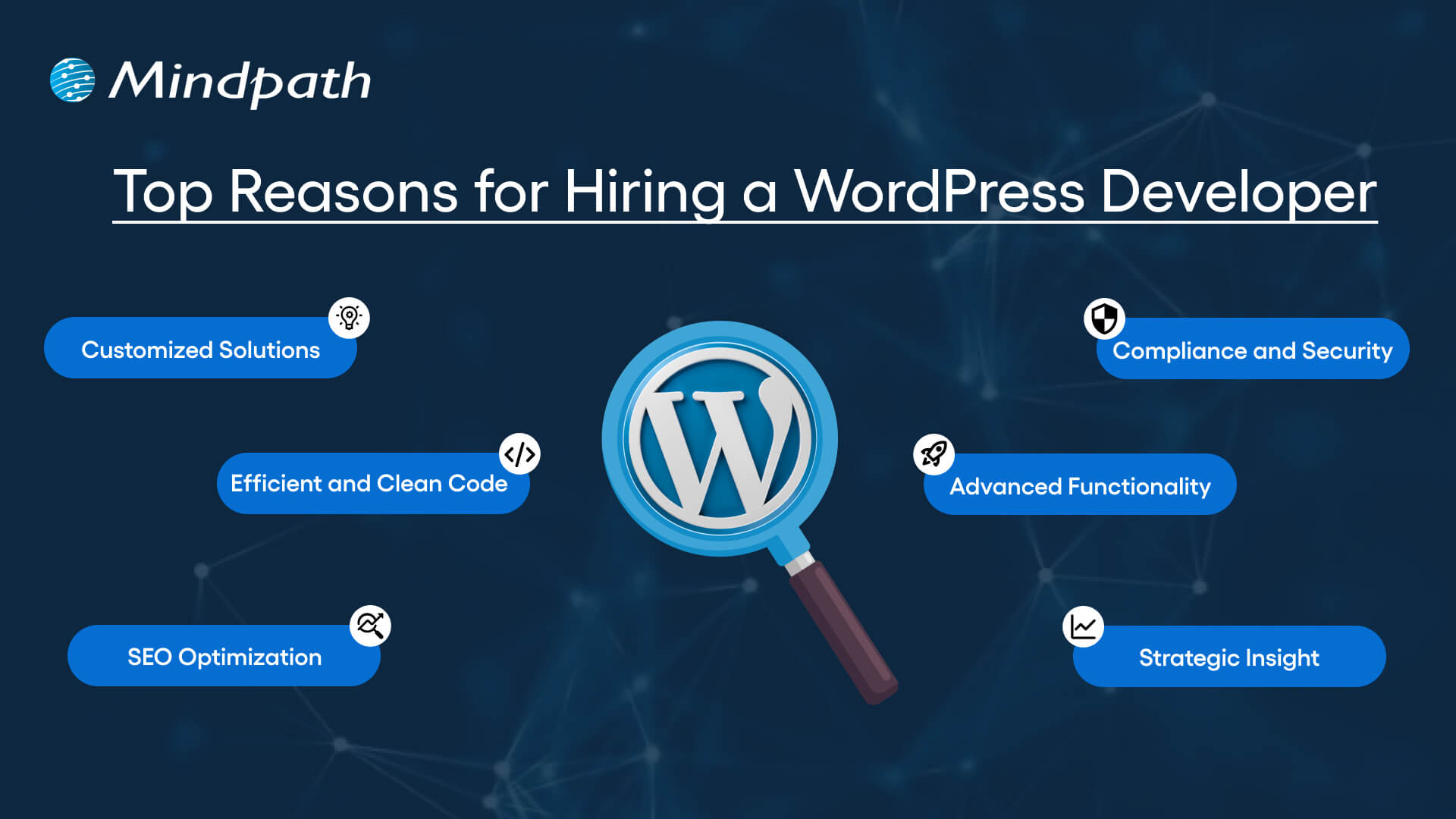
Top Reasons for Hiring a WordPress Developer

1. Customized Solutions

A professional WordPress developer can provide custom WordPress development for the site to match your unique brand identity, functional requirements, and user experience goals. Pre-built themes or plugins won’t offer you such flexibility.

2. Efficient and Clean Code

Skilled developers always prioritize writing scalable, secure, and optimized code. This ensures better SEO scores, fewer compatibility issues, and faster load times.

3. SEO Optimization

Developers know how to develop a website for search engines. For example, they use schema markup, semantic HTML, image optimization tools, and caching techniques that boost visibility and improve rankings.

4. Compliance and Security

From database protection to SSL configuration and plugin installation, professional WordPress developers deploy best security practices to protect your site from data breaches and malware. Besides, they ensure that all the plugins and elements are updated to the latest versions.

5. Advanced Functionality

Do you need a custom API integration or booking system? Well, a skilled WordPress developer knows how to integrate complex features that align with your user needs and business goals. They can also create custom plugins to expand the features of your site.

6. Strategic Insight

Apart from coding, WordPress developers help businesses to get detailed insight into conversion optimization, user behavior, latest trends, and more. All these things will help businesses in making smarter decisions.

Want to make sure your WordPress site is accessible to everyone? Check out our post on improve WordPress web accessibility to learn practical steps for making your site more inclusive and user-friendly.

Types of WordPress Experts- Which One Should You Hire

Understanding the benefits and value a developer can bring is just the beginning. To make the right decision on hiring a WordPress Developer, it is crucial to learn about the different types of WordPress developers you can hire. Remember that each brings a unique focus area and skill set.

1. Front-End WordPress Developers

These experts specialize in interactive and visual aspects of websites. They manage styling, layouts, and user experience and responsiveness using JavaScript, CSS, page builders, and HTML.

2. Back-End WordPress Developers

They focus on database management, server-side functionality, custom theme development, and plugin development. They work with WordPress core functions, MySQL, PHP, and more to create scalable websites.

3. Full-Stack WordPress Developers

Such experts handle back-end and front-end development tasks. They can create a website from scratch while ensuring seamless integration.

While hiring dedicated WordPress developer, you should choose the right type of developer to ensure your project aligns with the design goals, technical needs, and vision.

Curious about which developer’s role best suits your project? Dive into our article on Front-End vs Back-End vs Full-Stack to understand each role and decide which path aligns with your website’s needs.

WordPress Developer Checklist- Skills to Consider

Your hiring WordPress developer checklist should cover the key skills of WordPress developers. HTML, CSS, PHP, MySQL, and JavaScript rank among the key languages for WordPress development. Most developers are familiar with these languages, but knowledge of these technologies is not enough. Here are some skills that matter the most.

Hard Skills or Technical Capabilities

  • Knowledge of using core languages such as jQuery, JS, HTML5, CSS3, PHP, MySQL, React.js, and other languages.
  • Clear understanding of plugin architecture and WordPress core.
  • Building and customizing themes from scratch, and experience with various page builders like Beaver Builder, Gutenberg, Thrive Architect, Elementor, and Themify Builder.
  • Familiarity with REST API.
  • Knowledge of various optimization methods like scheme markup, image compression, caching, Core Web Vitals, minifying CSS, use of CDN, and more.
  • Understating security issues and applying fixes

Soft Skills

  • Ability to explain technical concepts in practical and simple terms.
  • Habit of making clear documentation.
  • Clarity and responsiveness in replies.
  • Ability to collaborate with backend teams and designers.
  • Familiarity with various management tools such as Jira, Trello, and Slack.
  • Willingness to accept feedback and incorporate it quickly.

Some Bonus Skills that Add Value

These skills are not that important for every project, but they can make a developer more valuable. These skills can include:

  • Experience in handling WooCommerce.
  • Knowledge about Headless WordPress configurations.
  • Use of Git or similar tools to manage collaborative workflows and code.
  • Experience in creating responsive and accessible designs to help websites meet the legal requirements of ADA.gov, etc.
  • A better understanding of the business’s goals, like lead generation, conversions, etc.

Want a more flexible and user-friendly website than a static HTML page can offer? Explore our blog on converting HTML to WordPress to see how shifting to WordPress can simplify maintenance and boost performance.

Hiring A WordPress Developer: Best Practices

Hiring a skilled WordPress developer can be a challenging process. That’s why utilizing a structured hiring a WordPress developer checklist is vital. A well-defined hiring checklist can help you save time, and you can hire the best talent for your projects. Here is how to begin your process to hire expert WordPress developer using a proven checklist.

1. Understand your Project Requirements and Goals

Before starting to search for a WordPress developer, it would be better for you to understand your project requirements. Do you want to create a new WordPress site from scratch or optimize an existing site? Are you creating a blog site, business website, or eCommerce platform?

Understanding these things will help narrow down the skills required. For instance, if you want to integrate APIs or advanced features into your site, then hiring a developer with skills in JavaScript or PHP would be a great choice.

Avoiding this step can lead to mismatched expectations. The more precise your needs, the easier your hiring a WordPress developer would be.

2. Selecting the Right Hiring Model

While hiring a WordPress developer, selecting the right engagement model is vital to aligning your development project budget, timeline, and scope. In general, WordPress developers come under three key categories these are:

  • Freelancers: Ideal for short-term and small projects due to their cost-effectiveness and flexibility.
  • Agencies: Offer complete solutions, including website design, development, SEO optimization, and maintenance. Agencies are ideal for large-scale and complex projects.
  • In-House Web Developers: They are best for organizations with ongoing development requirements. Businesses will enjoy faster turnaround and full control. However, this model requires businesses to invest in salaries, management overhead, and benefits.

Consider your budget, long-term objectives, and project size to choose the right model.

3. Developer’s Industry Experience

When using a hiring WordPress developer checklist, an important factor to consider is the developer’s industry-specific experience.

Working with a WordPress developer familiar with your business niche can significantly improve the outcomes while reducing costly trial and error. For instance, for creating an eCommerce website, hiring a developer with WooCommerce expertise will be the best option.

On the other hand, for a blog site, you should prefer to hire an expert with deep SEO and performance optimization knowledge.

This approach will accelerate development and boost functionality. And always ask developers whether they have built websites like yours.

4. Check References and Review Portfolios

Start by examining developers’ portfolios for design consistency, quality, and diversity of development projects that match your business niche. Also, check the custom developer tasks completed by developers to get an idea about their technical skills as well as problem-solving skills.

If possible, assess site performance, usability, and responsiveness to understand the developer’s attention to detail. Also, go through client references to confirm the developer’s support quality, professionalism, and reliability.

5. Conduct Technical Tests and Interviews

Don’t just rely on resumes. Conduct thorough practical tests and interviews. Start by creating targeted interview questions. For instance, you can ask, “How do you solve plugin conflicts”? Or “How do you check a site’s responsiveness?”

Practical tests can include fixing a site speed problem or creating a custom feature or post type. Such tests show developers’ technical skills, efficiency, and creativity. Besides, it helps you to know whether they can work under pressure. This step is pivotal for confident hiring decisions.

Stuck deciding whether WordPress or Drupal is a better match for your business? Our WordPress vs Drupal guide breaks down key differences to help you pick the perfect solution.

Common Mistakes to Avoid

Even with a solid WordPress checklist, mistakes can happen. Here are some common mistakes that you should avoid during the hiring process.

1. Don’t hire an expert based on just low rates. Focusing on the cost factor over quality can lead to poor site performance, missed deadlines, and you may end up with a site that may not meet your business goals.

2. Avoid developers who don’t want to sign confidential agreements. After all, keeping your business data, personal information, and intellectual property safe is important, especially when sharing sensitive details and backend access.

3. Don’t overlook maintenance service and ongoing support offered by the developer. Without this, your site may become vulnerable to bugs and security issues, affecting user experience, speed, and scalability.

4. Don’t ignore red flags such as lack of references, unclear communication, or vague answers.

5. Don’t make your hiring process long and complicated. Excessive interview rounds and lengthy assessments can frustrate candidates, and you may lose top talent.

6. Developers can only create and customize your site. They are not content strategist or designers. So, expecting them to handle everything would be a big mistake, leading to missed opportunities and misaligned results.

Want to ensure your WordPress site is running on the right PHP version for top performance and security? Check out our guide on WordPress PHP compatibility to keep your site efficient, stable, and future-ready.

Hire Smart and Built Better with Mindpath

Hiring a WordPress developer is a major investment that you make in your business. This can greatly influence your business’s digital future. By following this detailed WordPress developer checklist, you can avoid common mistakes and find a WordPress developer who can create a website that will boost your online presence.

If you are searching for a trusted platform to hire an experienced WordPress developer, you may not find a better option than Mindpath. We specialize in providing the industry’s best WordPress developers, who combine creative design skills, deep technical knowledge, and commitment to quality to develop a perfect solution. Your website needs creative vision, thoughtful design, and expert attention that can bring your brand to life. And for this, you can always count on Mindpath.
Related Post

Discover the top data and analytics trends for 2025, from AI and ML to hybrid cloud and edge analytics and learn how Mindpath can help.
Discover how Generative Engine Optimization (GEO) transforms digital marketing, enhancing visibility and brand authority in AI-driven world.

Related Post

Augmented IT Staff Onboarding

Are you ready to take your IT team to the next level? Imagine having skilled professionals join your organization seamlessly, enhancing productivity and innovation. But how do you ensure that their integration is smooth and effective? In this blog, we’ll explore the best practices for onboarding augmented IT staff, helping you create a welcoming environment that sets them up for success.  

Staff augmentation refers to the process by which companies hire highly skilled workers on a temporary basis to complement their workforce on information technology-based projects. This model gives businesses an avenue through which to outsource extra talents as and when necessary while still staying in control of the team and the projects. Compared to project outsourcing, whereby a company hires another business to handle an entire project, staff augmentation involves the hiring of individual experts to work with the in-house team on projects. This approach is particularly helpful for businesses with projects that change frequently, thus enabling them to adapt quickly to various needs by hiring temporary experts. Staff augmentation provides flexibility in that a business can manage its temporary workers directly while meeting the demands of the projects efficiently. 

Let’s dive into the best practices for onboarding augmented IT staff, helping you create a welcoming environment that sets them up for success! 

How to Integrate IT Augmented Staff

1. Understanding Your Team’s Needs

The first step in integrating IT augmented workforce is determining what your team genuinely needs. This begins with an assessment of your team members’ present skills and abilities, as well as the identification of any gaps that can jeopardize the success of your project. By carefully examining where your team lacks specialized knowledge, you can readily identify which areas might benefit from outside assistance. This might range from technical expertise to specialized understanding in certain areas of development, design, or IT infrastructure. 

Once you have a firm knowledge of these gaps, consider how the newly expanded personnel will fit into the existing team. Consider not just the specific abilities they will offer, but also how they will fit into the current tasks and the broader team environment. For example, if your team is working on a complicated software project and you detect a dearth of front-end development capabilities, employing IT specialists with a strong history in front-end technologies will successfully bridge that gap. 

In addition to talents, you should grasp your team’s work style and culture. Augmented employees that can adjust to your team’s workflow and communication style will integrate more quickly, resulting in better cooperation. When the new staff’s competencies are aligned with your project goals, it helps to establish a cohesive, high-performing team where everyone can successfully contribute to the same aims. 

2. Choosing the Right IT Staff

After determining the capabilities your team requires, the next essential action to take is to select the appropriate IT staff augmentation. It is not enough to just hire specialists with the necessary technical competence; you must also ensure that they can seamlessly integrate into your team and contribute productively.  Begin by seeking applicants with a track record of effective collaboration in comparable jobs. Strong communication skills are vital because they enable new employees to integrate quickly, convey ideas openly, and collaborate effectively with the current team. Cultural compatibility is another important issue. The more closely the new recruits connect with your team’s work environment and beliefs, the simpler it will be for everyone to interact and create a good, cohesive workplace.   To make the optimal decision, do extensive interviews and assessments. These should not just encompass technical abilities, but also include soft skills like problem-solving, flexibility, and collaboration. These characteristics are essential for ensuring that new hires can handle problems and adapt to your team’s workflow without affecting production. Furthermore, assembling a team with varied experiences and viewpoints might result in unique ideas. A diverse set of experiences and perspectives promotes a culture of creativity and continual growth, which can help both the team and the project as a whole. 

3. Onboarding and Training

Once you’ve decided on the ideal IT augmentation personnel, the following step is to guarantee a seamless onboarding and training process. This is essential to bringing new team members up to speed on the team’s goals, workflow, and expectations. A well-planned onboarding process offers the structure and resources required for effective integration, enabling new employees to immediately become productive and contribute to the team’s success. 

Effective onboarding entails more than simply describing job duties. It’s about introducing new employees to the corporate culture and helping them grasp the values and dynamics that motivate your team. This fosters a sense of belonging and strengthens ties with current team members, which is crucial for effective cooperation.  

 During the onboarding process, good communication is essential. Ensure that new personnel understand what is expected of them and offer regular feedback to help them. Support should not end after the first few days; regular coaching, check-ins, and training opportunities help new employees thrive in their responsibilities. By fostering open communication and providing the appropriate assistance, you foster a climate in which the augmented staff can thrive, resulting in a more unified and efficient team. 

Staff Augmentation Services at Mindpath

At Mindpath, we deliver the best IT staff augmentation solutions in the USA, allowing companies to scale and succeed. It is indeed our mission to integrate skilled professionals seamlessly into your team in ways that increase your capability and ensure that you can effectively deliver your project goals. Be it lending a helping hand for a specific project, having the right expertise on modernizing your technology, or being on the lookout for ways to design robust software systems, Mindpath has the right solutions for you. Here are some of our services:    

1. Dedicated Development Teams

We can provide you with experienced developers, integral parts of your team, to help with supplementary expertise and faster projects’ timeframes. Our developers blend in perfectly, ensuring smooth collaboration and delivery of results.    

2. Legacy Modernization

We can upgrade and modernize your old technology so that it can work with the best standards of today. We provide services such as an assessment of your existing systems, technology upgrade, data migration, and performance enhancements.    

3. Architectural Consultation

We consult on the design of robust and scalable software systems. Whether you are kicking off a new project or looking to better existing systems, we will help you build a solid ground and choose the best-suited technology for your needs.  

Final Thoughts!

Incorporating augmented IT workers into your organization can be a game changer, allowing you to swiftly address skill shortages, fulfil project objectives, and increase team efficiency. By assessing your team’s needs, carefully choosing the right specialists, and offering a comprehensive onboarding and training procedure, you provide the groundwork for seamless and effective integration. 

At Mindpath, we recognize the value of having the right people in place. Our staff augmentation services are designed to help you expand successfully while keeping control of your projects. Whether you want specialized development teams, legacy modernization, or architectural consultancy, Mindpath has the experience and solutions to take your IT capabilities to the next level. 

Looking to boost your team’s capabilities with expert IT professionals?

Mindpath offers seamless staff augmentation solutions tailored to your project needs.

Discover best practices for onboarding augmented IT staff, from identifying team needs to seamless integration, ensuring success.
hire the best healthcare app developers

Are you looking out for the perfect developer who can assist you in turning great healthcare app ideas into reality? With the changing scenery of health technology, finding the right kind of expertise can be quite a difficult process. In this blog, we will come across the steps to hire the perfect healthcare app developer for your project. 

Healthcare applications are mobile apps designed to make healthcare easier and more accessible. They perform duties like checking records, making appointments, and receiving medical advice from the comfort of one’s own home. These apps can be linked to wearable devices to monitor vital health parameters like steps taken or heart rate and help users monitor their health on a minute scale. Their main purpose is betterment in health and improving healthcare services. Some of these include healthcare apps used in billing, telehealth, or video consultation with doctors, practice management by arranging medical practices, and coding medical information. They will help the patients and doctors work together in the management of health and the diagnosis of conditions. According to a report, the global digital health market is projected to grow from USD 240.9 billion in 2023 to USD 946 billion by 2030. 

It is very important to hire healthcare app developers because they bring specialized experience and knowledge updated to help in developing complex healthcare apps. They ensure that your app complies with regulations such as HIPAA and GDPR and build it faster and more affordably compared to doing it yourself. These professionals also have continuous support to keep them updated. They also customize solutions for meeting any needs and seamlessly integrate with existing healthcare systems, making the app much more effective and efficient. 

So, let us dive deep into the steps to hire the perfect healthcare app developers which will be beneficial for you. 

Steps To Hire The Best Healthcare App Developers  

1. Define Your Requirements  

While looking to hire healthcare app developers, you must define your project objectives and requirements. Write down all the features that you want the app to have, like telemedicine capabilities for remote consultations, EHR integration to connect over electronic health records, and health monitoring tools that track different metrics. Identify your target audience and how the app will integrate with other already running systems, such as hospital management software. Giving an overview of the detail of needs helps identify the exact skill sets and expertise needed from the developers to ensure that they can adapt a solution catering to all your requirements and optimize the experience for the end-user. 

2. Shortlist Developers 

Deeply search for developers or companies having a successful history of health app development. Look for those who have effectively worked on similar apps and have experience with healthcare-specific features and regulations. Study their case studies, portfolios, and customer reviews to assess their expertise, past performance, and client satisfaction. Check the scale and complexity of previous projects to make sure that they fit your needs. Shortlist candidates who prove consistent in delivering healthcare apps with positive reviews from clients. Proper consideration will help you settle on developers who can carry out a project of your magnitude and finally come up with a high quality and effective solution. 

3. Evaluate Expertise and Technical Skills 

After you have shortlisted developers, you should assess their technical ability and experience. You should conduct technical interviews with them, discussing their experience and knowledge. You could even ask them to go for coding tests that would present them with real problems and then see how they solve them. Request samples of previous work done to determine the quality and relevance of projects completed before. They must know the programming languages and frameworks your app needs. One also needs to spot if they can solve any problem that might be caused by them during development. Such a rigorous process confirms whether the developers are well-endowed with the kind of skills relevant for the successful construction of a healthcare app. 

4. Review Past Experience 

Gather references from their past clients to know if they are work-oriented, reliable, and can meet deadlines.  Evaluate the past projects in which the developer was involved to understand the correctness of the delivered work. Determine whether they came up with top-of-the-line applications that could be said to be user-friendly yet solve their client’s needs if possible. This step is very important to substantiate their claims and ensure their work meets the standards that you have set for your work. A look at the track record will help you settle better on the right one through feedback from other customers. 

5. Check Communication and Cultural Fit 

This step is all about good communication and a proper cultural fit. While interviewing, review whether the developer can communicate his ideas clearly, is ready to listen, etc. Describe his attitude to working in a team, how he works, and evaluate whether it will align with the culture in your organization. This ensures high working relationships and effective results from the projects.

Is your healthcare app ready to meet the demands of the future?

With Mindpath’s expertise in advanced technology solutions, we can help you stay ahead in the evolving healthcare landscape.

How Can Mindpath Help In Healthcare Application Development Services 

Mindpath is dedicated to transforming the world of health care by providing state-of-the-art technology solutions. This is where we provide full-fledged health care software development services with a sole purpose: to enable health care providers to provide better patient care and smoothen operations while adhering to regulations and industry standards. It starts with strategic consulting for visibility and the exact requirement of your health care software project.  

We apply safe and scalable software into the development services under our care, such as Electronic Health Records, practice management systems, and patient portals, to make improvements in health care delivery on a larger scale and with greater efficiency within the organization. The design team is primed to create user-friendly, intuitive, self-explanatory screens with visuals that make the software functional and engaging. Further, we provide AI chatbots for managing their tasks to answer the queries of patients, manage appointments, and provide medical information to improve patient interaction and take some workload off the healthcare staff. 

Conclusion  

The future of healthcare has been very dynamic, especially due to technological innovation, making complex patient care more efficient, more accessible, and increasingly personalized. Trends such as telemedicine, AI-driven diagnostics, and wearable health technology are altering the nature of healthcare service delivery. Now is the time to get investments pumping into state-of-the-art healthcare applications catering to the modern patient and healthcare provider, with the global digital health market expected to grow soon. 

Mindpath leads from the frontline in this revolution with state-of-the-art healthcare application development services according to the newest industry trends. Our commitment to quality, compliance, and user-centered design assures effectiveness and engagement of the solutions we provide. Whether you want to enhance patient engagement through AI chatbots for healthcare, enhance operational processing through EHR integrations, or simply update legacy systems, Mindpath has rich experience in bringing any idea into life. 

Looking to take your healthcare services up a notch with state-of-the-art technology?

At Mindpath, we specialize in healthcare application development that can change the way patient care is operated.

Discover the key steps to hire top healthcare app developers. Learn how Mindpath’s innovative solutions can elevate your healthcare technology.
full stack development

Software development has evolved beyond the traditional approaches that required separate frontend and backend development teams. The need for full-stack development is evident in the new digital landscape, where user requirements and business goals change in an instant. Full-stack software development offers a strategic option to develop user-friendly and robust applications without paying a fortune.

With the growing competition to establish a strong digital presence, business owners must pick a reliable development approach, like full-stack. However, it is also important to learn what full-stack software development entails before embracing it. Let us discover more about the full-stack approach and how businesses can use it to develop their software applications.

Thinking of adopting full-stack development for your next project? Mindpath’s full stack development services will help you with the integration of front-end and back-end expertise that your business needs.

Understanding Full Stack Fundamentals

Full-stack has emerged as the most valuable strategy for software development that allows businesses to meet the emerging user requirements and business goals. It follows an end-to-end approach for developing software applications, involving both the frontend and backend. The answers to “What is full-stack development?” also emphasize how it can enhance cost-effectiveness, agility, and efficiency. You can understand full-stack in a better way by breaking it down into the two primary components.

1. Frontend Development

The frontend development deals with the client-side aspect of the application, or the part of the application that users see. It includes everything a user sees of an application on their smartphones or web browsers. The important elements of the frontend of an application include the design, images, layout, navigation menus, buttons, text, and anything that users can interact with.

The most important technologies for frontend development in the full-stack approach include HTML, CSS, and JavaScript. In addition, full-stack developers must also have a strong command of frontend frameworks and libraries. HTML serves as the foundation for arranging web content, while CSS helps in styling the interface by controlling fonts, layout, responsiveness, and colors.

The search for answers to “what is full-stack web development” will also help you understand the significance of JavaScript. It is a popular programming language that helps developers add dynamic and interactive elements to web pages. Most important of all, frameworks and libraries like Angular, Vue, and React simplify frontend development while empowering developers to create complex user interfaces without sacrificing responsiveness.

Planning to use full-stack development for your next web project? Before that, read about the future of full-stack development for web projects

2. Backend Development

The backend of a software application focuses on the server-side aspects of the application, which drive its functionalities. Backend development deals with logic, communication, and data storage, which work in the background and are never visible to users. The full-stack development definition describes the backend as the “brains” behind the working of an application. The backend processes requests from the frontend, interacts with databases, and sends data back to the frontend.

Backend development for a software application requires fluency in programming, backend frameworks, server management, APIs, and database management. The notable programming languages used to create backend logic include Python, Java, Ruby, Node.js, and PHP. Developers should also know how to leverage the relevant backend frameworks for each programming language. For instance, Ruby on Rails is ideal for Ruby, while Express.js is for Node.js, and Django is the best backend framework for Python.

Also Read: Full-stack development with Node.js

Database management and server management are also integral requirements for full-stack developers. Backend development is incomplete without databases, as they help with the storage and management of application data. Database management may involve the use of relational databases like MySQL and SQL Server or NoSQL databases such as MongoDB. Backend development also requires an in-depth understanding of best practices for configuring and managing web servers. Another important requirement for backend development focuses on APIs that establish rules and protocols for communication between different software components.

The answer to such a question is quite obvious and points to any developer who knows frontend and backend development. One of the significant highlights in any full-stack developer definition is the proficiency in frontend and backend development technologies. On top of it, full-stack developers must be fluent in security practices and DevOps to offer productive end-to-end software development solutions. Full-stack developers know how every layer of an application works, thereby empowering them with a holistic view of the development process.

The versatility of full-stack developers makes them one of the most valuable resources for businesses in the new technological landscape. Full-stack developers can create responsive web layouts, implement database integration, manage testing and debugging, and write server-side logic. On top of it, they also work in collaboration with UI/UX designers and other teams to develop efficient applications.

Understanding the differences between front-end, back-end, and full-stack developers is key to building an effective development team. Learn more about the distinct responsibilities of each developer in our blog: Front-end vs Back-end vs Full-stack developer

Workflow of Full Stack Development

The definition of full-stack indicates that combining frontend and backend development can serve promising advantages for businesses. At the same time, it is also important to wonder about the workflow in full-stack projects. Where does full-stack begin, and how does it integrate frontend and backend development in a single workflow? You can find the answer by reflecting on the full stack definition once again, by focusing on the end-to-end aspect of the process.

Full-stack developers begin with the planning stage and end with the deployment and maintenance stage. The following steps in the full-stack workflow can help you understand how the holistic approach blends the traditionally different sides of software development.

1. Planning

The first step in the full-stack workflow involves planning and identifying essential features and technical specifications for the application. Full-stack developers collect information about essential requirements and understand the scope of the project. The developers also collaborate with different stakeholders to come up with an outline of the features desired in the application and its technical specifications.

2. Frontend Development

After finalizing the design, the next step in full-stack development focuses on the frontend of the application. The frontend development starts with a definition of the project structure and selecting the relevant technologies like HTML and CSS. The full-stack developer will implement the user interface in this step while ensuring accessibility and responsiveness.

At the same time, developers must ensure that the frontend complies with important design guidelines. The other crucial tasks in the frontend development stage include the creation of reusable components and the integration of backend APIs to fetch and display data.

Must Read: Full-stack Development Trends

3. Backend Development

The next step in the full-stack software development workflow focuses on backend development and integration of the backend logic with the frontend. Developers can create the backend of a full-stack application with server-side scripting languages like Python, Node.js, or Ruby. In addition, developers also employ the relevant database management system for the application according to its requirements.

Apart from creating and implementing the server-side logic, full-stack developers also create RESTful APIs and address data management needs. The backend development stage also calls for attention to the security and scalability of applications. Therefore, developers have to implement comprehensive authentication and authorization mechanisms and follow the best practices for data validation.

4. Testing

Before launching the application, full-stack developers will implement comprehensive testing plans to find errors and bugs. Developers have to define unit tests, end-to-end tests, functional tests, and integration tests to measure the utility of the application in different scenarios. Writing the tests in the early stages of development helps in creating applications that align with the desired goals and requirements of features. It also ensures that the application is easy to maintain, reliable, and adheres to the desired specifications.

Following the testing process, developers work to achieve seamless integration of frontend and backend components. The process involves establishing communication between the frontend and backend with uninterrupted data flow and error management. Full-stack developers rely on testing on a wide range of devices, scenarios, and browsers to identify and resolve performance issues. As a result, they can ensure easier integration of frontend and backend components without conflicts.

5. Deployment and Maintenance

The final stage in the full-stack workflow or deployment focuses on preparing the application for the production stage. The deployment stage involves the configuration of essential server environments and setting up continuous integration and continuous deployment pipelines with DevOps. Full-stack developers must also ensure that the application has been optimized for production in the deployment stage.

Some of the important requirements for deploying a full-stack web application include database migration, scaling to adapt to the user traffic, and server provisioning. Once the deployment is complete, developers monitor the application performance to identify any anomalies. If they find any issues, then developers will address them, followed by providing continuous maintenance and updates.

Hiring the right talent can make or break your MVP. Learn why hiring a Full-Stack Developer for MVP Success can make your product development faster and more efficient

Popular Technology Stacks for the Full Stack Developer

The doubts of a business owner before adopting the full-stack approach also focus on the choice of technology stack. Technology stacks refer to the combinations of technologies used by full-stack developers to create software applications. You must also know that the full-stack developer’s salary depends a lot on the candidate’s fluency in different stacks.

The most popular technology stack alternatives include MERN, MEAN, LAMP, LEMP, and Python-based stacks. Each stack features distinct technologies serving different roles in the development cycle.

1. MERN

The MERN stack represents the combination of MongoDB, Express.js, React.js, and Node.js. MongoDB serves as the NoSQL database while React.js offers the frontend development library. Node.js works as the JavaScript runtime for the backend, and Express.js is the relevant backend framework for it. Developers can work with a single programming language as all components in the MERN stack are JavaScript-based.

2. MEAN

The MEAN stack includes similar components to the MERN stack, albeit with the exception of the Angular framework for frontend development. It is a popular choice for full-stack web solutions due to Angular, which offers a more structured framework for frontend development. At the same time, developers can capitalize on the advantages of working with a complete JavaScript ecosystem in the MEAN stack.

3. LAMP and LEMP

The LAMP tech stack includes Linux as the operating system, Apache as the web server, PHP as the server-side programming language, and MySQL as the relational database. It is a traditional tech stack, implemented in content management systems such as WordPress. The LEMP stack is similar to LAMP, albeit with a different web server, Nginx, which offers high performance and efficient management of concurrent connections.

4. Python-based Stacks

Python is also one of the most popular server-side programming languages for its readability. The effectiveness of full-stack development with Python also depends on its comprehensive collection of libraries and strong community. Python-based stacks can use different Python web frameworks, frontend frameworks, and relational databases, depending on the project requirements. The common choices for Python web frameworks include Django and Flask, while frontend framework choices include React and Angular.

Looking to reduce time and costs, and take full advantage of full-stack expertise. Discover how Mastering Full-Stack Development with Node.js can help businesses in streamlining workflows as well as boost project ROI.

How Does Full Stack Help Your Business?

As a business owner, you might wonder if full-stack is an effective approach to software development. Businesses can capitalize on the full-stack development benefits to get best outcomes for their businesses.

1. Faster and Efficient Development

The most promising advantage of full-stack software development is the speed of development. It reduces the dependencies between isolated frontend and backend development teams as a single developer takes responsibility for multiple aspects of the project. Full-stack developers can achieve faster iterations, release features quickly, and ensure faster time to market for new products, services, and updates.

2. Cost Savings

The next notable highlight in full-stack developer skills is the ability to offer the services of frontend and backend developers, along with database specialists, in one package. Businesses don’t have to hire different professionals for these roles, which reduces the costs of recruitment, onboarding, and other operational costs.

3. Flexibility and Consistency

Another promising advantage of working with full-stack developers is the assurance of flexibility in agile environments that demand rapid changes. Full-stack developers will quickly adapt to address the requirement of urgent attention to specific areas of an application. On top of it, the unified and consistent architecture ensures easier integration between the frontend and backend components without compatibility issues.

Want to accelerate your development process? Explore how a freelance full-stack developer can create interactive user interfaces and oversee deployment and maintenance.

Final Thoughts

The value of full-stack development for any business is about following a holistic approach to software development. The unique approach not only reduces costs but also provides a solution to avoid delays and deliver the best user experiences in applications. With the support of a full-stack developer, your business can navigate through the complexities of the digital landscape with ease.

We at Mindpath specialize in end-to-end software development and have helped clients create intuitive applications in different industries. Our commitment to deliver the best results stems from our ability to understand the client’s requirements and identify the best resources for their projects. Contact us to figure out the ideal course for your next software development project.