Integrating AI into Your Web Development Workflow: A Guide to Smarter, Faster Websites

Join our Newsletter!

Featured Posts

Support Is One Click Away

Home

Integrating AI into Your Web Development Workflow: A Guide to Smarter, Faster Websites

Integrating AI into Web Development

Integrating AI into Your Web Development Workflow: A Guide to Smarter, Faster Websites

Imagine a website that learns from user behavior, offers personalized suggestions, and even predicts what visitors need before they know it themselves. Sounds futuristic, right? But with the integration of AI into web development, this is becoming a reality. In this blog, we’ll explore how AI can be seamlessly integrated in web development.  

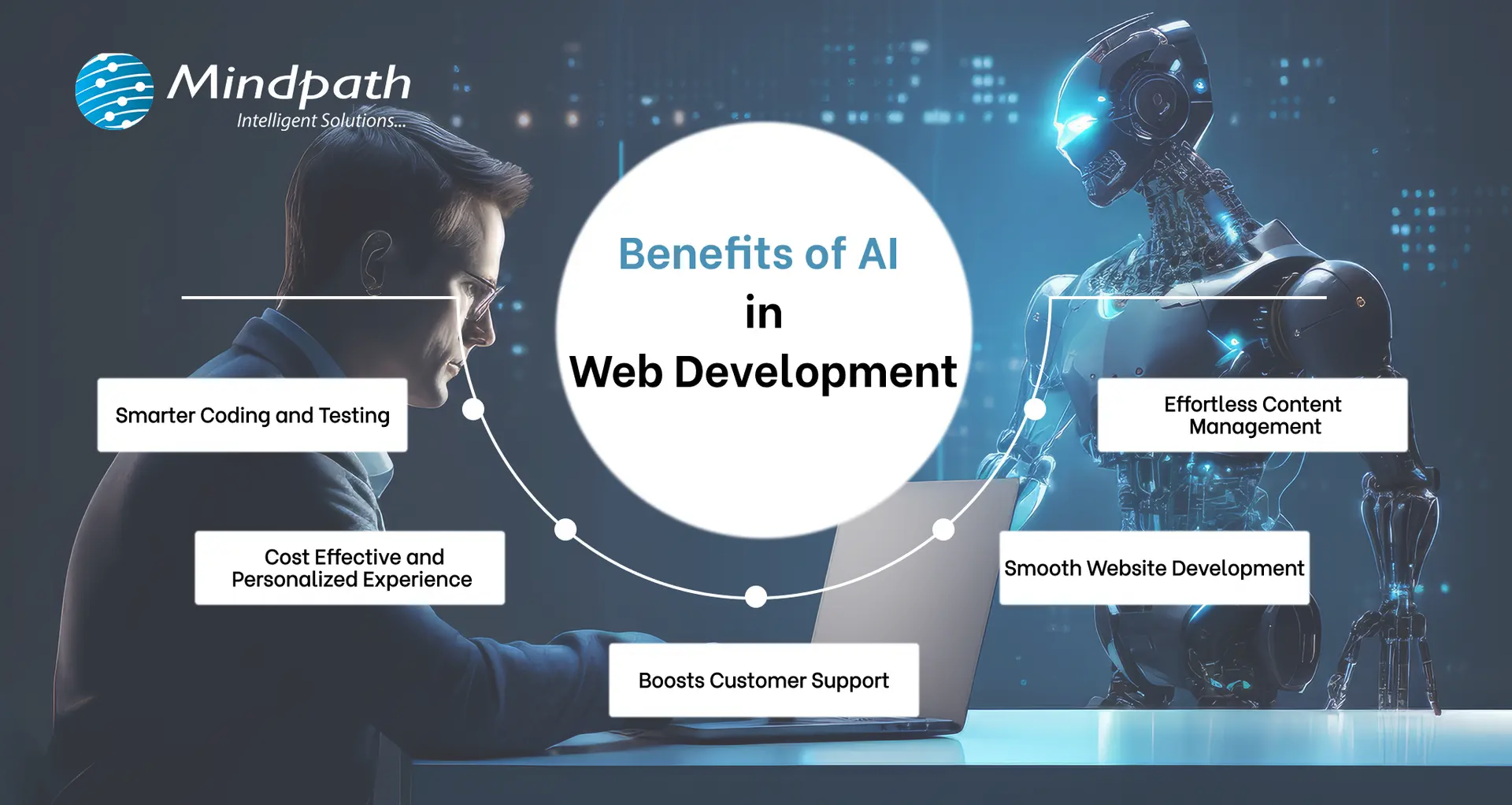
Artificial intelligence (AI) is transforming the landscape of web development, going well beyond the fundamentals of site building. Websites nowadays must be smarter, quicker, and more intuitive to satisfy user expectations. AI plays a critical part in doing this by automating repetitive operations, reducing human error, and providing personalized information suited to each visitor. It improves user engagement by analyzing behavior, forecasting trends, and optimizing design to provide a smooth experience. As digital competition heats up, organizations that use AI in their web development strategy not only keep up, but also stay ahead by providing cutting-edge solutions that attract and retain customers. 

Now, let’s dig in to explore how AI can be integrated in web development! 

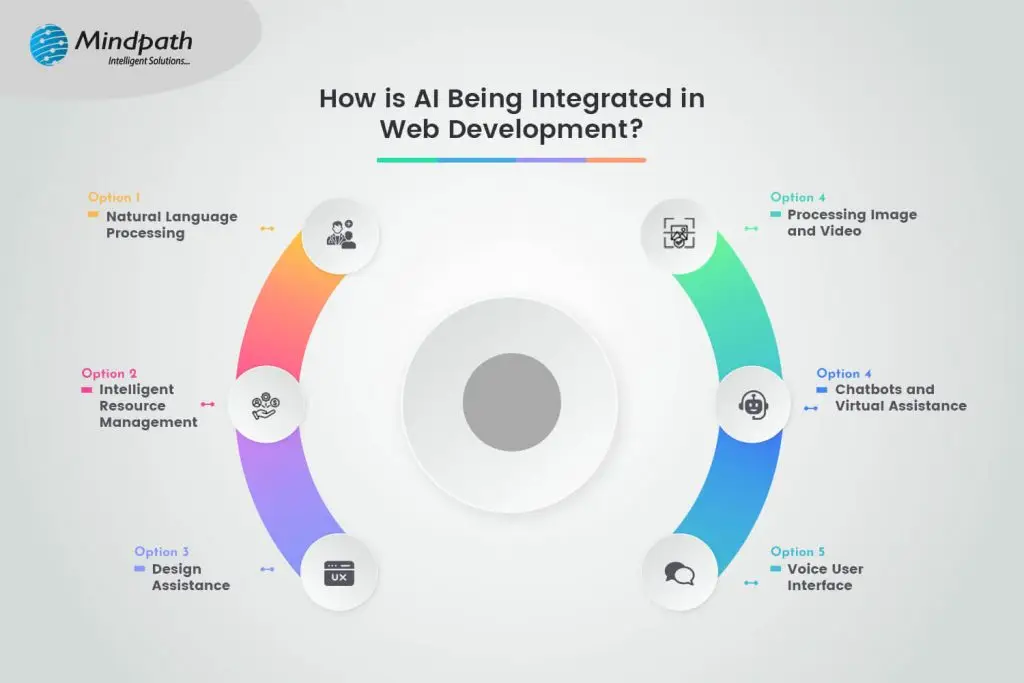
How is AI Being Integrated in Web Development?

1. Natural Language Processing

Back-end developers can enhance online applications by employing Natural Language Processing (NLP) to comprehend and analyze user-generated natural language input. By using NLP technologies or APIs, applications will become more conversational, allowing users to communicate using normal language rather than technical commands. 

NLP enables online systems to comprehend user intent and respond properly, resulting in more user-friendly and intuitive experiences. The back end processes the language, determines the user’s wants, and provides appropriate replies. This connection improves the whole interface, making online applications smarter and more sensitive to human input. 

2. Intelligent Resource Management

Artificial intelligence (AI) is quickly emerging as a game-changing technology, transforming numerous sectors, including resource management. Every organization requires efficient resource distribution, which entails managing assets such as time, money, and labor to achieve optimal output. 

AI development allows bespoke web development firms to considerably improve their resource allocation tactics and apps. AI aids in the optimization of resource distribution and utilization by analyzing data trends and forecasting demands. This leads to significant cost savings, increased efficiency, and more informed decision-making. Furthermore, AI can predict possible problems before they occur, allowing businesses to respond proactively and maintain smooth operations. 

3. Design Assistance

AI can be an invaluable resource for front-end developers, assisting them in creating visually appealing and user-friendly designs. AI-powered design tools and layout generators can offer design components, color palettes, and layouts that are appropriate for the website’s aims and user preferences. 

AI in design acts as a creative and supporting tool, making it accessible to people of all skill levels. One of the most significant benefits of adding AI into web development is that it allows designers to create high-quality designs more rapidly and affordably than ever before. This not only simplifies the design process, but also enables more experimentation and creativity in online design. 

4. Processing Image and Video

AI can play an important role in image and video processing activities such as image identification, tagging, and summarization. Front-end developers can employ AI-powered APIs for image and video processing to improve the visual content on their websites. 

Integrating these AI technologies allows developers to automate the process of labelling images and videos, making it easier for users to search for and identify relevant information. Video summarization algorithms can also create previews or highlight reels, converting long recordings into brief, compelling chunks. This feature not only enhances the user experience by making navigating easier, but it also encourages users to engage with additional information. 

5. Chatbots and Virtual Assistance

AI chatbots and virtual assistants are quickly becoming vital technologies in front-end development, providing customers with fast support and help. These AI-powered assistants improve customer service and increase user engagement by responding quickly to enquiries. Front-end developers can simply include chatbot APIs into their websites, enabling automated conversations and efficient issue solutions. 

These AI-powered chatbots can handle a variety of duties, including answering frequently asked enquiries, directing users through certain procedures, and aiding with debugging difficulties. Chatbots improve the user experience by simplifying interactions, allowing businesses to better serve their customers while freeing up human resources for more complicated enquiries. As a consequence, including AI chatbots into web development is a wise decision for increasing overall service quality. 

6. Voice User Interface

With the growth of voice-activated devices such as Amazon Echo and Google Home, voice user interfaces (VUIs) have become an important part of web development. The AI technology behind these interfaces recognizes and responds to voice requests, making websites more user-friendly and accessible. 

Integrating a VUI into web development has various benefits. It enhances accessibility for disabled individuals, making it easier to explore websites. Voice interfaces also provide hands-free interaction, which improves user convenience by allowing users to interact with material without the need to type. As a consequence, users can offer orders and receive replies more swiftly and intuitively.  

VUIs also decrease the requirement for manual entry, which saves users time and effort. They also improve user engagement and retention by providing a more engaging experience. Voice interfaces improve web application usability by allowing users to multitask while interacting with the website. Incorporating VUI technology into web construction is a forward-thinking strategy that matches with customer preferences. 

Also Read: AI in Hyperpersonalization: A New Era of Tailored Customer Solutions

Integrating AI in Web Development at Mindpath

Mindpath leverages artificial intelligence to improve web development and boost innovation. Our AI development services use modern algorithms and machine learning. Our Predictive Analytics solution helps you forecast trends, while Machine Learning Applications improve operational efficiency. Automation Solutions frees your team from everyday activities, allowing them to focus on strategic goals. With our Business Intelligence solution, we turn raw data into usable insights, providing visualizations and reports to help you make educated decisions. Our Conversational AI services create chatbots and virtual assistants that increase user engagement and offer immediate assistance. 

Wrapping Up!

Integrating AI into web development is more than a trend; it’s a game-changer that enhances user experience, improves efficiency, and drives innovation. By utilizing technologies like Natural Language Processing, intelligent resource management, AI-assisted design, image and video processing, chatbots, and voice user interfaces, businesses can create smarter and faster websites that cater to user needs. 

At Mindpath, we harness the power of AI to elevate web development. Our AI development services are tailored to help you deliver personalized and engaging online experiences. As the digital landscape evolves, incorporating AI into your web strategy is essential for staying competitive. Partner with Mindpath to embrace the future of web development and propel your business forward. 

Ready to transform your online presence with cutting-edge AI solutions?

Partner with Mindpath today and let us help you create smarter, more engaging websites!

Related Post

Optimize your React app for better speed and scalability. Explore advanced performance techniques, including virtualization and useMemo.

Related Post

hospital management system

How do hospitals maintain and keep everything running smoothly? Starting from patient records to important surgery schedules, billing and staff coordination, each and everything is well maintained and smooth, isn’t it? Are you curious to know what’s behind this? Well, it’s Hospital Management System (HMS) which does the magic in handling hospital operations smoothly.  

Are you confused about what does it mean and why is it essential for modern hospitals? Don’t worry, we have got you covered! This blog will walk you through everything you need to know about HMS. So, let’s dive in to learn! 

What is a Hospital Management System?

A hospital management system (HMS) is a type of software that helps hospitals manage everything effortlessly. It allows the doctors, nurses and other staff of a hospital to collect, store and share patient data in a secure and organized way. With the help of this system, the medical teams can easily get access to records such as X-rays, prescriptions and other important documents of patients.  

In most of the hospitals, doctors, nurses and the staff spend a lot of their time doing paperwork which can slow down things and also impact the patient’s overall experience. HMS can help in reducing the workload by handling many tasks automatically. It can bring all the necessary information and tools into one place which can help hospitals run their daily operations more proficiently with less delays. 

As per Market Research Future (MRFR) analysis, the global Hospital Management Software Market was valued at USD 29.33 billion in 2024. It is projected to reach USD 54.20 billion by 2034, growing at a rate of 6.33% annually between 2025 and 2034. This growth shows the increasing demand for smarter, more connected healthcare systems. 

Now that you have a clear idea about what HMS is, there is a major question that arises: 

What is the Function of HMS?

When a hospital begins implementing HMS, numerous day-to-day activities are simplified and streamlined. An HMS assists personnel in focusing more on patients and less on documentation. Let us discuss some important functions that make this system so valuable: 

  1. Scheduling Appointments – HMS facilitates patients to schedule appointments easily and doctors’ schedule efficiently which can eliminate confusion and lengthy waiting times. 
  2. Patient Data Management – It stores all the patient records including medical history, test results as well treatment details which can help doctors and nurses to quickly access the right information when needed. 
  3. Handling Billing and Invoice – It makes the billing process faster and more accurate by handling everything, from bill generation to payment tracking as well as insurance processing. 
  4. Inventory Management – Hospitals can keep track of medicines, equipments and supplies which helps in avoiding shortages and guarantees everything is available on time. 
  5. Reporting and Analytics – The system provides useful reports on hospital performance and operations, which helps in planning and improving services.  
  6. Communication – It facilitates easier communication between doctors, nurses and patients to remain connected and exchange crucial updates, resulting in improved coordination and care. 
  7. Intergration with Other Systems – Hospital management software can easily integrate with other systems such as electronic medical records so that everything is integrated into one place with a complete view of every patient’s care experience. 

Let us learn about some of the key benefits if you’re looking for more information about hospital management system: 

Key Benefits of Hospital Management System

A good hospital management software system can make a huge difference in how smoothly a hospital runs. It assists both staff and the patients by improving the quality of care and simplifying daily tasks. Here are some major benefits of you can expect: 

1. Cost Effectiveness

With everything automated and systematized, hospitals are able to cut down on paperwork, labor costs, and wastage of supplies. It also aids in improved planning and utilization of resources such as medicines and equipment. This reduces unnecessary costs and makes the operations more cost-effective, enabling the hospital to utilize its budget where it’s actually needed. 

2. Better Patient Experience

Patients are able to schedule appointments with minimal waits, receive follow-up reminders, and view their reports online. It makes them feel more in charge of their treatment and less anxious. It makes everything easier, from arrival to discharge, which results in a more pleasant, efficient hospital stay for each patient. 

3. Safe and Secure System

Patient data is stored securely and shared only to permitted staff members. This protects information from abuse or loss. A secure system ensures trust between patients and the hospital, and ensures appropriate processing of sensitive information  while keeping the hospital in line with privacy and security regulations. 

4. Easy to Access Data

All medical information such as treatment history, test reports, and medications are kept in one place. Doctors, nurses, and medical staff are able to access this info quickly from various departments. This streamlines treatment and prevents the need to repeat tests or inquire about the same information from patients repeatedly. 

5. Reduces Manual Errors

The system maintains accurate and up-to-date information, preventing staff from making mistakes such as providing the wrong medication or omitting important steps. Access to information in real time eliminates confusion, enhances coordination, and ensures that doctors adhere to the proper treatment protocols based on the most current and comprehensive patient information. 

6. Speed Up Patient Care Process

When doctors and staff have quick access to patient records and reports, they can make faster decisions. Automated tasks like test scheduling and report delivery save time. This helps patients get the care they need without delays, which is especially important in emergency or critical care situations. 

Ready to Upgrade Your Healthcare System?

A hospital management system can really make a difference in how a hospital operates. From enhancing patient care to accelerating operations and minimizing mistakes, HMS makes hospitals more efficient, well-organized, and responsive. Be it scheduling appointments, record management, or cost-cutting, HMS makes everything more efficient and reliable for patients and staff alike. 

At Mindpath, we specialize in delivering modern healthcare software development services that make hospital processes faster and smarter. Whether you’re planning a full hospital management system project or need a custom solution for specific tasks, we’re here to help. 

As a trusted healthcare app development company, we focus on building secure, user-friendly, and high-performing digital solutions. Our team understands the needs of healthcare and creates tools that support doctors, staff, and patients every step of the way. 

top genAI tools

If you’ve been paying attention to the tech world lately, you must have seen how the best GenAI tools are revolutionizing the way we can accomplish our jobs. Whether it is writing content in seconds or smartly developing sophisticated apps without heavy layers of coding, innumerable examples exist of how these tools are helping people do more with less effort. These AI tools are quickly becoming the new solution for developers, creators, and organizations who want to increase their speed and get better results.

The evolution of GenAI is transforming how industries approach work and innovation. Work that could take hours, and manual efforts are now being dramatically reduced to minutes through intelligent tools. Developers and organizations are employing GenAI tools in many everyday tasks. They provide efficiency, less effort, and improved outcomes. In this blog, we will showcase the most powerful GenAI tools carving the future of AI development. You’ll get a quick look at what they do and why they matter.

Looking to transform your ideas into intelligent, future-ready solutions with Generative AI? Our expert AI development services help you build scalable, smart systems that drive real business impact.

What is Generative AI?

Generative AI is an intelligent technology that creates new things using AI, like text, images, video, and even code. Generative AI can move beyond simply answering questions or completing simple tasks; it is able to generate something new. This allows businesses to operate more quickly and continually come up with new ideas.

Countless organizations are now taking advantage of generative AI to save time and operational efficiencies. Businesses apply it to write emails, design graphics, make advertisements as well as create chatbots. By leveraging generative AI, businesses can reduce manual labor, have fewer errors, and provide customers with their services in a more personalized and timely manner.

Here are some advantages of generative AI for businesses:

  • Creativity and Innovation – Generative AI allows businesses to develop more ideas and make new content.
  • Productivity – It saves time by taking responsibility for boring, menial tasks.
  • Efficiency – It allows work to be completed more quickly and with fewer errors.
  • Personalized Customer Experience – Business can create more personalized and relevant content for the customer.
  • Product Development – It can develop new products faster through automated coding, idea generation, and design enhancements.
  • Support Service/AI chatbots – It supports customer service chatbots that are capable of answering customer questions.
  • Better Decision-making – It provides some basic recommendations to businesses using data so they can make better decisions.
  • Reduction in Costs – It results in cost savings through automation of tasks and improved operations.

Curious about where Generative AI is headed next? Explore the top Generative AI Trends for 2025 and stay ahead of the innovation curve.

Best Generative AI Tools Driving the Future

Generative AI tools are making a big impact by helping businesses create content, improve services, and speed up their workflows. These tools are easy to use and offer smart solutions for many daily tasks. Below is a generative AI tools list that showcases the top tools shaping the future of work and technology.

1. Gemini 

Gemini is one of the best AI tools for students who need help with research, writing, and learning new topics. It works like a smart assistant that gives clear answers, supports multiple languages, and connects well with Google’s tools. It’s great for organizing ideas and understanding complex information more easily.

2. ChatGPT

ChatGPT is a helpful AI tool for writing, support, and idea generation. It can answer questions, create content, and help you think through new ideas. Whether you’re stuck on a project or need help with writing, it’s like having a smart assistant that’s ready to guide you anytime.

3. Cohere

Cohere is one of the useful generative AI tools for developers who want to build smart apps with language features. It helps create text for chatbots, search tools, and marketing content. Developers can use its API to train custom models and add natural language understanding to different types of projects.

4. GitHub Copilot

This tool is a great example of generative AI for coding, helping developers write code faster with real-time suggestions. It works smoothly with popular editors like Visual Studio Code and supports many languages. It also learns your coding style to give more personalized tips, making your development process easier and quicker.

5. AlphaCode

AlphaCode is a helpful generative AI coding tool that supports developers with tasks like writing code, fixing bugs, and learning new programming languages. It can save time by handling repetitive work and giving smart suggestions. It also helps improve code quality and makes team coding easier with shared ideas and solutions.

6. Microsoft Copilot

Microsoft Copilot is a smart assistant that helps with both coding and office work. It gives helpful code suggestions, writes documentation, and works well with tools like Visual Studio and Microsoft 365. It’s a great support tool for developers and teams who want to work faster and more efficiently.

7. Canva AI

Canva AI makes graphic design simple and fast, even if you’re not a designer. With its easy drag-and-drop setup and ready-made templates, you can create eye-catching visuals in minutes. It also gives smart design suggestions and helps keep your brand style consistent across all your projects.

8. DALL-E 2

This is one of the most creative generative AI applications, turning simple text into detailed images. You just describe what you want, and it creates visuals in different styles. It’s great for bringing ideas to life, whether you’re designing something new or showing a concept in a fun, visual way.

9. Microsoft Power Apps

This tool makes building apps easier by letting you use simple chat-like prompts instead of writing a lot of code. It helps create database layouts and app designs quickly. It’s great for teams working together and speeds up the whole process, though it works best within the Microsoft environment.

10. Turing’s CodeGen Copilot

This tool is one of the useful generative AI tools for programmers who want to save time and avoid repeating the same coding tasks. It fits well with tools like GitHub and Jira, making the workflow smoother. It helps boost productivity and lets developers focus more on creative and important work.

To explore how Generative AI is reshaping mobile and web experiences, check out our in-depth article on the Role of Generative AI in App Development. It dives into real-world applications and how this technology accelerates innovation in app design and functionality.

Want to Boost Your Workflows with the Best GenAI Tools?

GenAI tools are changing how we work, learn, and innovate. From faster coding to better customer service and content creation, these tools help users do more in less time. They are now essential for staying efficient, creative, and competitive in today’s fast-moving digital world.

Mindpath offers GenAI powered solutions to help businesses automate tasks, build smarter apps, and improve customer experience. Our expert team delivers AI tools that fit your goals, helping you reduce time, cut costs, and grow faster. Let us help you transform your business with our world-class, customised AI development services.

Discover top GenAI tools revolutionizing AI development. Enhance creativity, automate tasks, and streamline processes for your business success!
AI and ML innovations in Fintech
Imagine if your bank could know fraud before it happens, or your financial decisions were made faster and smarter. What if customer service was so attuned to your needs that speaking with them feels more like a chat with a friend? AI and Machine Learning are making these possibilities a reality today in the Fintech industry. Interesting, right? In this blog we are going to explore the key benefits as well as some use cases of AI and ML in the FinTech industry.  Artificial intelligence and machine learning are changing the way in which the FinTech industry works. This technology is being used to make financial services provided by FinTech companies smarter, faster, and more personalized. By using AI and ML, Fintech can analyze heaps of data in seconds and come up with proper decision-making, easy following of rules, and smoother customer experience. For instance, AI can be used to power chatbots that answer customer queries or build systems that tell whether a person is a good candidate for a loan.   In other words, AI and ML help Fintech companies provide better services that are much more inclined to individual needs. AI and ML play a huge role in making financial services better and more efficient. Through AI, Fintech companies can offer their services in a personalized way, like providing their clients with customized financial recommendations or using chatbots to answer their questions. Such technologies also lead to cost reduction because they replace repetitive functions with more important work. AI will enhance fraud protection by detecting and preventing threats, ensuring security for both customers and companies.   Let us dig deep to explore the benefits and use cases of AI and ML in the FinTech industry! 

Benefits of AI and ML for Fintech Companies

1. Advanced Fraud Detection

Artificial intelligence and machine learning make it much simpler to detect and prevent financial fraud. Traditional security systems, like firewalls, might overlook suspicious activity, but AI can analyze large amounts of data from many sources, including records of transactions, client profiles, and even social media.  

This aids in the detection of concealed symptoms of fraud, which would otherwise go undiscovered. AI allows systems to swiftly recognize unusual patterns, such as huge transactions or weird locations, that may suggest fraud. This means that financial institutions can decrease fraud losses while also improving the security of their payment and transaction systems. 

2. Streamlined and Automated Business Operations

AI and ML-powered operations are revolutionizing how financial duties are managed, making procedures more efficient and timesaving. AI can automate repetitive operations such as data input, verification, and reconciliation, saving time by extracting information from bank accounts, invoices, tax forms, and contracts. AI systems excel at analyzing vast volumes of unorganized text data, allowing reports to be generated fast. Furthermore, AI may use market data, economic indicators, and previous performance to anticipate investment possibilities and prepare for future cash flows. It improves financial planning accuracy by analyzing previous cash flow data and current market situations.  

3. Elevated Customer Service

Improved customer service powered by AI and ML greatly enhances how you connect with your customers. These technologies use client data, transaction history, and behavior to better understand specific requirements. This insight enables you to provide personalized product suggestions, financial advice, and focused marketing initiatives. Using AI for customer service allows you to swiftly answer commonly asked questions, assist with simple enquiries such as verifying account balances or recent transactions, and improve response times. AI also allows you to provide personalized suggestions based on consumer preferences, offer 24-hour live chat assistance, and communicate in many languages. 

4. Smart Financial Decisions Making

AI significantly enhances financial decision-making by detecting hidden patterns in data and evaluating their influence on your company. It enables you to simulate numerous scenarios, such as different investment, loan, or credit conditions, to understand how they may affect your results. By analyzing complicated financial data, AI aids in developing smart strategies that reduce risks and provide this knowledge in simple, understandable formats. AI also keeps you up to date on the newest data, allowing you to identify new ways to save money. It can immediately detect unexpected transactions or market swings, allowing you to alter your financial plans accordingly.  

5. Efficient and Strategic Resource Allocation

AI assists financial institutions in more effectively allocating resources by analyzing market data, previous performance, and risk indicators. This allows them to determine the best methods to invest assets, balance risk and return, diversify portfolios, and optimize resource utilization. AI may also categorize customers based on their behavior and preferences, allowing for more focused resource allocation. This translates to more successful marketing efforts, specialized product offers, and personalized customer service. Furthermore, AI assists in determining the optimum times to spend money on advertising for the greatest impact. 

Ready to elevate your financial technology?

Mindpath’s expert AI\ML solutions transform your operations with advanced analytics, automation, and tailored insights. 

Top Use Case of AI/ ML in Fintech

1. Algorithmic Trading

Algorithmic trading allows financial institutions to automate trading choices and manage large numbers of deals swiftly. Instead of manually handling each transaction, businesses utilize AI and ML algorithms to execute pre-set trading orders. TradeSmart, for example, uses AI and machine learning. They employ these technologies to automatically execute trades based on rules established by machine learning algorithms. By analyzing enormous volumes of historical data from multiple stock markets, TradeSmart assists investors in developing more successful trading methods. This enables for faster and more efficient trading than doing it by hand. 

2. Fraud Detection

Machine learning is critical in detecting and preventing fraud because it analyses enormous amounts of data to identify odd patterns and hidden links. Traditional fraud detection approaches may be restricted, but machine learning algorithms are more sophisticated and can detect abnormalities more efficiently. For example, Danske Bank in Denmark went from an outdated rule-based system to a machine learning technique for identifying fraud. This improvement dramatically enhanced their capacity to detect true fraud and minimize false warnings, demonstrating how powerful machine learning can be in combating financial crime. 

3. Regulatory Compliance

Machine learning is important in regulatory compliance because it helps financial firms manage complicated laws and regulations. ML algorithms can evaluate enormous quantities of regulatory papers and identify links between various norms, making it easier to stay current with changing regulationsFor example, cloud-based systems powered by machine learning may automatically track and update regulatory changes as they occur. Furthermore, ML can analyze transaction data to spot abnormalities, ensuring that all consumer transactions match legal requirements. Machine learning helps financial organizations stay compliant and manage regulatory needs more effectively. 

4. Stock Market Analysis

In the stock market, machine learning (ML) is used to make sense of the massive volumes of data generated by trading activity. While historical data serves as a basis, ML algorithms use real-time information such as news and trade outcomes to find patterns and trends. Traders utilize this information to make better judgements regarding their trading strategy. They select which ML algorithms to utilize based on their ability to forecast market moves and detect interesting patterns in data. This allows them to estimate stock market developments more precisely. 

5. Loan Automation

Machine learning is revolutionizing loan automation by analyzing more data than previous approaches, without being limited to FICO ratings and income information. Lenders may use machine learning to better assess risk by combining data from many sources. This includes information from social media accounts, phone records, energy bills, rent histories, and even health exams. Machine learning algorithms use this different data to provide exact risk assessments. If a borrower’s risk score matches the lender’s requirements, the loan may be immediately granted. Unlike human assessors, machine learning algorithms examine loan applications without bias or emotion. This promotes fair lending processes by decreasing the effect of racial, gender, and other prejudices, resulting in more equitable loan decisions. 

AI/ML Services at Mindpath

At Mindpath, learn how to provide AI and machine learning services that help your fintech business become smarter and more efficient. We work with the most advanced technologies to help you predict future trends, solve complex issues, and make informed decisions.  

Our advanced predictive analytics tools process financial data to predict market trends and customer behavior, to keep you ahead of every curve. On machine learning applications, we provide solutions that learn from financial data about how to manage your risks and make your trading strategies smarter over time.  

Utilizing our insights, fueled by your data, we derive useful information from you to help you make smarter investment decisions and optimize financial operations. In addition, our automation solutions save you lots of time and reduce errors by automating routine tasks, such as transaction processing and compliance management.  

Our AI and machine learning services are therefore aimed at boosting fintech operations by making them smarter and more innovative, so your business can be faster and more competitive in today’s financial industry. 

End Note

AI and machine learning are changing complex financial tasks into sleek, efficient processes within the vast FinTech space. It starts with detecting fraud accurately to loan approval and personalized customer services. Thus, this helps fintech businesses to make wiser financial decisions, manage their resources, and, in the long run, serve their clients in the most outstanding way. As these technologies continue to develop, so will innovation and efficiency in financial services, paving the way for a much more secure, intelligent, and customer centric future. 

At Mindpath, we are committed to making your fintech business to its full potential with AI and machine learning. Empowering the fintech landscape into the future will be based on predictive analytics and machine learning applications that our company specializes in, the outcomes and trends it brings to light, and automation solutions that drive operational efficiencies. We drive advanced technologies into your business for better decision-making, operational efficiency, and able to deliver hyper-personalized experiences. 

Looking to revolutionize your FinTech services?

Mindpath’s AI and ML solutions offer smarter fraud detection, streamlined operations, and personalized customer experiences.