Home

Unlocking the Potential of ReactJS in Social Media Platform Development

Unlocking the Potential of ReactJS in Social Media Platform Development

Join our Newsletter!

ReactJS for Social Media Platform

Key Takeaways

  • 01
    ReactJS helps build fast, interactive social media interfaces.
  • 02
    Reusable components make development and maintenance easier.
  • 03
    Real-time features can be integrated using technologies such as WebSockets.
  • 04
    Scalability depends on the complete architecture, not ReactJS alone.
  • 05
    Performance, security, SEO, and backend infrastructure should be considered during development.

Social media platforms need to deliver fast, interactive, and highly responsive experiences across devices. Users expect feeds to update quickly, notifications to appear without unnecessary delays, media to load smoothly, and interactions such as likes, comments, and messaging to feel seamless.

This is where ReactJS can be a strong technology choice for social media platform development. React is a JavaScript library for building user interfaces with reusable components, allowing development teams to create complex interfaces from smaller, maintainable building blocks.

For businesses planning a new social networking platform or modernizing an existing product, ReactJS can support both development efficiency and a consistent user experience when it is implemented with the right architecture.

Ready to stay ahead of the latest ReactJS trends? Our ReactJS development services help you build modern, scalable, and future-ready applications tailored to your unique business needs.

Why ReactJS is Suitable for Social Media Platforms

Social media applications contain many interactive elements: news feeds, profiles, reactions, comments, search, messaging, notifications, media galleries, and personalized recommendations.

React’s component-based approach makes it possible to build these interface elements independently and reuse them across different areas of an application. For example, a social media team could create reusable components for user profiles, post cards, reaction buttons, comment sections, and notification panels.

This approach can make large applications easier to maintain as new features are introduced.

React also supports modern rendering capabilities for web applications through React DOM, including client-side and server-side rendering APIs.

Key Benefits of ReactJS for Social Media App Development

1. Reusable UI Components

Social media platforms contain many repeated interface patterns. A post displayed in a user’s feed may also appear on a profile page, search result, or community page.

With React, developers can create reusable components instead of rebuilding the same interface repeatedly. This can improve development consistency and make future updates easier.

2. Interactive User Experiences

Social platforms depend heavily on real-time interaction. Users expect actions such as liking a post, opening comments, switching between tabs, or updating their profiles to respond quickly.

React is designed around components and state-driven UI updates, making it well suited to applications with frequent interface changes.

For example, when a user reacts to a post, the interface can update the relevant component without requiring the entire page to be rebuilt.

3. Scalable Front-End Architecture

As a social media product grows, its interface can become increasingly complex. New features may include groups, communities, live content, messaging, creator tools, advertisements, subscriptions, and recommendation systems.

A well-planned React architecture allows these features to be organized into manageable components and modules.

However, React itself does not automatically make an application scalable. Backend architecture, databases, APIs, caching, infrastructure, and application design also need to be planned for the expected traffic and data volume.

4. Performance Optimization Opportunities

Performance is particularly important for social media platforms because users frequently browse content and interact with multiple elements during a single session.

Development teams can use techniques such as code splitting, lazy loading, efficient component design, caching, optimized media delivery, and performance monitoring to improve the experience.

React also provides performance-focused developer tools that help teams analyze component rendering and identify potential performance issues.

5. Faster Feature Development

Reusable components can reduce repetitive front-end development work. Once common components are established, development teams can use them as building blocks for new features.

This can be useful for startups and growing businesses that need to test and launch new social features without rebuilding the entire interface each time.

ReactJS Features That Matter for Social Networking Platforms

A React-based social media application can support a wide range of user-facing functionality, including:

  • Personalized content feeds
  • User profiles and profile customization
  • Likes, reactions, comments, and shares
  • Real-time notifications
  • Search and filtering
  • Private messaging interfaces
  • Communities and discussion groups
  • Image and video content
  • Infinite scrolling
  • Content creation and editing
  • Moderation dashboards
  • Creator and business profiles

The important point is that React handles the user interface layer. Features such as real-time messaging, recommendation engines, authentication, data storage, video processing, and notifications typically require additional backend services and infrastructure.

ReactJS and Real-Time Social Media Features

Real-time functionality is one of the biggest requirements for modern social applications.

For example, users may need to receive notifications when someone comments on their post or sends them a message. These experiences can be implemented using technologies such as WebSockets or other real-time communication mechanisms alongside a React front end.

The React interface can then update the relevant components as new data becomes available.

This separation between the front end and backend services also allows development teams to design the application around APIs and independent services.

What Should Businesses Consider Before Choosing ReactJS?

ReactJS can be a strong option, but technology selection should be based on the product’s actual requirements.

Before starting development, businesses should consider:

1. User scale: How many users and concurrent sessions are expected?

2. Application complexity: Will the platform include messaging, live video, communities, or recommendation systems?

3. SEO requirements: Which pages need to be discoverable through search engines?

4. Performance: How will images, videos, scripts, and dynamic content be delivered efficiently?

5. Security: How will authentication, authorization, user data, and content moderation be handled?

6. Future development: Will the architecture make it easy to introduce new features?

React provides the front-end foundation, but successful social media platform development requires a broader technology and architecture strategy.

ReactJS for Social Media Platform Development: The Bottom Line

ReactJS offers a practical foundation for building modern social media interfaces because it supports reusable components, dynamic interactions, and flexible application architectures.

For businesses developing a social networking platform, the goal should not simply be to choose a popular framework. The technology should be combined with an appropriate backend, API architecture, database strategy, security model, cloud infrastructure, performance optimization, and product roadmap.

A well-designed ReactJS application can provide the responsive interface users expect while giving development teams a maintainable foundation for introducing new social features as the platform grows.

If you are planning to build or modernize a social media platform, a technical discovery phase can help determine whether ReactJS fits your product requirements, expected scale, performance goals, and long-term development strategy.

Build Your Social Media Platform with ReactJS

Turn your social media idea into a scalable, engaging platform with our ReactJS development expertise.

Frequently Asked Questions

Yes. ReactJS is well suited for building interactive social media interfaces such as feeds, profiles, comments, reactions, notifications, search, and messaging interfaces. Its reusable component architecture also helps teams maintain complex applications.
ReactJS provides reusable components, efficient UI updates, and a flexible architecture for building highly interactive web applications. These capabilities can help development teams create consistent and maintainable social media experiences.
Yes. ReactJS can be used for the user interface of real-time features such as notifications, messaging, comments, and activity updates. Technologies such as WebSockets or other real-time communication services can work alongside ReactJS to deliver live data.
ReactJS can support the front-end of a scalable social media platform, but scalability depends on the complete technology architecture. Backend services, APIs, databases, caching, cloud infrastructure, security, and performance optimization also play important roles.
ReactJS can be a strong choice for social media websites that require dynamic interactions and responsive user interfaces. It can be used to build features such as user profiles, content feeds, reactions, comments, search, communities, and notifications.

Support Is One Click Away

Featured Posts

Related Post

role of AI agents

In the fast-changing business world, AI agents are making a big impact by helping businesses work faster and smarter. As a business owner, you can certainly consider using AI agents for the purpose of automating repetitive tasks and gaining data-driven insights that can help in making strategic decisions. In fact, the strategic integration of AI agents by retail businesses has shown a 30% decline in operational costs, reports Experro in AI Agent Statistics 2025. It shows that when used well, AI agents can boost business efficiency and give a strong competitive edge. 

AI agents have definitely cemented their place in the business realm of the 21st century within a short span of time. Although the novel technology is in its nascent stage, it has shown immense promise. Let us explore the role of AI agents in the modern business landscape.

Looking to build AI agents that collaborate to solve complex business challenges? Explore Mindpath’s Multi-Agent System Development Services to create intelligent, scalable systems that automate workflows and improve decision-making.

What are AI Agents?

An AI agent is a software system that can perceive its environment, make decisions, and autonomously take multi-step actions to achieve a specific goal, without requiring constant human input. Unlike traditional chatbots, AI agents go well beyond natural language processing. Their core capabilities include problem-solving, decision-making, tool use (such as web search and APIs), and direct interaction with external systems.

What makes AI agents unique is their ability to break down complex tasks, learn from mistakes, and operate autonomously across enterprise applications. They can solve tasks relating to software design and code generation. Additionally, they are capable of solving tasks relating to conversational assistance as well as IT automation. AI agents basically utilize advanced natural language processing techniques for the purpose of comprehending and responding to the inputs of users. 

Curious how AI agents can improve your organisation’s choices? Discover AI in Decision Making to learn how intelligent systems enhance efficiency, reduce risks, and support strategic planning.

Benefits of Using AI Agents In Business Operations

The use of AI in business operations has gained momentum in recent years. Business entities of different natures and sizes have been integrating the capabilities of artificial intelligence in order to simplify and streamline their operations. Furthermore, the emergence of AI agents has been nothing less than a boon for businesses. Some of the popular AI agent examples that you may come across today include Siri as well as Google Assistant.

Some of the top benefits that businesses enjoy by adopting AI agents in their processes and operations include: 

1. Increased level of productivity

AI agents undoubtedly increase the overall productivity of business entities. This is possible since AI agent software is able to automate repetitive and time-consuming tasks. Businesses can leverage AI agents and ensure that their human employees can be free to focus on more complex and high-value tasks and processes. This automatically increases the output of businesses. 

2. Cost savings

AI agents deliver considerable cost savings for business entities by automating routine operations and minimizing the requirement for labour. With the help of AI agents, you can also decrease operational expenses in a number of areas, such as customer service. Furthermore, by relying on AI agents, the possibility of errors is reduced significantly.  

3. Better customer experience

The incorporation of AI agents by businesses creates an opportunity to enhance customer experience. With the help of AI agents, such as chatbots, businesses can offer personalized responses to their customers. Moreover, these AI agents can ensure to respond to the queries and complaints of customers instantly. Therefore, the overall satisfaction level of customers can be enhanced if businesses use AI agents. In fact, the introduction of AI agents in the customer service landscape is nothing new today.

4. Improved operational efficiency

Businesses are able to accelerate their workflows and streamline their processes by leveraging AI agents. AI agents create an opportunity for businesses to coordinate diverse processes and decrease delays. So, businesses are able to focus on their priority areas and optimize their operations. Furthermore, the 24/7 availability of AI agents ensures that there is productivity in an ongoing manner without any downtime. 

Wondering how AI agents can directly impact customer engagement? Explore AI Chatbot Examples to discover how intelligent automation improves conversions and customer support.

Revolutionary Impact of AI Agents on Business Operations

In the digital era, numerous digital tools and technologies have come into existence that have been adopted by businesses. However, a technology that is full of promise is none other than the AI Agent. Several business entities have witnessed the power of AI agents. In order to understand the revolutionary nature of AI agents, you need to take a look at their key impacts:

1. Automation

AI agents are optimizing the workflows of businesses through automation. They serve as valuable tools that can automate complicated or complex tasks that would otherwise need human resources. AI agent automation is undoubtedly one of the main areas that has undergone change in the modern business landscape. This shift certainly represents a major change in how businesses operate and handle tasks while ensuring resource optimization. Automation has definitely been acting as a key driver when it comes to modernizing business operations. 

2. Data-Driven Insights

The data-driven insights that are powered by AI agents have the potential to help businesses make strategic decisions. As a business owner, you can definitely consider integrating AI agents into your decision-making process. Since AI agents are capable of analyzing a large volume of data, your business can strategically utilize them to uncover patterns and trends. Using AI agents in decision-making is of high strategic value since it can empower businesses to optimize their processes and forecast demands. Moreover, through the data-driven insights, you will be capable of detecting risks that may not be noticed by human beings. 

3. Improved Customer Service and Support

The impact of AI business transformation can be felt in the area of customer service and support. The activities that are undertaken in the customer service domain are typically repetitive, and they are high in volume. In recent times, businesses have been integrating AI agents in their customer service function in order to promptly respond to the needs of the customers. This shift has been creating value not only for businesses but also for customers. Business entities are able to promptly respond to their customers thanks to AI agents. Similarly, customers do not have to wait for long hours to get their queries resolved.  

4. Increased Scalability

Heightened scalability through AI agents has certainly been transforming business operations today. This is because organizations are able to handle a high workload without having to increase their human resources. While adopting conventional models, businesses had to hire more staff to meet demand. However, that is not the case when it comes to AI agents. AI agents are capable of managing high volumes of tasks in an autonomous manner. Hence, there is efficient as well as rapid scaling that creates value for businesses.   

Want to tailor AI agents for your specific business needs? Explore OpenAI Fine-Tuning to discover how you can customize models for smarter, task-specific intelligence.

Best Practices While Incorporating AI Agents

In order to derive optimum value from AI agents, it is fundamental for businesses to adopt best practices. Such practices can play a catalytic role and enable your business to transform its operations in the intended manner. Some of the best practices that business entities need to bear in mind are:

1. Maintaining expert oversight

It is true that AI agents are capable of making decisions in an independent manner. However, human experts need to have the final authority over the decisions made by AI agents. As AI agent development is still a new concept, the role of human beings cannot be negated. Furthermore, it is crucial to set clear guidelines relating to the level of autonomy of the agents. 

2. Provision of internal data for training

Business entities need to bear in mind that the effectiveness of AI agents depends on the data used for training. As a business owner, you need to make sure that the AI agents remain connected with the appropriate data sources. This step is crucial to increasing the overall effectiveness of AI agents in the business context. 

3. Fostering a collaborative mindset

The staff should understand how AI agents work so that they can be optimally put to use. Members from the technical and non-technical teams must work together to gain a detailed insight into the key features and functionalities of AI agents. They need to locate areas where AI-based automation can alleviate or remove challenges. 

4. Emphasis on regular training

Business firms must arrange training workshops and other educational sessions so that their team members can cultivate essential skills to leverage AI agents. The team members need to be updated about the latest developments in the AI landscape.

Looking to see how AI agents can boost your business growth? Explore AI in Business Strategy to discover how autonomous systems align with long-term goals and competitive advantage.

Final Words

AI agents have certainly emerged as a revolutionary force in the contemporary business realm. Business firms can leverage these novel tools to streamline their work processes. Moreover, you can make use of AI agents to simplify how you handle your work and operations. In the prevailing business era, AI agents can certainly act as a lifesaver for your business and help you accomplish your business goals and objectives in an efficient and effective manner. 

Mindpath offers world-class AI development services that perfectly meet the needs of modern businesses. You must leverage these services so that your business can be equipped to capitalize on AI agents in an optimal manner. Our top-notch solutions can certainly transform your business processes and practices while giving you a competitive edge against your rivals and competitors. 

full stack development trends

The full-stack development landscape is changing rapidly, and 2026 is already showing great possibilities for new ideas and better tools. Getting familiar with the newest full-stack development trends can help developers, startups, and businesses create smarter solutions. User needs are increasing, along with the requirement for flexible and efficient development solutions, which means teams are taking a fresh look at how they build, test, and scale applications. Knowing how to navigate these changes can have a significant impact next time whenever you develop a new item or launch a new product.

With speed, scalability, and seamless user experience as the new focus, developers are integrating advanced front-end technologies with back-end solutions to develop modern digital products. With cloud platforms available everywhere and low-code solutions evolving more rapidly, full-stack development is moving to a whole new level.  These solutions are transforming processes that not only save time but also improve quality and naturally foster greater teamwork. In this blog, we will provide further insight into the most important trends shaping full-stack development in 2026.

Want to stay ahead in this competitive market requires the right expertise. Mindpath’s Full Stack Development Services offer comprehensive solutions tailored to modern business needs.

Understanding Full-Stack Development

Full-stack development refers to building both the front-end and back-end of a software application. Let’s dive in to understand! Every application has two main sections. The front-end is what users see and interact with, like buttons, images, and forms. The backend encompasses all the activities that take place in the background – saving data, running logic, interacting with other systems, etc.

Each side requires different skill sets and tool sets. Full-stack development combines both sides into one process. Full-stack development enables developers to create complete applications and allows us to develop the application seamlessly from the user interface through the server and database. This means that the application includes both of those components as one shared system, which makes development more efficient and organized.

Ready to level up your development strategy? Explore this blog highlighting the major benefits of full-stack development in building robust and efficient applications.

Some advantages of full-stack development include:

1. A full-stack developer saves money by doing both front-end and back-end work, minimizing the need for multiple specialists.

2. They speed up the development process by working across the entire tech stack, ensuring faster delivery and smooth collaboration.

3. With strong knowledge of current tools and trends, they support modern full-stack development by integrating advanced features like AI and responsive design.

4. Full-stack developers take full ownership of the codebase, simplifying responsibility and streamlining debugging.

5. They deliver well-rounded, quality solutions by working across the UI, backend logic and business processes, database activities and data expansion, and testing.

6. They even provide ongoing support and maintenance, which ensures long-term stability, security, and enhancement.

Thinking about improving your web application strategy? Explore full stack-development for web projects and learn how integrated development drives efficiency.

Top Full-Stack Development Trends 2026

As technology continues to grow, developers are embracing smarter tools and faster methods to build complete applications. The emerging trends in full-stack development are shaping how teams work, improve performance, and deliver better user experiences in 2026. Here are the top trends to watch:

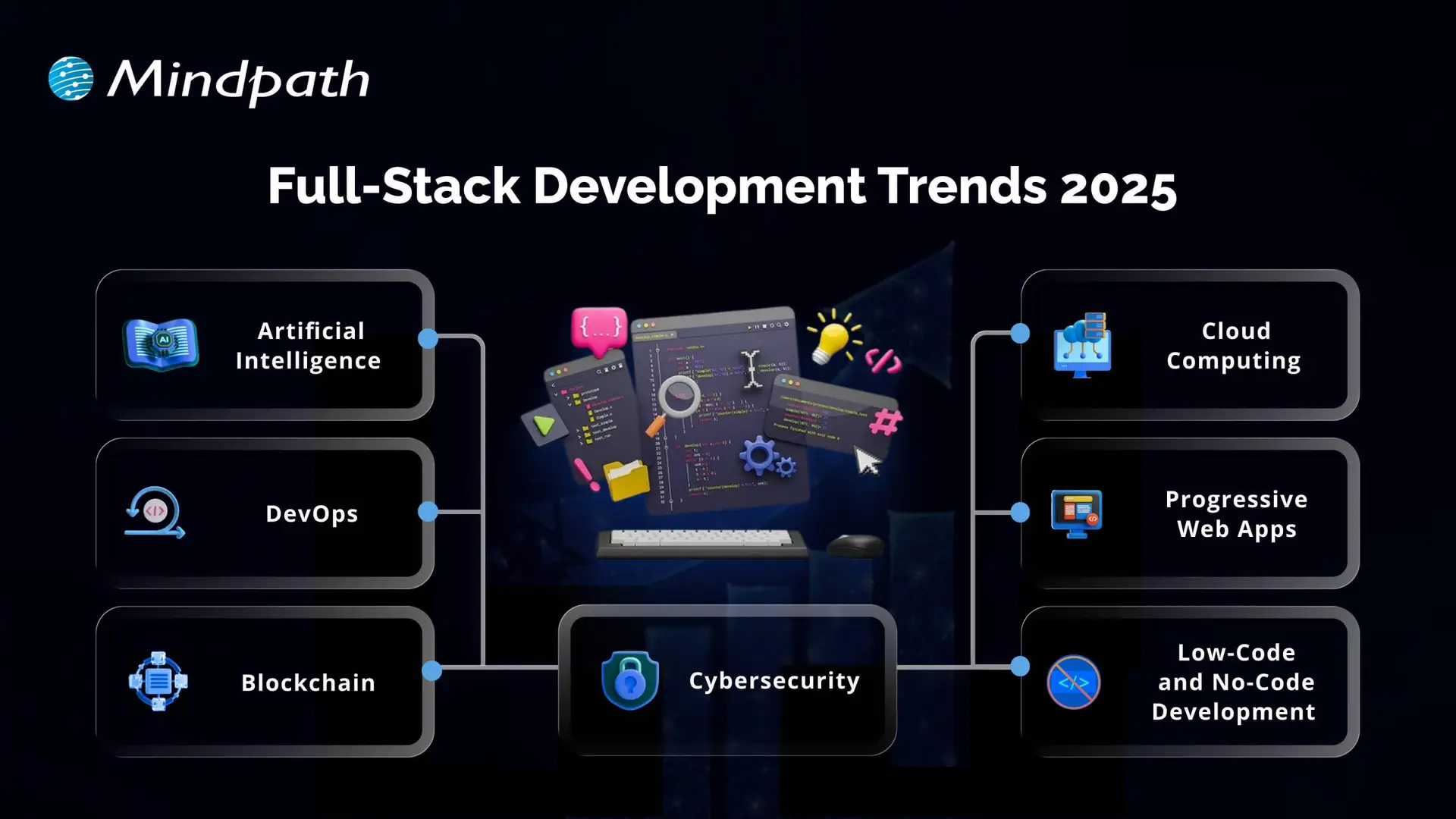
Full-Stack Development Trends 2025

1. Artificial Intelligence

Artificial Intelligence is one of the key full-stack development trends shaping how modern applications are built. It helps solve complex problems faster and allows systems to work without human interruption. Full-stack developers are well-suited for AI roles because they understand both design and logic, making it easier to build intelligent solutions. As the future of full-stack development evolves, AI will play a major role in improving performance and user experience.

2. Cloud Computing

Cloud computing is a fast-growing technology that allows access to data storage, processing power, and other resources over the internet. It supports the future tech stack for developers by offering flexibility, easy scaling, and pay-as-you-go pricing. Full-stack cloud developers are in demand to build and manage cloud-based applications that support collaboration and performance. To grow in this area, developers should understand IaaS, PaaS, SaaS and gain hands-on experience with platforms like AWS, Azure, and Google Cloud.

Also Read: Cloud Computing Trends

3. DevOps

DevOps is a practice that combines development and operations to improve how software is built, tested, and deployed. It helps teams work better together and use tools like continuous integration and delivery to release updates faster. DevOps plays an important role in improving application speed, quality, and reliability. As part of full-stack development trends, it supports the demand for efficient workflows and strong collaboration in building modern applications.

4. Progressive Web Apps

Progressive Web Apps (PWAs) are web applications that offer an app-like experience using modern browser features. They work offline, load quickly, send push notifications, and can be installed on devices without using much storage. As part of web development trends 2026, PWAs help businesses reach more users, especially on mobile, while keeping development simple and cost-effective. Their flexibility and performance make them a smart choice for companies looking to improve user experience.

5. Blockchain

Blockchain is a secure and transparent technology that stores data across a network of computers, making it difficult to change or hack. It is widely used in industries like finance and healthcare to protect transactions and manage decentralized systems. As part of full-stack development trends and the latest trends in web development, blockchain allows developers to build safer and more reliable applications. To work in this area, full-stack developers need skills in decentralized tools, enterprise systems, and Web3 architecture.

Must Read: AI in Cybersecurity

6. Cybersecurity

Cybersecurity is the practice of protecting systems, networks, and applications from online threats like malware, phishing, and DDoS attacks. It has become a key part of full stack development trends as developers need to build secure applications from the ground up. Companies are now including cybersecurity in their future tech stack for developers to keep data and systems safe. Full-stack developers aiming to work in this field should learn network security, web application security, cryptography, and secure coding practices.

7. Low-Code and No-Code Development

Low-code and no-code development platforms allow users to build websites and apps with minimal or no programming skills. These tools are growing as part of full stack development trends because they save time, reduce costs, and make development accessible to more people. While they are great for simple projects, they may not be suitable for complex or large-scale solutions. As part of the trends in software development, LCNC tools offer fast results and full-stack capabilities for quick product launches.

Curious about how development roles differ in modern projects? Explore Front End vs Back End vs Full Stack Developer to see how each contributes to building applications.

Ready to Leverage Full-Stack Development Trends for Your Next Project?

Full-stack development trends are shaping how modern applications are built, improved, and maintained. With advancements like AI, cloud, DevOps, and PWAs, developers and businesses can achieve faster, smarter, and more secure results. Staying updated with these trends will help you build stronger digital products that meet the growing demands of users in 2026 and beyond.

At Mindpath, we offer expert full-stack development services tailored to your business goals. Our skilled developers handle everything from front-end design to back-end logic, delivering complete, scalable solutions. If you’re looking to hire full-stack developers who understand the latest tools and technologies, our team is here to help you build your web and mobile applications with confidence and efficiency.

hire NodeJS developers in New York

Finding theright Node.js developer in New York requires more than just technical skills. You need professionals who understand industry challenges, adapt to new technologies, and collaborate effectively with your team. With New York’s competitive tech market, selecting the right candidate involves evaluating both technical expertise and soft skills, along with an understanding of local industry demands. Here are the key factors to consider when hiring expert Node.js developers in New York.

Key Takeaways

  • 01
    Node.js requires asynchronous programming knowledge due to its non-blocking I/O mechanism.
  • 02
    Developers must master Express, NestJS, or Koa frameworks to build scalable Node.js applications.
  • 03
    Database proficiency in MongoDB, PostgreSQL, or MySQL ensures reliable data persistence.
  • 04
    New York’s banking, journalism, and e-commerce sectors demand specialized Node.js technical expertise.
  • 05
    Competitive compensation and flexible schedules are essential for attracting top Node.js development talent.


1. Technical expertise

Hiring a qualified Node.js developer necessitates assessing their JavaScript competency, backend framework knowledge, and database integration abilities. Node.js uses a non-blocking I/O mechanism, hence a solid grasp of asynchronous programming is required. Developers should be familiar with popular frameworks such as Express, NestJS, and Koa, which assist construct scalable apps. Additionally, knowledge with MongoDB, PostgreSQL, or MySQL is required for data persistence. The ability to develop RESTful APIs guarantees that frontend-backend communication flows smoothly. Testing frameworks such as Jest and Mocha increase code quality while reducing defects. Ensuring that your developer is knowledgeable in these technical areas will aid in the creation of dependable and high-performance apps.

2. Industry Experience

New York is home to strong businesses such as banking, journalism, and e-commerce, all of which have specific technological needs. A financial developer may be familiar with stringent security and compliance standards, but a media developer may be skilled with large-scale data and streaming apps. E-commerce developers recognize the value of scalability, payment integration, and user experience optimization. Hiring developers with appropriate industry expertise shortens the learning curve, accelerates the application of best practices, and increases project productivity. They can also provide insights that are consistent with corporate objectives, resulting in improved decision-making and a stronger end product.

3. Market Competitiveness

The demand for Node.js developers in New York is high, making it essential to offer competitive salaries and benefits. A well-researched compensation package should align with current industry standards to attract and retain top-tier talent. Aside from salaries, offering flexible work arrangements, career growth opportunities, and skill development programs can make your company stand out. With the rise of remote work, many developers now prioritize work-life balance and flexible schedules. Additionally, a strong company culture and exciting projects can be key selling points. A well-structured hiring approach ensures you secure the best Node.js developers, helping your business build scalable, high-performance applications while maintaining a motivated workforce.

4. Soft Skills and Team Collaboration

Technical abilities are necessary, but soft skills are as important in guaranteeing a developer’s success in a team setting. Strong communication abilities allow for smooth cooperation with designers, product managers, and other engineers. A competent developer should also have a problem-solving attitude, which will help them to detect and resolve difficulties fast. Adaptability is another important attribute, as technology moves quickly, and developers must be willing to learn new frameworks and respond to project changes. A team-oriented approach also assures that the developer can work well in collaborative contexts, successfully exchange ideas, and contribute to the overall project’s success.
At Mindpath we connect you with top-tier talent to build high-performance, scalable applications tailored to your business needs. Whether you’re in finance, e-commerce, or media, our experts ensure seamless development with cutting-edge technology.

Discover the ultimate guide to hiring Node.js developers in London. Learn about the skills, benefits, and cost factors involved in finding the right talent for your project.