


Top 10 Mobile App Development Trends for 2025

Join our Newsletter!

Featured Posts

Support Is One Click Away

Home

Top 10 Mobile App Development Trends for 2025

mobile app development trends

Top 10 Mobile App Development Trends for 2025

Every year, new technologies reshape the way we use our mobile phones, and 2025 is no exception. If you are willing to create an app or just curious about the future of mobile technology, then staying updated with the latest mobile app development trends will be considered as a smart choice. These trends are not buzzwords but instead play a role in shaping the way individuals utilize apps, how they are developed by developers and how companies can expand through mobile platforms.

The mobile app world is changing at a quick pace, and 2025 will bring to us some of its most game-changing innovations. From smart AI features to faster and safer user experiences, mobile applications are becoming more effective and helpful in our day-to-day lives. This blog will walk you through the top 10 trends in mobile app development in 2025. 

Before learning about the trends, we must have a quick look at the market value of mobile app development: 

Interpreting Mobile App Development Market Value

According to a study by Allied Market Research, the worldwide mobile app development industry was valued at $195.7 billion in 2023 and is likely to grow to $606.1 billion by 2032. This growth, with a CAGR of 13.1% between 2024 and 2032, is primarily because an increasing number of people are using smartphones and wish to have apps according to their individual requirements.
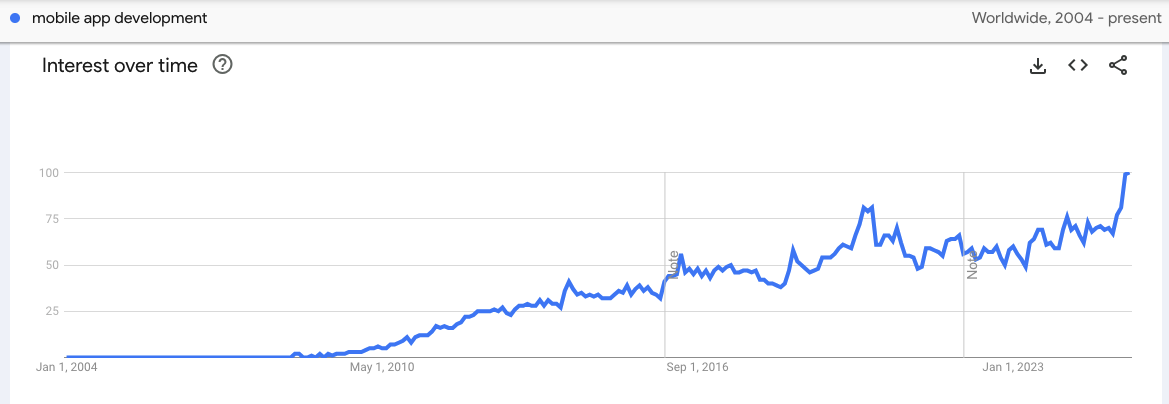
mobile app development google trends
Mobile App Development Google Trends

New technologies are helping to make apps smarter and more useful. More people shopping on phones and working remotely after the pandemic has also made mobile apps more popular around the world. Let’s see what are the latest trends for mobile app development in 2025.

Latest Mobile App Development Trends in 2025

The future of mobile app development is looking brighter than ever, with groundbreaking trends which are set to reshape the way we interact with technology. As we move forward, these emerging trends will drive innovation as well as set new standards for app performance and user experience. Let us take a look at it:  

1. Artificial Intelligence (AI)

Artificial intelligence (AI) is revolutionizing mobile app development in 2025. With advancements such as Apple’s Core ML 3, developers are now able to more easily incorporate AI into their apps. AI will make apps smarter, enhancing performance and user experience, and will be a driving force in defining the future of mobile applications.  

2. Augmented Reality (AR) and Virtual Reality (VR)

Augmented Reality (AR) and Virtual Reality (VR) will be big trends in mobile app development in 2025. AR is becoming more practical and useful across different industries, while VR is enhancing gaming experiences on mobile devices. Both technologies are helping create more interactive and engaging apps. As these trends grow, we’ll see AR and VR shaping the way users interact with apps in exciting new ways. Based on research by Statista, revenue in the AR & VR market worldwide is projected to reach US$46.6bn in 2025, with an annual growth rate (CAGR 2025-2029) of 7.42%, leading to a projected market volume of US$62.0bn by 2029. 

3. Predictive Analytics

Predictive analytics is transforming how mobile apps work. By using AI and data analysis, apps can now predict what users want or need, offering personalized experiences. In 2025, this technology is widely used to improve app interfaces and user interactions. Apps will offer content and suggestions based on each user’s actions, making them feel more intuitive and relevant. 

4. Cloud Computing Integration

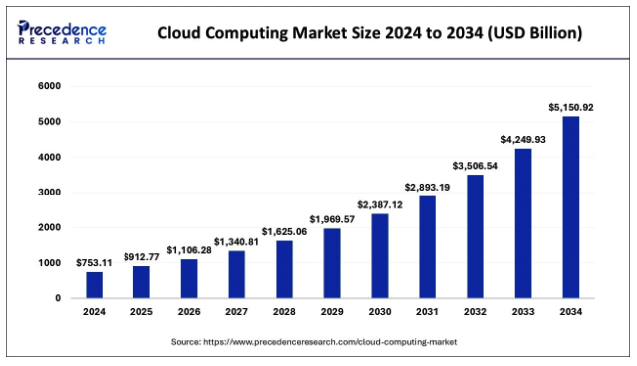
In 2025, cloud computing will become a key trend in mobile app development. It allows apps to store data and perform tasks on the cloud, rather than relying on the user’s device. This will not only improve app performance but also make development more efficient and cost-effective. As cloud technology continues to grow, it will play a major role in shaping mobile app functionality. According to Precedence Research, the global cloud computing market was valued at USD 753.11 billion in 2024 and is projected to grow to approximately USD 5,150.92 billion by 2034, with a CAGR of 21.20% between 2025 and 2034. 

cloud computing market

5. Chatbots

In 2025, chatbots will see widespread adoption in mobile apps, enhancing customer service and user interactions. Driven by AI, they will provide more natural, human-like responses, improving efficiency and responsiveness. This integration will streamline support processes and elevate the overall app experience, making it faster and more intuitive for users. 

6. 5G Technology

The rollout of 5G in 2025 will enhance app performance by providing faster speeds and lower latency. This will enable apps to support more advanced features and deliver smoother user experiences. With improved network efficiency, users can expect faster data processing and better overall functionality. The faster connectivity will also open doors for new, innovative app capabilities. 

7. Internet of Things (IoT)

The Internet of Things (IoT) is transforming how we interact with everyday devices, offering more convenience and automation. From controlling home appliances to managing security systems, IoT is becoming integral to modern living. As more devices become interconnected, the potential for smarter homes, workplaces, and healthcare solutions will continue to grow, creating a more seamless and efficient experience for users. 

8. Low-code /No-code Development

Low-code/no-code development is revolutionizing how apps are created by simplifying the process and allowing users with little to no coding experience to build apps. This approach speeds up development significantly, making it easier to create and modify apps quickly. By empowering business stakeholders and non-developers to participate in the process, it ensures the final product better meets user needs and business goals. Based on Statista statistics, the global low-code platform market is expected to reach around 65 billion U.S. dollars by 2027, reflecting its rapidly growing demand. 

9. Mobile App Security

Mobile app security is crucial as more businesses use apps to handle sensitive customer data. Vulnerabilities in apps can expose users to cyberattacks, leading to financial loss, fines, and a damaged reputation. To protect apps, developers must integrate strong security measures such as encryption, multi-factor authentication, and secure coding practices. Regular updates and testing are also essential to maintaining robust security. 

10. Apps for Foldable Devices

Foldable devices are making a strong comeback, with popular models like the Samsung Galaxy Z Fold 5, Huawei Mate X5, and Motorola Razr 40 leading the way. These devices allow users to adjust the screen size, providing both portability and an expanded experience. As their popularity grows, the demand for specialized mobile apps will rise, requiring optimized interfaces that adapt seamlessly as screens fold and unfold. 

Embrace the Future of Mobile Apps with the Latest Technology and Trends

The future of mobile technology is full of exciting changes. The top trends in mobile development for 2025 show us how fast the industry is moving. From smarter AI to apps for foldable devices, each trend brings new ways to build better user experiences. Staying updated with these trends in mobile development is important for creating apps that are fast, secure, and user-friendly. 

At Mindpath, we specialize in using the latest technology for mobile app development. Our team follows the latest trends in mobile development to deliver apps that are modern, efficient, and built for the future. If you’re looking for a mobile app development company your search ends here. We at Mindpath have a team of professionals with expertise in creating AI-powered apps, apps built for 5G, or solutions optimized for foldable devices, we’re here to turn your idea into a reliable mobile solution. 

Related Post

Hiring ReactJS developers? Explore essential factors like experience, skills, and project requirements to ensure a successful collaboration.
Discover how augmented analytics revolutionizes business intelligence with real-time insights, smarter decisions, and data democratization for faster growth.

Related Post

custom software development process

Whenever you are creating a tailored solution for your business, it is very important to clearly understand how the development process will be structured. The custom software development process clearly guides you in turning your ideas into a usable working solution. Every step matters – from understanding the requirements, conceptualizing the software, determining the specifications, and creating software that supports your goals. You will get to know what is to come, how teams will work together, and what to expect at every step as your project moves forward in purpose and clarity.

A thorough comprehension of how this process works gives you a better sense of clarity and confidence as you engage with the project. You will be able to understand each phase clearly and watch your vision come together step by step. Upon having this understanding, it is very easy and clear to collaborate with your development team. In this blog, you’ll go through the whole process and will understand how the custom software will come to life, step by step.

At Mindpath, we offer custom software development services to turn your vision into reality by guiding you through every step. Contact us today for a solution that turns your ideas into real-world project.

Importance of Custom Software Development for Businesses

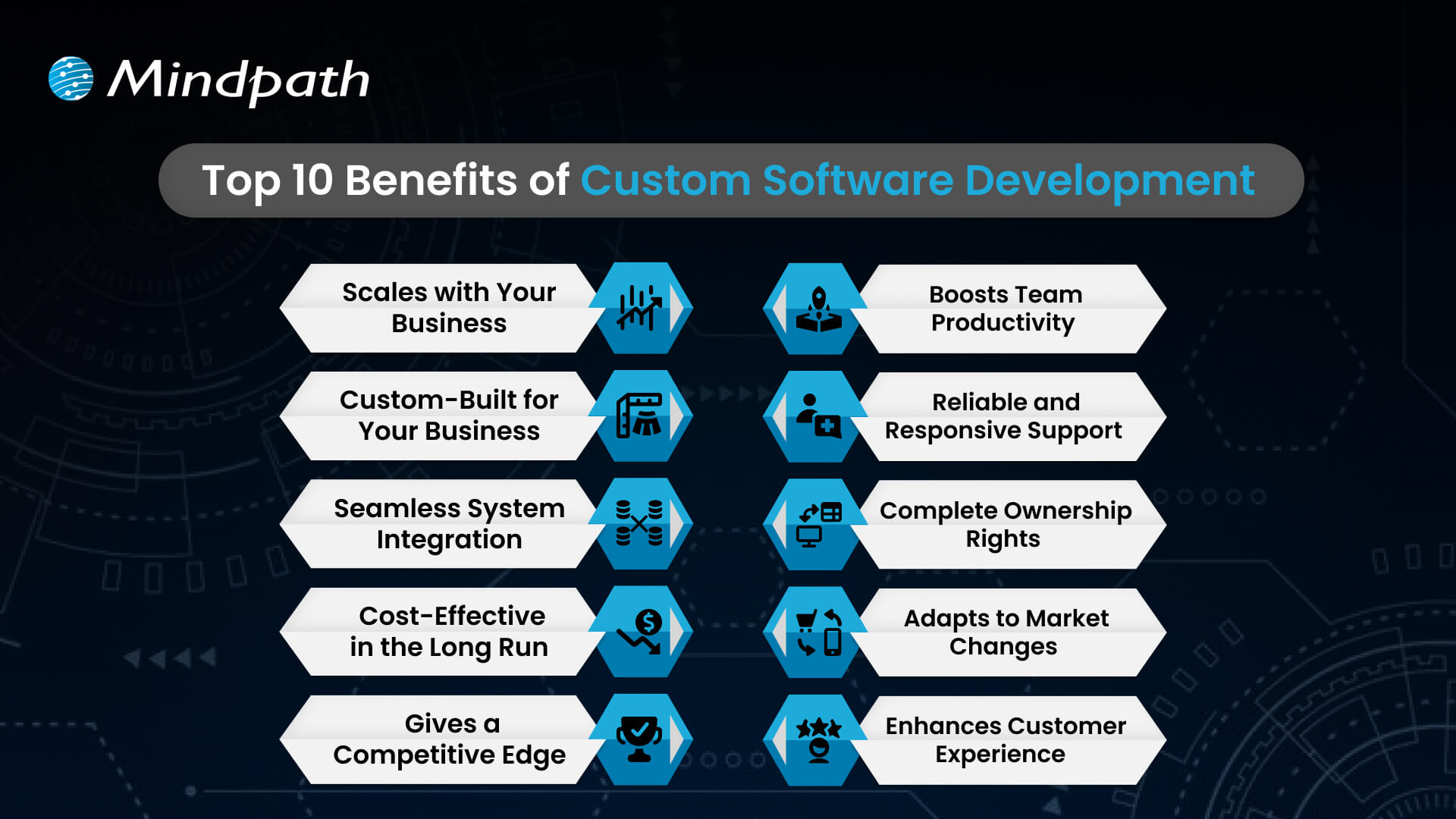
Custom software development is valuable because it provides businesses with tools made solely for them. Unlike off-the-shelf software, custom software solutions fit unique business requirements and methods. This leads to improved performance, increased efficiencies, and better results. It also minimizes unnecessary rework, saving time and money, and allowing companies to be more efficient overall.

Custom software is scalable with your business. You will be able to add features or alter functionality based on your requirements. This adjustable system uniquely supports a company’s long-term goals and puts you ahead of your competitors. Custom software solutions offer a better experience for both the user and employees, which supports increased productivity and satisfaction.

Understanding the Custom Software Development Process

It is essential to know about the process to be followed prior to starting a software project. By getting familiar with the software development process steps, you can be an active participant and an advantageous decision-maker throughout the project. By understanding the process, you will also ensure value delivery by building software with clear goals, planning, and execution.

Custom Software Development Process

1. Define Clear Objectives and Project Scope

The custom software development process begins by defining your goals and understanding what the software must achieve. This includes identifying the target users, the problem it solves, and how it should perform differently from existing tools. A detailed list of features and expected outcomes is prepared. Both functional and non-functional requirements are clearly documented. This step sets the direction and purpose for everything that follows.

2. Planning Resources and Software Design

Planning involves creating a detailed timeline, setting milestones, and organizing resources for development. Budgets, risks, and deliverables are clearly outlined to avoid delays or extra costs. During software development design, wireframes and prototypes are created to visualize the interface and user flow. The architecture is also planned, including system components and how they will interact. Technologies such as programming languages, frameworks, and databases are chosen here.

3. Development and Code Execution

At this point in the custom software development process, the programmers will begin the actual coding based on the approved designs. The developers will prepare technical infrastructure with tools, servers, and version control. The front-end, back-end, and database modules are built and integrated together. Each piece of software functionality is developed based on the description created in the design documents. The functionality is translated into active, live software with working features to start testing.

3. Software Testing and Quality Assurance

After the software is developed, it will go through a series of testing strategies to check for quality and reliability. The first step, or unit testing, will cover each feature and try to eliminate some early problems. Then the following step, called integration testing, will check the work of modules and ensure they work as a system. Once that’s complete, the next phase is system testing, which ensures all performance, security, usability, and reliability aspects are achieved and validated prior to the release of the product.

4. Deployment, Maintenance, and Support

In the final step of the custom software development process, the solution moves to a live environment for end users. The deployment may include installing the software on servers, setting up databases, and giving users access. After launch, the software is continuously monitored for issues. Maintenance includes fixing bugs, adding new features, and updating it for better performance. Ongoing support keeps the software running smoothly over time.

Real-World Examples of Customized Software

Below are six real-world customized software examples that demonstrate how businesses are navigating unique challenges by investing in custom software to create a digital solution. These tools have been developed to improve usability, performance, and long-term sustainability.

Real-World Examples of Customized Software

1. Uber

Uber constructed a custom ride-booking system complete with GPS tracking, so you know where your ride is located, secure payment options, and updates on the driver’s progression. The app shifted transportation in cities globally.

2. Netflix

Netflix utilizes AI-based recommendation engines and adaptive streaming systems to provide an overall personalized viewing experience through a fully custom platform.

3. Amazon

Amazon uses custom software to manage inventory, predict customer preferences, and allow one-click ordering for a fast and reliable purchasing experience.

4. Airbnb

Airbnb built a custom platform for travelers to pay securely, check real-time availability, and search by location for hosted accommodations around the globe.

5. Tesla

Tesla uses customized software for its smart vehicles to drive the autopilot capabilities, over-the-air updates, and real-time diagnostics to enable sophisticated performance.

6. Starbucks

Starbucks utilizes a custom application to allow customers to mobile order, encrypt reward tracking, and offer options for contactless payments, making the product experience more convenient and helping to cultivate loyalty.

Ready to Create Software That Aligns with Your Business?

Custom software development is the process of creating digital solutions that fulfill your specific business goals. From clarifying your vision to deploying the software and providing ongoing support, every step of the official custom software development process undergoes proper plan and execution. The final outcome of custom software typically entails better efficiency, enhanced experiences for users, and long-term growth through technology that suits your needs.

As a premier custom software development company, we at Mindpath specialize in providing full-spectrum custom software development services that suit your specific business. Our team expertly develops scalable, secure, and simple solutions that integrate well into your workflows and future goals. Partner with us to turn your ideas into powerful, high-performance software built for results.

React Roadmap for 2025

React is one of the most powerful and useful JavaScript libraries that developers around the world are using to build amazing web applications. ReactJS allows developers to create fast, interactive user interfaces for websites and apps, and has even improved their workflows. When you have the intention to progress your skills or improve your existing projects, a React roadmap can help you navigate what to learn next. Rather than blindly choosing where to begin and what is most important, a roadmap allows you to advance in your learning with confidence and real intent.

React is evolving, and in 2025, it is expanding forward with new capabilities such as server components, rendering methods, and development tools, to make learning React more valuable for new and expert users. Seeing how to use your time wisely and knowing what you may look at for a specific reason helps to save you time, but also helps to make modern applications. In this blog, you will discover a step-by-step process of learning, which can simplify mastering and using React in a project. Let’s get started!

If you’re planning to leverage React in your next project, our ReactJS development services can help you in creating modern, scalable web applications meeting your business goals.

Need for React Roadmap

It’s essential to have a clear learning plan when starting with React. A ReactJS roadmap for beginners allows you to learn complex subjects such as JSX, components, stat,e and hooks, by breaking these subjects down into smaller, more manageable pieces. Having step-by-step tasks gives you a foundation and keeps a focus on what matters. Instead of doing random tutorials every day, you have a learning path that makes sense and keeps your learning organized and flowing.

With new features and developments coming in the future of React, it’s good to be prepared. Having a React developer roadmap can give you a path of what you can learn and when you can learn it. This can help you eliminate confusion and wasted time. Roadmaps can often have actual projects where you actually perform them as a learning experience. This kind of experience will only help you to grow and develop your learning experience and skills, but it will also keep you motivated because you are able to see your progress clearly on your journey!

Key Concepts to Master Before Learning ReactJS

Before diving into React, it’s helpful to understand some core web development concepts that make learning smoother and more effective. These basics form the starting point of any React roadmap and give you the confidence to build with React efficiently.

Key Concepts to Master Before Learning ReactJS

1. JavaScript Basics

It is important for you to understand variables, functions, arrays, and objects in JavaScript. These are the building blocks for the logic and data in React.

2. Understanding the DOM

It is important for you to understand what the browser is doing in terms of displaying things and changing things via the DOM. React uses the DOM structure to show on the screen and make changes to it easily and efficiently.

3. Version Control with Git

It is important for you to understand how to track and manage your changes in your projects, via version control, specifically with Git. It is a vital part of a real-world React application, especially when working with a team.

4. HTML and CSS

Learning the fundamentals of HTML for structuring web pages and CSS for styling them is important. Understanding layouts related to flexbox or grids is necessary for developing responsive user interfaces in React. 

ReactJS Roadmap 2025

To become a skilled React developer in 2025, it’s important to follow a clear and practical learning path. This React tutorial, based on the latest ReactJS roadmap 2025, will guide you through the key topics to focus on at each stage of your journey.

ReactJS Roadmap 2025

1. Setup & Basics

Start by setting up your environment with tools like Node.js and npm to begin working with React. Learn how JSX works and how it allows writing HTML-like code inside JavaScript, which is essential in any React roadmap.

2. React Components

Understand the structure and role of components, which form the UI of any React application. Functional components, props, and state are core parts of this architecture, making them a key focus in the front-end roadmap.

3. React Hooks

Hooks let you use features like state and lifecycle in functional components without writing classes. Mastering built-in hooks such as useState, useEffect, and useContext is crucial in any modern React Roadmap.

4. Routing

Routing allows smooth navigation between pages in single-page applications using tools like React Router. It enhances user experience by loading components based on the URL, as commonly seen in apps.

5. State Management

State holds the data that drives your UI and updates the app when changes. Techniques like React Context API and Redux help manage local and global states effectively within your project.

6. Event Handling

React handles user actions such as clicks, form submissions, and scrolls through event handlers. Learning how to work with these events improves interactivity and responsiveness in your application.

7. Advanced & Custom Hooks

Explore patterns like component composition, higher-order components, and custom hooks to reuse complex logic. These advanced topics align with current React trends and best practices.

8. React Animations

Animations create smooth transitions and improve the user experience using tools like Framer Motion or React Spring. These libraries offer a flexible way to add motion to your interface.

9. React Frameworks

Explore frameworks built on top of React, such as Next.js and Gatsby, that enhance app performance and SEO. These tools are often mentioned in ReactJS blogs for speeding up development.

10. Projects

Apply what you learn by building real-world applications that solve problems and test your skills. Project-based learning is a major part of the React tutorial approach and strengthens your understanding of concepts in the JavaScript roadmap.

Ready to Start Your React Journey?

Following a structured React roadmap helps you learn React with purpose and confidence. This blog covered everything from the basics to advanced tools and trends that matter in 2025. By focusing on key concepts, building projects, and staying updated, you’ll be better prepared to grow as a skilled React developer in today’s fast-moving web world.

This React roadmap is just the beginning. At Mindpath, we bring these React concepts to life through modern and scalable solutions built by expert developers. Our ReactJS development services align perfectly with what you’ve explored in this blog, delivering clean architecture, smart component reuse, and performance-focused interfaces that work seamlessly across devices. Let us help you turn learning into real results through expert-driven development.

Generative AI Use Cases in Diverse Industries

“Necessity is the mother of invention.” We have all encountered this phrase in our science textbooks or while reading about most scientific innovations. Be it the invention of the cell phone, the internet, or the World Wide Web, each of these has brought a paradigm shift in the world of technology.  

While technology is rapidly expanding its horizon, Artificial Intelligence remains the buzzword that every business can’t stop gushing about. Generative AI, a subfield of artificial intelligence, has gained massive momentum post the launch of ChatGPT by OpenAI in 2022. Since then, generative AI use cases have found their way in some of the major industries, including healthcare, banking & finance, gaming, and supply chain, to name a few, marking the beginning of the Gen AI revolution.

But what is Generative AI? Is it only limited to text or image generation, or can it help in other fields as well? In this blog, we will be answering some of the burning questions around Generative AI and generative AI use cases across industries.  

Want to implement cutting-edge GenAI solutions in your company? Mindpath offers end-to-end AI Development Services for deploying generative AI applications efficiently.

Introduction to Generative AI 

Let’s start with the basics: what is Generative AI? A magic lamp that fulfils all your wishes; well, almost! Generative AI uses a pool of data that includes text, images, code, etc., amongst other data types.  

With the help of machine learning models and neural networks, this large sum of data gets analyzed, patterns are discovered, and output is delivered. Generative AI, as it says, is not limited to analyzing the data, but creates new information such as content, images, videos, and even code.  

Also Read: Top GenAI Trends 

Here are some of the key components of Generative AI:  

key components of Generative AI

  1. Data: Raw data such as documents, eBooks, ledgers, images, videos, codes and a lot more that Generative AI uses to learn.  
  2. Neural Network Models: They work just like a human brain; they help AI models to make sense of all the raw data we have put in the model.  
  3. Training and Model Parameters: There are some parameters that help AI models fine-tune the information, cut the noise and generate accurate output.  
  4. Input: When you ask a Gen AI model to create a cover letter for a job, create a report based on Excel data, generate a Ghibli image to roll with the current trends, that’s categorized as an “input”.  
  5. Output: Whatever results a Gen AI model, such as ChatGPT, MidJourney, Bart, delivers for your query is the output.  

Generative AI is gaining momentum, with a global market valued at USD 37.89 billion in 2025 which is projected to reach USD 1,005.07 billion by 2034 at a CAGR of 44.20%. (Source: Precedence Research)

Generative AI Use Cases Across Industries 

While Gen AI is growing, curating a business-first roadmap for its adoption is important for those seeking to leverage it to its fullest advantage.  Now that we have explored what Generative AI is, let’s move on to some prominent generative AI use cases in different industries, proving that it’s more versatile than we know!  

1. Healthcare 

According to a recent survey by Deloitte Center for Health Solutions, 75% of leading healthcare companies across the globe are either currently experimenting with generative AI or planning to scale Gen AI in the near future.  

In what area, you may wonder? Generative AI healthcare is being used to maintain patient records, drug discovery, interpreting and analyzing medical images such as X-rays, CT scans, MRIS, to mention a few.  

Scientist are using generative AI for modelling molecular structures that can help not just in creating new drug compounds but also in predicting their effectiveness.  

92% of healthcare leaders see a promising future of generative AI in improving efficiency as well as speeding the decision-making in critical scenarios.  

2. Banking  

Next up is the banking and finance industry. Generative AI in banking is fueling the fintech revolution in more ways than one. Generative AI is currently being leveraged for detecting fraud, assessing the credit score or credit risk based on the creditworthiness of an individual or an entity, customer support, automating routine tasks and compliance checks, creating investment strategies, among others.  

A recent report by KPMG revealed that around 76% of banking executives in the United States are planning to implement Gen AI for fraud detection and prevention, while 62% want to leverage it to improve their customer service, followed by 68% of professionals that believe Gen AI can be best used for regulatory compliance.  

3. Gaming  

One of the most exciting areas for generative AI applications could be gaming. According to Statista, over one-third of game developers across the globe are already using Gen AI tools in their studios. PCG, which stands for Procedural Content Generation, is the largest segment of the gaming industry where almost 30% gen AI is being used currently. PCG helps game developers create larger than life game world, environment and universe that intrigues the players and gives them a more immersive experience.  

Other than PCG, some other significant generative AI use cases in gaming include developing characters, detecting bugs, generating real-time content like new levels and challenges, and detecting any kind of irregularities or security breaches or threats.  

Wondering how AI can help your business to reach the exceptional level of growth? Read our blog to learn about the importance of generative AI for business.

4. Supply Chain 

When it comes to adopting Gen AI, the supply chain industry is no stranger to it. In fact, McKinsey’s survey revealed that a third of global businesses are effectively using generative AI in business areas, including operation processes automation (66%), production planning and scheduling (47%), quality control and inspection (44%), and inventory management (43%).  

Gen AI can support the supply chain industry with better demand forecasting, optimizing day-to-day operations, assessing and controlling supplier risks,  quality control, fraud detection, and much more!  

 5. Other Industries 

Apart from the above-mentioned industries, use cases of generative AI are prevalent in other industries such as sales and marketing, insurance, legal and compliance, human resources, product development, and many more.  

While many still utilize gen AI for content, image and code generation, the applications are certainly above and beyond. However, leveraging gen AI comes with its own set of challenges. Being AI-ready is in demand for every industry and business seeking to adapt and leverage AI to its advantage. There’s no one-size-fits-all guidebook or roadmap for AI adoption; rather, each business and industry needs to understand its niche and create a roadmap that generates true value.  

Wondering how generative AI is influencing content creation and design strategies? Check out our blog generative AI changing creative industries  to see how AI-driven creativity is shaping the future of industries.

Ready to Embrace Innovation with Generative AI?

Generative AI is expanding its horizon, and businesses have started to realize its true potential. While Gen AI continues to grow, it’s critical to assess all of its aspects that involve data security, lack of information, and overdependence.  

Businesses looking to adapt AI must look beyond the hype and create a strategy that works for them. At Mindpath, we help businesses create solutions that are based on their real pain points rather than creating just another software. When you talk to us, we attempt to understand your operations and what may work to make them more efficient.  

Our customer-first approach helps us identify gaps and curate a solution that works for you. Thus, if you’ve been wanting to adopt AI, the right time is now! Let’s discuss how our AI development services can help you make the best of up-and-coming technologies and get your business future-ready!