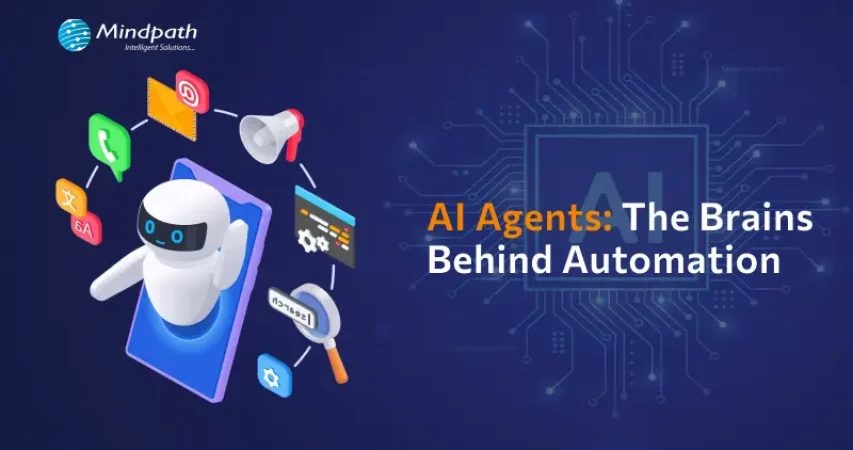
AI Agents: Everything You Need to Know in 2026

Join our Newsletter!

Featured Posts

Support Is One Click Away

Home

AI Agents: Everything You Need to Know in 2026

ai agents

AI Agents: Everything You Need to Know in 2026

Just think if there was a digital assistant that not only obeyed commands, but was able to understand goals, make decisions and learn from experience? Sounds exciting, right? What if we told you this already exists? Yes, you heard correctly. This is where AI Agent comes in, which is a smart system that is intelligent enough to work independently and get the job done without having to check in with a human often, truly showcasing how AI is transforming future possibilities.

These days, companies are turning to automation and intelligence-based tools, which would make artificial intelligence agents important, no matter where you are in business. They can assist organizations in their own endeavors. They can make a company’s operations more efficient, provide real-time personalization for customers, and provide companies with less effort or worry, especially when dealing with complex operations. Do you want to know more? Well, we have you covered. This blog will guide you through everything you need to know about AI agents. 

To start with, let’s understand the meaning of AI agent!

Want to turn AI agent concepts into real, high-performing applications? Mindpath offers AI development services, where we design and deliver intelligent systems tailored for future-ready organizations.

What is an AI Agent?

AI agents are smart computer programs that can think and act on their own. They look at everything around them and understand what is going on and then decide what they should do next in order to accomplish a specific objective. These agents gather input from their environment through sensors or data feeds and respond by carrying out actions through digital systems or physical devices. They are like good digital employees that don’t require someone to keep an eye on them at all times.

What is unique about artificial intelligence agents is that they can learn and make decisions on their own. They act according to rules, operate on data, and in some cases, learn from experience so that they become more efficient in what they do. You will encounter them in numerous fields such as business, science, and technology where they assist in accomplishing things quicker and more efficiently. These agents are increasingly becoming a significant aspect of how we utilize technology today. 

Also Read: Agentic AI

Types of AI Agents 

AI agents come in different types, each designed to handle tasks in unique ways depending on their abilities. Understanding these types helps us see how they solve problems and make decisions in various situations. Below are some common kinds of AI agents and examples of how they work in real life:

1. Model-Based Agents

These use an internal idea, or model, of their environment to make smarter choices. They can remember what happened and plan ahead based on how things are connected. A GPS navigation system is a good example as it uses traffic and map data to suggest the best route in real time, showing how AI agent architecture works with memory and planning.

2. Goal-Based Agents

This type of agents are mainly focused on reaching a goal and making decisions by thinking about what might happen next. They pick actions that move them closer to what they want to achieve. For example, a self-driving car makes choices like stopping or changing lanes based on the goal of getting passengers to their destination safely.

3. Reactive Agents

These are the simplest kind that respond only to what’s happening right now. They don’t remember anything from the past and follow basic “if this happens, then do that” rules. A common AI agent example for this is a thermostat that turns heating or cooling on based on the current room temperature.

4. Utility-Based Agents

These take it a step further by not only pursuing goals but considering what choice provides the best outcome. They opt for actions based on what is most useful or gratifying. For example, a delivery drone can take a longer route to escape adverse weather while ensuring it reaches its destination on time and securely.

5. Learning Agents

These get better over time by learning from what they do and how well it worked. They have different parts that help them act, learn, and explore new options. A Netflix-style recommendation system is one such AI agent platform, improving suggestions as it learns what users like.

Curious about how AI agents deliver faster, smarter real-time responses? Our in-depth blog on Conversational AI explains how these systems understand users, learn from interactions, and continuously improve.

As we now have a basic idea about artificial intelligence agents, here are some benefits it can offer. 

Understanding the Benefits of AI Agents

According to Grand View Research, the global AI agents market size was estimated at USD 5.40 billion in 2024 and is expected to grow at a CAGR of 45.8% from 2026 to 2030. This rapid growth is driven by the increasing adoption of open-source AI agents that offer flexibility and innovation across industries. These intelligent systems bring numerous benefits such as: 
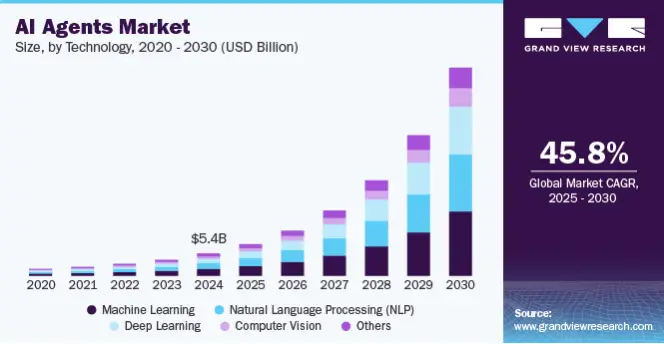
AI Agents Market Size & Trends

1. Ensure Accuracy

These tools can check their own work, find missing details, and fix mistakes. This helps keep results more accurate, even when things move quickly. It’s a smart way to keep quality high without slowing down. 

2. Cut Operational Costs

Automation helps cut down the cost of manual work and mistakes. It also reduces the need for constant back-and-forth between teams. That means more money saved on everyday business tasks. making AI in business strategy a valuable investment for long-term growth.

3. Build Custom Applications

Companies can develop tailored tools trained on their specific data and requirements. These solutions are designed to perform tasks according to the organization’s unique workflows and preferences. This makes AI for developers more effective and aligned with individual business goals. 

4. 24/7 Availability

AI tools can keep working in the background, even after work hours. They help with projects or answer customer questions at any time. This makes support and progress continue non-stop. 

5. Free Up Team Responsibilities

By handling repetitive tasks, these tools give team members more time to focus on creative ideas and big projects. It eases the load of daily tasks. This opens space for planning, strategy, and innovation. 

6. Boost Efficiency

Agentic AI tools help teams save time by handling many small decisions in complex tasks. This means people don’t need to step in every time, which makes work faster. With the right AI agent frameworks, teams can finish more in less time. 

Curious about which technologies are truly driving the next era of AI innovation? Explore our blog on GenAI tools to discover the most powerful solutions shaping the future of AI development.

Let us next learn how to create an AI agent:

Steps to Build an Artificial Intelligence Agent

Building an artificial intelligence agent involves a clear and structured process to ensure it performs effectively. Here’s a simple overview of the essential steps involved in creating a reliable and intelligent AI agent: 

1. Set Clear Goals and Purpose

Begin by clearly defining the specific tasks and functions the artificial intelligence agent will perform. Identify the problems it should solve and the target users it will serve, ensuring its goals match your business needs. Consider real-world use cases to determine the features and capabilities required. 

2. Gather and Prepare the Right Data

Gather data that reflects the type of interactions the artificial intelligence agent will handle, such as chat transcripts, voice recordings, or past user activity logs. Clean the data by removing errors and inconsistencies, then label it to help the agent understand user intent and context. Proper preparation of high-quality data is essential for accurate learning. 

3. Pick the Right Machine – Learning Model

Select a machine learning model suitable for your AI agent’s task, like neural networks for understanding language or reinforcement learning for decision-making. With your data in mind, determine if you can use a pre-trained model, or if you need to train a model from scratch instead. Fine-tuning pre-trained models can help calibrate them to your needs. and this is an area where the role of AI consultant becomes crucial in guiding the right model selection.

4. Train Your AI Agent to Learn

You will now configure your training environment and load the cleaned/labeled data you have. In the same way as traditional essential machine learning, the data has to be separated into training and testing data. The parameters need to be set like learning rate, epochs, and start training. Be aware of the performance metrics, the training metrics to make sure the model is learning as expected and when adjustments are needed. 

5. Test It to Make Sure It Works Well

Evaluate the artificial intelligence agent by running the AI agent through designated tasks, measuring accuracy, response time, and quality interaction with the user. You will use different testing methods like unit testing, user testing, and A/B testing to figure out its relative strengths and weaknesses. Lastly, you will also informally call out any open issues about the experience such as overfitting and refining the training or changing data as required. 

6. Launch and Keep Monitoring

Launch the AI agent on a dedicated platform, website, app, or voice interface and make sure that the integration is seamless. Monitor its usability using real-time analytics and user feedback to have a clear understanding of its performance and any analytics issues as soon as they arrive. To sustain systems and achieve the original intended purpose of engagement, systems should be routinely maintained, updated and improved. 

Wondering if your business is prepared to adopt AI and harness its full potential? Check out is your business ready for AI to assess readiness and start building a smart, future-proof strategy.

Are You Looking to Experience the Power of AI Agents?

AI agents have changed the way we interact with machines by letting systems do things on their own, learn on their own, and achieve more results in a shorter time. They provide freedom from manual effort, support better decisions, and improve efficiency in most industries and business functions. 

At Mindpath, we offer AI development services that fit your business needs. Our AI agents automate the routine tasks, improve the customer engagement experience, and support smarter ways of working, so that you can do things better in an increasingly competitive and tech-driven landscape. 
Frequently Asked Questions

1. How do AI agents fit into existing business systems without disrupting current workflows?

AI agents are designed to integrate with existing tools through APIs and automation layers. They can work alongside current systems without replacing them entirely. This allows businesses to improve efficiency gradually while maintaining stability and avoiding major operational disruptions during implementation.

2. What kind of tasks are best suited for AI agents in a business environment?

AI agents perform best in tasks that involve repetitive decision-making, data analysis, or real-time responses. Examples include customer support, workflow automation, data monitoring, and recommendations. Their ability to process large data quickly makes them valuable for improving speed and accuracy in operations.

3. How secure are AI agents when handling sensitive business or customer data?

AI agents can be highly secure when built with proper safeguards such as encryption, access controls, and compliance with data protection standards. Regular monitoring and updates are essential to maintain security. A well-designed system ensures that sensitive data is handled responsibly and protected from potential risks.

4. Do AI agents require continuous human supervision to perform effectively?

AI agents are built to operate with a level of independence, but they still require periodic monitoring and updates. Human oversight ensures that the system stays aligned with business goals, adapts to changes, and continues delivering accurate and relevant outcomes over time.

5. How can businesses measure the real impact of AI agents after implementation?

The impact of AI agents can be measured through key performance indicators such as reduced operational time, improved accuracy, cost savings, and better customer response rates. Tracking these metrics helps businesses understand how effectively the agents are contributing to overall performance and efficiency.

Related Post

How much does hiring a ReactJS developer cost? Learn about factors affecting rates, and how to find the best talent within your budget.

Related Post

Augmented Analytics

Are you ready to take your business intelligence to the next level? Imagine if you could make faster, smarter decisions with the help of advanced analytics tools. That’s where augmented analytics comes in. But what exactly is it, and how can it revolutionize the way businesses unlock insights? Let’s explore how this cutting-edge technology is transforming the world of business intelligence.  

What Is Augmented Analytics?

Augmented analytics is a new approach to data analysis that makes use of technology such as machine learning (ML), artificial intelligence (AI), and natural language processing (NLP). These technologies collaborate to simplify and accelerate the process of gaining insights from data. The fact that augmented analytics does not require extensive technical expertise distinguishes it from other approaches. It is intended to provide relevant information to people at all levels, from business users to data analysts, without the requirement for specialized expertise. Users can ask basic enquiries and receive immediate responses using techniques such as natural language queries and natural language creation. In many circumstances, augmented analytics can deliver more complete and precise insights in minutes, reducing time and boosting decision-making. Even someone with no technical knowledge can now identify crucial trends and patterns in data, which would have previously needed the skills of a data scientist. This makes it a game changer for firms that want to be more data-driven and responsive.  

How Augmented Analytics Work?

Augmented analytics employs artificial intelligence, machine learning, and natural language processing to simplify and accelerate data analysis. It automates the process of gathering, cleaning, and linking data from diverse sources, allowing teams to prepare data without requiring complex technical expertise. Instead of manually developing models, users can ask queries in plain language, and the system will instantly analyze the data and deliver thorough insights. These insights are presented instantaneously via dashboards, with real-time answers and explanations, reducing the time and effort often necessary to create reports and visualizations. This makes data analysis more accessible and efficient for everyone in the organization 

Advantages of Augmented Analytics in Business Intelligence

1. Breaking Data Barriers

In traditional business intelligence, each team frequently develops its own data models to address specific concerns. However, these models may not contain all important data, resulting in missed opportunities. For example, a marketing team can analyze CRM data while ignoring crucial findings from sales or customer support, which could have an influence on their marketing strategy. This results in data silos, in which important information is kept inside one department and not shared across the organization. Augmented analytics accelerates this process by integrating all of your data sources into a single streamlined solution. When you ask a question, the system collects data from all linked platforms, databases, and storage places to provide a comprehensive, correct response. It also updates itself with each query, resulting in tighter links across data sets. The insights and visualizations created are easily shareable across teams, allowing employees to collaborate and access the data they want. This not only eliminates silos but also guarantees that everyone in the organization is on the same page, using the most up-to-date information for improved decision-making and faster solutions to business difficulties. 

2. Smarter Business Choices

Waiting weeks for vital insights can lead to missed chances, whilst speeding the analysis can result in forgetting important facts. Augmented analytics tackles both of these issues by analyzing billions of information in seconds and providing timely and accurate insights. It doesn’t end there; augmented analytics explain the “why” behind each insight, giving you more information to make smarter decisions. This provides business users with not just the answers they want, but also the knowledge to properly comprehend the dataReal-time insights allow teams to act on information immediately, increasing overall efficiency and responsiveness. Whether it’s recognizing new trends, analyzing customer preferences, or making fast changes to strategy, augmented analytics guarantees that business choices are made using the most accurate and up-to-date information. By simplifying the process and lowering the risk of human mistakes, it allows organizations to remain agile and make wiser, more confident decisions, resulting in better commercial outcomes.  

3. Real-Time Data

Unlike standard business intelligence tools, which can take a long time to process data and give insights, augmented analytics returns results practically instantaneously. Simply ask a query, and the AI will process billions of data points in milliseconds. It then offers clear and simple insights and visualizations, allowing you to understand exactly what is going on in your business. Since the insights are supplied in real time, teams can act on them instantly, helping firms to seize time-sensitive opportunities. This speed not only facilitates speedy decision-making but also guarantees that firms remain agile and responsive to change. Whether it’s modifying strategy, recognizing patterns, or resolving difficulties, augmented analytics guarantees that users always have up-to-date, actionable insights at their fingertips, making the process faster, smarter, and more efficient. 

4. More In-Depth Analysis

Getting precise understanding from your data used to be a complicated and time-consuming process. However, with augmented analytics, you can swiftly delve into your data by analyzing billions of data points and many elements in only seconds. This provides you with more precise and granular insights that were previously difficult to obtain. Not only does it help you understand the “why” behind the findings, but it also reveals hidden patterns and trends that can be used to guide future decisions. This higher degree of research helps you to go beyond surface-level discoveries and uncover previously unknown aspects. Augmented analytics can uncover subtle links between variables by analyzing large volumes of data in real time, delivering a more comprehensive view of your organization The capacity to do in-depth analysis assists firms in making well-informed, data-driven choices, whether it’s increasing the customer experience, optimizing processes, or refining strategy. Companies can utilize this powerful tool to more accurately identify growth possibilities, minimize risks, and forecast future trends, providing them with a competitive advantage in an ever-changing market. 

5. Accessible Data for All

Traditionally, business intelligence systems depended significantly on IT teams and data experts to do the majority of the workload. However, augmented analytics transforms this by allowing anybody in the organization, regardless of technical experience, to access precise information. Augmented analytics enables users to study data in real time and construct their own visualizations to make sense of it. This change enables data scientists and analysts to focus on more complex duties, while the rest of the team can freely investigate and use data to make choices. By making data more available to everyone, augmented analytics creates a data-driven decision-making culture throughout the organization. Employees from many areas, including those who lack technological expertise, may now utilize the power of data to improve their processes, solve problems, and spot new opportunities. This data democratization not only boosts the general use of business intelligence tools, but it also helps to break down team barriers, fostering cooperation and creativity. When everyone is on the same page, organizations can make faster, smarter choices and achieve better business results. 

How Mindpath Can Help?

Mindpath makes it easy for your organization to use augmented analytics. Our skilled staff assists you in implementing cutting-edge BI technologies, ensuring that everyone, from data scientists to non-technical team members, has quick and easy access to vital information. We expedite data analysis by integrating new technologies such as AI and machine learning into your systems, allowing you to make better, quicker decisions based on real-time insights. Our technologies break down data silos, allowing your teams to interact and operate more efficiently together. With Mindpath’s help, you’ll have everything you need to maximize the value of your data, making it accessible, comprehensible, and actionable for everyone in your organization 

Wrapping Thought!

In today’s fast-paced corporate environment, keeping ahead requires making better judgements faster. Augmented analytics is the key to uncovering real-time, in-depth insights that improve your company’s performance. This breakthrough solution allows everyone in your organization to make data-driven decisions, regardless of technical skills, by breaking down data silos, allowing smarter decision-making, and democratizing data access. With Mindpath’s experience, your company can easily implement augmented analytics, expedite data processing, and ensure that everyone—from data scientists to non-technical team members—has access to vital insights. We help you incorporate AI and machine learning into your processes to increase collaboration, decision-making, and general efficiency. 

Want to unlock the full potential of your data with Mindpath's augmented analytics solutions?

Partner with us today to transform your business insights and decision-making!

Discover how augmented analytics revolutionizes business intelligence with real-time insights, smarter decisions, and data democratization for faster growth.
Drupal vs wordpress

At present, the debate of Drupal vs WordPress is more relevant than ever. WordPress is already powering a large number of websites all across the world. Gradually, Drupal has been strengthening its foothold in enterprise as well as government projects. This has given rise to an important question among businesses and professionals: Is Drupal better than WordPress, or is WordPress still the easier choice for users? 

The guide gives a comprehensive insight into both Drupal and WordPress. You need to get a holistic insight into these platforms so that you can choose the best solution that perfectly fits your needs.  An in-depth comparison between these novel platforms has been made, which can simplify your selection process and help identify the right CMS for your needs in 2026.

Want to build a CMS in your online presence that is flexible, user-friendly, and reliable? Our WordPress development services help you with custom solutions focused on delivering a secure and future-proof CMS tailored to your business needs.

WordPress at a Glance

In the year 2026, WordPress certainly remains the world’s most popular web content management system. Within a short span of time, WordPress has been powering over 40% of the web. The platform is known for its ease of use, along with a massive plugin library. The availability of flexible full-site editing tools makes WordPress perfect for professionals as well as small and medium-sized entities. 

Some of the unique attributes of WordPress that make it a useful CMS solution are the availability of a plethora of themes coupled with robust SEO plugin support. The existence of a thriving developer community allows users to get the optimum value by choosing WordPress.

An Insight into Drupal

Drupal has emerged as a powerful enterprise-grade CMS tool. You can use the free open-source web CMS for the purpose of building websites and web applications. Drupal has gained immense trust among government agencies and large organizations within a short period of time.

Drupal is known for its security and flexibility. Moreover, it is capable of handling a large volume of content and complex user workflows. These characteristics make Drupal a world-class CMS platform that is suitable for meeting the needs of content-heavy platforms. It is time to dive deeper and look at the differences, as now you have clarity about Drupal WordPress

Planning to, but don’t know what to look for when hiring a professional to handle your WordPress development needs? Discover our guide to hiring WordPress developers to help you make a smart, confident, and informed hiring decision. 

Comparison Between WordPress and Drupal

Are you wondering – Is Drupal similar to WordPress? The answer is Yes! However, even though WordPress Drupal are web content management systems, they have a number of differences. If you are planning on developing a website or web application, you need to have clarity on Drupal vs WordPress. Some of the main differences between WordPress and Drupal include

1. Ease of Use

When it comes to ease of use, WordPress is undoubtedly the clear winner in the year 2026. WordPress offers unmatched accessibility for beginners. Moreover, it can be scaled to handle complex projects. Some of the key features of WordPress include its Full Site Editing as well as the Gutenberg block editor. These elements make it easy for beginners to not only design but also publish pages without having to rely on coding. Furthermore, thousands of pre-built themes and plugins are available, which allow users to launch a site within a few hours.

However, Drupal has a steeper learning curve. You need to remember that its interface is less intuitive for non-developers. Moreover, configuring its modules requires technical knowledge. Experienced developers can leverage the tool, and it can offer them great flexibility and control.

2. Security

There exist differences between Drupal and WordPress when it comes to security. Security is undoubtedly one of the best features of Drupal. Drupal continues to be the ultimate CMS tool that is preferred by government websites and enterprise organizations. It not only offers a dedicated security team but also detailed advisories for minimizing vulnerabilities.

Even though WordPress can be considered to be secure at its core, it faces a greater risk. This is mainly because of its massive plugin ecosystem. Vulnerabilities may often arise from third-party plugins as well as outdated themes. Thus, in terms of security, Drupal is the clear winner out of the two CMS solutions. 

3. Performance

While making a comparison between Drupal or WordPress, the former shines when it comes to performance. Drupal delivers exceptional performance thanks to its advanced caching as well as API-first design. Moreover, its optimized architecture ensures that users can derive optimum value from the CMS tool. The entities that handle millions of pageviews can certainly rely on Drupal without having to sacrifice speed and efficiency. 

Over the years, the performance delivered by WordPress has improved. The improvement has been mainly because of the modern PHP versions coupled with block-based design. Similarly, the headless options have also contributed to improved performance. Users can derive immense value if they pair WordPress with strong hosting and caching layers. This can certainly help WordPress to scale well. However, users must bear in mind that the CMS tool typically requires more plugins as well as third-party optimizations.

Must Read: WordPress and PHP Compatibility

4. Cost

A common question that one may have is: What is the cost of using CMS tools? The core software is free in the case of WordPress. Moreover, several themes as well as lug-ins are free or low-cost. Furthermore, the development costs are lower because of the availability of a large talent pool.  

The Drupal software is free. However, users need to remember that the development as well as maintenance costs are higher. Currently, skilled and talented Drupal developers are in short supply in the labor market. This automatically makes Drupal development more costly in comparison to WordPress. It is important that users bear in mind while choosing between WordPress and Drupal. 

5. Flexibility

Flexibility is another important dimension that you must take into consideration while comparing WordPress and Drupal. WordPress definitely serves as a more flexible tool for everyday users. However, Drupal is better in terms of flexibility if you are working on highly structured and enterprise-level sites. These CMS tools adopt a different approach, which influences their overall flexibility. 

WordPress mainly thrives on its plugin and theme ecosystem. These elements make it flexible for individuals as well as small businesses. However, Drupal excels in areas such as complex workflow as well as content modeling. The fact that it focuses on granular user permissions and enterprise-grade content management enables developers to tailor Drupal to meet their complex needs. 

6. SEO Capabilities

SEO is indispensable in 2026, and both CMS tools offer solid, strong SEO options. WordPress is known to have popular SEO plugins such as Rank Math as well as Yoast. They provide beginner-friendly tools along with AI-driven optimization tips for users. Another benefit in the case of WordPress revolves around the presence of mobile-first templates.

When it comes to Drupal, it lacks plug-and-play tools. However, it offers granular control over SEO, including URL structure and metadata. These are other features as well relating to multilingual optimization, as well as structured content management. These features are highly appealing to enterprise SEO teams who are in search of precision.

Do you want your website to be accessible to every visitor? Learn how to improve WordPress web accessibility can help you reach more users and create an inclusive online experience.

WordPress vs Drupal: A Quick Comparison

Now that you have gone through the various comparison factors to understand the differences between Drupal and WordPress, let’s have a look at the quick comparison table. The table below gives an overview of the differences between WordPress and Drupal. 

Features WordPress Drupal
Ease of Use User-friendly  Ideal for Experienced developers
Security Low Security High security 
Performance Efficient performance for small and mid-sized sites High performance for enterprise-scale sites 
Cost Less Expensive More Expensive 
Flexibility High flexibility for everyday users Ideal for highly structured websites 
SEO Capability Better for quick SEO optimization Better for advanced SEO strategies 

Which Is Better, WordPress or Drupal?

The answer regarding which is better – Drupal or WordPress depends on your specific needs as a user. Whether you are a professional or a business entity, you need to know – WordPress versus Drupal. The insight can certainly help you choose between the two robust CMS platforms. 

WordPress is better for users who are looking for a user-friendly CMS tool. It can act as an easy-to-use CMS solution that will allow fast setup. The rich plugin options that are available make it ideal for blogs and the marketing sites of small and medium-sized enterprises. 

On the other hand, Drupal is a top content management system for handling enterprise projects. You can choose the solution if you are looking for top-grade security, a custom workflow, and excellent multilingual support. At present, both WordPress and Drupal have established themselves as amazing CMS solutions for businesses and professionals.   

Curious which platform will better support your website’s growth and design needs? Discover WordPress vs Webflow to understand their differences and choose the best option for your business.

Final Words

When it comes to WordPress versus Drupal, you need to bear in mind that there is no one-size-fits-all solution. WordPress has been dominating the market for ease of use, as well as affordability. It is the ideal choice for blogs and small and medium-sized businesses. However, Drupal is built for high complexity. It offers unmatched security along with enterprise-level content management.

If you want to leverage WordPress to the fullest, you must certainly choose our WordPress development services. The experts at Mindpath ensure that you get immense value from the novel CMS solution. Whether you are a business owner or a professional, you must consider leveraging these solutions to witness your website flourish.

ai in retail industry

Undoubtedly, the global retail landscape is going through a massive transformation. A major architect of this transformation is Artificial Intelligence, or AI. Today’s customers demand convenience, immediacy, as well as personalization. They expect companies to anticipate their needs. Well, AI in retail industry helps brands to achieve that. 

If you want to create a seamless shopping experience and boost customer engagement, retail AI would be an excellent option. Today, we are moving beyond simple automation to a new phase of creative and predictive intelligence. So, this blog explores how generative AI in retail and other AI tools are enhancing customer engagement. Besides, we will discuss some AI in retail examples to get a better idea about this.  

Looking to go beyond generic AI tools to create truly personalized retail experiences? Our AI development services help retailers build custom solutions that boost customer engagement and drive smarter growth.

AI in Retail Industry- A Short Brief

Artificial intelligence in retail store means the use of natural language processing, machine learning, generative AI, and computer vision to enhance or automate decision-making. These technologies also play a crucial role in streamlining operations and personalizing customer journeys. 

Offering predictive recommendations and data-driven insights, AI in retail industry boosts customer satisfaction and revenue. As per a recent survey, the use of AI in the retail sector can increase customer experience by 59 percent (Source: World Tea News). 

Besides, generative AI creates massive economic potential for retailers. It is projected to offer between USD 240 billion to USD 390 billion in economic value (Source: McKinsey).

Whether it is a recommendation engine suggesting useful products or a retail AI chatbot helping shoppers, AI can be embedded in all aspects of the customer journey. 

Must Read: AI in E-commerce

Generative AI in Retail- A Game-Changer for Customer Engagement

Generative AI for retail is now pushing boundaries by offering personalized and dynamic content at scale. Well, here is how it plays a crucial role in creating customer engagement strategies. 

1. Hyper-Personalized Product Recommendation

AI in retail industry effectively analyzes customers’ purchase history, preferences, and behaviour. It can provide customized product recommendations based on the gathered data. In addition, such recommendations can appear in applications, emails, or websites, which enhances the conversion rates. 

Customer satisfaction, shopping experience, and loyalty can be improved by offering the customers relevant products at the right time. 

2. Smart Virtual Assistants and Chatbots

Retailers are able to provide 24/7 customer support using generative AI chatbots. Bots can easily handle multiple queries without any issues. Furthermore, they can guide purchases. 

Over time, these intelligent bots can learn from customer interactions, improving personalization and accuracy. Besides, you will be able to reduce the cost of customer support when using a chatbot.

Want to offer instant and personalized support to your online shoppers? Explore conversational AI chatbots to learn how they improve customer engagement and boost conversions.

3. Demand Forecasting 

AI-driven demand forecasting involves using ML and data and analytics trends for predicting the demand of products in the future. Retailers can optimize inventory, improve logistics and reduce waste by analyzing market data, sales, and customers.

These models may be trained to respond to changes in the market, assisting retailers in better planning than the rest. So, they can react swiftly to the changes.

4. Dynamic SMS and Email Campaigns

Advanced AI tools for retail industry can create personalized SMS and email campaigns. For this, they consider various elements like behavioral data, seasonal trends, and customer segments. Speaking about some useful AI-powered tools you can use are OptiGenie, HubSpot, Canva, and AdCreative.ai.

These messages or emails are relevant and engaging, leading to higher click-throughs, open rates, and conversions. Furthermore, retailers can also automate outreach using these tools. 

5. Visual Search and Styling

Thanks to generative AI, customers can now find their desired products quickly. They just need to upload an image of the product, and the search engine will then display similar products instantly. 

Besides, these tools also offer styling suggestions based on the customer’s input. It is this visual search that can enhance product discovery and interaction while minimizing friction. It is used by retailers to offer a shopping experience that is immersive and intuitive. 

Planning to personalize every customer interaction at scale? Discover generative AI for customer service to learn how it delivers tailored responses and smarter assistance.

6. Custom Rewards and Loyalty Programs

AI assists retailers to design custom loyalty and reward programs by analyzing the frequency and preferences of purchases. Special offers, targeted incentives, and personalized rewards generate increased brand loyalty and purchase repetitions. 

The use of AI in retail industry ensures that all customers feel appreciated, establishing stronger customer relationships.

7. Sentiment Analysis

The use of AI in retail industry promotes sentiment analysis to monitor the emotions of the customers. These tools analyze social media, reviews, feedback, etc, to understand customers. With the right data, retailers will be able to respond to all negative sentiments positively. 

In addition, the insights are also used in the development of marketing plans and brand communication, which is in line with customer expectations.

Artificial Intelligence is no longer a futuristic concept. It is changing customer interaction by hyper-personalizing automated customer support, visual search, etc.  

Wondering how to connect customer data with long term planning? Check out AI in business strategy and discover how it improves forecasting, personalization, and operational efficiency.

Key AI Use Cases in Retail

Now, we shall find out the key AI use cases in retail industry that have contributed to the smooth transformation of the retail sector.

Use Cases Description
Inventory Optimization AI helps retailers stock the right products using predictive analytics. This helps avoid stockouts and overstock issues. 
Customer Segmentation AI can categorize customers based on their demographics, preferences, and behaviour for targeted marketing. 
Fraud Prevention AI tools regularly monitor transactions for suspicious activities, protecting customers and retailers. 
Price Optimization Retail AI tools adjust pricing based on competition, demand, and customer behaviour. 
Virtual Try-Ons AI allows shoppers to try products digitally, lowering return rates and enhancing customer engagement. 
Route Planning AI-assisted route planning helps retailers eliminate service disruption and manage changing conditions. 

A Few Real-World Examples of Generative AI in Retail

The influence of AI in retail industry revolves around the behavior of the customers. Some of the established retailers are using AI to offer superior experiences. The following are some real-world AI in retail examples that can be considered to have a clear picture.

1. Amazon Go Stores

These stores use computer vision, deep learning, and sensors and help customers purchase their preferred products. The AI tools monitor purchases and automatically charge the customer’s account. 

2. Shopify

Shopify Magic is a new product offered by Shopify that understands your retail store and creates content automatically. 

3. Sephora

It supports AI-based virtual try-ons for beauty products, increasing sales and improving customer confidence in the product. 

4. Walmart

They have implemented AI for predictive analytics as well as inventory management.

5. Zara

It applies predictive modeling systems that are supported by AI to analyze fashion trends. These models track social media platforms, sales data, etc to know what the customers truly desire. The company is also able to streamline supply chains with the help of AI. 

6. The North Face

They use IBM’s Watson to offer customers a conversational shopping assistant. 

Looking to anticipate market shifts before your competitors do? Discover Generative AI trends to learn how predictive insights shape smarter retail strategies.

Technologies and Tools Powering AI in Retail

AI in retail industry is driven by a robust ecosystem of tools and technologies. Both facilitate operational efficiency, and smarter decision-making. Read on to know a few major innovations that are supporting the retail sector.

1. Big Data & Predictive Analytics

Evaluate large datasets to predict customer behavior, trends, as well as inventory requirements. 

2. Data Management Tools

Help in organizing and retrieving both unstructured and structured data to support decision-making and personalization. 

3. Salesforce Einstein

Offers features such as automated workflows, predictive analytics, and powerful generative AI tools.

4. NLP

Natural Language Processing helps understand as well as respond to customer queries, feedback, and reviews. It powers chatbots as well as allows personalized communication.

5. Computer Vision

This technology helps with shelf monitoring, smart mirrors, and visual search by processing video data and images in the retail stores.

6. IoT or Internet of Things

IoT involves devices that are connected and used to detect foot traffic and monitor inventory.

These technologies assist retailers in ensuring that customers remain the focal point in the interaction process, enabling them to stay competitive in this changing market. 

Want to make faster and more accurate business choices in retail? Discover AI in decision making to learn how data driven insights improve customer engagement and operational efficiency.

AI and Retail- What Comes Next?

Due to the ongoing development of AI technology, the future of AI in retail industry promises a more personalized shopping experience. Retailers worldwide will implement AI more often for operational efficiency, customer service, and personalization, thus eliminating the lines between digital and physical commerce.

In the future, we can expect:

1. Application of Emotion AI

AI will be in a position to understand customer emotions and assist retailers in enhancing customer satisfaction.

2. Hyper-Personalization

Generative AI in retail will offer context-aware and real-time experiences across multiple channels. 

3. Sustainability Insights

AI will assist retailers in tracking and lowering their environmental impact. 

4. Virtual Shopping Assistants

AI-powered virtual shopping assistants will offer real-time and personalized shopping support. 

5. Blockchain Integration

Retail and e-commerce sectors will become more transparent and secure with the help of blockchain and AI.

Retailers who leverage AI will successfully meet customer expectations. Result? Increased customer engagement, loyalty, and growth.  

Curious why businesses are rapidly adopting intelligent technologies? Check out the benefits of AI and discover how it improves decision making and competitive advantage in retail and e commerce.

Ready to Transform Your Retail Business with AI?

Artificial intelligence is revolutionizing retail by enhancing customer engagement, personalizing shopping experiences, and improving operational efficiency. Retailers leveraging AI gain a competitive edge, optimize processes, and deliver smarter, data-driven experiences that delight customers and drive growth.

At Mindpath, we provide tailored AI development services for the retail sector. Our experts design custom AI solutions that streamline operations, enable predictive analytics, and boost customer engagement. Partner with us to harness AI strategically and create innovative, scalable retail experiences that drive measurable results.