Staff Augmentation vs Managed Services: Which Model is Right for Your Business?

Home

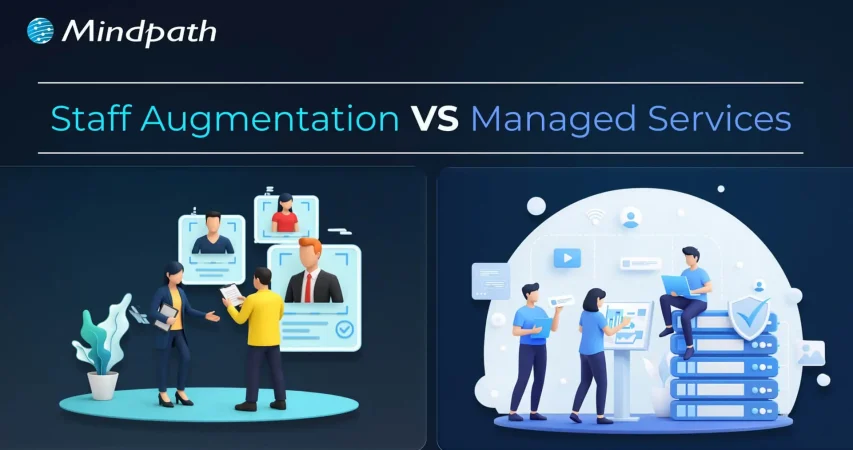
Staff Augmentation vs Managed Services: Which Model is Right for Your Business?

Staff Augmentation vs Managed Services: Which Model is Right for Your Business?

Decide between staff augmentation or managed services for your business. Explore their benefits and find out which is best for your IT needs.

Join our Newsletter!

Staff Augmentation vs Managed Services

The employees of a company are no doubt the most essential assets. In the recent scenario, businesses have plenty of choices to keep their team more robust and result-oriented. With the rise of remote work and technology, you don’t need to limit your team to a certain geographic location. Further, you can leverage the excellence of the worldwide talent pool.

A number of companies are choosing to outsource their tasks and project development. In fact, the global outsourcing market size is USD 1.02 trillion, and it is going to double by 2031 (Source). In this blog, let us compare two of the most essential outsourcing approaches: staff augmentation vs managed services. This can help you pick the right service that goes well with your company’s structure.

Want a team that can help you to stay competitive with evolving project demands? At Mindpath, we offer staff augmentation services that enable you to scale your workforce efficiently and cost-effectively.

What is Staff Augmentation?

Staff augmentation is a flexible outsourcing strategy where businesses temporarily hire external professionals to fill skill gaps, meet project demands, or scale operations, without the overhead of permanent, full-time hires. The process is quick, and you can augment capacity as per your current team’s needs. You can leverage near-shore, onshore, and offshore talent and scale the team as per the demands.

  • When it comes to the IT industry, businesses can use staff augmentation for multiple stages of the development process. Additionally, this includes workflow optimisation, programming, quality assurance, etc.
  • This can help you overcome specific challenges while hiring key skills that your internal team may be missing.
  • Talking about staff augmentation vs managed services, staff augmentation is cost-effective and offers flexibility.
  • It is a temporary solution that accesses your existing team and resources, and gets the benefits of outside talent while reducing the operational charges.

What are Managed Services?

Managed services are an integral approach to software development that allows you to outsource your IT functions to a provider from another region. Moreover, your business can outsource the work virtually to managed IT services. This can include anything from data migration to cybersecurity, and much more.

  • Managed service providers don’t integrate with your internal team but operate on their own.
  • They can offer you a reliable quote and project timelines. After you approve them, they will start working on the designated task while maintaining continuous communication.
  • The managed services model is cost-efficient as it lessens the requirement for overhead and resource management.
  • Your company can prioritize other business tasks and can check on the progress instead of assessing the work on a daily basis.

Looking to stay ahead in your hiring strategy with evolving workforce models? Check out the latest staff augmentation trends to learn what’s shaping the future of talent.

What are Some Key Differences between Managed Services vs Staff Augmentation?

To get a detailed knowledge of managed services vs staff augmentation, let us go through some of its key aspects. Here is a table that highlights all the essential features that these models consist of.

Important Features Staff Augmentation Managed Services
Benefits Cost efficiency is one major staff augmentation benefits. This model leverages a fixed rate and can be your long-term partner.
You can have access to a wide range of talented professionals. Prevents you from the risk of managing in-house teams.
It enables you to scale the team as per project demands. Provides access to a team with expertise across multiple elements.
Bridges temporary skills gaps. Allows the internal team to prioritize core operations.
Disadvantages It is a bit risky to integrate a new team to your existing operations. Integrating external resources might require extreme knowledge.
Risk of dependency on external providers for critical works. You need to depend on the provider to drive process success.
It needs a strong internal management capacity to handle the external professionals. No control over your project, team, or the development process.
Flexibility Your teams can be scaled quickly as per the existing skills gaps. Flexibility remains limited, and changes might give rise to additional payments.
Expertise It offers access to specific skills or expertise for a required timeframe. Offers a wide range of expertise and a supportive environment.
Responsibility The client is responsible for your project’s success and workflows. This model provider owns the project and offers a product as per the agreed requirements.
Focus Area It is task-specific and viable for short-term projects. It leveraged end-to-end solutions.
Customization This model is fully customizable as per your team dynamics. Follows the terms that is written on the agreement.
Best For Quick scaling where your workload is heavy. Suitable for long-term project commitments.

When Should You Prefer Staff Augmentation Services?

After assessing the staff augmentation benefits and other critical factors, let us understand when you should leverage this outsourcing model.

1. Your Need is Project-Specific

If your requirement is temporary, staff augmentation can help you bring in the specialized talent for a specific time period. Further, you can easily access the services as per your project demands without seeking any long-term commitments.

2. You Need Direct Assessment

When your company has a strong team, staff augmentation allows the external team to work under your supervision. So, this ensures your priorities are fulfilled with quality. Additionally, your existing team’s capabilities will also increase with better insights.

3. You are Handling a Strict Deadline

If your project’s timeline is critical and hiring full-time employees would take too long, staff augmentation provides rapid onboarding of skilled professionals. Further, this can help you maintain your project speed.

Want to avoid common onboarding challenges with external talent? Learn through our augmented staff onboarding guide for a smoother transition.

When Should You Prefer Hiring Managed Services?

Here are the instances where managed IT services can be your utmost preference.

1. You Desire Strategic IT Management

If your organization doesn’t have the leadership to manage all its internal IT operations, managed services can access the experts to take complete responsibility. Moreover, this ensures professional oversight for better performance management. Your team gets the freedom to focus on core functionalities.

2. You Need Predictable Solutions

When your company depends on consistent system performance and reliability, managed services can deliver structured processes. So, it keeps your team balanced while lessening the operational charges. Moreover, your plans will have that strategic influence on your audience.

3. Your Company Needs Long-Term Commitments

Managed services can offer continuous expertise when it comes to fulfilling your ongoing requirements.  Instead of hiring an internal team, you can get dedicated support that can encourage your overall functions.

Curious about hiring the right talent for short-term and long-term projects? Check out our staff augmentation hiring guide to learn practical hiring insights.

Cost Considerations of Both IT Outsourcing Models

It is important for you to understand that saving money is not always the primary goal. You also need to value precise creation. Here, go through the cost approaches of both the IT outsourcing models.

1. Staff Augmentation Costs

In this model, you need to pay only for the expertise you need. You can control the resource allocation, and there is no overhead of benefits, training, and recruitment. However, the charges might increase if you demand some change in the middle of your project.

2. Managed Services Costs

This model can assure you of predictable or fixed charges. It sometimes includes service level agreements for performance. The essential providers can handle multiple clients effectively. But managed services sometimes come with longer contractual commitments.

Looking to improve project delivery with the right technical expertise? Check out our IT staff augmentation guide to learn how to bring in skilled professionals.

Final Words

Staff augmentation and managed services can assist your business in completing the development projects more efficiently. However, when it comes to staff augmentation vs managed services, you need to assess their elements prior. Staff augmentation can be a great solution for businesses that need flexibility and short-term goals. On the other hand, managed services are best suited for long-term assistance.

Our experts at Mindpath can help you with both aspects. Partnering with us can offer you the support that you desire while filling the gap needed for your IT foundation.
Related Post

Agentic ai vs generative ai

Artificial intelligence created the biggest ripples in the domain of technology in the last decade. Following the adoption of generative AI tools, there is a new type of AI that showcases how artificial intelligence continues evolving. The agentic AI vs generative AI comparison has become a hot topic of discussion for businesses worldwide. Which one do you think delivers the best of AI for your business?

Since the public release of ChatGPT, many businesses have gradually incorporated generative AI in their workflows. However, agentic AI emerged as a practical solution to address the unrealistic expectations users had from generative AI. Is agentic AI better than generative AI? You should know that each one of them has distinct strengths for optimizing professional business practices.

If you are looking to build innovative AI solutions that help enhance your business performance. Explore Mindpath AI development services to see how you can leverage the best through our expertise in agentic and generative AI.

Understanding the Definition of Generative AI

Many people would think of ChatGPT and other tools like Midjourney upon hearing generative AI. How can you define generative AI in the present context? You can assume that generative AI refers to the variant of artificial intelligence that focuses only on creation. Take a generative AI tool and imagine something that you want to create, such as an image or a letter to your friend. All you have to do is offer instructions and it can create your image or letter. 

How does generative AI create something new from your instructions? The core design of generative AI or gen AI revolves around models learning from existing data. Generative AI models use the knowledge gained from their training to create new output that features some elements of human creativity. 

You must have searched for ‘what is gen AI’ after learning about the mainstream adoption of ChatGPT, DALL-E and other generative AI tools. The effectiveness of these tools revolves around advanced machine learning models or neural networks to understand and recreate the patterns from their training dataset.

Even with the widespread adoption, generative AI does not come without limitations. The outputs by generative AI systems are as accurate and relevant as the data used for their training. On top of it, generative AI is not capable of making decisions on its own and just creates from the patterns it has learned.

Wondering how your business can leverage AI to stay competitive? Discover generative AI for business to learn how intelligent systems drive innovation, efficiency, and growth.

Emergence of Agentic AI

The quest to solve the limitations associated with gen AI led to the creation of agentic AI. With the use of smart agents, AI switched to proactive functionality from its traditional reactive nature. You can define agent AI as a new variant of artificial intelligence that focuses on specific tasks and autonomous operation. Smart AI agents will not only generate outputs based on your instructions but also learn in real time, make decisions, and implement actions required to achieve your goals. 

One of the most distinctive highlights of agentic AI, which makes it capable of autonomous decision-making, is adaptability. The best example of agentic AI is evident in agents used for customer support or in the infrastructure of autonomous vehicles. AI agents use sensors and algorithms to understand the environment and process information, followed by executing actions with different degrees of human oversight.

You can understand the answers to “what does agentic AI mean” in the fast-paced digital landscape by identifying how it acts with a purpose. Agentic AI is not only about responding to input like generative AI. On the contrary, AI agents understand the objectives and make informed choices to achieve the specific goals.     

Curious how Agentic AI and Generative AI fit into the broader AI landscape? Explore types of Artificial Intelligence to discover how ANI, AGI, and ASI provide the foundation for advanced AI systems.

Unraveling Key Differences in the Agentic AI vs Generative AI Debate

The arrival of agentic AI represents a major paradigm shift in the domain of artificial intelligence after generative AI. At the same time, you cannot ignore how generative AI is the most effective option for content creation. Therefore, an overview of the differences between agentic and generative AI is essential to pick the right option for your requirements.

1. Core Objectives

The foremost point in any generative AI vs agent AI comparison shall focus on the core purpose of the two types of artificial intelligence. Generative AI emphasizes creation and its core purpose is to create original content from user instructions. You can create images, draft emails or generate marketing materials with generative AI. The primary value proposition offered by generative AI revolves around augmenting the creativity of humans. Generative AI aims to achieve its purpose with the help of pattern matching and linguistic fluency.

Agentic AI works with the core purpose to achieve the goals assigned to it. The primary goal of agentic AI exceeds beyond content creation and aims to achieve a broader set of specific goals. The role of AI agents is to work autonomously without waiting for your prompts, which empowers them to identify opportunities and make relevant decisions. You can find answers to ‘what is agent AI vs generative AI’ in the fact that agentic AI can come up with different strategies and pick the right one to achieve the defined goals. For example, agentic AI use cases in software testing not only focus on writing test cases but also adopt a proactive approach to ensure software quality.

2. Dependence on Prompts

You wouldn’t get any prizes for guessing that generative AI is highly dependent on prompts. Generative AI has been designed to be reactive, which means that it responds only to user queries or prompts. You can have the most sophisticated LLMs in your generative AI systems and they won’t do a thing without human inputs. It clearly shows that generative AI is not capable of identifying problems or initiating conversations on its own. The reliance on prompts creates a significant roadblock for expanding the utility of generative AI. As a result, the most sophisticated generative AI models also need human oversight for every decision.

The difference between generative AI and agentic AI is evident in the fact that agentic AI has been designed for autonomy. AI agents operate within specific constraints to achieve defined goals albeit with complete autonomy. Agentic AI knows exactly when it must execute an action and determines the ideal strategy that can help in achieve the desired goal. You can notice the autonomy of agentic AI in how they leverage adaptive behavior and sophisticate decision trees in their architecture. Upon encountering problems, AI agents know how to solve them independently without human intervention.      

3. Use Cases in Real World

Another point of comparison between agentic AI and generative AI draws attention towards their utility. Generative AI has become the preferred choice for creative and analytical tasks that require human oversight. You can notice most of the use cases of generative AI in content creation and code generation. In addition, it also serves as a promising tool for design and visual creation by translating your ideas into real art. Businesses have also adopted generative AI as a promising solution for complex data analysis tasks to generate valuable insights.

The agentic AI vs generative AI comparison shall also showcase the growing use of AI agents in business functions. Agentic AI can streamline autonomous software testing with its capability to adapt to changes in the software application. Similarly, you can find successful examples of agentic AI applications in supply chain optimization. The other prominent use cases of agentic AI include algorithmic trading and robotic process automation.  

4. Workflow of Agentic and Generative AI

Most of the discussions on differences between agentic and generative AI also emphasize how the two variants of AI work. Generative AI works by providing unidirectional responses according to your input. For example, you provide instructions to generate an image and generative AI will create the image for you. Generative AI does not retain persistent memory or understand the objective you are pursuing as it focuses solely on the immediate instruction. It is one of the reasons for which using generative AI in multi-step processes involves human intervention at every stage.

Agentic AI stands out as the solution where generative AI poses problems. You can understand the difference between generative AI and agentic AI clearly in the various applications of agentic AI. Smart AI agents are capable of handling complex tasks that involve multiple steps and require memory retention. Agentic AI can maintain state across different interactions and track the progress made towards the defined objectives. Subsequently, it can adapt strategies on the basis of results in the intermediate steps to achieve the final goal.  

Looking to leverage the power of both autonomous and creative AI systems? Learn the benefits of AI to explore how Agentic and Generative AI together can transform strategy, operations, and customer engagement.

The following table showcases the notable differences between generative AI and agentic AI.

Criteria Generative AI Agentic AI
Core Objectives Generative AI aims to augment the creativity of humans by facilitating faster content creation. Agentic AI aims to achieve the defined goals with autonomous action.
Dependence on Prompts Generative AI is highly dependent on prompts. Agentic AI can take autonomous decisions without prompts.
Use Cases Generative AI is useful for content creation and data analysis tasks. Agentic AI is useful for autonomous software testing, algorithmic trading and robotic process automation.
Workflow Generative AI works by offering single-shot response to user instructions or queries. Agentic AI works with complex and multi-step workflows by adjusting strategies to achieve defined goals. 

Final Thoughts

The differences between generative and agentic AI reveal how artificial intelligence offers two distinct solutions to achieve different business goals. If you want to create content, generative AI is your best pick. On the other hand, you should choose agentic AI when you need your AI systems to work independently on specific tasks. The overview of the generative AI vs agent AI comparison can help you pick the ideal AI for your business.  

Mindpath is a leading platform to provide AI development services tailored to your business requirements. We also specialize in developing generative AI models to help you achieve promising improvements in productivity. Our ability to identify the pain points of the client and understand their vision helps us create the most relevant solutions. Reach out to us and give your business an additional edge in the AI revolution now.

low-rank adaptation (lora)

The landscape of artificial intelligence is advancing at a higher rate. And it has made it crucial to ensure efficient adoption of LLMs or Large Language Models.  Low-rank adaptation (LoRA) has emerged as an effective technique to fine-tune LLMs. Developers are now looking for scalable methods to customize AI models. Well, LoRA offers them a lightweight and cost-effective technique.

Furthermore, it has made the process of low-rank adaptation of LoRA in fine-tuning feasible, accessible, and efficient. In this detailed blog, we will explore more about the LoRA adaptation, understand what it is, and how it works. Besides, we will also discuss why it is an important method for fine-tuning LLMs in 2025. So, read on!

Struggling to figure out how advanced tuning methods like LoRA can give your business a competitive AI advantage? Mindpath’s AI development services help you harness LoRA-driven fine-tuning to build smarter, faster, and more efficient AI solutions.

Low-Rank Adaptation (LoRA) – An Overview

Before exploring more about low-rank adaptation (LoRA), let’s start with the basics, i.e., what is low-rank adaptation in LoRA? It is an efficient fine-tuning method that trains large LLMs to easily handle new tasks. The best part is, with this method, developers don’t need to change any parameters. Instead of updating all parameters. LoRA freezes the model weight and then injects a few new weights or trainable low-rank matrices. Fine-tuning with LoRA significantly lowers the number of trainable matrices without affecting the model’s base knowledge.

Importance of LoRA

Large language models such as ChatGPT are powered by massive neural networks. These networks have trillions of parameters. And during pre-training, these parameters are fine-tuned to make models work properly. While it makes AI models powerful, there is no guarantee that they will work efficiently for certain tasks. Adapting a larger language model to a specific use case, like custom support automation or legal documentation, requires full fine-tuning. For instance, if you want to fine-tune GPT-4, then you will have to work on around 1.8 trillion parameters. Besides, the process demands enormous infrastructure and GPU memory.

However, low rank adoption (LoRA) provides developers with a more efficient and smarter alternative. It allows them to inject small training parameters into specific layers. This, in turn, reduces GPU memory requirements. Furthermore, it leads to minimal disruption, lower costs, and quick training. If you think Low Rank Adoption is the only parameter-efficient method, let us inform you that QLoRA or Quantization LoRA is now gaining popularity in the industry. The reason behind this is that it combines high-precision computation with low-precision storage.

Low Rank Adaptation LoRA Example

Now, let’s have a look at a Low rank adaptation LoRA example in order to get a clear idea about the impact of LoRA. Let’s assume you want to fin-tune BERT. You may opt for a full fine-tuning. But for that, you will have to retrain nearly 108,314,886 parameters. Besides, the method is resource-intensive.

On the other hand, using LoRA, you can freeze the model’s original weights. It allows you to train only the necessary adapters related to your tasks. In fact, you can achieve the desired results just by training only 78,342 parameters. As a result, you will witness a significant reduction in training time as well as machine cost.

New to fine-tuning techniques like LoRA and unsure where to start? Explore Large Language Model (LLM) to build a strong foundation before diving deeper.

Low-Rank Adaptation (LoRA) Techniques

Now that you have a clear understanding of low rank adaptation (LoRA), let’s talk about the right way to use Low-Rank Adaptation (LoRA) Techniques. To ensure desired outcomes, developers can follow these steps.

1. Selecting a Base Model

 Begin by choosing a suitable AI model. You can opt for GPT-4 or GPT-3 as per your need.

2. Create Datasets

After the selection of a model, next, you need to collect quality datasets. Here, you must ensure that those datasets match your fine-tuning objectives.

3. Deploy LoRA Modules

While deploying LoRA adapters, choose the right attention layers. To avoid any issues, ensure a balance between performance and efficiency.

4. Rank Tuning

Select an appropriate rank. While smaller ranks can lower training costs, they can limit the model’s expressiveness. In general, the value can range between 4 and 46, based on the task.

5. Train Adapter Parameters

Here you need to be careful. First of all, freeze all the original parameters. Once done, you can start training low-rank parameters on your dataset. There is no need to train all parameters.

6. Process Validation

Use a separate validation set to monitor the performance of the model. Keep in mind that if the training data is limited and the rank is too high, this can increase the risk of overfitting.

7. PEFT Libraries Integration

To streamline the implementation process, developers can deploy libraries such as Hugging Face’s Parameter-Efficient Fine-Tuning library. It offers plug-and-play support.

Wondering how LoRA compares to traditional fine-tuning approaches? Discover OpenAI’s Fine-Tuning API to understand when efficient fine-tuning matters most.

The Hidden Cost of Full Fine-Tuning

To get a clear understanding of the importance of Low-rank adaptation (LoRA), it is critical to understand the exhaustive technique it replaces, i.e., Full Fine-Tuning.

A pre-trained large language model is essentially a huge network of weight matrices that encode the learned knowledge of the model. When developers go for a full fine-tuning, they feed the model specialized datasets. After that, the model adjusts each parameter to align with the new task.

This process involves calculating errors in the output and sending gradient updates through the entire network using an optimizer such as Adam. However, this technique comes with some critical drawbacks.

1. High Computational Cost

Fine-tuning a model with billions of parameters requires massive GPU memory. To store the AI model, optimizer stats, and necessary gradients, you will need enough VRAM, around hundreds of gigabytes.

2. Storage Inefficiency

Full fine-tuning creates a new model file. A 70B model, at 16-bit precision, can be around 140GB. Storing this size of file for every user who needs a custom AI model is unsuitable. That means maintaining separate models at large is nearly impossible.

3. Risk of Forgetting

Updating all weights to understand the new tasks can overwrite the existing capabilities of the model. For instance, it may not be able to translate language. This can significantly reduce the model’s versatility.

For years, AI model customization was exclusive to the AI labs that created them. However, things have started to change, all thanks to low-rank adaptation (LoRA). It has changed the rules of fine-tuning.

Curious about what LoRA actually optimizes inside modern AI models? Explore attention mechanism explained to understand the architecture behind efficient adaptation.

Why LoRA is an Excellent Option for Fine-Tuning LLMs?

Low rank adaptation (LoRA) is an ideal method for fine-tuning LLMs. After all, it brings efficiency, scalability and versatility to the process.

Here are some benefits of LoRA that prove why it is an excellent option.

1. Parameter Efficiency

As mentioned above, LoRA reduces the number of parameters. It makes fine-tuning possible utilizing low-resource hardware. Apart from this, it opens doors for independent developers to customize AI models.

2. Retain Pre-Trained Knowledge

By preserving base model weight, LoRA eliminates the risk of catastrophic forgetting. Using this, developers can ensure that a model’s general language understanding capability remains intact while expanding to new domains.

3. Scalable Fine-Tuning

With low rank adaptation (LoRA), fine-tuning is faster compared to other techniques. Developers can fine-tune multiple versions of models for various domains. There is no need to duplicate the entire model. As a result, version control will be easier.

4. Full Impact with Zero Latency

The weights of the adapter can be easily merged with the pre-trained models during inference. This helps maintain runtime performance without added latency.

5. Versatility

LoRA seamlessly integrates with popular transformer architectures such as BERT, T5, and GPT. That’s why it is a versatile fine-tuning solution in 2026.

Thinking about where LoRA-fine-tuned models create real business value? Discover generative AI use cases in diverse industries to see how efficient AI adaptation drives impact.

Final Thoughts

Low-rank adaptation (LoRA) is now transforming the process of fine-tuning large language models. By reducing the total number of trainable parameters while maintaining the model’s integrity, LoRA has made fine-tuning more scalable, cost-effective, and accessible. Whether you are developing a multilingual translator or a healthcare chatbot, it offers the precision and flexibility required to train AI for real-world applications.

Developing and fine-tuning AI models can get complicated. This is where Mindpath comes in. Our AI development services can help you in designing and fine-tuning models using low-rank adaptation (LoRA). While doing that, we also ensure that all the things fit perfectly into your workflows. Let us make your AI solution personalized and powerful.

Support Is One Click Away

Featured Posts

Related Post

Discover why hiring a freelance full-stack developer in 2024 can boost your project’s efficiency, quality, and cost-effectiveness. Learn more with Mindpath!
Discover the top cloud computing trends for 2025, including AI, quantum computing, and hybrid solutions, and learn how they can shape your business’s future.