Home

MCP Server vs API: What’s the Difference?

MCP Server vs API: What’s the Difference?

Join our Newsletter!

MCP Server vs API

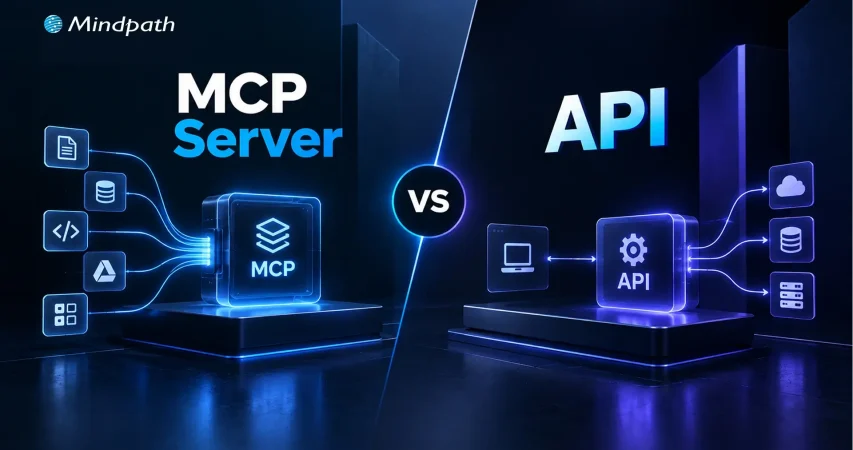
As AI agents move beyond answering questions to using tools, accessing data, and triggering actions, MCP vs API has become an important architecture discussion. An MCP server and traditional APIs can both connect AI systems with external capabilities, but they approach AI integrations from different layers and serve different interaction models.

Key Takeaways

  • 01
    APIs provide structured access to specific services, data, and application functions.
  • 02
    MCP gives AI applications a standardized way to discover and use tools.
  • 03
    MCP and APIs serve different roles and can work together within the same architecture.
  • 04
    APIs suit predictable workflows, while MCP supports more dynamic agent-driven interactions.
  • 05
    Choosing between MCP and API depends on system requirements, workflows, and existing architecture.

The distinction matters when designing systems that need reliable access to business applications, databases, and third-party services. Understanding where APIs fit, where MCP adds value, and how the two can work together helps teams build cleaner and more adaptable agent architectures. In this blog, we will compare MCP and APIs and explain where each approach fits best.

Ready to build AI systems that connect smoothly with your existing tools and services? Mindpath offers AI Integration Services to help businesses connect AI with their existing technology stack.

What is an API?

An API, or Application Programming Interface, is a defined way for one software system to communicate with another. It exposes specific operations or data through endpoints that an application can call using structured requests. The API handles the underlying business logic and returns a predictable response, allowing developers to connect services without accessing their internal implementation.

APIs are widely used across modern software architectures, including AI applications. An AI system can use an API to retrieve customer records, query a database, process payments, or trigger an action in another application. The developer typically determines which endpoint to call, what parameters to send, and how the returned data should be handled.

Key features of APIs: 

1. Defined Endpoints

Expose specific operations or resources through structured interfaces.

2. Request-response Model

Process an application request and return a structured result.

3. Authentication

Control access using methods such as API keys, OAuth, or tokens.

4. Predictable Interactions

Follow documented rules for parameters, methods, and responses.

5. System Integration

Connect applications, services, databases, and third-party platforms.

6. Developer-controlled Workflows

Let developers determine when and how each API operation is used.

What Is an MCP Server?

An MCP server is a system that exposes tools, resources, and other capabilities to an AI application through the Model Context Protocol. Instead of requiring an AI application to handle every integration through separate, custom logic, an MCP server provides a standardized way to make external capabilities available to an MCP client.

In the MCP vs API discussion, the key difference is the interaction model. An API typically gives a developer a defined endpoint to call, while an MCP server presents capabilities in a format designed for AI applications to discover and use within an agent workflow. This can help AI agents work with business systems, files, databases, and external services through a consistent interface.

Key features of MCP servers: 

1. Tool Access

Expose specific actions that an AI application can invoke when needed.

2. Resource Access

Provide structured access to relevant data and external information.

3. Capability Discovery

Allow the client to understand which tools and resources are available.

4. Standardized Communication

Use a common protocol for communication between MCP clients and servers.

5. Controlled Access

Define which capabilities and data an AI application can access.

6. Agent-oriented Integration

Support AI workflows where the model needs to interact with external tools and information.

MCP vs API: What Is the Difference?

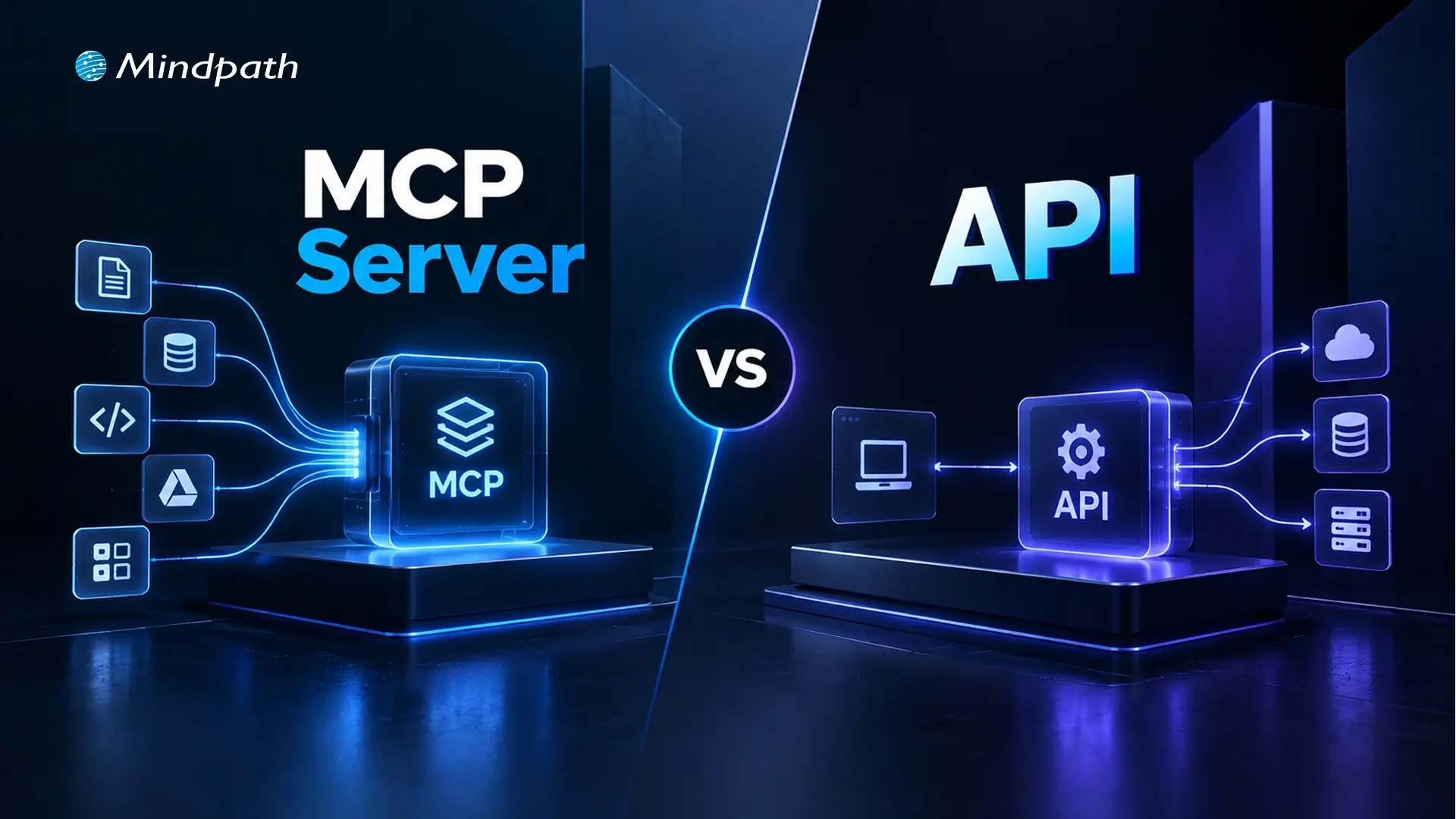
MCP and APIs can both connect software with external capabilities, but they are designed around different interaction patterns. An API gives an application a defined interface for requesting data or triggering specific operations. MCP provides a standardized way for AI applications to discover and interact with tools and resources.

The difference becomes clearer when an AI system needs to move beyond a fixed set of developer-defined calls. An AI API can efficiently support predictable operations, while MCP can help an AI application identify available capabilities and use them as part of an agent-driven workflow.

1. Purpose

APIs expose application functionality, while MCP structures access to tools and resources for AI applications.

2. Primary Consumer

APIs are commonly consumed by applications and developers, while MCP is designed around AI clients and agents.

3. Discovery

APIs generally depend on documentation and predefined integration logic; MCP supports standardized capability discovery.

4. Interaction

APIs typically follow explicit requests and responses, while MCP supports AI-driven tool and resource interactions.

5. Workflow Control

API workflows are usually defined by application logic, while MCP can support dynamic tool selection within agent workflows.

6. Integration Approach

APIs can connect systems directly, while MCP can provide an agent-facing layer over existing services.

Comparison Area API MCP
Primary Role Connects applications with specific services or functions Connects AI applications with tools, resources, and capabilities
Core Interface Endpoints, methods, parameters, and responses Tools, resources, prompts, and protocol-defined interactions
Typical Consumer Developers and software applications AI applications, assistants, and agents
Capability Discovery Usually handled through API documentation or application logic Capabilities can be exposed and discovered through the protocol
Interaction Pattern Application sends a predefined request AI application can select and invoke an available capability
Workflow Control Primarily defined by application code Can support dynamic, agent-driven workflows
Data & Actions Exposes specific data or operations Makes selected data and actions available to AI applications
Integration Layer Often serves as the direct service integration layer Can act as an AI-facing layer over existing services and APIs
Best Fit Predictable application workflows and system integrations Agentic workflows requiring access to multiple tools or resources
Relationship Can function independently or underneath other systems Can work alongside APIs rather than replacing them

How Do MCP and APIs Work Differently in AI Integrations?

The difference between MCP vs APIs becomes clearer when looking at how an AI system actually interacts with external capabilities. With a traditional API, the application usually knows the endpoint, required parameters, authentication method, and expected response before the workflow begins. The developer defines this logic and controls when the API is called.

With MCP, the interaction can be structured around capabilities available to the AI application. An MCP client connects to an MCP server, which exposes relevant tools and resources. The AI application can then use those capabilities as part of an agent workflow, while the underlying implementation remains behind the server interface.

A Typical API Workflow 

1. Identify the Service

The developer selects the required API and reviews its documentation.

2. Define the Request

Application logic specifies the endpoint, parameters, and authentication.

3. Send the Request

The application calls the API when the workflow reaches the relevant step.

4. Process the Response

The returned data is handled according to predefined application logic.

5. Continue the Workflow

The application determines the next operation based on the response.

A Typical MCP Workflow 

1. Connect the Client

The AI application establishes a connection with the MCP server.

2. Expose Capabilities

The server makes relevant tools and resources available to the client.

3. Understand Available Tools

The AI application can identify capabilities exposed through the server.

4. Invoke a Capability

The agent can use an appropriate tool as part of its task.

5. Use the Result

The returned information can inform subsequent steps in the AI workflow.

Which Approach Fits Your System Best?

APIs provide structured access to specific services, data, and operations, while MCP provides a standardized way for AI applications to discover and use tools and resources. Understanding this difference helps teams choose an approach that matches their architecture, workflow requirements, and intended system behavior.

Choosing between MCP and API can shape how effectively your AI system interacts with existing capabilities. Mindpath AI development services help businesses evaluate these architectures and build practical AI solutions around their technical requirements, existing systems, and long-term development goals.
Connect AI With Your Existing Systems

Build smarter AI integrations.

Frequently Asked Questions

Yes. An MCP server can connect with existing APIs and expose selected operations as tools for AI applications without replacing the underlying services.
Instead of relying entirely on predefined integration logic, AI applications can work with capabilities exposed through an MCP server and select relevant tools during a workflow.
If the application already knows the required operation and endpoint, direct API calls can provide a simpler and more controlled implementation.
The existing API layer can remain intact, while MCP adds an AI-facing layer that exposes selected services, data, or actions to agents.
The decision should consider how capabilities will evolve, how agents will access them, required permissions, existing APIs, maintenance effort, and future workflow complexity.

Support Is One Click Away

Featured Posts

Related Post

DevOps vs Traditional IT

The technology landscape has been drastically developing at a great pace. Businesses are under pressure to innovate faster and deploy more reliable customer experiences. At this great transformation, the conversation around DevOps vs. Traditional IT has become critical. So, the right approach can influence your speed, innovation, costs, and even customer satisfaction.

Further, there are some companies that still benefit from the structure and control of traditional models. On the other hand, others need the agility and automation that DevOps delivers. In this blog, you are going to understand the difference. This can also help you make the right choice that matches your business goals.

Planning to modernize your IT operations for faster and more efficient delivery? Mindpath offers DevOps services that help streamline workflows, enhance collaboration, and accelerate your development lifecycle.

What is Traditional IT?

The global IT services market size has already reached USD 1,652.27 billion this year. Further, it is going to expand to reach USD 3,299.78 billion by 2033. So, traditional IT values a structured process and initiates work step-by-step. Here, different teams manage multiple parts of the software development lifecycle. For example, developers write the code, and testers will verify if the system has any issues.

This structure majorly values the Waterfall model, where every phase must be completed before shifting to the next one. One of the best parts of traditional IT infrastructure is that it ensures thorough documentation and testing. But it somehow makes the process slower and more rigid. Any last-minute change can include major delays and disturbances.

  • You can have clear department roles and responsibilities.
  • It is a better option for legacy applications.
  • You can have strong control over infrastructure and other processes.
  • It is easily compliant in highly regulated environments.

What is DevOps?

The DevOps market size is expected to reach USD 108.26 billion by 2035. As per the recent statistics, around 72% developers are using the Agile method, whereas 46% of organisations are combining methodologies. So, DevOps is a modern and collaborative approach that combines development and operations into an individual workflow.

Instead of working in isolated teams, DevOps creates a culture of shared responsibility. Further, your whole team can leverage the relevance of automation and continuous improvements.

  • Unlike a traditional system, DevOps values agile principles.
  • It initiates modern IT operations that automate tasks like testing, integration, and deployment.
  • Additionally, this approach can help you reduce errors while improving the overall efficiency.

The Major Difference Between DevOps vs. Traditional IT

Both approaches aim to support your business technology. However, they hold some prominent differences as given below.

1. Deployment Speed

Traditional IT mainly uses scheduled releases, sometimes weekly or monthly. On the other hand, DevOps supports continuous releases through automation. This means you can go live with your features, fixes, and updates faster.

2. Team Structure

Your whole team might remain separated in traditional IT. Developers need to write the code, and they deploy it while handling the issues in the later stage. This can create communication gaps and delays. However, in DevOps, teams can work together from the beginning. This is one of the biggest DevOps benefits for business. Your developers and testers will have ownership.

3. Infrastructure Management

Traditional environments majorly depend on physical servers or manually managed systems. But DevOps relies on cloud environments, containers, and automation to handle infrastructure effectively.

4. Risk Handling

Traditional IT might avoid changes because it can introduce instability in the whole system. However, DevOps is capable of handling risks differently. Instead of making fewer big changes, it allows you to include smaller and more frequent updates.

Top DevOps Benefits for Business and IT Operations

Here are some top DevOps benefits for business that can incredibly encourage your performance in the long run.

1. Faster Time to Market

One of the biggest advantages of DevOps is speed. With automation, you can reduce the chances of delays in testing, deployment, and monitoring. This means your business can launch new products or features much faster.

2. Effective Collaboration

Instead of your teams blaming each other when issues arise, DevOps allows you to have better communication. They can work together and share goals and vision.

3. Higher Reliability

DevOps is not just about moving fast. It accesses continuous monitoring, automated testing, and smaller releases. This makes your systems stable over time.

4. Reduced Operational Charges

Manual processing can be expensive for you. Repetitive deployments, testing, and infrastructure management can consume your time and resources. So, DevOps can reduce these defects through precise automation.

5. Improved Security

With the right DevOps implementation, security assessment and monitoring tools can be directly added to your delivery pipeline. So, fewer blind spots mean faster issue assessment.

Why are Traditional IT Advantages Still Making Sense?

With the ultimate rise of DevOps, traditional models are still relevant in the market. Here are the situations where traditional advantages can be more prominent than speed.

  • You handle a strict environment with severe policy regulations.
  • Your application updates are infrequent and not very urgent.
  • Your internal team is structured around conventional infrastructure management.

A Brief Comparison Between Traditional IT vs. DevOps

Here are some key aspects that define the values of DevOps vs. traditional IT in a structured way.

Factors Traditional IT DevOps
Core Strength Stability and Control. Speed and collaboration.
Team Structure Excludes teams from development and operations. Make a team to work together.
Infrastructure Values manual proceedings. Use automation.
Business Impact Helps in maintaining stable IT environments. Supports modern IT operations.
Best For Regulated Industries Fast-Growing Businesses

The Best Approach for Many Businesses

You need to understand that organizations don’t just jump directly from traditional IT infrastructure to full DevOps. In fact, they change with time. They start by automating the testing phase while influencing the operation pipelines. Further, they might move selected workloads to the cloud while modernizing one application at a time. This hybrid approach can work best because it reduces disruptions while still bringing in the benefits of modern IT operations.

Conclusion

When it comes to DevOps vs. Traditional IT, both approaches come with their own uniqueness. But, in today’s highly developing technological world, DevOps is becoming a serious choice among competitive businesses. However, the best approaches depend on your business goals and growth plans.

If you are ready to make the shift to DevOps and future-proof your business, Mindpath can be your ideal partner. With our cloud and DevOps services, we help bridge the gap through automation, scalable infrastructure, and DevOps-led transformation solutions.

Agentic ai vs generative ai

Artificial intelligence created the biggest ripples in the domain of technology in the last decade. Following the adoption of generative AI tools, there is a new type of AI that showcases how artificial intelligence continues evolving. The agentic AI vs generative AI comparison has become a hot topic of discussion for businesses worldwide. Which one do you think delivers the best of AI for your business?

Since the public release of ChatGPT, many businesses have gradually incorporated generative AI in their workflows. However, agentic AI emerged as a practical solution to address the unrealistic expectations users had from generative AI. Is agentic AI better than generative AI? You should know that each one of them has distinct strengths for optimizing professional business practices.

If you are looking to build innovative AI solutions that help enhance your business performance. Explore Mindpath AI development services to see how you can leverage the best through our expertise in agentic and generative AI.

Understanding the Definition of Generative AI

Many people would think of ChatGPT and other tools like Midjourney upon hearing generative AI. How can you define generative AI in the present context? Generative AI is a subset of artificial intelligence and deep learning that uses trained models to create new, original content, such as text, images, audio, video, and code, in response to a simple prompt. Unlike traditional AI, which focuses on analyzing or classifying existing data, generative AI is built to synthesize something new. So if you want to create an image or a letter to your friend, all you have to do is offer instructions and it can generate that output for you.

How does generative AI create something new from your instructions? The core design of generative AI or gen AI revolves around models learning from existing data. Generative AI models use the knowledge gained from their training to create new output that features some elements of human creativity. 

You must have searched for ‘what is gen AI’ after learning about the mainstream adoption of ChatGPT, DALL-E and other generative AI tools. The effectiveness of these tools revolves around advanced machine learning models or neural networks to understand and recreate the patterns from their training dataset.

Even with the widespread adoption, generative AI does not come without limitations. The outputs by generative AI systems are as accurate and relevant as the data used for their training. On top of it, generative AI is not capable of making decisions on its own and just creates from the patterns it has learned.

Wondering how your business can leverage AI to stay competitive? Discover generative AI for business to learn how intelligent systems drive innovation, efficiency, and growth.

Emergence of Agentic AI

The quest to solve the limitations associated with gen AI led to the creation of agentic AI. With the use of smart agents, AI switched to proactive functionality from its traditional reactive nature. You can define agent AI as a new variant of artificial intelligence that focuses on specific tasks and autonomous operation. Smart AI agents will not only generate outputs based on your instructions but also learn in real time, make decisions, and implement actions required to achieve your goals. 

One of the most distinctive highlights of agentic AI, which makes it capable of autonomous decision-making, is adaptability. The best example of agentic AI is evident in agents used for customer support or in the infrastructure of autonomous vehicles. AI agents use sensors and algorithms to understand the environment and process information, followed by executing actions with different degrees of human oversight.

You can understand the answers to “what does agentic AI mean” in the fast-paced digital landscape by identifying how it acts with a purpose. Agentic AI is not only about responding to input like generative AI. On the contrary, AI agents understand the objectives and make informed choices to achieve the specific goals.     

Curious how Agentic AI and Generative AI fit into the broader AI landscape? Explore types of Artificial Intelligence to discover how ANI, AGI, and ASI provide the foundation for advanced AI systems.

Unraveling Key Differences in the Agentic AI vs Generative AI Debate

The arrival of agentic AI represents a major paradigm shift in the domain of artificial intelligence after generative AI. At the same time, you cannot ignore how generative AI is the most effective option for content creation. Therefore, an overview of the differences between agentic and generative AI is essential to pick the right option for your requirements.

1. Core Objectives

The foremost point in any generative AI vs agent AI comparison shall focus on the core purpose of the two types of artificial intelligence. Generative AI emphasizes creation and its core purpose is to create original content from user instructions. You can create images, draft emails or generate marketing materials with generative AI. The primary value proposition offered by generative AI revolves around augmenting the creativity of humans. Generative AI aims to achieve its purpose with the help of pattern matching and linguistic fluency.

Agentic AI works with the core purpose to achieve the goals assigned to it. The primary goal of agentic AI exceeds beyond content creation and aims to achieve a broader set of specific goals. The role of AI agents is to work autonomously without waiting for your prompts, which empowers them to identify opportunities and make relevant decisions. You can find answers to ‘what is agent AI vs generative AI’ in the fact that agentic AI can come up with different strategies and pick the right one to achieve the defined goals. For example, agentic AI use cases in software testing not only focus on writing test cases but also adopt a proactive approach to ensure software quality.

2. Dependence on Prompts

You wouldn’t get any prizes for guessing that generative AI is highly dependent on prompts. Generative AI has been designed to be reactive, which means that it responds only to user queries or prompts. You can have the most sophisticated LLMs in your generative AI systems and they won’t do a thing without human inputs. It clearly shows that generative AI is not capable of identifying problems or initiating conversations on its own. The reliance on prompts creates a significant roadblock for expanding the utility of generative AI. As a result, the most sophisticated generative AI models also need human oversight for every decision.

The difference between generative AI and agentic AI is evident in the fact that agentic AI has been designed for autonomy. AI agents operate within specific constraints to achieve defined goals albeit with complete autonomy. Agentic AI knows exactly when it must execute an action and determines the ideal strategy that can help in achieve the desired goal. You can notice the autonomy of agentic AI in how they leverage adaptive behavior and sophisticate decision trees in their architecture. Upon encountering problems, AI agents know how to solve them independently without human intervention.      

3. Use Cases in Real World

Another point of comparison between agentic AI and generative AI draws attention towards their utility. Generative AI has become the preferred choice for creative and analytical tasks that require human oversight. You can notice most of the use cases of generative AI in content creation and code generation. In addition, it also serves as a promising tool for design and visual creation by translating your ideas into real art. Businesses have also adopted generative AI as a promising solution for complex data analysis tasks to generate valuable insights.

The agentic AI vs generative AI comparison shall also showcase the growing use of AI agents in business functions. Agentic AI can streamline autonomous software testing with its capability to adapt to changes in the software application. Similarly, you can find successful examples of agentic AI applications in supply chain optimization. The other prominent use cases of agentic AI include algorithmic trading and robotic process automation.  

4. Workflow of Agentic and Generative AI

Most of the discussions on differences between agentic and generative AI also emphasize how the two variants of AI work. Generative AI works by providing unidirectional responses according to your input. For example, you provide instructions to generate an image and generative AI will create the image for you. Generative AI does not retain persistent memory or understand the objective you are pursuing as it focuses solely on the immediate instruction. It is one of the reasons for which using generative AI in multi-step processes involves human intervention at every stage.

Agentic AI stands out as the solution where generative AI poses problems. You can understand the difference between generative AI and agentic AI clearly in the various applications of agentic AI. Smart AI agents are capable of handling complex tasks that involve multiple steps and require memory retention. Agentic AI can maintain state across different interactions and track the progress made towards the defined objectives. Subsequently, it can adapt strategies on the basis of results in the intermediate steps to achieve the final goal.  

Looking to leverage the power of both autonomous and creative AI systems? Learn the benefits of AI to explore how Agentic and Generative AI together can transform strategy, operations, and customer engagement.

Agentic AI vs Generative AI: Key Differences

The following table showcases the notable differences between generative AI and agentic AI.

Criteria Generative AI Agentic AI
Core Objectives Generative AI aims to augment the creativity of humans by facilitating faster content creation. Agentic AI aims to achieve the defined goals with autonomous action.
Dependence on Prompts Generative AI is highly dependent on prompts. Agentic AI can take autonomous decisions without prompts.
Use Cases Generative AI is useful for content creation and data analysis tasks. Agentic AI is useful for autonomous software testing, algorithmic trading and robotic process automation.
Workflow Generative AI works by offering single-shot response to user instructions or queries. Agentic AI works with complex and multi-step workflows by adjusting strategies to achieve defined goals. 

Final Thoughts

The differences between generative and agentic AI reveal how artificial intelligence offers two distinct solutions to achieve different business goals. If you want to create content, generative AI is your best pick. On the other hand, you should choose agentic AI when you need your AI systems to work independently on specific tasks. The overview of the generative AI vs agent AI comparison can help you pick the ideal AI for your business.  

Mindpath is a leading platform to provide AI development services tailored to your business requirements. We also specialize in developing generative AI models to help you achieve promising improvements in productivity. Our ability to identify the pain points of the client and understand their vision helps us create the most relevant solutions. Reach out to us and give your business an additional edge in the AI revolution now.

MVP development

In the software development context, you must have come across the term MVP or minimum viable product. It is the simplest version of a product or application. MVP just has enough features so that initial users can test and provide their feedback. It is ideal for investors to look at the MVP of a product that is being pitched to them.

The importance of MVP development is vital in the prevailing business environment. Many startups fail today because they create products on the basis of assumptions. However, the best way to test those assumptions is by developing an MVP that the real users can see and use. It is the perfect time to learn about MVP and its relevance.

If you are looking to adopt MVP into your business, but don’t know where to start? Mindpath offers end-to-end MVP development services that help you validate ideas quickly while minimizing financial and technical risks.

What is a Minimum Viable Product (MVP)?

A Minimum Viable Product refers to the beta version of a new product that a business plans to create. It encompasses just enough features to capture the attention of early customers and collect feedback from them. The companies that adopt the MVP approach to collect as well as respond to user feedback are able to grow faster in the competitive market setting.

Businesses can use MVP in software development to test if customers are happy with their app before spending too much time and effort. As the needs and preferences of modern customers keep changing, it is fundamental for businesses to prioritize MVP development.

Benefits of Implementing MVP

You need to bear in mind that the concept of MVP product development comes from the lean startup methodology. It focuses on learning as well as building with scalability. When a business builds MVP, it is basically taking the first small step towards a new idea or product. This small step can enable businesses to understand the interest of the market in the product.

1. Gathering User Insights

Businesses can gain valuable insight from MVP development. It can teach them where to make improvements in their offering and scale back. Businesses can also add extra features in order to make their product or application more attractive and useful for the users.

2. Testing Business Idea

The key benefit of MVP is that it serves as a low-risk testing ground before businesses invest millions of dollars into a product. Startup businesses can validate their product through MVP development. It creates an opportunity to interact with customers and understand their needs.

3. Cost Efficiency

You need to remember that an MVP development company can help you in terms of cost-saving. Mature software products need years of development along with considerable investment. MVPs ensure that products are simple for coding as well as functionality, thereby reducing development cost. Once you start gaining customer feedback, you can start spending your money more wisely on the new product.

4. Assessing Market Demand

The MVP encompasses testing as well as analyzing the functionality of a product. Moreover, it helps in evaluating the market demand and helps in the acquisition of new customers in the market. It is vital for business organizations to understand the needs of their customers along with the existing solutions. The MVP approach empowers businesses to refine their offering and know whether their offering has a future in the market or not.

5. Securing Funding

Startups require funding in order to survive in the competitive market environment. MVP development for startups serves as a strategic method that can enable them to test the idea before reaching out to investors and other stakeholders. Such a systematic approach can help businesses to secure funds from investors who trust in their idea and Minimum Viable Product.

How Much Does MVP Development Cost?

The role of MVP development is indispensable for businesses. So it is time to focus on the MVP development cost. Businesses may wonder – How much does MVP development cost? The answer to the question is not straightforward. The average cost relating to MVP development depends on a number of factors, such as the scope of the project and team composition. Similarly, contractual dynamics may also play an important role in impacting the cost of MVP development.

When it comes to MVP, the cost can be categorized into specific features as well as development phases. The common categories that you may come across include market research, prototyping, and MVP development. It is crucial to bear in mind that the research phase is conducted in parallel with prototyping.

Difference Between MVP, Prototype, and Proof of Concept

In order to get a holistic insight into MVP, you must understand how it is different from Prototype and Proof of Concept. A layman may think that these terms are interchangeable. However, that is not true. Each of the terms has a different meaning that businesses should be familiar with.

1. MVP

MVP refers to a launchable product version. It includes core features. The purpose of MVP development is to validate the market potential of a product and gain valuable feedback from users.

2. Prototype

Prototype refers to a preliminary model of a product. It can also be described as a mock-up that is designed to test the design concepts and technical feasibility. It also helps to assess the functionality of a product before its complete development.

3. Proof of Concept

Proof of Concept is a small experimental project. It is undertaken to demonstrate the feasibility or viability of a concept. It is mostly tested internally before further investment is made.

The main difference between these three terms has been presented in the table below:

Aspect MVP Prototype Proof of Concept
Purpose Market validation Technical exploration Feasibility testing
Complexity Functional product Non-functional model Basic technical demonstration
Audience Potential customers Internal stakeholders Technical team

Misconceptions Relating to MVP

There are a number of misconceptions that startups may have about MVP. It is essential to have proper clarity about MVP so that businesses can take advantage of the approach while developing their offering.

1. A common misconception is that MVP is an inferior quality product. However, in reality, an MVP is crafted in a strategic manner. It focuses on the product or software that can deliver core value while maintaining user experience.

2. Another common myth is related to the investment aspect. You may believe that MVP in web development requires no major investment. However, that is not true. Although MVPs are more cost-effective than the final product, they require resource allocation and technical implementation.

3. Businesses may have the idea that one MVP may be sufficient while developing a product. But the truth is that MVP development is an iterative process. Businesses must continuously incorporate the feedback of users so that the best version of the product can be made.

4. You may think that an MVP is a universal solution for all startups. However, this is a common misconception. Not all startups might be able to validate their product or idea through an MVP.

Ready to launch your MVP without delays? Visit our blog on hiring full-stack developers for MVP to learn how to find developers who can handle both front-end and back-end tasks with ease.

Turn Your Product Idea into a Market-Ready MVP

In the current business landscape, the importance of MVP development cannot be negated. In order to sustain and survive in the complex business space, it is key for startups to develop a minimum viable product before investing completely in the actual product. It can empower businesses to refine their product or offering and create value for the end-users.

Businesses can take advantage of Mindpath’s minimum viable product development services. Our experts can help you develop your MVP in an efficient manner, and you can obtain relevant feedback to improve your offering. The MVP development process can play a strategic role, and it can give your business an edge.