It is undeniable that having a robust online presence is essential for any business these days. That presence can be created with the right web development services and it will yield real results. However, there are still many companies that are facing difficulties in selecting a suitable development type for their objectives. Having a good grasp of the options makes a huge difference.
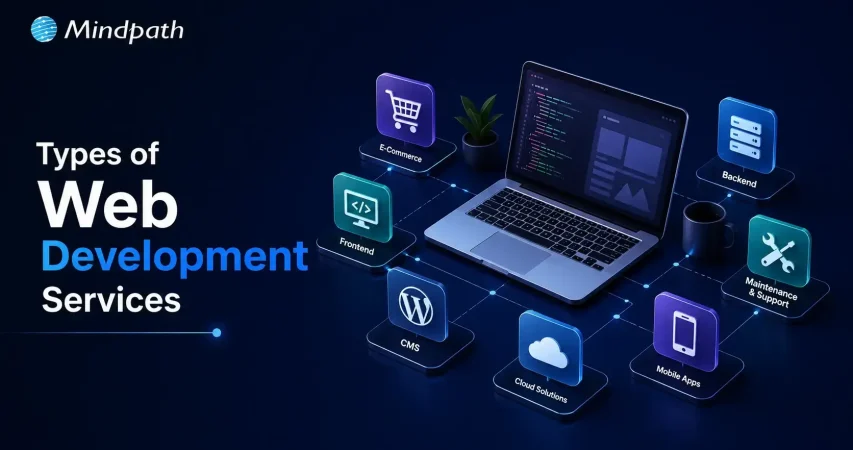
Well, where do you start then? There are many specialties in the field of web development. All perform a different business function. Some emphasize on user experience and design. Others take care of complicated system architecture. Understanding the distinction will help you to invest smarter and grow faster. Let’s dive into this blog to understand 10 major types of web development and their implications for your business. So, keep reading further!
Ready to build a powerful online presence? Explore Mindpath’s web development services and turn your ideas into high-performing digital solutions.
What are Web Development Services? A Quick Glance
Web development services encompasses all aspects of creating a functional website or web app. The developers are responsible for the coding, database design, and bringing it all together. Good development is the process of converting a visual design into actual, working product. It drives all of your clicks, load and interaction online. These services are more than just website development.
These comprise performance tuning, security, updates, and continuous support services. A great web development partner will be able to cover the entire process, from planning to launch. That means your website is not just an online page; it’s a business asset.
What are the Types of Web Development Services?
Web development is a collection of many different specialized services. Each has its own function in making a successful product. Picking the right one brings great benefits: you can save your time, lower the expenses, and get better results at the same time.
However, it’s not that obvious which one to choose without a guide. So, let us show the major types of the website development services your business should be aware of.
1. Front-end Development
Frontend development is the making of the visual and interactive part of a website or a web app. It includes everything a user sees and interacts with, such as page designs, buttons, and even animations. Frontend developers rely on HTML, CSS, and JavaScript, plus frameworks like React and Vue to design interfaces that are not only fast and responsive but also user-friendly.
Key Features of Frontend Development
Let’s dive into the features of front end development that make a website visually compelling and user-friendly.
- A good frontend loads quickly, and does not let folks bounce off the page.
- It provides a pretty appearance that fosters trust on the first impression.
- Users can move easily from one section to another, thanks to the smooth navigation.
- All elements are consistent throughout Chrome, Safari, Firefox and other browsers.
- Performance remains optimized with no lag, no freeze, no slowdowns.
- User data is secured and the interface is protected against threats.
2. Back-end Development
All backend development work powers the processes that are invisible to users of a website. Users don’t see it; however, they can get to the business success that it facilitates practically each day. It deals with the management of servers, databases, and application logic. Python, PHP, and Node.js are the coding languages that are used to perform these activities. A website without a strong backend cannot really operate well.
Key Features of Back-end Development
Let’s look at the essential elements of back-end development that ensure reliable, secure, and efficient web development services.
- Data is stored, managed, and accessed from structured databases in backend systems.
- Core business rules are applied efficiently, by server-side logic.
- APIs join frontend, backend and third-party tools together.
- Data of user is always safe with strong authentication and encryption strength.
- Architecture that can scale, so it won’t slow down with high traffic.
- Payment gateways and other external integrations smoothly connect your platform.
3. Full-Stack Development
Full-stack development refers to working on both the frontend and backend sides of a website or application. They are capable of managing everything, both the user interface and the data processing backend. They represent the generalists among web development services. A single proficient developer or a developer team is often able to build, operate, and deliver a whole product without the help of others.
Key Features of Full-Stack Development
Let’s take a look at the features that make full-stack development a good business option.
- Full stack developers take care of the entire development process all by themselves.
- They have experience in both front end and back end technologies.
- These popular stacks are used to create dynamic, fast web applications such as MERN.
- The less team changeovers, the quicker the delivery, the smoother the flow.
- Better performance and cleaner APIs through deep architectures knowledge.
- Both sides of the app scale and adapt with ease.
4. CMS Development
CMS development involves creating websites based on platforms that allow you to handle content without the need to write any code at all. WordPress, Shopify, and Drupal are well-known instances. It’s among the most sensible web development services for companies who desire to have complete control over their content. Refresh your pages, include blogs, and modify the content whenever you want.
Key Features of CMS Development
Here are the main points that make CMS development efficient and business-friendly.
- Intuitive editors make creating and formatting content quick and simple.
- Everything is stored in one easy to access place.
- Role Based permissions are used to maintain teamwork and smooth content flow.
- Schedule and publish content on different websites and social platforms without hassle.
- Inbuilt Analytics tools enable you to enhance content according to actual data.
- CMS platforms have a seamless interface with CRM and marketing applications.
5. eCommerce Development
E-commerce development refers to the creation of online stores that are capable of managing product display as well as ensuring payment security. Great ecommerce development services are centered on not only quick loading times and hassle-free checkout procedures, but also on robust security measures. The smallest elements are aligned with the main objective converting visitors into buyers.
Key Features of eCommerce Development
Let’s take a look at the essential components that make any ecommerce development project successful.
- Always, sensitive user data and payment information are guarded by robust security.
- The payment gateway integration is seamless, ensuring smooth and reliable transactions.
- Smart inventory tools are useful in keeping the product management organized and accurate.
- Order management logic ensures efficient order fulfillment from click to delivery.
- Scalable architecture helps control traffic surges without impacting performance.
- In-built analytics makes informed business decisions every day.
6. Mobile App Development
Mobile app development means creating software for smartphones and tablets. It includes designing, programming, and testing for Android and iOS environments. Even though it is a bit different from the usual web development, nowadays mobile apps are mainly connected to web-based backends. A good mobile app delivers your business at the fingertips of the customer.
Key Features of Mobile App Development
These are some of the characteristics of a strong mobile application that will be regarded as the defining features of a well-built mobile app.
- Smooth performance and speedy load time stop users from dropping off.
- Offline support allows the app to function without an Internet connection.
- Timely and personalized push notifications to re-engage users.
- User trust comes easily with strong encryption and biometric authentication.
- Every day, AI personalization provides more intelligent and relevant app experiences.
- Real-time analytics monitor behavior and provide ongoing app enhancements.
7. Progressive App Web Development (PWA)
A Progressive Web App works like a native app but runs directly in a browser. It loads fast, works offline, and feels smooth on any device. PWA development is a smart choice within web development services because one codebase works across all platforms. No app store needed, just a great experience every time.
Key Features of PWA Development
Here are the core features that make PWA development a powerful modern choice.
- Service workers enable smooth performance even on slow or no network.
- PWAs deliver native app-like navigation and full-screen experiences seamlessly.
- Users install PWAs directly from their browser onto any device.
- Updates happen automatically without any app store downloads needed.
- Push notifications keep users engaged with real-time personalized messages.
- HTTPS hosting ensures every PWA stays secure and data stays protected.
8. Web Accessibility Development
Web accessibility development makes sure every user can navigate and use your website, including people with visual, auditory, or cognitive disabilities. It follows standards like WCAG to remove digital barriers. Within web development services, accessibility is not optional. It is a responsibility that also improves usability and expands your audience reach.
Key Features of Web Accessibility Development
Here are the key features that make a website truly accessible for every user.
- Alt text helps screen readers describe images to visually impaired users.
- Captions and transcripts make audio and video content fully inclusive.
- High color contrast ratios improve readability for all users significantly.
- Every function works smoothly using a keyboard alone.
- Visible focus indicators show users exactly where they are navigating.
- Skip navigation links let users jump straight to main content.
9. Web Security Development
Web security development builds protection directly into your website from day one. It covers secure coding, data encryption, and regular vulnerability checks. Cyber threats like SQL injection and data breaches are real risks every business faces. A secure website protects your users, your data, and your business reputation effectively.
Key Features of Web Security Development
Here are the core features that keep a website secure and trustworthy.
- Multi-factor authentication ensures only authorized users access sensitive areas.
- SSL/TLS encryption protects data during transit and storage always.
- Secure coding practices block injection attacks and cross-site scripting effectively.
- Content security policies prevent malicious scripts from running on your site.
- Proper session management stops hackers from hijacking active user sessions.
- Web application firewalls filter and monitor all incoming traffic constantly.
10. API Development and Integration
API development and integration connects your software applications so they talk to each other smoothly. It is a core part of modern web development services. Think of it as a digital bridge between your tools, systems, and platforms. Good API development saves time, reduces manual work, and keeps your entire tech ecosystem running together.
Key features of API Development and Integration
Here are the key features that make API development truly effective.
- Multi-layer authentication keeps every API interaction fully secure.
- Cloud-native infrastructure scales smoothly under high traffic.
- Clear documentation makes third-party integration fast and simple.
- Rate limiting protects servers from overload and attacks.
- Versioning ensures updates never break existing integrations.
- Connectors link payment gateways, CRMs, and platforms effortlessly.
Ready to Build a Website That Works for Your Business?
Web development is not one-size-fits-all. Every business has different goals, and the right web development services help you meet them. Whether you need a fast frontend, a secure backend, or a full e-commerce store, picking the right type makes all the difference.
At Mindpath, we are a web development agency that actually listens. We understand your goals and build solutions around them. Contact us; we offer solid, results-driven development that helps your business grow online and stand out from the crowd.