Home

SaaS Challenges Every Business Faces and How to Solve Them

SaaS Challenges Every Business Faces and How to Solve Them

Join our Newsletter!

challenges of saas

The software realm has been growing like never before. New software solutions have been emerging frequently. Customers need to bear in mind that the market is extremely fierce at the moment. However, there is a broad range of SaaS challenges that businesses have to struggle with.

Key Takeaways

  • 01
    SaaS helps businesses access software through the internet without managing or installing it on their own devices.
  • 02
    Overlapping SaaS tools can increase costs and make it difficult to maintain visibility across the software stack.
  • 03
    Shadow IT can create security, visibility, and unnecessary software spending risks for businesses.
  • 04
    Managing SaaS contracts, software spending, and data security is essential for controlling SaaS-related risks.
  • 05
    A well-managed SaaS stack helps businesses identify challenges early and use SaaS solutions more effectively.

It is time to look at some of the challenges of the Software as a Service solution that exist today. Businesses need to bear in mind that there exist countless obstacles that they have to encounter in their path. The insight into these challenges is the fundamental step to identifying effective solutions that can help to overcome the problems.

Ready to overcome the common challenges that slow business growth? Our SaaS Development Services help streamline development while improving reliability and scalability.

What is SaaS?

Software as a service, or SaaS, refers to the method of software delivery. In the SaaS model, applications are basically hosted by a provider and made available to users via the internet. This arrangement enables users to gain access to software solutions on a subscription basis, and they do not have to manage or install them on their own devices.

Some of the common examples of SaaS solutions for businesses include CRM software, online productivity tools, and many more. The emergence of SaaS is certainly a breath of fresh air for businesses. However, it is important to bear in mind that businesses may encounter a plethora of SaaS challenges in their path.

Planning to adapt your business strategy to emerging software trends? Discover SaaS trends to check out the innovations driving growth and efficiency.

Common SaaS Challenges That Businesses Encounter and Their Solutions

Using SaaS comes with its own hurdles and challenges. If you use SaaS, you may be facing a number of these challenges. You need to be aware of the challenges of SaaS so that you can find the right solutions to address them.

1. Use of Similar Types of Products

One of the most common challenges is related to the use of overlapping products. A large firm is likely to have a large number of SaaS tools in its IT stack. It may give rise to visibility concerns. Without proper visibility, it may be very challenging to identify whether teams are using the same or different SaaS tools.

For example, different teams may be using varying cost management SaaS apps. Although the two tools may be different, they may have the same functionality. It implies that your company may be paying for similar features and functionalities twice.

Solution

A suitable solution to deal with these challenges of SaaS is to use a robust Software as a Service management tool. This tool can help you identify any kind of overlap between diverse software solutions. Once you have identified that there is a product or feature overlap, you can identify novel techniques to cut down unnecessary costs.

2. Shadowing Information Technology

A common challenge that business entities may face from a SaaS IT stack revolves around shadow Information Technology. It basically encompasses all the Information Technology systems and solutions that your business makes use of without the approval or knowledge of the Information Technology team. Shadow IT may also refer to the situation when a firm and its personnel have bought an app, implying the company has to pay for a similar kind of tool twice. These challenges come with their unique set of risks, such as a high possibility of data breach, etc.

Solution

You can partner with a company that can help your IT team uncover every tool or app that is used by the employees. Such a partner can help flag the applications that are not yet provisioned. This implies that your business will have proper visibility into shadow Information Technology prior to it becoming a major problem that is difficult to handle.

3. High Spending on Software

Overspending is a serious issue that business entities need to avoid at all costs, regardless of their size and nature. The companies that leverage SaaS solutions may spend too much money on software. This is a serious challenge that may give rise to complexities in the long run for the business. Businesses must be careful while choosing their SaaS solutions so that they can keep a tab on the money that they have.

Solution

It is essential for your business to plan an annual budget. It can give you an insight into the money that you need to spend on your software solutions or SaaS stack. You also need to broaden your knowledge into cost aspects relating to the contract, account use, and many more. You can take help from the biggest SaaS companies to gain insight into these aspects.

4. Lack of Understanding of SaaS Contracts

One of the common challenges of SaaS arises when companies have limited insight into SaaS contracts. With the growth of your SaaS solution, the total software contracts may also grow. After the contract has been signed and the application has been implemented, you need to have a solid understanding of the contract and its requirements. In the absence of a proper understanding, you may not be able to leverage the software solution to the fullest.

Solution

In order to address such challenges of SaaS, it is essential for you to keep the contract details and data in an organized manner. This approach will help you manage the details of the biggest SaaS companies with whom you partner in an organized fashion. You can use novel tools to manage software-related contract details in a well-organized and manageable manner. With the help of such tools, you can receive notifications on a real-time basis so that you can keep tabs on the contractual obligations. The organized information can certainly create value for your business in diverse ways.

5. Poor Data Security Measures

While talking about SaaS problems, one cannot ignore the issue relating to poor data security measures. It may increase the risk relating to data breaches, phishing scams, and many more. As Saas tools house tons of useful information about your company, SaaS problems may give rise to serious consequences for your business. The lack of a robust cybersecurity posture on the cloud can impact your business in diverse ways.

Solution

You can leverage cloud cybersecurity tools in order to derive optimum value from SaaS. You can also implement practices such as strong Identity and Access Management (IAM) and adopt the principle of least privilege. Moreover, it is essential to monitor the activities of users on a regular basis so that you can identify any suspicious activities that may exist.

A plethora of challenges and issues of SaaS may arise that business entities need to be aware of in the current times, as the use of Saas is gaining momentum like never before. So companies need to familiarize themselves with the top issues of SaaS. The insight can certainly empower you to effectively leverage Saas solutions in the business context.

Looking to overcome common SaaS challenges with the right development partner? Check out how to choose the right SaaS development services to learn how selecting the right team ensures success.

Final Words

Businesses that use SaaS need to keep track of their SaaS stack. It is a fundamental step that will empower you to be aware of the challenges that arise in your path. The insight will act as a stepping stone that can help you find appropriate solutions to address the identified challenges.

SaaS can give rise to both opportunities and challenges for businesses. In such situations, businesses must be aware of both these areas so that they can use these novel solutions optimally. Some of the common challenges that have been identified include the use of overlapping products, excessive shadow IT, etc. Mindpath’s excellent SaaS development services are designed to help businesses address the SaaS challenges and resolve them with expertise.
Building a SaaS Product?

Create a scalable SaaS solution built for growth.

Frequently Asked Questions

Common challenges include overlapping tools, rising costs, security risks, integration problems, limited visibility, data management, and difficulty controlling multiple SaaS applications.
Businesses can regularly review subscriptions, remove unused applications, identify overlapping tools, negotiate plans, and use SaaS management practices to control spending.
SaaS management provides better visibility into applications, users, costs, and usage, helping businesses avoid unnecessary spending and reduce operational complexity.
Use strong access controls, regular security reviews, employee awareness, centralized monitoring, appropriate permissions, and reliable processes for managing SaaS applications.
Multiple tools can be useful, but businesses should avoid unnecessary overlap and choose applications that integrate well and clearly support business requirements.

Support Is One Click Away

Featured Posts

Related Post

hiring full stack developer for MVP

The scale of innovation in the modern business landscape is growing consistently, calling for more efficient approaches to create digital solutions. Businesses choose to build MVPs or Minimum Viable Products before investing a huge amount in production. The benefits of hiring full-stack developer for MVP development have been drawing the limelight towards full-stack development services. 

Some business owners think about the possible ways in which full-stack developers can help with MVP development. With full-stack developers, businesses don’t have to hire multiple developers or set up a perfect team to create their MVP. Let us learn about the different ways in which full-stack development services contribute to the success of MVP.

Are you looking to turn your MVP idea into a market-ready product? Mindpath’s Full Stack Development Services will give you access to versatile developers who can handle both front-end and back-end seamlessly.

The Rise of Full Stack Developers

Full-stack development has emerged as one of the prominent alternatives to traditional development approaches. Businesses that have to hire full-stack developer for MVP development must know what a full-stack developer brings to the table. You must notice the term “full-stack” to understand the role of full-stack developers. It represents the complete technology stack or collection of technologies used to create a functional application. Full-stack developers are professionals who have expertise in frontend and backend development.

The versatility of full-stack developers empowers them to bridge the gap between what users see in an application and the underlying infrastructure that powers the application. On top of it, full-stack development also requires knowledge of other aspects such as version control, API integration, and database management. Businesses can find different technology stacks for full-stack development, like MERN, MEAN, LAMP, and Python-based stacks. Every technology stack offers a combination of powerful technologies used to create intuitive applications. 

Advantages of Creating a Minimum Viable Product (MVP)

The Minimum Viable Product or MVP is a trending buzzword in the digital landscape and a strategic solution for efficient product development. Imagine a situation in which a business has invested thousands of dollars in developing an app without a MVP. What will the business do if the target customer base of the organization does not like the app? The business would end up losing the money it invested in the app. 

Let us assume another scenario in which companies hire full-stack developer to create an MVP before rolling an app into production. The MVP is a minimal version of the software or application with limited features for the early adopters. Businesses create MVPs to test their digital products in the early stages of development and learn from the feedback of users to create effective solutions. The following advantages of a MVP will help you understand its significance in the dynamic business landscape.

1. Faster and Cost-Effective Development

One of the prominent advantages of MVPs is the assurance of faster time to market for new digital products and services. MVP focuses on achieving rapid deployment with essential features to gain an early advantage in the target market. 

Businesses can create MVPs without spending a lot on developing a product with full features and gather user feedback. As a result, the MVP can help in testing concepts and identifying the strengths and weaknesses of the application without unwanted expenses.

2. Risk Mitigation from User Feedback

The most distinctive highlight of MVP app development is the opportunity to interact directly with early adopters. Their feedback can help a business find valuable insights into the preferences, pain points, and requirements of users. Developers can use the feedback to ensure that the final product meets user expectations. Interestingly, MVP development involves continuous testing, feedback, and refinement to create more user-friendly and robust applications.

Feedback from users with a minimalistic version of the final product helps in reducing risks for businesses. For instance, business owners don’t have to invest extensively in concepts that their target audience does not like. Early feedback from users helps in identifying potential issues and implementing necessary modifications to reduce risks. 

3. Competitive Edge in the Market

The Minimum Viable Product also helps a business measure market interest and demand for their digital product. It can validate innovative ideas, while negative feedback opens new possibilities for timely modifications before investing a lot in app development. 

The ability to introduce a unique product in the market with limited features allows a business to gain a competitive advantage. Businesses can leverage MVPs to showcase their presence and build brand awareness before competitors jump in. On top of it, the MVP also offers an easy way to generate initial revenue that can be used to support product enhancements and development costs.

Want to stay ahead of the competition and build a truly impactful MVP? Discover the latest Full Stack Development Trends to leverage cutting-edge technologies, streamline development, and maximize your product’s success

Why Should You Hire Full Stack Developers for MVPs?

If the MVP is an important concern for businesses, then they might need specialists for the same. Is MVP development with full-stack developers a feasible choice for your business? The following benefits of working with full-stack developers will help you understand why they are the ideal choices for MVP projects. 

1. Cost Reduction

The cost of a MVP project is significantly less than that of a full-fledged development project. Interestingly, full-stack developers can reduce the cost of MVP development further with their versatility in frontend and backend technologies. Businesses don’t have to hire multiple specialists, thereby reducing the overall development costs. Startups and small enterprises can make the most of this advantage to create impactful MVPs with limited resources.

2. Faster Development

Hiring a full-stack developer is also a proven solution for accelerating the development process. Full-stack developers can contribute to the MVP success strategy with their expertise in frontend and backend domains to ensure seamless integration of all essential components. The streamlined development process supports faster iterations and offers flexibility for refining the product on the basis of users’ feedback. The speed of MVP development helps companies in validating innovative ideas and approving them for production to gain a competitive advantage.

3. Versatile Skillset

Full-stack developers are the ideal picks for MVP development due to their ability to make informed decisions according to the complete development stack and business goals. You can rely on them for end-to-end implementation, starting from creating interactive user interfaces to designing robust server-side architectures. The versatility of full-stack developers also empowers them to switch roles in the MVP development project without conflicts.

4. Lesser Communication Overhead

The next prominent advantage of hiring a full-stack developer for MVP is the assurance of efficient communication. Businesses don’t have to invest a lot of time in communicating with multiple specialists for a MVP project. If a business hires specialists for frontend and backend development, then it will have to monitor their work. On the contrary, full-stack development requires communicating only with a single person. The straightforward communication helps in reducing the possibilities of errors and increases the chances of overall success of the MVP project.

5. Easier Maintenance

With full-stack developers, businesses can avoid all worries about maintenance of the MVP project. Full-stack developers can leverage their expertise in different technologies to address the maintenance requirements, such as bug fixes, updates, and enhancements. On top of it, full-stack developers can implement changes quickly while ensuring compatibility and consistency between different development phases. 

6. Quicker Prototyping

If you have an innovative idea for an app and fail to develop it before your competitor, then you might lose the competitive edge. The value of full-stack development for startups, especially in the case of MVP development, is visible in faster prototyping. Businesses could build working prototypes for their innovative ideas and allow stakeholders to interact with the product. Faster prototyping helps in making necessary changes in the early stages of development and gives opportunities to outsmart the competition.

If you’re not sure what skills to look for in a full-stack developer, start by understanding the key factors that make one successful. Discover Things to Consider Before Hiring a Full Stack Developer to see what expertise can help your MVP stand out.

Challenges of Hiring Full Stack Developers for MVP Projects

The advantages of working with full-stack developers on MVP projects showcase why you need one right now. At the same time, business owners must pay attention to the challenges of hiring full-stack developers. For instance, it is difficult to find full-stack developers with the exact skills required for your MVP development projects. 

Businesses can capitalize on all the benefits of full-stack development only if they hire developers with experience in handling frontend and backend development. It is also important to know that full-stack developers are better picks for small and medium-sized projects. However, hiring only one full-stack developer for large and complex projects may not be the best choice for a business owner.         

Ready to Build Your MVP with the Right Full-Stack Team?

The decision to bring a full-stack developer into your workforce for MVP development is right for many reasons. For starters, you can build the Minimum Viable Product quickly and obtain user feedback to implement relevant modifications in the early stages. On the other hand, choosing a full-stack developer may be one of the toughest challenges for business owners.

At Mindpath, we offer full-stack development services personalized to align with client requirements and vision. We have helped multiple clients bring their vision to reality in the form of intuitive, user-friendly, and robust applications. Our experience and commitment to serving the best results in MVP development make us the best pick for startups and big corporations. Find the ideal resources to create your next MVP project right now.

Frequently Asked Questions

1. When is the right time to hire a full-stack developer for an MVP project?

The ideal time is during the early planning or prototype stage. Bringing in a full-stack developer early helps shape the product architecture, avoid rework, and ensure smooth development from the start, leading to faster validation and more efficient use of resources.

2. How can a full-stack developer support better product decisions during MVP development?

A full-stack developer understands both user-facing features and backend logic, which helps in making balanced decisions. This ensures that features are not only functional but also scalable, improving the overall quality and usability of the MVP from the beginning.

3. What should be evaluated before selecting a full-stack developer for an MVP?

It is important to assess practical experience, familiarity with relevant technology stacks, and the ability to handle end-to-end development. Strong problem-solving skills and an understanding of business goals also play a key role in ensuring successful MVP delivery.

4. How does working with a full-stack developer impact long-term product growth?

A well-built MVP creates a strong foundation for future development. A full-stack developer ensures clean architecture and scalable code, making it easier to expand features, handle increased users, and adapt to changing business needs without major redevelopment.

5. Can a full-stack developer manage changes effectively during MVP iterations?

Yes, full-stack developers are well-equipped to handle frequent changes during MVP cycles. Their ability to work across different layers of the application allows quicker updates, smoother adjustments, and better alignment with user feedback throughout the development process.

Web apps features

When you think about building something successful online, it’s not just the design or speed that matters. The real benefits come from the web app features that make your platform unique and the experience of your users engaging. Expectations continue to rise with the apps of today, especially as users expect their apps to be seamless, responsive, and can be able to solve problems. Isn’t it true that the users quickly leave if things feel complicated or outdated? So, that is why features play such a big role in shaping your user satisfaction.

Now imagine being in a competitive landscape in 2026 that will have elevated digital expectations. Users will certainly not be satisfied with a mediocre user experience; they will expect innovation and personalization with every click. Don’t you agree that a web app should not only function but also excite its users? Things like intelligent integrations, security, and ease of navigation won’t just be optional; rather, they’ll become baseline expectations. Let’s take a look at the top 10 features that reflect a true high-performing web app in this fast-changing world.

A Quick Understanding of Web Application

A web application is software that runs in a web browser, connecting users to interactive online services. While desktop applications require installation, web apps don’t need to be installed, so they’ll work on any device with internet access. Web apps combine software functionality with the ease of being on the web, which allows them to be fast, easy to use and scalable.

Web apps are powerful business tools that can drive revenue and customer engagement. They can facilitate transactions, communications, and data management. Businesses have built-in assurance that web applications are secure and can perform reliably. Companies today use web applications to automate or streamline tasks and provide a personalized service. Web applications offer the flexibility and functionality to support modern technologies, create competitive advantages in limited timeframes, and provide value to customers and businesses.

Planning a scalable web app for long-term success? Explore our web app development roadmap to discover the key stages of building high-performance applications.

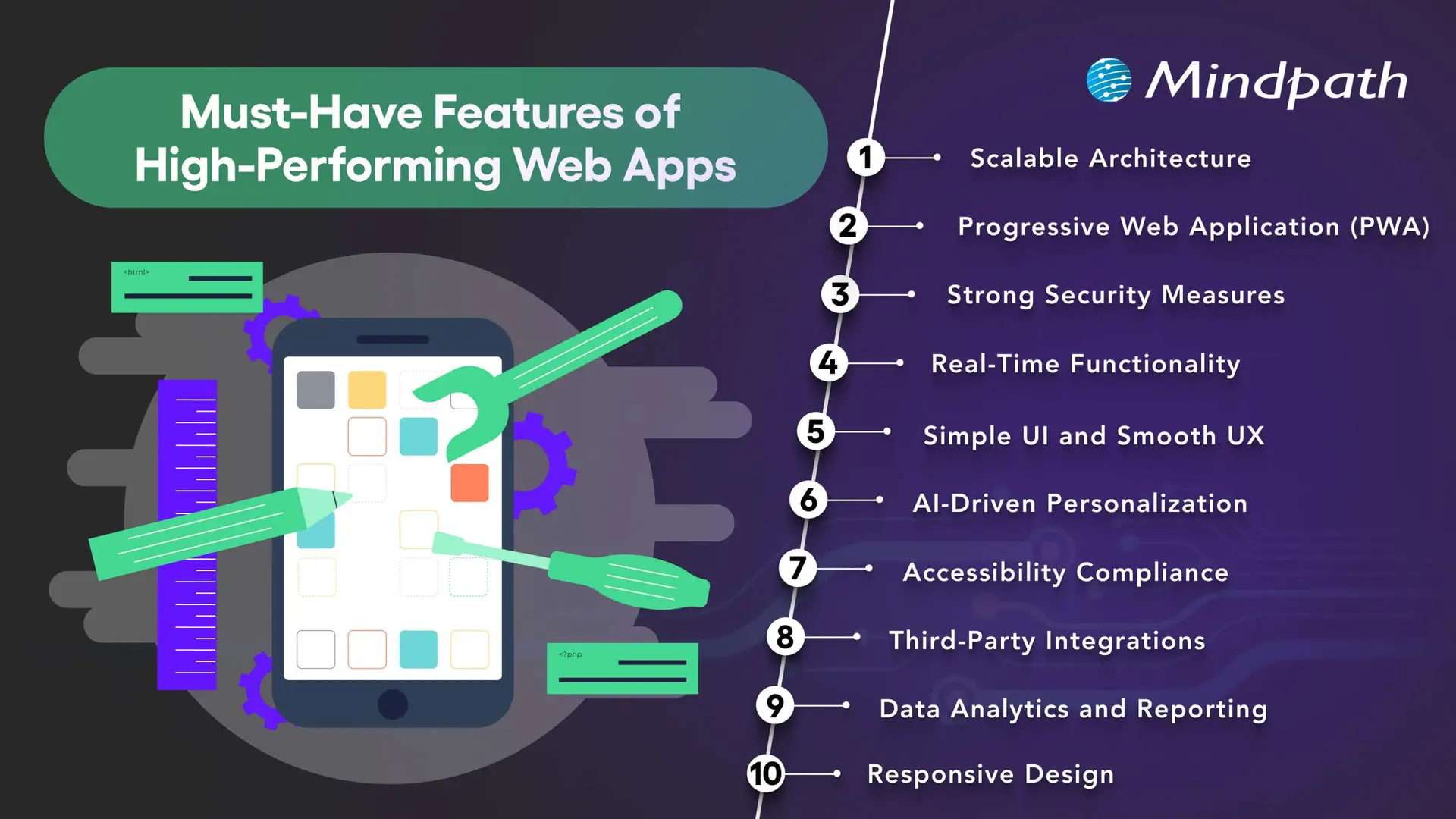
10 Must-Have Features of High-Performing Web Apps

To deliver speed, security, and usability, high-performing web applications rely on the right web app features. Nowadays, web and app development is always changing, and these features are the key to ensuring sustained success and satisfaction for users.

10 Must-Have Features of High-Performing Web Apps

1. Scalable Architecture

Growth is a keystone for any company, and scalability is what allows your web application to accommodate that growth smoothly. Proper use of cloud hosting services, load balancing, and microservices allows it to manage the increase in traffic without performance issues. Furthermore, having scaled and designed your application to work well in large increments means you will not have to completely rebuild your system as demand rises. This is one of the essential features of successful web app development.

2. Progressive Web Application (PWA)

PWAs are the perfect blend of web and mobile experiences wrapped up in one platform. They consult faster, work offline through service workers, and provide app-like usability without the hassle of installation. Research shows the PWA market is growing at a rapid pace, with a healthy number of adoptions across all industries for you to find yourself chasing. Digital solutions via a PWA will be one of the top features of web apps in 2026.

3. Strong Security Measures

Security is never optional in our current online world. Features such as SSL encryption, multi-factor authentication, and continuous vulnerability assessment are essential components of web application security to protect private data. Users want an application that they know they can trust to keep their personal and financial information safe. With web application development, security should be the foundation, not an afterthought!

4. Real-Time Functionality

Real-time updates make applications more engaging and exciting for users. Whether these components come by the way of a live chat, instant notifications, or live data streaming, users enjoy being connected without the potential delay. Businesses reap the advantages of more efficient communication systems and a greatly improved customer support system. This is just one of the many standard web app features users pretty much expect now.

5. Simple UI and Smooth UX

A clean interface and seamless navigation encourage apps to be more enjoyable as well as productive. A user is more likely to be happy using an app when there is an intuitive design with predictable layouts, immediate access to feature menus and categories, and effortless navigation. Well-consulted user experience reduces tension and frustration through session length, increases retention and creates a lasting positive experience. This is why simple and intuitively designed UX is up there with the essential features of successful web app design.

Want to know what makes users stay longer on web apps? Discover the latest UI/UX design trends in web application development, shaping high-performing apps in 2026.

6. AI-Driven Personalization

Artificial Intelligence is effectively powering personalization in web applications today. AI looks at data about users, makes content recommendations, predicts behavior, and enhances the accuracy of searches. As a result, interactions are smarter, which increases user satisfaction and retention. The use of AI in web development enables these AI-based personalized experiences, making them exceedingly valuable in the web app ecosystem and establishing them as one of the best web app features.

7. Accessibility Compliance

Achieving accessibility guarantees inclusivity among all users, including users with disabilities. Accessibility requires features like keyboard navigation, text-to-speech, high-contrast designs, etc. Accessibility makes sense because it helps all users online. Additionally, following web accessibility guidelines when creating websites, apps, and systems based on WCAG standards is the right thing to do and creates goodwill and trust across a larger audience. Accessibility is now one of the core features of successful web app development.

8. Third-Party Integrations

Modern web apps must be compatible with other tools. Payment gateways, analytics tools, and social media APIs are just a few examples of third-party integrations that greatly reduce the burden of burdensome workflows and subsequently speed things up. Third-party integrations enhance versatility and create a better user experience. Needlessly, for website application development, third-party integrations are vital in furnishing genuine value.

9. Data Analytics and Reporting

Analytics gives businesses actionable insights into user actions. They can monitor user behavior through dashboards, heatmaps, and customized reports to observe how users interact with the application. Leveraging that information can get a business closer to improving its services, maximizing its marketing, and strengthening performance. That’s why reporting is one of the most impactful web app features today.

10. Responsive Design

Responsive design is not optional, given that the majority of users are accessing the Internet with their mobile devices. A web app must be responsive across desktops, tablets, and smartphones. Responsive design means lower bounce rates, improved SEO, and better engagement. It is one of the top features of web apps that continues to be relevant in the long game for success.

Worried about vulnerabilities in your apps? Learn application security best practices for web and mobile apps to protect your users and data.

How to Develop a Web Application?

A web application is a direct bilingual service and bridge from your business to users in the interactive space; it supports developing seamless interactions, dependable functionality, and useful user experiences.

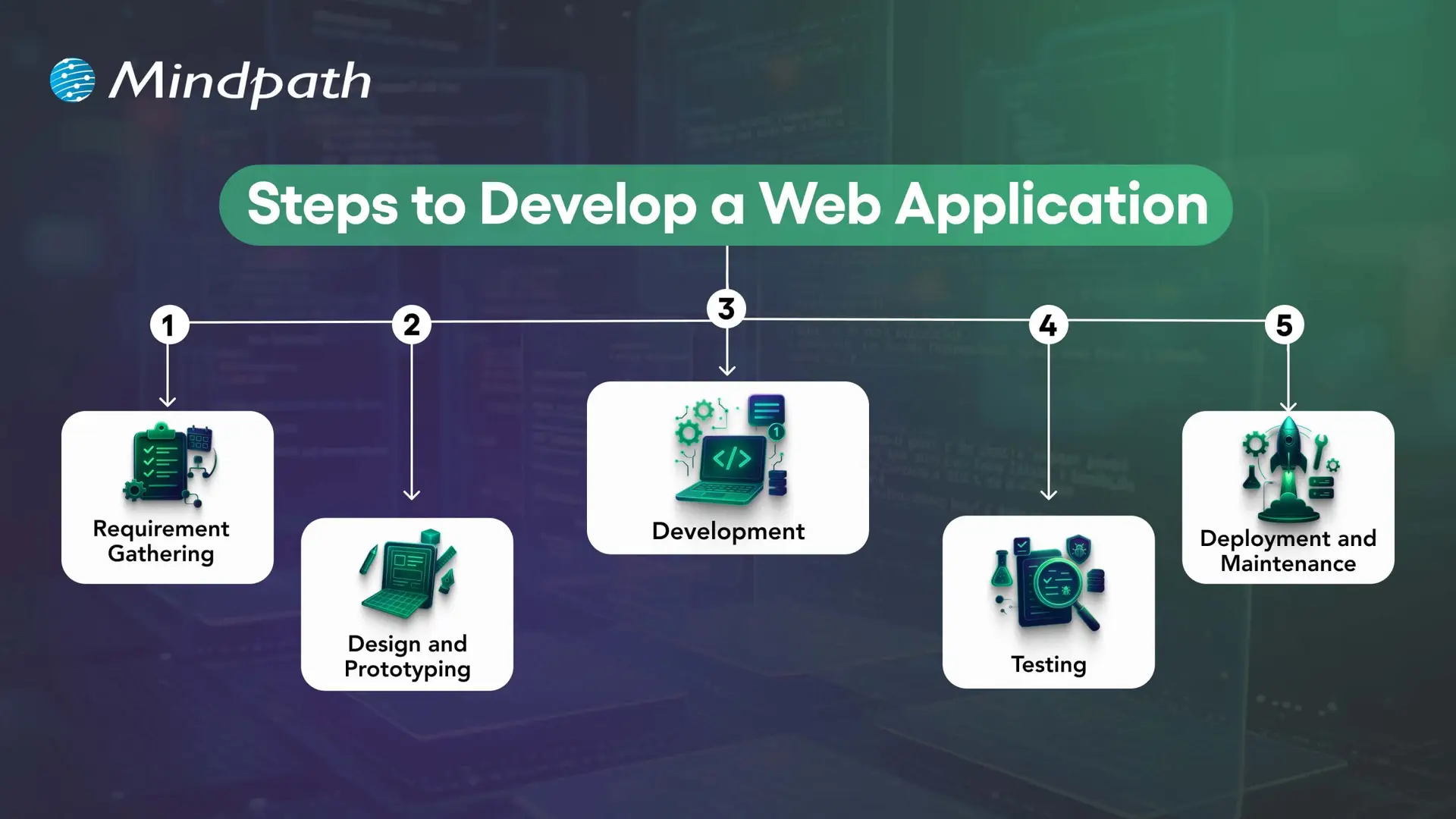
Steps to Develop a Web Application

1. Requirement Gathering and Planning

This phase analyzes the purpose of the application and the problem trying to be solved. The product objectives are informed by market research, planning the workflows, and a listing of web app features to ensure that the project begins with direction and clarity.

2. Design and Prototyping

The process of wireframing, mock-ups, and prototypes allows for the visualization of the layout, user flow, and interface design. This will be further supplemented with rigorous planning around the database and system architecture. This will ultimately provide a basis for functional and performance forms.

3. Development

Frontend development emphasizes crafting interactive and user-friendly interfaces. Backend development manages business logic, APIs, and data maintenance, and provides the groundwork for developing the functionalities of web applications.

4. Testing

Unit and integration testing assure both that the individual pieces work and that they work together. User Acceptance Testing ensures that the application meets the expectations of the user, while also performing reliable activities.

5. Deployment and Maintenance

The application will be deployed to the server and accessible to users, with ongoing monitoring, and promoted to production and changes. Maintenance will consist of bug fixes, upgrades, and implementation of new web app features based on changes in business needs.

Struggling with one-size-fits-all solutions? Explore custom web applications development for tailored functionality and seamless user experience.

Want to Create a Future-Ready Web Application?

In 2026, the success of any web application will depend on the strength of its web app features. Scalability, security, personalization, and responsive design are no longer optional but critical. Businesses that embrace these essential elements will be able to deliver seamless experiences, engage users effectively, and stay ahead in a competitive digital environment.

At Mindpath, we specialize in web application development tailored to your business goals. Our expertise ensures applications are secure, scalable, and built with the right web app features for long-term success. With a focus on innovation and usability, we deliver solutions that empower businesses to engage customers better and unlock real growth. Connect with us today to get started.

staff augumentation

In today’s world where technology is enhancing at a fast pace, businesses cannot afford to slow down, not even for a second. As deadlines are tighter, client demands are growing and skilled talents are harder to find, IT staff augmentation can be the perfect solution for these. Just think: what if you could access skilled professionals whenever you wanted them, whether it is to scale up a project or as expertise to reach a short-term goal, without having to go through the time-consuming hiring process? Isn’t it fascinating?

Staff augmentation allows you to grow as you need, with no boundaries, as many organizations are opting for faster and more flexible alternatives. If you hear this term frequently but aren’t sure exactly what it means and how it works, you are in the right place. In this blog, we will walk you through the essential things to know about staff augmentation. We will explain how staff augmentation works and describe the main benefits of this service in easy words! There is much value in exploring staff augmentation as a way to improve your team’s capabilities and altogether enhance your work outcomes. 

Looking for a partner you can trust to boost your IT projects? Mindpath is here to provide top-end services in the sphere of IT staff augmentation.

What is Staff Augmentation?

Staff Augmentation is when you hire competent professionals from an external agency to assist your in-house team for a defined period of time. These professionals aren’t permanent employees, but they will consider themselves regular members of your team. This is a flexible way to obtain extra assistance when your team is busy, or you require a special skill to complete a project.

To clarify, here’s a staff augmentation example. Suppose you are the owner of an online clothing store, and you want to introduce a mobile shopping app before the holiday season arrives. Your in-house developers are actively working on new updates for your website and are currently unable to take on other work. Instead of hiring full-time staff, you use IT staff augmentation to put some mobile app developers into your project through a trusted agency. The app developer will work with your task force, build the app, and when you are ready to launch it, their work will finish. This will give you the appropriate skills, at the appropriate time, without the lengthy hiring process or administrative burden of bringing full-time employees. 

Types Of Staff Augmentation

Staff augmentation comes in different types to match different business needs. Whether you need help with a short project or long-term support, there’s a model that fits just right.

1. Project-Based Staff Augmentation

This type is used when a company needs extra help for a specific project. Skilled professionals join the team just for that project and leave once the work is done. It’s a smart way to get things done faster without adding long-term costs.

2. Temporary Staff Augmentation

In this model, companies bring in experts for a short time to fill sudden gaps or meet urgent deadlines. It helps teams stay on track without rushing permanent hires. It’s great for short-term tasks or unexpected workload spikes.

3. Long-Term Staff Augmentation

Here, professionals work with the company for a longer time, often for months or even years. It’s helpful when you need ongoing support or special skills that your team doesn’t have. This model also helps reduce hiring costs while keeping projects moving.

4. Onshore Staff Augmentation

This means hiring professionals from the same country or region. It’s easier to work together because of the same time zone and better communication. Teams also benefit from cultural similarities and quicker collaboration.

5. Offshore Staff Augmentation

In this type, companies hire skilled people from other countries where labor costs are lower. It allows access to global talent and helps save money. It works well for remote projects that don’t need the team to be in the same location.

What is the IT Staff Augmentation Process?

The staff augmentation process may sound complex, but it’s actually quite simple when broken down into clear steps. Here’s how it works from start to finish to help you get the right talent for your business or project.

1. Identify Your Needs

Start by understanding what kind of skills or experience you need for the project. This helps you clearly define the roles and responsibilities for the temporary team members.

2. Estimate Team Size

Decide how many people you’ll need to get the job done smoothly and on time. Having a clear number makes it easier for your staffing partner to find the right talent.

3. Connect with a Staffing Partner

Once your needs are clear, your staff augmentation agency begins searching for the right professionals. They use their wide network to find candidates who match your project goals.

4. Screen and Shortlist Candidates

The agency carefully checks skills, experience, and qualifications before shortlisting the best profiles. You’ll then be invited to an interview and pick the ones who fit your team well.

5. Evaluate and Hire

Once you find the right candidates, you can try a short trial period to see how they perform. If everything goes well, you move forward by hiring and adding them to your team.

Benefits of Staff Augmentation

IT staff augmentation is becoming a go-to solution for businesses looking to strengthen their teams without long hiring delays. Here are the key benefits that make this approach a smart choice for many companies.

1. Team Scalability

One of the biggest benefits of staff augmentation is the ability to scale your team up or down as needed. You can bring in more people during busy times and reduce the team once the work is done. This is perfect for businesses with changing workloads or seasonal demands. It helps you stay efficient without overspending on full-time staff.

2. Access to Skilled Professionals

With staff augmentation, you get access to a large network of talented professionals through a trusted IT staff augmentation company. No matter what skill or experience level you need, there’s someone ready to support your project. This helps you find the right people faster without long hiring processes. It saves time and ensures your project is handled by experienced people.

3. Increased Productivity

Bringing in extra support allows your core team to focus on what they do best. They won’t get overwhelmed with too many tasks, and quality will stay high. With the right help in place, everyone works more efficiently. This leads to faster results and better outcomes.

4. Reduced Hiring Risk

Hiring full-time employees can be risky if they don’t turn out to be the right fit. With staff augmentation, you can try out professionals before making long-term decisions. It also allows you to bring in people who complement your team’s strengths. This makes your team stronger and reduces the risk of hiring mistakes.

5. Fresh Expertise and Ideas

Staff augmentation brings in people who have worked with many other companies and industries. They often come up with new ideas, fresh perspectives, and valuable insights. This can inspire your existing team and lead to better solutions. It’s a great way to bring innovation into your projects without a big change.

Ready to Boost Your Team the Smarter Way?

This blog gave us a complete look at how IT staff augmentation works and why it is becoming the smart choice for many businesses today. From types and processes to key benefits, everything you read helps you see how this flexible model can boost your team, meet project goals faster, and save hiring time without compromising quality. 

At Mindpath, we offer trusted staff augmentation services to help you grow your team quickly and smoothly. Whether you need short-term support or long-term experts, our skilled professionals are ready to join your projects. With the right talent at the right time, we help your business stay strong, flexible, and always ready for growth.  

Frequently Asked Questions

1. How does staff augmentation help during urgent project deadlines?

Staff augmentation allows businesses to quickly bring in skilled professionals when deadlines are tight. Instead of rushing the hiring process, companies can add experienced talent right away, helping projects move faster while maintaining quality and reducing pressure on the existing team.

2. Is staff augmentation suitable for small businesses or only large companies?

Staff augmentation works well for businesses of all sizes. Small businesses can use it to access specialized skills without long-term commitments, while larger companies use it to scale teams quickly. It offers flexibility that helps any business manage changing workloads effectively.

3. What factors should be considered before choosing staff augmentation services?

Before selecting staff augmentation services, businesses should evaluate project requirements, required skill sets, budget, and timelines. It is also important to ensure clear communication, cultural fit, and alignment with team workflows to achieve smooth collaboration and successful outcomes.

4. How can companies ensure smooth integration of augmented staff with internal teams?

Clear communication, defined roles, and proper onboarding are key to smooth integration. Providing access to tools, workflows, and team guidelines helps augmented professionals adapt quickly. Regular check-ins and collaboration ensure everyone stays aligned and works efficiently toward common goals.

5. Can staff augmentation support long-term business growth?

Yes, staff augmentation can support long-term growth by providing ongoing access to skilled professionals when needed. It helps businesses stay flexible, adapt to new opportunities, and manage evolving demands without committing to permanent hires, making it a practical strategy for sustainable expansion.

Discover staff augmentation for IT projects, its benefits, and top providers in the USA. Learn how it can bridge gaps and save costs.