Home

AI in Business Strategy: Driving Growth and Innovation

AI in Business Strategy: Driving Growth and Innovation

Join our Newsletter!

AI in business strategy

Think about the potential of AI in business strategy, accelerating your organization with enhanced insights and improved decisions. Imagine having intelligent tools to assess complex data, identify unseen patterns, and let your team have more freedom to genuinely innovate and grow. By adopting the right mindset, companies today are giving themselves a true competitive advantage with AI and changing every aspect of their operations daily.

This intelligent technology is helping companies find new opportunities, create more relevant customer experiences, and briskly adapt to changes in market needs. Embedding artificial intelligence benefits organizations to yield positive results. When used prudently, AI becomes a trusted partner in increasing efficiencies and establishing long-term, viable success.

In this article, you will learn about how AI can transform your strategy and scale your business. Let’s dive in!

Want to enhance your business strategy with artificial intelligence? Mindpath AI development services have a combination of providing strategic insights with hands-on expertise to provide intelligent growth across your organization.

What is an AI Business Strategy?

A business strategy is like an explicit blueprint that directs a company toward its goals. It answers important questions about where a business wants to go, how it plans to get there, and what makes it different from the rest of the marketplace. A clear strategy helps everyone understand the overall objective of the business and keeps colleagues headed in the right direction while working together.

Bringing AI into the plan strengthens the marketing strategy. An artificial intelligence strategy or AI strategy for business growth means using artificial intelligence to better facilitate your business objectives. This could mean improving customer service, making more effective decisions with your data, or even many other entirely distinct initiatives. The aim is to leverage smart tools to execute better, smarter, faster, while staying ahead of your competition.

Also Read: AI in E-Commerce

Benefits of an AI Business Strategy

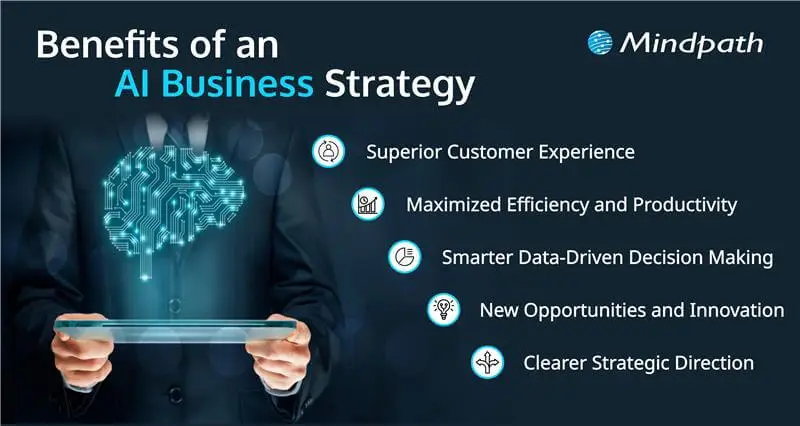
Having an AI business strategy can open up new opportunities and make your company more competitive. Here are some key benefits that show why investing in AI is worth it:
benefits of an ai business strategy

1. Maximized Efficiency and Productivity

AI can take care of repetitive work, so teams can spend more time on creative ideas and solving problems. It makes daily tasks easier and quicker, which improves workflow in every department. By spotting delays and gaps in processes, AI helps companies get things done faster. This boost in productivity helps businesses stay competitive. Companies can do more with less time and effort when using AI in business.

2. Smarter Data-Driven Decision Making

Using AI in business helps leaders make better decisions based on real data. AI tools can study huge amounts of information and find trends or risks that people might miss. This means managers can act faster and with more confidence. Predictive tools even help businesses see what customers might want next. Smart decision-making is key to staying ahead in a changing market.

You can learn more about how AI can transform decision-making in our guide, Power of AI in Decision-Making.

3. New Opportunities and Innovation

AI encourages companies to try new ideas and find fresh ways to earn money. It supports innovation by helping teams develop new products or enter new markets. With AI, companies can test different ways to work and reach more people. This can create new income streams and keep a business strong in tough markets. Staying open to new ways of working keeps the company growing.

4. Superior Customer Experience

AI for customer service makes it easier to understand what customers like and want. Businesses can offer more personal services, like tailored suggestions or special offers. Chatbots and AI tools give customers quick answers, anytime they need help. This keeps people happy and more likely to come back. Good customer service is always important, and digital transformation with AI makes it even better.

5. Clearer Strategic Direction

AI business strategies help companies plan for the future with clear data. Teams can set better goals because they know what is working and what needs to be changed. AI tools keep an eye on the market and help businesses adjust plans when needed. This makes it easier to stay on track even if things shift. A strong strategy backed by AI keeps everyone moving in the same direction.

How to Build an AI Business Strategy?

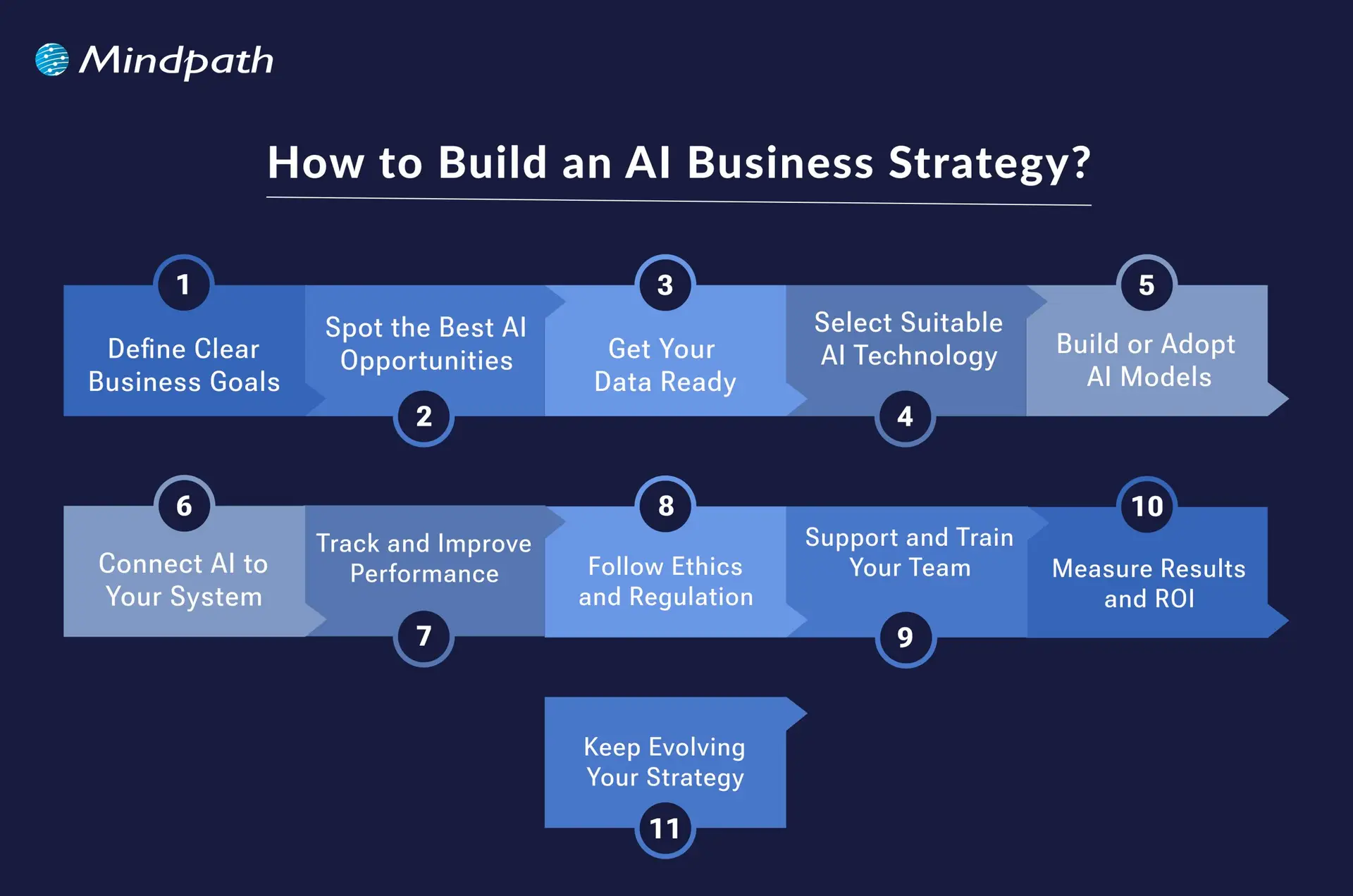
Building an AI business strategy takes careful planning and clear goals. Here are some practical steps to help you get started the right way:
How to Build an AI Business Strategy

1. Define Clear Business Goals

Start by deciding what you want to achieve with AI, like increasing sales, lowering costs, or improving customer service. Clear goals strategized by the expert AI consultant help you focus your efforts where they matter most. Knowing what you want makes it easier to pick the right AI tools later. A strong direction keeps your entire team aligned and motivated.

2. Spot the Best AI Opportunities

Look at your daily operations and see where AI can add the most value. This might be in customer support, marketing, supply chain, or product development. Finding the right areas will help you get quick wins and build confidence. Prioritizing these areas makes your investment more effective.

3. Get Your Data Ready

Good data is the foundation for AI success. Collect useful data from different parts of your business and make sure it’s accurate and well-organized. Clean and reliable data will help your AI tools work properly. Better data means better insights and fewer errors down the road.

4. Select Suitable AI Technologies

Explore the AI tools that match your goals and the type of data you have. This could include machine learning, chatbots, or automation software. Choose technologies that are practical and align with your strategy. Pick tools that your team can actually use and manage well.

5. Build or Adopt AI Models

Develop AI models that fit your business needs, either with your own experts or trusted partners. Some companies build custom models, while others use ready-made solutions. Test your models to make sure they perform well in real-world situations. Good models help you solve problems faster and smarter.

Ready to adopt the recent AI trends into your business? Read our detailed blog on Top AI trends, which provides a deeper understanding of how to implement AI into your business for future growth.

6. Connect AI to Your Systems

Make sure your new AI tools work smoothly with your current software and workflows. This may need teamwork between IT, data, and business teams. Good integration helps people use AI with less hassle. Seamless systems keep operations running without major disruptions.

7. Track and Improve Performance

Keep an eye on how your AI strategy is working post-implementation. Use regular checks to fix any issues and update the system with fresh data. A little maintenance keeps your strategy useful and accurate over time. Monitoring helps you spot new opportunities for improvement too.

8. Follow Ethics and Regulations

Think about the rules and responsibilities that come with using AI. Protect customer privacy and make sure your AI solution doesn’t create unfair bias. Stay up to date with local and international laws. Acting responsibly builds trust with customers and partners.

9. Support and Train Your Team

Help your team learn how AI fits into their work. Offer training so they feel comfortable using new tools and workflows. Encourage them to ask questions and share feedback. Well-trained employees make AI adoption smoother and more effective.

10. Measure Results and ROI

Decide which numbers will show if AI is really helping your business. This might be cost savings, higher sales, or better customer feedback. Keep tracking these results over time to see progress. Proving ROI makes it easier to get support for future AI projects.

11. Keep Evolving Your Strategy

Treat your AI business strategy as a work in progress. Keep testing, learning, and improving how you use AI as your goals change. Regular updates keep you competitive in a fast-changing market. A flexible approach helps you make the most of every opportunity.

Planning to leverage the power of artificial intelligence, understanding the technologies that drive it has become a crucial advantage. To dive deeper into the tools and technologies behind AI innovation, explore our detailed guide on the AI programming languages.

Ready to Transform Your Business with AI?

Adopting AI in business strategy helps your company make smarter choices, improve operations, and deliver better customer experiences. By understanding your goals and using AI wisely, you can drive innovation and stay ahead of the competition. Start with clear steps, keep learning, and stay flexible. This approach ensures that AI becomes a real advantage for your business growth.

At Mindpath, our AI development services are designed to help you unlock real results with confidence. We create solutions that match your unique needs, from custom AI models to smooth system integration. Our team works closely with you to ensure your strategy delivers value today and in the future. Let’s build an AI-powered roadmap for your success.

Frequently Asked Questions

1. How can small businesses start using AI without a huge budget?

Small businesses can begin with simple AI tools like chatbots, automated emails, or data analysis platforms. Start with one business problem instead of changing everything at once. Many affordable AI solutions today are scalable, making it easier to grow gradually without large upfront investments.

2. What challenges do companies usually face when adopting AI?

The biggest challenges are poor data quality, lack of skilled teams, and unclear business goals. Some companies also struggle with employee resistance to change. Proper planning, training, and choosing the right AI partner can make adoption much smoother and more successful.

3. How long does it take to see results from an AI strategy?

The timeline depends on the type of AI solution and business goals. Some companies notice improvements in productivity and customer support within a few months. Larger AI transformations may take longer, especially when they involve multiple departments and system integrations.

4. Can AI replace employees completely in business operations?

AI is designed to support employees, not completely replace them. It handles repetitive tasks and data-heavy work so teams can focus on creativity, strategy, and customer relationships. Businesses that combine human skills with AI usually achieve better results than relying only on automation.

5. How do businesses know if their AI strategy is actually working?

Businesses should track measurable outcomes like cost savings, faster processes, customer satisfaction, or increased sales. Regular performance reviews help identify what is working and what needs improvement. A successful AI strategy should create visible value for both the business and its customers.
Support Is One Click Away

Featured Posts

Related Post

react architecture 

Strong react architecture is the first step in building powerful digital products. It is also on a daily basis that the modern apps require speed, flexibility, as well as clean structure. So, what makes the complex applications continue to run smoothly as they increase? Intelligent architecture decisions determine performance, maintainability, and future growth. Thus, the need to know this basis becomes critical to serious business success.

Since user demands are increasing, the dispersed development is costly to roadblock and restrict innovation. A scalable approach ensures that the components are organized, data flows are clear, and teams are productive. Then, what is the secret to successful businesses creating React applications that can actually be maintained? In this blog, we will explore the react components architecture strategies behind scalable React applications. So, keep reading further!

Ready to turn your React architecture knowledge into a live, high-performing application built for scale? Explore Mindpath’s React development services and see how our expert team builds clean, modular, and future-ready solutions tailored to your business goals.

What is React Architecture and Why Does It Matter?

The react architecture is the intelligent architecture of a React application. It structures the code into reusable units that perform particular duties. This design ensures that the interface is clean, modular and simpler to construct. Having a clear data flow and logical design, developers build apps that remain organized as the complexity increases.

The significance of react scalable architecture is that it informs scalable and maintainable development. In the absence of adequate structure, large projects usually get confusing and difficult to operate. Proper architectural planning enhances performance, facilitates teamwork, and minimizes errors. It assists companies to create trusted applications that are easily adapted with changes in user requirements and capabilities.

Core Principles of React Architecture for Scalable Development

Developing scalable applications requires very solid structural foundations. Having clear principles enables teams to build faster, still keep quality, and reduce complexity.

Now, let’s look at the main principles that determine effective and future-proof React development.

1. Separation of Concerns

Do not mix UI, business logic, and data layers together. This results in a cleaner code base and also contributes to a more scalable react architecture that is easier to maintain.

2. Unidirectional Data Flow

Data flows from a parent component to a child component in a definite sequence. Hence making it simpler to identify changes and fix bugs.

3. Component-Based Modularity

Simply create reusable components which each have a single, well-defined responsibility. This way, you can keep your application flexible and well-organized.

4. Co-location

Keep related files together with their components. This practice not only makes the codebase clearer but also helps in managing project complexity.

5. Encapsulation via Module Boundaries

Only share the essential information between modules. This not only safeguards the structure but also makes the systems more manageable.

Key Features of a Strong React Architecture

A robust application framework is one of the great enablers of expansions, speed, and long-term stability. In fact, the proper basis goes hand-in-hand with boosting a team’s productivity and the quality of code.

Check below for the major characteristics that render feature-based architecture react a bigger scale and easier to handle.

1. Feature-Based Structure

Organizing code based on business features instead of file types is a good approach. Besides keeping projects nicely structured, it also allows easy scaling. React architecture patterns are more efficient when members of different teams can work on features independently.

2. Smart File Placement

Teams can locate related files very close to their main components to improve clarity and save on development time. With less confusion, programmers can work faster by navigating projects easily.

3. Clear Module Access

Have a single public entry point for each feature. This not only safeguards your internal code but also keeps your modules well-ordered. Besides that, it will make the whole system easier to maintain over time.

4. Layered State Management

Manage state according to its purpose and scope. For better control, keep local, server, and global data very separate. React clean architecture naturally leads to lesser complexity.

5. Separate Logic and UI

Separating business logic from visual components makes testing easier and improves code reusability. It will also result in neat development workflows.

6. Custom Hooks for Logic

Custom hooks are a good idea to implement reusable logic effectively. With components primarily responsible for rendering, hooks can handle the behavior part. This leads to simpler code overall.

7. Container and UI Split

There are two layers: one is responsible for data, and the other is oriented towards the presentation. The former deals with the application logic, and the latter is primarily focused on the look and feel. As a result, applications become cleaner and more flexible.

8. Centralized Service Layer

Separate API calls into one specific service section. This will enhance security, error management, and uniformity. Besides, it will help to keep the components cleaner.

React Architecture Best Practices for Scalable Applications

Developing scalable applications successfully entails doing a lot more than simply writing good code. Well-thought-out and intelligent ways of doing things lead to more robust systems, better performance, as well as easier expansion.

Below are the best practices that assist developers in creating dependable and scalable React applications.

1. Use Feature-Based Folder Structure

Instead of categorizing code based on file types, organize it according to business features. This helps in making the large applications scalable and easier to maintain.

2. Follow Single Responsibility Principle

A component is ideal for handling only one aspect of the task. This leads to cleaner, simpler and more reliable code.

3. Separate Logic and UI

Avoid mixing business logic with UI components. As a result, it will be easier to test, reuse, and have long-term flexibility.

4. Keep State Local

Put state in the nearest place to its actual user. Doing so lowers the complexity and prevents unnecessary global dependencies.

5. Apply Code Splitting

Load only the components required for your task at the moment. It will make the application faster and cut down the initial loading time drastically.

6. Use Type Safety

TypeScript aids in identifying bugs at an early stage of development. Thus enhancing your code quality and making really reliable applications.

Ready to Strengthen Your React Application for Future Growth?

Strong react architecture creates the foundation for scalable, maintainable, and high-performing applications. With the right structure, businesses improve development speed, reduce complexity, and build products that adapt smoothly to changing user needs.

At Mindpath, we provide ReactJS development services focused on scalable solutions, clean code, and long-term success. Our experts build powerful applications using smart react architecture strategies that support business growth.

Frequently Asked Questions

1. Why does React architecture matter more as an application grows?

As applications expand, poor structure creates maintenance issues, slower performance, and team confusion. Strong architecture keeps code organized, improves scalability, and supports smoother feature expansion.

2. How can React projects stay organized without becoming too complex?

Clear folder structure, reusable components, proper state management, and separated logic help projects stay clean. These practices reduce development stress and improve long-term efficiency.

3. What are the biggest mistakes teams make in scalable React development?

Common mistakes include overusing global state, mixing logic with UI, poor folder organization, and skipping performance optimization. These issues often slow growth.

4. How do custom hooks improve large React applications?

Custom hooks simplify reusable logic by separating behavior from components. This keeps code cleaner, easier to test, and more manageable across larger projects.

5. Which React architecture approach works best for modern business applications?

Feature-based structure often works best because it organizes code around business goals. This improves scalability, teamwork, and future development flexibility.

Monolith to microservices

Enterprise systems tend to have one unified architecture that facilitates early expansion. Gradually, construction gets heavy and hard to ascend. Releases slow down. Minor modifications require huge test cycles. Teams become under pressure to be more innovative. This is where monolith to microservices will be a strategic move towards enterprise legacy modernization. It is not a trend. It is a realistic reaction to actual operation constraints that influence operation, agility, and long-term development.

As businesses grow, they require systems that are flexible and capable of constant delivery and autonomous growth. Nevertheless, a monolithic building goes down only with solid architectural design and business focus. The technology leaders need to reconsider their deployment models, data management, and ownership of teams. Each step requires thorough consideration. In this blog, we will discuss how businesses may proceed in a practical manner to modernize architecture with clarity. So, keep reading!

Looking to simplify complex legacy systems for better agility? Mindpath’s legacy modernization services make it easier to break monoliths into microservices while keeping operations smooth.

What is Monolithic Architecture?

A monolithic architecture integrates all the application elements into a single piece of code. The database layer, business logic and user interface are a single system. Teams develop, test and deploy the application as a whole. It is a structure that promotes centralized control and easy management.

This model has been used by many enterprises to embark on their digital journey. Growth, however, makes the process more complex and causes the changes to slow down. Such a challenge tends to motivate the migration of monolith to microservices to enhance scalability and agility. Nevertheless, it is important to comprehend the monolithic basis before strategizing in terms of modernization.

Some of the advantages of monolithic architecture are listed here:

1. Quick initial development

2. Simple deployment process

3. Managing codes centrally

4. Reduced initial infrastructure price

5. Suitable for small teams

What is Microservice Architecture?

Microservice architecture forms an application of tiny, concentrated services. Every service deals with a certain business operation. They have teams that construct and operate. Services interact via APIs or messaging, which are lightweight. It is a structure that enables quicker releases and better ownership over teams.

Companies that switch from monolith to microservices have the goal of enhancing agility and scalability. Complex systems are broken down into services by teams. They enhance update control and performance control. This model facilitates constant delivery and the alignment of technology to evolving business needs.

Some of the advantages of microservice architecture are listed here:

1. An independent deployment of service.

2. Faster feature releases

3. Better fault isolation

4. Loosely planned technology options.

5. Targeted scalability

Want to ensure your move from monolith to microservices follows a clear direction? Explore legacy modernization strategy to build a structured and effective transformation plan.

Why do Organizations Switch from Monolith to Microservices?

As organizations become more and more application-driven, they become more complex. Monolith to microservices migration becomes a strategic decision when traditional architectures start limiting growth and flexibility.

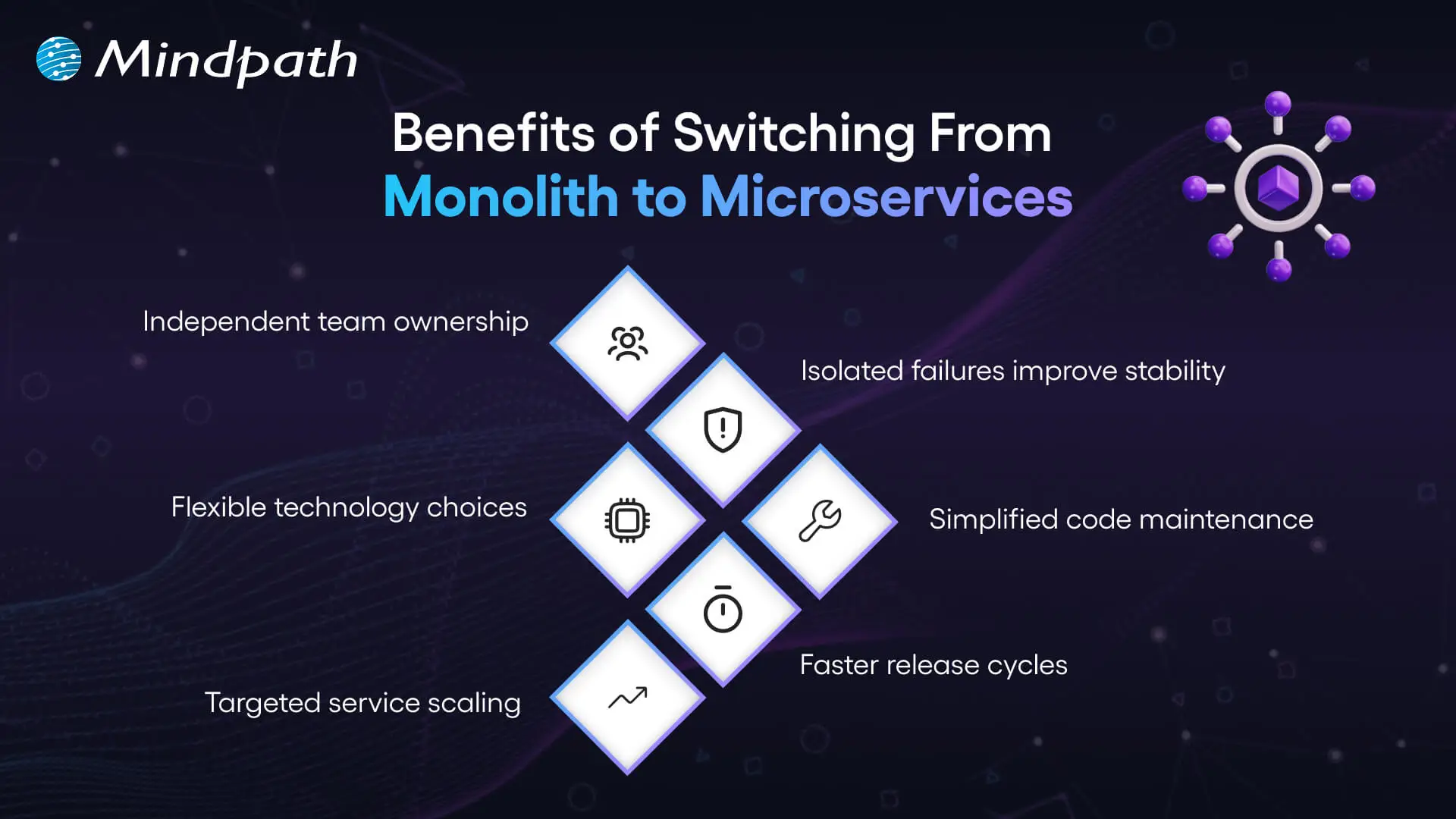
benefits of switching from monolith to microservices

1. Independent Team Ownership

Microservices provide teams with a definite service scope. The teams are in charge of their updates and releases. This construction minimizes wasting of time and enhances concentration. Organizations that follow monolith-to-microservices patterns build stronger ownership models.

2. Flexible Technology Stack

The appropriate tools depend on the service selected by the teams. They do not rely on a common technology. This innovation and future development is supported by this flexibility. It makes architecture flexible to alterations.

3. Targeted Scalability

Monolithic systems need to scale the whole application. Microservices permit the scaling of particular services. This method enhances management of resources. This accuracy is why many enterprises are abandoning monolithic to microservices.

4. Better System Stability

Even a single problem within a monolith is capable of affecting all. Microservice provides isolation of failures in a single service. The teams address the issues without impacting the entire system. This improves reliability.

5. Faster Release Cycles

Teams create and implement services on their own. They make releases without necessarily having to recreate the system. This enhances the speed of delivery. Business enterprises migrate from monolithic to microservice to enhance momentum.

6. Easier Maintenance

The huge codebases become hard to handle. Microservices separate applications into smaller parts. Developers are able to maintain and update services with ease. This facilitates long-term clarity.

Planning to reduce system limitations while adopting modern architectures? Learn from the benefits of modernizing legacy systems to improve overall performance.

Key Steps for Migrating from Monolith to Microservices

Organizations need to strategize before they shred a monolithic system into smaller services. Successful migration to microservices is based on clear strategy and disciplined execution.

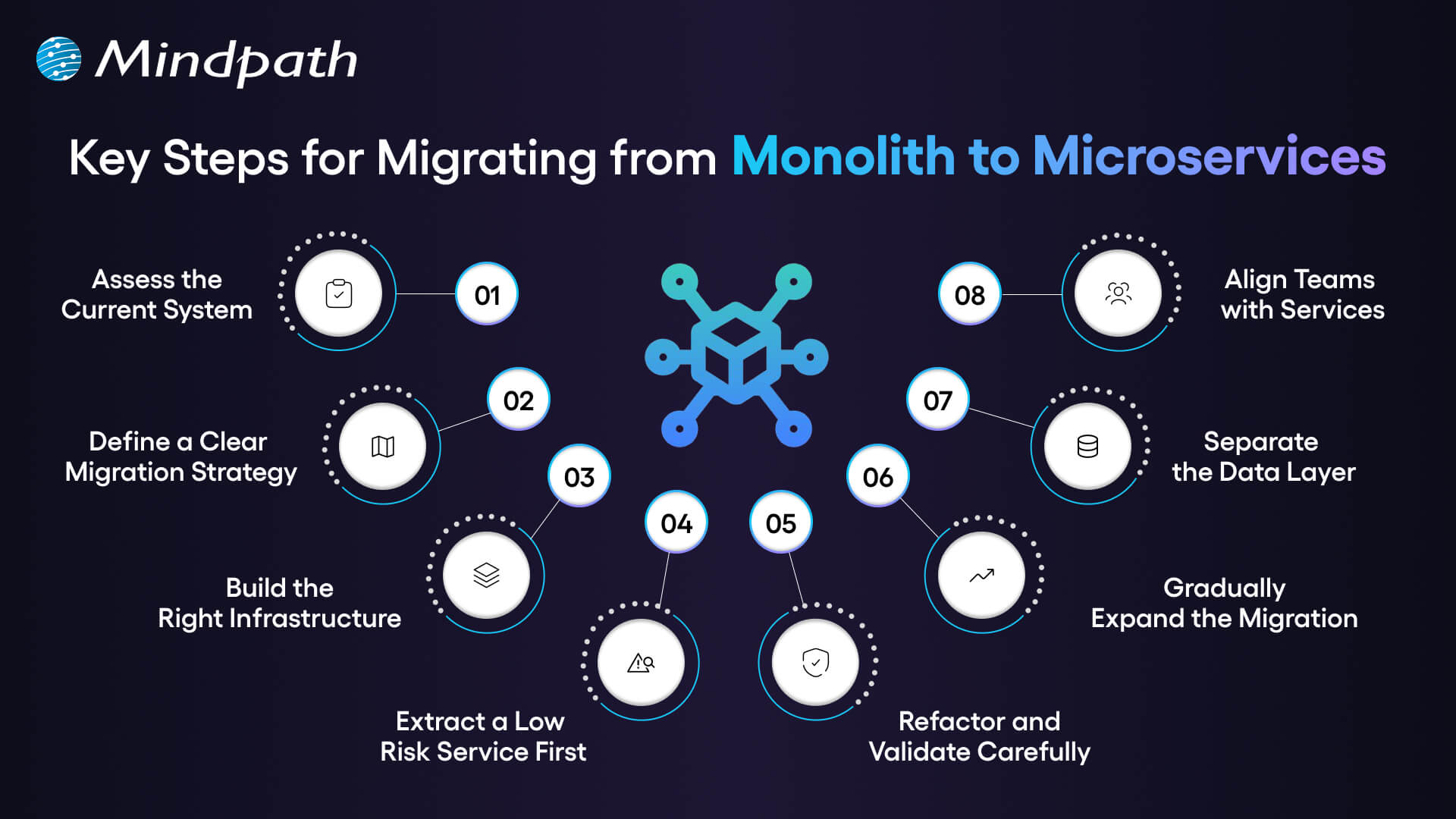
key steps for migrating from monolith to microservices

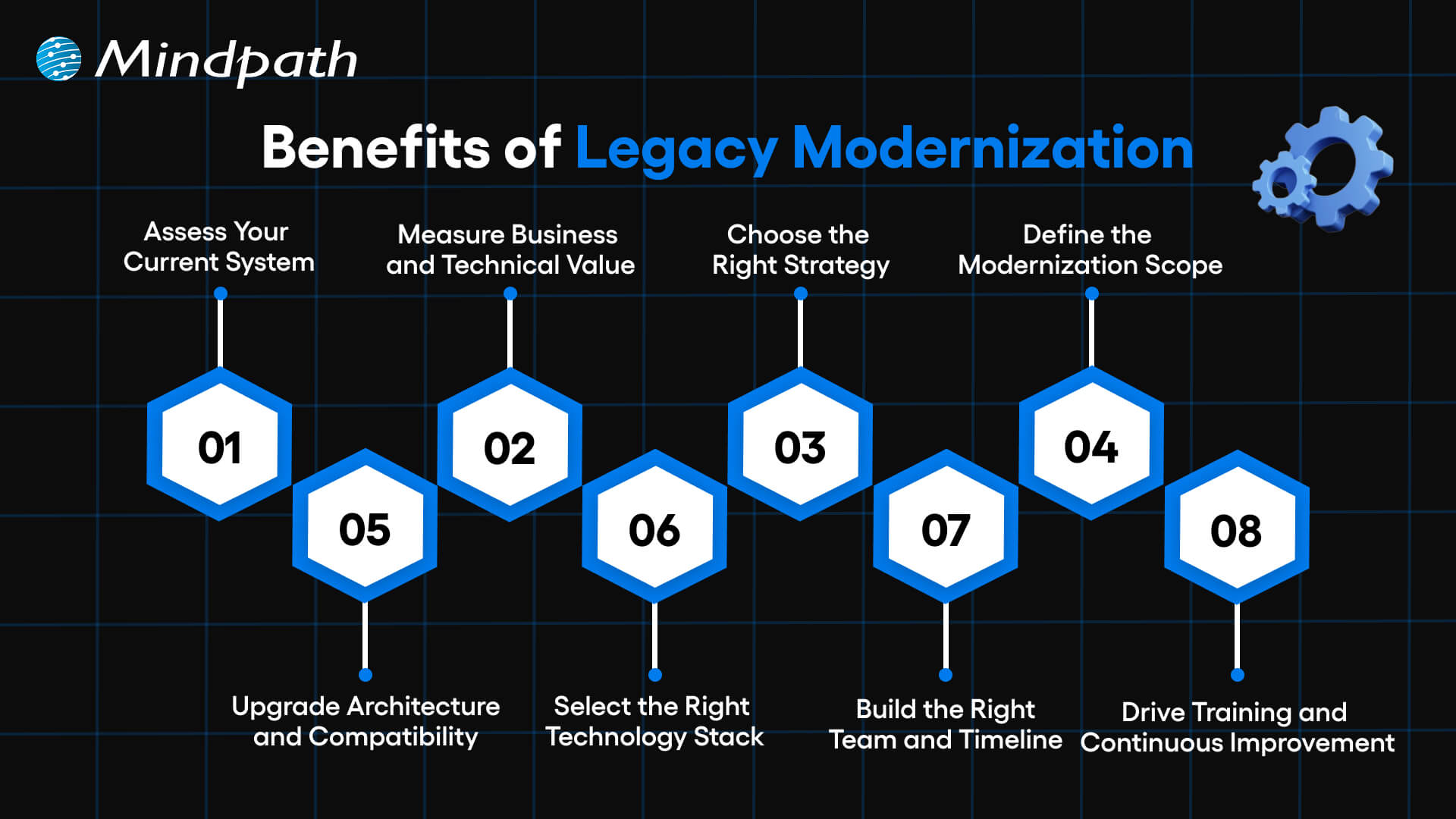
1. Assess the Current System

Begin by doing a line-by-line audit of your monolithic system. Check review services, dependencies, data flow, and performance gaps. This analysis forms the basis of successful monolithic to microservices migration.

2. Define a Clear Migration Strategy

Establish simple service boundaries on the capability of the business. Make decisions on the size of the service and the style of communication at the early stage. A strong monolithic to microservices migration strategy reduces confusion and prevents rework.

3. Build the Right Infrastructure

Finalize API gateway, service discovery and CI/CD pipelines. Insert containers and orchestration tools to introduce consistency. The powerful infrastructure promotes consistent monolithic to microservices conversion.

4. Extract a Low Risk Service First

Select a valuable module that is loosely coupled. Build it as a stand-alone service having its database. It is a risk-controlled step that is proving yourself.

5. Refactor and Validate Carefully

Refactor the chosen ones into a single service. Implement it and observe behavior closely. Logging and tracing helps to identify problems at an early stage.

6. Gradually Expand the Migration

Move other modules depending on the business priorities. Break-even monolith tasks gradually. This phased approach supports smooth monolithic application to microservices’ evolution.

7. Separate the Data Layer

Discontinue reliance on a corporate database. Allocate domain-owned datastores to each service. Synchronize the plan data keenly to ensure that it is consistent.

8. Align Teams with Services

Establish cross-functional teams for each microservice. Provide them with complete development and operations ownership. This is a structure that reinforces autonomy and long-term scalability.

Looking to enhance your modernization process with intelligent automation? Learn from AI-driven legacy system modernization to boost efficiency and performance.

Ready to Modernize Your Enterprise Architecture?

Contemporary business requires the ability to expand its systems as it grows and facilitate ongoing innovations. A clear shift from monolith to microservices improves agility, resilience, and operational control. The key to success lies in effective planning and implementation in phases and aligning a team. Through proper strategy, companies become simpler and create future ready digital platforms that underpin long-term business objectives.

At Mindpath, we provide legacy modernization services which help companies plan and implement legacy modernization with confidence and clarity. Our specialists evaluate architecture, establish migration roadmaps and deploy scalable microservices. We are performance-based, stability-centered and result-orientated. Collaborate with Mindpath to modify old systems into nimble, growth-motivated digital systems.

FAQs

1. Why should enterprises consider monolith to microservices today?

Enterprises face rapid market shifts and rising customer expectations. Monolith to microservices helps organizations build adaptable systems that support faster innovation. It also aligns technology with business domains, enabling better ownership, governance, and long-term digital growth without increasing structural complexity.

2. How do we know if our organization is ready for migration?

You should assess technical maturity, DevOps readiness, and team structure. Clear service boundaries and business alignment indicate strong readiness. Leadership commitment also plays a key role in successful transformation and sustainable architectural evolution.

3. Is monolith to microservices suitable for every business?

Not every system requires immediate migration. Smaller or stable applications may perform well as monoliths. However, enterprises planning aggressive scaling, multi-team collaboration, or global expansion often benefit from monolith to microservices as a long-term strategy.

4. What technical challenges arise during data separation?

Data decoupling often introduces consistency and transaction complexity. Teams must design domain owned databases and manage synchronization carefully. Event-driven patterns and API governance help maintain reliability during service level transitions.

5. How can Mindpath support our legacy transformation journey?

Mindpath’s legacy modernization services guide enterprises through assessment, planning, and execution. Our experts design scalable architectures and structured migration roadmaps. We help organizations transition confidently using proven monolith-to-microservices approaches aligned with measurable business outcomes.

AI tools for devops

Artificial Intelligence has certainly surfaced as a transformative force in the DevOps realm. In the current times, DevOps teams and professionals have the opportunity to leverage top Artificial Intelligence tools in order to streamline the software development process while promoting resource optimisation. 61% entities have reported that the adoption of AI in DevOps has significantly boosted their delivery ability.

Both novice and experienced DevOps professionals need to familiarise themselves with the strategic role of AI for the DevOps approach. The insight is crucial to capitalise on the capabilities of AI and strengthen how the DevOps approach is adopted while developing software solutions. Let’s identify some of the major AI tools that are revolutionising DevOps at the moment.

Want to adopt AI in DevOps with full potential? Mindpath’s AI Development Services provide full assistance on how you can select and implement the right tool according to your specific requirements.

Best AI Tools for DevOps Teams

Artificial Intelligence has been gaining high prominence in the DevOps arena. Within a short span of time, diverse AI tools have emerged that have simplified the work of DevOps teams. These tools have immense potential to redefine the DevOps approach.

It is imperative to identify the AI tools for DevOps so that you can simplify diverse processes relating to automation, security, code development and many more. Some of the top AI tools for DevOps professionals include:

1. GitHub Copilot

GitHub Copilot is undoubtedly one of the most popular AI tools for DevOps experts that exists today. It can be used as an extremely useful tool that is powered by Artificial Intelligence, which simplifies coding. It is capable of making suggestions to coders. Moreover, it can also assist coders by providing valuable assistance in entire functions. As a result, by leveraging the specific tool in the DevOps landscape, it is possible for developers to write code in an efficient manner. Furthermore, by leveraging the specific tool, the possibility of making errors is substantially reduced. GitHub Copilot represents a significant step toward the future of AI in software development and DevOps workflows.

2. AWS Codeguru

The popularity of Amazon Codeguru has been skyrocketing in recent times. It serves as a perfect tool that DevOps professionals can use for the purpose of automating code analysis. A highlight of this particular artificial intelligence for DevOps is that it is capable of making intelligent recommendations relating to code reviews. Coders and software developers can also rely on the specific tool to gain insightful suggestions relating to the performance of applications. With the help of this top-grade AI tool, DevOps teams can locate issues and improve the quality of their code, and fully leverage the benefits of AI in their development workflows.

3. Datadog

Datadog is a popular AI-driven platform that simplifies the processes for development teams. It is certainly among the top DevOps for business tools that can be used for diverse purposes such as monitoring, security, and performance. This tool offers rich insights to DevOps teams in terms of the behaviour of the software application and the overall health of the infrastructure. It certainly serves as a holistic tool that can offer observability power in an end-to-end manner to DevOps teams. You can definitely capitalise on this tool to achieve goals relating to real-time observability, unified monitoring, and troubleshooting.

4. Splunk

Splunk has gained a solid reputation in the DevOps scene of the current times. It acts as a robust data analytics and monitoring platform that can be used by DevOps teams. By choosing the specific AI-based tool, you can get complete visibility across the full software development lifecycle. In case you have limited familiarity with the particular tool, you can consider partnering with top providers of DevOps services. DevOps teams can leverage Splunk for diverse purposes, including monitoring of performance, event and log monitoring.

5. Sysdig

Sysdig serves as one of the most comprehensive DevOps platforms available for software developers at present. It has been specifically designed for diverse purposes such as monitoring and security in containerised environments. A chief highlight of the tool is that it integrates operations along with top security and offers unified control and visibility to teams. Thus, throughout the software development lifecycle, DevOps professionals can have a solid insight into the process. Moreover, you can rest assured about compliance and monitoring aspects by utilising the tool.

Trying to keep up with the rapidly evolving DevOps landscape as we move into 2026? Explore the latest DevOps trends shaping modern development, automation, and AI-driven workflows.

6. Dynatrace

In the contemporary DevOps landscape, the Dynatrace tool has been playing a cardinal role. It acts as an ideal observability platform that can be leveraged by DevOps teams while developing top-notch software applications. You can take advantage of this app to simplify processes relating to monitoring, collaboration, and automation. Furthermore, Dynatrace offers a broad range of tools that can create value for you relating to resilience engineering, release validation, and automated remediation of problems. The powerful capabilities of the AI tool can empower your DevOps team while developing novel software solutions.

7. Ansible

Ansible is a popular open source automation tool that streamlines DevOps practices for professionals. This tool is primarily used for the purpose of streamlining as well as automating a broad range of IT tasks and processes. It significantly contributes to the DevOps process by focusing on areas such as configuration management, deployment of applications, and the provisioning of infrastructure. Moreover, DevOps teams can leverage the AI-based tool to perform orchestration. This is because Ansible facilitates the orchestration of complex workflows and supports the coordination of multiple tasks.

8. Harness

In the current DevOps realm, Harness has emerged as a holistic software delivery platform., By using the specific tool, your DevOps team can automate the full software development process. Therefore, starting from continuous integration and continuous delivery, you can automate ongoing tracking of errors. Harness has been recognised as one of the most useful tools for DevOps professionals. With the help of the AI tool, your DevOps team can certainly accelerate the software development process and minimize the possibilities of errors and mistakes.

9. Argo CD

In recent times, Argo CD has surfaced as a popular AI tool that can be used by DevOps professionals. It is basically a declarative continuous delivery tool. By using the tool, it is possible for DevOps teams to automate the management as well as the deployment of software apps within Kubernetes clusters. The fact that it is open source in nature enables DevOps teams to use it in a highly versatile and flexible manner. The specific tool offers a broad range of features to users, such as single sign-on integration, multi-cluster management, and many more.

10. Snyk

While adopting the DevOps approach to develop software solutions, one cannot ignore the security aspect. This is when the Snyk tool comes into the picture. Snyk is a developer-first platform that incorporates security elements into the software development process. You can utilize this specific AI tool in your DevOps process for scanning vulnerabilities in code, containers and open-source dependencies. This tool is well-suited for diverse DevOps teams since it perfectly integrates with various elements, such as developer workflow, as well as cloud platforms. You can leverage the tool since it offers actionable insights that can enhance the overall quality of your software solution.

Looking to overcome DevOps hurdles such as security risks, and scalability issues? Discover DevOps challenges and solutions that help organizations overcome these issues and improve operational efficiency.

Benefits of AI Tools in DevOps

The use of AI tools in DevOps processes can give rise to a host of benefits for DevOps teams. Some of the major benefits that you must be aware of include:

1. Better reliability

DevOps teams can leverage AI capabilities to create highly reliable software solutions. This is mainly possible by making use of the predictive analysis function of AI technology.

2. Faster Software creation process

Software development can be quite time-consuming. However, by leveraging AI tools, it is possible to automate diverse processes. It can ultimately speed up the software development process for teams.

3. Proactive resolution of issues

Issues can act as major bottlenecks while developing software applications. With the help of the right AI tools, it is possible for DevOps teams to proactively deal with issues. Therefore, the overall quality of the software solution can also improve.

4. Improved collaboration

By using AI tools or generative AI tools for DevOps, it is possible for professionals to enhance collaboration. Collaboration can certainly open up new and better opportunities that can strengthen the overall process relating to the development of software solutions.

Want to learn how DevOps can transform your business and accelerate your development processes? Discover the benefits of DevOps for a deeper understanding of its impact and value.

Final Words

In the dynamic DevOps arena, the use of artificial intelligence tools is considered to be a necessity. DevOps teams need to be aware of the top tools so that they can strategically use them while creating software solutions. The selection of the right kinds of tools can certainly streamline the software development processes for you. Some of the top tools that you must be aware of include GitHub Copilot, AWS Codeguru, Datadog, Splunk, Sysdig, etc.

We at Mindpath help businesses to make the most of the top AI tools for DevOps with our AI Development Services. Our professionals ensure that the perfect AI tools are chosen that are in line with your DevOps processes. Moreover, you can see how intelligent DevOps can strengthen the quality of your software solutions.