How an AI Consultant Helps Businesses in Driving Digital Transformation? 

Join our Newsletter!

Featured Posts

Support Is One Click Away

Home

How an AI Consultant Helps Businesses in Driving Digital Transformation? 

AI consultant

How an AI Consultant Helps Businesses in Driving Digital Transformation? 

How can organizations navigate the dizzying speed of change in technology while being sure that they are creating action at every juncture? This is where the AI consultant comes in. The AI consultant is a facilitator who provides leaders with the ability to make decisions that create real change, instead of jumping from trend to trend with no direction other than the next trend. The role of AI consultant is all about actions that create a clear path forward. Isn’t it better to trust expertise that brings certainty to uncertainty?

Digital transformation then clearly becomes a much less daunting task. With appropriate direction, businesses can streamline processes, strengthen data-driven decisions, and increase customer experience.  Leaders can then invest in strategies that produce measurable results. No more guessing. Once each leader knows the target, transformation becomes an adventure where challenges can be tackled with purpose and growth can become scalable. In this blog, we will get into how an AI consultant can support companies pursuing digital transformation.

The expertise brought in by the AI consulting brings technical insights as well as strategic thinking. Mindpath’s AI Consulting Services help unlock new effectiveness and innovations in your business.

Why Do Businesses Need an AI Consultant?

An artificial intelligence consultant provides businesses with insight into how artificial intelligence can not only solve the problems they currently face but also improve operational effectiveness. They assess the company and what it needs and determine options for AI tools based on those needs, ensuring alignment through every stage of growth, operational efficiency, and an enhanced decision-making process going forward.

The consultant can also help address the gap between innovating AI technology and implementing that technology into the enterprise. They have both technical depth and strategic insight and offer organizations a roadmap to assist leaders in planning and applying solutions to achieve succinct outcomes. The prime focus is on measuring outcomes that create value, improve competitiveness, and position organizations for a digital transformation journey in the months and years ahead.

Must Read: Benefits of AI consulting

Responsibilities of an AI Consultant

By partnering with an AI consulting firm, businesses are able to work with experts who know how to make technology work for them. Their work includes strategy and planning as well as execution, ensuring AI solutions fit the overall business goals and create value that can be measured.

1. Finding the Right AI Opportunities

An AI consultant analyzes the existing processes of an organization to identify how artificial intelligence can offer measurable business value. They identify the use cases for an organization, including, but not limited to, automation, predictive insights, or improved customer experience, that can help to drive better results. This essentially creates the foundation for organizations to develop better opportunities from standard quotidian tasks that allow for AI business transformation.

2. Selecting the Right Tools and Platforms

An AI consulting service helps organizations determine the correct platforms and technology for their size, budget, and goals. For large enterprises, the consultant might recommend complex on-premises systems. For startups, a cloud solution might be the better choice. The right choice means that overall, AI adoption will go more smoothly, and you’re more likely to get better results from every project.

3. Training and Testing AI Models

The AI consultant regulates the building, training, and evaluation process before deployment. The AI consultant creates test cases for both accuracy and performance so that the solution sufficiently meets the business requirements. This process is crucial to the establishment of AI that can produce reliable and predictable results and information. This is also a part of AI consulting for business growth.

4. Preparing and Analyzing Data

All AI solutions require quality data, and this is why the AI consultant is so important. They clean, structure, and prepare datasets to make sure machine learning models can run reliably and accurately. Investing your data quality efforts in these specific steps provides the best foundation for solution scenarios like churn prediction or demand forecasting.

5. Monitoring and Improving AI Systems

Once deployed, AI systems require ongoing attention and refinement to remain effective. The AI consultant updates and operates the AI models, ensures the system scales, and deals with ethical implications. This continuing process facilitates flexible technology to adapt to the changing needs of the client’s business and ensures ongoing return on investment resulting from AI business transformation.

AI consulting is helping businesses in strategy making to become industry leaders. If you also want to know how, check out our blog: AI in business startegy

How Does an AI Consultant Drive Digital Transformation?

Understanding how AI consultants propel transformation is important for businesses that want to make better decisions and remain competitive. They can help organizations use AI in a more effective way and make sure that everything they do will lead to real change and long-lasting success.
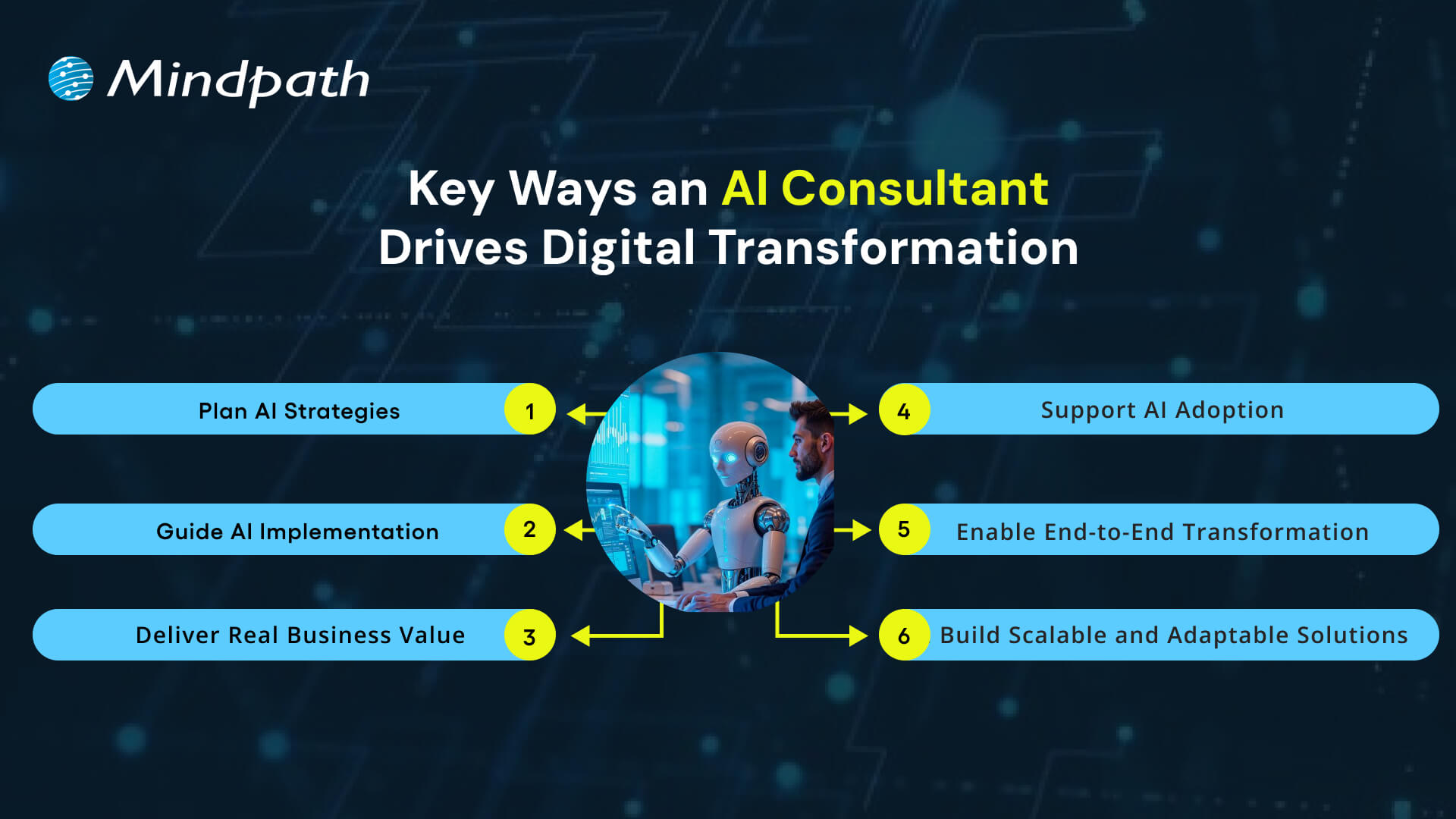
Key Ways an AI Consultant Drives Digital Transformation

1. Plan AI Strategies

An AI consultant assists organizations in synchronizing AI initiatives with fundamental business priorities while emphasizing outcomes over simply tools. They structure strategies that will connect data, technology, and business objectives into practical plans of action that ensure that digital transformation with AI delivers measurable outcomes throughout the organization.

2. Guide AI Implementation

Experts ensure teams apply AI technologies correctly in the right context, considering infrastructure, data, and practical implementation throughout the process. The increased exposure ensures reduced failed experiments, while returning greater proportions of success to AI projects.

3. Deliver Real Business Value

They emphasize outcomes that impact performance, not to simply automate. They work with experts to help companies develop smarter products, optimize workflows, and enhance the customer experience. All AI solutions are focused on achieving measurable outcomes and long-term benefits.

4. Support AI Adoption

Utilizing AI is much more than a technical shift; it’s an organizational change. They provide teams with tools to help them change their workflows, train them, and support their integration of AI tools into their regular workflows; all of which encourage a short adoption window, continued use of AI across the organization.

5. Enable End-to-End Transformation

Experts advocate total digital transformation through the alignment of people, processes, and technology, connecting leadership with technical and non-technical teams to maximize the impact of AI on transforming the future. The holistic nature of these AI consultant roles makes them central to any successful long-term transformation program.

6. Build Scalable and Adaptable Solutions

They will help provide assurance that these AI systems can be flexible and scalable to adapt to future needs when business requirements change. They monitor the AI systems are performing correctly and making iterative improvements as the businesses grow continuously. The continuous support allows organizations to realize the best potential of their AI systems over extended periods.

AI consulting is transforming the way modern businesses grow and compete in the market. Discover more on why organizations need AI consulting services to unlock growth and drive innovation in a rapidly changing market.

Want to Unlock the Full Potential of AI for Your Business?

Digital transformation is only effective when organizations thoughtfully and strategically leverage AI to transform processes, decisions, and experiences. An AI consultant partners with organizations to identify overall goals, align technology to deliver on those goals, build actionable plans, and deliver measurable results. With AI applied in a measured and thoughtful manner across all functions and operations, organizations can gain long-term growth, efficiency, and competitive advantage while using technology as a true driver and enabler of success.

We at Mindpath provide expert AI consulting services that guide businesses through planning, implementation, and scaling of AI solutions. Our team ensures every initiative aligns with strategic priorities, enabling measurable results and continuous improvement. By combining technical expertise with business insight, we empower organizations to leverage AI effectively and gain lasting value from their digital transformation efforts.
Related Post

Discover top Node.js libraries for AI integrations and learn to enhance your applications with machine learning, NLP, and more.
Discover the ultimate guide to hiring Node.js developers in London. Learn about the skills, benefits, and cost factors involved in finding the right talent for your project.
Discover the power of cloud-native development! Learn its benefits and how it helps businesses enhance security, efficiency, and performance.

Related Post

hiring a wordpress developer

WordPress remains a top choice for website development due to its scalability, ease of use, and flexibility. However, to unlock WordPress’s true potential, it is crucial to hire the right developer- an expert who can understand your goals, the technical nuances of WordPress, and your customers. Yet, hiring a WordPress developer is a major investment.

It is not just about finding a professional who can write code; it is a strategic partnership between your business and an expert who can offer you the required solutions. Besides, it involves more than just checking technical skills. This detailed hiring WordPress developer guide will guide you through the hiring process, helping you make an ultimate hiring a WordPress developer checklist.

Are you looking for expert help to build your WordPress site? At Mindpath, you can hire WordPress developers who are highly skilled and dedicated to building high-performing websites that drive measurable results.

Top Reasons for Hiring a WordPress Developer

Before diving into the WordPress developer checklist to ensure a successful hiring, let’s understand why you should hire expert WordPress developer.

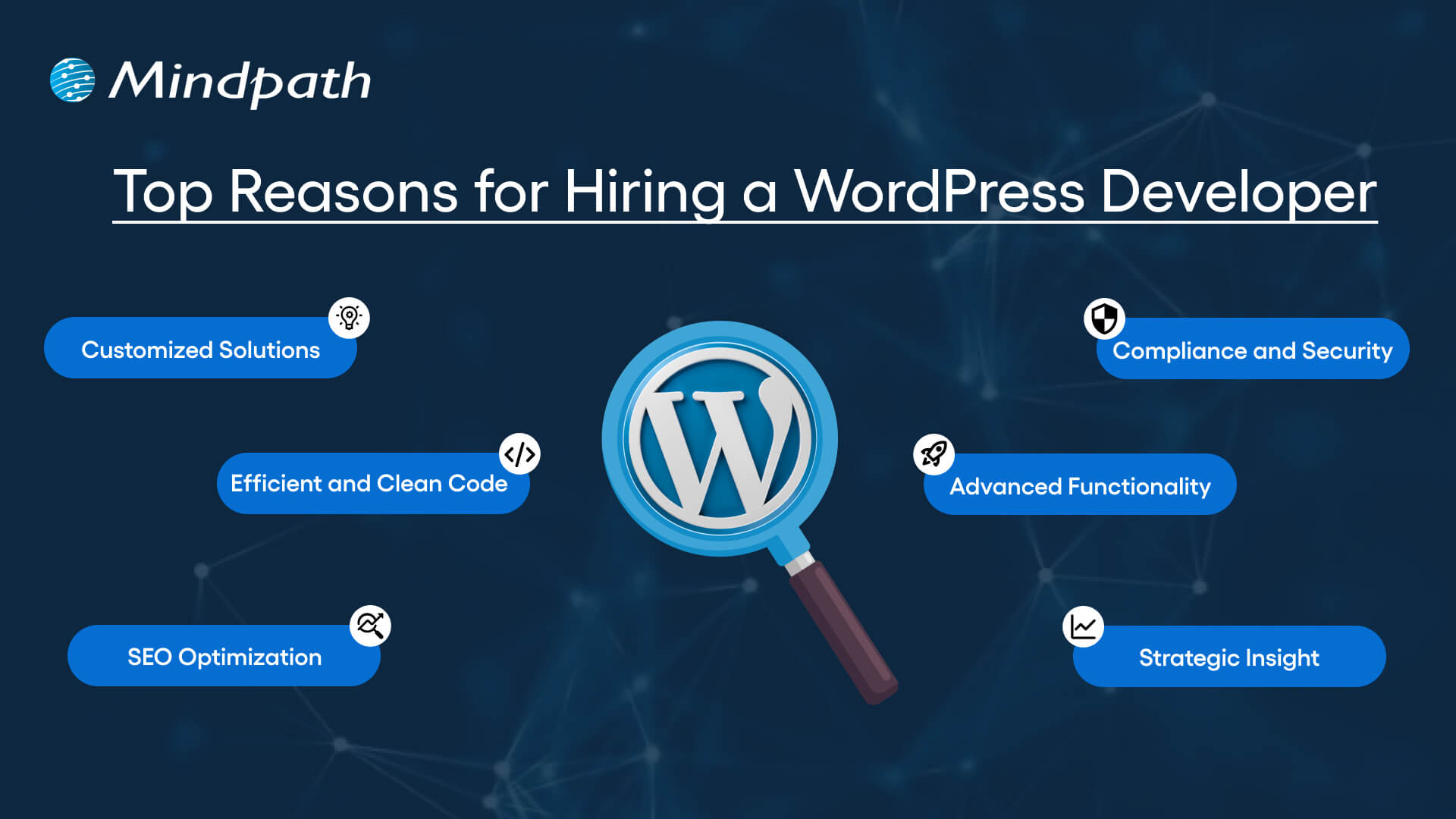
Top Reasons for Hiring a WordPress Developer

1. Customized Solutions

A professional WordPress developer can provide custom WordPress development for the site to match your unique brand identity, functional requirements, and user experience goals. Pre-built themes or plugins won’t offer you such flexibility.

2. Efficient and Clean Code

Skilled developers always prioritize writing scalable, secure, and optimized code. This ensures better SEO scores, fewer compatibility issues, and faster load times.

3. SEO Optimization

Developers know how to develop a website for search engines. For example, they use schema markup, semantic HTML, image optimization tools, and caching techniques that boost visibility and improve rankings.

4. Compliance and Security

From database protection to SSL configuration and plugin installation, professional WordPress developers deploy best security practices to protect your site from data breaches and malware. Besides, they ensure that all the plugins and elements are updated to the latest versions.

5. Advanced Functionality

Do you need a custom API integration or booking system? Well, a skilled WordPress developer knows how to integrate complex features that align with your user needs and business goals. They can also create custom plugins to expand the features of your site.

6. Strategic Insight

Apart from coding, WordPress developers help businesses to get detailed insight into conversion optimization, user behavior, latest trends, and more. All these things will help businesses in making smarter decisions.

Want to make sure your WordPress site is accessible to everyone? Check out our post on improve WordPress web accessibility to learn practical steps for making your site more inclusive and user-friendly.

Types of WordPress Experts- Which One Should You Hire

Understanding the benefits and value a developer can bring is just the beginning. To make the right decision on hiring a WordPress Developer, it is crucial to learn about the different types of WordPress developers you can hire. Remember that each brings a unique focus area and skill set.

1. Front-End WordPress Developers

These experts specialize in interactive and visual aspects of websites. They manage styling, layouts, and user experience and responsiveness using JavaScript, CSS, page builders, and HTML.

2. Back-End WordPress Developers

They focus on database management, server-side functionality, custom theme development, and plugin development. They work with WordPress core functions, MySQL, PHP, and more to create scalable websites.

3. Full-Stack WordPress Developers

Such experts handle back-end and front-end development tasks. They can create a website from scratch while ensuring seamless integration.

While hiring dedicated WordPress developer, you should choose the right type of developer to ensure your project aligns with the design goals, technical needs, and vision.

Curious about which developer’s role best suits your project? Dive into our article on Front-End vs Back-End vs Full-Stack to understand each role and decide which path aligns with your website’s needs.

WordPress Developer Checklist- Skills to Consider

Your hiring WordPress developer checklist should cover the key skills of WordPress developers. HTML, CSS, PHP, MySQL, and JavaScript rank among the key languages for WordPress development. Most developers are familiar with these languages, but knowledge of these technologies is not enough. Here are some skills that matter the most.

Hard Skills or Technical Capabilities

  • Knowledge of using core languages such as jQuery, JS, HTML5, CSS3, PHP, MySQL, React.js, and other languages.
  • Clear understanding of plugin architecture and WordPress core.
  • Building and customizing themes from scratch, and experience with various page builders like Beaver Builder, Gutenberg, Thrive Architect, Elementor, and Themify Builder.
  • Familiarity with REST API.
  • Knowledge of various optimization methods like scheme markup, image compression, caching, Core Web Vitals, minifying CSS, use of CDN, and more.
  • Understating security issues and applying fixes

Soft Skills

  • Ability to explain technical concepts in practical and simple terms.
  • Habit of making clear documentation.
  • Clarity and responsiveness in replies.
  • Ability to collaborate with backend teams and designers.
  • Familiarity with various management tools such as Jira, Trello, and Slack.
  • Willingness to accept feedback and incorporate it quickly.

Some Bonus Skills that Add Value

These skills are not that important for every project, but they can make a developer more valuable. These skills can include:

  • Experience in handling WooCommerce.
  • Knowledge about Headless WordPress configurations.
  • Use of Git or similar tools to manage collaborative workflows and code.
  • Experience in creating responsive and accessible designs to help websites meet the legal requirements of ADA.gov, etc.
  • A better understanding of the business’s goals, like lead generation, conversions, etc.

Want a more flexible and user-friendly website than a static HTML page can offer? Explore our blog on converting HTML to WordPress to see how shifting to WordPress can simplify maintenance and boost performance.

Hiring A WordPress Developer: Best Practices

Hiring a skilled WordPress developer can be a challenging process. That’s why utilizing a structured hiring a WordPress developer checklist is vital. A well-defined hiring checklist can help you save time, and you can hire the best talent for your projects. Here is how to begin your process to hire expert WordPress developer using a proven checklist.

1. Understand your Project Requirements and Goals

Before starting to search for a WordPress developer, it would be better for you to understand your project requirements. Do you want to create a new WordPress site from scratch or optimize an existing site? Are you creating a blog site, business website, or eCommerce platform?

Understanding these things will help narrow down the skills required. For instance, if you want to integrate APIs or advanced features into your site, then hiring a developer with skills in JavaScript or PHP would be a great choice.

Avoiding this step can lead to mismatched expectations. The more precise your needs, the easier your hiring a WordPress developer would be.

2. Selecting the Right Hiring Model

While hiring a WordPress developer, selecting the right engagement model is vital to aligning your development project budget, timeline, and scope. In general, WordPress developers come under three key categories these are:

  • Freelancers: Ideal for short-term and small projects due to their cost-effectiveness and flexibility.
  • Agencies: Offer complete solutions, including website design, development, SEO optimization, and maintenance. Agencies are ideal for large-scale and complex projects.
  • In-House Web Developers: They are best for organizations with ongoing development requirements. Businesses will enjoy faster turnaround and full control. However, this model requires businesses to invest in salaries, management overhead, and benefits.

Consider your budget, long-term objectives, and project size to choose the right model.

3. Developer’s Industry Experience

When using a hiring WordPress developer checklist, an important factor to consider is the developer’s industry-specific experience.

Working with a WordPress developer familiar with your business niche can significantly improve the outcomes while reducing costly trial and error. For instance, for creating an eCommerce website, hiring a developer with WooCommerce expertise will be the best option.

On the other hand, for a blog site, you should prefer to hire an expert with deep SEO and performance optimization knowledge.

This approach will accelerate development and boost functionality. And always ask developers whether they have built websites like yours.

4. Check References and Review Portfolios

Start by examining developers’ portfolios for design consistency, quality, and diversity of development projects that match your business niche. Also, check the custom developer tasks completed by developers to get an idea about their technical skills as well as problem-solving skills.

If possible, assess site performance, usability, and responsiveness to understand the developer’s attention to detail. Also, go through client references to confirm the developer’s support quality, professionalism, and reliability.

5. Conduct Technical Tests and Interviews

Don’t just rely on resumes. Conduct thorough practical tests and interviews. Start by creating targeted interview questions. For instance, you can ask, “How do you solve plugin conflicts”? Or “How do you check a site’s responsiveness?”

Practical tests can include fixing a site speed problem or creating a custom feature or post type. Such tests show developers’ technical skills, efficiency, and creativity. Besides, it helps you to know whether they can work under pressure. This step is pivotal for confident hiring decisions.

Stuck deciding whether WordPress or Drupal is a better match for your business? Our WordPress vs Drupal guide breaks down key differences to help you pick the perfect solution.

Common Mistakes to Avoid

Even with a solid WordPress checklist, mistakes can happen. Here are some common mistakes that you should avoid during the hiring process.

1. Don’t hire an expert based on just low rates. Focusing on the cost factor over quality can lead to poor site performance, missed deadlines, and you may end up with a site that may not meet your business goals.

2. Avoid developers who don’t want to sign confidential agreements. After all, keeping your business data, personal information, and intellectual property safe is important, especially when sharing sensitive details and backend access.

3. Don’t overlook maintenance service and ongoing support offered by the developer. Without this, your site may become vulnerable to bugs and security issues, affecting user experience, speed, and scalability.

4. Don’t ignore red flags such as lack of references, unclear communication, or vague answers.

5. Don’t make your hiring process long and complicated. Excessive interview rounds and lengthy assessments can frustrate candidates, and you may lose top talent.

6. Developers can only create and customize your site. They are not content strategist or designers. So, expecting them to handle everything would be a big mistake, leading to missed opportunities and misaligned results.

Want to ensure your WordPress site is running on the right PHP version for top performance and security? Check out our guide on WordPress PHP compatibility to keep your site efficient, stable, and future-ready.

Hire Smart and Built Better with Mindpath

Hiring a WordPress developer is a major investment that you make in your business. This can greatly influence your business’s digital future. By following this detailed WordPress developer checklist, you can avoid common mistakes and find a WordPress developer who can create a website that will boost your online presence.

If you are searching for a trusted platform to hire an experienced WordPress developer, you may not find a better option than Mindpath. We specialize in providing the industry’s best WordPress developers, who combine creative design skills, deep technical knowledge, and commitment to quality to develop a perfect solution. Your website needs creative vision, thoughtful design, and expert attention that can bring your brand to life. And for this, you can always count on Mindpath.

Discover the essential factors for hiring a top WordPress developer. Learn about expertise, communication, experience, cost, and finding the right platform.
MVP in software development

MVP in Software Development is also known as Minimum Viable Product. It is the particular version of a software application with enough core features so that it can be released to the early users. The fundamental goal of developing MVP software is to validate it and get it to the market quickly.

As innovation in the current market setting is growing at a rapid pace, it is essential for businesses to realize the importance of software development MVPs. You need to develop an MVP before investing a significant amount of money in the full-scale product. This strategic development methodology can be implemented by the development team without having to build a complete software product. It is the right time to explore the relevance of MVP in software development.

Wondering how to validate your software idea before committing full resources? Mindpath’s MVP development services help businesses build functional prototypes and gather real user feedback quickly.

What is MVP Development?

In the era of digitalization, startup businesses may wonder – what is MVP in software development? In simple words, MVP or Minimum viable product is the test version of a product or software. This strategic development approach begins with the creation of the beta version of the software that a business plans to create. 

This basic version consists of the essential features and functions. These elements are included by taking into consideration the pain points of clients. The core idea behind the MVP development process is to build customer-oriented software applications. It helps businesses to ascertain whether their product is up to the mark or if it requires improvement. MVP development focuses on minimizing costs and business operations. It even helps to build the software in a smarter and efficient manner.

Stages for Building an MVP

In order to build an MVP in the context of software development, a systematic approach has to be adopted. The MVP development process involves a series of stages that you need to be aware of. You need to follow the steps in a methodical manner so that you can succeed while developing an MVP. 

1. Defining the Problem 

The fundamental step is to know the problem or pain points of your users. If businesses do not have insight into this area, they may end up creating an app that no one will use. So you need to clearly define the specific problem that your software application is going to solve. At this stage, startup businesses can consider using MVP development services. Otherwise, they can sit and discuss with their development team the problem that the application is going to solve. It is also important to understand how important the application will be for people who will be using it. 

2. Knowing the Target Audience

At this stage of the MVP development process, it is essential for you to decide who will be your target audience. A common mistake that some developers make is that they decide to create an app for everyone. It is advisable to target a niche group when startups develop an application. It can help narrow the focus of the project and develop well-functioning software. Businesses need to build the target audience persona and make it as detailed as possible.  Some of the details that should be included in the persona include profession, age, and income group. 

3. Ascertaining Key Features

Startups need to determine the key features that the first version of the product must have. It is an important thing you need to look at after defining the problem and identifying your target audience. At this stage, businesses need to list down all the possible features of the product. Then you must decide the essential features that need to be incorporated to make the software application usable. From the list of features, you can choose the most essential features that need to be included in the MVP. 

Must Read: MVP for Startups

4. Building the MVP

Once you have clarity about the features of your MVP, it is time to start creating the product. At this stage, you have to determine the programming language, framework, and other tools that you plan to use. You can even consider taking the help of an MVP development company if you wish to build your MVP. At this particular stage, you do not have to think about making a perfect product. Instead, startup businesses must focus on building a product that is usable for the intended audience. The ultimate goal must be to develop a functional product within the shortest period of time. 

5. Testing the Product

After you have created your MVP, it is time to test it. You must reach out to early adopters who are going to be the actual users of your software application. It is vital to search for the people who match the created buyer persona. You must request them to try out your MVP. If it is possible, you can reach out to them via social media or email. At this stage, your ultimate goal should be to get a good number of people and gather feedback from them. Collecting honest feedback is crucial to making improvements in the software application MVP. 

6. Using Feedback for Product Improvement

Once users start giving feedback about your MVP, you need to start collecting it. Moreover, you need to see what the best way is to implement them so that your software can meet the needs of the target audience. Initially, you need to focus on how your software solves the problem for users. If you receive positive feedback, you need to look at additional features that you can incorporate into your actual product. The feedback loop can guide you to develop the ideal product that can effectively meet the needs of the intended users. 

Ready to push your MVP from idea to functional product? Explore our blog on hiring full stack developers for MVP to learn what abilities truly drive strong outcomes.

Advantages of Developing a Successful MVP

The creation of an effective MVP can give rise to a host of advantages for startup businesses. You need to be aware of the chief benefits.

1. An MVP can help a business quickly decide whether the solution genuinely resonates with the target audience or not. It can save valuable time as well as resources of your business while helping you to test the core assumptions with the actual users. 

2. An MVP can enable businesses to test their business concept with limited investment, as it can minimize the financial exposure that is associated with full-scale software development. So businesses can avoid making costly mistakes. 

3. The invaluable feedback that businesses can gather can help in iterating and refining the product. So you can take into account the actual needs and preferences of your customers and create value for them through the software solution.

4. An MVP can help you launch your software application sooner in the market. This will be possible since you can focus on the essential features and key functionalities. The MVP can help you gain a competitive edge in the market setting. 

In the current times, when the needs and preferences of customers are rapidly changing, businesses need to understand the importance of an MVP. A successful MVP can enable businesses to create something that can create value at a comprehensive level.  

Curious about the different ways software can be built? Check out our guide on the types of software development to learn which approach fits your project best.

Final Words

In the context of software development, the relevance of a minimum viable product cannot be ignored. If businesses plan to develop a new software solution in the market, they need to adopt the MVP approach. The systematic development approach can enable businesses to create software that can create value for the ultimate users in the market. Businesses need to understand the strategic value of a minimum viable product. The knowledge can empower them to build software applications that perfectly match the needs of their target audience.

Mindpath’s MVP development services can help businesses develop their minimum viable product in an effective and efficient manner. Our experts will guide you to make refinements in your software by taking into account the needs of your target audience. 

Benefits of agile methodology

Approaching software development without a flexible mindset can often result in delays and stress. This is where the benefits of agile methodology come into play. Agile allows a team to react quickly to change, provide value continuously, and maintain common goals. Agile fosters teamwork, quick delivery, and incremental updates. If you ever find that you are constantly feeling stuck or that things are moving too slowly, then Agile can provide a steady flow that will keep things moving forward and adjust its plans accordingly.

Agile offers structure while maintaining flexibility. Project work is broken down into smaller bits and allows for feedback and change along the way. This helps keep developers, testers, and clients engaged through the process. People can track progress more easily and receive results faster. Agile doesn’t just focus on completing tasks, but on building something useful at every step. This blog highlights some of the primary benefits of Agile that many of today’s teams prefer to embrace.

Explore how custom software development services using agile methodologies elevate your business performance. Reach us at Minpath, and we will provide expert guidance to you every step of the way.

What is Agile Methodology?

Agile methodology is an adaptive and collaborative method of software development based on the principles set forth in the values of the Agile Manifesto. Agile focuses on teamwork, the ability to adapt, continuous improvement, and the delivery of working software in small, manageable pieces. An agile team is self-organized and can adapt quickly to changes during the development life cycle. So, what is the main objective of agile methodology? It is to be responsive and provide value more quickly.

Agile focuses on helping teams select tools and techniques for their goals rather than abiding by a single standardized process. Each project can look a little different, but they all follow the same Agile principles by planning in short iterative cycles, soliciting feedback, and adjusting from there. Ultimately, Agile allows teams to deal with uncertainty during a project in order to improve at every turn.

Also Read: Types of Software Development

Types of Agile Methodologies

Agile provides several methodologies that adhere to its fundamental principles; however, they differ in structure and practice. Each is intended to foster teamwork, speed, and flexibility in its own unique way.

Types of Agile Methodologies

1. Crystal

Crystal is a lightweight agile methodology that encourages rapid delivery of working software, communication with customers, reducing risks, and frequent releases. It is flexible with respect to team size and project complexity, and it promotes collaboration and communication to improve team and customer feedback.

2. Scrum

Scrum is a prescribed agile framework that arranges work into fixed-length sprints, which allow the team the opportunity to inspect how much work was done so far and adjust based on that. The goal is to enhance visibility, facilitate some level of collaboration consistently, and have continuous improvement as the team works through it with prescribed roles and ceremonies.

3. Kanban

The kanban approach is concerned with delivering work continuously and has a strong lean focus on improving the process. The visual workflow helps teams find bottlenecks, work on reducing cycle times, and allows managing work to be simplified using boards and cards.

4. Lean

Lean focuses on maximizing customer value by eliminating waste and improving efficiency throughout the development process. It supports fast delivery, strong team collaboration, and quick response to feedback.

5. Scrumban

Scrumban fuses the structured planning of Scrum with the visual task management of Kanban to allow flexible value-based delivery. It is an adaptable and process-focused method that allows teams to incorporate regular updates, rapid releases, clear task ownership, and adaptability as project needs change.

Wondering how Agile practices fit into the bigger picture of building high-impact web applications, our web app development roadmap outlines the full step-by-step journey from planning to deployment.

Top Benefits of Agile Methodology

Agile provides a modern approach for the management of software projects, which is focused on flexibility, collaboration, and rapid delivery. Here are some important agile software development benefits that aid teams in creating better products with better timeliness.

Top Benefits of Agile Methodology

1. Customer-Centric Results

Agile methodologies promote regular feedback and involvement from customers in every aspect of development, leading to products that can be tailored to more accurately fit the needs of the user. One of the key agile software development advantages is that this increases customer satisfaction (as perceived by customers during development) and trust moving forward.

2. High-Quality Deliverables

With every sprint of work teams are testing and improving their work. You will note that the ongoing improvement is one of the key benefits of agile software development, and it helps teams develop stable and reliable products. Solving problems early is part of the workflow.

3. Flexibility to Change

Agile teams can quickly adjust plans in response to new feedback or ever-changing goals, and ease of change is one of the greatest strengths of agile software development. The essence of agility is the ability to stay aligned with business needs without spending unnecessary time or going off track.

4. Clearer Planning and Estimations

Agile operates within short, structured cycles, which allow for considerably improved estimation of timelines and budgets. This is one of the most important benefits of agile software development, especially for project managers whose primary goal is to solicit the meters for project planning in the most effective way possible. Predictable progress encourages smarter decisions.

5. Reduced Development Risks

Frequent reviews and updates allow teams to catch issues early when they are still not serious problems. This built-in risk control offered by agile is of major benefit to agile project success. Agile provides full visibility into work progressing at all times.

6. Stronger Team Collaboration

Agile encourages daily stand-ups, a routine dialogue, and real-time feedback/updates. This collectively helps with teamwork, collaboration, and confusion regardless of role. Better communication is one of the fundamental advantages of agile methodology and contributes to an easier, smoother project flow.

Want to know how businesses turn ideas into scalable software solutions? Explore the custom software development process and the role Agile plays in efficient execution.

Ready to Embrace the Agile Advantage?

Agile has changed the way modern teams build software by promoting collaboration, speed, and flexibility. The benefits of agile methodology include higher customer satisfaction, better product quality, reduced risk, and smoother workflows. By using short cycles and continuous feedback, Agile helps teams deliver faster, smarter, and with greater confidence, making it a preferred choice for many development teams today.

Want to apply these custom software development benefits to your next project? At Mindpath, we offer custom software development services built around proven agile methodologies. Contact us and our team will help you with clear communication, flexible planning, and faster delivery that meets your business goals. With Mindpath, you get tailored solutions that revolve around your business requirements and deliver long-term value with every sprint.