Multi Cloud vs. Hybrid Cloud – Choosing Right Model for Your Business

Join our Newsletter!

Featured Posts

Support Is One Click Away

Home

Multi Cloud vs. Hybrid Cloud – Choosing Right Model for Your Business

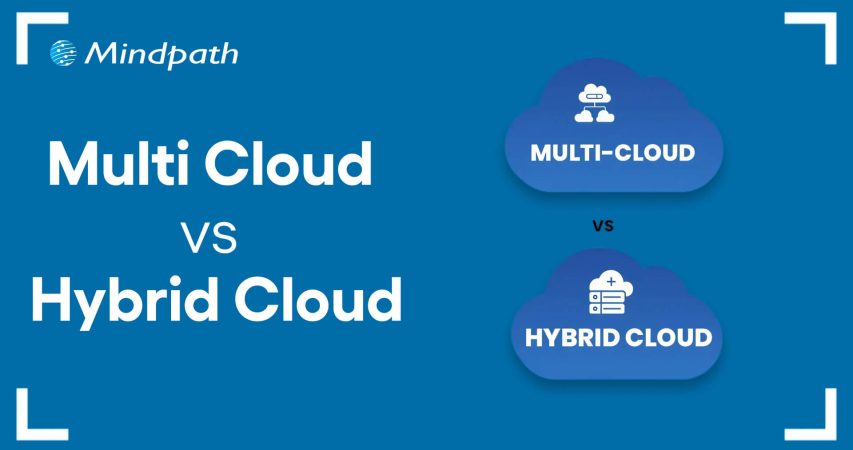
Multi Cloud vs Hybrid Cloud

Multi Cloud vs. Hybrid Cloud – Choosing Right Model for Your Business

Deciding between multi-cloud vs. hybrid cloud strategies is becoming an important choice for organizations that want to remain agile and scalable. Every organization needs to find a way to balance flexibility, security, and performance, and this holds true with cloud architecture as well. The more complex challenge is determining which model can optimize operations while allowing the teams in the organization to innovate unhindered. As technology progresses to new heights, a strong cloud architecture can be a differentiating element within an organization’s growth.

It is essential to be certain of how both cloud models serve your business objectives and technical goals to make the better decision. It is not just an issue about infrastructure, but positioning your organization for the future and digital resilience. Understanding their differences helps organizations make confident and data-driven decisions in a world where technology changes rapidly. In this blog, we will explain some of the fundamental principles of multi-cloud and hybrid cloud so that the decision on which is best for you will be less difficult.

Want to determine which cloud strategy will be ideal for your organization? Contact us to get deeper insights and make smart business decisions that lead to future growth.

Understanding the Fundamentals of Hybrid Cloud and Multi-Cloud

A hybrid cloud combines both private and public cloud services in order to provide an adaptable and secure environment for computing. Organizations can house sensitive data in a private cloud to protect it, while still utilizing the on-demand, scalable, and cost-effective computing of the public cloud. Hybrid clouds offer enhanced control, resource utilization, and performance. Utilizing a hybrid cloud allows organizations to efficiently manage workloads across the types of cloud while enjoying the benefits of both cloud types.

A multi-cloud strategy uses multiple cloud service providers to achieve specific corporate objectives. In the multi-cloud vs. hybrid cloud debate, companies will tend to prefer multi-cloud solutions for flexibility, avoiding being locked into a single vendor platform, and minimizing operational risks such as downtime or loss of data. Each application in a multi-cloud environment can run on a public cloud platform or private cloud platform based on relative performance or cost needs.

Wondering how application architecture impacts multi-cloud and hybrid cloud success? Explore cloud-native development to learn how cloud-native apps improve scalability and flexibility.

Advantages of Hybrid Cloud

A hybrid cloud gives companies the right combination of flexibility and control, helping companies manage data securely and securely provide scalability and efficiency for operations.

1. Strong Security and Data Control

Hybrid cloud allows companies to maintain improved control of sensitive data and mission-critical systems. Companies can use private servers to store private information and public clouds for everyday tasks, allowing for a balance between security and freedom.

2. Smarter Cost Management

Businesses can reduce their costs by maintaining constant workloads on private systems, while variable workloads can move to the public cloud. This model allows for a pay-as-you-go system that reduces risk of overspending and improves cost optimization.

3. Faster Performance and Low Latency

Hybrid cloud enhances performance by positioning time-sensitive jobs, such as analytics or IoT applications, nearer to the end user. The configuration call for helps to reduce latency and increase response times for the users.

4. Reliable Disaster Recovery

Businesses are able to store crucial data in the public cloud while ensuring that a main version is also preserved on their premises and if there is a systems failure, they can quickly restore and resume business as usual with minor interruptions.

5. Greater Scalability on Demand

Organizations can easily scale their capacity up or down via the public cloud when they find themselves in busy periods or running promotional activities that bring in high traffic. After the busy period ends, they can scale down their capacity, so they aren’t wasting money and resources.

6. Better Compliance and Data Governance

Hybrid cloud helps companies follow data protection rules by keeping customer data on local servers. At the same time, they are still able to carry out non-sensitive work in a public cloud, thus making an informed decision on multi-cloud vs hybrid cloud.

7. Boosted Innovation and Flexibility

Teams can experiment with fresh tools and services in the public cloud without interfering with core systems. This illustrates that the difference between multi-cloud vs hybrid cloud can drive business innovation and flexibility within the digital age.

Is your cloud strategy aligned with long-term digital growth goals? Discover digital transformation for businesses to understand how the right cloud approach accelerates innovation.

Examples of Hybrid Cloud

These are some real-world hybrid cloud examples and how organizations use this approach to improve business flexibility, security, and efficiency.

1. Digital Transformation

A hybrid cloud modernizes IT systems with a remote workforce and protects data in a secure environment.

2. Disaster Recovery

Hybrid clouds help your business continue operating normally by recovering data at a fast speed in the event of outages.

3. Development and Testing

Developers develop and test apps in their public clouds, then port to private clouds.

4. Cloud Bursting

During peak traffic, additional workloads move from private clouds to public clouds without impacting performance.

5. Edge Computing

Delivers and processes data near the user, resulting in faster and lower latency experiences.

6. AI & Machine Learning

A hybrid cloud supports AI workloads with the best scalability and the security of their data.

Looking for ways to optimize costs and scale applications seamlessly in complex cloud setups? Discover serverless architecture in cloud computing to explore how serverless solutions support modern cloud architectures.

Advantages of Multi-Cloud

The following are the main benefits of a multi-cloud strategy that will help to improve business performance and facilitate better operations.

1. Business Continuity Edge

In comparing multi-cloud vs. hybrid cloud, one advantage of multi-cloud is that it allows operations to continue even if one of the providers has an outage. By spreading workloads across a combination of platforms, businesses provide continued performance and reliability.

2. Flexible Cost Management

In the hybrid cloud vs. multi-cloud comparison, another of the advantages of multi-cloud is improved cost control. This allows companies to choose the cheapest cloud provider for each workload and optimize resources effectively.

3. Customized Security Approach

Multi-cloud allows organizations to engage with providers that best suit their compliance and security requirements. This helps to ensure improved data security and better alignment with regulatory standards.

4. Independent Provider Choice

Using a multi-cloud strategy, organizations will have less reliance on one vendor. They will have the flexibility to move workloads, negotiate terms, and meet changing demand in the market.

5. Optimized Technology Access

Each cloud provider has a service that they do best, e.g., AI, analytics, or integration. Multi-cloud allows organizations to select the cream of the crop and combine them together to get the best performance and innovation.

6. Enhanced Global Reach

Multi-cloud allows applications to be deployed across multiple locations to minimize latency and enhance speed. This is especially useful for global companies that need to provide consistent, reliable speeds globally.

7. Ongoing Innovation Power

By utilizing countless ecosystems in the cloud, firms are able to engage with new, emerging technologies that give them flexibility and even a competitive advantage regarding innovation and continued growth.

Curious about where cloud adoption is heading next? Explore cloud computing trends to discover emerging technologies shaping multi-cloud and hybrid strategies.

Examples of Multi-Cloud

Here are real-world examples of multi-cloud that demonstrate how businesses use multiple providers to enhance their performance, flexibility, and reliability.

1. Specialized Services

A business may use Google Cloud for analytics and AWS or Azure for AI tools to get the best of each platform.

2. Disaster Recovery & Continuity

A financial firm can rely on OCI for core apps and IBM Cloud as a backup to ensure uninterrupted operations.

3. Cost & Performance Balance

A retailer may host its e-commerce site on one cloud and run analytics on another to save costs and improve speed.

4. Diverse SaaS Usage

An organization can follow a multi-cloud approach by using Salesforce for CRM and Workday for HR management.

5. Compliance & Data Security

A healthcare provider may store patient data in a private cloud while using a public cloud for general operations.

Looking to build healthcare software that meets strict compliance and data security standards? Explore our blog on healthcare software to discover how secure cloud-based solutions protect sensitive patient data.

Multi-Cloud vs. Hybrid Cloud: A Comparison Table

Below is a brief comparison table showcasing the primary differences between hybrid cloud and multi-cloud, so you can gauge which model may work better for your business requirements.

Aspect Hybrid Cloud Multi Cloud
Definition Combines private and public clouds to work as one integrated environment. Uses multiple public cloud providers for different workloads.
Primary Goal Balance security with scalability by keeping sensitive data on private clouds. Maximize flexibility and performance by choosing the best services from each provider.
Architecture Integrates on-premise infrastructure with one or more cloud services. Operates across multiple independent cloud platforms without tight integration.
Data Management Data moves between private and public clouds based on need. Data is distributed across several cloud platforms for specific tasks.
Security Control Offers stronger control and compliance for sensitive workloads. Security depends on each provider’s standards and your management strategy.
Cost Efficiency Reduces cost by keeping predictable workloads in private environments. Optimizes cost by comparing pricing and using best-fit providers.
Use Case Ideal for regulated industries needing data privacy and scalability. Perfect for businesses aiming for high availability and vendor flexibility.
Example A bank using private cloud for transactions and public cloud for analytics. A retailer using AWS for e-commerce, Google Cloud for data, and Azure for AI.

Ready to Choose the Right Cloud Strategy for Your Business?

Deciding between multi-cloud vs. hybrid cloud depends on your organization’s needs for flexibility, performance, and security. Both approaches empower businesses to innovate and scale effectively. Understanding their core differences helps you design a cloud strategy that aligns with your goals and builds a strong foundation for long-term digital success.

At Mindpath, we deliver expert cloud computing services to help businesses design secure and scalable environments. Our team builds tailored multi-cloud vs. hybrid cloud solutions that enhance performance, reduce costs, and boost efficiency. Partner with us to create a future-ready infrastructure that keeps your business innovative, adaptable, and competitive in a fast-changing digital world.
Related Post

Explore how digital transformation reshapes businesses, boosts efficiency, enhances customer experiences, and drives sustainable growth for success.
Discover how hiring remote developers can drive startup success by tapping into global talent, enhancing productivity, and reducing costs.

Related Post

what is conversational ai

Companies today understand that it’s essential to have satisfied customers at every touchpoint, to keep in front, and that is where the magic of Conversational AI resides. Are you wondering what is conversational AI? It is the technology that informs smart chatbots and virtual assistants that provide 24/7 interactions for infinitely scalable engagements. Organizations leverage conversational AI to reduce waiting hours, respond to customer inquiries in real-time, and keep delivering a consistent quality of service.

This amazing technology is enhancing efficiencies, saving costs, and maximizing customer satisfaction. Conversational AI stands to revolutionize the performance of an organization, as well as the measurement of its growth, by automating processes with personalized support. If you’re interested in how it works and what benefits it has in store for you, let’s discuss all its amazing features in this blog, step by step.

Are you looking to implement smart chatbots or a virtual assistant in your business to enhance customer engagement? Mindpath’s AI Development Services will help you achieve customer satisfaction with 24/7 support.

What is Conversational AI?

Conversational AI is smart technology that helps artificial intelligence bots like chatbots and virtual assistants talk with people in a natural, human-like way. It’s all about making AI more human, so interactions feel real and engaging. By understanding what we say and how we say it, these systems make conversations easier and more helpful for everyone.

Conversational AI is built using machine learning and natural language processing, and it harnesses the knowledge of millions of conversations. Learning from these conversations allows artificial intelligence bots to improve upon responding to questions, solving problems, and predicting what a customer may need next more accurately. It’s a powerful step toward making AI more human and building better customer experiences.

Also Read: How conversational AI chatbots help businesses!

Types of Conversational AI

There are different types of Conversational AI technologies a business can use to meet customers and deliver its services to them. Each one operates in its own way and could have its own niche when it comes to customer support, sales, or engagement objectives.

1. Voice Bots/Assistants

Voice bots and assistants are a type of conversational technology that interacts with people through spoken language. They listen to what a person says, figure out what they need, and respond naturally. This makes everyday tasks easier, from playing music to managing smart home devices.

2. AI Chatbots

AI chatbots are a powerful type of conversational AI designed to hold natural, human-like chats. These conversational agents use advanced language models to understand context and respond in a way that feels personal and clear. They help businesses handle complex questions and provide better support around the clock.

3. Interactive voice response (IVR)/Interactive voice assistants (IVA)

Interactive Voice Response and Interactive Voice Assistants are a type of conversational AI that helps people navigate phone systems using voice or keypad inputs. They understand what a caller needs and guide them to the right solution without long wait times. This makes customer service smoother, faster, and more convenient.

Wondering how conversational AI is advancing into systems capable of autonomous action and decision-making? Explore how Agentic AI is redefining intelligent, self-directed digital behavior.

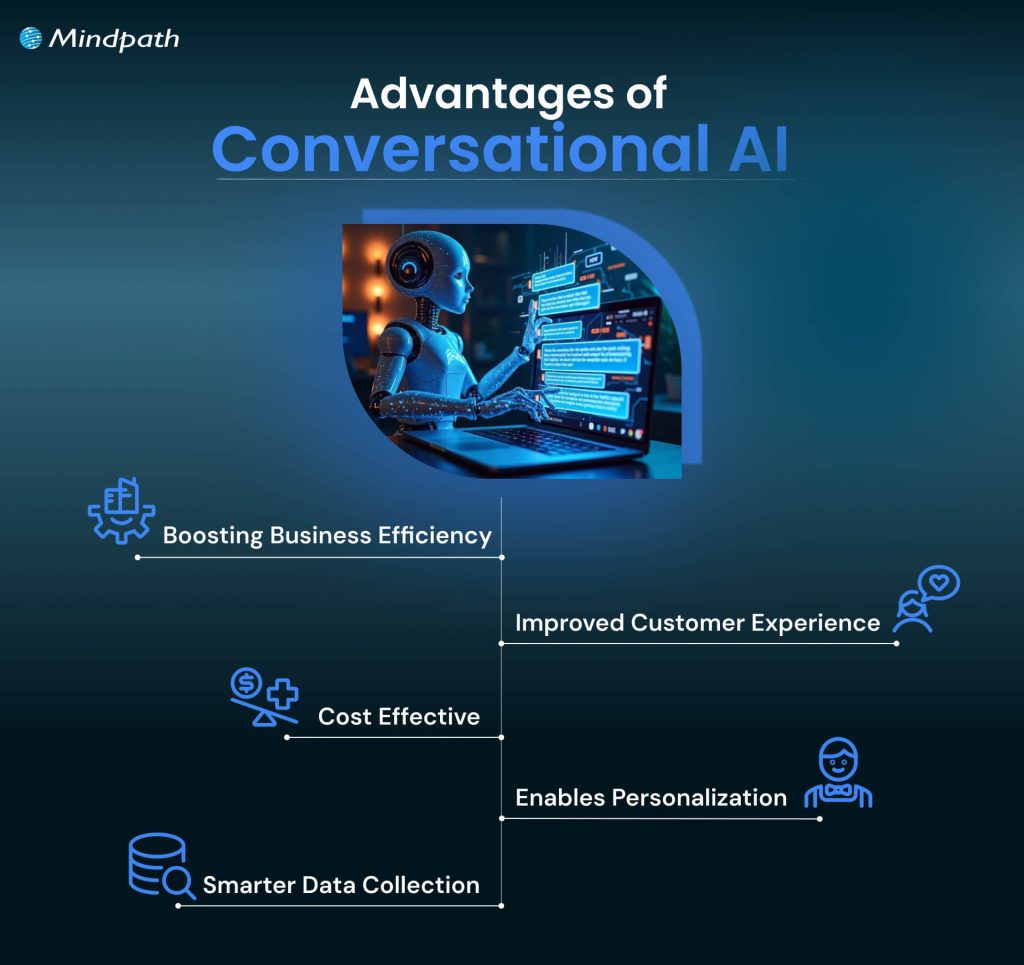
Advantages of Conversational AI

Conversational AI has become an important part of how companies connect with people today. Here are some key advantages it can bring to your business.

Advantages of Conversational AI

1. Boosting Business Efficiency

Conversational Artificial Intelligence can manage many routine tasks without needing a human agent every time. This means your team can spend more time on important work while the AI handles simple customer conversations. With artificial intelligence conversation tools available 24/7, your business can solve customer queries faster and work more efficiently, showcasing the many benefits of chatbot technology for operational productivity.

2. Cost-Effective

A good conversational AI platform can handle customer calls and chats automatically, with little need for extra staff. By making AI more human and accurate, it helps you manage high volumes of requests without extra cost. This saves money on daily operations and reduces mistakes, keeping your business cost-effective.

3. Improved Customer Experience

Artificial intelligence bots make it easy for customers to get quick answers and help whenever they need it. This technology offers personalized replies and a smooth, contactless service for people all over the world. It creates a better customer experience and keeps people happy with your business.

4. Enables Personalization

This technology learns from each customer’s information, like location and past interactions, to offer a more personal chat experience. It can suggest helpful answers and next steps based on what each person needs. This makes solving problems faster and reduces the need for follow-up calls.

5. Smarter Data Collection

This technology helps you collect useful information from every customer conversation. By tracking what people say and how they interact, you can spot trends and understand what customers really want. This makes it easier to improve your sales and marketing strategies over time.

Want to explore the innovations shaping the future of conversational AI? Explore our blog on the top AI trends to discover the emerging technologies redefining intelligent communication.

Use Cases of Conversational AI

Conversational AI can be used in many ways to make business operations smoother and customer interactions better. Here are some common use cases that show how an example of conversational AI works in real life.

1. Conversational IVR Systems

Modern IVR systems let customers speak naturally instead of pressing buttons to find help. For example, airlines now use conversational IVR to let travelers say things like “Change my flight” or “Check flight status” and get quick answers without waiting for a live agent.

2. Seamless Transfer to Live Agents

When a bot can’t handle a request, it passes the chat to a live agent along with all the details, so nothing gets lost. For example, a telecom company’s virtual assistant can detect when a billing issue is too complex and smoothly transfer the full conversation to a specialist who can resolve it faster.

3. Round-the-Clock Support

These chatbots answer simple customer questions at any time of day without needing a live agent. For example, an online retailer’s chatbot can help shoppers check order status or find return instructions even after business hours.

4. Tailored Product Recommendation

This technology suggests items people might like based on what they’ve bought or browsed before. For example, a streaming service’s chatbot can recommend new shows or movies based on what you’ve just finished watching.

Ready to build conversational AI that boosts sales and strengthens customer engagement? Learn how AI in e-commerce transforms online shopping experiences and drives measurable business growth.

5. Effortless Onboarding

These assistants help new employees feel confident and prepared by guiding them through company policies and tasks step by step. For example, an HR team can use an AI onboarding assistant to help new hires complete paperwork, set up work tools, and get reminders about training sessions.

6. Task Automation

These bots connect chats to your business tools, so tasks like updating customer records or creating tickets happen instantly. For example, the best conversational AI chatbot for an e-commerce store can automatically create a return request and send an update to the warehouse team.

7. Faster Lead Conversion

These chatbots ask visitors the right questions to see if they’re a good fit for your product or service. For example, a real estate company’s chatbot can collect details about a buyer’s budget and location, then connect them with the right agent.

8. Timely Updates

These AI tools send helpful reminders and updates before customers even ask, keeping everyone informed and stress-free. For example, a healthcare provider can use this to remind patients about upcoming appointments or share wellness tips.

If you want to use AI to improve your healthcare services. Learn from our blog AI in Healthcare, where we highlight real-world use cases of conversational systems supporting medical professionals and patients.

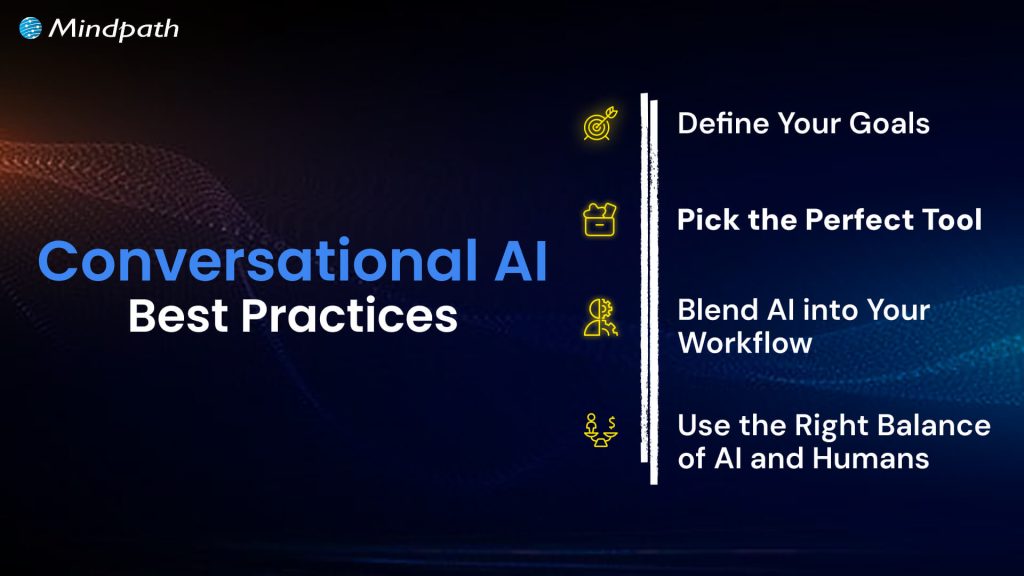
Conversational AI Best Practices

Using Conversational AI, the right way can help you get the best results for your business and your customers. Here are some best practices to keep in mind as you build and manage your AI solutions.

Conversational AI Best Practices

1. Define Your Goals

Always be clear about why you want to use conversational AI and what you want to achieve. Make sure it fits well with your bigger business plans, so it truly adds value.

2. Pick the Perfect Tool

Pick a conversational AI tool that fits your industry and matches your budget and goals. Make sure it can grow with your business, so you get the most value over time.

3. Blend AI into Your Workflow

Connect your conversational AI with your other business tools so it works smoothly with your daily tasks. This makes your processes faster, more accurate, and more useful for your team.

4. Use the Right Balance of AI and Humans

Let AI handle simple, repetitive tasks while your team focuses on work that needs a human touch. Always set clear points where the bot should hand over to a person for the best customer experience.

Curious how AI can optimize your workforce and improve business outcomes? Check out AI redefining job roles in Tech to see how intelligent systems are reshaping employee roles and driving operational efficiency.

Take the Next Step with Conversational AI

Conversational AI is transforming how businesses connect with people by making everyday interactions faster and more personal. It helps companies work smarter, serve customers better, and grow with less effort. Now that you know what is conversational AI, you can start using it to create more value.

Mindpath offers professional AI development services to help you build and launch conversational AI that matches your business goals. Our experts create secure, easy-to-scale chatbots, voice assistants, and smart integrations. Let us help you deliver great customer experiences and stay ahead in the AI space.

Discover the power of Conversational AI! Learn its benefits, features, and how Mindpath can help transform your customer interactions.
how much hire react developer

The Ultimate Guide to React JS Developer Cost of Hiring is a complete guide on budgeting and recruiting React developers. With its coverage of important cost considerations including expertise, geography, and hiring practices, it provides you with the necessary knowledge to guide your decision-making for your web development project. 

Are you prepared to use React JS to revolutionize your web development approach but are concerned about the costs of bringing in top talent? Understanding the importance of hiring ReactJS developers can help you make an informed decision, ensuring that your investment leads to high-quality, efficient, and scalable solutions. If so, you are not alone in this. Explore “The Ultimate Guide to React JS Developer Cost of Hiring” to learn all you require to adequately plan your budget to hire React JS Developer

Facebook created the widely regarded JavaScript library React to create dynamic and interactive user interfaces. React’s outstanding efficiency, adaptability, and sustainability have made it an essential technology for several leading companies since its initial release in 2013. The construction of reusable user interface components is made possible by this library, which accelerates development procedures and decreases long-term maintenance expenses.  

One notable aspect of React is its virtual Document Object Model (DOM), which streamlines the rendering and updating operations. The extensive ecosystem that surrounds React provides complete solutions for the building of modern web applications. Examples of these tools are Redux for state management and React Router for routing. It is also used by well-known businesses like Netflix, Instagram, and Airbnb, proving its scalability and dependability for busy applications.  

In this blog, we will take a deep dive into the potential cost for hiring a ReactJS developer in 2024. So, let’s dive right in!  

Rate Dynamics and Considerations 

Hiring a React developer is an important investment; therefore, companies looking to develop or improve their online apps must be aware of the associated costs. A React developer hourly rate often ranges between $50 and $200 or more. Also, React native Developer Hourly Rates in India ranges between $22 to $30 depending upon the experience of the developers.  Senior developers with years of expertise and specialized abilities command higher prices, while junior developers, who are just starting in their careers, usually charge on the lower end of this range. Developers in high-cost regions—like Western Europe and North America—generally charge more than developers in lower-cost regions—like Eastern Europe, Asia, and the Caribbean. In addition to hourly costs, organizations ought to consider the entire cost of ownership when employing a React developer. This covers not just the direct expenditures related to the developer’s hourly rate but also other costs like hiring, onboarding, training, and any tools or software that may be required. Long-term initiatives can accumulate significant costs, therefore it’s important to properly plan and budget for these costs.  


Key Factors Influencing React JS Developers Cost 

Several crucial factors influence React JS developer cost, impacting budgeting and decision-making for businesses: 

  • Experience Level 

React developer hourly rates are heavily influenced by their amount of experience. Junior developers—those with less than two years of experience—usually charge between $50 and $80 per hour. Mid-level developers (two to five years) bill more, often between $80 and $120 per hour. Senior developers (five years or more), who possess advanced skills and leadership qualities, typically charge $120 to $200 per hour or more. 

  • Location  

Developer rates vary significantly by location. In North America and Western Europe, higher living costs and demand result in higher prices. Conversely, countries like India ($22-$30/hour), Ukraine, and Brazil offer competitive rates with a large, skilled talent pool. Eastern Europe, including Ukraine and Poland, provides top-notch developers at more affordable rates, making these regions popular for outsourcing due to their cost-effectiveness and qualified professionals.  

  • Hiring Model 

The cost-benefit ratio should be considered when deciding how to assemble your team. Freelancers may be more expensive for short-term projects, while in-house teams incur additional costs for overhead and perks. With the ability to utilize worldwide talent without the costs associated with standard office settings, remote developers provide an affordable alternative. ReactJS can significantly benefit your web project by offering a flexible, efficient, and scalable solution. This strategy guarantees adaptability and access to specialized expertise catered to the requirements of your project.

  • Complexity level 

The amount of expertise needed from the developer depends on how complex the project is. While complicated apps needing sophisticated state management, API integration, or real-time data processing may just require fundamental frontend development abilities, they may require more experienced developers, which will increase expenses. 

  • Duration of Contract 

Short-term contracts often have higher hourly rates due to the transient nature of employment. Negotiated reduced rates or salaries, which demonstrate consistency and commitment, are frequently the outcome of long-term contracts or full-time employment. 

 Cost Estimation 

Estimating the entire ReactJS developer cost requires numerous factors to guarantee appropriate budgeting and project planning. When recruiting for software development projects, there are additional expenditures to consider in addition to direct developer fees. These consist of overhead expenses related to upkeep of actual office space, furnishings, and utilities.  

Employing in-house developers also means paying more for insurance, perks, and maybe higher wages to compete in regional markets. In addition, there are expenses for hiring, integrating new team members into current workflows, and providing training. It is important to incorporate these additional costs into budgetary planning to guarantee thorough financial transparency and effective resource distribution over the project. 

Tips to Optimize Hiring Budget   

  • Defining Project Scope 

To begin with, make sure the project’s scope is clear. Establish clear expectations for potential developers by outlining precise goals, deliverables, and deadlines. This transparency guarantees that developers can precisely predict costs and durations while minimizing scope creep. 

  • Leverage Hybrid Teams 

Employ a hybrid team strategy by bringing in outside resources like contractors or freelancers to supplement in-house developers. With this tactic, you may keep core team cohesiveness while utilizing specialized abilities for certain project stages or tasks. 

  • Consider Remote Developers 

Adopt remote hiring procedures to get access to a worldwide talent pool and maybe cut expenses related to typical office-based teams. The flexibility that remote developers provide in terms of schedule and location makes it simpler to locate qualified experts who meet the needs of your project. Project management software and video conferencing are two examples of tools that make it easier for distant teams to collaborate and communicate effectively. 

Conclusion 

To sum up, the current employment patterns for React engineers highlight a change in project management towards adaptability, efficacy, and economy. Companies are using remote recruiting and hybrid team strategies more and more to maximize resource allocation and tap into a variety of international talent pools. To reduce costs and expedite development processes, it is still critical to clearly define the project scope and ensure that developer expectations are in accordance with project objectives. These tactics help businesses not only improve project outcomes but also encourage creativity and scalability in contemporary web development endeavors as they negotiate the ever-changing world of tech talent acquisition. 

Whether you’re looking for junior developers to start your project or seasoned experts to lead complex initiatives, mindful budgeting is crucial. At Mindpath, we specialize in connecting businesses with top-tier ReactJS developers skilled to meet your project needs. If you’re searching for skilled developers who can bring your vision to life, contact us today to discuss how we can support your development journey effectively. 

Looking for a ReactJS Developer for your next project?

Get insights on React developer hiring costs, including experience, location, and hiring models. Plan your budget effectively with our comprehensive guide.
Augmented reality in ecommerce

The e-commerce model has led to the transformation of how business operations are conducted in the 21st century. This novel concept has expanded the boundaries for businesses. E-commerce businesses are in a position to exploit a broad range of advanced technologies. A new technology that has been redefining the e-commerce landscape is augmented reality.

Augmented reality in e-commerce has the potential to enhance the online shopping experience of customers. This is possible since AR commerce blends digital products with the real-world environment of customers. Thus, augmented reality allows customers to view as well as interact with virtual products before making the purchase. It is the perfect time to learn how the augmented reality process is revolutionising the e-commerce setting. 

Want to prepare your online store for the growing demand for immersive and interactive shopping experiences? Connect with Mindpath to discover how you can bring advanced AR capabilities into your business.

What is Augmented Reality?

Before exploring the impact of augmented reality in e-commerce, you need to know what is augmented reality. Augmented reality refers to the technology that is capable of overlaying digital information on how a user views the real world in real time. This advanced technology enhances their reality by adding computer-generated elements to it. 

Within a short span of time, augmented reality has gained massive popularity. This is because it can merge the physical and digital worlds, thereby creating an interactive experience for users. You can have such a surreal experience either through a smartphone, AR glasses, or a tablet.  

Is your e-commerce business ready for the next phase of digital innovation? Explore digital transformation for businesses to discover how AR fits into modern growth strategies.

How E-commerce Businesses are Using Augmented Reality?

Although the AR technology is in its infancy, its application in the e-commerce space has been surging. Many e-commerce businesses have been leveraging the technology in diverse ways to shape the experiences of their customers. 

1. Virtual Try-Ons

While purchasing apparel, people usually prefer to try on the garments. You do not need to physically try on apparel thanks to the use of Augmented reality in e-commerce. This is because you can try it out virtually before deciding whether to buy it or not. Therefore, the augmented reality technology helps online shoppers comprehend what they are purchasing and how the items will look on them. 

2. Interactive User Manuals

An interactive user manual is considered to be a great application of AR in e-commerce. This is especially useful when customers buy a product that has a learning curve before it can be used easily. Such manuals can be a great help for users as they can refer to them to understand how the product works. Interactive user manuals are capable of responding to the actions of users. Moreover, they can offer on-page contextual support while using a website or software. 

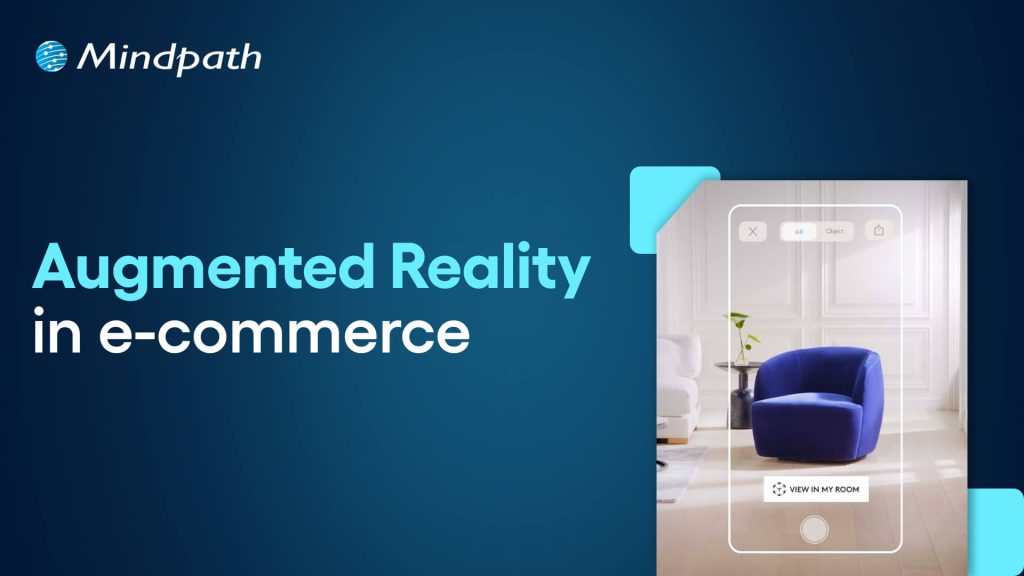
3. Preview Placement

The preview placement gives customers a view in real-time of what a product will look like in their own environment. This can be extremely helpful when you decide to buy furniture or a television set for your home. Many brands have started using AR in order to help their customers visualize how their products will fit in the homes of customers. It has undoubtedly simplified the overall shopping experience for modern customers. 

4. Social Media Filters

There was a time when social media filters were used by online users just for fun. However, a number of brands have started leveraging social media filters to showcase their products. Many brands have already come to realize that the novelty factor relating to AT filters has the potential to boost customer engagement. Such strategic use of AR by brands has been wowing customers today. 

How do businesses measure the real impact of AR on conversions and engagement? Explore the importance of data-driven decision-making for Businesses to discover how insights optimize e-commerce performance.

Benefits of Augmented Reality for Businesses

The proper use of AR by e-commerce businesses can give rise to immense value for them. The capabilities of Augmented Reality can give an edge to modern businesses while they create value for their customers. 

1. Better Customer Engagement 

You need to bear in mind that augmented reality technology is highly interactive in nature. Thus, it can make it easier for customers to get hooked on the sites of online businesses. The longer they stay on the site, the higher the chances for them to make a purchase. Even if they do not make a purchase, it will create an opportunity for them to build a relationship with the brand. Thus, the quality of customer engagement can improve. 

2. Reaching Out to New Customers

In the highly competitive e-commerce landscape, businesses need to constantly look for new customers. The use of Augmented Reality can certainly give you an edge as a business. In the noisy world, it can serve as a suitable tool that can help grab the attention of your potential customers. You can create a highly engaging AR campaign in order to make your business seen and heard by online users. 

3. Reduced Returns

When businesses use AR technology, they not only empower themselves but also empower their customers. As customers have a lot of information, when businesses use AR, the possibility of product returns drops considerably. The application of AR makes it possible for customers to get a glimpse of how certain products will look in their personal space. So they can be more sure while making their purchase decisions. 

4. Possible Challenges That May Arise

The rising number of augmented reality examples shows that the future of AR in e-commerce is full of new possibilities. However, it is crucial for businesses to bear in mind that they may face a number of challenges while adopting AR technology. The insight can help them prepare themselves to use the novel technology in a strategic manner.

Wondering how artificial intelligence complements augmented reality in online shopping? Explore AI in e-commerce to discover how intelligent technologies personalize experiences and increase conversions.

5. High-Quality 3D Models

A common technological challenge that businesses may encounter is related to achieving high-quality 3D models. Businesses must keep in mind that the models need to be realistic in nature in order to boost customer engagement and experience. However, in the technical sense, it may not be an easy task to achieve. In order to reduce this kind of complexity, it is advisable for businesses to use robust tools. 

6. Balancing Efficiency and Cost

It is very important to bear in mind that generating 3D assets can be a costly affair. In fact, the costs may range between a few hundred and several thousand dollars per product. In order to strike a balance between cost and efficiency, businesses can consider leveraging cloud infrastructure. 

7. Seamless Integration with Workflow

Another challenge that may arise in the path of businesses revolves around the integration of AR technology with the existing workflow.  Complexities may arise when online retailers try to integrate 3D assets into their current product catalogue. It is vital to remember that this specific process needs to be smooth and streamlined. It must also be scalable to enhance overall customer satisfaction. 

It is essential for online retailers to effectively address these challenges. By addressing these obstacles and bottlenecks, they can leverage AR technology to the fullest and offer a highly engaging experience to their target audience. 

Planning to deliver AR experiences through mobile commerce apps? Discover mobile app development technologies to explore tools that power interactive shopping journeys.

Final Words

Augmented Reality has emerged as a breath of fresh air in the prevailing e-commerce landscape. The novel technology has been gaining high momentum as it creates a plethora of benefits for businesses in the form of better customer engagement, the ability to reach out to new customers, and reduced returns.

Mindpath’s innovative services relating to augmented reality can create immense value for modern businesses. Our experts will ensure that your businesses can boost customer engagement by leveraging augmented reality technology. You can capitalise on the real potential of AR technology and witness your business reach new heights.  

Discover how Augmented Reality (AR) is transforming e-commerce with immersive shopping experiences, boosting engagement, and improving sales.