Home

What Does It Actually Cost to Build a Custom LLM-Powered App in 2026? 

What Does It Actually Cost to Build a Custom LLM-Powered App in 2026? 

Join our Newsletter!

LLM - Powered App Development Cost

Imagine you’ve got an idea for a custom LLM-powered app. Maybe you want to automate customer support, build an AI assistant, or transform how your team works. But here’s what stops most entrepreneurs and business leaders cold: they don’t really know how much LLM-powered app development costs actually impact their budget. The price tag feels mysterious, unpredictable, and frankly, intimidating.

Key Takeaways

  • 01
    LLM app costs vary based on complexity, integrations, infrastructure, and scale.
  • 02
    SMBs can start AI projects with manageable budgets and phased investments.
  • 03
    API-based models offer faster deployment and lower upfront development costs.
  • 04
    RAG solutions improve AI performance without expensive model fine-tuning requirements.
  • 05
    Careful planning and cost optimization help maximize long-term AI value.

Good news: you’re definitely not alone. Hundreds of companies across the UK, US, Europe, Australia, and Canada wrestle with this exact question daily. They want real answers, not guesswork. They need clarity on what drives costs when building AI solutions. We’ve analyzed the numbers, industry benchmarks, and actual project data. Ready to cut through confusion? Everything unfolds in this blog.

Ready to build a custom LLM-powered application? Explore Mindpath’s AI development services to create scalable, intelligent solutions tailored to your business needs.

Why Can’t Businesses Ignore LLM-Powered App Development Anymore?

AI stopped being a trend years ago. Every competitor is moving forward with intelligent apps while you’re watching from the sidelines. Companies that skip LLM-powered app development risk becoming irrelevant faster than you’d think.

The payoff is real and measurable. Better customer service, faster workflows, and smarter operations aren’t theoretical anymore. Your team knows what needs fixing. AI solves it. LLM development pricing makes sense when the alternative is falling behind.

Here are the 5 reasons why AI integration is no longer negotiable:

1. Massive Productivity Gains

Your team does less tedious work today. Real-time returns show up immediately.

2. Enhanced Customer Retention

Support gets faster and smarter simultaneously. Customers notice better service instantly.

3. Hyper Efficiency in Workflows

Humans focus on strategic work instead. Automation handles repetitive stuff every day.

4. Rapid Market Growth

The AI space is expanding aggressively right now. Early movers have significant advantages.

5. Competitive Positioning in Your Industry

Your competitors are already building AI solutions. LLM-powered app development cost becomes minimal when you’re losing market share.

Key Factors Driving LLM-Powered App Development Costs

1. Model Architecture & Selection

API models keep your initial costs down. Custom models demand expensive computing power.

2. Data Preparation & Management

Building clean data takes real time. Proprietary knowledge needs special architecture setup.

3. System Integration & Infrastructure

Enterprise systems integration requires custom backend work. Self-hosted models need serious cloud infrastructure.

4. Regulatory Compliance & Security

Regulated industries need advanced protection standards.

5. Inference & Ongoing Maintenance

LLM token costs scale with user volume. Models need constant monitoring and optimization

LLM App Development Pricing for Different Business Scenarios

Every business is different, so your AI app development cost varies wildly depending on what you’re actually building. Let’s break down real pricing for the scenarios most companies face today.

1: Basic AI Chatbot or MVP

Build Cost: $20,000–$50,000 with a 2-4 month development timeline. Ideal for customer support, lead qualification, and knowledge retrieval. Running costs typically range from $50–$500 per month, while LLM Fine Tuning Cost remains minimal.

2: Mid-Level Business Assistant

Build Cost: $50,000–$150,000 with a 4–8 month implementation timeline. Includes custom dashboards, workflow automation, and business system integrations. Running costs generally range from $500–$5,000 per month.

3: Complex Enterprise AI

Build Cost: $150,000–$500,000+ with development timelines exceeding 9 months. Building LLM-powered applications at enterprise scale requires private infrastructure and compliance measures. Running costs can range from $5,000–$40,000+ per month.

How Much Should SMBs Budget for an LLM-Powered Application?

LLM-powered automation for SMBs is becoming more affordable and accessible than ever before. Understanding the expected budget helps businesses plan smarter investments and avoid unnecessary development expenses.

1. Proof of Concept & Business Analysis ($3,000 – $15,000)

Every successful AI project starts with validating the idea before full-scale development begins. This stage helps businesses identify valuable use cases, assess feasibility, and reduce the risk of costly changes later.

2. Data Preparation & Ingestion ($5,000 – $30,000)

AI systems perform only as well as the data they receive. Preparing, cleaning, and organizing business documents ensures the model can deliver accurate and relevant responses.

3. Application & Integration Development ($5,000 – $40,000)

This phase focuses on building the user experience and connecting AI with existing business systems. It often includes interfaces, workflows, databases, and Retrieval-Augmented Generation (RAG) capabilities.

4. API Usage Costs ($200 – $2,000/month)

Many SMBs choose cloud-based AI models because they eliminate large infrastructure investments. Costs increase with application usage, making scalability easier to manage during growth.

5. Infrastructure for Self-Hosted Deployments ($3,000 – $15,000/month)

Businesses requiring complete control over data may choose private model hosting environments. This approach increases the LLM-Powered App Development Cost but provides stronger privacy, security, and customization options.

6. Vector Database Hosting ($500 – $5,000/month)

Vector databases allow AI applications to search and retrieve business knowledge efficiently. They play a critical role in improving response accuracy and delivering context-aware answers.

7. AI Gateway & Observability ($0 – $300/month)

Monitoring tools help organizations track model performance, usage patterns, and operational expenses. Early visibility into system behavior prevents unexpected costs and improves reliability.

8. Maintenance & Updates ($1,000 – $5,000/month)

AI applications require continuous optimization to maintain performance as business needs evolve. Regular updates, prompt improvements, and data management ensure long-term value from the investment.

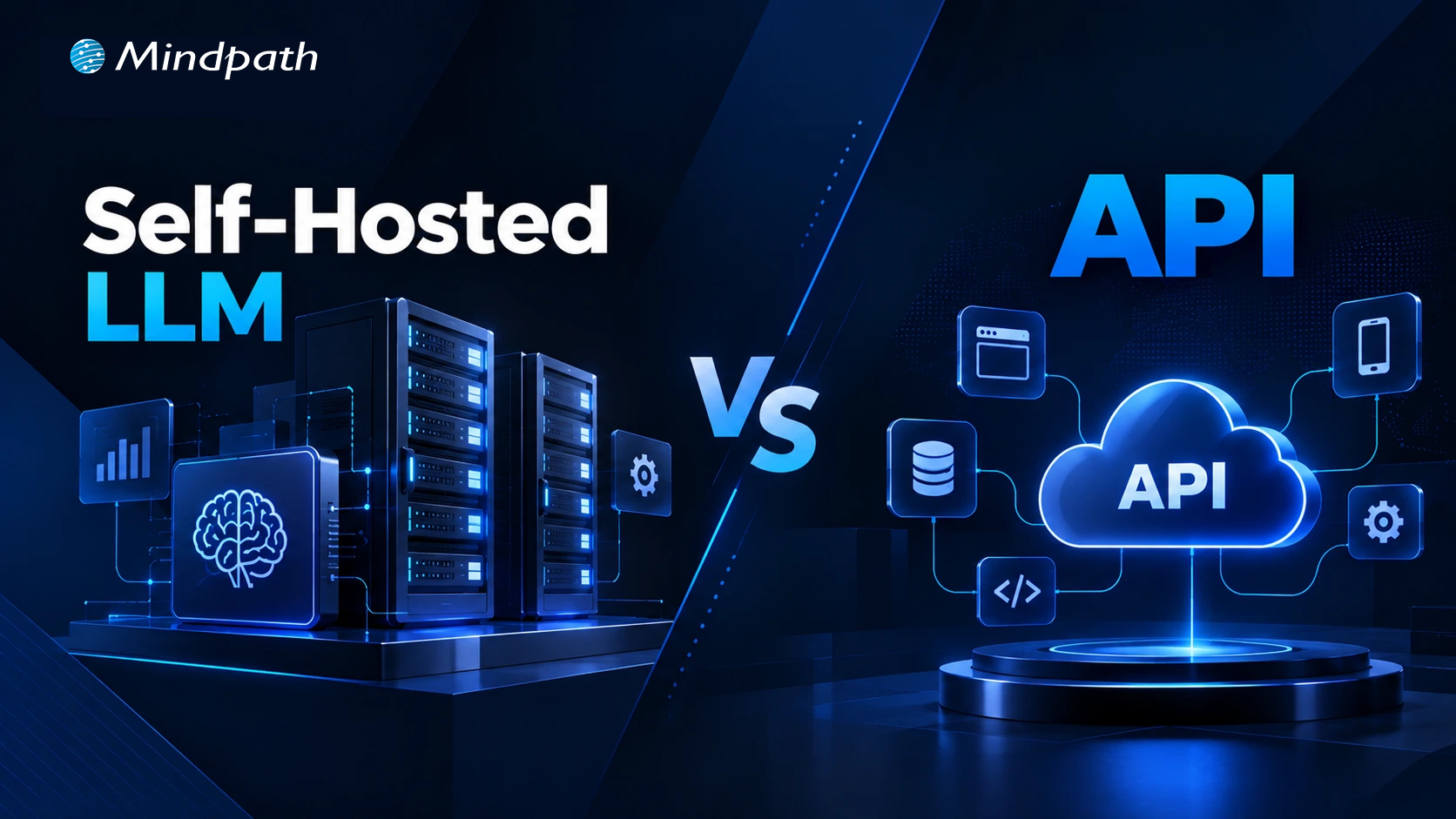
API vs Self-Hosting: Which Option Delivers Better Long-Term Value?

The initial development budget is only part of the investment. Businesses must also evaluate ongoing operational expenses, scalability requirements, security needs, and long-term maintenance costs before choosing an AI deployment strategy.

The right choice depends on how frequently the application is used, the level of data privacy required, and the organization’s growth plans. Understanding both approaches helps businesses avoid unexpected costs as their AI adoption expands.

Factor API-Based Models Self-Hosted Models
Upfront Cost Low initial spend High setup cost
Monthly Cost Usage-based pricing Fixed infrastructure cost
Deployment Time Weeks to launch Months to deploy
Data Privacy Shared environment Full data control
Maintenance Provider managed In-house management
Best For SMBs, startups Large enterprises

How to Reduce LLM-Powered App Development Costs?

Building an LLM-powered application does not always require a large budget. With the right strategy, businesses can reduce development expenses while still creating a reliable and scalable AI solution. Here are some practical ways to control costs:

1. Start with an MVP

Validate ideas early before investing heavily in full development.

2. Use API-Based Models

Reduce infrastructure costs with ready-to-use cloud AI services.

3. Implement RAG First

Improve responses using business data without expensive model training.

4. Reuse Existing Data

Leverage current business information to reduce preparation expenses significantly.

5. Prioritize High-Impact Use Cases

Focus resources on projects delivering maximum business value first.

6. Scale Infrastructure Gradually

Expand resources only when application demand and usage increase.

7. Optimize Prompts Regularly

Improve output quality while lowering token consumption and costs.

8. Partner with Experts

Avoid costly mistakes through experienced AI development guidance.

Ready to Build an AI Solution That Fits Your Budget?

Understanding the budget to build LLM-powered app in 2026 helps businesses make smarter technology investments. From development and infrastructure to maintenance and scaling, knowing the cost factors allows you to plan effectively and build AI solutions that support long-term business growth.

At Mindpath, we provide AI development services tailored to your business goals and budget. Our team helps organizations build scalable LLM-powered applications, from MVPs to enterprise solutions, with the right strategy, technology, and support for successful implementation.
Frequently Asked Questions

The best approach is to define the application’s purpose, expected users, required integrations, and data sources. These factors significantly influence development expenses. A clear project scope helps create more accurate cost estimates and reduces the chances of unexpected budget increases later.
Yes. As user numbers, data volume, and feature requirements increase, operational expenses often rise. Additional costs may include API usage, infrastructure upgrades, monitoring tools, security measures, and ongoing maintenance to ensure consistent performance and scalability.
It depends on business goals. Existing AI tools can solve common challenges quickly, while custom applications provide greater flexibility, deeper integrations, and unique features tailored to specific workflows. The right choice depends on long-term business needs and expected return on investment.
Many organizations focus only on initial development expenses and overlook ongoing costs. Maintenance, model updates, infrastructure, security, and monitoring are essential parts of operating an AI application and should be included in the overall budget from the beginning.
The timeline varies based on the project’s complexity and objectives. Simple automation and support solutions can deliver measurable benefits within a few months, while larger AI systems may require longer implementation periods before producing significant operational and financial returns.

Support Is One Click Away

Featured Posts

Related Post

Software Development Cost

When thinking about software development cost in 2026, it is not strictly about budgeting; it is about making informed decisions that end up delivering a successful project. New tools, frameworks, and approaches to development appear every year; therefore, how businesses spend money on development is also changing. How do you maximize your investment while being innovative and keeping your project on track? The solution is to know what drives the cost, and how those drivers may steer the final outcome.

The software world is fast-moving, and when you do not pay attention to these details, you can be setting yourself up for struggles later on when you want to scale. Companies today are not just looking at the bottom-line costs, but at a different perspective centered around value, flexibility, and speed of delivery. This makes it essential to look at the real cost drivers in depth. Understanding all the factors can better inform their decisions, maintain their agility, reduce certain risks, and build software projects that are set up for considerable success in 2026 and the following years. Keep reading to learn more about the cost of software development in detail.

If you need to boost efficiency, growth, and customer satisfaction, that will transform your business. Mindpath’s software development services will help you achieve these goals. Contact us now to unlock the long-term impact.

Why Understanding Software Development Costs Matters?

Comprehending software development costs is significant because it establishes the complete journey of a project. Given the right cost information, it enables teams to plan budgets that are realistic, deploy skilled resources, and be confident with their risk management. This implies avoiding unnecessary costs and deadlines. This also means delivering a project on time, within scope, and within the levels of quality expected by clients.

Moreover, knowing the cost factors will help organizations remain competitive and make better decisions. It can enhance transparency with clients, add trust with clarity and financial planning, and facilitate long-term sustainability by considering upkeep and future capacity. These insights support stronger profitability, but more importantly, they allow organizations to achieve longevity and value for all software development endeavors.

Must Read: Types of Software Development

Key Factors Influencing Software Development Cost

The cost of development in 2026 will be a combination of many important factors, which are not limited to coding. Each of the elements potentially influences the budget, timeline, and success of the software.

Key Factors Influencing Software Development Cost

1. Project Scope and Complexity

A project’s scope indicates the required features, integrations, and functionality. In complex applications that have advanced features, automation, or leveraged AI, you will need to find skilled experts, which increases the costs of development. Simple apps and apps with basic or limited functions require fewer resources and typically have a faster build time and are less expensive.

2. Technology Stack

The choice of technology stack and cloud platform will have a direct impact on the budget. Some are more advanced, and some integration services will necessitate higher expertise by the team; thus, software development cost estimation is even more important. Arriving at an appropriate compromise will maintain performance within a budget constraint.

3. Team Size and Skills

The size and the expertise level of a team will dictate how well a project moves through its lifecycle. More people or more specialized roles will increase costs, but the outcome is generally better. The right mix of skills to bring down custom software development cost and to meet business outcomes is possible.

4. Development Methodology

A project’s management approach is critical in terms of both its time and cost outcomes. Agile approaches provide flexibility and collaboration, while Waterfall is more rigid and less flexible. Choosing the right method will make your team more efficient and control overall software development costs and capitalization.

5. Geographical Location

When hiring talent from different regions, it changes the total price you pay, which comes down to the cost of living and hourly rates in that area. Outsourcing or offshoring gives you access to skilled professionals at a lower cost. You still maintain quality while keeping your software development cost clear and manageable.

Planning to develop unique software solutions? Visit our blog on the custom software development process to see how expert teams combine planning, automation, and best practices to deliver exceptional results.

Software Development Cost Breakdown

When you break down the software development cost, it shows where your money goes in a project. Having an understanding of development costs will allow businesses to leverage that information to plan better, to manage costs, and to optimize value for the end product.

Software Development Cost Breakdown

1. Team Composition

The type of team you choose has an immediate impact on the overall software development cost. Freelancers charge approximately $30 – $80/hour, in-house developers in the UK cost about $65,000 – $120,000/year, while agencies charge about $90 – 150/hour, or approximate project fees of $50,000 – $260,000+. A software development cost calculator is helpful to analyze these various options against your overall business requirements.

2. UI/UX Design

User experience and budget have significant implications for design. In the UK, organisations will typically allocate between 15% and 25% on design within the total cost, with costs of a simple/basic layout around $4,000 – $9,000, to a complex layout with advanced animations and branding costing $10,000 – $33,000+. High-quality design conserves software development costs and increases user adoption.

3. Project Scope & Complexity

The complexity of your app is one of the biggest determinants of software development cost. A simple MVP may cost around $20,000 – $40,000; basic mediums such as CRMs or booking systems will cost $40,000 – $100,000; anything that is enterprise SaaS or an AI platform would start at $100,000 – $325,000+. There is a direct correlation: the more features, the more time and money it takes to develop.

4. Development Time

The number of hours it takes to build an app can also affect the budget. A simple app in the UK requiring approximately 500 hours of work may cost $50,000. A medium app that needs 800 – 1,000 hours might cost $65,000 to $100,000. A large or complex project of 1500+ hours may run over $130,000. All of these estimates are inclusive of coding, testing, and debugging.

Planning to build software tailored to your business? Explore our blog on custom software development benefits to learn how personalized solutions improve efficiency, scalability, and overall performance.

Key Strategies to Manage Software Development Cost

Managing software development costs requires smart planning and clear decisions. By focusing on efficiency and resources, businesses can reduce expenses without losing quality.

Key Strategies to Manage Software Development Cost

1. Start with Clear Planning

A strong plan with well-defined requirements keeps the project on track. It helps avoid confusion, delays, and extra costs later in development.

2. Adopt Agile Development

Agile methods allow teams to work in small, flexible cycles. This makes it easier to fix issues early and adjust to changes without wasting resources.

3. Use Cloud Infrastructure

Cloud services remove the need for heavy hardware investments. They provide scalable resources on a pay-as-you-go model, which keeps expenses under control.

4. Automate for Efficiency

Automation in testing, integration, and deployment saves time and reduces manual effort. It improves quality and keeps the workflow faster and smoother.

5. Focus on MVP First

Building a Minimum Viable Product gets the core idea to users quickly. It helps validate the concept before committing to a larger software development cost.

Ready to avoid costly software errors? Dive into our blog on Custom Software Development Mistakes to learn what to watch out for and ensure smooth project delivery.

Ready to Take Control of Your Software Development Cost?

In 2026, managing software development cost is about making smart choices that balance innovation, speed, and value. By understanding the real cost drivers and applying strategies like Agile, cloud adoption, and focusing on MVPs, companies can deliver projects that scale efficiently, reduce risks, and ensure long-term success in a competitive digital market.

At Mindpath, we provide end-to-end software development services that optimize cost and quality. Our skilled teams combine planning, design, and modern frameworks to create scalable solutions. With transparent pricing models and deep technical expertise, we help businesses control software development costs while delivering impactful applications built to perform and grow with your vision.

Discover the key factors influencing software development costs and how to optimize your budget. Learn how Mindpath can help.
Cyber Security for business 

You depend on computer systems to manage business, data storage, and customer services on a daily basis, isn’t it? Cyber security for business now plays a critical role in keeping everything stable and secure. Nevertheless, not every organization realizes how rapidly risks develop and to what extent they could influence development. In that case, is your business ready to face the threats that continuously evolve in size and complexity?

Simultaneously, companies seek to develop, innovate, and remain competitive continuously. Thus, security can no longer remain in the background as a fundamental role. It requires a more agile, responsive strategy that complies with the business objectives. In this blog, you will discover how the contemporary strategies are defining the tougher protection and smarter decision-making. So, let’s dive in!

Planning to build a security infrastructure that’s monitored, maintained, and always ready for emerging threats? Mindpath offers end-to-end managed IT services that cover security protocols and 360-degree infrastructure monitoring for businesses of every size.

What is Cyber Security?

Cyber security for business focuses on protecting systems, networks, and critical data from digital threats. It assists organizations to avoid unauthorized entry, loss of data and disruption of operations. Businesses today are dependent on effective security measures to protect sensitive data, uphold trust, and guarantee a smooth business process in an increasingly interconnected and risk-based world.

Concurrently, business cyber security requires a multi-layered structure that incorporates people, procedures, and high-tech systems. Companies enhance greater security defenses in instances where they integrate security measures with business operations. With the increasing complexity of threats, businesses should remain vigilant, operate fast and provide a higher level of protection to ensure long-term stability and ensure growth that is safe.

What is the Importance of Cyber Security for Businesses?

There is an increasing trend in cyber risks as companies increase the reliance on digital systems and data. Everyorganization requires high levels of protection to prevent disruption and retain confidence. The following are the main reasons why cyber security is one of the most important aspects of growth and stability protection.

1. Securing Critical Business Data

Companies need to secure confidential data including personal information and financial data of customers. Strong Business data security helps prevent breaches that lead to losses and damage. A focused approach to data protection in cyber security keeps valuable assets safe and reliable.

2. Ensuring Smooth Business Continuity

Cyber threats have the potential to disrupt day-to-day activities and reduce productivity. A strong cyber security for business strategy helps avoid downtime and keeps systems running. This enables teams to operate without interruption and be able to remain on a steady performance.

3. Meeting Compliance Requirements

Companies have to take stringent measures on keeping their customer and company data secure. Security practices can be used to address these standards and mitigate legal risks. This will guarantee easier operations without fines and legal regulations.

4. Strengthening Customer Confidence

Customers want businesses to ensure that their personal information is always safeguarded. Good security administration develops trust and is responsible. This results in long-term relationships and an improved customer loyalty.

5. Gaining a Competitive Edge

Organizations having high levels of security are distinguished in the competitive market. They minimize risks and emphasize more on growth and innovation. This brings a stable situation where long-term business success can occur.

Modern Cyber Security Approaches for Businesses

Cyber threats keep changing and pushing the conventional security measures. Organizations can no longer afford to rely on passive methods of protection. Here are the modern approaches that strengthen cyber security for business.

1. Building Employee Awareness

The employees are important to recognize the risks and avoid threats. Frequent training enhances the quality of decision-making and minimizes errors. This directly strengthens Cyber Security for business by minimizing human-related risks.

2. Applying Strong Access Controls

Companies need to restrict the access to sensitive data in accordance with the roles. Implementation of controlled access minimizes the possibilities of misuse both internal and external. This approach builds a stronger foundation for IT Security across systems.

3. Using Strong Passwords and Authentication

Secure passwords are used to secure systems against intrusion. Multi-factor authentication involves an additional authentication process. These steps follow essential cybersecurity best practices and improve overall protection.

4. Keeping Systems Updated and Backed Up

Periodic fixes address the security lapses and enhance performance of the system. Important data is safeguarded through backups in case of unforeseen circumstances. They assist one another to ensure uniform and stable operations.

5. Creating Adaptive Security Policies

The security policies should be modified with the varying technologies and threats. Exceptional guidelines make the employees stick to the proper practices. This guarantees greater organization and discipline in the organization.

6. Working Closely with IT Teams

Business executives have to collaborate with IT departments to control risks. Teamwork enhances the speed of response in case of security situation. This further supports Cyber Security for business in a structured way.

7. Monitoring Third-Party Access

Third-party users may bring risks to business systems. Tracking their activity assists in detection of abnormal behavior at an early stage. This limits possibility of data breach and misuse of the systems.

8. Conducting Regular Security Audits

Audits in security assist in determining the loopholes in the systems. They offer precise lessons in order to enhance protection initiatives. Frequent audits help businesses to remain safe and legal.

9. Promoting Continuous Security Training

Constant learning ensures that employees are kept abreast of the emerging threats. It creates awareness and enhances security practices. This develops a powerful and insecure working culture.

Ready to Strengthen Your Business Security Today?

Cyber threats are constantly increasing and weighing down on all organizations. Organizations need to take decisive and concrete measures to remain secure. An excellent Cyber security solution can minimize the risks and enhance stability. It also helps in improved decision making and long-term development. Companies can secure data, preserve trust, and run their operations without challenges in an evolving rapid digital environment with the right approach.

At Mindpath, we provide quality cybersecurity services to meet the needs of current business. Our specialists aim at developing powerful strategies that safeguard systems and information. We assist companies in enhancing security, minimizing risks, and remaining ready against the changing threats. Having a pragmatic and outcome-driven strategy, Mindpath can help organizations create a secure and confident future.

Frequently Asked Questions

1. Why is Cyber Security for business becoming more important now?

Businesses rely heavily on digital tools and data, which increases exposure to risks. Cyber threats evolve quickly and target organizations of all sizes. Strong security helps prevent financial loss, protects sensitive information, and ensures smooth operations without unexpected disruptions.

2. What are the first steps to improve Cyber Security for business?

Start by identifying key assets and understanding potential risks. Implement strong passwords, update systems regularly, and train employees on basic security practices. A clear and simple security plan builds a strong foundation and helps prevent common threats effectively.

3. How can small businesses handle cybersecurity without a large budget?

Small businesses can focus on simple and cost-effective steps like using secure passwords, enabling multi-factor authentication, and keeping software updated. Employee awareness also plays a major role. Even basic measures can reduce risks and improve overall protection.

4. How often should businesses review their cybersecurity strategy?

Businesses should review their cybersecurity strategy regularly to stay aligned with new threats. Quarterly checks work well for most organizations, while high-risk industries may need more frequent reviews. Regular updates help identify gaps and keep systems secure.

5. What role do employees play in maintaining business security?

Employees act as the first line of defense against cyber threats. Their daily actions, such as handling emails and accessing systems, directly impact security. Regular training and clear guidelines help them identify risks and follow safe practices consistently.

Building scalable applications with React

Only adopting modern features for your website in 2026 is not taking you anywhere in the competitive field. You need to think beyond looks and achieve the right performance, visibility, and scalability for your application. Around 92% of businesses in the US consider web performance to be critical for growth. So, if your site has gone missing in the search engines and is not responsive, it might lag behind among the competitors. Here, React can be your foremost solution. 

Building scalable applications with React has become a savior for many developers as it promises high-performing and dynamic results. In the US, around 3,685,454 live websites have preferred React for their front-end operations. So, React is not at all a buzz. In fact, it is a practical and proven tool that ensures businesses of all sizes stay relevant in the market. Let us discover how ReactJS can match your application-building visions. 

Want to transform your digital presence with a responsive and high-performing web application that keeps users engaged? At Mindpath, we offer ReactJS development services that empower businesses with scalable and future-ready solutions.

What is a Scalable Website Capable of?

Before we understand why ReactJS excels, it is necessary to understand what scalability in a web application truly includes. A scalable application will be able to handle a growing number of users. Further, it can support increasing data volumes and can adapt to new features without massive rewrites. Most importantly, it will be able to maintain performance under heavy load while allowing multiple teams to work simultaneously. 

Moreover, scalability is not only a backend concern. Front-end architecture plays a critical role in assessing how well an application grows. Further, poor front-end development can slow down your development while increasing bugs and degrading user experience with the app expansion. So, building scalable applications with React can address such challenges at the UI level, keeping the core of your app safe. 

Why Use ReactJS for Developing a Scalable Website?

ReactJS is a JavaScript library that was created to build interactive user interfaces effectively. In order to do this, its design philosophy prioritizes performance, modularity, and maintainability. This is what you can get by developing a scalable web app with ReactJS.

Moreover, it encourages predictable data flow, reusable components, and optimized rendering to create a scalable website. So, the applications become easier to extend and maintain over time. 

1. Faster Development Through Component-Based Architecture

Adopting traditional features to make your modern websites might put you at high risk. If a single change is tangled, it might hamper the overall features of your platform. So, it will be hard for your team to continuously fix them. On the other hand, scalable web applications with ReactJS encourage component-based architecture. 

It allows your developers to segment the user interface into tiny and independent reusable units known as components. So, to change something in your application, you don’t need to rewrite or rebuild the entire code. You can easily update a single component and change the flows whenever you feel it. 

2. SEO Optimization Through Server Side Rendering

It has become a necessity for developers to keep their websites fast and visible in 2026. So, you can’t compromise its quality. Previously, SEO was all about keywords. But now, Google’s page speed, Core Web Vitals, and mobile responsiveness serve a critical role in your rankings. 

React maintains its web application scalability through Server Side Rendering. So, instead of creating the whole page in the user’s browser, it enables pre-rendering the full pages on the server side only. This ensures search engine bots can easily crawl your pages. Moreover, it improves your rankings. 

3. Availability of Scalable Framework

Launching is not a big deal, but growing without diminishing performance is the real test. There are many technologies that lag behind when their user traffic increases or new features are added. So, you can avoid such issues by developing scalable apps with React. 

Its virtual DOM and modular components ensure you can expand the platform with the growth of your user base and changing features. So, you don’t need to renew the whole process from scratch. 

Looking to optimize your React app architecture for growth? Explore our detailed guide on mastering scalable web development with React

4. Relevance of Progressive Web Apps for Incredible UX

Users of the recent era demand that web applications be extremely seamless and smooth, just like native mobile applications. If you are facing slow responsiveness and inefficient page designs, React can be the deal breaker. It comes with Progressive Web App techniques that help you get reliable, fast, and app-like experiences even in the browser. 

Your business will benefit from smoother experiences and higher engagement while keeping your users active. Along with scalability in web applications, you can be assured of better conversion rates. 

5. Development Costs Can Be Minimized Through Reusable Code

Launching a scalable application is just the initial phase. Further, feature expansion, updates, and bug fixing can drain your budget vastly, especially if your codebase is not correct. React can assist you in getting rid of such issues. 

Due to its component-based architecture, it allows developers to create reusable and small pieces that can be utilized through multiple sections of your apps. This feature can save a lot of time while limiting the risks of inconsistencies. 

6. Seamlessly Integrates with Modern AI Technologies

Today’s applications need to be smarter and, most importantly, they should personalize experiences while predicting user requirements. So, building scalable applications with React totally fits into this futuristic concept. 

Its modular and flexible features make it a reliable choice for integrating AI, ML, and other essential technologies. Further, such actions don’t require any rebuilding from the beginning. 

7. Good Community Support

ReactJS has a broad category when it comes to its efficient features. React offers a broad ecosystem for developers who want to thrive in the digital era. With the availability of proficient tools, you can easily improve your app’s performance while making it scalable for the changing trends. 

With its Chrome and React developer tools, ReactJS allows you to verify components and maintain the hierarchies more effectively. 

Significant Web Applications Created with ReactJS

ReactJS is an extremely popular library for generating user interfaces. So, there are many large-scale and popular applications that have been built through ReactJS. Here are some reliable examples. 

1. Instagram

Instagram is a well-known platform that uses ReactJS to create dynamic and interactive web experiences. This includes story elements, feed, and real-time valuable interactions. 

2. Facebook

Facebook is one of the original developers of ReactJS. So, it uses ReactJS for multiple parts of its platform, especially for the user interface elements.

3. Netflix

This high-end platform uses this library to keep its user interface attractive and ever evolving. It particularly uses this library for rendering content like user profiles, videos, and recommendations. 

4. Airbnb

It leverages React to improve its web experience, starting from listing pages to booking systems and user dashboards. It adopts an interactive and highly customer-oriented experience to remain at the forefront of the competitive edge. 

Curious how ReactJS enhances UI performance and flexibility? Explore our complete breakdown of ReactJS web development to gain clarity on its features, benefits, and real-world use cases.

How Web Application Scalability with React is Different from Other Libraries?

Here is a brief comparison of React with other libraries and why a scalable website with React is more efficient in the current scenario. 

Elements ReactJS Other Valuable Frontend Libraries
Scalable features Specifically created to manage scalable applications with reusable components. Scalability highly depends on strict rules and becomes complicated with app’s growth.
Architecture Component-based and works for modular enhancements. It is hard to make large-scale changes.
Performance Updates only essential UI changes with the usage of virtual DOM. Direct DOM manipulation can slow down your large applications.
Code Reusability Highly reusable. Reusability Differs.
Speed Ensures faster development due to a modular structure. Slower as applications become huge.

This valuable comparison reveals that ReactJS excels in creating a scalable website. So, this is ideal for apps that expect user growth and demand to add more features with changing trends. 

Conclusion

Giving rise to scalable applications is not an option anymore in 2026. In fact, it has become a necessity for businesses that want to adopt long-term digital success. Starting from modular architecture, performance optimization, and development efficiency, building scalable applications with React remains undefeatable. Further, this library offers everything required to support scalability in the development process.

By accessing smoother experiences and faster growth, ReactJS stands out as an essential technology for modern scalable applications. Businesses that invest in the right frontend foundation today can be prepared for future challenges. So, it’s time to leverage the expertise of companies like Mindpath. Here, the experts can help your organization get the influential potential of ReactJS to generate high-performing solutions. Let experts handle your app’s features while making it result-driven and futuristic with scalable measures. 

Discover how ReactJS development enables scalable, high-performance applications with benefits like optimized routing, state management, etc.