The Ultimate Guide to Hiring Skilled Node.js Developers in London for Your Next Project

Join our Newsletter!

Featured Posts

Support Is One Click Away

Home

The Ultimate Guide to Hiring Skilled Node.js Developers in London for Your Next Project

The Complete Guide to Hiring Expert Node.js Developers in London

The Ultimate Guide to Hiring Skilled Node.js Developers in London for Your Next Project

Hiring the right developer for your project is crucial, especially when it comes to complex web applications. If you’re looking for a solution that is scalable, high-performance, and capable of handling real-time data, Node.js might be the technology you need. But how do you ensure you’re hiring the best Node.js developers for your needs in a competitive tech hub like London? In this comprehensive guide, we’ll walk you through the essential aspects of hiring Node.js developers in London, what to look for in a candidate, and why London is an ideal place to find top-tier talent.

Why Hire Node.js Developers in London?

When it comes to building fast, scalable web applications, Node.js is one of the best frameworks available. Leveraging its ability to handle real-time data, build microservices, and manage high-performance APIs, many businesses are turning to Node.js developers to bring their vision to life. However, finding the right developers can be tricky. That’s where London comes in—a vibrant hub of innovation and tech talent.

Hiring Node.js developers in London gives you access to some of the most skilled professionals in the industry. These developers have a deep understanding of JavaScript and backend technologies, making them adept at creating modern, robust applications. Let’s dive into the benefits and considerations when hiring Node.js developers in this thriving city.

Key Benefits of Hiring Node.js Developers in London

1. Scalability and Performance

Node.js is known for its scalability and ability to handle large amounts of traffic. By hiring Node.js developers in London, you ensure your application is built to scale seamlessly. Whether your project involves real-time communications, an online marketplace, or a streaming service, Node.js can handle numerous requests simultaneously, making it ideal for high-performance apps. London’s developers are adept at building lightweight, fast, and scalable systems capable of supporting thousands of concurrent users without affecting performance. This makes it an excellent choice for businesses anticipating rapid growth or dealing with high user interaction.

2. Cost-Effectiveness

While London is known for its high living costs, it offers a wealth of skilled professionals at competitive rates. Node.js developers in London are highly efficient, and their expertise helps reduce development costs. Since Node.js operates on a single-threaded event loop, it reduces the need for additional servers, thus lowering infrastructure costs. Moreover, London-based developers are experienced in building scalable solutions, saving your company from costly redesigns or performance issues down the road.

3. Faster Development Cycles

One of the biggest advantages of Node.js is its speed. Because it allows developers to work on both the frontend and backend with JavaScript, development cycles are streamlined. Node.js also has a non-blocking architecture, which allows developers to build apps that process multiple requests at the same time without delay. This is especially beneficial for companies that need to get products to market quickly and react to changing business conditions.

4. Access to a Diverse Talent Pool

London boasts a large and diverse community of developers skilled in Node.js. The city’s reputation as a tech hub means that you can easily find developers with the right set of skills to meet your project requirements. Whether you need a single expert or an entire development team, London’s talent pool offers flexibility in terms of experience and specialization. Additionally, developers in London are well-versed in modern development practices like microservices, cloud computing, and API development, enabling them to tackle a variety of complex projects.

5. Expertise in Emerging Trends

London-based Node.js developers are often at the forefront of emerging technology trends. The city’s vibrant tech ecosystem ensures that developers are continuously learning and adapting to new tools and frameworks. Whether it’s serverless architecture, real-time applications, or the integration of microservices, London developers have firsthand experience in utilizing the latest technologies to build innovative solutions. Their deep knowledge of industry best practices ensures that your application will be developed with modern techniques, making it future proof.

Factors to Consider While Hiring Node.js Developers in London

When you start the hiring process, it’s crucial to know what to look for in a Node.js developer to ensure you find the right fit for your project. Experience, technical skills, problem-solving abilities, and familiarity with modern development tools all play a key role in making the right choice. Additionally, understanding the local job market and legal considerations can help streamline the process. Here are some of the key factors to consider while hiring Node.js developers in London to ensure you hire the best talent for your business needs.

1. Strong JavaScript Foundation

Since Node.js is built on JavaScript, your developers must have a deep understanding of the language. Developers should be proficient in core JavaScript concepts like closures, promises, asynchronous programming, and event loops. A strong foundation in JavaScript will ensure that your project runs smoothly and that the code is efficient and easy to maintain.

2. Experience with Popular Node.js Frameworks

Node.js frameworks like Express.js, Koa.js, and NestJS simplify the development process and make it faster. These frameworks offer tools to build scalable and efficient applications with minimal effort. Developers with experience using these frameworks will be able to deliver high-quality results in less time. When hiring, ensure the developer is comfortable with at least one of these frameworks to ensure efficiency.

3. Database Management Skills

Node.js developers should have experience working with databases such as MongoDB, MySQL, and PostgreSQL. Knowledge of both SQL and NoSQL databases is essential for building scalable and efficient applications. Developers should be able to design, query, and manage databases to store, retrieve, and manipulate data securely and efficiently.

4. Asynchronous Programming Expertise

Asynchronous programming is a key component of Node.js development. Node.js is non-blocking, meaning that it can process multiple requests simultaneously without delay. Developers need to be well-versed in callbacks, promises, and async/await to handle concurrent processes effectively. This is particularly important for real-time applications that need to respond quickly under heavy traffic loads.

5. Collaborative and Adaptable

In addition to technical skills, collaboration is essential. Node.js developers need to work well with other team members, including designers, front-end developers, and stakeholders. The ability to communicate effectively and adapt to changing requirements will ensure that your project stays on track and meets deadlines.

What Skills to Look for While Hiring Node.js Developers in London

Finding the right Node.js developer requires a deep understanding of the technical expertise needed for building high-performance applications. A skilled developer should have strong proficiency in JavaScript, experience with Node.js frameworks, and knowledge of database management and API development. Additionally, familiarity with performance optimization and security best practices is essential. Here are the critical skills to look for while hiring Node.js developers in London to ensure you select the best candidate for your project.

1. JavaScript Fundamentals: A solid understanding of JavaScript fundamentals, such as closures, scopes, and asynchronous programming, is essential for any Node.js developer. Mastery of these concepts will lead to clean, efficient code and optimal application performance.

2. Experience with Node.js Frameworks: Developers should have hands-on experience with popular Node.js frameworks such as Express, Koa, and NestJS. These frameworks help streamline the development process and offer tools for building scalable, secure applications.

3. Database Management: Node.js developers must be proficient in managing databases such as MongoDB, PostgreSQL, and MySQL. A strong grasp of data storage and retrieval methods is essential for building high-performance applications.

4. API Development: Node.js developers should have expertise in designing and implementing RESTful APIs. This is essential for integrating different parts of your application and enabling communication with external services.

5. Asynchronous Programming: Developers need to be familiar with asynchronous programming patterns like callbacks, promises, and async/await. This is vital for managing concurrent processes and ensuring the responsiveness of your application, especially under heavy traffic conditions.

6. Security Best Practices: Ensuring the security of your application is paramount. Developers should be well-versed in security best practices, such as input validation, data sanitization, and secure coding techniques to protect against vulnerabilities like SQL injection and cross-site scripting.

7. Version Control: Proficiency in Git is essential for managing code changes and collaborating with other developers. Node.js developers should be familiar with Git workflows to ensure smooth project development.

How Much Does It Cost to Hire Node.js Developers in London?

The cost of hiring Node.js developers in London can vary significantly based on their experience, the complexity of your project, and the company size. Here’s a breakdown of what you can expect:

1. Experience Level

Junior Developers: Junior developers with limited experience typically charge £30-£70 per hour. They are well-suited for handling simpler tasks but may need guidance on more complex issues.

Senior Developers: Experienced developers with advanced skills and expertise charge £70-£150 per hour. They are capable of managing complex projects, leading teams, and solving technical challenges, which justifies their higher rates.

2. Project Complexity

The complexity of your project also plays a key role in determining the cost. If your project requires advanced knowledge in areas like cloud computing, microservices, or real-time systems, you’ll need developers with specialized skills, which can increase rates.

3. Company Size and Location

Larger companies based in central London typically offer higher hourly rates, ranging from £70 to £150. Smaller startups or companies located in suburban areas may offer lower rates, often between £30 to £70 per hour, depending on their budget and project scale.

Wrapping Note!

Hiring skilled Node.js developers in London can significantly enhance the performance, scalability, and reliability of your web applications. With a rich talent pool, competitive pricing, and expertise in the latest technologies, London offers a great environment for finding developers who can bring your ideas to life. By considering factors such as experience, technical skills, and project requirements, you can ensure that you hire the right developers for your next big project.

Ready to take your project to the next level? Hire skilled Node.js developers At Mindpath in London and bring your vision to life with high-performance, scalable applications.

Contact us today to build a future-ready solution tailored to your needs!

Related Post

Learn how Node.js powers real-time chat apps with speed, scalability, and WebSocket support. Discover Mindpath’s expert Node.js services.
Discover how integrating AI into web development can enhance user experience, improve efficiency, and drive innovation.

Related Post

ReactJS for Progressive Web App development

Creating applications that are fast, dependable, and smooth on all devices is important for every company today, right? So, when you think of building something like that, ReactJS for Progressive Web App development may be a wise option for you. It allows you to create applications that give the experience of a native application without the cost or intricacy. There are many modern companies already using this approach to enhance performance and keep users invested with consistent user experiences.

ReactJS offers speed, flexibility, and user-centric features that are perfectly aligned with progressive web app goals. ReactJS has reusable components and fast rendering, making it easy for developers to build responsive and high-performance apps. PWAs built with ReactJS are responsive and load fast, work offline, and allow a smooth mobile experience that users will enjoy. In this blog, we will examine the top reasons why ReactJS is great for developing PWAs.

Looking to engage users with fast and seamless web applications? At Mindpath, we offer ReactJS development services where our experts help you create user-focused Progressive Web Apps that give users a smooth digital experience.

Understanding the Fundamentals of PWAs

Progressive Web Apps (PWAs) are modern web applications that function like mobile apps. With a PWA, you can open it in a web browser, but it behaves like a real app on your phone or computer. They are designed to function seamlessly across all devices (smartphones, tablets, or desktops), which is nicer than having separate mobile websites, apps, and desktop apps.

Progressive Web Apps are created using HTML, CSS, and JavaScript. They are fast to load; they work when users are offline and can send push notifications. They also allow access to certain phone functionality, such as the camera or location. PWAs can help businesses save time and money since they must build one app that can work everywhere.

Looking for specialists who can handle complex front-end challenges in your business? Learn why partnering with an expert React Development Company is a smart move.

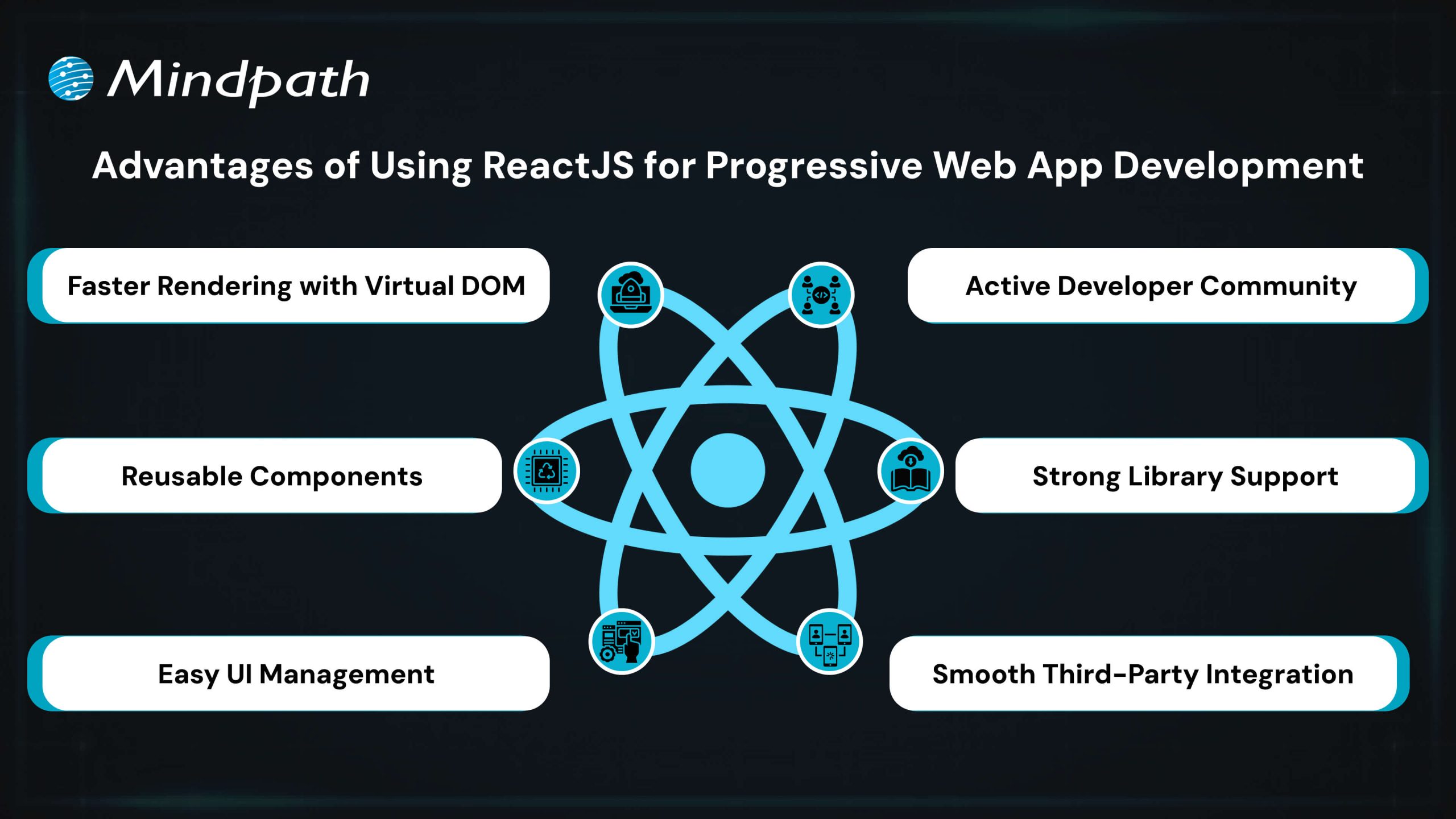
Advantages of Using ReactJS for Progressive Web App development

Using ReactJS for PWA development is a great choice for creating secure and fast web applications. With the growing ReactJS trends, developers hope that they can deliver seamless and user-friendly experiences. Here is how ReactJS is perfect for your PWAs.

Advantages of Using ReactJS for Progressive Web App development

1. Faster Rendering with Virtual DOM

React uses a Virtual DOM to update only the parts of the page that change. This speeds up performance and ensures a smooth user experience. It’s ideal for building fast and responsive ReactJS PWA solutions.

2. Reusable Components

React’s component-based structure allows developers to reuse code across the app. This makes it easier to manage the app and scale it as it grows. It’s a key reason why teams choose ReactJS for progressive web app development.

3. Easy UI Management

React follows a declarative style for creating user interfaces. This makes it simple to manage and update interactive elements in the app. It helps deliver a smooth and engaging ReactJS progressive web app experience.

4. Active Developer Community

React has a strong global community that shares solutions, tools, and tutorials. This support helps developers solve problems faster and stay updated. It also contributes to the future of ReactJS in modern web development.

5. Strong Library Support

React has many libraries like React Router and Redux that simplify routing, data flow, and offline features. These tools help developers add advanced features to PWAs with less effort. They make building a PWA with React more efficient and reliable.

6. Smooth Third-Party Integration

React works well with tools needed for Progressive Web Apps, such as service workers and web app manifests. These tools help enable offline access, background syncing, and “Add to Home Screen” functionality. This makes it easier to implement full PWA capabilities when building with React.

Want to keep your large React app fast and responsive as it scales? Discover the best practices for optimizing React performance for large applications.

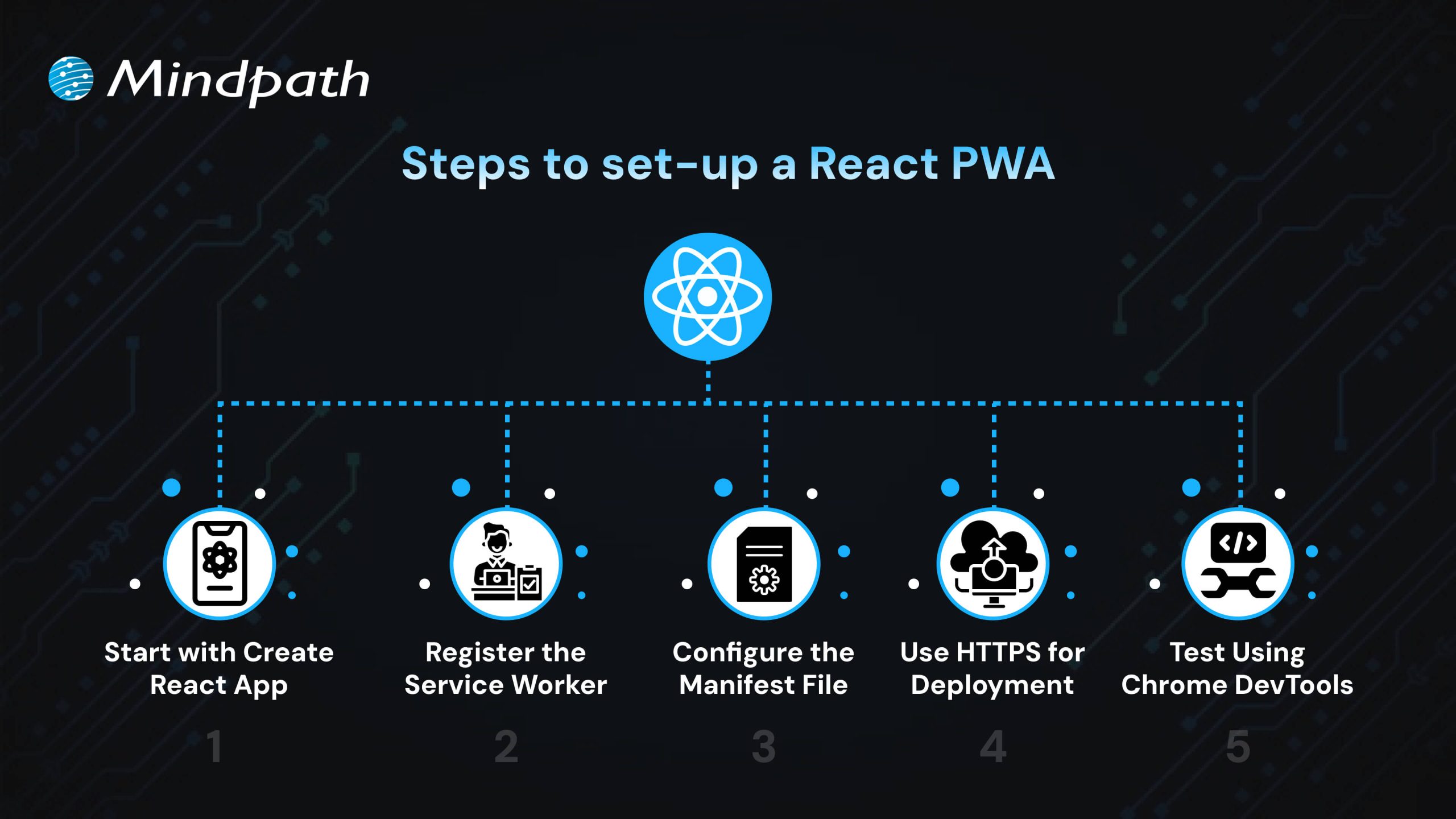
Steps to Set Up a React PWA

Getting started with React is a smart move when building modern web apps that work offline and feel like native apps. If you’re planning to use React for progressive web app development, here are the key steps to set it up properly.

Steps to Set Up a React PWA

1. Start with Create React App

The easiest way to begin is by using Create React App, which includes built-in support for PWAs. It sets up a basic structure with everything needed for ReactJS PWA development, including service workers and a manifest file. CRA also optimizes the build process, making your app production-ready. This setup ensures you have a strong foundation to build a scalable and responsive PWA.

2. Register the Service Worker

To activate offline support, register the service worker by calling ‘serviceWorkerRegistration.register()’. This enables background caching, which is key to building a progressive web app with React that works without an internet connection. A registered service worker allows the app to cache assets and serve them even when the network is unavailable. It also helps improve performance by reducing server requests, ensuring a better user experience in the future of web development.

3. Configure the Manifest File

Update the manifest.json file in the public folder to define your app’s name, icons, theme color, start URL, and display mode. These settings control how your app appears when installed on a device. A properly configured manifest ensures your PWA looks and feels like a native app. This also helps in enabling features like splash screens and full-screen display, supporting the growth of progressive web apps with React development.

4. Use HTTPS for Deployment

For security, PWAs must be served over HTTPS. Local development through CRA handles this, but for live deployment, ensure your server uses a valid HTTPS setup. A secure context is required for service workers and features like push notifications. Using HTTPS also improves user trust and SEO performance.

5. Test Using Chrome DevTools

Use Chrome DevTools to inspect and test your PWA setup. You can verify service worker status, cached files, and manifest settings. Lighthouse audits can also help you improve your app based on best practices for React for progressive web app development. Testing ensures your PWA meets performance, accessibility, and usability standards.

Seeking a development approach that reduces complexity while enhancing functionality? Read why React Web Development is ideal for modern projects.

Ready to Build a Powerful PWA with ReactJS?

ReactJS offers all the essential tools to build fast, reliable, and interactive web apps that feel like native experiences. Its reusable components, strong ecosystem, and smooth performance make it a top choice for modern applications. Choosing ReactJS for progressive web app development is a future-focused decision that brings real value to your business.

At Mindpath, we deliver expert ReactJS development services tailored to your goals. We build responsive, scalable, and feature-rich PWAs with smooth offline access and high performance. Our experienced team uses the latest tools and trends to create apps users love. Partner with Mindpath and bring your next ReactJS PWA to life with speed and quality.

Discover why ReactJS is perfect for Progressive Web App (PWA) development. Learn how Mindpath can help you build high-quality PWAs.
qualities of a good software engineer

The tech space is moving faster than it ever has, and businesses need professionals who are adaptable in the face of frequent change. Conversations about the qualities of a good software engineer often extend beyond coding. Businesses want engineers to contribute to real change and add some actual value through their work. The demand is not only for talent in the area of technical skills but also for people who can demonstrate impact in other areas of development.

At the same time, a job as a successful engineer shows far more than what a résumé can include. Simply put, this job involves constant learning, being a good team player, and being able to adapt to evolving project needs. Every organization is looking for individuals who can maintain the idea of long-term while developing ideas into effective solutions. In this blog, we look through the top qualities that describe a truly good software engineer.

To transform your idea into a powerful solution with the help of the right guidance. Contact us, and we will help you to implement the action that brings long-term success.

Why are Good Software Engineers Essential in a Company?

Good software engineers are essential to developing and sustaining the core systems that drive modern business. They design reliable, scalable responses, implement security, and develop user-friendly applications that facilitate growth. Their individual or team ability to resolve complex technical problems contributes to efficiency and drives innovation, and as such, they are a fundamental pillar of long-term success in competitive markets.

In addition to their role in custom software development, they also test, debug, and service software, while negotiating the escalating complexity of digital systems and software. By merging the business objectives with the technical implementation of the project, they can realize a project that provides real value. These roles articulate the qualities of a good software engineer and are fundamental to taking a business idea and transforming it into a meaningful and forward-looking outcome.

Must Read: Custom Software Development Benefits

What are the Qualities of a Software Engineer?

When companies are looking for quality people, they will be interested in the traits of a good software engineer that extend beyond their programming capabilities. These traits combine technical skills with problem-solving, teamwork, and flexibility, making engineers quality adders to any project. Below are the key characteristics that define them.

Qualities of a Good Software Engineer

1. Analytical and Critical Thinking

A great quality of a good software engineer is having analytical and critical thinking skills. Software engineers often work on unfamiliar systems with very little direction, so understanding how to break the system down into its components is helpful in realizing how the system really works. In doing this, the software engineer can recognize large patterns, see how inputs and outputs follow, and find a way to add value to the solution.

2. Knowledge of Software Architecture

Being knowledgeable about software architecture is an important software engineering characteristic that enables solid system designs. Engineers need to understand the flow of data through a system and how each element transforms that data. That knowledge supports engineers in building robust systems by allowing them to select the best architectural pattern that will last into the future.

3. Expertise in Tools and Technologies

It is a powerful strength of a software engineer to know development tools and alternative technologies. Software engineers need to investigate new options, balance trade-offs of risks to benefits on each alternative technology, and pivot accordingly to use the development tools that best contextual fit the immediate problem. If only to remain curious and current, software engineers have the opportunity to not make archaic choices.

4. Task Management and Prioritization

Managing multiple projects effectively is a key characteristic of a software engineer. All engineers perform some form of balancing act between regular day-to-day items and urgent tasks, including outages or bug fixes. With a little planning and prioritization, engineers can respond to urgent tasks while maintaining a steady pace on all projects.

5. Debugging and Testing Skills

Debugging and testing form an essential part of the qualities of a good software engineer. Engineers often occupy their time to sustain and upgrade developed projects; thus, referencing the strengths of their debugging skills will allow them to get to the root of an issue efficiently and start unpicking it. Testing will confirm that the software is functioning according to the specifications, while it will also reduce any risk of surprises.

6. Effective Documentation

Good documentation is an often-neglected, but vital, characteristic of software engineering. Engineers who write and update their documentation when they develop and change the software make it easier for others to understand the system and maintain it later. Good documentation, where records are kept clearly and accurately, will help reduce confusion, save time, and enhance collaborative efforts across teams.

Curious about the different kinds of software a skilled engineer might work on? Explore the various types of software development and see how each requires unique skills and expertise.

7. Curiosity and Open-Mindedness

Curiosity and open-mindedness are important qualities of a good software engineer because technology moves quickly. Great engineers investigate different ways of doing things, accept new ideas, and change how they do things – every time the new way is better. This mindset propels the innovation needed to successfully help teams solve problems.

8. Self-Motivation and Proactiveness

A successful software engineer is a self-starter who is proactive in identifying threats to successful project outcomes before they turn into large problems. Successful software engineers seek out opportunities to solve problems rather than waiting for someone to instruct them or blindly ignoring a potential risk altogether. A proactive software engineer can help dramatically improve team performance and produce better long-term project outcomes.

9. Prioritization Skills

Tremendous prioritization skills are a functional strength of a software engineer. Since not every task becomes urgent, engineers must focus on how to properly handle critical issues versus long-term goals. When the decisions are made competently enough, all teams can focus on issues that need immediate resources.

10. Empathy and Teamwork

Teamwork and empathy are defining qualities of a good software engineer in collaborative environments. Clear communication, attentive listening, and being mindful to consider the viewpoint of others are important to collectively solving problems as a team. These interpersonal skills cultivate healthier team dynamics and improve the likelihood of successfully completing the project.

11. Willingness to Learn

Having humility is a powerful software engineering characteristic, as no one can know everything in such a broad discipline. Engineers who are open to feedback and learn from others use their time wisely and bolster their skills. When an engineer is humble, they help cultivate stronger, more supportive teams that drive performance.

12. Responsibility and Ownership

A positive sense of responsibility is one key qualities of a good software engineer. Engineers understand their systems very well and will have to take responsibility, whether it be for successes or failures. Being responsible for their thoughts and actions earns engineers trust among the stakeholders that will, in time, improve user experiences.

Want to see how skilled engineers turn concepts into working software? Explore the custom software development process to understand the stages that ensure quality and efficiency.

Ready to Work with Skilled Software Engineers?

The qualities of a good software engineer show how vital they are in shaping ideas into real, impactful solutions. Strong technical skills combined with collaboration, adaptability, and ownership make them essential to building reliable and scalable systems. These qualities ensure not only innovation but also long-term success in today’s competitive and constantly changing digital landscape.

At Mindpath, our custom software developers bring these qualities into every project. They combine expertise, curiosity, and responsibility to create solutions tailored to your business needs. By focusing on innovation, reliability, and long-term value, our team ensures that your ideas are developed into secure, scalable, and user-friendly software designed to drive growth and meet evolving market demands.

Mobile app development technologies

Mobile app development technologies are important in the fast-paced environment of technology because they define how companies engage with users and keep them engaged. Each swipe, tap, and click is based on technology that is getting faster, smarter, and more interactive. If you’ve ever noticed, some apps feel effortlessly smooth, and others do not. The difference is usually related to the frameworks and platforms chosen for the business objectives and user expectations, and understanding these technologies provides a big advantage over others.

Delving into the newest trends in mobile application development often presents a plethora of choices that can seem confusing. However, choosing the appropriate technology can improve app performance, security, and the overall user experience. Developers routinely test technologies, frameworks, languages, and software solutions to create apps that can more easily rise above the fray. In this blog, we will explore the latest trends and the specific technologies that power the successful mobile app today.

Want to use top mobile app development technologies into a functional app? Mindpath offers mobile app development services, which will turn your imagination into a fully working, high-quality app.

What are Mobile App Development Technologies?

Mobile app development technologies refer to the programming languages, frameworks, and tools used to develop applications for mobile devices. These technologies provide developers with the means to develop compatible applications that would run across devices on platforms such as Android and iOS.

The landscape of mobile development technologies consists of native development tools, cross-platform frameworks, and backend services. The combination of these tools enables the development of applications that provide rich user experiences, work with cloud services, and utilize the native features provided by the device. Choosing the appropriate technology allows developers to build all of these easily, efficiently, and in a scalable way.

Also Read: AI in Mobile Apps

Top Mobile App Development Technologies in 2025

In order to remain competitive as an app developer, it is important to stay informed about the best technology for mobile app development in 2025. The choice of development tools can positively affect the performance, usability, and scalability of modern applications.

1. Flutter 3.22

Flutter 3.22 is a highly favored mobile app development platform to help developers develop applications for mobile devices, the web, desktop, and embedded devices. It provides high-performance and smooth animations that allow applications to run quickly and feel responsive. Developers also appreciate its professionally designed UI components, making it easy for developers to create stunning and consistent user interfaces.

2. Kotlin Multiplatform Mobile (KMM)

Kotlin Multiplatform Mobile (KMM) is a mobile app development framework that allows developers to share code for Android and iOS apps. It utilizes the modern, efficient programming language Kotlin to simplify the process of creating a mobile app for two platforms at once. This translates into a significant time saving, might help to reduce errors, and assure consistent behavior across your Android and iOS devices.

3. C++

C++ is among the most robust mobile app development technologies currently available for building high-performance applications. It enables developers to take direct control of system resources, which is often favored for complex applications or graphics-intensive applications. Also, by using C++, you can rest assured your apps are running as efficiently as possible, even as they traverse between different platforms.

4. Swift

Swift, a mobile application technology developed by Apple, is for building native iOS applications. It is fast, safe, and reliable, while also allowing seamless integration into AI and machine learning. With Swift, developers can build iPhone and iPad apps that are fast, safe, and modern.

5. AR/VR Integration Tools

AR/VR integration tools are tools for mobile app development that help developers add augmented reality and virtual reality features to an app. Integrating augmented and virtual reality features into apps is a valuable way to engage users while making an experience much more entertaining or immersive. These integrations are extremely popular in gaming and even found in some education and retail apps to enhance user experiences.

Ready to build smart mobile apps, but still wondering how AI can transform your development approach? Discover our blog on the benefits of AI in mobile app development to understand how AI can reshape modern app development.

6. AI-Assisted Development Tools

AI-Assisted Development Tools refer to tools such as GitHub Copilot and Amazon CodeWhisperer that support the automation of coding tasks. They streamline developers’ efforts in application development through code suggestions, error detection, and execution of tests. The upshot is that developers can create apps faster and also more efficiently.

7. React Native

React Native is another top mobile app development technology that enables developers to create apps for both iOS and Android using JavaScript. It provides a native look and feels with one complete codebase, reducing development time and duplication of effort. Companies are drawn to React Native because of its quick development period and strong support from the community.

8. Ionic

Ionic is a hybrid app framework and is a popular option among mobile app development technologies, allowing developers to write cross-platform apps using HTML, CSS, and JavaScript. It allows developers to write one codebase to operate on multiple devices. Ionic is very much favored by developers to create efficient and visually striking apps.

9. NativeScript

NativeScript is a flexible framework that matches the up-to-date trends in mobile application development with the ability to create fully native apps using JavaScript, TypeScript, Angular, or Vue.js. With NativeScript, you have full access to the native APIs offered by the OS, meaning that your application will work and perform like a truly native solution. NativeScript enables developers to build highly efficient and rich-featured mobile applications.

10. Xamarin (.NET MAUI)

Xamarin (.NET MAUI) is a framework aligned with mobile app development trends through the creation of native apps for Android, iOS, Windows, and macOS. While using C# and the .NET ecosystem, developers can share code and have a consistent experience across all platforms. Overall, this reduces development time, and provides high-quality apps.

Want to understand where custom mobile applications are creating real competitive advantages across the market? Discover our blog on the Custom Mobile Application Development Services to uncover high-impact opportunities and emerging trends.

Ready to Build the Next Successful Mobile App?

Mobile app development technologies continue to evolve, offering smarter tools and faster frameworks to help developers create better apps. Choosing the appropriate technology guarantees improved performance, security, and scalability. With the growth of innovation, staying up to date with current tools is critical for a company to provide seamless and engaging mobile experiences.

At Mindpath, we provide expert mobile app development services intended to turn your ideas into strong digital solutions.  Our experienced developers create secure, high-performing, and easy-to-use applications by applying modern tools and proven approaches. Partner with us to build an app that empowers your brand and creates long-lasting value for your users.