Offshore Software Development: What You Need to Know

Join our Newsletter!

Featured Posts

Support Is One Click Away

Home

Offshore Software Development: What You Need to Know

offshore software development

Offshore Software Development: What You Need to Know

Offshore software development is redefining how businesses are developing digital solutions. Are you still wondering what we mean by offshore? It means working with teams or services located in another country, often to obtain cost-effective expertise and accelerate delivery. In the world of software, this approach opens doors to global talent, allowing companies to develop high-quality products without the high expenses of local hiring

To elaborate, what we are referring to is outsourcing software development tasks to overseas teams that specialize in the technology and services. These teams are often found in areas with proven traditional IT qualifications and strong pricing competitiveness such India, eastern Europe, and southeast Asia. Do you want to learn more about this development? Don’t worry, in this blog we will be going into all you need to know about offshore software development. 

Ready to take your business to the next level? Partner with Mindpath for expert offshore development services that drive innovation, efficiency, and growth. Contact Us!

What is Offshore Software Development?

Offshore software development refers to collaborating with a software team that is located in a different country to manage your tech initiatives. An example for it can be a UK-based company that hires a Philippine development team to build a website or software tool. This helps reduce costs and makes it easier to find the right talent. Businesses prefer this model because they get quality work without spending too much money. The Philippines, for instance, offers skilled developers who are experienced and reliable. While there might be challenges like time zone gaps or communication styles, this kind of software development still helps companies finish projects faster and focus on their main goals. 

Fascinatingly, according to a Business Research Insights survey, the software offshore market was worth roughly USD 160.9 billion in 2024, and is on track to reach USD 413 billion by 2033, with a CAGR of 11.04%. Factors for this growth in the offshore software market include the affordable technology needs to increase usage, the demand for tech solutions to better connect with the global community, and also the need for talented developers. Countries such as India, China, and parts of Eastern Europe have emerged as preferred locations, because they provide access to talent, sufficient infrastructure, and a business-friendly environment.  

Also Read: Offshore Development Benefits for Businesses

What is the Offshore Development Process?

Offshore software development is the development of software with teams in other countries that help you in the efficient building and maintenance of your software. Here is a simple set of steps that companies tend to go through when working with offshore developers: 

offshore software development process

1. Recognizing the Need

The organization recognizes it has additional skills or resources requirements, and they must determine what to outsource like coding, testing, or support work.  

2. Finding an Offshore Partner

They seek a trusted team in another country with a solid skill set and experience, often in a region well known for technology. 

3. Beginning the Project

Both teams establish project goals, working timelines, and methods to communicate, likely via video calls or project tracking software. 

4. Developing and Coding

The offshore team will begin the project and communicate updates consistently, using project tracking and collaboration tools online 

5. Testing and Quality Assurance

The teams will thoroughly test the software to resolve any challenges, ensuring it all works before launching. 

6. Deployment of the Software Solution

The completed software solution will be deployed and the team will continue to provide services or updates according to demand. 

7. Continued Collaboration

The firm will still do business with the offshore team in terms of updating and improving and developing future work. 

While offshore development gives you access to global talent and cost advantages, you may also explore custom software development to better understand when tailor-made solutions are the right choice.

Benefits of Offshore Software Development

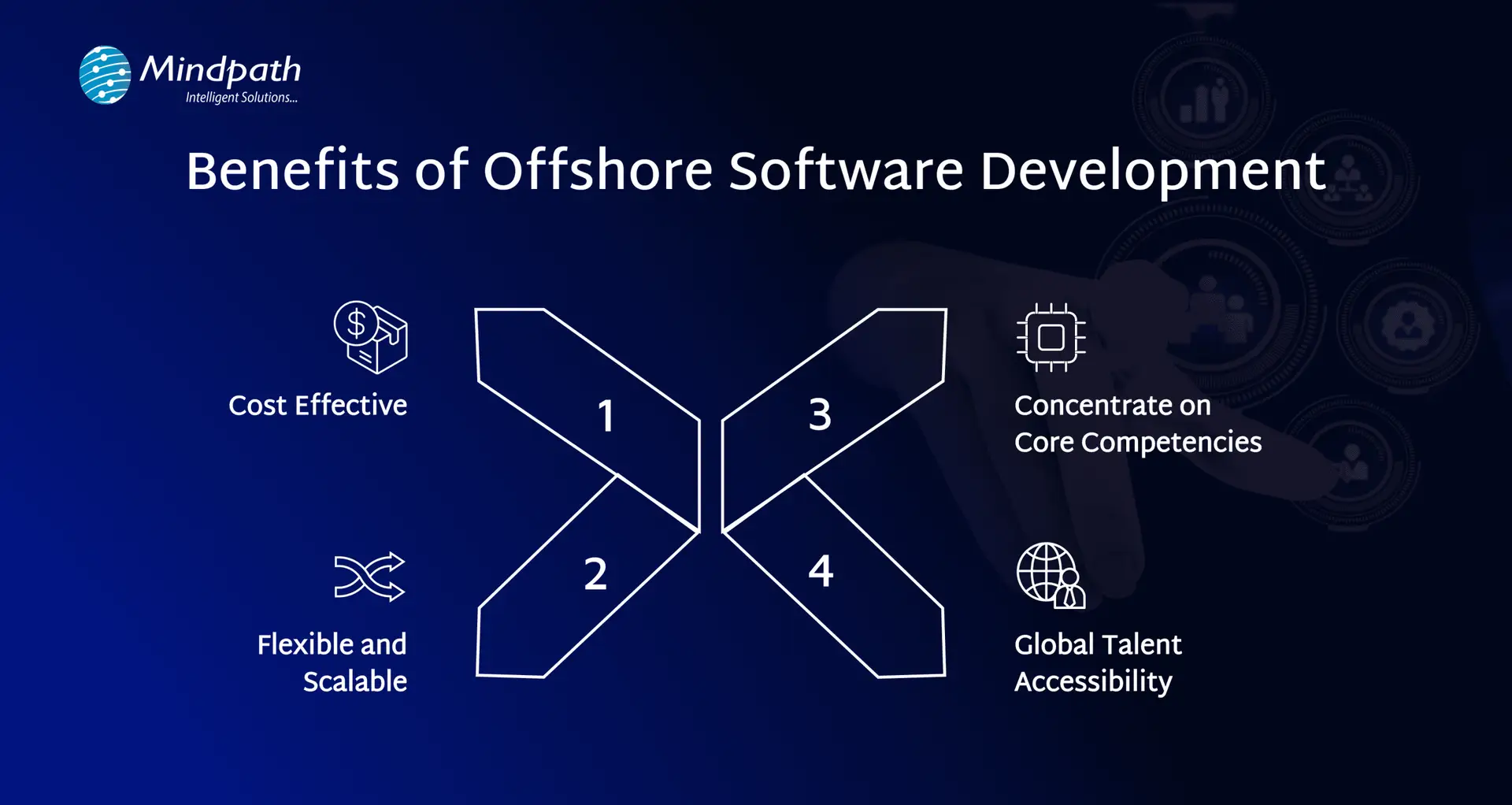
Development of offshore software is now a common approach for businesses that want to increase their tech potential. It fosters sustainable growth by providing a more intelligent way of managing development requirements across countries. Let us examine its benefits: 
benefits of offshore software development

1. Cost-Effective

Sometimes, hiring developers from other countries can cost less than building a local team. This could help companies save money without sacrificing quality. The additional budget can be utilized to help grow the business, such as marketing or product upgrades. It is a more resourceful approach to balancing costs while remaining competitive.

2. Flexible and Scalable

Offshore development services easily allow you to adapt team sizes and add or downsize developers based on project needs. There is ease of access to add a number of developers to your team when your workload increases, or to scale down easily as workload begins to slow down. This provides operations with greater flexibility, gives you quicker access to talent while avoiding lengthy hiring processes. This engagement allows quicker delivery for your clients and provides a smoother operating working relationship for your offshore team.

3. Concentrate on Core Competencies

Future-proofing by outsourcing software work allows companies to turn their attention back to what they do best. They can manage just the right amount of technical detail, and spend more time on strategy, customer service, or new product growth. While offshore teams will take care of the technical detail while being very diligent and skilled in doing this work, allowing companies to focus on even bigger parts of the operation like overall performance

4. Global Talent Accessibility

Offshore teams also allow companies to expand their access to the world’s best talent. Instead of only hiring locally, your teams have access to experts from around the globe, which can be a huge advantage for partnerships and companies looking for the exact skills they need. Skilled and knowledgeable individuals will lead to improved, more diverse ideas, a wider range of perspectives, and improved quality assurance, all of which will lead to improved and better-quality results. It is a great opportunity to be more intentional about building and fine-tuning more creative teams. 

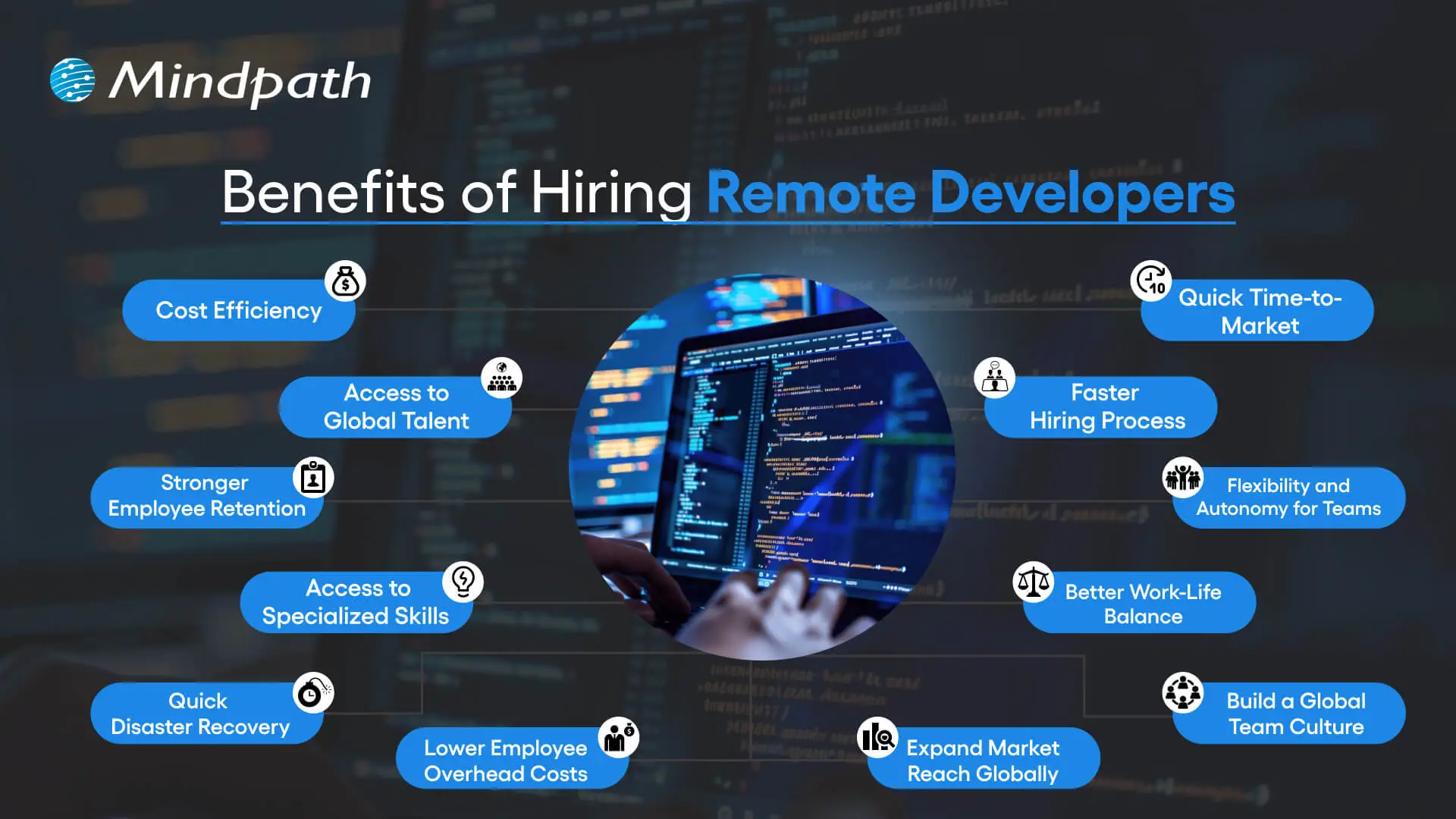
If reducing onboarding time and accessing a wider talent pool are priorities, our article on the key benefits of hiring remote developers shows how remote hires can complement offshore strategies.

Ready to Work with an Offshore Software Development Company?

Offshore software development has become a powerful strategy for companies looking to build high-quality digital products without stretching their budgets. By working with skilled teams from other countries, businesses can meet deadlines faster, access a wide talent pool, and stay focused on their core goals. While it may come with a few challenges like time zone gaps, the right planning and communication make it a highly effective and scalable approach for long-term success. 

At Mindpath, we provide reliable offshore software development services tailored to your business needs. Our global teams bring technical expertise, timely delivery, and smooth collaboration to every project. Whether you need help with custom software, mobile apps, or support and maintenance, we’re here to support your goals with cost-effective solutions. With clear communication and dedicated teams, Mindpath makes offshore development simple, efficient, and successful for companies of all sizes. 

Frequently Asked Questions

1. How can communication gaps be managed effectively in offshore software development?

Clear communication channels, regular meetings, and proper documentation help reduce misunderstandings. Using collaboration tools and setting overlapping working hours can improve coordination. A structured communication plan ensures both teams stay aligned, even when working across different time zones and cultural contexts.

2. What should businesses check before signing a contract with an offshore team?

It is important to review technical expertise, past projects, client feedback, and security practices. Clear agreements on timelines, deliverables, and communication methods should be defined. This helps avoid confusion later and ensures the partnership is built on transparency and mutual understanding from the start.

3. How does offshore development impact project timelines and delivery speed?

Offshore teams can often accelerate delivery by working in different time zones, enabling near round-the-clock progress. However, proper planning is essential to avoid delays caused by coordination issues. When managed well, it can significantly improve turnaround time and overall project efficiency.

4. Is offshore software development suitable for small and mid-sized businesses?

Yes, it is often a practical choice for smaller businesses looking to access skilled talent without high hiring costs. It allows them to build quality software within budget while focusing internal resources on growth, operations, and customer engagement.

5. How can businesses maintain quality control when working with offshore teams?

Quality can be maintained by setting clear standards, conducting regular reviews, and using testing frameworks throughout the project. Continuous monitoring, feedback loops, and defined performance metrics help ensure the final product meets expectations and aligns with business requirements.

Related Post

Discover the benefits of serverless architecture, from cost savings to faster development, and learn how Mindpath can help your business thrive.
Discover the top Node.js trends shaping digital technology in 2024, from AI and TypeScript to IoT and cloud computing. Explore how Node.js drives innovation!

Related Post

hiring offshore developers

The software development market size is expected to reach USD 1.11 trillion by 2031. Software development is all about building applications and programs that are used on our mobile devices and computers. This is why the trend of hiring offshore developers has escalated drastically due to the global shortage of skilled IT talent. Further, offshoring experts can be cost-effective while lowering your overhead charges.

As per a detailed survey of Manpower, around 76% of employers in the recent scenario lack the right talent in the IT sector. So, businesses growing with escalating digital demands need offshore development to stay competitive without overburdening their budgets.

Let us explore the major steps involved in choosing the right offshore developers while preventing common pitfalls.

Looking to scale your team quickly without long hiring delays? At Mindpath, we offer expert staff augmentation services to fill your talent gaps efficiently.

Who are Offshore Developers?

Offshore developers generally work from distant regions to assist in certain software development tasks. So, by sticking to the expertise of offshore developers, your company can leverage the values of skilled experts to generate or balance its programs. Moreover, such professionals can include backend engineers, DevOps Experts and much more.

When you hire offshore developers, make sure to maintain collaboration through advanced communication tools and effective workflows. Further, they also value structured project management processes.

What are Some Advantages of Hiring Offshore Developers?

Hiring offshore developers can be extremely beneficial for your company while unlocking potential opportunities. Some of the convenient aspects have been given here for your reference.

1. Enjoy Access to Global Technical Expertise

Local hiring markets majorly suffer from skill shortages and high competition. So, offshore software engineers give your business access to a wider pool of experienced professionals. Further, the experts will have utmost knowledge about emerging technologies like data engineering and AI to make your software perform effectively.

This global rich can make it easy for you to hire offshore development with industry-rich skills that you might not get locally.

2. Faster Development Cycles

Your team will be distributed across different time zones. This can support faster development cycles without hampering quality. So, while your one team signs off for the day, the other one will continue to make progress.

3. Cost Optimization with Sacrificing Quality

One of the most essential advantages of offshore hire is cost-effectiveness. Your company can easily reduce the development charges while still working with skilled professionals. Additionally, lower operational charges allow your business to invest more in product innovation and customer satisfaction.

Planning to scale your project without overspending? Explore our comprehensive guide on offshore software development strategies for expert insights..

What are Some Different Ways to Hire Offshore Developers?

It is very important for you to pick the right engagement model to achieve success. So, consider the values of hiring offshore developer as they are flexible and businesses can adapt them as per the project requirements.

1. Project-Oriented Offshore Development

This type of model suits businesses with a clear and defined scope while holding clarity about their budget and timeline. You can hire offshore developers to leverage specific features or applications. This makes it convenient for short-term or fixed-requirement projects.

2. Dedicated Teams

A dedicated offshore team majorly works on your project and functions as an extension of your in-house team. Additionally, this approach can benefit your long-term projects or evolving projects. This is efficient when you want to strengthen your team by scaling it up.

3. Offshore Staff Augmentation

Such an offshore development model allows your company to strengthen existing teams by adding software engineers with specific skill sets. This approach is extremely useful during peak workloads.

Want to know the best practices for managing an offshore development team successfully? Explore our comprehensive blog on offshore software development for business for actionable tips.

How to Hire Industry-Leading Offshore Developers?

You can go through the steps below to make your offshore hiring process effective and result-oriented. Moreover, these streamlined steps have always been advantageous for many leading tech giants.

1. Assess Your Requirements

Before you pick any offshore developers, it is necessary for you to understand your requirements. Figure out what you actually want to achieve from the project and what features it should include. As different projects require different skill sets, determine the specific talent you need from your offshore developers.

Set a timeline for your project and assess how much you are willing to spend on this development success. This approach can narrow down your search while fulfilling your requirements on time.

2. Search for Desirable Candidates

Once you are assured about your project requirements, you can start searching for the right candidate. Browse online platforms and efficient job portals to find reliable candidates. Further, you can value the recommendations and referrals of your colleagues and friends to find talented developers.

You can also search in the professional networks and communities to find a suitable offshore development team that strives for better results.

3. Conduct Interviews and Verify the Candidates

Prepare a list of useful questions before you conduct any interviews. Always include those questions that can help you assess the candidate deeply. You can ask about their experience in custom software development and how they are committed to their service. Further, you can also assess their technical expertise.

You can also ask them to explain certain concepts and how they can easily solve multiple levels of project risks. Also, verify their communication skills and how transparent they are with their points of view.

4. Onboard Your Developers

Once you are done with hiring the best developers from around the globe, you can onboard and manage them as per your project requirements. Further, to be assured of successful communication and effective collaboration, use necessary tools like Skype and Slack.

Wondering how remote developers can enhance your project efficiency without breaking the budget? Discover the benefits of hiring remote developers to optimize your offshore hiring strategy.

How to Evaluate the Talent of Offshore Developers?

Hiring an offshore development team requires more than just reviewing the resumes. So, a detailed assessment can ensure you are getting your hands on the right professionals.

  • Communication Expertise

Your offshore development team will work remotely. So, it becomes essential for them to value clear communication. You need to assess if they are capable of explaining multiple technical concepts, and they must respond to your feedback quickly.

  • Technical Knowledge

It is necessary to go through the offshore developers’ previous projects. Moreover, consider experts who have experience working with similar type of technologies that your industry prioritizes on daily basis.

  • Problem-Solving Techniques

Offshore developers should also be aware of authentic analytics skills instead of just coding knowledge. They should innovate and instead of strictly working on instructions.

Are you finding it challenging to keep your offshore development team aligned and productive? Learn about top remote work tools that simplify team management.

Conclusion

Hiring offshore developers comes with its own incredible benefits. However, the complete process of picking the right development team might feel challenging to you. So, if you are willing to leverage the expertise of the best offshore team of developers, then Mindpath can be your ultimate solution.

We bring a trusted expertise in custom software engineering and staff augmentation. With a focus on quality and long-term collaboration, we help businesses turn their offshore development into a competitive benefit.

FAQs

1. Is Offshore Development Convenient for Entrepreneurial Businesses?

Startups often value the work of offshore development to reduce costs and adapt quickly as per the changing markets. Further, this approach can help you maintain product quality without harming your pockets.

2. Can Offshore Developers Work with Complicated Projects?

Professional offshore developers can easily handle complex projects when they are supported with the right planning and tools.

3. What Is One of the Biggest Challenges in Offshore Hiring?

Unclear expectations and poor communication are the most dangerous risks, and both can hamper your workflows.

4. How Do Offshore Developers Integrate with My In-House Team?

Offshore developers can easily integrate with your in-house team through shared workflows and multiple collaboration tools like Skype.

5. What Should I Include in an Offshore Development Contract?

Your offshore development contract should clearly mention the objective of the work along with the pricing model and confidentiality protocols.

Learn how to hire offshore developers with our comprehensive guide. Maximize your business growth by accessing skilled talent and streamlining your process.
Generative AI Use Cases in Diverse Industries

“Necessity is the mother of invention.” We have all encountered this phrase in our science textbooks or while reading about most scientific innovations. Be it the invention of the cell phone, the internet, or the World Wide Web, each of these has brought a paradigm shift in the world of technology.  

While technology is rapidly expanding its horizon, Artificial Intelligence remains the buzzword that every business can’t stop gushing about. Generative AI, a subfield of artificial intelligence, has gained massive momentum post the launch of ChatGPT by OpenAI in 2022. Since then, generative AI use cases have found their way in some of the major industries, including healthcare, banking & finance, gaming, and supply chain, to name a few, marking the beginning of the Gen AI revolution.

But what is Generative AI? Is it only limited to text or image generation, or can it help in other fields as well? In this blog, we will be answering some of the burning questions around Generative AI and generative AI use cases across industries.  

Want to implement cutting-edge GenAI solutions in your company? Mindpath offers end-to-end AI Development Services for deploying generative AI applications efficiently.

Introduction to Generative AI 

Let’s start with the basics: what is Generative AI? A magic lamp that fulfils all your wishes; well, almost! Generative AI uses a pool of data that includes text, images, code, etc., amongst other data types.  

With the help of machine learning models and neural networks, this large sum of data gets analyzed, patterns are discovered, and output is delivered. Generative AI, as it says, is not limited to analyzing the data, but creates new information such as content, images, videos, and even code.  

Also Read: Top GenAI Trends 

Here are some of the key components of Generative AI:  

key components of Generative AI

  1. Data: Raw data such as documents, eBooks, ledgers, images, videos, codes and a lot more that Generative AI uses to learn.  
  2. Neural Network Models: They work just like a human brain; they help AI models to make sense of all the raw data we have put in the model.  
  3. Training and Model Parameters: There are some parameters that help AI models fine-tune the information, cut the noise and generate accurate output.  
  4. Input: When you ask a Gen AI model to create a cover letter for a job, create a report based on Excel data, generate a Ghibli image to roll with the current trends, that’s categorized as an “input”.  
  5. Output: Whatever results a Gen AI model, such as ChatGPT, MidJourney, Bart, delivers for your query is the output.  

Generative AI is gaining momentum, with a global market valued at USD 37.89 billion in 2025 which is projected to reach USD 1,005.07 billion by 2034 at a CAGR of 44.20%. (Source: Precedence Research)

Generative AI Use Cases Across Industries 

While Gen AI is growing, curating a business-first roadmap for its adoption is important for those seeking to leverage it to its fullest advantage.  Now that we have explored what Generative AI is, let’s move on to some prominent generative AI use cases in different industries, proving that it’s more versatile than we know!  

1. Healthcare 

According to a recent survey by Deloitte Center for Health Solutions, 75% of leading healthcare companies across the globe are either currently experimenting with generative AI or planning to scale Gen AI in the near future.  

In what area, you may wonder? Generative AI healthcare is being used to maintain patient records, drug discovery, interpreting and analyzing medical images such as X-rays, CT scans, MRIS, to mention a few.  

Scientist are using generative AI for modelling molecular structures that can help not just in creating new drug compounds but also in predicting their effectiveness.  

92% of healthcare leaders see a promising future of generative AI in improving efficiency as well as speeding the decision-making in critical scenarios.  

2. Banking  

Next up is the banking and finance industry. Generative AI in banking is fueling the fintech revolution in more ways than one. Generative AI is currently being leveraged for detecting fraud, assessing the credit score or credit risk based on the creditworthiness of an individual or an entity, customer support, automating routine tasks and compliance checks, creating investment strategies, among others.  

A recent report by KPMG revealed that around 76% of banking executives in the United States are planning to implement Gen AI for fraud detection and prevention, while 62% want to leverage it to improve their customer service, followed by 68% of professionals that believe Gen AI can be best used for regulatory compliance.  

3. Gaming  

One of the most exciting areas for generative AI applications could be gaming. According to Statista, over one-third of game developers across the globe are already using Gen AI tools in their studios. PCG, which stands for Procedural Content Generation, is the largest segment of the gaming industry where almost 30% gen AI is being used currently. PCG helps game developers create larger than life game world, environment and universe that intrigues the players and gives them a more immersive experience.  

Other than PCG, some other significant generative AI use cases in gaming include developing characters, detecting bugs, generating real-time content like new levels and challenges, and detecting any kind of irregularities or security breaches or threats.  

Wondering how AI can help your business to reach the exceptional level of growth? Read our blog to learn about the importance of generative AI for business.

4. Supply Chain 

When it comes to adopting Gen AI, the supply chain industry is no stranger to it. In fact, McKinsey’s survey revealed that a third of global businesses are effectively using generative AI in business areas, including operation processes automation (66%), production planning and scheduling (47%), quality control and inspection (44%), and inventory management (43%).  

Gen AI can support the supply chain industry with better demand forecasting, optimizing day-to-day operations, assessing and controlling supplier risks,  quality control, fraud detection, and much more!  

 5. Other Industries 

Apart from the above-mentioned industries, use cases of generative AI are prevalent in other industries such as sales and marketing, insurance, legal and compliance, human resources, product development, and many more.  

While many still utilize gen AI for content, image and code generation, the applications are certainly above and beyond. However, leveraging gen AI comes with its own set of challenges. Being AI-ready is in demand for every industry and business seeking to adapt and leverage AI to its advantage. There’s no one-size-fits-all guidebook or roadmap for AI adoption; rather, each business and industry needs to understand its niche and create a roadmap that generates true value.  

Wondering how generative AI is influencing content creation and design strategies? Check out our blog generative AI changing creative industries  to see how AI-driven creativity is shaping the future of industries.

Ready to Embrace Innovation with Generative AI?

Generative AI is expanding its horizon, and businesses have started to realize its true potential. While Gen AI continues to grow, it’s critical to assess all of its aspects that involve data security, lack of information, and overdependence.  

Businesses looking to adapt AI must look beyond the hype and create a strategy that works for them. At Mindpath, we help businesses create solutions that are based on their real pain points rather than creating just another software. When you talk to us, we attempt to understand your operations and what may work to make them more efficient.  

Our customer-first approach helps us identify gaps and curate a solution that works for you. Thus, if you’ve been wanting to adopt AI, the right time is now! Let’s discuss how our AI development services can help you make the best of up-and-coming technologies and get your business future-ready!  

Frequently Asked Questions

1. Why are generative AI use cases expanding so quickly across industries?

Generative AI use cases are expanding because businesses need faster innovation, better decision-making, and automation at scale. The technology can process vast datasets and generate meaningful outputs, helping industries respond quickly to market changes while improving efficiency, accuracy, and customer experience.

2. How can companies identify the right generative AI use cases for their industry?

Businesses should start by analyzing operational challenges, repetitive workflows, and data-heavy processes. The most effective generative AI use cases solve real business problems rather than following trends. A clear roadmap, measurable goals, and strong data infrastructure help ensure successful adoption.

3. Is generative AI suitable for regulated industries?

Yes, but with caution. Regulated industries like healthcare and finance must ensure data privacy, compliance, and transparency. Proper governance frameworks, human oversight, and secure infrastructure are essential to safely implement AI solutions without violating regulatory standards.

4. What skills are required to implement generative AI in an organization?

Organizations need a mix of AI engineers, data scientists, domain experts, and cybersecurity professionals. Beyond technical roles, leadership must understand strategy and change management. Training employees to collaborate with AI tools is equally important for long-term success.

5. What risks should businesses consider before scaling generative AI solutions?

Key risks include data bias, security vulnerabilities, inaccurate outputs, and overdependence on automation. Businesses should validate AI-generated results, maintain human supervision, and establish ethical guidelines. A balanced approach ensures innovation without compromising reliability or trust.

generative ai for business

Ever imagined a machine that could produce articles, logos, and new content to power your business? Sounds intriguing, isn’t it? Well, that is what generative AI can do for your business. This new-generation artificial intelligence is transforming future of businesses by generating new content, images, product designs and even strategy concepts from patterns it has acquired by analyzing the existing data. In this blog, we are going to discuss how generative AI for business can create innovation and give a competitive advantage.

So, before we learn about how generative AI can transform businesses, let’s understand what is generative AI.

Looking for ideas to reshape your business with generative AI? Unlock smarter growth, faster innovation, and personalized customer experiences with Mindpath’s AI-powered solutions

What is Generative AI?  

In simple terms, generative AI is an artificial intelligence that takes huge datasets and algorithms to learn the pattern and then generates new outputs based on its understanding. While AI is all about recognizing data, classifying it, or predicting, generative AI takes it a step further—it produces new content. For instance, it can author customer emails, create social media posts, produce product descriptions, and even assist in designing user experiences. 

Generative AI has the ability to provide enterprises with numerous benefits like enhancing innovation and creativity, enhancing productivity and reducing expenses. Generative AI also facilitates original idea creation, speed in product development, and custom-built customer experiences. In addition, it has the potential to enable workers to focus on more critical activities and reinforce security and raise the satisfaction levels of customers. 

Also Read: Generative AI Revolution

Let’s dive in how generative AI can drive business innovation and creativity for businesses. But before that have a quick look at the Google Trends for Generative AI for Business.

generative ai for business trends

How does Generative AI Drive Innovation for Businesses? 

In today’s fast-moving digital world, innovation is the key to staying ahead. Generative AI in business is assisting companies in igniting new ideas, enhancing content, and accelerating processes. Let us see how generative AI for innovation is changing the way companies think and create. 

1. Personalization Fuels Innovation 

Building a strong customer connection helps in driving business growth and personalization plays a major role in it. Companies can deliver tailored content and better user experiences with the help of smart tools that can understand customer behavior. This is precisely where generative AI for innovation can make a huge difference by helping businesses personalize at a scale which is much faster and more accurate than manual efforts.  

2. AI Creativity and Human Creativity: A New Partnership 

There is much discussion circulating about AI creativity vs. human creativity. It shouldn’t be about who is superior, but how they can both contribute to success. Humans can provide emotion, context and novel ideas to which AI can provide structure and new insights based on data. Merging the two can assist businesses to work more smartly. For example, how generative AI can augment human creativity is seen when it rapidly produces ideas or content, and humans are able to edit and make them work for the brand’s voice and objectives. This also ties into how AI is redefining job roles in tech, showing the evolving collaboration between human expertise and AI capabilities.

3. Unlocking Potential through Data-Driven Creativity 

Generative AI for business enables companies to convert information into intelligent ideas through analysis of customer behaviors, market patterns, and performance outcomes to develop valuable content, product layouts, or advertising campaigns. Humans contribute creativity, passion, and profound meaning, while AI contributes pace, logic, and the capacity to process vast volumes of data rapidly. When combined both, companies are able to develop meaningful experiences that connect with people and result in improved outcomes. aligning with the latest Gen AI trends in business intelligence.

4. Streamlining Operations 

When used properly, Generative AI in business enables companies to save time by automating routine work and processing large sets of data. This allows teams more time to come up with new ideas and more efficient ways of working. When businesses apply this type of thinking, they can grow more quickly, plan more smartly, and stay ahead of market change. That’s how generative thinking helps businesses innovate smarter because it provides them with the space, tools, and insights to grow more smartly. 

5. Securing Financial Transactions 

Generative AI is becoming a necessity for securing financial systems and mitigating risks. It enables companies to identify potential financial risks by processing vast amounts of data efficiently and accurately. The technology also helps in forecasting market trends, enhancing decision-making. Additionally, generative AI is improving fraud and suspicious activity detection in real-time. It’s transforming trading by offering insights from enormous data sets, ensuring smarter and safer transactions. 

Wondering how generative AI is influencing content creation and design strategies? Check out our blog generative AI changing creative industries  to see how AI-driven creativity is shaping the future of industries.

Use Cases of Generative AI for Business Growth 

Generative AI for business is revolutionizing the way companies develop by enhancing customer experience, increasing productivity of employees, and accelerating innovation. From conversational tools like ChatGPT, Bard, and Midjourney to live business applications, the effects are tangible. Here are some simple yet impactful generative AI use cases that fuel business growth today:

Use Cases of Generative AI for Business Growth 

1. AI-Driven Product Ideas

With tools such as Midjourney, businesses are able to create product ideas, packaging, and graphics. It illustrates how AI can be applied in innovation, by assisting teams to come up with creative ideas quicker and validate what is effective with actual audiences.

2. Smarter Customer Support

Tools like ChatGPT help companies create AI-powered chatbots that answer customer questions instantly. This improves response time and frees up human agents to focus on complex issues. It’s a simple way to offer 24/7 support and boost customer satisfaction.

3. Streamlining Employee Workflows

According to the McKinsey Generative AI Report, generative AI can automate tasks that take up 60–70% of employees’ time today. This includes writing emails, summarizing reports, and generating presentations—especially helpful for knowledge workers and high-skill roles.

4. Personalized Marketing Campaigns

Generative AI technology assists companies in crafting customized ads and suggestions based on user data. This renders marketing more precise and efficient, enabling more engagement and sales while saving time for marketers.

5. Fast Content Generation

With platforms like Bard, teams can quickly write blogs, product descriptions, and emails. This saves time and allows employees to focus on strategy. It’s one of the most practical generative AI examples used daily across industries. 

Looking to leverage generative AI for smarter, more adaptive app solutions? Explore our blog on Generative AI in App Development highlights practical applications, transformative benefits, and strategies to stay ahead in the digital landscape.

Ready to Make Your Business AI-Ready? 

Generative AI is changing the way businesses work, think, and grow. It’s not just about automation, it’s about helping teams be more creative, make faster decisions, and offer better experiences to customers. Be it creating content, improving support, or building new ideas, generative AI for business is making every day work smarter and more efficient. 

At Mindpath, we specialize in delivering cutting-edge AI development services tailored to meet the unique needs of modern businesses. Our expertise in generative AI enables companies to streamline operations, boost productivity, and create intelligent solutions that drive real value. Whether you’re looking to implement AI-powered automation, enhance customer engagement, or accelerate innovation, Mindpath is your trusted technology partner for consistent business growth! 

Frequently Asked Questions

1. What is generative AI for business users?

Generative AI for business refers to AI systems that create new content, ideas, designs, or solutions based on existing data. Instead of only analyzing information, it generates emails, reports, marketing copy, product concepts, and more. Business users can apply it to improve creativity, automate tasks, and make smarter decisions faster.

2. What are some applications of generative AI in business?

Businesses use generative AI for content creation, customer support chatbots, product design concepts, personalized marketing campaigns, and financial risk analysis. It also helps generate reports, automate emails, and create digital assets. These applications support innovation, reduce manual work, and improve overall operational efficiency.

3. How can we implement GenAI to improve efficiency?

To implement GenAI effectively, businesses should first identify repetitive tasks and content-heavy processes. Next, integrate AI tools with existing systems like CRM or ERP platforms. Start with pilot projects, measure performance, and scale gradually. Proper data management and employee training are essential for long-term success.

4. What is the future of GenAI in business?

The future of Generative AI for business looks highly promising. It will continue enhancing personalization, predictive decision-making, and intelligent automation. As technology advances, AI systems will become more context-aware and collaborative, working alongside humans to drive innovation, improve productivity, and create smarter digital ecosystems.

5. What is one limitation of generative AI in business?

One major limitation of Generative AI for business is its dependence on data quality. If trained on biased or inaccurate data, outputs may be misleading. It also lacks true human judgment and emotional understanding, which means human oversight remains necessary to ensure accuracy, brand alignment, and ethical use.