Home

LLMOps vs MLOps: Key Differences in Managing AI Models in Production

LLMOps vs MLOps: Key Differences in Managing AI Models in Production

Join our Newsletter!

llmops vs mlops

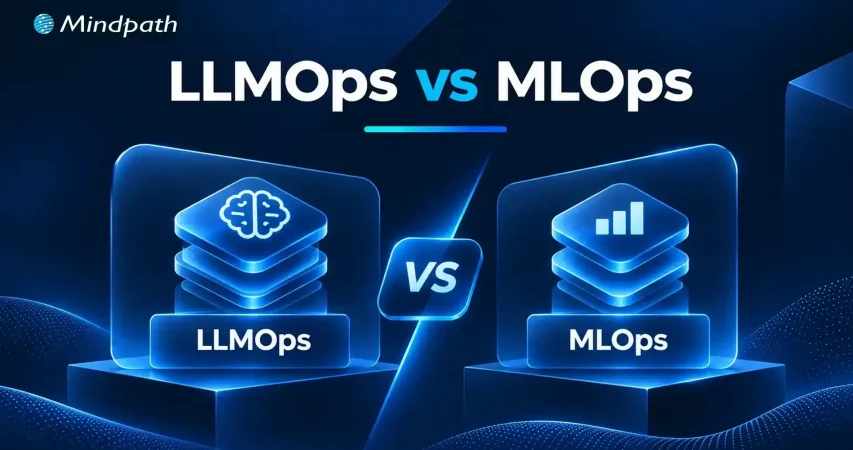
Moving AI models from experimentation to production requires careful planning, consistent monitoring, and ongoing maintenance. Traditional machine learning operations have established processes for training, testing, deploying, and maintaining models. However, large language models introduce additional challenges, including prompt management, response quality, hallucination detection, and inference cost control. This has made LLMOps vs MLOps an important consideration for businesses building production-ready AI applications.

Key Takeaways

  • 01MLOps manages traditional machine learning workflows, while LLMOps addresses generative AI applications.
  • 02LLMOps introduces additional requirements for prompt management, response evaluation and hallucination monitoring.
  • 03Data preparation, model development, and evaluation differ across both operational approaches.
  • 04Choosing suitable LLMOps tools improves monitoring, deployment and production management.
  • 05Businesses can combine MLOps and LLMOps to manage diverse AI applications effectively.

While both practices aim to maintain reliable AI systems, their operational requirements differ in several areas. Understanding these differences helps businesses choose the right approach for their AI initiatives. In this blog, we will examine their key differences, workflows, essential tools, and practical applications.

Struggling to manage AI models and maintain their performance in production? Mindpath offers AI development services to help businesses build, deploy, and manage scalable AI solutions with reliable production workflows.

Understanding the Foundations of MLOps and LLMOps

Understanding how these two operational approaches work is essential before comparing their capabilities. Although MLOps and LLMOps share several engineering principles, they address different requirements in the development and management of AI applications.

1. What Is MLOps?

MLOps, or Machine Learning Operations, combines machine learning development with DevOps practices to manage the complete ML lifecycle. It establishes consistent processes for preparing data, training models, validating results, deploying models, and monitoring their performance in production.

Its primary goal is to make machine learning workflows reliable, repeatable, and easier to maintain. MLOps uses automation, model versioning, and continuous integration to help engineering teams manage changes and maintain consistent model performance.

Key responsibilities of MLOps include:

  • Data Preparation: Cleaning, processing, and organizing training datasets.
  • Model Training: Developing models using selected algorithms and datasets.
  • Model Validation: Testing performance through accuracy, precision, and recall.
  • Automated Deployment: Releasing validated models into production environments.
  • Performance Monitoring: Tracking model behaviour, data drift, and prediction quality.

For instance: A subscription business can use an ML model to identify customers likely to discontinue their subscriptions. MLOps help manage the training data, model updates, deployment, and ongoing prediction monitoring.

2. What Is LLMOps?

LLMOps, or Large Language Model Operations, focuses on managing the development, deployment and maintenance of applications powered by Large Language Models (LLMs). It covers foundation model selection, prompt engineering, retrieval pipelines, fine-tuning, evaluation and production monitoring.

Its primary goal is to maintain reliable and cost-effective generative AI applications. LLMOps introduces additional practices for evaluating responses, identifying hallucinations, managing token consumption and maintaining consistent output quality across different user interactions.

Key responsibilities of LLMOps include:

  • Model Selection: Choosing suitable foundation models for specific applications.
  • Prompt Management: Creating, testing and versioning prompts.
  • Retrieval Management: Connecting LLMs with relevant external knowledge sources.
  • Response Evaluation: Assessing relevance, factual accuracy, and contextual grounding.
  • Production Monitoring: Tracking hallucinations, latency, token usage and response quality.

For instance: A customer support assistant can use an LLM connected to a company’s knowledge base to answer customer queries. LLMOps helps manage its prompts, retrieval pipeline, response quality and production performance.

LLMOps vs MLOps: 8 Key Differences Explained

MLOps and LLMOps share operational foundations such as automation, deployment, version control, and continuous monitoring. However, their requirements differ based on model architecture, output characteristics, and production challenges. Understanding LLMOps vs MLOps helps businesses choose suitable practices for managing their AI applications.

Comparison factor MLOps LLMOps
Primary focus Traditional ML models LLM-powered applications
Data management Training datasets and feature pipelines Contextual data, prompts and retrieval sources
Model development Training and tuning ML models Foundation model selection, prompting and fine-tuning
Evaluation Accuracy, precision, recall and F1-score Relevance, factual accuracy, groundedness and safety
Version control Models, datasets and feature pipelines Models, prompts, configurations and retrieval components
Deployment Model serving and inference pipelines LLM serving, API integrations and application pipelines
Monitoring Data drift, model drift and prediction quality Hallucinations, latency, token usage and response quality
Cost management Training, infrastructure and inference costs Inference, API consumption and infrastructure costs

These differences become clearer when examining the operational processes involved in developing and maintaining both types of AI systems.

1. Data Management and Preparation

MLOps manages training datasets through data cleaning, feature engineering and automated processing pipelines. LLMOps also manage contextual information, embeddings, vector databases, and retrieval sources to provide relevant information during model interactions.

2. Model Development and Experimentation

MLOps involves algorithm selection, feature engineering, hyperparameter tuning, and repeated training experiments. LLMOps focuses on foundation model selection, prompt engineering, Retrieval-Augmented Generation (RAG) and fine-tuning to meet specific application requirements.

3. Model Evaluation and Performance Metrics

Traditional ML models are evaluated using metrics such as accuracy, precision, recall, and F1-score. LLMOps requires additional evaluation of response relevance, factual correctness, contextual grounding, toxicity and consistency, often supported by automated testing and human feedback.

4. Deployment and Version Management

MLOps deployment involves packaging trained models, configuring inference endpoints, and integrating them into applications. LLMOps must also manage foundation model versions, prompt templates, API configurations, and retrieval pipelines to maintain consistent application behaviour.

5. Monitoring, Observability and Cost Control

MLOps monitoring tracks data drift, prediction errors, model performance, and infrastructure health. LLMOps additionally monitors hallucinations, prompt failures, response latency, API reliability and token consumption to maintain response quality and control inference expenses.

These operational requirements also influence the selection of LLMOps tools, particularly for evaluation, tracing, deployment, and production monitoring.

MLOps vs LLMOps: Which Approach Should Businesses Choose?

The right approach depends on the type of AI applications a business plans to develop and maintain.

MLOps is suitable for:

  • Predictive analytics and forecasting.
  • Fraud detection and classification.
  • Recommendation systems.
  • Demand prediction and customer segmentation.

LLMOps is suitable for:

  • Generative AI applications.
  • AI-powered customer support assistants.
  • RAG-based knowledge systems.
  • Document processing and AI agents.

Businesses planning LLM deployment should consider the operational requirements of their applications, including response quality, scalability, and monitoring. Organizations using both traditional ML and generative AI can combine MLOps and LLMOps practices within an integrated operational framework.

Best Practices for Managing MLOps and LLMOps in Production

Although MLOps and LLMOps have different operational requirements, both need consistent management practices to maintain reliable AI systems.

  • Maintain Version Control: Track models, datasets, prompts, and application configurations.
  • Build Evaluation Datasets: Test models against realistic business scenarios and expected outcomes.
  • Monitor Production Performance: Track model quality, latency, security, and operational expenses.
  • Strengthen AI Governance: Implement access controls, data protection and responsible AI safeguards.
  • Automate Operations: Automate testing, deployment, and continuous performance evaluation.

Human review also remains important for high-impact or sensitive AI applications. While traditional ML workflows require oversight of predictions, LLM-powered applications need additional checks for inaccurate, biased, or unsafe responses.

How Can You Build Production-Ready AI Systems with the Right Framework?

MLOps and LLMOps share the goal of maintaining reliable AI systems in production. While LLMOps extends traditional operational practices to address generative AI challenges, the right framework depends on model requirements, application complexity, infrastructure and business objectives.

At Mindpath, we help businesses build production-ready AI applications through AI consulting, model development, fine-tuning, and AI agent development. Our AI engineering expertise supports businesses in designing, deploying and managing AI systems aligned with their goals. Explore Mindpath’s MLOps development services to build scalable and reliable AI applications.
Build and Manage AI Models with Confidence

Improve AI operations with scalable model development and deployment solutions from Mindpath.

Frequently Asked Questions

Yes, existing MLOps practices provide a foundation, but additional capabilities are needed to manage prompts, response quality, hallucinations, and LLM-specific costs.
Yes, even pre-trained models require evaluation, monitoring, prompt management, and performance optimization when integrated into production applications.
Businesses can use continuous evaluation, prompt versioning, response monitoring, and regular testing to identify performance issues and maintain reliable outputs.
Businesses should assess data privacy, response accuracy, infrastructure requirements, inference costs, scalability, and potential security risks before production deployment.
Yes, managed LLM APIs and cloud-based monitoring tools allow smaller teams to build and maintain LLM applications without managing extensive infrastructure.

Support Is One Click Away

Featured Posts

Related Post

Cost to Hire ReactJS Developers in New Jersey

The cost of hiring a ReactJS developer in New Jersey depends on several factors, including experience, project complexity, development requirements, and the level of support you need. While a simple ReactJS website may require a smaller investment, complex enterprise applications can cost significantly more.

Understanding the cost of ReactJS developers in New Jersey can help businesses plan their budgets and choose the right development model. Hourly rates, project scope, technical expertise, integrations, and post-launch requirements all influence the final cost. Therefore, it is important to evaluate the complete project rather than focusing only on the developer’s hourly rate.

This guide explains the average ReactJS developer rates in New Jersey, project-based costs, key pricing factors, and ways to manage your development budget effectively.

How Much Does It Cost to Hire a ReactJS Developer in New Jersey?

ReactJS developer costs in New Jersey can vary based on experience and project requirements. Junior developers generally charge less, while senior developers with experience in complex applications and large-scale systems command higher rates.

As a general estimate, ReactJS developers may charge between $12 and $150+ per hour, depending on their experience level. Project-based development can start at around $5,000 for a simple application and exceed $60,000 for complex ReactJS solutions.

The following sections provide a closer look at these costs.

1. ReactJS Developer Hourly Rates by Experience Level

One of the biggest factors affecting the cost of hiring ReactJS developers is their level of experience. A junior developer may be suitable for straightforward tasks, while advanced applications often require senior developers with strong technical expertise.

  • Junior ReactJS Developer

Junior ReactJS developers typically charge between $12 and $40 per hour. They are generally suitable for basic websites, simple interfaces, UI development, and smaller ReactJS projects.

Hiring a junior developer can be a cost-effective option when the project has a clearly defined scope and does not involve complex integrations or advanced functionality. However, businesses should still evaluate practical experience and technical skills before making a decision.

  • Mid-Level ReactJS Developer

Mid-level ReactJS developers generally charge between $40 and $80 per hour. They can handle more complex applications, API integrations, reusable components, and broader development responsibilities.

For businesses developing a moderately complex web application, a mid-level developer can offer a good balance between cost and technical expertise. Moreover, their experience can help reduce development issues and improve project efficiency.

  • Senior ReactJS Developer

Senior ReactJS developers can charge $80 to $150+ per hour. Their experience is particularly valuable for enterprise applications, complex architectures, performance optimization, advanced integrations, and large-scale development projects.

Although the hourly rate is higher, experienced developers can often handle challenging requirements more efficiently. As a result, businesses may benefit from better scalability, maintainability, and development quality.

2. Cost of Hiring a ReactJS Developer for a Simple Project

A simple ReactJS project may cost between $5,000 and $15,000. This range is suitable for smaller applications, prototypes, basic business websites, and projects with limited functionality.

These projects may include standard UI development, responsive layouts, basic API integration, and limited backend requirements. Therefore, a junior or mid-level ReactJS developer may be sufficient for this type of work.

However, businesses should not choose a developer based only on the lowest price. Even simple projects require clean code, responsive design, reliable functionality, and proper testing to ensure the website can perform effectively.

3. Cost of Developing a Complex ReactJS Application

Complex ReactJS applications can cost between $20,000 and $60,000 or more. The final price depends on the number of features, technical requirements, integrations, development timeline, and expertise required.

Complex applications may include advanced API integrations, database management, user authentication, real-time functionality, performance optimization, dashboards, and custom business logic. Consequently, these projects often require mid-level or senior ReactJS developers.

Additional requirements can increase the overall development cost. For example, businesses may need UX/UI design, third-party integrations, testing, maintenance, security improvements, or post-launch support. Defining these requirements early can make budgeting more accurate.

4. Key Factors That Affect ReactJS Development Costs

The cost of hiring a ReactJS developer in New Jersey is not determined by hourly rates alone. Several project-related factors can influence the final budget.

  • Project Complexity

A basic website requires less development effort than a complex enterprise application. More features, workflows, integrations, and technical requirements naturally increase development time and cost.

  • Developer Experience

Experienced ReactJS developers generally charge higher rates. However, their expertise can help businesses manage complex requirements, identify technical issues earlier, and build scalable applications.

  • Required Features

Features such as real-time updates, authentication, payment systems, dashboards, custom APIs, and advanced user interactions can increase development costs.

  • Third-Party Integrations

Integrating external APIs, payment gateways, analytics platforms, CRM systems, or other business tools requires additional development and testing. Therefore, the number and complexity of integrations should be considered when preparing the project budget.

  • UI/UX Design Requirements

If the ReactJS developer is also responsible for implementing a completely custom UI/UX design, the project may require additional time. Businesses should clearly define whether design services are included in the development scope.

  • Maintenance and Support

ReactJS development does not necessarily end when the application goes live. Businesses may require bug fixes, updates, performance improvements, security maintenance, and feature enhancements. Including ongoing support in the initial plan can make long-term costs easier to manage.

5. How to Choose the Right ReactJS Developer in New Jersey

Choosing the right developer requires more than comparing hourly rates. Start by reviewing their ReactJS experience, previous projects, technical skills, and understanding of your business requirements.

  • Review their portfolio: Check whether they have worked on projects similar to yours.
  • Evaluate technical expertise: Consider their knowledge of ReactJS, APIs, databases, frontend architecture, and related technologies.
  • Discuss project requirements: Clearly explain your goals, features, timeline, and expected outcomes.
  • Compare development proposals: Review scope, estimated timelines, costs, and deliverables before making a decision.
  • Consider long-term support: Confirm whether the developer or development company can provide maintenance after launch.

6. How to Optimize Your ReactJS Development Budget

Businesses can manage ReactJS development costs by defining requirements before development begins. A clear scope helps prevent unnecessary changes and reduces the risk of budget increases during development.

Starting with an MVP can also be useful for businesses with limited budgets. Instead of building every feature at once, you can prioritize essential functionality, launch the initial version, collect feedback, and expand the application gradually.

Additionally, choosing a developer based on the complete value they provide rather than their hourly rate can lead to better results. A developer with stronger technical expertise may complete complex tasks more efficiently, reducing the overall development effort.

Why Hire ReactJS Developers from Mindpath?

Looking for skilled ReactJS developers in New Jersey? Mindpath offers ReactJS development services tailored to different project requirements. Whether you need a simple web application or a complex enterprise solution, our experienced developers focus on building scalable and high-quality applications.

Our approach considers your project goals, technical requirements, expected functionality, and long-term growth. By choosing the right development approach from the beginning, businesses can manage costs while building a ReactJS application that supports future needs.

Conclusion

The cost of hiring a ReactJS developer in New Jersey can range from $12 to $150+ per hour, while project-based development can range from approximately $5,000 to $60,000 or more. The final cost depends on developer experience, application complexity, features, integrations, design requirements, timeline, and ongoing support.

Therefore, businesses should define their requirements carefully and compare developers based on expertise, project experience, development approach, and overall value. A well-planned ReactJS project can help you control costs while creating a scalable and reliable web application. Contact us.

Discover the ultimate guide to hiring Node.js developers in London. Learn about the skills, benefits, and cost factors involved in finding the right talent for your project.
Cloud Disaster Recovery

Today’s digital-first world has made businesses heavily dependent on data, applications, and uninterrupted operations. However, what happens when a cyberattack occurs or a system fails unexpectedly? This is where cloud disaster recovery becomes essential. According to recent reports, the cloud disaster recovery market size is growing at a CAGR of 24.94% and is expected to reach USD 71.8 billion by 2032.

A well-planned recovery approach can help your business resume operations quickly while minimizing data loss. Therefore, having a cloud computing disaster recovery plan has become an important part of modern business continuity.

Looking for a reliable way to manage your cloud infrastructure while improving performance and reducing operational costs? At Mindpath, we offer managed cloud services that help businesses optimize, secure, and scale their cloud environments with ease.

What Does Cloud Disaster Recovery Mean?

When a business loses critical data, its operations can be affected, leading to financial losses and service disruptions. Therefore, it is important to understand why your company needs cloud disaster recovery solutions and how they can support business continuity.

  • Cloud disaster recovery involves backing up data, applications, and IT infrastructure in a cloud environment so they can be restored quickly after a disruption.
  • Instead of relying only on physical backup systems, businesses can use cloud-based disaster recovery services to replicate and store their systems on secure, off-site cloud servers.
  • When a system failure occurs, these systems can be restored quickly, depending on the recovery strategy and infrastructure in place.
  • Cloud disaster recovery helps businesses protect critical data and reduce the risk of permanent data loss.
  • It works as a secondary recovery environment that can be activated when the primary systems become unavailable.

Why are Cloud Disaster Recovery Solutions Important for Your Business?

Around 72% of organizations are concerned about future cybersecurity risks related to hybrid or remote working environments. In addition, businesses of every size can face hardware failures, human errors, cyberattacks, and other disruptions. This is why a cloud computing disaster recovery plan can be valuable for business continuity.

1. Ensure Business Continuity

Downtime can directly affect revenue and customer trust. Therefore, cloud disaster recovery can help maintain business operations by restoring critical systems quickly and reducing the impact of interruptions.

2. Safeguard Critical Data

Data is essential to almost every business. For this reason, cloud computing disaster recovery helps secure backups and reduce the risk of data loss during unexpected events.

3. Strengthen Cloud Security

Modern cloud environments can include encryption, access controls, and compliance features. Together, these capabilities can strengthen your overall cloud security strategy.

Ready to strengthen your business against unexpected cloud disruptions? Check out our blog on cloud security risks to understand potential threats and how to mitigate them effectively.

4. Faster Recovery

Cloud environments can support faster recovery through automated backup and recovery processes. As a result, businesses can restore critical systems sooner and resume operations with fewer delays.

5. Improved Compliance

Many industries must follow strict data protection and security standards. Therefore, cloud disaster recovery solutions can support compliance requirements by providing appropriate security and backup capabilities.

6. Reduce Operational Disruptions

Automating backup and recovery processes can reduce manual work. In turn, this can lower the risk of human errors and help businesses respond more effectively to unexpected disruptions.

Together, these are some of the essential benefits of a disaster recovery plan that businesses should consider.

Looking to strengthen your cloud disaster recovery strategy? Learn which top cloud security tools can protect your business from data loss and cyber threats.

What are the Main Types of Disaster Recovery in Cloud Computing?

Understanding the different types of disaster recovery in cloud computing can help your business choose an approach that matches its recovery requirements, budget, and infrastructure.

1. Pilot Light

A pilot light approach maintains a minimal version of your environment in the cloud. During a major disaster, additional resources can be activated and scaled to support recovery.

2. Backup and Restore

In this approach, data is backed up periodically and restored when required. It can be cost-effective; however, the amount of potential data loss depends on the backup frequency.

3. Warm Standby

A warm standby environment is a scaled-down but functional system that runs continuously. Consequently, it can support faster recovery when the primary environment becomes unavailable.

4. Multi-Site

With a multi-site approach, fully replicated systems operate across multiple locations. This setup can support very low downtime when properly implemented.

Each approach offers a different balance of recovery speed, cost, complexity, and infrastructure requirements. Therefore, businesses should select a strategy based on their specific recovery objectives.

Want to future-proof your disaster recovery strategy with modern cloud solutions? Explore the cloud computing trends to deepen your understanding and stay ahead.

Major Disaster Recovery Strategies for Your Business

To build an effective disaster recovery strategy, businesses should identify potential risks and establish clear recovery processes. The following steps can help create a more reliable approach.

  • Identify potential threats such as power failures, cyberattacks, and natural disasters. Then, determine which risks can be addressed through cloud-based disaster recovery services.
  • Set clear Recovery Time Objectives (RTOs) and Recovery Point Objectives (RPOs) to define acceptable downtime and potential data loss.
  • Maintain continuous and reliable data replication across multiple cloud regions where required.
  • Automate recovery processes where possible to reduce manual errors and support faster execution. Regular testing is also essential.
  • Choose reliable cloud-based disaster recovery solutions that meet your performance, security, and recovery requirements.

Do you know which cyber threats pose the biggest risk to your cloud infrastructure? Discover the most common cloud computing attacks and how to protect your business from them.

Cloud-Based Disaster Recovery Services vs. Traditional Techniques

Cloud-based disaster recovery services differ from traditional disaster recovery techniques in areas such as cost, recovery speed, scalability, and maintenance. The comparison below highlights the key differences.

Elements Cloud DR Traditional DR
Cost Pay as you use High upfront charges
Recovery Speed Faster Slower
Scalability High Limited
Maintenance Minimal High

Common Challenges You Might Face in Cloud Disaster Recovery

Although cloud disaster recovery offers several benefits, businesses should also consider its potential challenges. Understanding these limitations can help organizations plan their recovery strategy more effectively.

  • Data privacy concerns may arise when business information is managed by third-party providers.
  • Recovery operations can depend heavily on reliable internet connectivity.
  • Subscription and service costs can increase based on the required infrastructure and recovery resources.
  • Businesses may face additional complexity when managing multi-cloud or multi-level environments.

However, careful planning, regular testing, and the right technology partner can help businesses manage these challenges effectively.

Wondering how cloud solutions can improve your business resilience and efficiency? Check out our blog on the benefits of cloud migration to explore its advantages and real-world impact.

Best Practices for Implementing Your Cloud Disaster Recovery

To maximize the benefits of a disaster recovery plan, businesses should follow a few essential practices. First, test the recovery plan regularly and encrypt sensitive data to reduce security risks. In addition, maintain multiple backup locations and train employees on recovery procedures. Most importantly, monitor your systems continuously so that potential issues can be identified early. Together, these practices help your business stay prepared for unexpected disruptions.

Bottom Line

Cloud disaster recovery should be an important part of your business continuity strategy. From protecting critical data to supporting faster recovery, it can help modern organizations prepare for unexpected disruptions. By implementing the right IT solutions, businesses can reduce the impact of system failures and improve their ability to respond to changing risks.

Mindpath can help your business build robust and secure cloud environments. Through our cloud managed services, we provide consultation, deployment, and ongoing management to help businesses avoid unnecessary trial and error. Moreover, we help organizations remain competitive, resilient, and responsive even when unexpected disruptions occur.

AI use cases for business

The adoption of artificial intelligence in business functions would have sounded like a myth almost a decade ago. You will come across many organizations leading the charge by adopting AI in business functions in 2026. The curiosity to learn about AI use cases for business will also lead to thoughts about the ways in which AI brings value to business operations. According to a 2025 survey by McKinsey, almost 88% of participating organizations claimed that they used AI in one business function (Source).

The McKinsey Global Tech Agenda 2026 report also showcases that 54% of companies treat AI as their top investment (Source). The statistics for AI adoption clearly suggest that businesses see huge potential for ROI in AI use cases. According to Deloitte’s 2026 AI report, almost 42% of companies believe that they are strategically prepared for AI adoption (Source). Every business owner should know the business use cases of AI that deliver tangible improvements in their ROI.

Looking for smarter ways to enhance productivity and deliver better customer outcomes? Mindpath offers end-to-end artificial intelligence development services tailored to optimize performance and drive success.

Unravelling the Top AI Use Cases for Business with Measurable ROI

The growing use of AI in business creates big questions about the value that artificial intelligence brings to the table. Many enterprise AI examples have showcased measurable ROI albeit with modest outcomes, such as growth in capacity, productivity and efficiency. Do you want to adopt AI in business use cases that deliver measurable ROI? It is more important than ever for every business owner to identify AI use cases that improve ROI by enhancing productivity and expanding revenue opportunities.

1. Using AI for Content Generation

One of the most common use cases of AI that you will come across, even in public use, is content generation. Businesses can leverage Generative AI tools for content generation in various ways that empower content and marketing teams with significant time savings. Marketing teams can use AI tools to reduce the time required to generate marketing materials by streamlining the content creation process. On top of it, AI writing assistants serve valuable support in localizing content and creating nuanced translations.

The best example of AI success stories in streamlining marketing content creation workflows is Currys. The UK-based electronics retailer incorporated Adobe Firefly in its creative workflow for faster idea generation, iteration on campaign visuals and producing on-brand asset variants. With the help of AI, the creative team of Currys reduced content production time by almost 50%. AI also helped the marketing team of the organization reduce dependency on third-party agency costs.

2. Predictive Maintenance and Quality Control

For many years, businesses had to rely on vendor recommendations for predictive maintenance. However, vendors with years of industry experience failed to achieve precision and accuracy in predicting malfunctions. Artificial intelligence plays a major role in enhancing predictive analytics to achieve better accuracy in monitoring equipment health. AI-powered predictive maintenance systems can use sensor data, field reports, ERP logs and production records to draw precise estimates of equipment lifetime and probability of failure.

The best example of using AI to enhance predictive maintenance and quality control is Rolls-Royce. It uses a combination of AI-powered predictive analytics and digital twin technology to monitor the performance of aircraft engines and critical systems. Sensors embedded in aircraft engines send real-time data to machine learning models, which can identify subtle patterns that indicate possibility of failure. Rolls-Royce has used AI-driven predictive analytics to extend the time required between maintenance schedules by around 48%. AI has helped in reducing unplanned service events and longer engine runtimes between scheduled maintenance.

Curious how automated machine learning can simplify model building and accelerate your AI initiatives? Discover our guide on automated machine learning to explore how it helps deliver faster insights with minimal manual effort.

3. Personalizing the Customer Experience

Businesses can use AI-powered customer experiences to achieve significant improvement in sales and reducing cost to serve each customer. Personalization is no longer a luxury that brands offer to few selected customers and every customer expects it by default. One of the best examples of applied AI solutions is visible in the applications of highly personalized recommendation engines. You can utilize large language models and AI agents to facilitate real-time interactions with customers while capturing their preferences and understanding the context.

Many successful case studies of AI-powered personalization showcase positive ROI and Starbucks is one of the leading examples. Starbucks introduced Deep Brew, a machine learning platform to integrate AI in the customer experience journey. Deep Brew analyzes transaction and loyalty data to come up with personalized recommendation and offers for customers. The system takes data from the Starbucks mobile app, purchase history of customers and contextual signals to create personalized promotions and digital interactions. Starbucks has achieved a 30% ROI for AI-powered personalization and offers with Deep Brew.

4. Fraud Detection

Almost every industry that you will come across has to experience problems with fraud detection. As a matter of fact, fraud detection is not limited only to the domains of finance and banking. The list of AI use cases for business also emphasizes how artificial intelligence has become a powerful tool for fraud detection. Businesses can use generative AI platforms to detect fraud patterns in user activity and call logs with more accuracy. On top of it, AI agents can facilitate end-to-end management of fraud detection workflows and complement the work of human reviewers.

HSBC is the biggest example of companies leverage AI and machine learning systems to improve fraud detection. The leading global bank has integrated AI and machine learning in its financial crime and fraud detection operations with significant improvement over the traditional rules-based monitoring. The AI platforms of HSBC detect two to four times more suspicious activity as compared to traditional methods. At the same time, the AI systems also helped HSBC in reducing false positives by almost 60%, thereby improving focus on genuine threats.

5. Enhancing Knowledge Management

Knowledge management is probably one of the biggest concerns in everyday operations of a business in 2026. The ability to leverage AI in operations that require knowledge sharing will empower businesses to improve their ROI by significant margins. The combination of conversational AI and autonomous agents can help teams in supporting new employees with personalized assistance. New hires don’t have to rely on managers and team leaders for basic questions, thereby empowering senior employees to focus on high-priority tasks.

Morgan Stanley has implemented Morgan Stanley Assistant, an internal knowledge copilot to help financial advisors gain access to institutional knowledge. The assistant helps advisors in searching, retrieving and understanding content from the large internal database of the organization. The interesting part is that advisors can do all of these tasks directly in their workflow without manually searching through policy materials and research. Morgan Stanley has successfully expanded the scale of its assistant to help more than 16,000 financial advisors.

Looking to enhance your customer service experience with faster responses and smarter support solutions? Explore the benefits of AI for customer service to discover how it improves efficiency, personalization, and customer satisfaction.

Final Thoughts

The ability to leverage AI for transformation can be one of the biggest strengths for any business in 2026. If you are a business owner, then it is high time to think about AI as a strategic investment and not as a fancy experiment. The AI use cases for business clearly showcase the power of artificial intelligence to deliver measurable ROI. You should choose a reliable technology partner to help you embrace the power of AI for your business.

Mindpath is one of the leading platforms for AI development services with years of experience in the industry. Our team of experts specializes in creating custom AI solutions for businesses in every industry with unwavering focus on client requirements. We are committed to bring your vision to life with our distinct capabilities and industry expertise in AI. Consult with our experts to find the ideal roadmap for AI adoption now.