Home

Agentic RAG Architecture: How It Works and Business Uses

Agentic RAG Architecture: How It Works and Business Uses

Join our Newsletter!

agentic RAG

Business information is often spread across documents, databases, internal knowledge bases, and enterprise systems. Finding the right information is only part of the challenge. Connecting details from different sources and answering complex queries accurately can be difficult for conventional retrieval workflows. This is where agentic RAG offers a more flexible approach to information retrieval.

Key Takeaways

  • 01
    Agentic RAG enables AI agents to plan, manage, and improve information retrieval.
  • 02
    Its architecture combines reasoning, retrieval tools, data sources, and iterative evaluation.
  • 03
    Dynamic retrieval helps businesses handle complex queries across multiple information sources.
  • 04
    Standard RAG remains effective for straightforward knowledge retrieval requirements.
  • 05
    Reliable implementation requires strong data security, continuous evaluation, and cost management.

Traditional RAG retrieves relevant context to support large language model responses, but fixed retrieval steps can fall short when queries require deeper investigation. Agentic RAG introduces AI-driven retrieval decisions, allowing systems to plan searches, evaluate results, and gather additional information. This blog examines its architecture, practical use cases, differences from standard RAG, and implementation considerations.

Ready to Build Smarter AI Retrieval Systems?
Mindpath offers AI agent development and RAG development services to help businesses build intelligent retrieval solutions for complex information workflows.

What Is Agentic RAG and How Does It Work?

Agentic RAG is an advanced approach to retrieval-augmented generation that uses AI agents to manage and improve the information retrieval process. Instead of following a fixed sequence of retrieval steps, the system can decide how to search, which sources to access, and when additional information is needed to answer a query.

Its working process involves several key capabilities:

1. Understanding User Intent

The AI agent interprets the user’s question and identifies the information needed to address it accurately.

2. Query Planning

It breaks complex questions into smaller queries and determines the most suitable retrieval strategy.

3. Dynamic Information Retrieval

The agent selects relevant tools and data sources, such as vector databases, enterprise knowledge bases, APIs, and SQL databases.

4. Result Evaluation

It examines retrieved information, identifies missing context, and initiates further searches when necessary.

5. LLM-Powered Reasoning

Large language models support query planning, tool selection, information assessment, and response generation. Businesses can also evaluate different large language models based on their application requirements.

6. Grounded Response Generation

The system combines relevant retrieved information to produce contextual answers supported by available evidence.

The key distinction is that agentic RAG retains the retrieval foundation of conventional RAG while adding an agent-driven reasoning and orchestration layer. This approach is closely connected to agentic AI architecture, where AI agents coordinate different components to complete complex tasks.

Agentic RAG Architecture: Core Components and Workflow

The architecture of Agentic RAG combines AI reasoning, retrieval infrastructure, and response generation to handle complex information requests. Each component has a specific role in managing how information is searched, evaluated, and used.

Core Components of Agentic RAG Architecture

1. AI Agent and Reasoning Engine

Interprets user requests, determines retrieval strategies, and coordinates the entire process based on the information required.

2. Query Planner and Decomposer

Breaks complex questions into smaller subqueries, making information retrieval more targeted and manageable.

3. Retrieval Tools and Data Sources

Connects the agent to vector databases, keyword search systems, SQL databases, APIs, and enterprise knowledge bases.

4. Retrieval and Reranking Layer

Uses semantic search, keyword matching, and hybrid retrieval to identify relevant information and rank results by relevance.

5. Context and Memory Management

Maintains conversation history, task context, and previously retrieved evidence across multiple retrieval steps. Effective context engineering helps the system retain relevant information throughout complex retrieval workflows.

6. Response Generation and Validation

Combines retrieved information, checks its relevance to the original question, and generates a grounded response.

How the Agentic RAG Workflow Operates?

The agentic retrieval process generally follows six stages:

1. User Query

Receives a question or information request.

2. Intent Analysis

Identifies the user’s objective and the information needed.

3. Query Planning

Creates subqueries and selects suitable retrieval tools.

4. Dynamic Retrieval

Searches relevant databases, documents, and external sources.

5. Evaluation and Iteration

Reviews results, identifies missing information, and initiates additional searches when required.

6. Grounded Response

Combines the retrieved evidence into a contextual answer with source references where available.

Unlike a fixed retrieval pipeline, this workflow allows the agent to revisit earlier steps when the available information is insufficient. This makes the architecture suitable for questions that require multiple searches and deeper investigation. Frameworks such as LangChain and LangGraph can support the development and orchestration of these workflows.

Agentic RAG vs RAG: What Are the Key Differences?

The main difference between standard RAG and agentic RAG lies in how information retrieval is managed. Standard RAG follows a predefined retrieval process, while agentic RAG allows an AI agent to make retrieval decisions based on the query and available information.

Comparison factor Standard RAG Agentic RAG
Retrieval process Usually predefined Agent-directed and iterative
Query handling Direct retrieval Decomposes complex queries
Source selection Predetermined search setup Dynamic tool selection
Retrieval steps Typically fixed Adapts to intermediate results
Decision-making Application-controlled Agent-guided orchestration
Complexity Relatively simpler More complex to implement
Best suited for Direct knowledge queries Multi-step information tasks

When Does Standard RAG Fall Short?

Standard RAG can struggle when business queries require information from multiple sources, follow-up searches, or connections between different pieces of evidence. Its predefined workflow may not provide enough flexibility for such tasks.

However, it remains effective for straightforward knowledge retrieval. Agentic RAG becomes a stronger choice when applications need adaptive searches, deeper information analysis, and dynamic tool selection.

Businesses can also evaluate different types of AI agents to understand which agent capabilities are suitable for their retrieval and automation requirements.

Practical Business Use Cases of Agentic RAG

Businesses often need to connect information stored across different systems to resolve complex queries. The agentic RAG architecture supports these requirements through adaptive retrieval and coordinated access to multiple information sources.

1. Enterprise Knowledge Management

Employees often struggle to find information across internal documents, policies, project records, and databases. AI agents can search these sources, connect relevant details, and provide contextual answers to complex workplace queries. An effective enterprise AI knowledge base can support this type of information access.

2. Customer Support and Service

Resolving customer issues may require checking order history, product documentation, and previous support interactions. The system retrieves information from these sources to help support teams address multi-step requests.

3. Financial Research and Analysis

Analysts can retrieve relevant details from financial reports, regulatory documents, market information, and internal records to support research and evidence-based assessments.

4. Healthcare Information Management

Authorized healthcare professionals can retrieve relevant patient records, clinical documentation, and medical guidelines to support information review and clinical workflows.

5. Legal and Compliance Research

Legal teams can search contracts, regulations, case documents, and internal policies to identify relevant clauses, compare requirements, and support compliance reviews.

These applications demonstrate how adaptive retrieval can help organizations access connected information, reduce manual searching, and support more informed business workflows.

Implementation Challenges and Best Practices of Agentic RAG

Implementing agentic RAG requires careful planning to maintain retrieval accuracy, system performance, and data security. Businesses should consider the following challenges before deployment.

Challenges to Consider

1. Increased Latency and Cost

Multiple reasoning and retrieval calls can increase response times and token consumption.

2. Retrieval Reliability

Poor tool selection or irrelevant search results can affect answer quality.

3. Security and Access Control

Agents must follow data permissions when accessing sensitive business information. Following responsible AI development practices helps establish appropriate safeguards.

4. Evaluation Complexity

Each retrieval step and generated response requires proper evaluation.

Best Practices for Reliable Implementation

  • Define clear tool permissions and retrieval boundaries.
  • Set limits on reasoning iterations and tool calls.
  • Use source metadata, reranking, and evidence validation.
  • Monitor retrieval accuracy, groundedness, latency, and cost.
  • Maintain human oversight for sensitive or high-impact workflows.

A well-planned implementation helps businesses balance retrieval flexibility with reliability, security, and operational efficiency. Regular AI agent testing also helps evaluate system behavior, retrieval quality, and response accuracy before and after deployment.

Building a Reliable Agentic RAG System for Business Needs

Building a reliable system requires a clear implementation strategy that aligns technical capabilities with business requirements. Businesses should focus on the following steps:

1. Define Business Requirements

Identify specific use cases and limitations in existing retrieval workflows.

2. Assess Data Readiness

Evaluate enterprise data quality, accessibility, and structure.

3. Choose the Right Technology

Select suitable LLMs, databases, retrieval infrastructure, and orchestration frameworks.

4. Design Retrieval Workflows

Establish tool permissions, validation processes, and iteration limits.

5. Test and Monitor

Evaluate performance using real-world queries and continuously monitor retrieval quality. An enterprise AI deployment checklist can help businesses plan deployment requirements and operational readiness.

Successful implementation requires coordinated AI engineering, reliable data infrastructure, and continuous evaluation to maintain system performance.

Is Agentic RAG the Right Next Step for Your Business?

Agentic RAG expands information retrieval through dynamic planning, iterative searches, and tool orchestration. However, standard RAG remains effective for simpler queries. The right approach depends on your data complexity, business requirements, response expectations, and implementation costs.

At Mindpath, we help businesses develop intelligent AI systems through our AI agent development and RAG development services. Our team works with businesses to design retrieval architectures that align with their data requirements, operational goals, and technical needs. Partner with Mindpath to build scalable AI capabilities that improve information access and support smarter business workflows.

Ready to Build Advanced Agentic RAG Solutions?

Build intelligent retrieval systems that connect data sources and handle complex queries.

Frequently Asked Questions

It compares retrieved information, evaluates source relevance, and uses validation rules to prioritize reliable evidence before generating a response.
Yes, a single agent can coordinate multiple searches and tools. Multiple agents are optional and depend on the application’s complexity.
Businesses can integrate databases, APIs, document repositories, internal knowledge bases, and cloud-based data platforms.
Yes, it can connect customer records, product documentation, order histories, and support interactions to help resolve complex customer requests.
When existing retrieval workflows struggle with multi-step queries, multiple data sources, and information gaps that require additional searches.

Support Is One Click Away

Featured Posts

Related Post

web design and development services

Web design and development services help businesses build websites that do more than establish an online presence. A well-planned website makes it easier for customers to understand your offerings, find relevant information, contact your team, and complete important actions. Its design, functionality, performance, and security all influence how people interact with your business.

Professional web design and development bring visual design, user experience, technical implementation, and business strategy together. Whether you need a corporate website, an e-commerce platform, or a custom web application, the right approach can support customer acquisition, operational efficiency, and long-term growth.

Key Takeaways

  • 01
    Professional web design and development services combine usability, visual consistency, and technical functionality to support business goals.
  • 02
    A responsive, accessible, and fast website helps customers navigate content and complete tasks across devices.
  • 03
    Custom functionality, secure integrations, and scalable architecture can help a website adapt as business requirements change.
  • 04
    Website performance, clear calls to action, and intuitive navigation can support lead generation and conversions, but results depend on the overall customer journey.
  • 05
    Choosing the right development partner requires evaluating technical expertise, security practices, communication, maintenance, and long-term costs.
Planning a new website or redesign? Mindpath offers web development services to help businesses build functional, responsive, and scalable digital experiences.

What are Web Design and Development Services?

Web design and development services cover the planning, design, construction, testing, launch, and ongoing improvement of websites and web applications. Web design focuses on the visual presentation and user experience, while web development implements the functionality, integrations, and technical systems that make a website work.

Depending on the project, these services may include website strategy, information architecture, UI/UX design, front-end development, backend development, content management systems, e-commerce functionality, accessibility, performance optimization, security, and ongoing maintenance.

Service area What it covers Business purpose
Website strategy Goals, audiences, requirements, and site structure Align the website with business priorities
UI/UX design Layouts, navigation, visual hierarchy, and interactions Make information and tasks easier to understand
Front-end development Responsive interfaces and browser interactions Deliver a usable customer-facing experience
Backend development Business logic, databases, APIs, and server-side functionality Support website operations and data processing
Integrations CRM platforms, payment gateways, and third-party systems Connect website activity with business workflows
Maintenance Updates, monitoring, bug fixes, and security improvements Keep the website reliable over time

The exact scope depends on the website’s complexity, business model, and technical requirements. A simple corporate website may need a different combination of services than a large e-commerce platform or an application with user accounts and complex integrations.

7 Key Benefits of Professional Web Design and Development Services

Professional web design and development can help businesses create a stronger digital presence when the website is built around clear user needs and measurable business objectives. The following benefits explain how thoughtful design and reliable engineering can support growth.

1. A Better User Experience

A website should help visitors find information and complete tasks without unnecessary effort. Professional design teams organize content, create clear navigation, establish visual hierarchy, and design interfaces around the needs of the target audience.

For example, a B2B company can organize its service pages around customer problems, explain its capabilities clearly, and make consultation requests easy to find. An e-commerce business can simplify product discovery, filtering, and checkout.

A consistent experience across mobile phones, tablets, and desktops also helps users interact with the website in the way that suits them.

Business impact: Easier navigation, fewer usability obstacles, and a clearer path from the first visit to the desired action.

2. Scalability as Your Business Grows

Business requirements change over time. A website may need additional service pages, new markets, customer portals, e-commerce capabilities, or integrations with internal systems. A suitable architecture makes these changes easier to plan and implement.

Professional developers assess expected traffic, content management needs, integration requirements, and future functionality before selecting a technical approach. Depending on the project, this may involve a content management system, a custom application architecture, or modular components that can be extended as requirements evolve.

Scalability does not mean choosing the most complex technology from the beginning. It means building an appropriate foundation that can accommodate realistic growth without unnecessary expense.

Business impact: A website that can adapt to new services, changing workflows, and additional functionality with a manageable level of rework.

3. Improved Website Performance

Website speed and responsiveness affect how easily visitors browse content, interact with forms, and complete transactions. Professional development teams can identify performance bottlenecks and address issues involving large images, excessive JavaScript, unnecessary requests, caching, and inefficient rendering.

Performance work should be based on measurement rather than assumptions. Teams can use real-user monitoring, browser tools, and Core Web Vitals reports to identify pages and interactions that need attention.

  • Optimize image dimensions and delivery formats.
  • Reduce unnecessary scripts and dependencies.
  • Use caching and content delivery techniques where appropriate.
  • Load non-essential resources only when needed.
  • Monitor loading, responsiveness, and visual stability after launch.

Business impact: Faster, more responsive experiences that help visitors complete important tasks with less friction.

Related reading: Web Development Trends shaping modern websites and digital products.

4. Stronger Security and Reliability

Websites may process contact information, customer records, account credentials, payments, and other sensitive data. Professional development practices help reduce risks through secure implementation, appropriate access controls, dependency management, and ongoing maintenance.

Security measures may include HTTPS, secure authentication, input validation, authorization checks, protected secrets, dependency updates, logging, backups, and monitoring. The specific controls depend on the application’s architecture and the sensitivity of the information it handles.

Security is not a one-time feature. Software dependencies, infrastructure, and threats change, so businesses need a plan for updates, incident response, and recovery.

Business impact: Better protection for customer information, reduced exposure to preventable vulnerabilities, and more reliable website operations.

5. Integration With Business Systems

A website becomes more useful when it connects to the systems that support daily operations. Professional development teams can integrate websites with CRM platforms, payment gateways, marketing tools, inventory systems, analytics platforms, and internal APIs when the requirements and available interfaces support those connections.

For example, a service business can send qualified form submissions to its CRM, while an online store can connect product availability and order information to inventory systems. These integrations can reduce duplicate data entry and improve visibility across business processes.

Integrations should include appropriate authentication, error handling, data validation, and monitoring. A poorly implemented connection can introduce operational risks even when the website’s interface appears to work correctly.

Business impact: More connected workflows, reduced manual administration, and better coordination between website activity and internal systems.

6. Better Lead Generation and Conversion Opportunities

A business website often supports specific actions, such as requesting a consultation, submitting an inquiry, booking a demonstration, or completing a purchase. Professional design and development help make these actions clear and reduce unnecessary steps.

Effective conversion-focused design includes relevant messaging, visible calls to action, trustworthy information, usable forms, and clear explanations of products or services. Teams can also use analytics and controlled experiments to identify where visitors abandon a journey.

A redesigned website does not automatically generate more revenue. Results depend on factors such as audience quality, offer relevance, pricing, traffic sources, sales follow-up, and the wider customer experience.

Business impact: A clearer path to inquiries and purchases, with measurable opportunities to improve conversion rates.

7. A Distinct and Consistent Brand Identity

A website communicates a company’s identity through its typography, colors, imagery, layout, content, and interactions. A consistent design system helps keep the experience recognizable across pages while supporting the brand’s positioning and communication style.

Professional design teams can create reusable components, establish visual guidelines, and ensure that service pages, landing pages, and other sections follow a consistent structure. This is particularly useful for businesses with multiple offerings or a growing content library.

Brand consistency should also support usability. Decorative elements, animations, and visual effects are most effective when they reinforce the message rather than distract from the content.

Business impact: A more recognizable digital presence and a consistent experience across important customer touchpoints.

Essential Features of an Effective Business Website

The right features depend on the website’s purpose, but most business websites benefit from a set of foundational capabilities that support usability, visibility, security, and ongoing improvement.

Feature Why it matters What to check
Responsive design Supports users across different screen sizes Navigation, content, and forms work on mobile and desktop
Accessible interface Helps people with different abilities use the website Keyboard access, labels, contrast, and semantic structure
Performance optimization Reduces delays during browsing and interactions Core Web Vitals and important user journeys
Search-friendly structure Helps search engines understand and index useful pages Titles, headings, crawlability, canonical URLs, and internal links
Security controls Protects systems and information Authentication, permissions, updates, backups, and monitoring
Analytics Helps teams understand website performance Conversion events, traffic quality, and engagement metrics
Content management Makes content updates easier Publishing workflow, permissions, and maintainability

Custom Website Development vs. Template-Based Websites

Businesses can build websites using pre-designed templates, customized content management systems, or fully custom development. The best option depends on the required functionality, budget, time frame, maintenance resources, and expected growth.

Factor Template-based approach Custom development
Initial setup Often faster when requirements match the template Usually requires more planning and implementation
Design flexibility Depends on the template and customization options Can be tailored to specific brand and user requirements
Functionality Uses available features, plugins, or extensions Can support specialized workflows and integrations
Maintenance Depends on the platform, theme, plugins, and support model Depends on architecture, documentation, and ongoing support
Best suited for Projects with common requirements and limited customization Projects with distinct requirements or specialized functionality

Custom development is not automatically better for every business. A well-maintained template-based website may be the more practical option when requirements are straightforward. Custom development becomes more valuable when standard solutions cannot adequately support the desired experience, integrations, or workflows.

For more detail, read about the benefits of custom website development services.

How to Choose the Right Web Design and Development Company

Choosing a development partner involves more than comparing portfolios or initial quotes. Businesses should evaluate whether the team understands their goals, can explain technical decisions, and has a reliable process for delivery and ongoing support.

1. Review Relevant Experience

Look for experience with projects that have similar business requirements, technical complexity, integrations, or audience needs. Ask how the team approached challenges and what evidence supports the results described in its case studies.

2. Evaluate the Discovery and Design Process

A capable partner should clarify business objectives, audience needs, functionality, content requirements, and success metrics before implementation. Wireframes and design reviews can help stakeholders identify problems before they become expensive development changes.

3. Ask About Technology and Integrations

Discuss the proposed platform, architecture, APIs, content management requirements, and future maintenance. The technology should suit the business rather than being selected simply because it is popular.

4. Check Security and Quality Assurance

Ask how the team handles testing, accessibility, performance, security updates, backups, and deployment. Clarify who is responsible for testing and how issues discovered after launch will be addressed.

5. Understand Communication and Project Ownership

Agree on project milestones, review cycles, responsibilities, documentation, source-code ownership, and handover requirements. Clear communication helps stakeholders identify risks and resolve decisions without unnecessary delays.

6. Compare Total Cost, Not Just the Initial Quote

Consider design and development, hosting, licenses, third-party services, content migration, maintenance, support, and future enhancements. A lower initial quote may not represent the lowest total cost over the website’s useful life.

Before making a decision, use this guide: Questions to Ask a Website Design Company.

Common Website Development Mistakes to Avoid

  • Starting without clear goals: Define what the website should help the business achieve before selecting features or visual styles.
  • Ignoring mobile usability: Test important pages and user journeys on different screen sizes and devices.
  • Prioritizing appearance over usability: Visual design should help users understand content and complete tasks.
  • Adding unnecessary functionality: Avoid features that introduce cost or complexity without solving a defined problem.
  • Neglecting accessibility: Include accessible navigation, meaningful labels, readable content, and keyboard support.
  • Launching without adequate testing: Check forms, integrations, links, redirects, performance, and security before release.
  • Ignoring maintenance: Plan for updates, backups, monitoring, and ongoing technical support.
  • Failing to measure results: Track relevant indicators after launch and use the findings to prioritize improvements.

How to Measure the Success of Your Business Website

A website’s effectiveness should be assessed against its intended business purpose. Traffic alone does not establish whether the site is generating qualified leads, supporting customer tasks, or contributing to revenue.

Objective Useful metrics
Generate leads Qualified inquiries, form completion rate, and cost per lead
Increase online sales Purchase conversion rate, checkout completion, and revenue
Improve usability Task completion, form errors, and user feedback
Improve performance Core Web Vitals, page loading behavior, and interaction responsiveness
Strengthen organic visibility Relevant search impressions, clicks, rankings, and organic conversions
Support operations Manual processing time, data errors, and successful system integrations

Set a baseline before making significant changes, then compare performance over an appropriate period. This makes it easier to distinguish genuine improvements from changes caused by traffic mix, seasonality, marketing activity, or other external factors.

Build a Website That Supports Your Business Goals

Professional web design and development services help businesses create digital experiences that combine usability, functionality, performance, and security. The right approach can make it easier for customers to engage with your brand, complete important tasks, and access the services they need.

Mindpath provides web development services tailored to business requirements, from customer-facing websites to more complex digital solutions. By aligning design decisions with technical requirements and measurable objectives, businesses can build a website that supports their current needs and future growth.

front-end development trends

Front-end development trends in 2026 are shaping how businesses build websites, web applications, and digital products. Modern front-end development goes beyond visual design. It influences website speed, accessibility, customer experience, application scalability, and conversion performance. Businesses must therefore evaluate new technologies based on the problems they solve rather than adopting every emerging tool.

Key developments include AI-assisted coding, React Compiler, edge computing, WebAssembly, motion design, Progressive Web Apps, and performance-focused development. Understanding these trends helps business leaders and product teams make better technology decisions, improve digital experiences, and plan sustainable application development.

Key Takeaways

  • 01
    AI-assisted coding can accelerate front-end workflows, but developers must review generated code for security, accessibility, and maintainability.
  • 02
    React Compiler, edge computing, and WebAssembly address different performance challenges and should be adopted when the application needs them.
  • 03
    Motion UI and Progressive Web Apps can improve user experiences when they support usability, accessibility, and real customer needs.
  • 04
    Core Web Vitals, responsive design, and accessibility should be considered throughout development, not only before launch.
  • 05
    Businesses should prioritize front-end technologies according to performance needs, integration requirements, development costs, and long-term maintenance.
Building a new digital product? Mindpath’s full-stack development services combine front-end and backend capabilities to support scalable web applications.

8 Important Front-End Development Trends in 2026

The most relevant front-end development trends in 2026 focus on improving development efficiency, application performance, interface usability, and the way web applications serve customers. The following technologies and practices offer different benefits depending on the product, its users, and its technical requirements.

Trend Primary purpose Business benefit
AI-assisted coding Support code generation, testing, and debugging More efficient development workflows
React Compiler Automate certain React performance optimizations Less manual optimization work in suitable applications
Edge computing Run supported workloads closer to users Lower latency for suitable requests
WebAssembly Execute supported compiled code in the browser Better performance for computation-heavy features
Motion UI Provide visual feedback and guide user interactions Clearer, more intuitive interfaces
Performance optimization Reduce unnecessary downloads, rendering work, and delays Faster, more responsive experiences
Progressive Web Apps Extend web experiences with supported app-like capabilities Convenient access across supported devices
Core Web Vitals Measure loading, responsiveness, and visual stability Measurable user experience improvements

1. AI-Assisted Front-End Development

AI coding assistants are becoming part of front-end development workflows. They can suggest code, generate component drafts, explain unfamiliar functions, help create tests, and identify potential errors. This allows teams to spend less time on repetitive tasks and more time on architecture, product decisions, and quality assurance.

For businesses, the value depends on how AI fits into the existing development process. Generated code still requires review because it may introduce security vulnerabilities, accessibility problems, unnecessary dependencies, or inconsistent design patterns.

Practical business applications

  • Creating initial drafts of reusable interface components.
  • Generating test cases for common user journeys.
  • Identifying potential bugs during code review.
  • Documenting existing components and development standards.
  • Helping teams maintain consistent patterns across large applications.

Business consideration: Evaluate AI tools based on development time saved, review effort, code quality, data privacy, and compatibility with your technology stack. Faster code generation does not automatically mean faster delivery of a reliable product.

2. React Compiler and Automated Optimization

React Compiler is designed to optimize React applications by automatically handling certain memoization tasks. Traditionally, developers have used tools such as useMemo, useCallback, and React.memo in appropriate situations to avoid unnecessary recalculations or component renders.

The compiler can reduce the need for some manual optimizations when an application is compatible with it. However, it does not eliminate every performance issue. Network requests, large assets, inefficient data processing, third-party scripts, and poor component architecture can still affect the user experience.

When businesses may benefit

  • Large React applications with complex component trees.
  • Dashboards that update frequently as data changes.
  • Business applications with interactive forms and reusable interface components.
  • Products where unnecessary rendering contributes to measurable performance problems.

Business consideration: Confirm compiler compatibility, test the existing application, and measure performance before and after adoption. Automated optimization should complement, not replace, performance testing.

3. Edge Computing for Faster Web Experiences

Edge computing moves supported computation closer to the people or systems requesting it. Instead of sending every request to a central origin, applications can use geographically distributed infrastructure to process selected requests, deliver cached content, or run lightweight functions closer to users.

For a business serving customers across multiple regions, edge delivery can reduce latency for suitable workloads. It may also support authentication checks, request routing, personalization, and other functions when the chosen platform and architecture allow them.

Where edge computing can help

  • Serving static assets and cached content to geographically distributed users.
  • Running lightweight request-handling logic closer to customers.
  • Supporting global websites and applications with regional traffic.
  • Reducing repeated requests to the origin for cacheable resources.

Business consideration: Edge computing is not necessary for every website. Evaluate user locations, application architecture, data residency requirements, caching rules, operating costs, and the latency of the existing system before investing.

4. WebAssembly for Computation-Heavy Interfaces

WebAssembly, commonly called Wasm, is a portable binary instruction format that allows supported compiled code to run in compatible environments, including modern browsers. It can be useful when a web application needs computational performance that is difficult to achieve efficiently with JavaScript alone.

Businesses can use WebAssembly for specialized browser-based features such as image processing, audio and video tools, scientific calculations, complex visualizations, and certain document-processing workflows.

Potential use cases

  • Interactive engineering or financial calculations.
  • Browser-based image editing and media processing.
  • Complex data visualization and simulation tools.
  • Reusing suitable code written in languages that compile to WebAssembly.

Business consideration: WebAssembly is not a replacement for JavaScript across an entire website. Assess whether the workload is genuinely computation-heavy and account for integration complexity, download size, browser compatibility, and debugging requirements.

5. Motion UI and Meaningful Micro-Interactions

Motion UI uses animation and transitions to communicate changes in an interface. Micro-interactions provide feedback for actions such as submitting a form, saving a document, expanding a menu, or adding an item to a cart.

When used thoughtfully, these details help users understand what happened after an action and where to focus next. For businesses, this can make complex workflows easier to follow without adding unnecessary visual complexity.

Examples of useful micro-interactions

  • Showing a clear loading state when a form is submitted.
  • Confirming that a record has been saved successfully.
  • Providing visual feedback when a menu opens or closes.
  • Highlighting validation errors next to the relevant fields.
  • Using subtle transitions to explain changes in page layout.

Business consideration: Motion should support the task rather than distract from it. Avoid excessive animation, provide appropriate reduced-motion behavior, and test interactions on mobile devices and with keyboard navigation.

6. Performance-First Front-End Development

Performance optimization is an ongoing engineering practice, not a final step before launch. Slow pages, delayed interactions, and unexpected layout shifts can frustrate users and interrupt important business tasks.

Modern front-end teams use techniques such as code splitting, lazy loading, image optimization, caching, font optimization, and the removal of unused JavaScript. The right combination depends on how the application is built and where performance bottlenecks occur.

Practical performance techniques

  • Load only the JavaScript needed for the current page or feature.
  • Compress images and serve appropriately sized formats.
  • Defer non-essential scripts when appropriate.
  • Reduce unnecessary third-party scripts and dependencies.
  • Cache suitable assets and API responses.
  • Measure real user performance in addition to running laboratory tests.

For businesses, the objective is to make key journeys such as account registration, product browsing, checkout, and dashboard navigation responsive and reliable. Performance work should be prioritized according to actual user impact.

Related reading: Web Development Trends

7. Progressive Web Apps for Cross-Device Access

Progressive Web Apps (PWAs) use web technologies to provide app-like capabilities where supported by the browser and operating system. Depending on the implementation, a PWA can offer installation, offline access to selected content, caching, and certain device integrations.

For businesses, a PWA can provide a convenient way for users to access services without maintaining separate native applications for every platform. It may be suitable for customer portals, field-service tools, content platforms, retail experiences, and applications that need limited offline functionality.

Important considerations for PWA adoption

  • Identify which features users need when connectivity is limited.
  • Define how cached content and offline changes will be synchronized.
  • Evaluate installation and notification support across target devices.
  • Apply secure authentication and protect sensitive cached information.
  • Test browser and operating system differences before launch.

Business consideration: A PWA is not automatically a replacement for a native application. The decision should depend on device integration needs, distribution requirements, offline behavior, user expectations, and development resources.

Read more about Progressive Web Apps and their role in modern web development.

8. Core Web Vitals and User Experience Measurement

Core Web Vitals are Google’s metrics for evaluating important aspects of the user experience. They focus on loading performance, responsiveness, and visual stability. Monitoring these metrics helps businesses identify technical issues that may affect the usability of their websites.

Metric What it measures Good target
Largest Contentful Paint (LCP) How quickly the main visible content loads 2.5 seconds or less
Interaction to Next Paint (INP) How responsive the page is to user interactions 200 milliseconds or less
Cumulative Layout Shift (CLS) How much unexpected layout movement occurs 0.1 or less

These thresholds are evaluated at the 75th percentile of page visits, with mobile and desktop experiences assessed separately. Businesses can use tools such as Google PageSpeed Insights, Search Console, and real-user monitoring systems to identify performance issues.

Good Core Web Vitals contribute to a better user experience, but they do not guarantee higher search rankings. Search visibility also depends on relevance, content quality, technical accessibility, competition, and other factors.

How AI Is Changing Front-End Development Workflows

AI is influencing several stages of front-end development, from initial implementation to testing and maintenance. Its most useful role is to support developers with repetitive or time-consuming tasks while leaving architectural decisions, validation, and accountability with the team.

1. Code Generation and Component Drafts

AI tools can produce initial component implementations from written requirements, suggest code patterns, and help developers adapt existing interfaces. Teams can use these drafts to accelerate routine work, provided the output follows the application’s design system and coding standards.

2. Error Analysis and Test Creation

AI assistants can help explain error messages, identify possible causes of bugs, and generate test cases. Developers should still reproduce problems, run automated tests, and verify fixes rather than relying on generated explanations alone.

3. Design System Consistency

When supplied with clear design rules, component specifications, and examples, AI tools can assist with implementing reusable UI patterns. A documented design system remains important because it defines approved components, typography, spacing, colors, and interaction behavior.

4. Documentation and Code Maintenance

AI can help summarize unfamiliar code, draft documentation, and identify opportunities to simplify existing components. Teams should review generated documentation and suggestions for correctness, especially in applications with complex business logic.

Recommended approach: Introduce AI into specific workflows, establish code review standards, protect confidential information, and measure its effect on delivery time and defect rates. This creates a more reliable basis for deciding where AI adds value.

Why Front-End Performance Matters to Businesses

Front-end performance affects how easily customers can complete tasks. A slow product page can interrupt shopping, a delayed dashboard can hinder decision-making, and an unresponsive form can prevent users from submitting important information.

The impact depends on the application and its users. Rather than optimizing every element equally, businesses should identify the pages and interactions that matter most to customers and measure their performance.

Performance Priorities by Business Goal

Business goal Front-end priority What to measure
Improve e-commerce conversions Optimize product images, checkout, and interaction speed Checkout completion and page performance
Improve SaaS usability Reduce delays in dashboards, forms, and navigation Task completion and interaction responsiveness
Improve content discovery Optimize content loading, navigation, and mobile layouts Engagement and Core Web Vitals
Support international users Use suitable caching and content delivery strategies Regional latency and real-user performance

Skills and Capabilities Front-End Teams Need in 2026

As front-end tools evolve, successful teams need more than familiarity with a particular framework. They must understand how to build accessible, secure, maintainable interfaces that support business requirements.

Core Technical Skills

  • HTML, CSS, JavaScript, and TypeScript fundamentals.
  • Component-based frameworks such as React and Vue.
  • Responsive layouts and cross-browser compatibility.
  • API integration, asynchronous programming, and error handling.
  • Automated testing, debugging, and version control.
  • Performance measurement and optimization.
  • Accessibility standards and secure coding practices.

Product and Collaboration Skills

  • Understanding user journeys and business requirements.
  • Working with designers to implement consistent interfaces.
  • Collaborating with backend engineers on APIs and data flows.
  • Communicating technical trade-offs to stakeholders.
  • Reviewing AI-generated code and maintaining quality standards.

Businesses should build teams around the needs of their products rather than requiring every developer to master every emerging technology. Strong fundamentals, continuous testing, and effective collaboration often provide more lasting value than chasing individual trends.

How Businesses Should Choose the Right Front-End Technologies

Not every front-end trend is suitable for every business. A technology that solves a performance problem in a large application may introduce unnecessary complexity to a small marketing website. Before adopting a new tool, evaluate its expected benefits alongside implementation and maintenance costs.

  1. Define the business problem. Identify whether the priority is faster loading, improved usability, development efficiency, accessibility, or a new product capability.
  2. Assess the existing technology stack. Review framework compatibility, current dependencies, infrastructure, and team expertise.
  3. Estimate total cost. Include implementation, training, testing, licensing where applicable, monitoring, and ongoing maintenance.
  4. Run a focused pilot. Test the technology on a representative page or workflow before expanding its use.
  5. Measure results. Compare performance, delivery effort, defect rates, user feedback, or other relevant baseline metrics.
  6. Plan for security and accessibility. Validate data handling, dependencies, keyboard navigation, contrast, and reduced-motion behavior where relevant.

This approach helps businesses adopt front-end technologies based on measurable needs instead of temporary popularity.

Common Mistakes to Avoid in Front-End Development

  • Adopting tools without a clear need: New frameworks or infrastructure can increase complexity when they do not solve an actual problem.
  • Ignoring accessibility: Interfaces should support keyboard navigation, readable content, meaningful labels, and assistive technologies.
  • Overusing animation: Excessive motion can distract users, affect performance, and create accessibility barriers.
  • Depending entirely on AI-generated code: Human review, testing, and security checks remain essential.
  • Testing only on desktop: Mobile devices, different browsers, and varying network conditions can expose issues missed during development.
  • Measuring performance only before launch: Real-user data and ongoing monitoring help teams identify regressions after releases.
  • Ignoring long-term maintenance: Dependency health, documentation, and clear architecture matter as applications grow.

Build Better Digital Experiences with Mindpath

Front-end development trends in 2026 are most valuable when they address real business needs. AI-assisted coding can support development workflows, performance engineering can improve responsiveness, and thoughtful interface design can make digital products easier to use. The right combination depends on the product, its audience, and its long-term goals.

Mindpath helps businesses turn technical requirements into scalable digital solutions through its full-stack development services. By aligning front-end experiences with backend architecture, performance, and product objectives, businesses can build web applications designed for usability, maintainability, and growth.

maintenance support

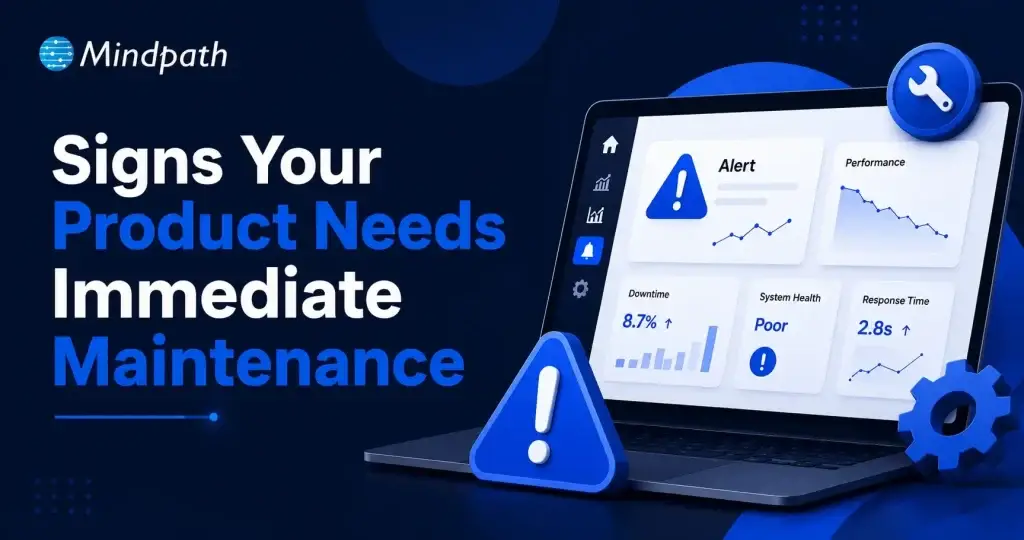
Failure can be indicated well before it is seen. Reliable delivery teams begin to become aware of minor disruptions at an early stage. When systems exhibit minor yet consistent problems, maintenance support is needed. Are there minor errors that are occurring more frequently than anticipated? Do the response times seem a little bit out of tune during normal operations? These signals do not tend to be loud; however, they reflect more technical gaps that require consideration.

Besides, regular delays, unplanned downtime, and user complaints are hard to come by on their own. They accumulate pressure against business continuity and trust, over time, by users. Consequently, a prompt response maintains systems as dependable and effective. By neglecting the early warning signs, risks and cost are likely to rise. In this blog, key indicators will highlight when immediate maintenance action becomes necessary.

Ready to fix recurring issues before they start affecting your customers and revenue? Mindpath offers maintenance and support services to quickly resolve problems and keep your product running smoothly.

Why are Maintenance and Support Services Essential for a Business Product?

Business products need consistent performance to meet user expectations and market demands. Even small issues can affect reliability and growth. Maintenance support keeps systems stable, secure, and aligned with changing needs, ensuring smooth operations over time.

As businesses grow, products face higher traffic, security risks, and shifting user behavior. Regular updates and monitoring improve efficiency. Strong support services help businesses adapt quickly, protect performance, and maintain long term value without unexpected setbacks.

Here are the key points why support and maintenance are important:

1. Stronger Security and Risk Control

Frequent updates are used to address vulnerabilities before they are a major problem. This safeguards data, compliance, and minimizes exposure to cyber risks.

2. Better User Experience

Ongoing improvements make interfaces smoother and faster to use. As a result, users stay satisfied and engage more with the product.

3. Reduced Costs Over Time

Regular upkeep averts serious problems that require costly repairs. This will reduce the long term costs and eliminate the surprises of costs of repairs.

4. Improved Performance and Scalability

Regular optimisation and monitoring of systems is more effective. They are also capable of managing more workloads as the business needs increase.

5. Less Downtime and Smooth Operations

Active surveillance detects problems earlier than they can impact performance. This will maintain uniform operation and minimize unplanned disruptions.

6. Continued Relevance and Flexibility

The updates maintain products in line with new technologies and market demands. This assists companies remain competitive and prepared to change.

Key Signs Your Product Needs Immediate Maintenance Support

Products are capable of alerting to a decrease in their performance through early signs, and fixing them with the help of maintenance and support at once is the best way to do that. Not reacting quickly to these signs can lead to instability, whereas, by taking timely actions, we can keep the systems dependable.

1. System Struggles to Handle Growth

When ‍ the user base increases, the application either runs very slow or stops working altogether. Software maintenance support can help not only in improving the scalability of the application but also in ensuring smooth performance during system ‍ ‌‍ ‍‌growth.

2. Frequent Crashes and Downtime

During ordinary operation, the system crashes, sticking or having to be continually restarted. This is not only a reflection of its instability but also a signal for the need of quick measures that would strive to bring back the regular functioning.

3. Slow Speed and Response Issues

One of the main reasons why users get frustrated with an application is when pages take too long to load. Not only does it affect user experience, but it can also lead to low user engagement. In this regard, application maintenance support is a great solution to optimize performance and minimize latency.

4. Rising User Complaints

Another sign of a troubled product is when users start reporting problems more frequently such as errors, missing features, or poor usability. In fact, this could be a clear indication that the product is no longer satisfying the users and hence, requires immediate improvement.

5. Security Gaps and Risks

If updates are not implemented, the system becomes vulnerable to exposure and unauthorized access. Therefore, regular patches are not only vital for data security but are also the best way to keep the application safe from security loopholes.

6. Outdated Technology Stack

With technology advancing rapidly, the use of outdated frameworks and systems often becomes a major hindrance to performance and compatibility. This is why only technology updates lead to better efficiency and at the same time meet the needs of modern users.

7. Hard-to-Manage Code Structure

Simple changes take too long due to complex and unstructured code. This slows development and signals the need for code optimization.

8. Failed Backup and Data Risks

Backup processes fail or recovery tests do not work properly. This increases the risk of data loss and demands immediate attention.

9. Overloaded Support Team

The team spends most time fixing urgent issues instead of improving the product. This shows deeper system problems that need structured maintenance.

10. Broken Integrations and Features

Third-party tools or APIs stop working as expected. This not only affects the product operation but the entire functioning also gets disrupted.

Is Your Product Ready for Reliable Performance?

Ignoring early warning signs can impact performance, security, and user trust. Timely maintenance support helps businesses stay ahead of issues and ensure smooth operations. A proactive approach keeps systems stable, efficient, and aligned with changing business needs.

At Mindpath, we provide maintenance and support services to keep your product running without disruptions. Our team ensures consistent performance, quick issue resolution, and long-term stability, helping businesses focus on growth with confidence and reliability.