Home

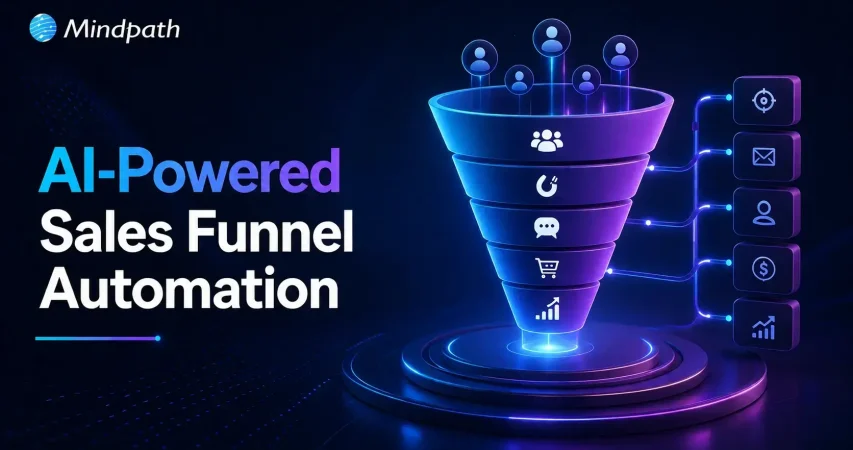
How Can AI Automate Your Sales Funnel?

How Can AI Automate Your Sales Funnel?

Join our Newsletter!

AI for Sales Automation

Sales teams today are under constant pressure to move faster, respond quicker, and convert more leads without burning out their staff. This is where AI sales automation comes in, helping businesses handle repetitive tasks, qualify leads, and guide prospects through the funnel without needing constant manual input.

Key Takeaways

  • 01
    AI agents automate lead scoring, follow-ups, and meeting scheduling, allowing sales teams to focus on closing more deals.
  • 02
    AI for sales prospecting identifies high-quality leads faster by analyzing large volumes of customer data.
  • 03
    Automated sales workflows improve response times and reduce missed follow-ups throughout the sales funnel.
  • 04
    AI-powered sales funnels engage prospects 24/7, keeping leads active and improving conversion opportunities.
  • 05
    Continuous AI learning helps optimize sales performance and improve funnel efficiency over time.

From automated follow-ups to smarter lead scoring, AI is changing how sales funnels operate at every single stage. In this blog, we are going to explore how AI can automate your sales funnel and what that actually means for your business in 2026.

Want to automate your sales funnel and close more deals with less manual effort? At Mindpath, we build AI-powered sales automation solutions that streamline lead generation, automate follow-ups, and help businesses increase conversions with intelligent AI agents.

What are AI Agents and How are They Helping Sales Teams in 2026?

AI agents are software programs built to carry out tasks on their own, based on rules, data, and learning patterns, without needing a person to guide every step. In 2026, these agents have moved well beyond simple chatbots. They now sit inside CRMs, email platforms, and scheduling tools, working quietly in the background to move deals forward.

For sales teams, this means an AI agent can read incoming leads, understand their intent, respond with relevant information, and even schedule a call, all while a sales representative is busy elsewhere. This shift is a big part of why AI sales automation has become such a common term in boardrooms this year. Businesses are no longer asking whether they should adopt it; they are asking how fast they can roll it out.

How Does AI Sales Automation Streamline Lead Generation and Prospecting?

Finding the right leads used to take hours of manual research and cold outreach. AI has changed that by doing the heavy lifting in the background, so sales representatives can focus on actual conversations instead of searching for names.

1. Smarter Lead Scoring

AI tools rank leads based on their likelihood to convert. This helps sales teams spend their time on prospects who are actually ready to buy.

2. AI for Sales Prospecting at Scale

AI can scan thousands of profiles, websites, and public data points in minutes. This gives reps a steady stream of qualified prospects without the manual grind.

3. Predictive Intent Tracking

AI studies browsing behavior, email opens, and website visits to flag buying signals. Reps get notified the moment a lead shows real interest.

4. AI Based Lead Generation From Multiple Channels

AI pulls leads from social media, forms, and third-party databases into one place. This removes the need to manually check five different tools every morning.

Automating Sales Workflows With AI

Once a lead enters the funnel, there is a lot that needs to happen correctly and on time. Missed follow ups and slow responses are two of the biggest reasons deals fall through, and this is exactly where automation earns its keep.

1. Automated Qualification Questions

AI chatbots ask the right questions upfront to filter serious buyers from casual browsers. This saves reps from wasting time on leads that were never going to convert.

2. Sales Process Automation for Follow Ups

AI sends timely, personalized follow up emails based on where a lead is in the funnel. No prospect slips through the cracks because someone forgot to check in.

3. Smart Meeting Scheduling

AI agents coordinate calendars and book meetings without the usual back and forth emails. This alone saves reps several hours every single week.

4. Deal Stage Tracking

AI updates CRM records automatically as a deal moves forward. Sales managers get a real time, accurate view of the pipeline at all times.

Building an Automated Sales Funnel That Works Round the Clock

A funnel that only works during business hours is a funnel that is leaving money on the table. AI removes that limitation by keeping every stage of the funnel active, even when the sales team has logged off for the day.

1. 24/7 Lead Engagement

Chatbots and AI agents respond to inquiries instantly, no matter the time zone or hour. Prospects get answers immediately instead of waiting until the next morning.

2. Automated Sales Funnel Nurturing

AI sends the right content to the right lead at the right stage, without a human triggering it manually. This keeps prospects warm until they are ready to talk.

3. Sales Workflow Management Software Integration

AI connects with existing tools, so data flows smoothly between marketing, sales, and support teams. Nothing gets lost between departments anymore.

4. Continuous Learning and Optimization

AI studies what worked and what did not, then adjusts messaging and timing automatically. The funnel keeps getting sharper the longer it runs.

Ready to Automate Your Sales Funnel With AI?

AI is no longer a nice to have for sales teams; it is quickly becoming the backbone of how modern funnels operate. From the first touchpoint with a lead to the final signed deal, AI sales automation is helping businesses respond faster, work smarter, and close more deals with fewer resources stretched thin. Companies that adopt this early are already seeing shorter sales cycles and happier sales teams who spend less time on admin work.

At Mindpath, we build AI development services designed around how your sales team actually works, not a generic template pulled off a shelf. Whether you need help with lead scoring, automated follow-ups, or a fully connected sales workflow, our team can design and deploy an AI agent that fits directly into your existing systems. If you are ready to see what a smarter, automated funnel looks like for your business, we would love to show you.
Frequently Asked Questions

It refers to using AI tools and agents to handle sales tasks like lead scoring, follow ups, and scheduling automatically. This reduces manual work and helps sales teams close deals faster with less effort.
AI can manage most repetitive tasks like outreach, qualification, and nurturing. However, human reps are still valuable for complex negotiations and building genuine relationships with high value clients.
No, small and mid-sized businesses benefit just as much, often more. It helps smaller teams do more with limited staff, making growth possible without hiring a large sales department right away.
AI scans data from multiple sources to identify and rank leads based on their buying intent. This means sales reps spend time on prospects who are genuinely likely to convert soon.
Yes, Mindpath designs AI agent solutions tailored to your existing tools and sales process. We focus on practical integration rather than offering a one size that fits all products.

Support Is One Click Away

Featured Posts

Related Post

Emerging Technologies

In the digitalized era, several new emerging technologies have surfaced that are full of promise. The identification of such technologies is essential for individuals as well as businesses. This is because they can influence the lives of people in society and the overall economy.

Before identifying different types of emerging technologies, it is important to understand the emerging technologies meaning. Emerging technologies are rapidly evolving technologies whose potential is yet to be realized entirely. AI is among the top emerging technologies examples that one can come across. 83% of business entities have claimed that they prioritize AI in their business plans. A comprehensive list of new technologies has been developed that can transform the digital realm.

Ready to explore how emerging technologies like AI, Blockchain, and IoT can transform your business? Contact us to discover how our expertise can turn these emerging trends into practical solutions

Top Emerging Technologies

Now that you are familiar with the concept of emerging technologies, it is time to look at some of the top emerging technologies. Currently, new technologies are entering the digital space like never before. It is crucial for IT leaders to keep track of emerging trends and technologies. The insight can enable them to leverage top technologies to shape the future with responsible innovation. The list highlights the 8 types of emerging technologies in a digital world that can act as a revolutionary force in 2026.

1. Artificial Intelligence

While discussing the topic of emerging technologies, the first novel technology that comes to mind is undoubtedly Artificial Intelligence (AI). AI can be defined as the ability of computer systems to emulate human intelligence. This emerging technology enables machines to reason, learn, and perceive just like humans. Although AI is still in its nascent stage, it has evolved into a powerful tool that is redefining diverse industries such as healthcare, manufacturing, education, and many more. While making technology-related predictions, one cannot ignore AI.

2. Virtual Reality and Augmented Reality

Virtual Reality (VR) and Augmented Reality (AR) are undoubtedly among the top cutting-edge technologies in 2026. VR is capable of immersing users in environments that are fully simulated. Thus, it blocks the actual world and allows individuals to experience a virtual space. AR technology integrates digital elements into the real world. As a result, it is capable of enhancing the perception of users with rich contextual information as well as visuals. AR and VR have found a place in Gartner technology trends 2026 as they are capable of offering immersive experiences to users.

3. Blockchain

While discussing the topic of Emerging Technologies 2026, one has to consider blockchain technology. Blockchain can be defined as a digitalized and immutable ledger that is capable of recording transactions while tracking assets across a business network. It is among the latest technology trends since it is highly transparent and secure in nature. This novel technology has gained high prominence in recent years due to cryptocurrencies.

4. Internet of Things

The Internet of Things or IoT is definitely among the most promising technologies that exist today. It basically helps connect physical devices to the internet. Therefore, it is possible to gather, share, and process data in a seamless manner. It is certainly among the top trending technologies that are transforming lives. Today, it is common to leverage IoT technology to create smart cities. In the future, the capabilities of IoT may reach new heights, and its presence may expand further.

Wondering how small businesses can benefit from new tech? Explore emerging technologies for small businesses to boost growth and efficiency.

5. Robotics

Robotics is certainly among the top technologies that exist in the year 2026. It is a rapidly evolving innovation that has been reshaping industries through automation and efficiency. This is among the top trending techs as it is capable of designing, operating, and using robots. The emergence of robotics technology has made it possible to utilize robots so that they can perform repetitive tasks. The strategic adoption of this technology can boost the overall efficiency of businesses across various industries.

6. Agentic AI

Today, Agentic AI is recognized as one of the top innovative digital technologies. Agentic AI has sophisticated reasoning capability, which enables it to solve complex problems. This novel technology can make decisions in an autonomous manner. Thus, it does not rely on human intervention to achieve challenging goals and objectives. It is a novel technology that is able to adapt in real-time. Hence, it acts as a valuable tool for businesses in the current times. By leveraging agentic AI technology, businesses can understand customer intent and predict their future needs. Thus, they can easily get a competitive edge in their area of operation.

7. Quantum Computing

Quantum Computing is among the most promising emerging technologies that exist now. This evolving field basically relies on quantum mechanics for solving complex problems. Thus, its ability to handle problems is a much more efficient way as compared to conventional computer systems. Although this novel technology is in its early stages, it is full of promise. The evolution of quantum computing can revolutionize diverse areas such as cryptography as well as drug discovery. This emerging technology is based on aspects relating to physics, mathematics, and computer science. This innovation is among the top predictions for 2026 that businesses need to focus on.

8. Ambient Computing

The list relating to emerging technologies cannot be complete without ambient computing. Ambient computing refers to the technology that can be seamlessly integrated into one’s surroundings. Thus, it can become an intuitive part of one’s life. The purpose of such technology is to create environments that are capable of responding to human needs. Ambient Computing is among the new and emerging technologies that rely on both IoT as well as AI. One of the most popular examples in this context involves wearable devices that monitor the health condition of individuals.

Planning to modernize your business with new technology? Check out digital transformation for businesses to learn how tech boosts innovation and competitiveness.

Challenges Associated with Emerging Technologies

It is true that diverse types of novel technologies are arising that hold immense promise. However, they also give rise to certain challenges and concerns. A number of challenges have been identified relating to the top types of emerging technologies in the digital world.

1. Ethical concerns

A common issue that arises in the digital space due to emerging technologies revolves around ethical concerns. For example, Agentic AI is the latest emerging technology that gives rise to ethical issues relating to bias and poor transparency.

2. Privacy concerns

A common concern that exists in the digital world is related to privacy risks. Malicious actors may exploit emerging technologies by using sophisticated techniques. As a result, the privacy of online users may be at the receiving end.

3. Regulatory challenges

As technologies are constantly evolving, the regulatory landscape is not entirely developed. Thus, it creates gaps that may be exploited. For instance, poor regulations may increase the risk relating to cybersecurity aspects.

Want to stay ahead in the digital era? Explore digital transformation trends to see how emerging technologies are reshaping business and innovation.

Final Words

In the prevailing technology-driven era, new types of technologies are coming into existence. Some of the most promising technologies are AI, Blockchain, IoT, and many more. These technologies hold the promise to redefine the digital space like never before.

The list of emerging technologies highlights some of the top technologies that can impact individuals as well as businesses. In addition to identifying these technologies, a number of challenges have been identified. It is necessary to take into consideration their potential along with the associated challenges as these elements may together transform the digital space. Mindpath helps businesses and individuals navigate these emerging technologies through tailored solutions and expert guidance

Explore emerging technologies like robotics, AI, and cybersecurity innovations and driving future success for businesses.
multi cloud strategy

Modern businesses operate in a highly dynamic environment. They need to focus on resilience and flexibility while performing in the market. The high intensity of competition that they encounter in their path further complicates their situation. This is when a multi-cloud strategy comes into the picture.

A multi-cloud strategy is an ideal option for contemporary businesses. It empowers business entities by increasing their flexibility and optimizing their costs. Moreover, such a strategic approach can even enhance the resilience of businesses in the unpredictable business landscape. It is the perfect time to explore the core benefits of a multi-cloud strategy for modern enterprises.

Wanting to leverage modern cloud technologies to make your operations faster and more scalable? Mindpath provides cloud infrastructure services that help you build, deploy, and manage systems with confidence.

What is a Multi-Cloud Strategy?

Before looking at the benefits of a multi-cloud approach, you need to have a clear understanding of the specific concept. A multi-cloud strategy is a plan to use computing services from two or more public cloud providers, such as Amazon Web Services (AWS), Microsoft Azure, and Google Cloud, simultaneously. Rather than relying on a single vendor, businesses distribute workloads across these providers to tap into each one’s strengths. You may be wondering why such a decision is essential. This is because a single cloud provider can restrict the full potential of the cloud strategy of a business. 

A multi-cloud strategy is ideal for businesses today because it directly addresses the key risks of single-provider dependence, namely vendor lock-in, limited flexibility, and single points of failure. It gives businesses greater control over their operations and measurably improves operational efficiency.

It’s worth noting that a multi-cloud strategy can span private cloud, public cloud, and specialized cloud services. When businesses adopt a multi-cloud infrastructure, they are no longer locked into the constraints of a single provider. Instead, they can pick the best tool for each job, choosing whichever platform best fits a specific workload while maintaining better control over their infrastructure. This flexibility lets them respond to market shifts quickly and operate with higher agility and improved system uptime.

Wondering which cloud technologies will shape the future of your business? Explore our blog cloud computing trends to discover the latest innovations driving scalability, efficiency, and growth.

How is the Multi-Cloud Strategy Different from the Single Cloud and Hybrid Cloud Approaches?

In order to get a comprehensive insight into multi-cloud architectures, you must know that it is different from single-cloud and hybrid-cloud approaches. In a single cloud approach, a business depends on a single cloud provider for all its workload. In the case of a hybrid cloud, businesses combine on-premise infrastructure with a private or public cloud. While talking about multi-cloud vs hybrid cloud, you need to remember that multi-cloud involves using multiple cloud providers for different workloads. 

In the case of a single cloud approach, the management is simplified. However, the issue relating to vendor lock-in may arise. It can automatically limit the overall flexibility for businesses. The hybrid cloud model, on the other hand, offers more balance between conventional IT and cloud solutions. 

However, businesses must remember that there is limited producer diversity. The multi-cloud approach offers multi-cloud benefits since it minimizes dependency on a single provider and boosts resilience for businesses. Thus, out of all these options, the multi-cloud approach creates immense value for contemporary business entities. 

Benefits of a Multi-Cloud Strategy

Now that you know, what is multi-cloud? It is time to look at some of the associated benefits. It is fundamental for businesses to remember that a multi-cloud strategy can give rise to a plethora of benefits. The awareness of these benefits can help them decide whether they want such a solution or not. 

1. Avoiding Vendor Lock-In

If businesses opt for the multi-cloud strategy, they can rest assured about the vendor lock-in issue. This issue mainly arises when businesses depend on a single provider; however, in the case of a multi-cloud strategy for businesses, they depend on diverse providers. Thus, the dependence on a single vendor gets reduced substantially. Thus, businesses are able to enjoy ample flexibility while operating in the dynamic and uncertain business environment.

2. Cost Efficiency

One of the main benefits of a multi-cloud strategy is related to cost efficiency. In fact, the multi-cloud strategy is ideal for businesses that intend to curb their IT spending. You need to remember that the public cloud option comes with less overhead. Moreover, it allows businesses to scale up or down as per their needs and requirements. Businesses can leverage a multi-cloud strategy and take advantage of the best pricing and performance options. 

3. High Reliability

A multi-cloud strategy undoubtedly reduces the risks relating to unplanned downtime. This is because it minimizes the risk relating to a single point of failure. An outage in a single cloud will not necessarily have an adverse impact on the services on other clouds. In case the cloud goes down, businesses can route their computing needs to another cloud. Thus, the reliability is high when businesses choose the multi-cloud strategy.  

4. Advanced Security

If businesses are looking for high security while leveraging cloud services, the multi-cloud strategy is an ideal option. This is because a multi-cloud strategy enables businesses to not only deploy and scale workloads but also implement robust security policies. You can also take advantage of compliance technologies in a consistent manner across all your workloads, irrespective of the service or vendor. In the highly unpredictable times, the role of heightened security cannot be negated for businesses.   

5. Best Feature of Each Cloud Solution

The multi-cloud approach enables business entities to choose from many cloud vendors. Thus, it offers ample flexibility in order to match the specific capabilities and features to optimize the workload of businesses. You can take into consideration diverse factors such as speed and performance, and choose the best cloud solution that perfectly aligns with your business needs.  

Looking to build applications that scale seamlessly across multiple clouds? Explore our blog cloud‑native development to discover how cloud-native architectures improve performance, flexibility, and business growth.

Disadvantages of a Multi-Cloud Approach

Businesses need to keep in mind both multi-cloud advantages and disadvantages while deciding on the multi-cloud strategy. It is necessary to be aware of the associated disadvantages so that businesses can set their expectations accordingly. 

1. Management Complexity 

One of the most common disadvantages is related to management complexity. It might not be easy for businesses to manage a multi-cloud strategy. They need to dedicate their time and effort so that the strategy can work in favor of the business. 

2. Operational Overhead

Businesses may find it challenging to coordinate between diverse platforms. Furthermore, it may increase the management overhead for the business. There is a need for sophisticated tools to manage all the platforms in a perfect manner. 

3. Heightened Cost 

Although all the services may be cheaper, the total cost may be higher. This is mainly due to the added overheads relating to the management of diverse cloud platforms. Thus, businesses need to understand the importance of careful planning as well as management. 

4. Heightened Security Risks

As each cloud provider has its own security and compliance model, ensuring consistency is not easy for businesses. The lack of consistency in terms of security can undoubtedly give rise to security risks. This is a serious disadvantage that businesses cannot ignore. 

Struggling to make informed decisions about your cloud investments? Discover our blog importance of data-driven decision making for businesses to learn how analytics and data insights improve cloud strategy outcomes.

Final Words

In the competitive business setting, businesses need to adopt a multi-cloud strategy. Before implementing the strategy, insight into the related benefits as well as disadvantages is essential. The key benefits and disadvantages relating to a multi-cloud strategy have been presented, which can guide businesses to make their cloud-related decisions. 

Mindpath’s top-notch cloud infrastructure services are ideal for modern businesses. The experts can make sure that the business can derive optimum value from their cloud approach. The strategy can certainly act as a source of competitive advantage in contemporary times. 

Frequently Asked Questions

Discover the benefits of a multi-cloud strategy for modern enterprises, including improved security, flexibility, cost savings, and risk management.
IT Staff Augmentation

You can’t delay your product launches, as your competitors might win the trust of your audiences before you. Yet many organizations are still dealing with long hiring cycles and limited IT skills. This is where the potential of IT staff augmentation becomes a significant inclusion. The following market is going to reach USD 857.2 billion by 2032 (Source). This is the best way to scale your teams instantly without compromising control over your project.

Traditional hiring is slow and expensive. On the other hand, outsourcing can sometimes make you lose control of your work. Staff augmentation combines flexibility that encourages direct oversight. Further, it accesses your companies to temporarily scale the teams.

Let us further discuss the diversifying role of IT staff augmentation services and how it can help your team become extensively competitive.

Need to expand your team without the long hiring cycles and overhead costs? Mindpath offers tailored staff augmentation services designed to provide on-demand expertise and boost your operational efficiency.

What is Staff Augmentation?

IT staff augmentation is simply the practice of extending your in-house IT team with external experts for a certain project or duration.

  • Instead of hiring full-time employees for every role, you can bring in specialists like QA engineers, developers, DevOps engineers, etc., based on your project needs.
  • This process is a bit different from traditional outsourcing, where the external professionals integrate directly into your existing teams, culture, and processes.
  • The outsourced experts can use your tools while sticking to your reliable work processes. Additionally, they report everything to the head.
  • This allows you to only pay for the expertise when you require it. This is also viable for industries where project workloads change, and specific technologies are needed to scale IT teams.

What are the Major Differences Between Traditional Hiring and Outsourcing?

Here, you can go through the ultimate difference between traditional hiring and outsourcing.

1. Traditional Hiring

Hiring full-time employees offers your business a sense of stability and permanence. Teams can develop a workplace culture while sharing knowledge with each other. This approach can be reliable for long-term commitment. However, it has to deal with high-cost salaries. Further, you need to train your team with efficient workshops. It can also be challenging if the role needs niche expertise.

2. Outsourcing

Outsourcing follows a different route. Here, your whole company will hand over the project or a whole business function to a third-party vendor. Moreover, outsourcing can somehow minimize the management overload. But you need to be aware of certain risks like communication gaps, misalignment in vision, and lack of transparency.

3. IT Staff Augmentation

This approach offers you a flexible staffing model while allowing your company to leverage traditional and outsourcing facilities at once. Instead of giving up a project, you will enjoy the ownership. However, you can upgrade your team by plugging in the experts as required.

Planning to choose between flexible staffing and fully managed solutions? Discover our staff augmentation vs managed services comparison to learn what works best.

How Does IT Staff Augmentation Encourage Project Scalability Solutions?

Modern projects rarely value accurate timelines. Your requirements might change, and unexpected challenges might arise. Further, a rigid structure might struggle to keep up with the speed of the projects. This is where project scalability solutions can be a great preference.

1. On-Demand Skill Access

Instead of waiting to find the right candidate, businesses can effectively onboard expert professionals for specific roles. These experts can join your company immediately to initiate the project.

2. Flexible Resource Allocation

With a flexible staffing model, you only consider the talent you need. If a certain phase of the project is complete, you can scale down the external support without cutting off the internal staff.

3. Faster Time to Market

When you can easily fill in the talent gaps and scale teams up and down, your project timelines will decrease. Further, your complicated features will be built at a time while lessening the feedback loop. In addition to this, your deployment will become much more seamless. IT staff augmentation has a direct influence on your ability to offer desirable results to your customers sooner.

4. Minimal Hiring Risks

As we have discussed earlier, traditional hiring generally includes making long-term commitments. With IT staff augmentation, you can evaluate if the performance fits in real time. If an engagement is not offering you desirable results, you can adjust it without any long-term consequences.

5. Better Innovation

Bringing in diverse talent introduces new ideas and concepts along with best practices. Moreover, new skills can increase your creativity and assist your teams in adopting modern approaches faster.

This is an effective benefit that can encourage your future projects even after the augmentation timeline ends.

Looking to speed up your hiring process while scaling projects efficiently? Check out our staff augmentation hiring guide to learn how to find the right talent faster while reducing hiring delays and improving project outcomes.

What are Some Top Staff Augmentation Benefits?

Understanding the staff augmentation benefits can help you understand why this approach has become popular in recent years.

1. Enjoy Your Access to Global Talent Pools

Staff augmentation is not limited to a certain location. You can easily access global talent pools to find eminent skills that are hard to source locally. As the current world is valuing remote work, this access expands your options.

2. Cost Efficiency

This approach allows you to invest budget in innovation instead of overhead. Full-time employee hiring includes benefits along with salaries and proper training. On the other hand, staff augmentation is a bit more reliable as you pay for what is required. This is how you can leverage innovations without going out of your budget.

3. Seamless Integration

Unlike outsourcing, where the whole project is handed over to a third party, staff augmentation empowers your internal team to stay in control. Further, the external professionals work with the internal staff to make your project result-oriented.

4. Scalability Without Ruining Quality

As your project needs have been growing, your team can extend the resources. This can help you conduct the project within the given timeline without burdening the internal team members.

Wondering how to create a smooth onboarding experience for external talent? Discover our augmentation staff onboarding guide to learn practical techniques for better integration.

Common Use Cases of Staff Augmentation

Businesses across multiple industries use IT staff augmentation in several scenarios, as listed below.

1. Quick Product Development

When you launch MVPs and new digital services, time is the most necessary asset. A flexible staffing model can help your company gather high-performance teams as soon as possible.

2. Short-Term Projects

For major initiatives like performance tuning, security audits, and QA cycles, hiring full-time employees might not make any sense. So, augmented professionals fit such temporary requirements precisely.

3. Technology Transitions

Migration to microservices or enterprise platforms often needs skills that your internal staff might not have. So, staff augmentation fills these gaps efficiently.

Planning to build a high-performing team without increasing overhead costs? Discover our cost effective IT staff augmentation blog to learn efficient scaling methods.

Best Practices for Successful IT Staff Augmentation

For IT staff augmentation to leverage real value, organizations should initiate the best practices as given below.

1. Clearly Define Your Requirements

Always be authentic about what you desire. Further, ensure the type of technologies you want to use. You need to be clear and mindful so that professionals can match your interests.

2. Select the Right Providers

Evaluate the IT staff augmentation teams based on their quality and depth of talent. Further, screen their initiation process and check their industry reputation and client feedback to scale IT teams.

3. Ensure Cultural and Communication Alignment

Soft skills matter as much as technical skills. Further, pick staff who can collaborate effectively with your team.

Ready to Scale Your Team Strategically With IT Staff Augmentation?

IT staff augmentation is not just a short-term effort. It is a long-term strategy for companies that want to stay innovative and competitive in the current age. Moreover, it offers the precise balance between cost efficiency, control, and speed. This allows your companies to prioritize growth without facing any talent shortages.

If you are ready to grow efficiently while delivering your projects confidently, explore Mindpath as your leading partner. We can help your company understand the IT staffing strategies from the core. Further, we can customize solutions that are just made for you.

Discover how IT staff augmentation boosts project scalability with quick access to talent, cost-effective scaling, and expert support.