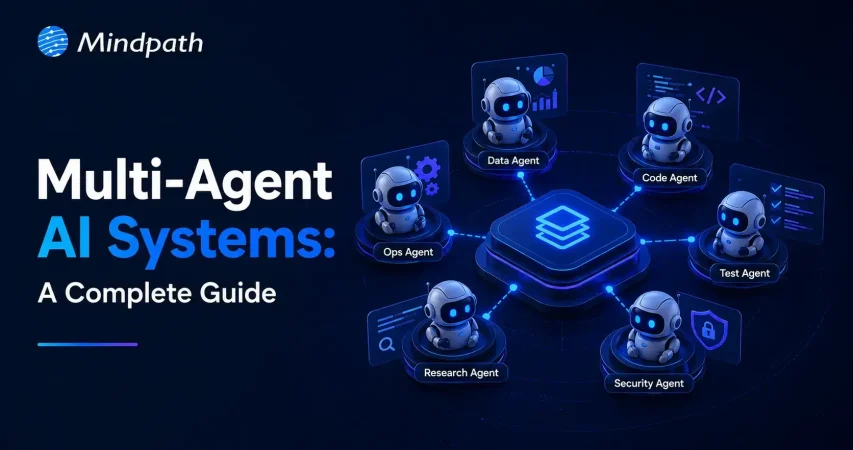
Businesses are entering a new phase where intelligent software handles complex decisions instead of completing isolated tasks. Multi-Agent AI Systems are leading this transformation by allowing multiple AI agents to collaborate, communicate, and solve business challenges with greater speed and accuracy. This shift is helping organizations automate entire workflows while improving operational efficiency across different departments.
Key Takeaways
- 01
Multi-agent AI systems simplify complex business workflows through intelligent collaboration. - 02
Specialized AI agents improve speed, accuracy, and operational efficiency. - 03
Businesses gain scalable automation with coordinated AI decision making. - 04
Strong architecture ensures reliable communication between multiple AI agents. - 05
Careful implementation maximizes long-term business value and performance.
As organizations expand their AI capabilities, they require solutions that can coordinate multiple tasks without constant human intervention. That is where intelligent collaboration between AI agents becomes valuable for modern enterprises. In this blog, we are going to explore what multi-agent AI systems are, their benefits, architecture, working process, use cases, implementation approach, and why businesses are adopting them in 2026.
Looking to deploy intelligent AI agents that collaborate seamlessly across your business? Explore our multi-agent AI system development services to build scalable, secure, and high-performing AI solutions tailored to your needs.
What are Multi-Agent AI Systems?
A multi-agent AI system is an artificial intelligence environment where sethrough AI agent orchestration to veral independent AI agents work together toward shared or individual objectives. Each agent performs specialized responsibilities while exchanging information and coordinating decisions to achieve efficient business outcomes.
Instead of relying on one intelligent model for every responsibility, these systems distribute tasks across multiple specialized agents. This collaborative approach improves decision quality, reduces processing delays, and enables businesses to automate increasingly complex operational processes.
How Do Multi-Agent AI Systems Work?
Multi-agent AI systems follow a structured workflow where specialized agents collaborate to complete complex business tasks efficiently.
1. Task Distribution: The system divides a business request into smaller tasks and assigns them to specialized AI agents.
2. Independent Processing: Each agent performs its assigned task using its own knowledge, tools, and reasoning capabilities.
3. Agent Communication: Agents exchange updates through AI agent orchestration to stay aligned throughout the workflow.
4. Decision Coordination: The system combines outputs from multiple agents to generate a unified and accurate response.
5. Continuous Learning: Feedback and performance data help agents improve accuracy and efficiency over time.
Benefits of Multi-Agent AI Systems
Organizations are increasingly investing in this approach because it delivers measurable improvements across business operations.
1. Improved Task Specialization
Each AI agent focuses on a specific responsibility instead of managing every business function simultaneously. This specialization improves response quality while reducing errors during complex business processes.
2. Better Scalability
Additional agents can be introduced whenever business requirements continue expanding across departments or operational functions. Organizations can therefore increase automation without rebuilding existing AI infrastructure.
3. Faster Decision Making
Multiple agents process different tasks simultaneously while continuously sharing relevant information with one another. Parallel execution significantly reduces delays across time-sensitive business workflows.
4. Greater Operational Reliability
If one agent experiences temporary issues, other agents continue performing their assigned responsibilities without interruption. This distributed structure minimizes operational downtime while improving business continuity.
5. Flexible Business Automation
Organizations can customize different agents for finance, customer service, logistics, sales, or internal operations independently. This flexibility allows businesses to automate diverse workflows using the same intelligent ecosystem.
Multi-Agent AI System Architecture
A well-designed architecture enables multiple AI agents to communicate, collaborate, and complete business objectives efficiently.
1. User Interface
The user interface acts as the entry point where users submit requests or business queries. It collects inputs and forwards them to the system for further processing.
2. Orchestrator
The orchestrator manages task allocation and coordinates communication between different AI agents throughout the workflow. It ensures every agent receives appropriate responsibilities and works toward the desired outcome.
3. Specialized AI Agents
Each agent is designed for a specific responsibility, such as research, planning, data analysis, customer support, or content generation. This specialization improves both efficiency and response quality across business operations.
4. Shared Knowledge Base
A centralized knowledge base stores documents, business rules, databases, and historical information for all agents. Access to shared information helps maintain consistency and supports better decision-making.
5. Communication Layer
The communication layer enables agents to exchange updates, share results, and coordinate their activities efficiently. This multi-agent AI framework ensures smooth collaboration without creating duplicated efforts.
6. Monitoring and Feedback System
The monitoring layer tracks agent performance, workflow progress, and system health in real time. Business feedback is also collected to improve future accuracy and overall system performance.
Real-World Use Cases of Multi-Agent AI Systems
Businesses across industries are adopting intelligent agent collaboration to automate complex workflows and improve operational efficiency.
1. Customer Support Automation
Different agents handle customer identification, issue analysis, response generation, and ticket resolution simultaneously. This approach delivers faster responses while improving customer satisfaction across multiple communication channels.
2. Supply Chain Management
Multiple agents monitor inventory levels, forecast demand, optimize transportation, and identify potential supply disruptions. Businesses gain better visibility while reducing operational delays and unnecessary costs.
3. Healthcare Operations
AI agents coordinate appointment scheduling, patient record management, clinical documentation, and insurance verification together. Medical professionals spend less time on administrative work and more time providing patient care.
4. Financial Services
Agents analyze transactions, detect fraudulent activities, generate compliance reports, and assess financial risks continuously. Financial institutions improve security while making faster and more informed business decisions.
5. Software Development
Different agents assist with requirement analysis, coding, testing, documentation, and deployment activities during software development. These collaborative AI agents accelerate development cycles while improving software quality.
6. Business Intelligence
AI agents collect information from different business systems before generating dashboards and strategic insights. Decision makers receive accurate recommendations without manually combining information from multiple sources.
How to Build a Multi-Agent AI System?
Organizations should follow a structured approach when planning how to build a multi agent AI system for business automation.
1. Identify Business Objectives
Begin by defining the workflows that require automation and measurable business improvements. Clear objectives help determine the required agent capabilities.
2. Design Agent Responsibilities
Assign specific responsibilities to every agent instead of expecting one model to perform every task. Specialized roles improve efficiency and simplify future maintenance.
3. Select the Right Technology Stack
Choose appropriate AI models, databases, APIs, cloud infrastructure, and development frameworks before implementation begins. Technology decisions directly influence scalability and long-term performance.
4. Develop Communication Workflows
Create standardized communication methods that allow agents to exchange information accurately and efficiently. Well-defined workflows improve collaboration across the complete system.
5. Test and Optimize
Validate system performance using real business scenarios before deploying it into production environments. Continuous testing improves reliability and supports successful multi-agent AI implementation.
Challenges of Multi-Agent AI Systems
Businesses should understand these common challenges before implementing multi-agent AI systems across critical operations.
1. Communication Complexity: Poor coordination between agents can reduce efficiency and create inconsistent outcomes.
2. Data Security: Protecting sensitive business data remains essential when multiple agents access shared information.
3. Integration Challenges: Connecting AI agents with existing legacy systems may require careful planning and development.
4. Performance Monitoring: Continuous monitoring helps maintain accuracy, reliability, and overall system performance.
5. Higher Implementation Costs: Initial development and deployment can require significant investment in technology and expertise.
6. Scalability Management: Managing a growing network of AI agents becomes more complex as business operations expand.
Ready to Build Smarter AI Systems for Your Business?
Businesses are rapidly moving toward intelligent automation that manages complete workflows instead of isolated tasks. Multi-Agent AI Systems provide the flexibility, scalability, and intelligence needed to improve operational efficiency, accelerate decision making, and support long-term digital transformation across industries.
At Mindpath, we help organizations design, develop, and deploy custom AI Development Services that solve real business challenges and support long-term growth. Our team builds secure, scalable, and future-ready AI agent solutions that integrate seamlessly with your existing systems while delivering measurable business value.