Home

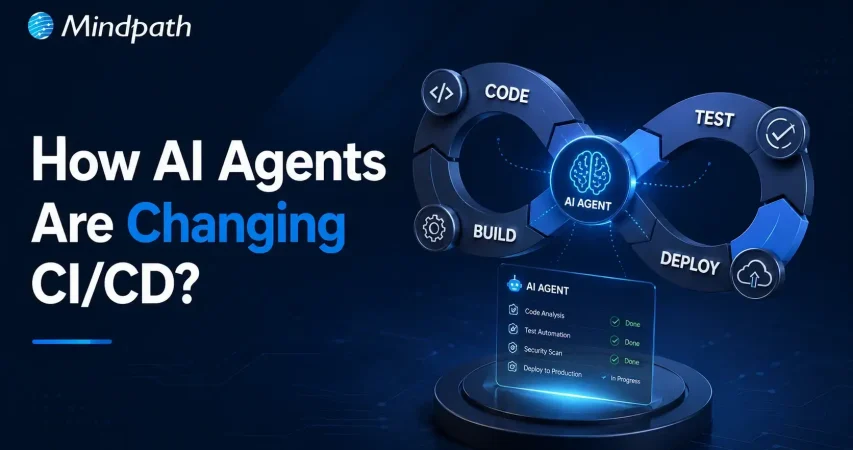
How AI Agents are Changing CI/CD: Automated Code Review, Testing & Deploys 

How AI Agents are Changing CI/CD: Automated Code Review, Testing & Deploys 

Hire Talent

Join our Newsletter!

AI Agents in CI/CD Pipelines

Modern software teams push updates faster than ever, yet speed alone no longer defines success. AI Agents in CI/CD Pipelines are changing how teams build, validate, and release software with greater accuracy and consistency. As delivery cycles grow more demanding, many organizations now look beyond traditional automation. They want systems that can analyze, decide, and act intelligently throughout development workflows.

Key Takeaways

  • 01
    AI agents improve CI/CD workflows through faster analysis, smarter decisions, and automated actions.
  • 02
    Automated code reviews help developers identify quality issues and security risks earlier.
  • 03
    Intelligent testing reduces maintenance work while improving test coverage and pipeline speed.
  • 04
    Predictive insights help teams detect deployment risks before they affect production environments.
  • 05
    AI-driven monitoring and rollbacks support reliable releases and faster incident recovery.

As a result, AI-driven development practices continue to gain momentum across modern engineering teams. Developers now expect faster feedback, stronger code quality, and smoother releases without increasing operational pressure. At the same time, businesses seek reliable ways to improve delivery performance and reduce costly errors. In this blog, we will explore how AI agents are reshaping CI/CD workflows and driving smarter software delivery.

Planning to integrate AI agents into your CI/CD pipeline? Mindpath provides AI Agents development services that improve development efficiency, reduce errors, and accelerate release cycles.

What are AI Agents in CI/CD Pipelines?

AI agents in CI/CD pipelines are intelligent systems that help automate and improve software delivery processes. Powered by large language models and machine learning, they analyze pipeline activities, identify issues, and support faster decisions throughout the AI agents’ software development lifecycle.

Unlike traditional automation tools that follow fixed rules, AI agents can learn from data and adapt to changing conditions. They monitor workflows, recommend improvements, and respond to problems in real time, helping teams maintain efficient, reliable, and scalable CI/CD operations.

What are the Key Functionalities of AI Agents in CI/CD Pipelines?

AI agents bring intelligence and adaptability to every stage of the CI/CD process. They go beyond traditional automation by analyzing data, making decisions, and continuously improving workflow efficiency.

The following functionalities highlight how AI agents help development teams deliver software faster, improve quality, and reduce operational challenges across modern CI/CD pipelines.

1. Autonomous Failure Analysis

AI agents quickly analyze logs, test results, and system activity when failures occur. They identify the root cause faster, helping teams resolve issues without lengthy investigations.

2. Self-Healing Test Execution

AI agents adjust tests automatically when minor UI or code changes appear. This reduces unnecessary test failures and keeps pipelines running smoothly.

3. Intent-Driven Test Generation

Developers can describe testing requirements using simple language. AI agents convert those requirements into executable test cases with minimal manual effort.

4. Proactive Risk and Anomaly Detection

AI agents monitor build history, code changes, and error patterns continuously. They detect potential risks early and alert teams before problems escalate.

5. Intelligent Test Selection and Parallelization

AI agents identify which tests relate to specific code changes. They run only the necessary tests and optimize execution time across the pipeline.

6. Automated Security and Compliance

AI agents scan applications for vulnerabilities and policy violations automatically. They help teams maintain security standards and support compliance requirements.

7. Auto-Remediation and Rollbacks

AI agents respond quickly when deployment issues or production incidents occur. They can initiate corrective actions, perform rollbacks, and support faster recovery.

Why are Traditional CI/CD Pipelines No Longer Enough?

1. Limited Infrastructure Awareness

Complex cloud environments require deeper context than scripts provide.

2. Struggles with AI-Generated Changes

High-volume code updates overwhelm traditional review workflows.

3. Security Risks Increase

Broad credentials create larger attack surfaces across pipelines.

4. Tight System Coupling

Connected processes reduce flexibility and slow scaling efforts.

5. Lack of Intelligent Decision-Making

Static rules cannot adapt to changing development conditions.

How Do AI Agents Improve Modern CI/CD Workflows?

AI Agents for DevOps bring intelligence to software delivery by continuously analyzing data, automating decisions, and responding to issues in real time. Instead of relying only on predefined rules, they help teams optimize workflows, improve code quality, reduce deployment risks, and accelerate release cycles across modern CI/CD environments.

1. Automated Code Review

AI Agents in CI/CD Pipelines analyze code changes and identify bugs, security gaps, and coding issues automatically. They provide instant feedback, helping developers improve code quality before merging changes.

2. Intelligent Test Case Generation

AI agents create test cases based on application logic, requirements, and code changes. This reduces manual effort and strengthens DevOps and test automation practices.

3. Smarter Software Testing

Modern AI software testing tools use AI agents to execute, optimize, and maintain tests continuously. They improve test coverage while reducing repetitive testing tasks.

4. Self-Healing Test Automation

AI agents detect minor application changes and automatically update affected test scripts. This keeps automated testing reliable and reduces maintenance workloads.

5. Predictive Failure Detection

AI agents analyze historical pipeline data, build logs, and deployment patterns. They identify risks early and help teams prevent failures before production releases.

6. Intelligent Deployment Management

AI agents evaluate deployment readiness using performance metrics, test results, and risk indicators. They support safer releases by recommending the best deployment actions.

7. Continuous Monitoring and Incident Response

AI agents monitor applications and infrastructure after deployment in real time. They quickly detect anomalies, investigate issues, and support faster resolution.

8. Automated Rollbacks and Pipeline Optimization

When deployments cause problems, AI agents can trigger rollback actions automatically. They also analyze pipeline performance and recommend improvements for faster software delivery.

Ready to Build Smarter CI/CD Pipelines with AI?

AI agents in CI/CD pipelines help teams improve code quality, strengthen testing, and manage deployments with greater confidence. They bring faster insights to complex delivery workflows while reducing repetitive work. As software releases become more frequent, intelligent automation can help organizations maintain speed, reliability, and control.

At Mindpath, we provide AI Agent development services that help businesses build practical, scalable, and secure solutions. Our team can support your journey with AI agents in CI/CD that align with your development workflows, testing needs, and deployment goals.
Frequently Asked Questions

Yes. AI agents can integrate with common repositories, testing platforms, cloud services, and deployment tools. Teams can introduce them gradually, starting with code reviews or test analysis, without replacing the complete CI/CD environment or disrupting established development processes.
Teams should treat AI feedback as an additional review layer, not an automatic approval system. Clear review rules, human validation, secure access controls, and regular feedback checks help ensure suggestions remain accurate, relevant, and aligned with coding standards.
Start with repetitive, low-risk tasks that consume significant time. Code quality checks, test failure analysis, test case suggestions, and pipeline log summaries often provide early value while allowing teams to evaluate results before automating more sensitive deployment activities.
No. AI agents support DevOps engineers by handling repetitive analysis, testing tasks, and pipeline monitoring. Engineers still make important decisions, define standards, review critical changes, and manage complex situations that require business context, technical expertise, and accountability.
Yes. AI agents can assess test results, code changes, infrastructure signals, and past deployment patterns before release. This helps teams identify risky changes early, prioritize important checks, and make informed release decisions without adding unnecessary manual review delays.

Support Is One Click Away

Featured Posts

Related Post

AI consulting 

Artificial intelligence is now at the center of business decision-making, creating growth and efficiency across industries. Companies that turn to AI consulting receive better insights, more efficient systems and management, and stronger customer ties. Business leaders today operate in a world where competitors move quickly to leverage evolving technology. The advantage lies in applying AI to directly address their goals and challenges. AI transforming future where consulting provides highly technical solutions into practical applications, enabling businesses to take the next steps with confidence.

Key Takeaways

  • 01
    AI consultants assess data, systems, and workflows before recommending any strategy.
  • 02
    A clear roadmap helps align AI initiatives with measurable business outcomes.
  • 03
    Tailored AI solutions are designed to fit each company’s specific needs.
  • 04
    Ethical governance ensures AI systems remain fair, transparent, and compliant.
  • 05
    Training and ongoing support help teams adopt new AI workflows smoothly.

Ultimately, the biggest challenge we are facing today is implementing AI in a way that produces measurable impact. This is where consulting firms can assist, through methodologies, strategies, roadmaps, and implementation assistance. Consulting makes complexity simple and provides direction and location for leaders in a digital economy that is rapidly changing. In this guide, we’ll provide perspectives on how consulting can help your business stay relevant and future-ready.

Want to get expert guidance on how to use AI in your business to tackle your challenges? Mindpath AI Consulting Services offers personalized strategies that unlock the AI’s full potential.

What is AI Consulting?

AI consulting encompasses bringing value to businesses through AI usage. It is the combination of technical skills and industry knowledge to help organizations realize their objectives, from conceptual planning to operationalizing and managing AI solutions. AI consulting should always address how to make AI work for a particular business need.

Consultants start by investigating how a company operates, what its goals and objectives are, and its data quality. AI strategies and solutions are created and customized in a way that supports the overall goal and aspirational growth of the company.

Key Roles of an AI Consultant

The role of AI consulting firms is vital to the adoption and scaling of artificial intelligence by businesses. The consultants in these firms take on multiple roles and help businesses execute AI projects that are well-designed, actionable, and aligned with their objectives.

Key Roles of an AI Consultant

1. Assessing AI Readiness

Consultants begin by looking at a company’s current technology and the structure of its data. They examine strengths, gaps, and where AI could be optimally used. This step ensures the business is ready for AI to move forward with AI consulting.

2. Building the Right Strategy

Consultants partner with executives to harmonize AI initiatives with broader business objectives. They outline achievable outcomes, prioritize initiatives, and develop a roadmap that considers both growth and innovation. This allows companies to better understand how AI properly fits in their operating model and reduces any bias that AI strategy consulting can involve.

3. Designing and Implementing Solutions

Consultants develop AI models, tools, or applications to satisfy custom requirements. This can include customizing existing technology when that is more efficient, cost-effective or time-conserving. The consultant is the one who determines the methods used to develop and test the models to create measurable outcomes.

4. Managing Data Effectively

Consultants generally prioritize data quality, security, and organization, as those are all critical parts of any AI project. They create the actual process for collecting, organizing, and engaging with that data. If organizations can manage their data effectively, they can get actionable insights more efficiently and ultimately leverage the long-term value of AI consulting for business leaders.

5. Ensuring Ethical Use

Consultants establish boundaries and frameworks for ethical AI behavior, while assuring AI systems demonstrate fairness, transparency, and compliance. With governance in place, Artificial Intelligence consulting companies help clients build trust and reduce risk.

6. Training and Supporting Teams

Consultants will also prepare employees to use new AI systems confidently. They design and execute traineeships and develop protocols to transition through changes in workflows. This allows for a transition with less friction and allows the teams to adapt to new ways of working.

For a deeper understanding of how AI trends help businesses in achieving digital transformation. Read our blog: Top AI Trends.

AI consulting for small businesses helps with AI adoption to increase efficiency and lower costs while making more informed decisions. AI consultants will help small businesses find the best tools and strategies for their situation and growth objectives.

Importance of AI Consulting

1. Expert Knowledge

AI consultants bring deep technical and industry knowledge to guide businesses to learn about and select the best AI technologies available. Such guidance will provide information to make informed decisions and help prevent expensive mistakes that will demonstrate the value of the AI consulting.

2. Clear Strategy Planning

Consultants create an actionable roadmap that aligns the business goals of AI-related projects, identify priority use cases, set measurable outcomes, and provide a path to success through AI adoption consulting. AI in business strategy leads to growth and innovation, which helps the business to stand out from its competitors.

3. Tailored Solutions

Companies are provided with AI solutions based on their needs, problems, and data context. Consultants also confirm that the AI solution can run with their process; this shows the level of expertise offered in AI implementation consulting.

4. Scalability and Flexibility

Consultants design AI systems to be highly scalable and flexible for changing conditions. They also govern projects from small pilots to full deployments while applying proven practices from AI consulting examples.

5. Risk Management

Consultants establish governance standards and monitor AI systems to support bias mitigation, data protection, and a compliant setting. This governance approach reduces risk and adds certainty to AI advancements, which aligns with the goal of AI integration consulting when done properly.

6. Cost Efficiency

The goal is to remove repetitive tasks from the shoulders of employees, reduce errors, reduce resources used, save money, become more productive, and advertise the value of AI consulting.

7. Competitive Advantage

The benefit of using AI for customer service enables organizations to innovate, streamline customer interactions, and make faster data-driven decisions. Expert teams or firms providing consultancy can help organizations stay ahead of competitors and discover new opportunities, particularly highlighting the utility of a well-developed AI consulting guide.

The Process of AI Consulting

The process of AI consulting has a structure that guides businesses from the plan to a successful and assured implementation. Each stage focuses on connecting technology to real business goals to ensure smooth and outcome-driven adoption.

1. Business Review

Consultants examine present systems, data, and workflows to observe strengths and gaps. They look at goals and challenges while creating the right path forward for AI Consulting.

2. Strategy Roadmap

Following that review, consultants synthesise work into a strategy, with priorities and measurable goals. The actual roadmap describes the roadmap for the entire AI journey.

3. Solution Planning

Consultants formulate solutions that are appropriate for business requirements and help determine the right Gen AI tools to choose. They define data requirements and provide planning methods for system integration.

4. Guided Execution

Consultants help businesses build pilot projects to test the value of solutions. They iterate the solutions before proceeding to full deployment.

5. Team Training

Consultants train employees in the use of AI tools and new workflows. They also create change management plans to ensure seamless implementation.

6. Ongoing Optimization

Consultants monitor the performance of AI systems and make adjustments if necessary. They review outcomes on a periodic basis to keep up with the constantly changing needs of the business.

AI consulting helps organizations to make smarter decisions and turn new ideas into real business results. Discover more about why organizations need AI consulting services to unlock growth in your business.

Ready to Transform Your Business with AI Consulting?

AI consulting services give businesses the expertise and structure needed to adopt artificial intelligence effectively. By evaluating, planning, and acting, companies can realize new efficiencies, enhance customer experience, and mitigate risk. When done correctly, business AI consulting navigates to make complex technologies practical and measurable, and helps organizations keep pace competitively in the rapidly changing digital economy.

At Mindpath, we deliver tailored AI consulting services designed to meet your business goals. Our experts focus on AI integration consulting to ensure solutions are scalable, ethical, and results-driven. With proven experience in business AI consulting, we provide strategies and implementation support that bring real impact. Partner with us to accelerate innovation and future growth.

Frequently Asked Questions

1. How does a business know if it is actually ready to start working with an AI consultant?

Readiness usually comes down to data quality, clear goals, and leadership buy-in. If a company has organized data and a real problem it wants AI to solve, that is often a strong starting point. A consultant can also assess readiness during the initial business review stage.

2. What is the typical timeline for seeing results after starting an AI strategy with a consulting partner?

Timelines vary depending on project complexity, but pilot projects often show early results within a few months. Full deployment and measurable business impact usually take longer, since consultants prioritize testing and refining solutions before scaling them across the entire organization for long-term reliability.

3. Can small businesses with limited budgets realistically benefit from working with an AI consultant?

Yes, many consultants offer scalable solutions designed specifically for smaller operations. Instead of large enterprise systems, small businesses often start with focused tools that improve efficiency or customer service. The goal is practical impact, not unnecessary complexity that exceeds the budget or actual business need.

4. How do consultants make sure AI systems remain ethical and fair after they are deployed?

Consultants set governance frameworks that monitor for bias, ensure transparency, and maintain compliance over time. This is not a one-time check. Ongoing monitoring and periodic reviews help catch issues early, keeping the AI system aligned with ethical standards as data and business conditions evolve.

5. What happens if a business tries to implement AI without any outside consulting support?

Without proper planning, companies often face poor data quality, unclear goals, or solutions that do not fit their actual workflow. This usually leads to wasted resources and slow adoption. Consulting helps avoid these common pitfalls by bringing structure, experience, and a tested implementation process to the project.

Hybrid Cloud Benefits

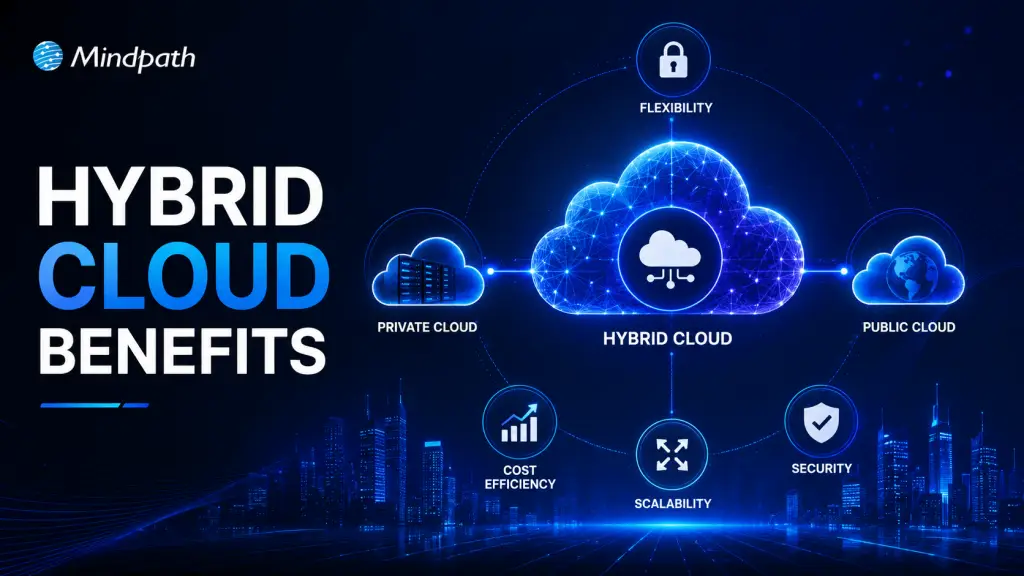
Imagine a world where businesses can enjoy the flexibility of public cloud services while keeping sensitive data safe in a private environment. Sounds ideal, doesn’t it? That’s the promise of hybrid cloud! But why is it gaining so much attention? What makes it the perfect choice for modern businesses? Let’s dive into the key benefits of this game-changing approach.

Looking to improve cloud performance without adding complexity? At Mindpath, we offer managed cloud services that simplify operations, strengthen security, and support business growth.

What is Hybrid Cloud?

A hybrid cloud is a configuration that combines private and public cloud technologies. It combines private servers in your office or data center with public cloud services from firms such as Google Cloud or Amazon Web Services. This architecture allows enterprises to store and manage their data and apps in the most appropriate location for their purposes. For example, sensitive or vital data can be kept protected in the private cloud, while less crucial operations can be done on the public cloud to save money and enhance speed. Businesses can also shift workloads across various clouds, making it an extremely adaptable and practical option. Hybrid clouds are popular because they provide businesses with the best of both worlds: security and flexibility. They are especially useful during digital transitions, when firms need to change their systems without totally shutting down their existing activities. This strategy enables businesses to work smarter, save money, and expand more effectively.

How Does Hybrid Cloud Work?

A hybrid cloud combines two or more types of cloud environments, such as private data centres and public cloud services, into a single system. This connectivity enables enterprises to effortlessly transfer data and applications across various environments. The hybrid cloud requires robust networking to function properly. This is accomplished via techniques such as local networks (LAN), virtual private networks (VPN), and APIs, which allow smooth communication between the various elements of the cloud. Virtualization and containerization are two common current technologies used in hybrid cloud systems. These solutions simplify resource management and sharing by producing virtual replicas of hardware or software. These resources are also managed using specialized software, which enables organizations to swiftly change or assign them as needed.

Advantages of Hybrid Cloud

1. Better Return on Investment (ROI)

A hybrid cloud enables you to integrate your existing private infrastructure with public cloud services. This allows you to simply extend your computer capacity without having to invest in expensive new hardware or run additional data centers. Instead of investing more in physical servers, you can leverage the public cloud to meet additional storage, computing power, and processing requirements. This technique guarantees you only pay for what you use, which helps to keep prices down. By embracing the public cloud’s flexibility and scalability, you improve your capacity to manage rising workloads while saving money on infrastructure. As a consequence, organizations can enhance their return on investment (ROI) by employing cloud services more efficiently and lowering operating costs. This combination of flexibility and cost savings makes hybrid cloud an excellent solution.

2. Enhanced Speed and Performance

Hybrid cloud solutions enhance performance, particularly for applications that require quick processing and minimal latency. By combining private and public cloud resources, data can be processed closer to end users, saving travel time and resulting in faster response times. This is vital for applications that need real-time processing, such as video streaming, online gaming, and financial transactions. For applications deployed in remote regions or with high performance requirements, a hybrid cloud configuration can guarantee that data is handled quickly by allocating resources to the best location. This can be accomplished by edge computing, which brings processing closer to the user, minimizing latency and improving the user experience. By lowering latency, hybrid cloud enables organizations to provide quicker, more dependable services, hence boosting overall application performance and customer happiness.

3. Accelerated Innovation

Hybrid cloud solutions allow enterprises to use cutting-edge technologies such as AI and machine learning without having to entirely replace or expand their present infrastructure. This makes it easy to implement modern tools and capabilities while minimizing costs and interruption. Businesses can maximize their existing systems while gaining access to the cloud’s scalability and flexibility by combining private and public cloud services. This allows teams to operate more effectively, minimizing the time required to create and deploy new apps. Organizations can bring innovations to market faster by shortening development cycles and responding to customer needs and industry developments in real time. The hybrid cloud method enables firms to explore, create, and deploy apps more quickly, providing a competitive advantage. This mix of technological access and operational flexibility accelerates innovation, allowing businesses to stay competitive in a rapidly changing digital market.

4. Stronger Control Over Applications

A hybrid cloud model provides enterprises with more flexibility over where their applications are hosted and how computing resources are distributed. This flexibility enables businesses to select the optimum environment for each application, ensuring that sensitive data is kept safe and regulatory needs are satisfied. This is particularly significant in regulated businesses. Businesses can enhance their data privacy and control by hosting particular apps in private clouds or on-premises. Simultaneously, less sensitive apps can operate on the public cloud, improving scalability and efficiency. Businesses can leverage hybrid cloud to guarantee that their applications are efficiently managed, reducing risks while still benefiting from the flexibility and cost savings provided by public cloud services. This control enables organizations to achieve privacy requirements and regulatory compliance.

5. Flexible and Efficient Operations

Hybrid cloud computing allows enterprises to pick the environment that best meets their needs. Hybrid solutions, whether in a private or public cloud, enable you to adapt and grow in response to individual requirements. One of the primary advantages of hybrid cloud is the ability to construct apps with containers. Containers make programs portable, allowing them to be seamlessly transferred between public and private clouds. This flexibility enables enterprises to take use of the finest aspects of any cloud environment, therefore improving performance, security, and cost-effectiveness. A hybrid cloud allows you to easily modify your operations to suit changing demands, such as scaling up during peak hours or relocating apps to a more secure environment when necessary. This versatility benefits companies to stay agile, reducing downtime and improving overall operational efficiency.

Cloud Computing Services at Mindpath

We provide a variety of cloud computing services to help your organization function smoothly and efficiently. Whether you need to store data, operate apps, or extend your operations, our cloud solutions offer the flexibility and security you want. We assist you in selecting the best cloud configuration for your organization, whether it’s a private cloud for sensitive data or a public cloud for ease of access and scalability. Our staff guarantees that your cloud environment is optimized for speed, cost-effectiveness, and security, enabling you to focus on developing your business rather than worrying about technology. Mindpath’s cloud computing services allow you to develop quicker, enhance productivity, and take use of the newest cloud technologies to remain ahead of the competition.

Wrapping Note!

Hybrid cloud is transforming businesses by offering a mix of flexibility, security, and scalability. It allows companies to optimize resources, improve performance, and innovate faster, all while ensuring data privacy and compliance. At Mindpath, we provide tailored cloud computing services to help you harness the full potential of hybrid cloud, enabling your business to stay agile and competitive. Let us help you take your business to the next level with the power of hybrid cloud.

Discover the benefits of hybrid cloud for businesses, including improved performance, innovation, and flexibility.
Hire NodeJS Developers in London
The cost of hiring Node.js developers in London varies according to expertise, project complexity, and firm size. Junior developers often charge £30-£70 per hour, but experienced developers charge between £70 and £150 per hour. It’s critical to assess your project’s requirements and budget appropriately. The following are significant factors that determine these expenses.

1. Experience Level

The experience of a Node.js developer significantly impacts the hourly rate. Junior developers with limited experience in Node.js typically charge lower rates, between £30 – £70 per hour. They can handle basic tasks but may need more guidance. In contrast, senior developers with extensive experience in complex Node.js projects and advanced skills may charge £70 – £150 per hour. Their expertise includes managing large-scale applications, leading teams, and solving intricate technical challenges, justifying their higher rates.

2. Project Complexity

The complexity of the project plays a crucial role in determining developer rates. Projects requiring expertise in advanced Node.js frameworks (such as NestJS or Express) or specialized areas like cloud integration and real-time services will demand developers with advanced skills. Such projects often require a deeper understanding of architecture and scalability, leading to higher rates. Developers with specialized knowledge will charge more to reflect the increased technical demands and the project’s overall complexity.

3. Company Size and Location

The size of the company and its location can also influence Node.js developer rates. Larger companies located in central London typically offer higher hourly rates, ranging from £70 to £150. These companies often have more significant resources, larger budgets, and complex projects. In contrast, smaller startups or businesses based in suburban areas may offer lower rates, typically between £30 to £70, as they often work with tighter budgets and smaller-scale projects. However, location does not always guarantee lower rates, as other factors such as the project type can still affect pricing.

At Mindpath. we offer expert Node.js developers with the right experience to meet your project’s needs, whether you’re looking for junior talent or senior developers with specialized skills. Our developers are proficient in advanced frameworks, real-time solutions, and complex cloud integrations, ensuring your project is in capable hands.

Start building your team with Mindpath today!

Discover the cost to hire Node.js developers in London: £30-£70/hour for juniors and £70-£150/hour for experienced, depending on expertise and project complexity.