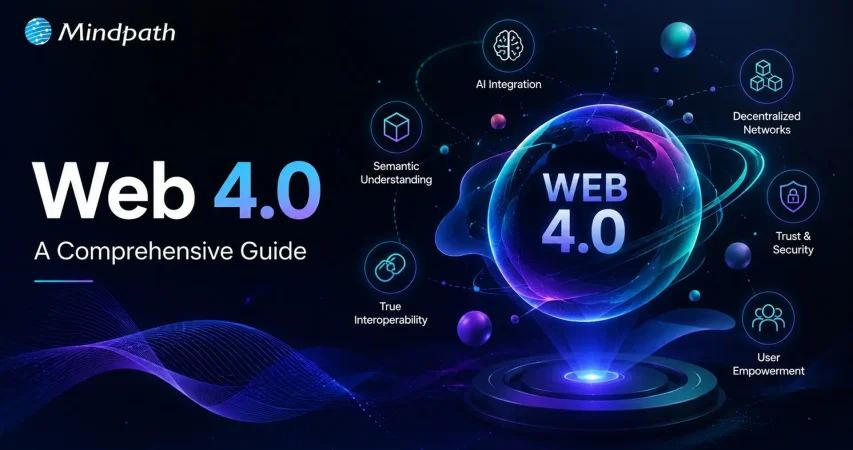
Understanding Web 4.0 – A Comprehensive Guide 

Home

Understanding Web 4.0 – A Comprehensive Guide 

Understanding Web 4.0 – A Comprehensive Guide 

Join our Newsletter!

Web 4 

The emergence of Web 4.0 is revolutionizing how we communicate, share, and engage with the digital world. It is no longer just a platform to find information. The internet is evolving into an intelligent, highly personalized, and interactive medium with which humans can have meaningful conversations. Businesspeople, programmers, and users are at the crossroads. But, what if the web thinks in a more intelligent way, reacts very quickly, and adapts to human needs? We are already witnessing the start of a change that is affecting innovation, and its influence is extending over various sectors.

Along with the changing of technology, people’s desires go beyond only fastness and accessibility. Now, users are looking for connected systems that understand their actions, assist them in decision-making and give them smooth experiences. As a result, Web 4.0 promises a future when digital environments will be more natural and relevant to human life. It provokes organizations to change their strategy and at the same time, it inspires customers to think about bigger opportunities. In this blog, let us discover how the upcoming internet era currently influences technology, business, and people’s experiences online. So, keep reading further!

Looking to stay competitive in the Web 4.0 era with smarter digital solutions? Mindpath offers AI development services to help you build smart applications that grow with your business. 

What is Web 4.0?

Web 4.0, commonly known as the symbiotic web, is less about information sharing and more about creating digital experiences that comprehend user needs. This phase of the Internet involves technology that can think and be connected on a deeper level. This web will be a network that connects people, devices, and systems in a smooth way. Through advanced web methods, organizations will be able to make decisions more rapidly. It will offer personalized communication, and collaborate effectively across digital environments.

Web 4.0 differs from the previous web versions in that it emphasizes intelligence, automation, and greater control of the user. It incorporates technologies, such as AI, machine learning, and decentralization to enhance the daily digital encounters of users. The individuals will enjoy improved privacy, robust security, and increased control over their personal data. In a deeply interconnected digital-physical environment, Web 4 is truly a game changer for businesses.

How Does Web 4 Differ from the Earlier Versions?

The internet has changed a lot over time. In this ongoing digital transformation, Web 4.0 is quite different from Web 1.0, 2.0, and 3.0 in that it provides more thorough personalization and a smooth digital interaction.

Let us have a glance at how this Internet 4.0 differs from the earlier versions through this table:

Category  Web 1.0  Web 2.0  Web 3.0  Web 4.0 
Internet Function Static information browsing Social content sharing Decentralized digital ownership Intelligent connected ecosystem
User Interaction Read-only access Read-write participation User-controlled engagement Predictive personalized interaction
Main Technology Basic web pages Social media platforms Blockchain smart systems AI-powered automation
Data Ownership Company-controlled data Platform-managed data User-owned assets Secure adaptive control
Experience Quality Limited digital presence Interactive online communities Transparent secure networks Seamless human-machine integration

What are the Key Benefits of the 4.0 Web?

Through the intelligent web, digital experiences are being transformed into smarter, faster, and more responsive. Web 4.0 not only focuses on connectivity but also fosters meaningful interactions that change according to user requirements. Its sophisticated features are allowing new opportunities to be unveiled by both companies and ordinary users.

1. Smart Personalization

Web 4.0 comprehends user behavior and provides the most pertinent digital experience to the users. It facilitates user to get quick recommendations, anticipatory assistance, and tailor-made services. This smart way enhances ease of living as well as business operations.

2. Stronger Data Security

Web 4.0 is built around decentralized systems which allow users to have greater control over their personal data. By minimizing the risks associated with central platforms and enhancing transparency, it leads to much safer and secure online experiences.

3. Better Human-Tech Connection

The future of  web is all about more interactive ways for humans to interact with digital systems. With the use of Web 4.0, communication will get better by using technology that is more human-like in responding to our needs. So, the result will be a highly intuitive experience through digital interfaces.

4. Advanced Automation

Artificial Intelligence (AI) has become one of the key components of Web 4.0. It is capable of automating repetitive tasks thus increasing the efficiency level of the work. This also leads to faster workflows, smarter virtual assistants, and less manual work. Businesses, in this way, could enhance their productivity without spending more time.

Must Read: AI vs Automation

5. Seamless Device Connectivity

Web 4.0 facilitates creating seamless experiences through multiple devices and platforms. Users can effortlessly switch from one platform to another without any loss in functionalities. Hence, this leads to highly connected and continuously consistent digital engagements.

6. Smarter Business Insights

Web 4.0 will enable companies to leverage real-time data for making superior decisions. It also enhances the capacity to analyze customer behavior and identify market trends, which subsequently results in quick and better business development strategies.

Key Challenges and Limitations of Web 4.0

Web 4.0 definitely opens a door to a fantastic innovation landscape, but along with it, several complex challenges arise that neither businesses nor users should overlook. Let’s explore the issues and major shortcomings of Web 4.0.

1. Privacy and Data Protection

A lot of personal information will be needed in Web 4.0 to provide smart experiences. This results in heightened worries about improper use of data, cyber risks, and identity theft. Keeping the users’ privacy safe is still a big issue.

2. Ethical AI Concerns

Autonomous systems may raise problems concerning bias, fairness, and accountability. AI’s decision-making might even become non-transparent or unethical at times. Developing responsible systems entails continuous oversight and control.

3. High Infrastructure Demand

Web 4.0 requires powerful computing systems, more advanced networks, and a massive scale of connectivity. Many areas still don’t have this technological basis. Today, it is costly and challenging to implement globally because of this.

4. Complex Development Process

Constructing Web 4.0 systems relies on the integration of AI, IoT, machine learning, and decentralized technologies. Overseeing such sophisticated systems calls for highly skilled professionals and substantial resources. This level of intricacy may hinder the pace of adoption.

5. Growing Digital Divide

High-tech solutions might be equally accessible to everyone for only a limited period. A shortage of gadgets and internet infrastructure may expand the gap of inequality. Such a scenario poses difficulties for achieving a sustainable and inclusive digital development.

6. Technology Dependence Risks

More automation might mean less human engagement in everyday decision-making. Relying too much on digital systems might disable our problem-solving skills. It is really necessary to find a balance in the use of technology and human control.

7. Expanded Cybersecurity Threats

The more connected devices there are, the more potential access points for hackers. One single flaw may give rise to the compromise of several systems. Hence, ensuring the safety of interlinked networks is of utmost importance.

Real-World Applications of Web 4.0

Web 4.0 is more than a mere futuristic idea as it is already radically changing various sectors via technologically advanced and interconnected devices. Its tangible effects are revolutionizing business operations as well as digital human interactions. The following are some significant examples of Web 4.0 being used in practice.

1. Smart Healthcare Solutions

Web 4.0 is an enabler for healthcare in being more proactive and personalized. Devices being worn on the body and AI systems can keep track of one’s health, assess potential risks, and aid in quicker medical interventions. Patient care and daily wellness management could be significantly enhanced by such developments.

2. Connected Smart Cities

Cities are making use of Web 4.0 to enhance traffic flow, reduce energy consumption, and improve the delivery of public services. Real-time sensors and smart systems are the backbone of better urban management. This results in urban areas that are more efficient and responsive to the needs of their inhabitants.

3. Autonomous Transportation

One of the ways Web 4.0 is backing up intelligent transportation is through the interaction of vehicles and infrastructures. Various applications can be used for better route planning, accident reduction, and improving travel time. In fact, this is the technology behind the development of safer commuting options.

4. Personalized Digital Learning

Cutting-edge AI and virtual reality technologies tailor individual learning experiences; with the help of these adaptive learning tools, students can be catered to their pace and needs. As a result, educational methods become markedly enjoyable and effective.

5. Secure Financial Systems

By leveraging decentralized technologies and safe transactions, Web 4.0 further solidifies digital finance. It also increases transparency in logistics and supply chains. Such innovations contribute to building trust and enhancing operational efficiency.

6. Predictive Smart Living

Smart homes and retail platforms, through connected systems, can predict what users need. Personalized actions and recommendations are ways through which devices and services respond faster. This convenience is a portrayal of the future of the internet.

7. Intelligent Task Automation

Web 4.0 opens up the possibility of AI handling almost all kinds of tasks without humans. It can schedule your meetings and do a lot of digital operations on the go. This helps users save time and streamline daily activities.

The Future of Web 4.0 and What Lies Ahead

Web 4.0 continues to evolve as emerging technologies reshape how people, businesses, and systems connect. Its future promises deeper intelligence, stronger automation, and more immersive digital experiences. Here are some key developments expected in the future of Web 4.0.

1. Autonomous AI Partners

Web 4.0 will move beyond basic digital assistants into smarter autonomous systems. These AI agents will manage complex tasks, make decisions, and operate across platforms. This shift will improve productivity and digital convenience.

2. Advanced Human-Machine Interaction

Future Web 4.0 experiences will feel more natural and seamless. Voice commands, gesture controls, and smarter interfaces will reduce dependence on traditional screens. Human and digital interaction will become more intuitive.

3. Predictive Personalization

Web 4.0 will better understand user behavior, habits, and preferences. Systems will anticipate needs and offer proactive solutions before users search. This will create faster and more personalized experiences.

4. Connected Digital Ecosystem

Connected devices will communicate continuously across homes, workplaces, and cities. This deeper IoT integration will support smarter environments and automated living. Daily experiences will become more responsive.

5. Trusted Digital Infrastructure

Blockchain will strengthen trust, security, and transparency behind Web 4.0 systems. It will support secure automated transactions between users, businesses, and AI systems. This foundation will improve reliability.

6. Immersive Digital Experiences

Web 4.0 will expand beyond traditional browsing into interactive 3D environments. AR, VR, and spatial computing will transform work, shopping, and communication. Digital experiences will feel more engaging and realistic.

Ready to Embrace the Next Digital Evolution?

Understanding the web 4.0 definition helps businesses and individuals prepare for a smarter digital future. As technology evolves rapidly, adopting intelligent systems early can unlock innovation, stronger connections, and sustainable growth in an increasingly connected world.

At Mindpath, we provide AI development services that help businesses adapt to Web 4 advancements with confidence. Our innovative solutions support smarter automation, digital transformation, and future-ready growth through advanced technology.

Frequently Asked Questions

1. How will Web 4.0 change everyday online experiences?

Web 4.0 will make digital experiences more personalized, predictive, and seamless. It can improve how people shop, learn, work, and communicate by using smarter systems that understand behavior and respond faster.

2. Is Web 4.0 only useful for large businesses?

No, Web 4.0 can benefit businesses of all sizes. Small companies can also use AI, automation, and connected technologies to improve customer service, increase efficiency, and compete more effectively.

3. What industries will benefit most from Web 4?

Healthcare, education, finance, retail, transportation, and smart city development are expected to benefit greatly. These industries can use intelligent technologies to improve services, decision-making, and user experiences.

4. Will Web 4.0 improve online privacy and security?

Web 4.0 can enhance security through decentralized systems and advanced technologies, but it also creates new risks. Strong cybersecurity strategies and ethical data management will remain essential for safer digital environments.

5. Do businesses need technical expertise to adopt Web 4.0?

While advanced expertise helps, businesses can start gradually by integrating AI tools, automation, and connected platforms. Strategic planning and the right technology partners can simplify the transition successfully.
Related Post

Are you looking to build a fast and scalable web application? Do you need expert NodeJS developers in New York to bring your ideas to life? Finding the right developers can be challenging, but with the right team, you can create high-performance applications that drive business success. But where can you find the best talent? Hiring Node.js developers in New York is essential for businesses seeking scalable and high-performance applications. With its event-driven architecture and non-blocking I/O, Node.js enables fast and efficient development, making it a preferred choice for real-time applications, APIs, and enterprise solutions. New York’s dynamic tech ecosystem offers access to highly skilled Node.js developers with expertise in modern frameworks and development best practices. Whether you’re building a startup or expanding an existing platform, choosing the right developers ensures seamless execution, optimized performance, and long-term success. Let’s explore how you can hire top NodeJS developers to take your project to the next level!

Steps to Hire Node.js Developers in New York

1. Define the Role

Begin by writing a comprehensive job description that outlines the responsibilities, requisite abilities, and credentials for the Node.js developer position. Indicate your proficiency in JavaScript, Express.js, databases (MongoDB, PostgreSQL), and cloud services. Mention your experience with API development, real-time data management, and performance optimization. Clearly identify soft skills such as problem-solving, teamwork, and communication to ensure alignment with the business culture. To attract the best candidates, mention if the position is onsite, remote, or hybrid, as well as the project requirements. A clearly defined position guarantees that only the most qualified and relevant Node.js engineers in New York apply.

2. Build a Hiring Process

Create a systematic hiring funnel to evaluate prospects efficiently. Begin with scanning resumes to identify competent individuals, followed by technical examinations to evaluate coding abilities. Next, conduct behavioral and cultural fit interviews to evaluate collaborative abilities. Include a test project to evaluate real-world problem-solving ability. Ensure that the process is in accordance with the business’s needs, timetables, and project scope. A well-planned recruitment strategy makes recruitment easier, allowing firms to find the top Node.js developers in New York who meet both technical and cultural requirements.

3. Find Candidates

Finding the appropriate Node.js developers are essential. Post job openings on LinkedIn, Indeed, Glassdoor, and the local NYC tech employment boards. Use networking events, hackathons, and developer meetings to connect with talent. Alternatively, work with a Node.js development agency in New York to have access to pre-vetted professionals. Agencies manage the vetting process, saving time while assuring high-quality personnel. Whether you’re recruiting freelancers, in-house developers, or outsourcing to an agency, using different sourcing channels will help you identify the most competent and experienced Node.js individuals for your project.

4. Assess Candidates

Review portfolios and GitHub repositories to assess technical and problem-solving skills. Check past projects to see experience in Node.js frameworks, databases, and cloud deployment. Ask candidates about coding methodologies, debugging strategies, and security best practices. Consider administering a practical coding test to determine efficiency in handling real-world scenarios. Pay attention to soft skills such as communication, adaptability, and teamwork to ensure compatibility with your current team. A thorough examination assures you choose professional and skilled Node.js developers in New York who can produce high-quality apps.

5. Interview Candidates

Prepare an organized interview procedure that includes technical and behavioral questions. Begin with a screening interview to examine experience, previous projects, and technical expertise. Follow up with a detailed code interview that covers Node.js architecture, performance optimization, and database administration. Include a live coding session or case study to put your real-time problem-solving abilities to the test. Conduct team interviews to evaluate collaboration and cultural fit. In New York’s competitive tech industry, a rigorous but fast interview process is required to obtain top personnel while assuring alignment with your company’s vision and goals.

6. Hire candidates

After conducting interviews, choose the finest Node.js engineers based on technical knowledge, problem-solving skills, and cultural fit. Check references to confirm previous performance and professionalism. To recruit excellent people, provide competitive compensation that is in line with New York’s technology market requirements. Prior to onboarding, clearly describe job expectations, team structure, and project goals. Integrating new personnel into your development workflow and introducing them to the team can help to ensure a pleasant onboarding experience. Hiring the best Node.js engineers in New York guarantees the success of your online and software development projects.

Ready to Hire the Best Node.js Developers in New York?

At Mindpath we provide top-tier Node.js development services to help businesses build scalable, high-performance applications. Whether you need a dedicated developer or a full-scale development team, our experts are ready to bring your vision to life.
Contact Mindpath today and get the right Node.js developers for your project.

Discover the ultimate guide to hiring Node.js developers in London. Learn about the skills, benefits, and cost factors involved in finding the right talent for your project.
generative ai for business

Ever imagined a machine that could produce articles, logos, and new content to power your business? Sounds intriguing, isn’t it? Well, that is what generative AI can do for your business. This new-generation artificial intelligence is transforming future of businesses by generating new content, images, product designs and even strategy concepts from patterns it has acquired by analyzing the existing data. In this blog, we are going to discuss how generative AI for business can create innovation and give a competitive advantage.

So, before we learn about how generative AI can transform businesses, let’s understand what is generative AI.

Looking for ideas to reshape your business with generative AI? Unlock smarter growth, faster innovation, and personalized customer experiences with Mindpath’s AI-powered solutions

What is Generative AI?  

In simple terms, generative AI is an artificial intelligence that takes huge datasets and algorithms to learn the pattern and then generates new outputs based on its understanding. While AI is all about recognizing data, classifying it, or predicting, generative AI takes it a step further—it produces new content. For instance, it can author customer emails, create social media posts, produce product descriptions, and even assist in designing user experiences. 

Generative AI has the ability to provide enterprises with numerous benefits like enhancing innovation and creativity, enhancing productivity and reducing expenses. Generative AI also facilitates original idea creation, speed in product development, and custom-built customer experiences. In addition, it has the potential to enable workers to focus on more critical activities and reinforce security and raise the satisfaction levels of customers. 

Also Read: Generative AI Revolution

Let’s dive in how generative AI can drive business innovation and creativity for businesses. But before that have a quick look at the Google Trends for Generative AI for Business.

generative ai for business trends

How does Generative AI Drive Innovation for Businesses? 

In today’s fast-moving digital world, innovation is the key to staying ahead. Generative AI in business is assisting companies in igniting new ideas, enhancing content, and accelerating processes. Let us see how generative AI for innovation is changing the way companies think and create. 

1. Personalization Fuels Innovation 

Building a strong customer connection helps in driving business growth and personalization plays a major role in it. Companies can deliver tailored content and better user experiences with the help of smart tools that can understand customer behavior. This is precisely where generative AI for innovation can make a huge difference by helping businesses personalize at a scale which is much faster and more accurate than manual efforts.  

2. AI Creativity and Human Creativity: A New Partnership 

There is much discussion circulating about AI creativity vs. human creativity. It shouldn’t be about who is superior, but how they can both contribute to success. Humans can provide emotion, context and novel ideas to which AI can provide structure and new insights based on data. Merging the two can assist businesses to work more smartly. For example, how generative AI can augment human creativity is seen when it rapidly produces ideas or content, and humans are able to edit and make them work for the brand’s voice and objectives. This also ties into how AI is redefining job roles in tech, showing the evolving collaboration between human expertise and AI capabilities.

3. Unlocking Potential through Data-Driven Creativity 

Generative AI for business enables companies to convert information into intelligent ideas through analysis of customer behaviors, market patterns, and performance outcomes to develop valuable content, product layouts, or advertising campaigns. Humans contribute creativity, passion, and profound meaning, while AI contributes pace, logic, and the capacity to process vast volumes of data rapidly. When combined both, companies are able to develop meaningful experiences that connect with people and result in improved outcomes. aligning with the latest Gen AI trends in business intelligence.

4. Streamlining Operations 

When used properly, Generative AI in business enables companies to save time by automating routine work and processing large sets of data. This allows teams more time to come up with new ideas and more efficient ways of working. When businesses apply this type of thinking, they can grow more quickly, plan more smartly, and stay ahead of market change. That’s how generative thinking helps businesses innovate smarter because it provides them with the space, tools, and insights to grow more smartly. 

5. Securing Financial Transactions 

Generative AI is becoming a necessity for securing financial systems and mitigating risks. It enables companies to identify potential financial risks by processing vast amounts of data efficiently and accurately. The technology also helps in forecasting market trends, enhancing decision-making. Additionally, generative AI is improving fraud and suspicious activity detection in real-time. It’s transforming trading by offering insights from enormous data sets, ensuring smarter and safer transactions. 

Wondering how generative AI is influencing content creation and design strategies? Check out our blog generative AI changing creative industries  to see how AI-driven creativity is shaping the future of industries.

Use Cases of Generative AI for Business Growth 

Generative AI for business is revolutionizing the way companies develop by enhancing customer experience, increasing productivity of employees, and accelerating innovation. From conversational tools like ChatGPT, Bard, and Midjourney to live business applications, the effects are tangible. Here are some simple yet impactful generative AI use cases that fuel business growth today:

Use Cases of Generative AI for Business Growth 

1. AI-Driven Product Ideas

With tools such as Midjourney, businesses are able to create product ideas, packaging, and graphics. It illustrates how AI can be applied in innovation, by assisting teams to come up with creative ideas quicker and validate what is effective with actual audiences.

2. Smarter Customer Support

Tools like ChatGPT help companies create AI-powered chatbots that answer customer questions instantly. This improves response time and frees up human agents to focus on complex issues. It’s a simple way to offer 24/7 support and boost customer satisfaction.

3. Streamlining Employee Workflows

According to the McKinsey Generative AI Report, generative AI can automate tasks that take up 60–70% of employees’ time today. This includes writing emails, summarizing reports, and generating presentations—especially helpful for knowledge workers and high-skill roles.

4. Personalized Marketing Campaigns

Generative AI technology assists companies in crafting customized ads and suggestions based on user data. This renders marketing more precise and efficient, enabling more engagement and sales while saving time for marketers.

5. Fast Content Generation

With platforms like Bard, teams can quickly write blogs, product descriptions, and emails. This saves time and allows employees to focus on strategy. It’s one of the most practical generative AI examples used daily across industries. 

Looking to leverage generative AI for smarter, more adaptive app solutions? Explore our blog on Generative AI in App Development highlights practical applications, transformative benefits, and strategies to stay ahead in the digital landscape.

Ready to Make Your Business AI-Ready? 

Generative AI is changing the way businesses work, think, and grow. It’s not just about automation, it’s about helping teams be more creative, make faster decisions, and offer better experiences to customers. Be it creating content, improving support, or building new ideas, generative AI for business is making every day work smarter and more efficient. 

At Mindpath, we specialize in delivering cutting-edge AI development services tailored to meet the unique needs of modern businesses. Our expertise in generative AI enables companies to streamline operations, boost productivity, and create intelligent solutions that drive real value. Whether you’re looking to implement AI-powered automation, enhance customer engagement, or accelerate innovation, Mindpath is your trusted technology partner for consistent business growth! 

Frequently Asked Questions

1. What is generative AI for business users?

Generative AI for business refers to AI systems that create new content, ideas, designs, or solutions based on existing data. Instead of only analyzing information, it generates emails, reports, marketing copy, product concepts, and more. Business users can apply it to improve creativity, automate tasks, and make smarter decisions faster.

2. What are some applications of generative AI in business?

Businesses use generative AI for content creation, customer support chatbots, product design concepts, personalized marketing campaigns, and financial risk analysis. It also helps generate reports, automate emails, and create digital assets. These applications support innovation, reduce manual work, and improve overall operational efficiency.

3. How can we implement GenAI to improve efficiency?

To implement GenAI effectively, businesses should first identify repetitive tasks and content-heavy processes. Next, integrate AI tools with existing systems like CRM or ERP platforms. Start with pilot projects, measure performance, and scale gradually. Proper data management and employee training are essential for long-term success.

4. What is the future of GenAI in business?

The future of Generative AI for business looks highly promising. It will continue enhancing personalization, predictive decision-making, and intelligent automation. As technology advances, AI systems will become more context-aware and collaborative, working alongside humans to drive innovation, improve productivity, and create smarter digital ecosystems.

5. What is one limitation of generative AI in business?

One major limitation of Generative AI for business is its dependence on data quality. If trained on biased or inaccurate data, outputs may be misleading. It also lacks true human judgment and emotional understanding, which means human oversight remains necessary to ensure accuracy, brand alignment, and ethical use.

Support Is One Click Away

Featured Posts

Related Post