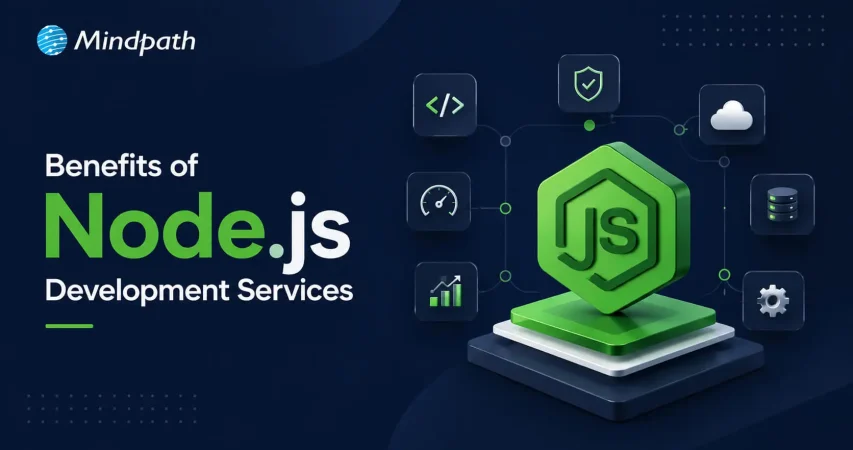
Benefits of Using NodeJS Development Services

Home

Benefits of Using NodeJS Development Services

Benefits of Using NodeJS Development Services

Join our Newsletter!

nodejs development services

People want apps that work faster, real-time communication, and digital solutions that can grow with their needs, so web development is changing quickly. Companies don’t want websites that stay the same all the time. They want platforms that can handle a lot of traffic, use data, and make things run smoothly. This change has made Nodejs development services one of the most popular choices in the tech world.

Node.js is very popular because it can handle many requests at once, doesn’t block, and is event-driven. More and more companies, both big and small, are paying for NodeJS development solutions to make sure their apps are up to date and meet the needs of their users.

Planning to build a high-performance application with expert support? Mindpath provides professional services where you can hire expert NodeJS developers for scalable and reliable solutions.

Businesses that want to use NodeJS development need to know what it can do for them. This article talks about why Node.js is a good choice and how it can change the way you make things.

Top Benefits of NodeJS Development Services

In today’s fast-paced digital landscape, businesses need applications that are not only fast and scalable but also capable of handling real-time interactions. This is where NodeJS development services stand out. They enable organizations to build modern, high-performance applications that align with evolving user expectations and business goals.

1. High Performance and Faster Execution

Node.js is powered by Google’s V8 engine, which compiles JavaScript into machine code for faster execution. This results in high-speed application performance, even under heavy traffic conditions. For businesses, this means improved user experience, faster load times, and reduced bounce rates.

2. Real-Time Application Capabilities

One of the biggest advantages of NodeJS development services is the ability to build real-time applications. Whether it’s chat applications, live dashboards, collaborative tools, or streaming platforms, Node.js enables instant data processing and communication, enhancing user engagement.

3. Scalability for Business Growth

Scalability is critical for any growing business. Node.js allows applications to handle multiple concurrent connections efficiently, making it ideal for platforms expecting rapid user growth. Businesses can scale horizontally without compromising performance, ensuring long-term sustainability.

4. Faster Development and Time-to-Market

With access to a vast ecosystem of libraries and reusable components through npm, developers can build applications more quickly. This significantly reduces development time, helping businesses launch products faster and stay ahead of competitors.

5. Cost Efficiency and Resource Optimization

NodeJS development services reduce overall development costs by enabling full-stack JavaScript development. This eliminates the need for separate frontend and backend teams, streamlining resources and improving productivity.

6. Flexibility with Modern Architectures

Node.js works seamlessly with microservices and cloud-based architectures. This flexibility allows businesses to build modular applications that are easy to maintain, update, and scale according to changing requirements.

7. Strong Community and Ecosystem Support

Node.js has a large and active developer community that continuously contributes to its ecosystem. This ensures access to updated tools, frameworks, and solutions, reducing development challenges and improving reliability.

NodeJS Development Solutions for Businesses

NodeJS development services are not limited to a single type of application. They are widely used across industries to create scalable and efficient digital solutions tailored to business needs.

Common Business Applications Include:

1. Real-Time Applications

Chat platforms, gaming apps, and collaboration tools.

2. Streaming Services

Video and audio streaming platforms with seamless delivery.

3. API Development

Fast and scalable APIs for web and mobile applications.

4. Microservices Architecture

Modular systems for large-scale applications.

5. Single Page Applications (SPAs)

Dynamic and responsive web applications.

By leveraging these solutions, businesses can enhance performance, improve user engagement, and streamline operations.

Role of a NodeJS Development Company

A NodeJS development company can help businesses get the most out of Node.js. These businesses have the knowledge, tools, and processes in place to ensure that apps are of the highest quality.

A business that helps people advance in their careers offers:

  • All the services for Node.js development
  • Making apps just for you
  • Using and combining APIs
  • Help and maintenance
  • Making things work better

If you hire professionals who have been doing this for a long time, you can be sure that your project will use the best methods and the newest technology.

Tips to Hire a NodeJS Development Company

Selecting the right development partner is a critical decision that directly impacts your project’s success. Here are some essential tips to guide you:

1. Assess Technical Expertise

Ensure the company has strong experience in NodeJS development and is familiar with modern tools and frameworks. Their technical capability determines the quality of the final product.

2. Review Portfolio and Case Studies

Analyze their past projects to understand their experience across industries and the complexity of solutions they have delivered.

3. Check Client Feedback and Reputation

Look for reviews, testimonials, and ratings to evaluate reliability, communication, and client satisfaction.

4. Evaluate Communication and Transparency

Effective communication is key to successful collaboration. Choose a company that provides regular updates and maintains transparency throughout the project.

5. Understand Their Development Approach

Nodejs development companies following agile methodologies can adapt quickly to changes and ensure timely delivery of projects.

6. Consider Scalability and Post-Launch Support

A good development company provides ongoing support, maintenance, and scalability options to ensure long-term success.

7. Compare Pricing and Engagement Models

Select a company that offers flexible hiring models and transparent pricing aligned with your budget and project requirements.

Future of NodeJS Development Services

The future of nodejs development services looks bright because more and more companies are using new technologies. Node.js is likely to be a big part of the future of web development because of the rise of cloud computing, microservices, and real-time apps.

It will still be useful in business because it can adapt to new needs and support architectures that can grow.

Looking to Hire a NodeJS Development Company for Your Project?

Choosing the right development partner can significantly impact your business growth and application performance. Partner with Mindpath, a trusted NodeJS development company, and work with experienced professionals who know how to build scalable, high-performing, and future-ready applications.

Take the next step today and transform your ideas into powerful digital solutions!

FAQs

1. What are NodeJS development services?

NodeJS development services include building, deploying, and maintaining web applications using Node.js technology.

2. Why should businesses use Node.js for development?

Node.js offers high performance, scalability, and real-time capabilities, making it ideal for modern applications.

3. What are the advantages of NodeJS development?

Key advantages include speed, scalability, non-blocking architecture, and a large ecosystem of tools and frameworks.

4. What are popular NodeJS web frameworks?

Popular frameworks include Express.js, NestJS, Koa.js, and Sails.js.

5. Should I hire NodeJS developers or a development company?

Hiring developers is suitable for dedicated projects, while a development company provides end-to-end solutions.

Related Post

Agile Methodology

In today’s rapidly evolving digital world, agile methodology is changing how businesses plan, build, and deliver projects. Rather than drawn-out timelines with large cycles of progress, teams are able to move steadily through short sprints with defined goals. This process allows leaders to maintain visibility at every stage of the project while maintaining a firm hold on customers’ needs. Isn’t that what every business wants, speed with flexibility? Using this process makes projects feel lighter, more reactive and adaptive, and easier to navigate and manage, thus transforming work into a journey of growth and learning.

At its core, agile emphasizes collaboration, transparency, and continuous improvement. Because everyone knows what to expect and when, the flow of work stays uninterrupted. There is a connection between teams and their clients that helps decrease surprises and strengthen trust. Small changes are easier to accommodate after the fact than big changes once the project is underway. In this blog, we will unpack Agile in extraordinary detail, illustrating why it is more than a method and how it leads to sustainable success.

Are you looking to achieve sustainable success for your business? Contact us to choose the right direction in this fast-paced digital world, and we will guide you on how you can enhance your business performance.

What is Agile Methodology?

The agile development meaning is simple and strong: it consists of a project management approach that splits the total work into smaller pieces we can manage as sprints. Each sprint focuses on delivering a usable output in which we can be flexible and adaptive to the process. Upon completing the sprint, we review where we have gone, gather feedback, and improve the next cycle. This way we are progressing, while having clarity, with a greater velocity, while getting closer to what customers want.

The agile methodology exists with the guidance of the Agile Manifesto, a guiding document of values and principles established in 2001 by software professionals, where the key aspects of collaboration, working software, flexibility, and customer satisfaction are prioritized over formalized processes. The Agile Manifesto lays out the values, which consist of 12 principles that teams can follow to help ensure consistent efforts to deliver value.

Below are the 4 values of Agile:

1. Individuals over Processes

Agile prefers a team working together, rather than strict processes.

2. Software over Documentation

Working software is more important than paper.

3. Customers over Contracts

Customers provide feedback to the development more than the details described in the contract.

4. Changeover Plans

Adapting to change is valued more than sticking to fixed plans.

Not sure which software development approach fits your Agile project goals and business needs? Explore the key types of software development and how choosing the right path can help your Agile teams deliver better, more tailored results.

What are the 12 Principles of Agile?

The 12 Principles of Agile methodology build on the 4 core values and are used to help put them into practice in real-world projects. They provide a key for teams to focus on collaboration and flexibility, and continuously deliver value to customers.

Principles of Agile Methodologies

1. Customer Satisfaction

Customers should be satisfied by receiving value sooner rather than later.

2. Embrace Change

Adopt the mindset that the most valuable features might change and keep an open mind toward new needs, even late in a project.

3. Frequent Delivery

It’s important to deliver and share updates frequently to make sure that you’re showing consistent value to customers.

4. Collaboration

Remove silos and work together as a team.

5. Motivated Teams

Organize work around motivated individuals, people who are ready to work hard and have a commitment to their work.

6. Face-to-Face Communication

Conversations will make for a quicker, clearer understanding.

7. Working Software

Demonstrate progress with working software.

8. Sustainable Pace

Progress can continue if a sustainable speed is possible so that the team goes home and rests and comes back tomorrow.

9. Continuous Excellence

Strive to be smarter & faster by raising the quality.

10. Simplicity

Opt for the simplest & most effective solutions rather than the complicated & ineffective ones.

11. Self-Organizing Teams

Allow teams to organize themselves and provide real value.

12. Reflect and Improve

Regularly stop and reflect to learn and improve for value.

Curious about how Agile fits into real software build workflows from idea to launch? Learn the custom software development process to understand how Agile practices help teams stay flexible and aligned with business goals.

Advantages of Agile Methodology

Agile methodology provides a flexible approach to project management that keeps customer needs first. These are the main advantages that make it a highly-sought after strategy for modern development.

Advantages of Agile Methodology

1. Stronger Collaboration

The agile methodology creates constant client involvement, building transparency, and ensuring developers stay aligned with real needs.

2. Accurate Planning

With agile, project managers can estimate costs and timelines more precisely through short, iterative sprints.

3. Flexibility in Change

Agile methodology project management allows quick adjustments to market shifts or client requirements without slowing progress.

4. Better Quality

Agile integrates continuous testing, which helps identify issues early and deliver reliable, high-performing products.

5. Lower Risk, Faster ROI

By following agile methodology practices, teams reduce risks with frequent feedback and deliver faster returns through incremental value.

Not sure how development structure impacts long-term ROI? Explore how Agile-driven SDLC models reduce rework, control costs, and deliver measurable business value.

What is the Process of Agile Methodology?

The agile methodology process emphasizes looking at projects in smaller, more manageable steps to create quick, flexible progress. The agile project methodology has teams working because of different cycles, quickly adapting to changes and delivering value in every step.

Process of Agile Methodology

1. Requirements

Teams root through customer requirements and prioritize them against business objectives and user needs. It’s a liberation activity that sets the course of the project and a solid base for the later phases.

2. Planning

The planning phase creates a roadmap for development and delivery. Teams agree on the schedule, sprint goals, and resources within the confines of the agile framework to maintain flexibility.

3. Development

Developers develop features in short iterations using Agile methodologies. The aim is to deliver working software quickly across agile techniques; collaboration and adaptability are important.

4. Testing

Once a feature is built, the team immediately tests the feature. Testing is performed to ensure the software works properly and meets the quality expected by the customer.

5. Deployment

The product or feature is launched for actual use. Early releases will enable users to provide feedback that can inform future improvements in the agile methodology process.

6. Maintenance

Teams constantly maintain and enhance the software to meet customer requirements. In agile methodology, the maintenance step of the product becomes an evolving process within the context of ongoing agile system development.

Worried that Agile alone won’t prevent costly mistakes in your software delivery? Explore common mistakes in custom software development projects and how proper planning and Agile practices can help avoid them.

When Does Agile Deliver the Most Value?

The agile style works best for projects that need flexibility and constant advancement. Here are several examples of where it offers the most value.

Best Situations for Using Agile Methodology

1. Evolving Needs

The agile methodology is the best option for projects with changing or ambiguous requirements because it allows teams to shift focus quickly while still maximizing delivery.

2. Complex Projects

Large and complex projects become easier to handle when broken into smaller, manageable parts. This approach reduces errors and improves coordination.

3. Customer Guidance

Regular customer feedback ensures the product meets actual needs. It creates a strong link between users and the development team.

4. Speed to Market

Short sprints make it possible to release working features quickly. This helps businesses gain a competitive edge faster.

5. Small to Medium Teams

Agile methodology works best for teams of a few to a few dozen people. It keeps communication simple and collaboration effective.

6. Cross-Functional Skills

Teams with developers, testers, and designers working together achieve higher quality. This collaboration reduces dependency on outside resources.

7. Transparency

Everyone involved can see the project’s progress clearly at all times. This openness builds trust and accountability.

8. Risk Management

Teams detect issues early and resolve them before they grow bigger. This approach reduces delays and prevents unexpected problems.

Struggling to justify the business case for investing in custom development alongside Agile practices? Discover the top benefits of custom software development and see how Agile can help you unlock scalable, tailored solutions that grow with your company.

Want to Unlock Success with Agile Methodology?

The agile methodology has transformed how businesses manage projects, deliver value, and respond to change. Focusing on flexibility, collaboration, and continuous improvement, it gives teams the tools to adapt quickly while keeping customers at the center. Its principles and processes ensure projects move smoothly, delivering higher quality outcomes and long-term success in a competitive digital landscape.

At Mindpath, we use the agile methodology to design and deliver custom software that evolves with your business. Our approach blends speed, adaptability, and technical expertise to create solutions that meet real needs. With strong collaboration and a focus on innovation, we help businesses reduce risk, accelerate growth, and achieve sustainable results through high-performing, tailored products.

Discover how Agile methodology transforms web and app development with flexibility, collaboration, and faster delivery.
ai ethics guide

AI ethics is the multidisciplinary field that governs the responsible design, deployment, and regulation of artificial intelligence systems in alignment with human values. It plays a key role in making sure that AI systems create measurable value for society while protecting human rights and preventing harm. It involves a broad range of considerations such as fairness, transparency, privacy, security, accountability, and the prevention of bias and discriminatory outcomes in automated decision-making.

While talking about the topic relating to artificial intelligence, one cannot ignore the importance of AI ethics. As AI is growing at an exponential rate, it is essential to understand the role of AI ethics in the prevailing AI realm. As AI is impacting the lives of people in diverse ways today, it is the right time to broaden the insight into AI ethics. The AI Ethics guide will help you explore AI Ethics at an in-depth level and understand why it matters so much today. 

Ready to adopt AI in a way that it operates ethically and protects your business from risks as you scale? Mindpath offers trusted AI development services that help you build transparent, responsible, and future-ready AI solutions.

Key Areas of AI Ethics

The definitions of AI may vary considerably. However, AI ethics combines a number of elements, including security, safety, and human concerns. It also involves the responsible use of AI by taking into consideration the environmental concerns. The chief areas of the AI ethics framework include:

1. Avoiding AI Bias 

AI systems learn from data. The systems with poor design are likely to demonstrate biased behavior. You must remember that AI models with poor training may showcase bias against minorities. This is when AI ethics principles come into the picture. AI ethics principles relating to fairness and justice can make sure that the possibility of bias can be curbed effectively. 

2. Artificial Intelligence and Privacy 

Artificial intelligence relies on information in order to learn. A considerable amount of this information comes from users. Thus, it automatically gives rise to privacy concerns for users. This is because not all users are well-aware of the information that has been gathered about them and how it is being used. An AI ethics framework can make sure that there is no compromise when it comes to the privacy of users. It even ensures that their information is used in a responsible manner.

3. Avoiding AI Mistakes 

It is essential to bear in mind that poorly constructed AI systems are prone to making mistakes. Such mistakes may lead to diverse consequences, such as the loss of revenue or accidents. This is why the AI Ethics guide stresses the importance of adequate and proper testing so that AI will not pose a risk to humans. 

4. Management of AI Environmental Impact 

With each passing day, AI models are getting larger and bigger. These large models consume a high volume of energy for the purpose of training. Thus, AI has become a large consumer of resources in the prevailing times. Ensuring the ethicality of AI is essential so that researchers can design energy-efficient AI systems that can strike a balance between energy efficiency and performance. 

Planning to align innovation with responsible governance? Discover the types of AI to learn how each category impacts compliance and ethical standards.

Understanding AI Ethical Principles

The AI Ethics guide sheds light on the five Ethical principles of AI that you need to bear in mind. You need to familiarize yourself with the AI ethics principles so that you can understand their relevance in the real-world setting.

1. Transparency

One of the fundamental ethical principles relating to AI revolves around transparency. AI systems and tools need to be transparent in nature so that people can understand how they work. The role of transparency is cardinal to understanding how AI systems make decisions. It will help disclose the overall functionality of AI systems to humans. 

2. Fairness

In case you are wondering, what are the 5 ethics of AI? You need to remember that one of the key principles is related to fairness. AI systems need to be fair and just in nature so that the possibility of biased behavior can be eliminated. While creating AI models and systems, developers need to adopt a fair approach so that these systems will not generate discriminatory outcomes. The AI systems need to treat all individuals and groups in an equitable manner. One of the key AI ethics examples involves addressing biased behavior in hiring algorithms.

3. Accountability 

While talking about – What are the 5 ethics of AI? You cannot ignore the importance of accountability. In fact, accountability is a critical component of AI ethics. A chain of accountability should be in place so that appropriate individuals and organizations can be held responsible while using AI systems. There needs to be a clear line of responsibility so that systems can operate in a trustworthy way. When it comes to accountability in the context of AI teams, they need to understand the importance of prevention as a cure. 

4. Reliability

In order to be ethical in nature, AI systems need to function in a reliable manner. It can ensure that the outcomes that have been achieved by the particular system are consistent and reproducible. Reliability is especially important when AI is being used in important areas such as healthcare and finance. It is fundamental to monitor AI systems to ensure that they are reliable and dependable in nature. 

5. Privacy and Security

AI systems need to respect the privacy as well as the security of users. It is essential to have in place proper security measures so that sensitive data can be stored in a secure and safe manner. Some of the measures organizations can adopt include data encryption, identifying system vulnerabilities, and safeguarding against malicious attacks. It is fundamental to adopt responsible data collection practices along with the deployment of robust data governance practices. One of the common AI ethics examples involves protecting user data privacy in the healthcare setting. 

Want to implement artificial intelligence responsibly without risking compliance or trust? Discover an AI roadmap to learn how a structured approach ensures ethical and sustainable adoption.

Technical Requirements for Creating Ethical AI Systems

In order to make sure that AI systems are ethical in nature, it is essential to focus on the technical aspects. Organizations need to fulfill a number of technical requirements so that AI systems can function in an ethical and responsible manner.   

1. Focus on Bias Detection

There is a need to use diverse data sets in order to detect as well as correct bias in AI models. It is a key step that has to be taken in order to ensure that AI systems can operate in a fair manner. 

2. Focus on Explainability

The role of explainability and transparency is high while talking about AI ethics. The developed AI systems should function transparently for users. Methods such as decision trees and feature importance scores can be adopted to boost transparency. 

3. Data Privacy

The safe management of data used by AI systems is a must. Moreover, proper compliance with relevant privacy laws is essential so that the privacy of users will not be compromised at any stage. Practices such as anonymization and data encryption need to be adopted while using AI systems. 

Curious why some organizations struggle with responsible AI rollout? Check out challenegs of AI adoption and discover how the right approach balances innovation with ethical oversight.

Ready to Build Ethical AI That Drives Real Business Value?

In the era of artificial intelligence, the role of AI ethics is extremely important. It helps ensure that this powerful technology is used in a responsible and trustworthy way. As AI continues to evolve rapidly, understanding and applying ethical principles becomes essential for businesses, developers, and organizations. By prioritizing ethical practices, organizations can adopt AI with greater confidence while creating long-term value for society. 

At Mindpath, we provide expert AI development services which help organizations build responsible and future-ready AI solutions with strong ethical foundations. Our experts focus on transparency, data security, and fairness so businesses can innovate confidently while protecting trust and compliance. Partner with Mindpath to turn AI innovation into responsible and sustainable growth.

Support Is One Click Away

Featured Posts

Related Post

Discover how DevOps can save your business costs by improving efficiency, and enhancing collaboration across teams for high-quality delivery.