How AI and Automation Accelerate Legacy System Modernization? 

Join our Newsletter!

Featured Posts

Support Is One Click Away

Home

How AI and Automation Accelerate Legacy System Modernization? 

AI-driven legacy system modernization

How AI and Automation Accelerate Legacy System Modernization? 

AI-driven legacy system modernization is transforming how businesses approach aging technology. Firms are under increasing pressure to remain competitive and deal with complicated and old systems. Is it possible to make this process smarter with the help of technology? The dilemma is how to balance innovation and stability, and how several are looking at the active reformation of legacy workflow by AI and automation.

The adoption of smart solutions enables organizations to be agile and fast in integrating main systems. They are able to detect bottlenecks, minimize mistakes and streamline processes to a much greater accuracy. This solution triggers the debate of efficiency and future-proofing. In this blog, we will explore how AI and automation can bring the legacy systems up to date. Keep reading further!

Looking to future-proof your legacy applications with AI-driven solutions? Mindpath’s legacy modernization services help organizations upgrade systems efficiently and stay ahead in the digital landscape.

What is AI-Driven Legacy System Modernization?

AI-driven legacy system modernization uses artificial intelligence to analyze and update outdated software efficiently. It automates activities such as refactoring of code, documentation and testing processes without interfering with business logic. The method speeds up access upgrades, minimizes mistakes, and decreases expenditures to assist the organizations to modify old systems to new agile systems that are cloud-capable.

The adoption of AI in legacy modernization will allow decisions to be made more intelligently when upgrading the system. Machine learning suggests trends, risks forecasts and provides best optimized solutions. Generative AI can help generate proper code and documentation and minimal disruption. Through AI, organizations can modernize in a shorter time, continue working with the existing systems, and optimize them to grow in the future.

Must Read: Benefits of Modernizing Legacy Systems

Why AI-Driven Legacy Modernization Matters?

Old systems have been known to slack innovation and amplify risks in operation. These are the advantages of AI and automation in legacy system modernization.

1. Faster Modernization Cycles

AI-driven legacy system modernization speeds up system upgrades by automating repetitive tasks. Organizations accomplish projects in lesser time, downtime is minimized and efficiency enhanced.

2. Cost Reduction

AI maximizes the investment of the resources and reduces errors that reduce the expenses of the modernization. The process of legacy application modernization is predictable and more cost-effective.

3. Improved Accuracy

AI is very accurate in analyzing code and data which minimizes human errors. This makes sure that the updates do not affect business logic and system stability.

Must Read: Monolith to Microservices

4. Enhanced Security

Artificial intelligence-based devices identify threats immediately and indicate vulnerabilities. Companies enhance protection and comply successfully.

5. Scalability and Flexibility

AI allows legacy systems to manage increasing data and traffic. They are unified with modernization based on cloud, IoT, and advanced platforms.

6. Future-Proofing Operations

AI-driven legacy system modernization supports incremental upgrades, extending system lifespan while adapting to evolving technologies. This makes systems up to date and capable of future expansion.

Wondering how to balance AI innovation with a strong modernization plan? Discover the legacy modernization strategy to achieve a more effective transformation.

Role of AI in Legacy System Modernization

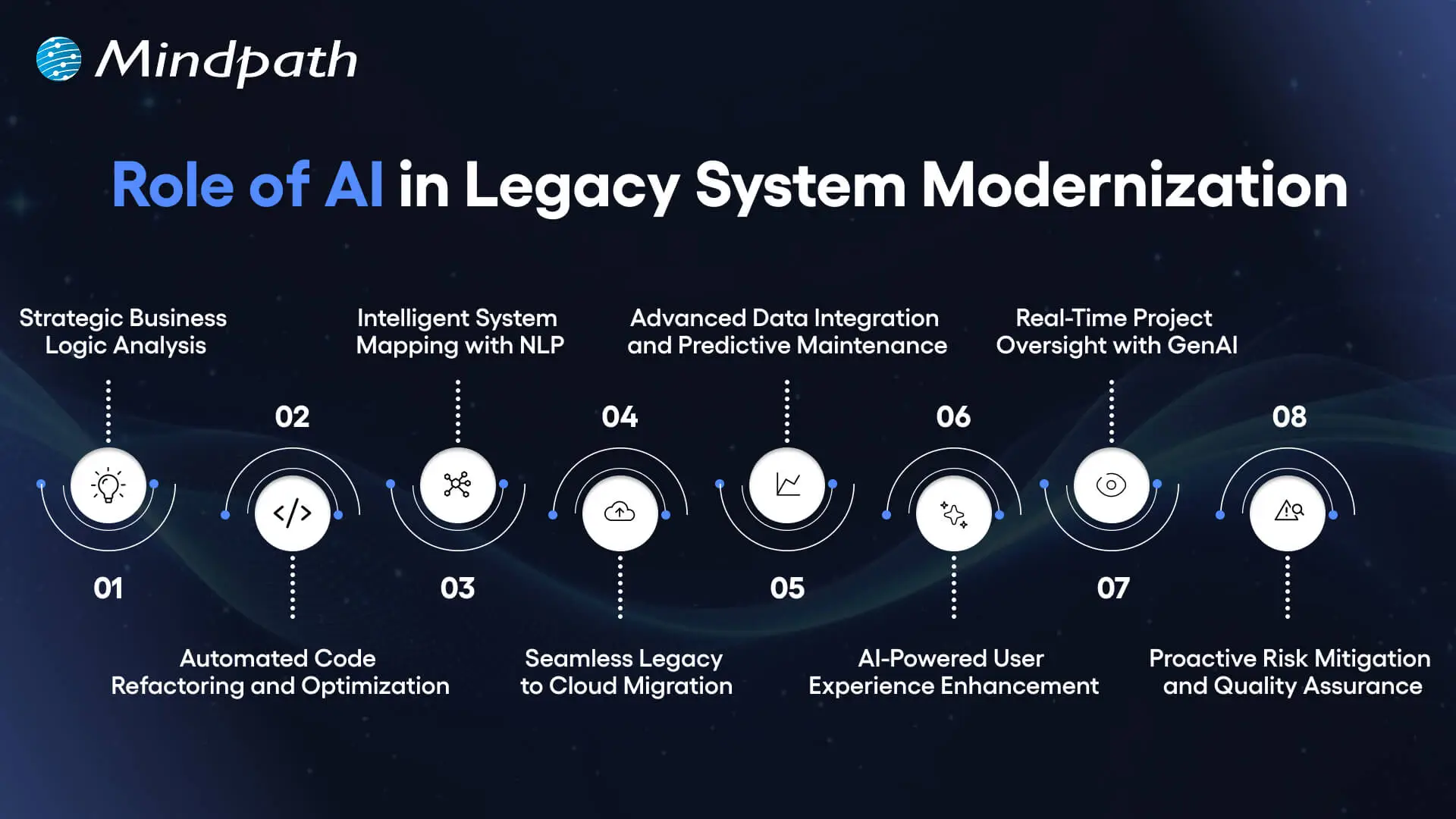
AI-driven legacy system modernization is reshaping how organizations update and optimize outdated systems. Here are the roles of AI-driven legacy system modernization in transforming legacy operations efficiently.
role of ai in legacy system modernization

1. Strategic Business Logic Analysis

AI-driven legacy system modernization starts by uncovering hidden business logic. It plots dependencies and decision rules. Modernization becomes smarter and data-driven, and teams are given a clear understanding.

2. Automated Code Refactoring and Optimization

AI rewrites the old code to new cloud-ready codes. Refactoring is faster, fewer errors in the system, and the system itself is much better with generative AI.

3. Intelligent System Mapping with NLP

Natural language processing transforms the complex old code into canned knowledge. Inefficiencies and bottlenecks are promptly found and assist in accelerating modernization.

4. Seamless Legacy-to-Cloud Migration

AI-driven legacy system modernization enables smooth cloud transitions. It also re-architectures code to reflect the current architectures and best practices.

Must Read: Benefits of Cloud Migration

5. Advanced Data Integration and Predictive Maintenance

AI integrates multiple sources of data to allow a smooth integration. Predictive analytics will identify possible problems before they happen and minimize downtime and operational problems.

6. AI-Powered User Experience Enhancement

AI interprets the user behavior in order to streamline interfaces. Chatbots and virtual assistants automate the repetitive field of work making it more engaging and efficient.

7. Real-Time Project Oversight with GenAI

AI offers invaluable real-time insight into the state of modernization. Predictive analytics and automated documentation keep the stakeholders updated and project on schedule.

8. Proactive Risk Mitigation and Quality Assurance

AI reduces the human factor and promotes uniformity. Modernization with structures and low risk can have safety nets that are provided through automated testing and monitoring.

Looking to create a clear path for modernization powered by AI and automation? Check out the legacy modernization roadmap to organize your approach effectively.

Ready to Transform Your Legacy Systems?

AI-driven legacy system modernization empowers businesses to update old systems quickly and accurately. It reduces errors, lowers costs, and improves performance. Companies gain clear insights into business logic and system dependencies, enabling smarter decisions. Modernization also ensures systems stay scalable, secure, and ready to support future growth efficiently.

Mindpath legacy modernization services help organizations implement AI-driven solutions smoothly. Our team analyzes existing systems, refactors code, and enables cloud integration. We provide predictive analytics, risk mitigation, and real-time monitoring. With our services, companies can modernize legacy systems efficiently while preserving core business logic and maintaining operational continuity.
FAQs

1. How does AI-driven legacy system modernization support business growth?

AI-driven legacy system modernization helps companies scale systems to handle more data and traffic. It ensures faster decision-making, improves performance, and keeps core business logic intact. Mindpath’s services guide businesses in adopting AI to modernize efficiently and support long-term growth.

2. Can my existing legacy system work with new technologies after modernization?

Yes. AI-driven legacy system modernization enables integration with cloud platforms, IoT, and modern applications. Mindpath’s legacy modernization services ensure your system becomes compatible with emerging technologies while maintaining stability and operational continuity.

3. How does modernization impact overall operational efficiency?

Modernization reduces manual work, shortens upgrade timelines, and minimizes errors. By applying AI-driven legacy system modernization, companies achieve faster operations, lower costs, and higher system reliability. Mindpath helps organizations implement these efficiency improvements effectively.

4. What technical steps are involved in AI-driven legacy system modernization?

AI maps business logic, automates code refactoring, analyzes dependencies, and predicts potential failures. Tools like generative AI and NLP convert complex legacy code into modern, cloud-ready formats. Mindpath applies these techniques to ensure smooth, accurate modernization.

5. How does AI help in risk reduction during modernization?

AI identifies vulnerabilities, monitors system performance, and flags potential failures early. AI-driven legacy system modernization reduces errors and ensures consistent updates. Mindpath’s services integrate these safeguards, creating structured, low-risk modernization projects.

Related Post

The ultimate eCommerce showdown: WooCommerce vs. Shopify! Explore their features, benefits, and which platform is right for your business.

Related Post

Html to Wordpress

Anyone who has a HTML website might feel left out in the era of websites that load within seconds. Did you know that HTML websites were a thing when there was not content management system in the market? The transition from HTML to WordPress is no longer an option in an extremely competitive digital market. With static HTML pages, you would have to struggle to get the top ranks in search engine results.

The biggest problem with HTML websites is that they come with duplicate code on every page, thereby making them slow. On the other hand, WordPress is faster, more secure and offers more flexibility to build any type of website. As a matter of fact, more than 43% of websites in the world run on WordPress. Let us find out why you should ditch HTML and switch to WordPress now.

Want to convert your static HTML site into a fully functional WordPress site with enhanced features and performance? Mindpath offers WordPress development services to help you build a custom website according to your business demands.

The Rise of WordPress in Website Building

WordPress started off as a blogging platform and the open source nature empowered it to transform into a website builder. Before WordPress, you would need a technical team to create a website and manage it. The search for a HTML to WordPress converter tool has been growing because WordPress has made it easier to build websites. You can now install the WordPress software and use the desired themes or plugins to develop websites with sophisticated functionalities and updated designs.

If you have been wondering whether switching to WordPress is a good decision, then you must take a look at websites powered by WordPress. Big names in the world of business such as Disney, Times Magazine, Sony Music and many others use WordPress. The versatile mix of power and simplicity with WordPress has been one of the biggest reasons for its widespread adoption.      

Is WordPress a Reliable CMS for Website Building?

Giving up on HTML, which has been a trusted ally of website developers for a long time, can be difficult. However, the need to convert HTML to WordPress is growing as WordPress is the top content management system in the world right now. It works as an open-source ecosystem that offers benefits for beginners as well as experienced developers.

WordPress offers a user-friendly interface in its dashboard, which you can use to create websites from scratch. The best thing about the WordPress dashboard is that you don’t need advanced technical expertise to use it. In addition, you can also find thousands of themes and plugins in WordPress that help you customize your website the way you want.

Want to build a website that truly reflects your brand’s unique identity and goals? Explore our guide to custom WordPress development to discover how tailored solutions can enhance your site’s performance and impact.

Why Should You Choose WordPress Over HTML?

With so many powerful features, it is hard to ignore the urge to switch to WordPress right away. You should search for a HTML website to WordPress converter that makes it easier to embrace the benefits of WordPress. Don’t you know how WordPress will enhance your HTML website? An overview of the advantages of transitioning to WordPress can offer some help in finding the answer to such questions.

Key Reasons to Choose WordPress Over HTML

1. Easy for Beginners

The best thing about WordPress is that beginners will find it easy to use without any technical complexities. You don’t need coding skills to create your website and manage it on WordPress. The intuitive dashboard of WordPress allows you to create customized layouts, add more pages and update menus at one place. 

WordPress offers better flexibility than traditional website development approaches with more control over design, content management and functionality. Furthermore, the themes and plugins offered by WordPress help you add new features without waiting for developers. In other words, anyone can build a website without technical skills when they know how to use WordPress.   

2. Optimize Your Website for Smartphones

Do you know that most of the traffic to your business will come from mobile users? Many of you would need a HTML to WordPress converter online when you discover that WordPress offers mobile responsiveness. Most of the WordPress themes are tailored to function seamlessly on different screen sizes and device types. 

The interesting part of mobile responsiveness with WordPress is that your website will have the same aesthetic appeal on all devices. Apart from the consistent user experience on different devices, mobile responsiveness also makes your website rank higher on Google. With a few modifications to theme files and some new WordPress plugins, your static HTML website will run seamlessly on all mobile devices.

3. Assurance of Better Security

Businesses should also trust WordPress for its commitment to safeguarding any website hosted on the platform. You will get regular security updates on WordPress, which help in combating new security threats. On top of it, WordPress also offers additional security plugins and SSL certificates to enhance your website’s security. The biggest benefit of converting HTML to WordPress is visible in the efforts made by WordPress to address emerging vulnerabilities.

You must understand that modern approaches to website security need multiple layers of protection. For instance, you will need data encryption, backup systems and malware scanning to maintain the security of your website. WordPress offers the complete package to safeguard your website from hackers and unprecedented security breaches.

4. Build Any Type of Website

In its initial days, WordPress served as a useful tool for blogging alone. The transition of WordPress to a powerful driving force behind some of the biggest websites shows how it has evolved over the course of time. You should know how to add HTML to WordPress for switching from an outdated format to a versatile toolset. You can use WordPress for any type of website, whether it is for a small business or a large corporation.

WordPress is capable of hosting e-commerce websites, communities or social media networks. Businesses can always find WordPress plugins that will make their website better. Most important of all, you don’t have to worry about adaptability when your website needs to grow alongside your business. It is definitely a huge advantage for websites in an extremely competitive business landscape.

Unsure whether your WordPress project is following the right development standards and best practices? Check out our WordPress developer checklist to make sure every essential step is covered for a smooth and successful build.

5. Adopt the Design You Want

The problem with a static HTML website is that you don’t have any control over the design once it’s published. WordPress does not let you worry about changing the design of your website according to emerging trends. When you convert a website to WordPress, you get the advantage of capitalizing on its extensive theme library. You can have a business site, blog or an ecommerce site and still ensure that their design matches with your needs and style. 

The theme library of WordPress offers free and premium themes that you can choose for your website. You can also find additional themes from third-party developers and design marketplaces that bring unique features and layouts. The live previews of each theme help you check each design without affecting website functionality or content.  

6. Rank Higher with SEO Support

WordPress stands out as the most popular option to create websites now because of its SEO support. What will you gain from a website that never shows up on the first page of search results? You can download WordPress and capitalize on its strong SEO foundation to ensure a higher rank on search engines. The advantages of WordPress for SEO revolve around its strict coding guidelines that call for clean and structured code.

The code is not the only thing that makes WordPress websites easier to rank on Google and other search engines. You will also find user-friendly URLs, meta-descriptions and titles to gain more visibility in search engines. On top of it, the SEO plugins on WordPress will provide a lot of support in optimizing your website.

7. Vibrant Community of Developers

The biggest strength of WordPress is its large and active community of developers. As an open-source platform, WordPress continues growing with the contributions of multiple users and developers. The community not only introduces updates to the source files but also makes WordPress more secure and updated along the lines of latest trends. 

Another promising reason to convert HTML to WordPress theme for your website is the accessibility to website creation tools offered by the community. It ensures that developers alone don’t have the exclusive rights to use WordPress tools. Even a blogger or business owner can be a part of the WordPress community and capitalize on its diverse offerings.

8. Add New Features without Developers

Websites have to evolve and add new features to accommodate the emerging requirements of users. WordPress allows you to add new features to your website without the intervention of developers. The collection of powerful plugins available with WordPress can help you introduced advanced features without code changes. 

Plugins are the ideal tools for adding shopping carts, contact forms and other features on WordPress websites. You can also explore custom WordPress plugins by third-party developers to enhance their websites. On top of it, you can activate or deactivate plugins as required, which offers the flexibility for customizing a website to your needs. 

Unsure if your current security measures are enough to protect your WordPress site? Our safeguarding WordPress vulnerabilities guide can help you strengthen your defenses and protect your business.

Final Thoughts

The decision to convert your website from HTML to WordPress should not be a difficult one, considering the benefits of WordPress. It allows anyone to create a website without technical knowledge alongside offering the flexibility to add new features. In addition, you cannot ignore the benefits of regular security updates, a supportive community and control over website design. 

Mindpath specializes in converting HTML websites to WordPress for any type of website. We have years of experience in WordPress development that brings more credibility to our services. Our services for switching your website to WordPress also offer the assurance of an easy conversion procedure. If you want a website that is easier to update and maintain, then Mindpath is here to help you.

Mobile app development technologies

Mobile app development technologies are important in the fast-paced environment of technology because they define how companies engage with users and keep them engaged. Each swipe, tap, and click is based on technology that is getting faster, smarter, and more interactive. If you’ve ever noticed, some apps feel effortlessly smooth, and others do not. The difference is usually related to the frameworks and platforms chosen for the business objectives and user expectations, and understanding these technologies provides a big advantage over others.

Delving into the newest trends in mobile application development often presents a plethora of choices that can seem confusing. However, choosing the appropriate technology can improve app performance, security, and the overall user experience. Developers routinely test technologies, frameworks, languages, and software solutions to create apps that can more easily rise above the fray. In this blog, we will explore the latest trends and the specific technologies that power the successful mobile app today.

Want to use top mobile app development technologies into a functional app? Mindpath offers mobile app development services, which will turn your imagination into a fully working, high-quality app.

What are Mobile App Development Technologies?

Mobile app development technologies refer to the programming languages, frameworks, and tools used to develop applications for mobile devices. These technologies provide developers with the means to develop compatible applications that would run across devices on platforms such as Android and iOS.

The landscape of mobile development technologies consists of native development tools, cross-platform frameworks, and backend services. The combination of these tools enables the development of applications that provide rich user experiences, work with cloud services, and utilize the native features provided by the device. Choosing the appropriate technology allows developers to build all of these easily, efficiently, and in a scalable way.

Also Read: AI in Mobile Apps

Top Mobile App Development Technologies in 2025

In order to remain competitive as an app developer, it is important to stay informed about the best technology for mobile app development in 2025. The choice of development tools can positively affect the performance, usability, and scalability of modern applications.

1. Flutter 3.22

Flutter 3.22 is a highly favored mobile app development platform to help developers develop applications for mobile devices, the web, desktop, and embedded devices. It provides high-performance and smooth animations that allow applications to run quickly and feel responsive. Developers also appreciate its professionally designed UI components, making it easy for developers to create stunning and consistent user interfaces.

2. Kotlin Multiplatform Mobile (KMM)

Kotlin Multiplatform Mobile (KMM) is a mobile app development framework that allows developers to share code for Android and iOS apps. It utilizes the modern, efficient programming language Kotlin to simplify the process of creating a mobile app for two platforms at once. This translates into a significant time saving, might help to reduce errors, and assure consistent behavior across your Android and iOS devices.

3. C++

C++ is among the most robust mobile app development technologies currently available for building high-performance applications. It enables developers to take direct control of system resources, which is often favored for complex applications or graphics-intensive applications. Also, by using C++, you can rest assured your apps are running as efficiently as possible, even as they traverse between different platforms.

4. Swift

Swift, a mobile application technology developed by Apple, is for building native iOS applications. It is fast, safe, and reliable, while also allowing seamless integration into AI and machine learning. With Swift, developers can build iPhone and iPad apps that are fast, safe, and modern.

5. AR/VR Integration Tools

AR/VR integration tools are tools for mobile app development that help developers add augmented reality and virtual reality features to an app. Integrating augmented and virtual reality features into apps is a valuable way to engage users while making an experience much more entertaining or immersive. These integrations are extremely popular in gaming and even found in some education and retail apps to enhance user experiences.

Ready to build smart mobile apps, but still wondering how AI can transform your development approach? Discover our blog on the benefits of AI in mobile app development to understand how AI can reshape modern app development.

6. AI-Assisted Development Tools

AI-Assisted Development Tools refer to tools such as GitHub Copilot and Amazon CodeWhisperer that support the automation of coding tasks. They streamline developers’ efforts in application development through code suggestions, error detection, and execution of tests. The upshot is that developers can create apps faster and also more efficiently.

7. React Native

React Native is another top mobile app development technology that enables developers to create apps for both iOS and Android using JavaScript. It provides a native look and feels with one complete codebase, reducing development time and duplication of effort. Companies are drawn to React Native because of its quick development period and strong support from the community.

8. Ionic

Ionic is a hybrid app framework and is a popular option among mobile app development technologies, allowing developers to write cross-platform apps using HTML, CSS, and JavaScript. It allows developers to write one codebase to operate on multiple devices. Ionic is very much favored by developers to create efficient and visually striking apps.

9. NativeScript

NativeScript is a flexible framework that matches the up-to-date trends in mobile application development with the ability to create fully native apps using JavaScript, TypeScript, Angular, or Vue.js. With NativeScript, you have full access to the native APIs offered by the OS, meaning that your application will work and perform like a truly native solution. NativeScript enables developers to build highly efficient and rich-featured mobile applications.

10. Xamarin (.NET MAUI)

Xamarin (.NET MAUI) is a framework aligned with mobile app development trends through the creation of native apps for Android, iOS, Windows, and macOS. While using C# and the .NET ecosystem, developers can share code and have a consistent experience across all platforms. Overall, this reduces development time, and provides high-quality apps.

Want to understand where custom mobile applications are creating real competitive advantages across the market? Discover our blog on the Custom Mobile Application Development Services to uncover high-impact opportunities and emerging trends.

Ready to Build the Next Successful Mobile App?

Mobile app development technologies continue to evolve, offering smarter tools and faster frameworks to help developers create better apps. Choosing the appropriate technology guarantees improved performance, security, and scalability. With the growth of innovation, staying up to date with current tools is critical for a company to provide seamless and engaging mobile experiences.

At Mindpath, we provide expert mobile app development services intended to turn your ideas into strong digital solutions.  Our experienced developers create secure, high-performing, and easy-to-use applications by applying modern tools and proven approaches. Partner with us to build an app that empowers your brand and creates long-lasting value for your users.

energy efficient computing

In every digital action and decision we make, from storing information to running software, energy is consumed. The more companies leverage technology, the more they are transitioning to energy-efficient computing to lower their power usage, while reducing their environmental impact. This approach is looking at technology used in business from an energy usage standpoint but still achieving the same performance. This will help companies save money and become more responsible corporate citizens.

With pressure mounting for organizations to meet their sustainability commitments, companies are becoming greener within their technology strategies. Whether utilizing data center migrations to improve performance or selecting devices with lower energy usage, every decision counts toward a more sustainable future. This blog is going to detail how energy-efficient computing allows for long-term business success and creates technology solutions for both the environment and performance.

Ready to make your business more sustainable and cost-effective? Partner with Mindpath today to explore how our energy-efficient solutions can transform your operations!

What is Energy Efficiency in Computing?

Energy efficiency in computing is when technology is used in a way that lowers power consumption while continuing to offer good performance. Energy efficiency is often used interchangeably with the term green computing, which refers to the design and use of systems that can perform a task with less energy to lower overall electrical consumption.

In a way, energy efficiency improves the management and use of IT resources. Energy efficiency supports sustainable development through the mitigation of energy waste, reduced operating costs, and reduced environmental impact of digital systems. Green computing has a significant role in building more sustainable and responsible technology ecosystems for the future.

Principles of Energy-Efficient Computing

To build sustainable IT solutions, it’s important to follow key principles that reduce energy use without affecting performance. These principles guide the design and management of systems that are both powerful and smart.

1. Algorithm Optimization

Writing efficient code helps computers do tasks faster using less power. When algorithms are simple and well-structured, they reduce processing time and save energy naturally.

2. Efficient Hardware Design

Using devices that need less power but still work well is a big part of saving energy. This includes better-designed chips, improved memory, and smarter storage systems.

3. Power Management

Smart systems can lower energy use by adjusting power based on what the computer is doing. For example, they slow down the processor or turn off parts when they’re not needed.

4. Sustainable Practices

Using eco-friendly materials and cleaner processes helps reduce the impact of making devices. Recycling old equipment, working from home, and checking energy use regularly also support energy-efficient goals.

Curious how small businesses can leverage technology to boost efficiency and sustainability? Check out emerging technologies for small businesses to discover tools and strategies that can transform your IT operations.

Benefits of Energy-Efficient Computing

Energy efficiency in computing is becoming a key focus as digital systems continue to grow. It supports a smarter approach to technology by encouraging responsible energy use in everyday operations. Here are some of the key benefits it can offer:

1. Reduces Energy Use and Power Bills

Sustainable computing helps lower the amount of electricity used across devices and systems. By using energy-efficient computing systems and optimized processes, businesses can cut down on unnecessary energy waste. This directly leads to lower electricity bills over time. It also supports a more sustainable and cost-aware IT environment.

2. Supports a Healthier Environment

When technology uses less energy, it puts less pressure on natural resources. Responsible device use helps reduce carbon emissions and limit electronic waste. These practices also help conserve fuel and raw materials needed for power. As a result, green computing has become a key step toward protecting the planet.

3. Builds a Responsible Brand Image

Companies that follow green practices show their commitment to sustainability. Using energy-efficient computing systems sends a positive message to customers and employees. It shows the company cares about the environment and long-term impact. This can improve brand loyalty and attract people who value responsible businesses.

4. Saves Money with Smarter Solutions

Choosing energy-efficient solutions means spending less on electricity and cooling. Using energy-efficient algorithms and virtual systems helps reduce the need for extra hardware. Over time, this leads to fewer devices, lower maintenance costs, and less electronic waste. All of this adds up to significant long-term savings for companies.

5. Helps Meet Environmental Rules

Governments are putting strict rules in place to reduce energy waste and pollution. By using energy-efficient data centers and low-energy devices, companies stay in line with environmental laws. This helps them avoid fines and builds a more trustworthy business. Following energy efficiency practices also prepares companies for future regulations.

Want to stay ahead in optimizing IT infrastructure while reducing energy consumption? Explore cloud computing trends to learn how the latest cloud innovations are driving efficiency and sustainability in enterprise computing.

Want to Make Your Technology Smarter and Greener?

Energy-efficient computing is becoming essential for companies that want to grow responsibly. It helps reduce power use, cut costs, and lessen the environmental impact of digital systems. By improving how we design and manage technology, companies can still achieve high performance while using fewer resources. This shift supports long-term success and builds a stronger foundation for growth. As more organizations focus on sustainability, energy-efficient computing becomes a smart and necessary step toward a cleaner and more efficient future for everyone.

At Mindpath, we specialize in sustainable software development that helps businesses reduce energy use while keeping systems fast and reliable. We create sustainable IT solutions by using efficient coding practices, smart architecture choices, and scalable technologies that use fewer resources. Our approach helps clients lower operating costs, reduce their carbon footprint, and meet environmental goals with ease.

Whether you’re upgrading systems or starting from scratch, we design digital solutions that support both your business growth and the planet. Let us help you build software that’s future-ready and environmentally responsible.

Frequently Asked Questions

1. How can energy-efficient computing improve long-term business performance?

Energy-efficient computing helps businesses run systems smoothly while using less power. This leads to lower operating costs, better system performance, and reduced downtime. Over time, it supports consistent growth by making IT operations more reliable, cost-effective, and aligned with sustainability goals.

2. What are some simple ways to start energy-efficient computing in daily operations?

Energy-efficient computing can start with small steps like using energy-saving devices, optimizing software, and turning off unused systems. Moving to cloud-based solutions and monitoring power usage regularly also helps businesses gradually reduce energy consumption without affecting daily performance.

3. Does energy-efficient computing affect system speed or performance?

Energy-efficient computing is designed to maintain or even improve performance while reducing energy usage. Optimized algorithms, smart hardware, and better power management ensure systems run efficiently without slowing down, making it possible to achieve both sustainability and high performance together.

4. How can businesses measure the impact of energy-efficient computing?

Businesses can measure impact by tracking energy usage, system performance, and cost savings over time. Tools that monitor power consumption and efficiency levels provide clear insights. These metrics help companies understand improvements and make better decisions for future technology investments.

5. Why is energy-efficient computing important for future-ready businesses?

Energy-efficient computing supports long-term sustainability by reducing environmental impact and operational costs. As regulations and awareness grow, businesses that adopt efficient practices stay ahead. It helps build a responsible image while ensuring systems are prepared for future technological and environmental challenges.

Discover how energy-efficient computing can reduce costs, helping businesses create a sustainable, future-ready infrastructure.