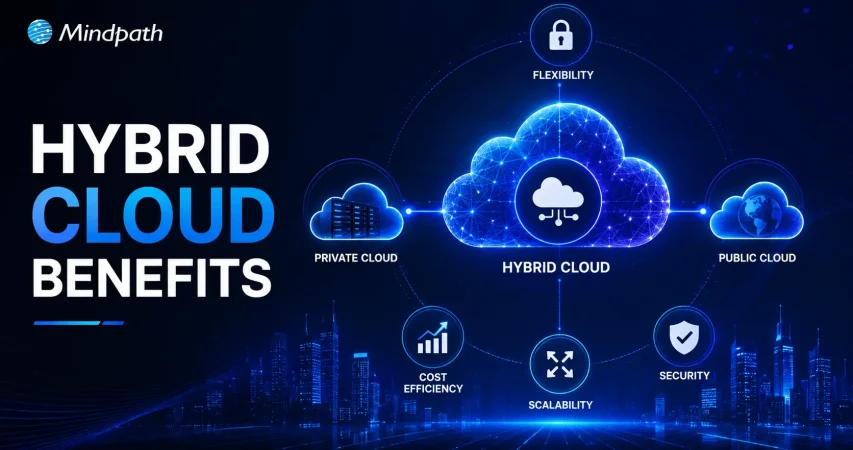
The Rise of Hybrid Cloud: Transforming Businesses with Benefits

Join our Newsletter!

Featured Posts

Support Is One Click Away

Home

The Rise of Hybrid Cloud: Transforming Businesses with Benefits

Hybrid Cloud

The Rise of Hybrid Cloud: Transforming Businesses with Benefits

Imagine a world where businesses can enjoy the flexibility of public cloud services while keeping sensitive data safe in a private environment. Sounds ideal, doesn’t it? That’s the promise of hybrid cloud! But why is it gaining so much attention? What makes it the perfect choice for modern businesses? Let’s dive into the key benefits of this game-changing approach. 

What Is Hybrid Cloud?

A hybrid cloud is a configuration that combines private and public cloud technologies. It combines private servers in your office or data center with public cloud services from firms such as Google Cloud or Amazon Web Services. This architecture allows enterprises to store and manage their data and apps in the most appropriate location for their purposes. For example, sensitive or vital data can be kept protected in the private cloud, while less crucial operations can be done on the public cloud to save money and enhance speed. Businesses can also shift workloads across various clouds, making it an extremely adaptable and practical option. Hybrid clouds are popular because they provide businesses with the best of both worlds: security and flexibility. They are especially useful during digital transitions, when firms need to change their systems without totally shutting down their existing activities. This strategy enables businesses to work smarter, save money, and expand more effectively.  

How Does Hybrid Cloud Work?

A hybrid cloud combines two or more types of cloud environments, such as private data centres and public cloud services, into a single system. This connectivity enables enterprises to effortlessly transfer data and applications across various environments. The hybrid cloud requires robust networking to function properly. This is accomplished via techniques such as local networks (LAN), virtual private networks (VPN), and APIs, which allow smooth communication between the various elements of the cloud. Virtualization and containerization are two common current technologies used in hybrid cloud systems. These solutions simplify resource management and sharing by producing virtual replicas of hardware or software. These resources are also managed using specialized software, which enables organizations to swiftly change or assign them as needed. 

Advantages of Hybrid Cloud

1. Better Return on Investment (ROI)

A hybrid cloud enables you to integrate your existing private infrastructure with public cloud services. This allows you to simply extend your computer capacity without having to invest in expensive new hardware or run additional data centers. Instead of investing more in physical servers, you can leverage the public cloud to meet additional storage, computing power, and processing requirements. This technique guarantees you only pay for what you use, which helps to keep prices down. By embracing the public cloud’s flexibility and scalability, you improve your capacity to manage rising workloads while saving money on infrastructure. As a consequence, organizations can enhance their return on investment (ROI) by employing cloud services more efficiently and lowering operating costs. This combination of flexibility and cost savings makes hybrid cloud an excellent solution. 

2. Enhanced Speed and Performance

Hybrid cloud solutions enhance performance, particularly for applications that require quick processing and minimal latency. By combining private and public cloud resources, data can be processed closer to end users, saving travel time and resulting in faster response times. This is vital for applications that need real-time processing, such as video streaming, online gaming, and financial transactions. For applications deployed in remote regions or with high performance requirements, a hybrid cloud configuration can guarantee that data is handled quickly by allocating resources to the best location. This can be accomplished by edge computing, which brings processing closer to the user, minimizing latency and improving the user experience. By lowering latency, hybrid cloud enables organizations to provide quicker, more dependable services, hence boosting overall application performance and customer happiness. 

3. Accelerated Innovation

Hybrid cloud solutions allow enterprises to use cutting-edge technologies such as AI and machine learning without having to entirely replace or expand their present infrastructure. This makes it easy to implement modern tools and capabilities while minimizing costs and interruption. Businesses can maximize their existing systems while gaining access to the cloud’s scalability and flexibility by combining private and public cloud services. This allows teams to operate more effectively, minimizing the time required to create and deploy new apps. Organizations can bring innovations to market faster by shortening development cycles and responding to customer needs and industry developments in real time. The hybrid cloud method enables firms to explore, create, and deploy apps more quickly, providing a competitive advantage. This mix of technological access and operational flexibility accelerates innovation, allowing businesses to stay competitive in a rapidly changing digital market. 

4. Stronger Control Over Applications

A hybrid cloud model provides enterprises with more flexibility over where their applications are hosted and how computing resources are distributed. This flexibility enables businesses to select the optimum environment for each application, ensuring that sensitive data is kept safe and regulatory needs are satisfied. This is particularly significant in regulated businesses. Businesses can enhance their data privacy and control by hosting particular apps in private clouds or on-premises. Simultaneously, less sensitive apps can operate on the public cloud, improving scalability and efficiency. Businesses can leverage hybrid cloud to guarantee that their applications are efficiently managed, reducing risks while still benefiting from the flexibility and cost savings provided by public cloud services. This control enables organizations to achieve privacy requirements and regulatory compliance. 

5. Flexible and Efficient Operations

Hybrid cloud computing allows enterprises to pick the environment that best meets their needs. Hybrid solutions, whether in a private or public cloud, enable you to adapt and grow in response to individual requirements. One of the primary advantages of hybrid cloud is the ability to construct apps with containers. Containers make programs portable, allowing them to be seamlessly transferred between public and private clouds. This flexibility enables enterprises to take use of the finest aspects of any cloud environment, therefore improving performance, security, and cost-effectiveness. A hybrid cloud allows you to easily modify your operations to suit changing demands, such as scaling up during peak hours or relocating apps to a more secure environment when necessary. This versatility benefits companies to stay agile, reducing downtime and improving overall operational efficiency. 

Also Read: Multi-Cloud vs. Hybrid Cloud: Key Differences You Need to Know

Cloud Computing Services at Mindpath

At Mindpath, we provide a variety of cloud computing services to help your organization function smoothly and efficiently. Whether you need to store data, operate apps, or extend your operations, our cloud solutions offer the flexibility and security you want. We assist you in selecting the best cloud configuration for your organization, whether it’s a private cloud for sensitive data or a public cloud for ease of access and scalability. Our staff guarantees that your cloud environment is optimized for speed, cost-effectiveness, and security, enabling you to focus on developing your business rather than worrying about technology. Mindpath’s cloud computing services allow you to develop quicker, enhance productivity, and take use of the newest cloud technologies to remain ahead of the competition. 

Wrapping Note!

Hybrid cloud is transforming businesses by offering a mix of flexibility, security, and scalability. It allows companies to optimize resources, improve performance, and innovate faster, all while ensuring data privacy and compliance. At Mindpath, we provide tailored cloud computing services to help you harness the full potential of hybrid cloud, enabling your business to stay agile and competitive. Let us help you take your business to the next level with the power of hybrid cloud. 
Ready to leverage hybrid cloud for your business?

Partner with Mindpath today to explore our tailored cloud solutions and stay ahead in the digital world!

Related Post

How much does hiring a ReactJS developer cost? Learn about factors affecting rates, and how to find the best talent within your budget.

Related Post

top AI trends

AI trends are growing at an accelerated rate, creating new opportunities and challenges for leaders in today’s workforce. From intelligent automation to advanced data analysis, AI is delivering smarter and leaner business processes, and playing a critical role in AI in decision-making. Fascinating, isn’t it? AI now permeates companies of all sizes for improving decision-making and performance. These transitions are already contributing to how businesses will operate and compete across every industry in 2026!

It is vital to keep up with the trends in AI because they are directly relevant to how businesses grow, change, and ultimately fulfill growing expectations. The faster leaders recognize trends, the smarter they can invest and prepare their teams, in order to gain an advantage over their competitors. If you do not pay attention to these trends, you may run the risk of missing advancements in tools, significant improvements in workflows, and smart strategies.

Want to know what are the top AI trends for 2026? This blog will provide you with all the AI trends business leaders will want to be aware of and should pay particular attention to in 2026.

Wondering how to get started with AI development the right way? Our AI Development Services can help you build impactful solutions from concept to deployment.

What is Artificial Intelligence (AI)?

Artificial Intelligence (AI) is a type of technology that helps computers in thinking, learning, and making choices like people. It allows machines to use language, read information, and analyze data to give helpful responses. In business, AI is primarily being utilized to make workflow quicker and smarter.

For example, AI allows an organization to better appreciate the needs of its customers, and provide its products or services to them, when they need them, in a timelier manner. AI functions for businesses efficiently by helping cut down the time taken for a task that people typically take a lot longer to do. AI can minimize errors, take care of repeated and tedious work, and it can operate indefinitely without breaks.

It means that an organization can receive a product quicker, save time to increase productivity, and use their time to pursue other important goals. AI can also help organizations improve the quality of their products and services by being able to produce and share insights derived from their data, helping ensure smarter, and more informed decisions.

Let us know about some AI statistics that highlight how organizations are adopting and managing AI technologies in 2026:

  • According to Statista, the AI market is expected to reach US$244.22 billion in 2026 and grow to US$1.01 trillion by 2031, with a CAGR of 26.60%.
  • As per McKinsey AI report, more than three-quarters of organizations now use AI in at least one business function.
  • An artificial intelligence survey from Forbes reveals that 25% of enterprises will deploy AI agents in 2026 to handle complex, multi-step tasks.
  • Analytics Insight states that 80% of retail executives plan to accelerate AI adoption through automation by the end of 2026.

Is your business missing out on the advantages AI can offer? Explore the benefits of AI from increasing efficiency and cutting costs to making smarter, data-driven decisions that drive growth.

Top AI Trends for 2026

Trends in artificial intelligence are shaping how businesses operate, innovate, and grow in 2026. As more companies start using AI to improve workflows and decision-making, these key developments are driving real impact across industries.

1. AI Reasoning Gets Smarter

Among the latest developments in AI, one major shift is its growing ability to reason and make sense of complex situations. In 2026, large language models can think more like humans, helping businesses go beyond basic insights. They now support smarter planning and stronger decision-making. This means companies are using AI not just to understand data, but to act on it more confidently.

2. Generative AI Reshaping Content Strategy

The best artificial intelligence trend in 2026 is the rise of generative AI in content creation. It allows businesses to create text, visuals, and videos instantly from basic prompts. This helps teams produce more personalized content at scale without extra effort. It’s making content strategies faster, smarter, and more effective across industries.

Also Read: Top GenAI Trends 

3. AI Agents Redefining Business Efficiency

One exciting use of AI in business is the rise of intelligent AI agents that act like real team members. These smart tools handle tasks like finding new leads, managing admin work, and analyzing data in real time. By doing this, they help teams work faster and focus on bigger goals. Companies are now seeing lower costs and fewer errors due to these advanced AI systems.

4. Multi-Agent Systems Streamlining Workflows

A new shift in AI is the use of multiple agents working as a team to handle complex business tasks. Each AI agent focuses on a specific job, like customer service or finance, and they all work together smoothly. This makes it easier to automate detailed processes that once needed people to manage them. The result is faster work, better accuracy, and stronger connections between business systems.

5. Industry-Driven AI in Action

Different industries are now using AI in ways that fit their unique needs. Sectors like finance, healthcare, insurance, and manufacturing are leading the way because they already follow strong rules around data and systems. These fields need custom AI tools for tasks like managing claims, tracking supply chains, or handling appointments. Tailored AI solutions are helping these industries work faster, meet rules, and serve people better.

How is AI reshaping the way websites are built and optimized? Explore our detailed article on AI in Web Development to see how it’s driving smarter design, faster deployment, and better user experiences.

6. GPUs Powering the Future of AI

A key new technology in AI is the growing use of GPUs to run advanced models. These powerful chips help process large amounts of data quickly, which is essential for AI tasks. As AI adoption grows, the demand for GPUs is rising across both cloud and on-premise systems. They now play a central role in building fast, efficient, and scalable AI infrastructure.

7. A Shift Towards Small Language Models (SLMs)

One trend catching the eye of artificial intelligence companies to invest in is the move from large to small language models. These smaller models, called SLMs, can do many of the same tasks as LLMs but use fewer resources. They are faster, cheaper to run, and easier to manage, making them a smart choice for everyday use. With techniques like pruning and knowledge sharing, SLMs are becoming more efficient without losing quality.

8. Businesses Turn to Open-Source AI

Open-source AI is becoming a strong choice for businesses that want more freedom and flexibility. Unlike closed systems, open-source models let companies build and manage AI tools on their own, keeping data private and costs lower. They can also fine-tune models using their own data to get better results. This shift is helping more businesses create powerful AI solutions without relying on big tech providers.

9. RAG Brings More Accuracy

One growing method to reduce wrong answers from AI is called Retrieval-Augmented Generation, or RAG. It helps AI pull information from reliable and current sources, making responses more accurate. While it improves relevance, it doesn’t always provide personalized answers without added context. Still, RAG is becoming a valuable tool for businesses looking to make AI more useful and trustworthy.

10. Swarm Learning Driving AI Progress

Swarm learning is a new way for AI systems to grow by sharing what they learn with each other. Instead of learning alone, connected AIs exchange knowledge in real time. This helps them improve faster and solve problems more efficiently. It’s a smart way to build stronger AI by working as a team.

Looking for smarter ways to handle customer queries and optimize workflows? Explore our blog to see how conversational AI chatbots can transform your business.

Is Your Business Aligned with the Top AI Trends?

AI trends are reshaping how businesses grow, compete, and deliver value across every industry. From reasoning models to open-source tools and AI agents, these trends are helping companies simplify operations, improve decision-making, and stay ahead. By understanding what’s emerging in 2026, leaders can better prepare for new opportunities and future success.

At Mindpath, we offer AI development services that align with the latest AI trends and business goals. We create intelligent tools, automation systems, and custom AI models that improve decision-making and increase efficiency. Our solutions are built to fit your operations, boost productivity, and support long-term growth. With Mindpath, businesses gain reliable and future-focused AI support.

serverless architecture in cloud computing

Have you heard a lot about serverless architecture in cloud computing and are still unsure of what it is? If so, you’re not alone. Many developers, startups, and business owners wonder how this model works and how their approach to building and deploying apps will change with it. So, what is the hype about, and why is it catching everyone’s attention in 2026?

Serverless architecture in cloud computing is a smarter way of providing a scalable application without the hassle of server management. With serverless computing, you rely on the cloud provider to do all the provisioning, scaling, and maintenance, leaving you to deal with just the code and get features delivered faster. Since more companies are evolving into modern cloud solutions, serverless is becoming a common approach to delivering applications. In this blog, we will cover everything you need to know. So, let’s dig in!

Ready to transform your cloud infrastructure with serverless architecture? Connect with us, and our team will guide you from planning to deployment, ensuring maximum efficiency and scalability.

What is Serverless Architecture in Cloud Computing?

Serverless architecture in cloud computing is a modern way to bring software to market. Rather than having to manage a server’s infrastructure, developers develop and run applications without having to deal with the environment. The developer doesn’t need to worry about servers, updates, scaling, and instead just writes code and deploys. The cloud provider takes away all of the backend tasks, such as server provisioning, maintenance and scaling, making the team’s development as a whole faster without focusing on technology-driven software engineering.

In a serverless model, application code is decomposed into independent functions, commonly known as Function as a Service (FaaS). Each function performs a specific function with the ability to respond to events such as HTTP requests or file uploads. Once the application is deployed, the cloud provider executes the function when required. If no servers are available, the provider spins one up for you automatically. Developers do not take part in this process; it is handled for them on their behalf without the developers noticing.

Must Read: Cloud Computing Trends

Fundamental Concepts in Serverless Computing Architecture

To understand how serverless computing truly works, it’s important to grasp its core principles. Here are the fundamental concepts that define serverless architecture and how they support modern application development:

1. Cold Start

If a function hasn’t run in a while, it might take longer to start up. This is called a cold start.

2. Warm Execution

When a function runs quickly because it was recently used, it’s called a warm execution.

3. Invocation

Every time a serverless function runs, it’s called an invocation.

4. Duration

This is the total time a function takes to run from start to finish.

5. Orchestration

Orchestration means managing how different serverless functions work together in a sequence.

6. Function-as-a-Service (FaaS)

FaaS lets developers write small functions that run automatically when certain events happen.

7. Event

An event is what triggers a function to run, like an HTTP request or file upload.

8. Stateless

Serverless functions don’t remember anything from one run to the next.

Ever wondered how cloud apps grow without server management? Read our blog on Cloud-Native Development to see how it powers agile and resilient serverless architectures.

Advantages of Serverless Architecture

Serverless architecture helps businesses build and deploy apps faster with less infrastructure management. According to Grand View Research, the global serverless architecture market was valued at USD 9.42 billion in 2023 and is expected to grow at a 28.2% CAGR from 2024 to 2030. Here are some key advantages that make serverless a popular choice in cloud computing today:

1. Cost-Effective Usage Model

Serverless platforms charge only for actual function execution time. There are no costs for idle servers, making it highly economical, especially for applications that run on demand or infrequently.

2. Faster Time-to-Market

Cloud functions enable developers to build and deploy features quickly. This rapid development approach helps businesses stay agile and respond faster to market needs.

3. Auto Scaling Capabilities

Applications built on cloud functions can easily scale up or down based on real-time user demand. This automatic scaling ensures performance stays smooth during traffic spikes without any manual effort.

4. Simplified Backend Management

With serverless architecture in cloud computing, developers no longer need to manage servers, updates, or scaling. It allows teams to focus on development while the cloud provider handles operations behind the scenes.

5. Modular and Clean Code

Each function in a serverless setup performs a specific task, promoting modular design. This leads to easy maintenance, especially when working with components like a serverless database or microservices.

6. Ideal for Event-Based Solutions

Serverless architecture in cloud computing supports event-driven applications, making it perfect for real-time analytics, chatbots, IoT, and more. It allows seamless integration with tools that react instantly to user actions or data changes.

How do teams deploy serverless apps faster and more reliably? Explore our DevOps blog to learn how automation and collaboration make it possible.

Serverless Architecture Use Cases

Serverless architecture in cloud computing is changing the way developers build and manage applications. It’s perfect for handling tasks that run occasionally or need to scale quickly without manual setup. Here are some common and practical use cases:

1. Automated CI/CD Workflows

Serverless tools help speed up software delivery by automating tasks. For example, pushing code can trigger a function to build the app or run tests right away.

2. Scalable APIs

You can use serverless Lambda with tools like Amazon API Gateway to build RESTful APIs. These APIs grow with your traffic, so you never have to worry about performance limits.

3. Event-Driven Actions

Serverless architecture in cloud computing is ideal for user actions that trigger automated tasks. For example, when someone signs up, it can update a serverless database and send a welcome email using cloud functions.

4. Background Processing

Serverless functions are great for behind-the-scenes work like video processing or updating product details. These tasks run in the background without slowing down the main app.

5. Flexible Growth

With serverless architecture in cloud computing, teams can move parts of an app one step at a time. It’s easy to expand later by adding more functions or connecting to a serverless database.

6. Smarter Security Tasks

Cloud functions can check new containers for security risks or support safer login methods. They’re also useful for things like two-factor authentication and SSH key validation.

Securing serverless applications can be challenging, how is it done? Discover about DevSecOps to see how security is built into every stage of cloud development.

What is the Difference Between Serverless Architecture and Cloud Architecture?

While both serverless architecture and cloud architecture use cloud environments to run applications, they differ in how infrastructure is managed and how applications are built. Here’s a quick comparison to help you understand the key differences between the two:

Aspect Cloud Architecture Serverless Architecture
Definition A broad model where computing resources are delivered over the internet. A model where apps run without managing servers directly.
Infrastructure Management Developers may manage virtual machines or containers or use managed services. All server management is handled by the cloud provider.
Scalability Manual or auto-scaling needs to be configured. Automatically scales based on demand.
Cost May include fixed costs for allocated resources, even if unused. Pay only for the time and resources your code actually uses.
Development Focus Requires DevOps involvement for setup, monitoring, and updates. Developers focus only on writing and deploying code.
Flexibility Offers a range of service models like IaaS, PaaS, and SaaS with customizable resources. Designed for small, modular functions that respond to specific events.
Examples AWS (EC2, S3), Microsoft Azure (VMs), Google Cloud (Compute Engine) AWS Lambda, Azure Functions, Google Cloud Functions

Is Your Business Ready to Go Serverless in the Cloud?

Serverless architecture in cloud computing offers a powerful way to build fast, scalable, and cost-efficient applications. With no server maintenance to worry about, developers can focus fully on innovation. As businesses aim for agility and flexibility in 2026, serverless becomes the smart choice for modern app development and digital transformation.

At Mindpath, we offer expert cloud computing services tailored to your business goals. From setting up serverless frameworks to managing cloud resources and infrastructure, we help you scale with ease. Partner with us to streamline your operations and deliver high-performing cloud-based solutions with confidence.

Discover the benefits of serverless architecture, from cost savings to faster development, and learn how Mindpath can help your business thrive.
woocommerce vs shopify

In the e-commerce landscape, businesses need to make a number of critical decisions. In case you are planning to venture into the e-commerce space, it is imperative to choose the right platform. This decision can certainly influence the success of your business in the dynamic e-commerce arena. 

The platform that you choose for your e-commerce store can undoubtedly influence the overall performance and success of your business. The top names that are ruling the e-commerce platform setting are Shopify WooCommerce. You need to dive into the world of WooCommerce Shopify so that you can make a proper comparison between these platforms. You need to know how these e-commerce platforms differ from one another so that you can make the ideal selection.

Planning to grow your online business and make a real difference in sales and customer experience? At Mindpath, we provide expert web development services that create user-friendly online stores designed to boost conversions and engage your customers.

An Insight into Shopify

Shopify refers to a cloud-based e-commerce platform. It offers a diverse range of tools for business entities so that they can sell their offerings online as well as in person. It is undoubtedly considered to be one of the most popular platforms that empowers entrepreneurs and large brands to not only create but also manage their online store. It has a diverse range of features that you can capitalize on in order to give an edge to your business in the competitive space. 

You must get a holistic insight into Shopify and its features to understand its true capabilities as an e-commerce platform. One of its distinguishing features is related to the creation of a store. Businesses can also use their selling tools and payment processing features to streamline their practices and operations. 

An Insight into WooCommerce

WooCommerce is an open-source e-commerce plugin for WordPress. It is completely free for users. WooCommerce enables users to transform a WordPress website into an entirely functional online store. It offers a diverse range of tools so that you can add products and set up payment options for your target audience. 

A unique thing about WooCommerce is that it is ideal for experienced sellers in the e-commerce domain. You can extend its functionality with the help of a number of add-ons and themes. Businesses need to familiarize themselves with the core features of WooCommerce so that they can make use of the platform in an optimal manner. Its key features that you need to know about include the availability of a large library of themes and high extensibility.  

Must Read: AI in E-commerce

Difference Between WooCommerce and Shopify

Now that you have a basic understanding of Shopify and WooCommerce, it is time to look at them at a closer level. Businesses that plan to establish themselves on the online platform need to know the key differences between these platforms so that they can have clarity on WooCommerce vs Shopify. The insight into this area is crucial to choosing the suitable platform and thriving in the market. 

1. Cost

While talking about WooCommerce vs Shopify, one of the key differences between the two options revolves around their cost. WooCommerce and Shopify have entirely different pricing structures. WooCommerce is entirely free for users, so you do not have to pay anything to use it for your online business. Thus, it offers ample flexibility with variable costs for users. 

On the other hand, when it comes to Shopify, it has a subscription model for its users. WooCommerce vs Shopify pricing is a major point of difference that you need to take into consideration for your e-commerce business. The ultimate budget of businesses can play a catalytic role in choosing their ideal e-commerce option.  

2. User-Friendliness

The ease of use or user-friendliness is a key dimension that you need to bear in mind while selecting between WooCommerce and Shopify. You must keep in mind that both these e-commerce solutions offer a diverse user experience. As WooCommerce is an open-source plugin for WordPress, which is self-hosted, it requires manual setup. 

Every aspect has to be handled separately by businesses while using the plugin. Moreover, businesses should know that it requires ongoing management as well. When it comes to Shopify, it has an all-in-one dashboard that users can use for their needs.  Thus, users can have a hassle-free experience if they choose Shopify. 

Not sure which technologies will give your e-commerce business the best performance and scalability? Explore our blog tech stack for your web app success to learn how to choose the right tools for long-term growth.

3. Themes as well as Templates

While talking about shoplift vs WooCommerce, it is key to understand how they differ in terms of available themes and templates. WooCommerce offers a humongous library of premium as well as free WordPress themes. You can choose the specific theme that is ideal for your business. The good news for users is that there is an opportunity to customize the themes on WooCommerce. 

When it comes to Shopify, businesses can use professionally designed themes. Such themes can certainly give an edge to your business. But you have to bear in mind that there are limited options to customize the themes. You need to take into account WooCommerce vs Shopify themes while choosing the ideal option out of the two options.

4. Scalability

Scalability is an important dimension that every e-commerce business needs to prioritize. You need to make sure that your online store grows in a seamless manner as your business expands. Your store must be able to handle additional product offerings and additional users. WooCommerce serves as a highly flexible option for e-commerce businesses. 

However, in order to leverage the flexibility that it offers, businesses must be aware of how to use the available tools. Shopify undoubtedly simplifies the degree of flexibility by offering built-in tools for businesses. You can leverage these tools as they will handle most of the work for your business. 

5. Security

Security is undoubtedly a non-negotiable element you need to look at while understanding the difference between WooCommerce and Shopify. If you plan to use WooCommerce, you need to know that, since it is a self-hosted solution, the onus of security lies with you. Although it offers certain security features, most of the security depends on elements such as the hosting environment and plugins. 

Similarly, the manner in which businesses maintain their websites also influences the quality of security. On the other hand, Shopify offers robust security to e-commerce businesses. This specific platform has in place holistic security measures that can safeguard both customer and store-related data. 

Concerned about keeping your online store and customer data secure? Read our blog application security best practices for web and mobile apps to learn proven methods to protect your business.

6. Payment Gateway 

As a majority of online customers are making online payments, it is essential for e-commerce businesses to have in place a robust payment gateway mechanism. Both Shopify and WooCommerce offer a diverse range of payment gateway options that you need to be aware of. As WooCommerce is integrated with WordPress, it offers a high degree of flexibility when it comes to payment gateways. 

It is possible to integrate almost any gateway. But the particular process may require additional setup for businesses. When it comes to Shopify, it comes with built-in options. The built-in payment option offered by Shopify makes it simpler for businesses to accept payments from customers without requiring additional setup. Moreover, it supports international payments, thereby creating value for modern businesses. 

7. Customization

The difference between WooCommerce and Shopify arises when looking at the customization dimension. You can look at WooCommerce as a blank canvas. It offers high power to businesses to customize their online store based on their needs and requirements. On the other hand, Shopify keeps things simple for businesses. 

It offers limited customization ability as a business. Without having to do much customization, businesses can have a professional-looking online store. You can take advantage of the drag-and-drop editor to build your store. However, this feature limits the ability to customize for users. 

Looking for innovative ways to stand out in the crowded e-commerce space? Learn from our blog, augmented reality in e-commerce, and see how AR technology can transform your online store.

The table presented below gives an overview of the main differences between Shopify and WooCommerce. Businesses can certainly refer to it while making the selection between WooCommerce or Shopify.

Basis WooCommerce Shopify
Cost Free  Monthly subscription model 
User-friendliness Not beginner-friendly and requires manual setup Beginner-friendly and intuitive
Themes and Templates Offers a large library of WordPress themes and high customization ability Offers professionally developed themes and low customization ability
Scalability Flexible but requires good hosting and optimization Effortless scaling with business
Security Security level depends on hosting and manual updates Security is fully managed and comprehensive 
Payment Gateway Multiple payment gateways with no additional charge Shopify payments and external payments with applicable fees
Customization High customization Limited customization

Selecting Between WooCommerce and Shopify

It is crucial for businesses to remember that the ultimate choice of WooCommerce and Shopify depends on the goals as well as the needs of businesses. You need to keep in mind your budget and WooCommerce vs Shopify payments while choosing the ideal platform for your e-commerce business. You must remember that both platforms offer a unique set of advantages for businesses. 

As the pros and cons of each of these options vary, you need to carefully consider them while making your choice. WooCommerce empowers businesses to customize their online stores. On the other hand, Shopify offers a professional-looking store thanks to its drag-and-drop option. 

Struggling to make informed platform decisions for your e-commerce business? Explore our blog on the  importance of data-driven decision-making for businesses to learn how data insights can guide your choices.

Final Words

In the cut-throat competitive business space, it is mandatory to choose the ideal platform for e-commerce success. In order to make the right choice, you need to have clarity on your basic requirements. This insight can guide you to choose the best platform that perfectly meets your needs and expectations. 

Mindpath provides web development services that understand the need to choose the right platform for e-commerce businesses. Businesses can undoubtedly rely on our experts to make use of high-quality WooCommerce and Shopify solutions. These high-quality solutions can make sure that your business can thrive in the unpredictable e-commerce realm and gain an edge over its competitors. 

The ultimate eCommerce showdown: WooCommerce vs. Shopify! Explore their features, benefits, and which platform is right for your business.