

Why ReactJS is Essential for Building Scalable Applications

Join our Newsletter!

Featured Posts

Support Is One Click Away

Home

Why ReactJS is Essential for Building Scalable Applications

ReactJS development

Why ReactJS is Essential for Building Scalable Applications

Ever wondered how some applications handle thousands of users without missing a beat? Or why do certain websites stay smooth and responsive as they grow? When it comes to scaling web applications, ReactJS plays a huge role. But how exactly does it make a difference? Let’s dive into how ReactJS enables developers to build applications that are ready to grow and perform at their best, no matter the user load.  

In today’s fast-paced digital world, developing apps that are quick, adaptable, and scalable is crucial. ReactJS has been a popular choice among developers, providing a robust framework for creating dynamic user interfaces that can manage huge traffic with ease. ReactJS’s component-based structure and quick rendering make it excellent for creating responsive applications that can scale with your business.  

Now let’s explore why ReactJS is essential for building scalable applications! 

Benefits of ReactJS for Building Scalable Applications

1. Scalability

ReactJS is an excellent solution for creating applications that can scale as your business grows. Its component-based structure enables developers to divide the software into smaller, independent sections that function together seamlessly. This implies that if new features or updates are added, individual components may be upgraded without interrupting the entire system, allowing for faster and more efficient upgrades. 

React also supports current scaling approaches like micro frontends, which let distinct elements of the user interface function as separate “mini apps.” This enables teams to work independently on various application areas minimizing, accelerating development and minimizing possible conflicts. Furthermore, React works easily with scalable backend services, allowing it to manage additional users and expanded features without losing speed or efficiency. ReactJS helps guarantee that your application can meet expanding needs by preparing for scalability from the beginning, making it responsive and adaptive over time. This technique not only enhances the user experience but also reduces long-term maintenance requirements, providing a stable basis for your program in the future. 

2. Performance

ReactJS is designed with speed in mind, allowing you to develop apps that are both quick and responsive. Performance optimization is essential for scalable systems as they expand in size and complexity. React has various strategies to aid with this, including lazy loading, which loads components only when they are required, reducing initial load time. Memorization is another useful feature that stops React from re-rendering components that have not changed, conserving processing resources and ensuring that the app runs smoothly. By minimizing needless renderings and optimizing component loading, React guarantees that even huge apps seem snappy and responsive to the user. This attention on efficiency improves the entire user experience, making the program delightful to use regardless of size. High performance not only increases customer happiness, but it also contributes significantly to the product’s long-term success by improving application efficiency and scalability. 

3. Testability

ReactJS facilitates application testing, which is essential for preserving high standards of quality and stability as the app expands. By creating unit and integration tests, developers may identify and address issues early on, maintaining the code’s dependability and maintainability. Tools like Jest and Enzyme are well-liked options for developing and executing tests with React since they make it easier to verify that every component of the application functions as intended. 

By simulating diverse scenarios, these testing tools help make sure the app works properly in a range of circumstances. Developers can swiftly find any problems and add new features or modifications without affecting current code by testing individual components and their interactions. This focus on testability not only improves the app’s reliability but also makes ongoing development faster and easier, supporting the application’s scalability and success over time.  

4. Routing

Routing is crucial for travelling between various parts or pages in complicated web systems. Navigating an application is made easy with ReactJS due to frameworks like React Router, which let developers design well-structured, intuitive user pathways. Users can effortlessly access various features without having to reload the entire page by segmenting the program into discrete routes, each of which is connected to components. 

The program is kept organized by this routing system, which facilitates management and growth for developers when new features are introduced. Furthermore, usability is enhanced by designing clear, legible URLs, which make it simpler for users to locate what they need and provide a more natural experience. Developers can ensure that navigating is fluid and natural with React Router, improving user experience overall and making the application more efficient and scalable. 

5. Centralized State Management

Managing state—data that numerous components require access to—becomes increasingly important as React applications expand. Developers may arrange this shared data in a single, easily accessible location with the use of centralized state management solutions like Redux, MobX, or React’s Context API. All components can swiftly access and update the data they require in a centralized state without the need for complicated data-sharing configurations. 

This method makes it simpler to detect and anticipate changes in the application state in addition to streamlining data flow between components. Because the state behavior is uniform throughout the program, debugging, testing, and maintenance are much easier when the state is centralized. This increases the application’s dependability, which facilitates scaling and updating, all of which are critical for long-term development success. 

Also Read: The Complete Guide to Hiring React Developers – MindPathTech

ReactJS Services at Mindpath

Our skilled React.js developers at Mindpath have the necessary abilities and expertise to construct contemporary, engaging user interfaces that increase user engagement and satisfaction. Whether you want to create a web application from scratch, upgrade an existing one, or quickly get your product to market, Mindpath is here to help with cost-effective solutions, quick development timeframes, and dependable support. Here’s a review of the services we offer: 

1. ReactJS Front-End Development

We are involved in creating responsive and dynamic user interfaces to improve user experience and interaction with your website. 

2. React Native App Development

Our team develops cross-platform mobile apps with React Native and gives them the native look and feel across iOS and Android devices. 

3. ReactJS Consulting

We expertly guide you on the usage of ReactJS in your projects so that the development strategy and architecture may be better optimized for the projects. 

4. ReactJS API Integration

We will integrate your ReactJS applications easily with external APIs and connect them seamlessly for smooth data and functionality exchange. 

5. ReactJS Enterprise App Development

We develop scalable and reliable applications that large organizations can use to take up complex requirements with high performance and efficiency. 

6. ReactJS Maintenance & Support

Continuous maintenance and support services that keep your ReactJS applications in motion, fixing any issues fast. 

7.React Web Design

We design engaging and user-friendly web interfaces that provide an impressive user experience through a focus on aesthetics and functionality using ReactJS. 

8. Custom React JS App Development

Build customized ReactJS applications that meet your business requirements, providing personalized solutions to all your needs. 

9. ReactJS Upgradation

Upgrade your existing ReactJS applications to their latest versions, offering you brand new features and improved performance. 

10. ReactJS Product Development

We develop innovative products with ReactJS; high quality and performance-driven applications that fulfill your business needs. 

11. ReactJS Ecommerce Development

We will build robust, interactive e-commerce platforms using ReactJS to ensure a great online shopping experience. 

 12. ReactJS Migration

We help migrate your existing applications to ReactJS while ensuring smooth transitioning and improved performance. 

13. ReactJS Plugin Development

Developing custom plugins for ReactJS that extend functionality and fit in perfectly with other tools and systems. 

14. ReactJS Social Media & Interactive Apps

Let us help you create engaging social media and interactive applications using ReactJS that improve user interaction and their experiences. 

15. ReactJS Customization Services

We will customize ReactJS components and applications according to your needs and wishes. 

Wrapping Up!

ReactJS is a powerful tool for building scalable applications that can grow with your business. Its flexibility, performance optimization features, and centralized state management make it the go-to choice for developing dynamic, efficient, and user-friendly web apps. Whether you’re creating a new app or enhancing an existing one, ReactJS ensures smooth scalability and long-term success. At Mindpath, our ReactJS development services are designed to help you unlock the full potential of your application, with a focus on performance, quality, and seamless user experiences.  

Ready to build scalable, high-performance applications with ReactJS?

Partner with Mindpath today and let our expert developers bring your ideas to life!

Related Post

Explore how sustainable technology is transforming businesses. Discover its benefits, from AI-driven ESG reporting to digital documentation and IoT innovations.

Related Post

software development in the transportation and logistics industries
Have you ever wondered how something you ordered online magically arrives at your doorstep only a few days after clicking “buy”? Or how companies manage to deliver millions of packages all around the world so fast? The answer lies in the digitization in the transportation and logistics industries. In this blog, we are going to explore the notable real-world use cases of digital transformation of logistic and transportation industry. So, let us dive in! 

What Is Digital Transformation In Logistics And Transportation Industry?   

In today’s fast-moving world, old ways of doing things in logistics and transportation simply make it very difficult to keep up with increasing demands for speed and great service. Many logistics companies these days seek to solve the problem by digital transformation: basically, updating archaic systems with modern technologies that automate tasks and provide a better experience for customers. Though the logistics industry is far ahead of most digital technology applications compared to many other sectors, several gaps remain.   Digital transformation is important in package delivery as it plans routes better by using GPS and optimization software to deliver goods quickly; improves customer experience through the ability of real-time tracking; and makes operations more efficient by automating recurring tasks like sorting packages or inventory.   However, difficulties persist in the form of high costs of new technology and employee training, and problems of data security. Despite these challenges, the opportunities for growth and improvement remain immense. A digital transformation in logistics businesses would keep them well ahead of their competition and meet the ever-raising expectations of the consumer of the present day. Digital transformation is no longer an option for logistics and transportation companies; it is a necessity. Companies that refuse to innovate are left behind; those ready for change will thrive in the digital age. 

Statistic Report For Digital Transformation In Logistics And Transportation Industry.   

The digital transformation in transport and logistics is growing rapidly. In 2018, the global market of the Digital Transformation in Transportation and Logistics industry was US$54.92 billion and is pegged to reach US$145.28 billion by 2025, at a CAGR of 13.0%. The market is expected to reach USD 22.17 billion by 2028 from an estimated value of USD 7.15 billion in 2018, growing at a CAGR of 11.5% during the forecast period. The growth rate underscores robust digital technology adoption that solves problems like underutilized assets, supply chain inefficiencies, and poor demand-supply matching. Digital transformation improves connectivity and visibility across traditionally isolated systems that helps stakeholders collaborate with each other more effectively along the supply chain.   The major names associated with making this change a reality include IBM, Oracle, Samsung, SAP, and Tech Mahindra. Each of these vendors is developing robust new platforms that will be useful in driving this change. While the market expands across regions such as North America, Europe, Asia Pacific, South America, and the Middle East and Africa, operational and customer experience efficiency lies in automation and real-time data analytics. This demand for technologies underpins the requirement of innovation in the creation of effective and resilient logistics networks that answer today’s demand for speed and excellence. 

Benefits Of Digital Transformation In Logistics And Transportation Industry    

1. Cost Reduction  

Digital transformation saves a lot of money for logistics companies. Automation decreases labor costs, as repetitive tasks are taken care of, hence requiring fewer people to do those jobs. Data helps in the optimization of delivery routes, hence cutting fuel costs and the carbon emission rate. Digital tools make it possible to do more with less, whether it be warehousing, managing inventory, or handling transportation and last-mile delivery. That means companies will work more efficiently and reduce their operational costs. 

2. Improve In Efficiency 

Digital transformation solves these very issues in many ineffective supply chains that lack real-time transparency. Automated warehousing and inventory management reduce manual labor and, in turn, human error. With the digital tools available, firms can track their shipments and inventory in real time, knowing where everything is at any moment. Greater visibility allows one to respond to change in the fastest way possible without any delays. Digital technology also projects demand so that a company can have the right product at the right time, therefore reducing overstock and/or running out of stock items.  

3. Improves Customer Experience 

Processing orders at speed and with transparency—these are the current demands of customers in the marketplace. Companies that outperform these expectations will create satisfied customers with the help of digital tools. Web and mobile apps empower customers to track their orders in real-time and raise issues. AI-driven chatbots extend instant support, answering questions within a snap of fingers, round the clock. Predictive analytics enables personalized product recommendations, letting customers feel important. Digital solutions ensure that customers are kept happy and loyal by making services faster, more transparent, and more personalized. 

4. New Business Model  

The digital transformation opens new, exciting ways of providing services beyond simple transportation. For example, delivery takes on a different dimension with speed through drone deliveries and self-driving trucks. Digital freight marketplaces connect shippers to extra space carriers, easing the way to find and work available resources. Such solutions open opportunities for value growth and increasing revenues. The accomplishment and differentiation of leading logistics players in a changing market can be driven by such technologies. 

Use Cases of Digital Transformation in Logistics and Transportation Industry 

 1. Predictive Analytics and Big Data 

Predictive analytics and big data greatly help in doing tasks related to forecasting demand and inventory management. Advanced algorithms embedded in predictive analytics examine large amounts of data for discovering patterns and trends. In doing so, this greatly assists businesses in predicting what may be needed later and adjusting the level of inventory accordingly. Something like Snowflake enables organizations to share past and current data in a bid to improve planning and make information more accessible to all. 

2. Telematics and Internet of Things (IoT)   

Telematics and IoT bridge the gap in asset monitoring and shipment tracking. IoT-enabled devices close the blind spots by sensing and transmitting the data in real-time. For instance, GPS and RFID tags assist in locations and conditions, like the tracking of shipment location, which allows route optimization and, therefore, better utilization of the assets. 

3. Cloud-based Computing 

It allows flexibility, remote access, and security by transcending the constraints of traditional on-premises data centers and legacy IT systems. Cloud computing is one of the technologies that will help companies involved in shipping and logistics scale easily, allow access to any data from any part of the world, and increase overall efficiency. With the ability to rapidly adapt through cloud-based solutions, companies can easily streamline their operations, securing their data much better and increasing manifoldly in performance as well as competitiveness. 

4.  Artificial Intelligence (AI)   

Artificially intelligent technologies can come up with advanced algorithms that analyze heaps of data and deliver valuable insights from them. These technologies are focused on the optimization of logistics operations by calculating multitudes of variables and learning from new data continuously available. AI improves route planning, reduces inefficiency, and raises overall operational performance. This will give rise to more efficient and effective logistic operations if companies apply AI in making smarter decisions, streamlining processes, and better meeting customer needs. 

5. Mobility as a Service (MaaS)   

Traditional modes of transportation usually do not rise to the convenience and sustainability expected of them today. Mobility as a Service looks to bridge this gap and provide one amazing app in which users can discover and book a ride from a range of choices, including public transit, ride-hailing, car-sharing, bikes, or scooters. MaaS makes getting around easier while reducing the environmental effect by integrating the services of all different means of transport. Research has demonstrated that people could be flexible with their travel; this would mean that they no longer require their own vehicle with the integration of these services.  

Looking to revolutionize your logistics?

Mindpath offers cutting-edge solutions to boost efficiency and cut costs.

Transportation and Logistic Development Services at Mindpath 

We, at Mindpath, provide a range of services that can empower logistics companies, transportation providers, and supply chain managers to take on the challenge of using technology for much smoother and more efficient operations. 

1. Custom Chatbot Development: 

Our chatbots help customers who are running transportation and logistics businesses provide better customer support: answer inquiries, manage bookings, track shipments, and be available 24/7 to keep customers happy at a reduced cost. 

2. Website Development: 

Strong presence in online media is quite important. Our group creates user-friendly, visually appealing, and search engine-friendly websites for logistics businesses. This would provide dual benefit to the business by making it visible and growing. 

3. Mobile App Development: 

We develop mobile applications for the management of Logistics and Transportation on the go. Our apps are quite solid at both iOS and Android devices with a smooth experience and useful features. 

4. Inventory Management System: 

We can design a tailored system to assist you in effective inventory management. Real-time data, automation, and actionable insights of stock position are some of the salient features of our systems. 

5. Fleet Tracking Software: 

Our fleet tracking software lets you track your vehicles in real time. It helps in performance tracking, route optimization, and timely deliveries, which in turn increase efficiency and reduce costs. 

6. Software Maintenance & Support: 

We keep updating your logistic and transportation software to run smoothly. This means technical support, updating features, or just ensuring that everything works well. 

Conclusion  

Digital transformation is disruptions in logistics and transport due to efficiency, cost reduction, and improved customer experience. With the speed of technological change accelerating, it’s highly important to be one step ahead about innovation, whether AI, cloud computing, or predictive analytics. At Mindpath, we believe in empowering businesses to lead this change. That’s why we deliver custom technology solutions to help your business thrive in a transforming world—from custom chatbots to advanced fleet tracking. 

Ready to embrace the future of logistics?

Let Mindpath guide you every step of the way.

Explore how digitization transforms logistics with real-world use cases, benefits, and cutting-edge technologies that boost efficiency, reduce costs, and enhance customer experience.
what is conversational ai

Companies today understand that it’s essential to have satisfied customers at every touchpoint, to keep in front, and that is where the magic of Conversational AI resides. Are you wondering what is conversational AI? It is the technology that informs smart chatbots and virtual assistants that provide 24/7 interactions for infinitely scalable engagements. Organizations leverage conversational AI to reduce waiting hours, respond to customer inquiries in real-time, and keep delivering a consistent quality of service.

This amazing technology is enhancing efficiencies, saving costs, and maximizing customer satisfaction. Conversational AI stands to revolutionize the performance of an organization, as well as the measurement of its growth, by automating processes with personalized support. If you’re interested in how it works and what benefits it has in store for you, let’s discuss all its amazing features in this blog, step by step.

Are you looking to implement smart chatbots or a virtual assistant in your business to enhance customer engagement? Mindpath’s AI Development Services will help you achieve customer satisfaction with 24/7 support.

What is Conversational AI?

Conversational AI is smart technology that helps artificial intelligence bots like chatbots and virtual assistants talk with people in a natural, human-like way. It’s all about making AI more human, so interactions feel real and engaging. By understanding what we say and how we say it, these systems make conversations easier and more helpful for everyone.

Conversational AI is built using machine learning and natural language processing, and it harnesses the knowledge of millions of conversations. Learning from these conversations allows artificial intelligence bots to improve upon responding to questions, solving problems, and predicting what a customer may need next more accurately. It’s a powerful step toward making AI more human and building better customer experiences.

Also Read: How conversational AI chatbots help businesses!

Types of Conversational AI

There are different types of Conversational AI technologies a business can use to meet customers and deliver its services to them. Each one operates in its own way and could have its own niche when it comes to customer support, sales, or engagement objectives.

1. Voice Bots/Assistants

Voice bots and assistants are a type of conversational technology that interacts with people through spoken language. They listen to what a person says, figure out what they need, and respond naturally. This makes everyday tasks easier, from playing music to managing smart home devices.

2. AI Chatbots

AI chatbots are a powerful type of conversational AI designed to hold natural, human-like chats. These conversational agents use advanced language models to understand context and respond in a way that feels personal and clear. They help businesses handle complex questions and provide better support around the clock.

3. Interactive voice response (IVR)/Interactive voice assistants (IVA)

Interactive Voice Response and Interactive Voice Assistants are a type of conversational AI that helps people navigate phone systems using voice or keypad inputs. They understand what a caller needs and guide them to the right solution without long wait times. This makes customer service smoother, faster, and more convenient.

Wondering how conversational AI is advancing into systems capable of autonomous action and decision-making? Explore how Agentic AI is redefining intelligent, self-directed digital behavior.

Advantages of Conversational AI

Conversational AI has become an important part of how companies connect with people today. Here are some key advantages it can bring to your business.

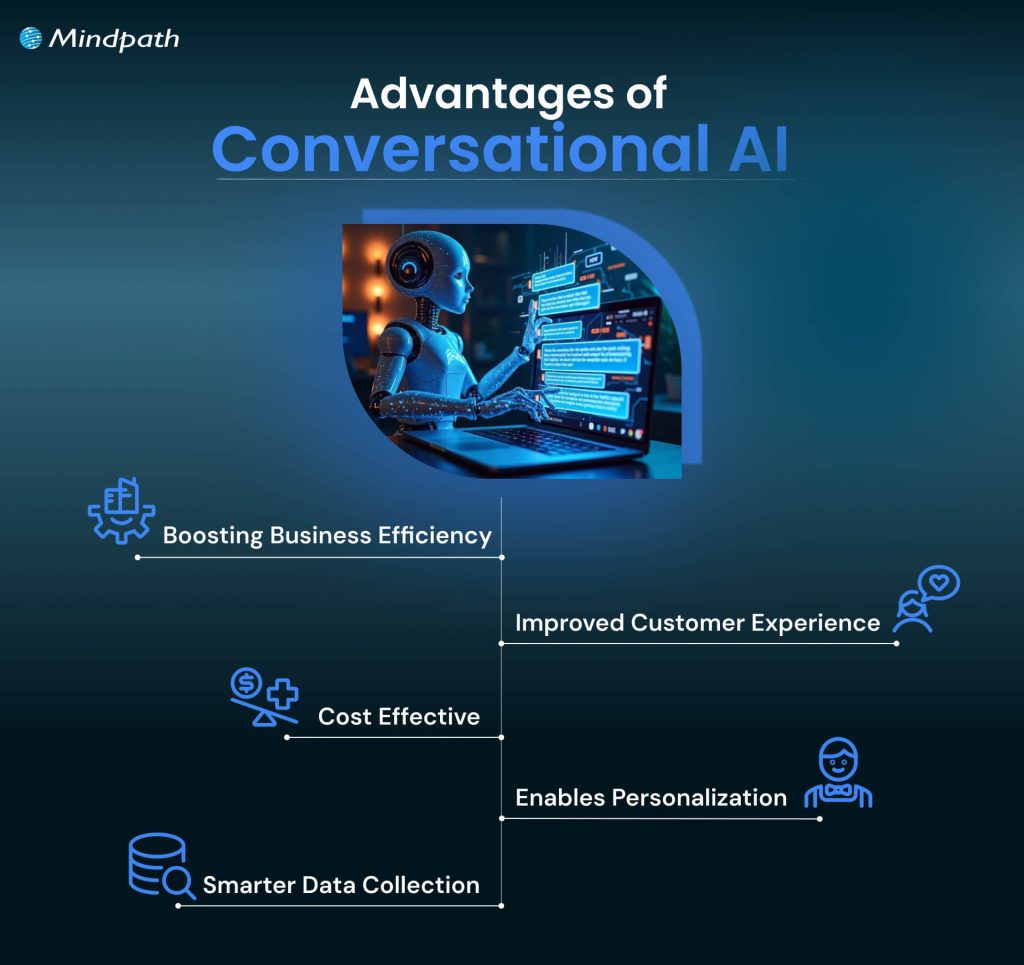
Advantages of Conversational AI

1. Boosting Business Efficiency

Conversational Artificial Intelligence can manage many routine tasks without needing a human agent every time. This means your team can spend more time on important work while the AI handles simple customer conversations. With artificial intelligence conversation tools available 24/7, your business can solve customer queries faster and work more efficiently, showcasing the many benefits of chatbot technology for operational productivity.

2. Cost-Effective

A good conversational AI platform can handle customer calls and chats automatically, with little need for extra staff. By making AI more human and accurate, it helps you manage high volumes of requests without extra cost. This saves money on daily operations and reduces mistakes, keeping your business cost-effective.

3. Improved Customer Experience

Artificial intelligence bots make it easy for customers to get quick answers and help whenever they need it. This technology offers personalized replies and a smooth, contactless service for people all over the world. It creates a better customer experience and keeps people happy with your business.

4. Enables Personalization

This technology learns from each customer’s information, like location and past interactions, to offer a more personal chat experience. It can suggest helpful answers and next steps based on what each person needs. This makes solving problems faster and reduces the need for follow-up calls.

5. Smarter Data Collection

This technology helps you collect useful information from every customer conversation. By tracking what people say and how they interact, you can spot trends and understand what customers really want. This makes it easier to improve your sales and marketing strategies over time.

Want to explore the innovations shaping the future of conversational AI? Explore our blog on the top AI trends to discover the emerging technologies redefining intelligent communication.

Use Cases of Conversational AI

Conversational AI can be used in many ways to make business operations smoother and customer interactions better. Here are some common use cases that show how an example of conversational AI works in real life.

1. Conversational IVR Systems

Modern IVR systems let customers speak naturally instead of pressing buttons to find help. For example, airlines now use conversational IVR to let travelers say things like “Change my flight” or “Check flight status” and get quick answers without waiting for a live agent.

2. Seamless Transfer to Live Agents

When a bot can’t handle a request, it passes the chat to a live agent along with all the details, so nothing gets lost. For example, a telecom company’s virtual assistant can detect when a billing issue is too complex and smoothly transfer the full conversation to a specialist who can resolve it faster.

3. Round-the-Clock Support

These chatbots answer simple customer questions at any time of day without needing a live agent. For example, an online retailer’s chatbot can help shoppers check order status or find return instructions even after business hours.

4. Tailored Product Recommendation

This technology suggests items people might like based on what they’ve bought or browsed before. For example, a streaming service’s chatbot can recommend new shows or movies based on what you’ve just finished watching.

Ready to build conversational AI that boosts sales and strengthens customer engagement? Learn how AI in e-commerce transforms online shopping experiences and drives measurable business growth.

5. Effortless Onboarding

These assistants help new employees feel confident and prepared by guiding them through company policies and tasks step by step. For example, an HR team can use an AI onboarding assistant to help new hires complete paperwork, set up work tools, and get reminders about training sessions.

6. Task Automation

These bots connect chats to your business tools, so tasks like updating customer records or creating tickets happen instantly. For example, the best conversational AI chatbot for an e-commerce store can automatically create a return request and send an update to the warehouse team.

7. Faster Lead Conversion

These chatbots ask visitors the right questions to see if they’re a good fit for your product or service. For example, a real estate company’s chatbot can collect details about a buyer’s budget and location, then connect them with the right agent.

8. Timely Updates

These AI tools send helpful reminders and updates before customers even ask, keeping everyone informed and stress-free. For example, a healthcare provider can use this to remind patients about upcoming appointments or share wellness tips.

If you want to use AI to improve your healthcare services. Learn from our blog AI in Healthcare, where we highlight real-world use cases of conversational systems supporting medical professionals and patients.

Conversational AI Best Practices

Using Conversational AI, the right way can help you get the best results for your business and your customers. Here are some best practices to keep in mind as you build and manage your AI solutions.

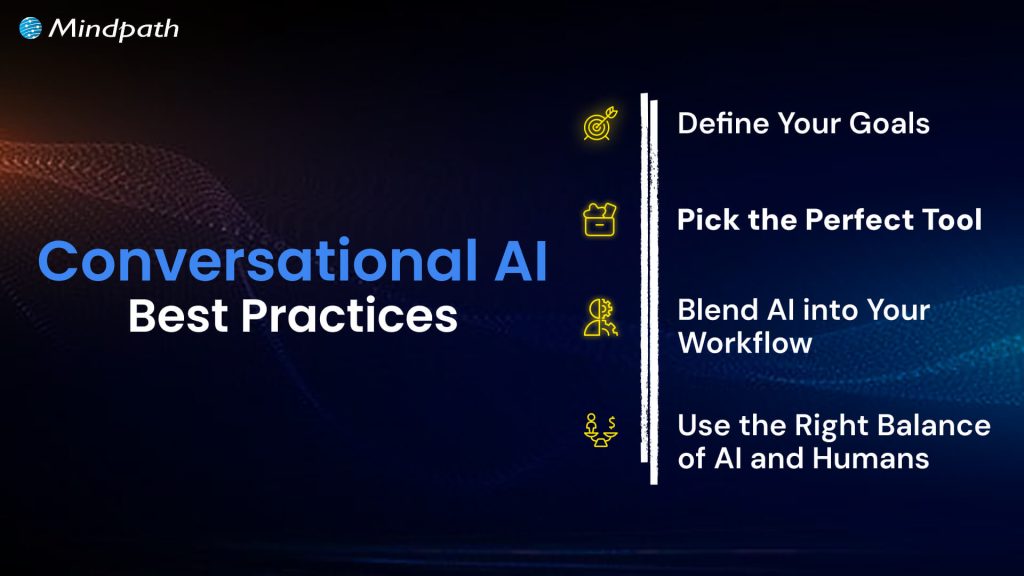
Conversational AI Best Practices

1. Define Your Goals

Always be clear about why you want to use conversational AI and what you want to achieve. Make sure it fits well with your bigger business plans, so it truly adds value.

2. Pick the Perfect Tool

Pick a conversational AI tool that fits your industry and matches your budget and goals. Make sure it can grow with your business, so you get the most value over time.

3. Blend AI into Your Workflow

Connect your conversational AI with your other business tools so it works smoothly with your daily tasks. This makes your processes faster, more accurate, and more useful for your team.

4. Use the Right Balance of AI and Humans

Let AI handle simple, repetitive tasks while your team focuses on work that needs a human touch. Always set clear points where the bot should hand over to a person for the best customer experience.

Curious how AI can optimize your workforce and improve business outcomes? Check out AI redefining job roles in Tech to see how intelligent systems are reshaping employee roles and driving operational efficiency.

Take the Next Step with Conversational AI

Conversational AI is transforming how businesses connect with people by making everyday interactions faster and more personal. It helps companies work smarter, serve customers better, and grow with less effort. Now that you know what is conversational AI, you can start using it to create more value.

Mindpath offers professional AI development services to help you build and launch conversational AI that matches your business goals. Our experts create secure, easy-to-scale chatbots, voice assistants, and smart integrations. Let us help you deliver great customer experiences and stay ahead in the AI space.

Discover the power of Conversational AI! Learn its benefits, features, and how Mindpath can help transform your customer interactions.
full stack nodejs

Companies are now seeking scalable and robust applications, which can meet both years of functional performance and user expectations. That’s when full-stack Node.js development comes into play, uniting the power of frontend and backend within a single environment. It allows developers to build faster and smarter while creating applications to remain adaptable as the business continues to grow.

In this way, constructing end-to-end solutions is more fluid and intelligent. With cohesive databases, APIs, and user interfaces integrating and interfacing, developers can automate some of the hassle proactively. Understanding full-stack Node.js ultimately gives developers an advantage to think forward as technology grows and gives organizations tangible opportunities to grow with applications that perform and scale easily. So, let’s dive in to know how this expertise truly makes a difference.

Want to build an advanced application without compromising performance? At Mindpath, our full-stack development services will help you provide the best solutions, handling both front-end and back-end with efficiency.

Understanding the Fundamentals of Full-Stack Development

Full-stack development means developing on the front end and back end of a web application. The front end refers to all the things that the user responds to and interacts with, such as buttons, layouts, designs, etc. The back end refers to all of the things that run in the background, like databases, servers, etc., and all the logic that makes it run smoothly, working together.

A full-stack developer has the capability to deal with both sides. They are capable of building UX and the technology that serves the app. This gives them agile skills that allow them to build comprehensive applications entirely from front to back.

Understanding the Basics of Node.js

Node.js is a platform that allows you to run JavaScript code in a JavaScript runtime outside of the browser. It is built on Google’s V8 engine, which is extremely fast and built to be efficient. Node.js allows developers to write server-side applications using the same exact language as for the front end, making development and management easier and smoother.

An advantage of Node.js is that it operates asynchronously, which allows tasks to not have to wait for one another to complete, meaning that applications can handle multiple requests at once. Because of this, the use of full-stack Node.js is quickly becoming a good choice when building scalable, real-time, and modern applications.

The success of using Node.js in full-stack development depends on hiring the best developer. Discover the key Factors to Consider while Hiring Node.js Developers.

Why is Node.js Important for Full-Stack Development?

Utilizing Node.js full-stack technology is an impressive approach to developing a complete web application. Here are reasons that Node.js is a valuable technology option in the full-stack.

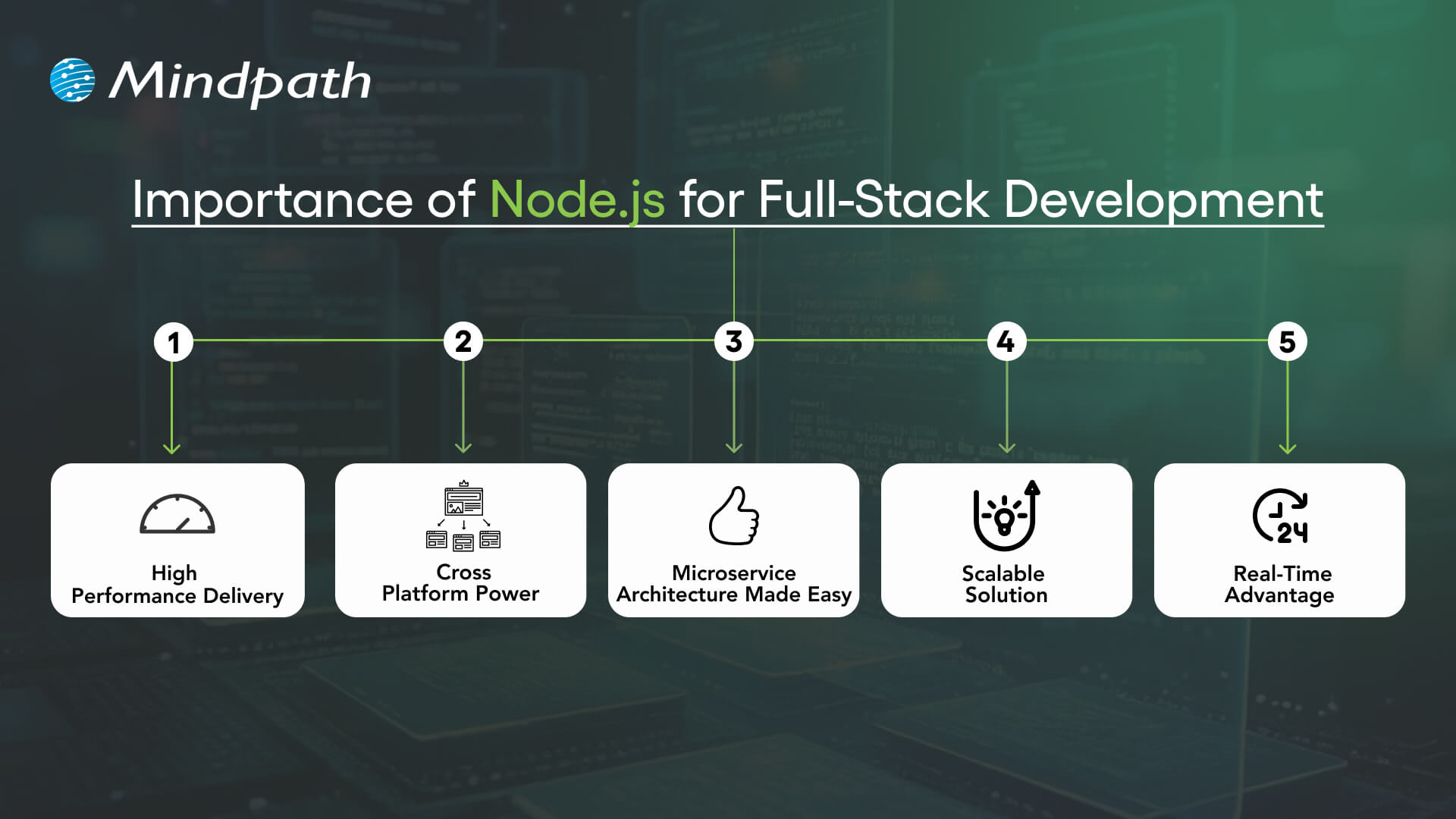
Importance of Node.js for Full-Stack Development

1. High Performance Delivery

Node.js utilizes a non-blocking I/O hardware model that can handle hundreds or even thousands of requests simultaneously, providing faster response times and greater user-specific.

2. Cross-Platform Power

With the Node.js full stack, developers can write mobile and desktop apps to run on Windows, macOS, Linux, and more. By relying on a single JavaScript code base, developers can save time and effort writing for multiple platforms.

3. Microservice Architecture Made Easy

Full-stack Node allows users to break one larger application down to multiple smaller independent services using infrastructure that is easier to work with. This approach lets developers build faster, stay flexible, and rely on proven solutions.

4. Scalable Solution

Full-stack Node.js is used by major players like Walmart, Uber, and Trello to handle millions of users. It helps to lower load time significantly, and it ensures your applications will scale seamlessly, as your demands increase.

5. Real-Time Advantage

When it comes to applications that leverage chat, live streaming, food delivery, or payments, Node.js full-stack is the way to go. It seamlessly provides real-time updates to keep the user engaged and connected.

Also Read: Full-stack Development for Web Projects

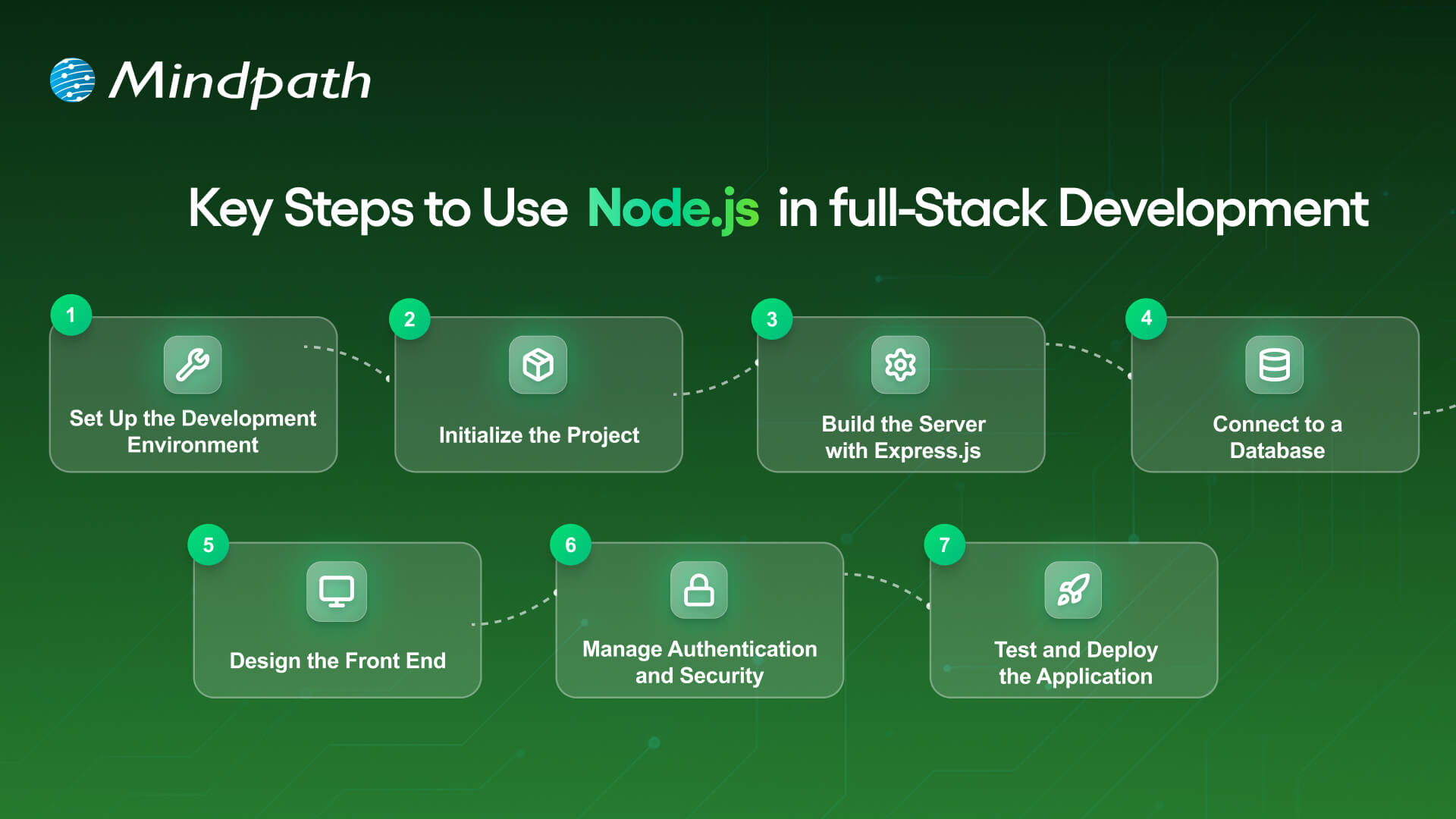
Key Steps to Use Node.js in Full-Stack Development

A full-stack Node.js developer is involved in both the front end and the back end of web application development and will work to build complete web applications. Below is a synopsis of the primary steps to utilize Node.js in full-stack development that is easy and productive.

Key Steps to Use nodejs in full stack development

1. Set Up the Development Environment

To begin your application-building experience, you will need to install Node.js and npm (Node Package Manager). These tools will allow you to execute JavaScript beyond the browser, and they will also help manage libraries with ease. Verify the setup by checking versions with simple commands in your terminal.

2. Initialize the Project

Make a new folder for your app, and use ‘npm init’ to create a ‘package.json’ file. A package.json file holds important information, such as your project name, dependencies, and scripts. It will serve as the basis for managing everything in your project.

3. Build the Server with Express.js

Install Express.js so you’ll be able to set up the backend server and handle all of the different routes. Express.js makes handling requests, responses and APIs supposedly easy. This step will ensure the backend runs appropriately with the frontend.

Must Read: Full-stack development trends

4. Connect to a Database

Based on your needs for this project, select a database like MongoDB or PostgreSQL. This should be paired with a Node.js library like Mongoose or Sequelize, which will allow you to connect to and perform both read and write operations on your data. At this point, you will have the ability for your application to persist and retrieve your data.

5. Design the Front-End

Build the front-end using a library such as React, Angular, or Vue. You can link the front-end through RESTful APIs or GraphQL to your Node.js back end. At this point, players will finish the bridge for a Full-stack Node.js application.

6. Manage Authentication and Security

Use libraries like Passport.js or JWT to add secure login and registration. Secure necessary paths so that any authorized user can get to those routes. You should always consider security in any Full-stack Node.js application.

7. Test and Deploy the Application

Create unit and integration tests to ensure that your application does what you intended. Deploy the application to cloud hosting solutions like Google Cloud, AWS, or Heroku. To utilize your Full-stack Node.js application’s performance tool on different scales, you should monitor its performance!

Looking to integrate AI in your Node.js projects? Explore our Ultimate Guide to Node.js Libraries for AI Integration to discover the most effective libraries for building smart, scalable, and future-ready applications.

Ready to Unlock the Power of Full-Stack Node.js?

Full-stack Node.js has proved to be a smart choice for building scalable, high-performing, and real-time applications. It unites front-end and back-end seamlessly, helping developers create complete solutions with speed and flexibility. With its ability to handle microservices, cross-platform apps, and real-time updates, it has become an essential technology for modern web development.

At Mindpath, we provide expert full-stack development services designed to match your business goals. Our skilled Node.js developers bring deep technical knowledge and practical experience to build secure, scalable, and user-friendly applications. If you are looking to transform your digital ideas into reality, hiring a Node.js expert from our team ensures growth and lasting impact.

Master full-stack development with Node.js! Its scalability, performance, and seamless frontend-backend integration.