Top GenAI Tools for Teachers: Transforming Classrooms in 2026

Join our Newsletter!

Featured Posts

Support Is One Click Away

Home

Top GenAI Tools for Teachers: Transforming Classrooms in 2026

GenAI tools for teachers

Top GenAI Tools for Teachers: Transforming Classrooms in 2026

The year is 2026 and AI isn’t just knocking at the doors of the education industry as it has become an integral part of the classroom, research lab and faculty room. Educators have been burdened with expectations and exhaustion due to changing curriculum designs in different parts of the world. The arrival of GenAI tools in education sector has marked the introduction of many new opportunities for educators.

Generative AI is gradually becoming an indispensable companion of teachers worldwide for many reasons. Most important of all, gen AI tools are not replacing the human element in the teaching experience. On the contrary, generative AI empowers teachers and helps them provide personalized learning experiences to every student. Let us find out the top generative AI tools that can help teachers.

Want to stay ahead in the education sector by offering smarter, more efficient solutions? Mindpath offers generative AI development services to help education businesses build custom, scalable AI tools tailored to their needs.

Understanding the Significance of Generative AI for Teachers

The biggest problem for teacher in the modern education industry is the burden of tedious and repetitive administrative tasks. Imagine the stress on teachers who have to evaluate the test papers of each student and prepare lesson plans for the next day. The use of GenAI tools for teachers can help in reducing the burden of administrative tasks, especially with automated grading and generation of personalized learning materials. Generative AI tools can allow teachers to invest their efforts in interacting with students, fostering creativity and nurturing critical thinking skills.

Teachers should understand that generative AI is not just another technological trend that will fade away with time. As a matter of fact, generative AI signifies a major paradigm shift in the domain of education. You can notice the broader impact of generative AI in education sector in different solutions like personalized learning at scale, automated content generation and better student engagement. Generative AI can help learners by creating adaptive learning systems that align with the learning style, strengths and weaknesses of each learner.

The reduced administrative burden on educators helps them interact directly with students and craft innovative teaching strategies. GenAI tools also help educators provide instant feedback on student assignments thereby allowing students to learn quickly from their mistakes. Teachers can rely on generative AI to improve student engagement by creating interactive content and personalized assessments. As a result, generative AI helps educators transform learners into active participants in the learning journey.

Looking for ways to integrate cutting-edge AI into your teaching strategy? Read this blog on generative AI trends to stay ahead with the newest AI innovations.

What are the Top Generative AI Tools for Teachers?

The blend of artificial intelligence and education brings promising results for learners as well as educators. You might be wondering about the top generative AI tools preferred by teachers and their special features. The following list of generative AI tools can help you understand the significance of gen AI in the education sector.

1. ChatGPT

The biggest generative AI tool that attracts the attention of educators worldwide is ChatGPT. It is still one of the basic tools that transformed how we interacted with artificial intelligence. Educators can trust ChatGPT for its versatility and use it as an assistant for different types of tasks. ChatGPT is one of the top 10 AI tools in education for drafting lesson plans, summarizing research papers or providing answers to difficult student questions. Educators can trust ChatGPT for brainstorming, content creation and delivering responsive student support.

2. Sendsteps

Sendsteps AI is a unique platform that makes the process of creating assignments a lot easier for learners. It relies on the power of natural language processing to understand the teacher’s instructions with accuracy. The AI tool uses teacher instructions to craft content personalized to specific needs and learning objectives of students. Educators can also use Sendsteps for creating interactive quizzes with the facility of automatic grading.

3. Google Gemini

Another big name among the best AI tools for students and teachers is Google Gemini. It stands out with multimodal capabilities that make it better than text-only models. Google Gemini can not only generate text but also images and audio content, thereby enhancing its versatility for classroom applications. Teachers can rely on Gemini to create lesson materials, interactive quizzes with audio prompts and explanation of scientific concepts with diagrams.

4. Canva Magic Studio

You cannot think about AI tools in the field of education without focusing on Canva and its ‘Magic Studio’ AI features. Canva is a distinct AI tool in education that allows you to create visually stunning presentations effortlessly. Teacher can also use it to craft compelling educational videos, infographics and interactive worksheets. The ‘Magic Studio’ feature of Canva also provides personalized recommendations for content generation while creating teaching aids.

Also Read:  Generative AI Predictions

5. Quizizz

Quizizz is another generative AI platform that helps teachers in creating interactive quizzes. It can help teachers in crafting engaging quizzes, interactive lessons and polls from different source materials. The AI tool can also help in generating different types of questions, such as open-ended or multiple-choice questions. Educators can transform quizzes and assessments into fun experiences for students with Quizizz while obtaining an accurate impression of student performance.

6. Socrative

The list of top generative AI tools that can help teachers also includes Socrative, an AI-powered student response system. Socrative is the best example of using generative AI for educators to enhance their capabilities for evaluating student assignments. Teachers can use Socrative to create open-ended questions and quizzes to collect formative assessment data. The data obtained from such tests can help teachers recognize the weaknesses and students and modify their teaching approaches.

7. Nearpod

Nearpod is also a useful generative AI tool for embedded open-ended questions, quizzes and polls in presentations. Teachers can use Nearpod as one of the top education AI tools to create engaging lessons for students. The tool also provides valuable data on student performance along with creative tools for educators. The creative tools can help in creating interactive learning experiences that boost critical thinking and creativity of learners.

8. Flipboard

One of the most interesting AI tools that teachers can use in 2025 is Flipboard. It is the best AI for education delivery in a completely new and innovative format. Flipboard helps educators in combining articles, videos and other web content on a specific topic in the format of a digital magazine. Educators can share the digital magazines with students through links that can enhance the learning experience.

9. Magic School AI

Magic School AI is a comprehensive collection of AI tools for educators, focused on automation of common classroom tasks. It is one of the best generative AI tools to create subject-specific lesson plans, worksheets and rubrics. Teachers can find more than 60 tools in Magic School AI for different aspects of the teaching experience.

10. Curipod

The collection of GenAI tools for education must also include Curipod for its capabilities as a lesson planning assistant. It helps in making classroom learning more engaging with interactive activities. Curipod can create presentations with interactive elements to encourage student participation. Teachers can use Curipod as a trusted solution for real-time understanding of student performance and fostering active learning.

Could understanding AI applications in other industries help you choose the best tools for your classroom? Discover how generative AI in market research, providing insights that can spark innovation in teaching.

11. Eduaide.AI

Eduaide.AI is one of the few generative AI tools created specifically for educators. It helps in streamlining lesson planning and creation of learning resources. The AI tool can help in generating lessons plans aligned with popular standards. The intuitive interface of the platform combined with emphasis on pedagogical support makes it an invaluable tool for educators.

12. Otter.AI

Otter.AI is also another notable example of education AI tool with distinctive features. The AI-powered transcription service leverages generative AI for real-time transcription of spoken language in class lectures or parent-teacher conferences. The tool plays a crucial role in enhancing accessibility of education and efficiency of taking notes.

13. Evernote

Evernote is a comprehensive organizational tool for an educator, which utilizes generative AI for content curation. Teachers can use Evernote to save videos, articles and other web content to create educational content. The AI tool helps in effective collection and organization of research materials, creation of lesson plans and sharing personalized learning resources with students.

14. Gradescope

Gradescope also showcases another example of using generative AI tools for learning improvement through the use of AI for simpler and faster grading process. Teachers can use Gradescope for automated assessment of complex assignments like essays, code submissions or problem sets. The AI-powered features of the platform not only save the time of teachers but also ensure grading consistency and offers accurate analytics for student performance.

15. Raindrop.io

Raindrop.io is another promising addition to the list of top gen AI tools in the domain of education. It is a bookmarking tool that helps teachers in saving and organizing web content alongside creating collections of bookmarks. Teachers can share the bookmarks with learners, which may be videos, articles or any relevant web content for future reference.

Curious about the most impactful ways generative AI is being applied across different industries and classrooms? Explore detailed generative AI use cases in our comprehensive guide to see how these tools are transforming education and beyond.

Ready to Transform Education with Generative AI?

Generative AI tools are revolutionizing education by reducing administrative burden, enabling personalized learning, and boosting student engagement. Educators can focus on creativity, critical thinking, and meaningful interactions while students enjoy adaptive and interactive learning experiences in the classroom.

At Mindpath, AI development services help education businesses build custom, scalable generative AI solutions. From automating lesson plans and grading to creating personalized learning platforms, our expert team designs tailored AI tools that empower teachers and enhance student engagement.
Related Post

Related Post

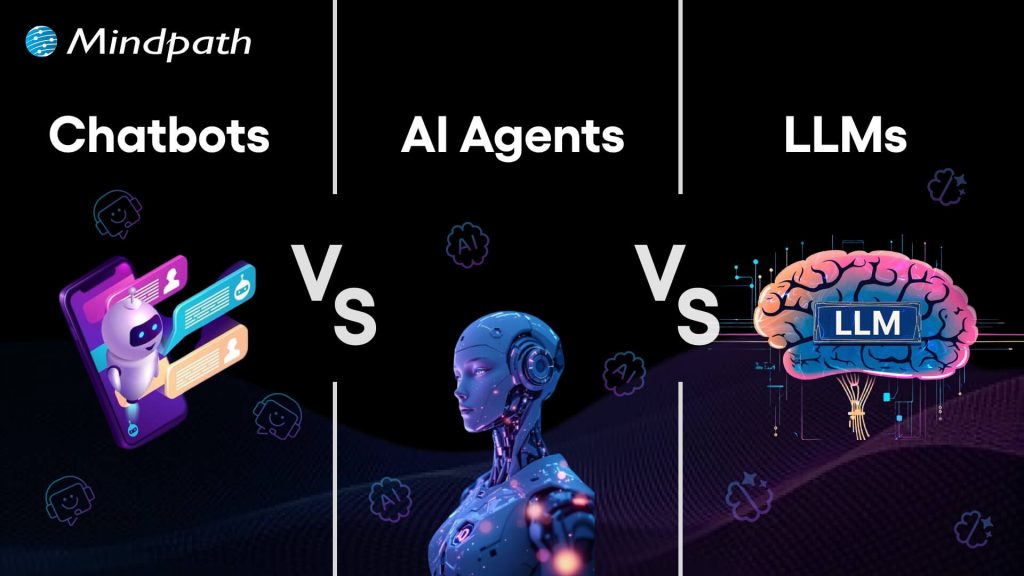
chatbots vs AI agents vs LLMs  

AI is transforming business communication, behavior, and decision making. However, the process of selecting the appropriate intelligence layer is still bewildering, right? When teams compare chatbots vs AI agents vs LLMs, the choice impacts speed, cost, and growth. So, how do you align technology and actual business objectives? We must overcome the indecisiveness and begin to think clearly, practically and strategically.

Expectations are growing at a rapid rate as the debate on automation commences. Customers desire fast responses, smarter behaviors, and repeat experiences. In the meantime, leaders desire control, magnitude, and value that is measurable. This tension renders this decision to be critical. But what are some of the ways these technologies would fit various business requirements nowadays? In this blog, we will guide you to make the correct choice for your business with confidence. So, continue reading further!

Ready to use the right AI technology to streamline and scale your business? Mindpath offers customised AI development services to build chatbots, AI agents, and LLM-powered solutions.

Choosing the Best: Chatbots vs AI Agents vs LLMs

In today’s industry, chatbots, AI agents, and LLMs play key roles in improving business operations. Each brings unique capabilities, but the right choice depends on your specific business needs. Let’s dive deeper into each technology to understand how it can best serve your goals.

What is a Chatbot?

A chatbot is a computer application that converses with the user via text or voice. It solves queries, provides information and directs the users in real time. Companies implement chatbots on websites and applications to assist customers, save time, and enhance the speed of the responses.

Chatbots cope with direct and simple conversations that are easy to explain in the context of chatbots vs AI agents vs LLMs debate. They respond according to set patterns or trained responses. This renders them dependable when it comes to FAQs, bookings, and simple support matters.

How Does a Chatbot Work?

Chatbots operate through reading the input of users and comparing it with the trained data or rules. They apply AI, machine learning and NLP to comprehend intent. Then, they choose the most appropriate response, according to some patterns, logic, or previous interactions.

There are two main chatbot types for chatbot for business use. Declarative chatbots act according to the established rules and respond to the frequently asked questions. Predictive chatbots are based on advanced AI and learning. They are dynamic, personalized, and predictive in terms of user needs.

What are the Key Benefits of a Chatbot?

Chatbots are more effective in addressing specific tasks. This is why they are highlighted in comparisons such as Chatbots vs AI agents vs LLMs. Some of its notable advantages include the following.

1. Offer 24/7 services immediately that enhance customer satisfaction.

2. Provide quick and reliable customer experiences channelwide.

3. Drive growth and sales with personal and timely contacts.

4. Gather customer information to enhance knowledge and business practices.

5. Minimize the expense of dealing with the large volume of queries via chatbots and AI agents.

Curious which chatbot capabilities deliver real value compared to AI agents and LLMs? Discover AI chatbot examples to check out practical use cases that support smarter decisions.

What is an AI Agent?

An AI agent refers to a system that performs work without human intervention through the use of tools and workflow. It is able to make decisions and resolve problems. AI agents respond to environments and take actions, which means that there is no need to have human guidance on daily operations.

As we always compare Chatbots vs AI agents vs LLMs, AI agents are more effective in complex and multi-step tasks than simple chatbots. They apply NLP in LLMs, automate processes, and offer intelligent support to all enterprise software and IT systems.

How Does an AI Agent Work?

The AI agents operate based on a defined role, type of communication and personality. They obey orders and apply tools to accomplish tasks that are effective. The agents evolve with time, learn to be more accurate, make better decisions and cope with complex situations.

A clear persona makes sure that there is a consistent behavior as the agent develops. Memories store short term, long term, episodic, and shared information to aid in learning. Tools enable access to data, manipulation or control of systems. LLMs play the role of the brain where they can make intelligent use of understanding, reasoning and language production.

What are the Key Benefits of an AI Agent?

The AI agents provide more intelligent automation and work on more advanced tasks than simple interactions. They have advanced business capabilities in comparison with Chatbots vs AI agents vs LLMs. Some of the most outstanding advantages are as follows.

1. Increase productivity through an AI agent for business to automate your tasks.

2. Better accuracy through identification of mistakes and production of quality output.

3. Work 24/7, accomplish tasks and help teams at any time.

4. Cut the expenses through automation of workflows and manual inefficiencies when we comparison chatbots vs AI agents.

5. Use data to offer information and make superior decisions.

Looking to decide whether AI agents are the right fit for your business operations? Check out the role of AI agents to learn how they handle complex tasks autonomously.

What is an LLM?

Large language model (LLM) is a computer program that is capable of comprehending and producing text based on deep learning algorithms. It learns on large amounts of data to identify patterns in language and comprehend human language.

LLM forms the backbone of chatbots and AI agents in the debate of Chatbots vs AI agents vs LLMs discussion. They interpret speech, invent answers and facilitate thinking. Fine-tuning LLM provides an accurate performance of tasks. These include answering questions or summarizing content or translating the text effectively.

How Do LLMs Work?

LLMs learn language by training on massive text datasets. They apply Transformer neural networks, which apply self-attention to learn context, patterns and relationships. This enables them to produce human text, respond to questions, summarize, and do other language tasks.

In LLMs for business, these models automate the process of creating content, customer support and data analysis. They forecast words in a text one by one, identify more complex patterns and give correct answers. They also enable companies to save time, enhance communication, and make smarter decisions effectively.

What are the Key Benefits of LLMs?

LLMs have advanced language interpretation and generation that redefine the way businesses interact with data and clients. They are more flexible and intelligent than any other model in comparisons such as Chatbots vs AI agents vs LLMs. Some of the notable advantages include the following.

1. Automation of language and data processes to enhance productivity and minimize the effort.

2. Scale operations in a graceful way to handle the large and increasing quantities of data.

3. Provide low-latency and fast responses to improve Chatbots and LLMs based interactions.

4. Multiple languages should be supported to allow worldwide communication and expanded presence.

5. Create insights that can make informed choices in the comparison of AI agents vs LLMs.

Want to see how LLM capabilities will expand beyond text generation? Learn about the future of LLMs to discover trends redefining intelligent systems.

Chatbots vs AI Agent vs LLMs: Key Differences

Before settling on the appropriate intelligence model to use, businesses should have clarity. This section describes the difference between the chatbots and the AI agent and the LLMs:

1. Functional Scope

Chatbots are based on guided responses and structured conversations. They are able to deal with direct user queries in their day-to-day operations.

AI Agents accomplish objectives based on actions and decisions. They work outside of a discussion and control workflows on their own.

LLMs are language understanding and language generating machines. They justify contents, analysis and arguments between systems.

2. Intelligence Depth

In Chatbots vs. AI Agent vs. LLMs, chatbots are based on predetermined logic. They are competent in foreseeable and monotonous situations.

AI agents are based on reasoning and awareness. They modify behaviors depending on the objectives and results.

The LLLs have high language intelligence. They decode intent, tone as well as context.

3. Level of Autonomy

Chatbots are responsive and wait until the users prompt them. They are unable to start and take charge of things individually.

AI agents are very independent and only act on the goals that have been specified. Their planning and implementation are not guided constantly.

The operation of LLMs needs prompts or integrations. They never take action independently.

Also Read: LLaMA LLM

4. System Complexity

Chatbots have minimal architecture and processes. This makes deployment and maintenance simple.

AI agents entail multi-step systems containing memory and equipment. They control cross-platform complex processes.

LLMs are based on the use of advanced neural networks. They are complex enough to do in-depth processing of language.

5. Cost and Growth Readiness

Chatbots provide cost-effective scaling when it comes to simple support requirements. A lot of teams implement them rapidly.

AI agents are more expensive to invest in but are easily scalable to automation. They are appropriate to be used in the enterprise settings.

The LLMs are ecologically friendly as they are scaled using cloud APIs. The overall cost depends on the volume of usage.

6. Architectural Dependency

Chatbots tend to incorporate LLMs to have conversations. The connection is evident in Chatbots vs LLMs discourses.

AI agents use LLMs as their reasoning engine. They incorporate action and planning layers.

LLMs provide the foundation across systems. This role helps explain the differences in Chatbots vs AI agents vs LLMs clearly.

Planning to deploy AI solutions that focus on instant communication and support? Discover conversational AI chatbot to check out how they fit modern business needs.

Let us understand more clearly through the difference table:

Feature  Chatbots  AI Agents  LLMs 
Interaction Communicates with users through text or voice Interacts with users and systems to complete tasks Understands and generates language for multiple applications
Task Scope Handles simple and repetitive tasks Manages complex multi-step workflows independently Performs advanced content, analysis, and language tasks
Decision-Making Follows predefined rules and scripts Makes autonomous decisions based on goals and context Supports reasoning when integrated into systems or prompts
Learning Learns slowly through updates and rules Improves from past interactions and feedback Learns from large datasets and adapts to patterns automatically
Integration Works alone or with basic systems Integrates with tools, software, and workflows Powers other systems and integrates into chatbots or AI agents
Efficiency Provides quick responses for simple queries Saves time through task automation Processes large amounts of language data rapidly
Suitability Ideal for basic customer support and FAQs Best for enterprise automation and multi-step tasks Suitable for advanced language intelligence and analysis
Scalability Scales easily for repeated interactions Handles growing workflows and processes Scales via cloud APIs for large data and tasks

Ready to Choose the Right AI for Your Business?

The decision on Chatbots vs AI agents vs LLMs influences the manner in which your business operates and develops. All the options address various problems and suit various objectives. Chatbots are good at one-dimensional conversations. AI agents are independent in handling complex tasks. LLMs drive language comprehension on a system-wide basis. Understanding needs will result in more intelligent decisions. The comparison assists teams in making clear and confident decisions.

At Mindpath, our AI development services assists companies to convert AI concepts into practical solutions. Our professionals create chatbots, AI agents, and LLM based systems that will suit your objectives. We are concerned with speed, precision and a value that is measurable. Mindpath Teams develop scalable AI solutions using the framework that enable growth, better decisions, and customer experiences in industries.

 FAQS

1. What are the major differences between Chatbots, AI Agents and LLMs?

When we make a comparison of chatbots vs AI agents vs LLMs, each has a different business purpose. Chatbots are directed towards basic conversations and user guidance. The AI agents are involved in their tasks and decision-making, whereas the LLMs comprehend and create language within systems.

2. Can chatbots work without LLMS?

Yes, chatbots and LLMs do not always work together. Business chatbot can be executed with the help of predefined rules or scripts. LLMs do not make simple tasks mandatory, and they enhance the quality of conversation.

3. Between chatbots and AI agents, which is more advanced?

The AI agents prove better in the chatbots vs AI agents debate. They are future-oriented and execute multifaceted and multi-process work. Chatbots are primarily the ones that answer questions and are programmed to act according to certain patterns.

4. Do AI agents need LLMs to function?

LLMs for business improve an AI agent and LLMs combination. Even in the absence of LLM, AI agents can operate with the help of tools and rules. LLMs enhance the agents by making them smarter, improving their reasoning, understanding and natural language output.

5. When should a business choose AI agent, chatbot, and LLMs?

Chatbots and AI agents can be used to support or automate the work. Chatbots and LLMs perform better when the natural language understanding is serious. The appropriate decision is based on the complexity of the task and business objectives.

full stack nodejs

Companies are now seeking scalable and robust applications, which can meet both years of functional performance and user expectations. That’s when full-stack Node.js development comes into play, uniting the power of frontend and backend within a single environment. It allows developers to build faster and smarter while creating applications to remain adaptable as the business continues to grow.

In this way, constructing end-to-end solutions is more fluid and intelligent. With cohesive databases, APIs, and user interfaces integrating and interfacing, developers can automate some of the hassle proactively. Understanding full-stack Node.js ultimately gives developers an advantage to think forward as technology grows and gives organizations tangible opportunities to grow with applications that perform and scale easily. So, let’s dive in to know how this expertise truly makes a difference.

Want to build an advanced application without compromising performance? At Mindpath, our full-stack development services will help you provide the best solutions, handling both front-end and back-end with efficiency.

Understanding the Fundamentals of Full-Stack Development

Full-stack development means developing on the front end and back end of a web application. The front end refers to all the things that the user responds to and interacts with, such as buttons, layouts, designs, etc. The back end refers to all of the things that run in the background, like databases, servers, etc., and all the logic that makes it run smoothly, working together.

A full-stack developer has the capability to deal with both sides. They are capable of building UX and the technology that serves the app. This gives them agile skills that allow them to build comprehensive applications entirely from front to back.

Understanding the Basics of Node.js

Node.js is a platform that allows you to run JavaScript code in a JavaScript runtime outside of the browser. It is built on Google’s V8 engine, which is extremely fast and built to be efficient. Node.js allows developers to write server-side applications using the same exact language as for the front end, making development and management easier and smoother.

An advantage of Node.js is that it operates asynchronously, which allows tasks to not have to wait for one another to complete, meaning that applications can handle multiple requests at once. Because of this, the use of full-stack Node.js is quickly becoming a good choice when building scalable, real-time, and modern applications.

The success of using Node.js in full-stack development depends on hiring the best developer. Discover the key Factors to Consider while Hiring Node.js Developers.

Why is Node.js Important for Full-Stack Development?

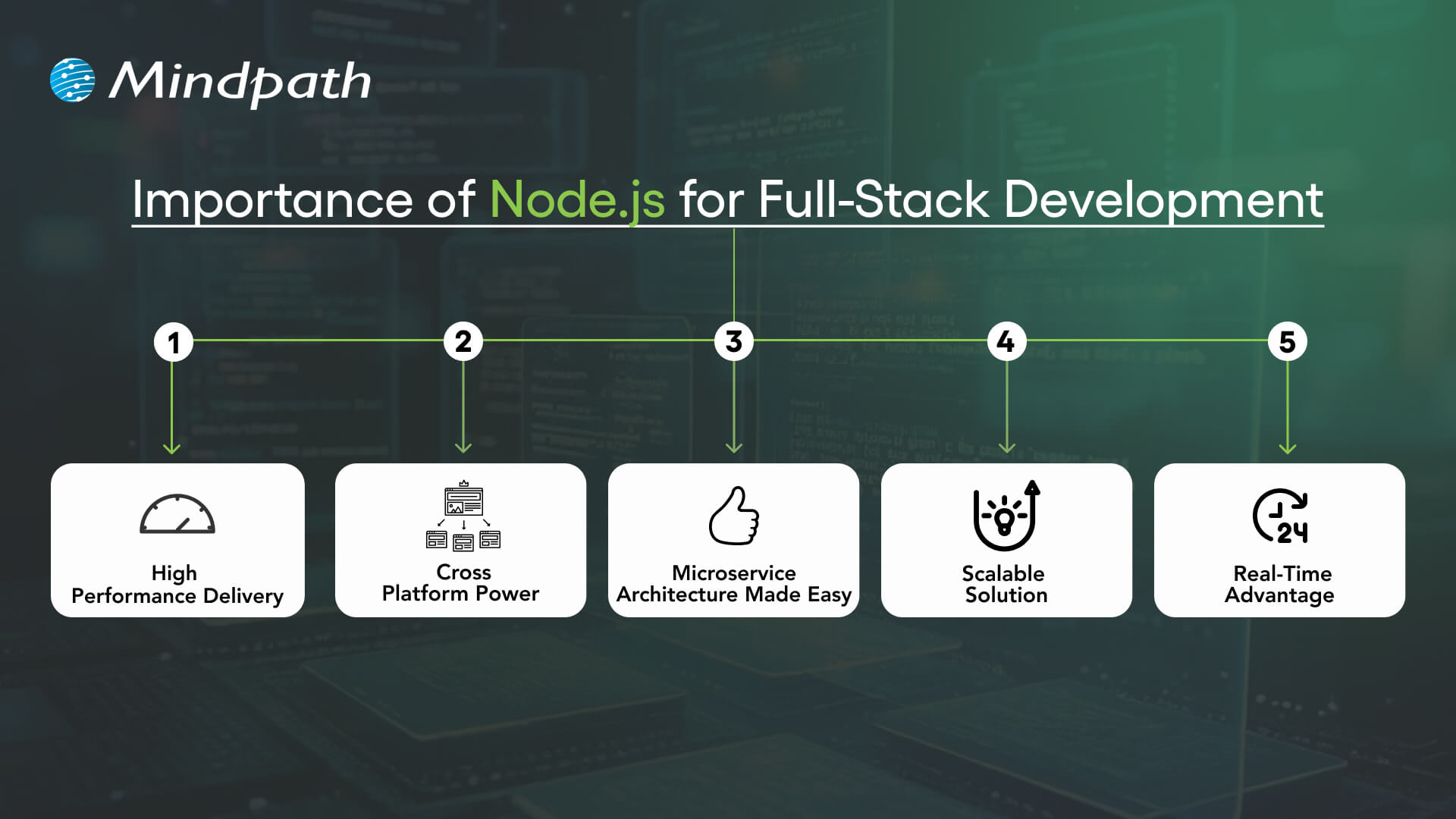
Utilizing Node.js full-stack technology is an impressive approach to developing a complete web application. Here are reasons that Node.js is a valuable technology option in the full-stack.

Importance of Node.js for Full-Stack Development

1. High Performance Delivery

Node.js utilizes a non-blocking I/O hardware model that can handle hundreds or even thousands of requests simultaneously, providing faster response times and greater user-specific.

2. Cross-Platform Power

With the Node.js full stack, developers can write mobile and desktop apps to run on Windows, macOS, Linux, and more. By relying on a single JavaScript code base, developers can save time and effort writing for multiple platforms.

3. Microservice Architecture Made Easy

Full-stack Node allows users to break one larger application down to multiple smaller independent services using infrastructure that is easier to work with. This approach lets developers build faster, stay flexible, and rely on proven solutions.

4. Scalable Solution

Full-stack Node.js is used by major players like Walmart, Uber, and Trello to handle millions of users. It helps to lower load time significantly, and it ensures your applications will scale seamlessly, as your demands increase.

5. Real-Time Advantage

When it comes to applications that leverage chat, live streaming, food delivery, or payments, Node.js full-stack is the way to go. It seamlessly provides real-time updates to keep the user engaged and connected.

Also Read: Full-stack Development for Web Projects

Key Steps to Use Node.js in Full-Stack Development

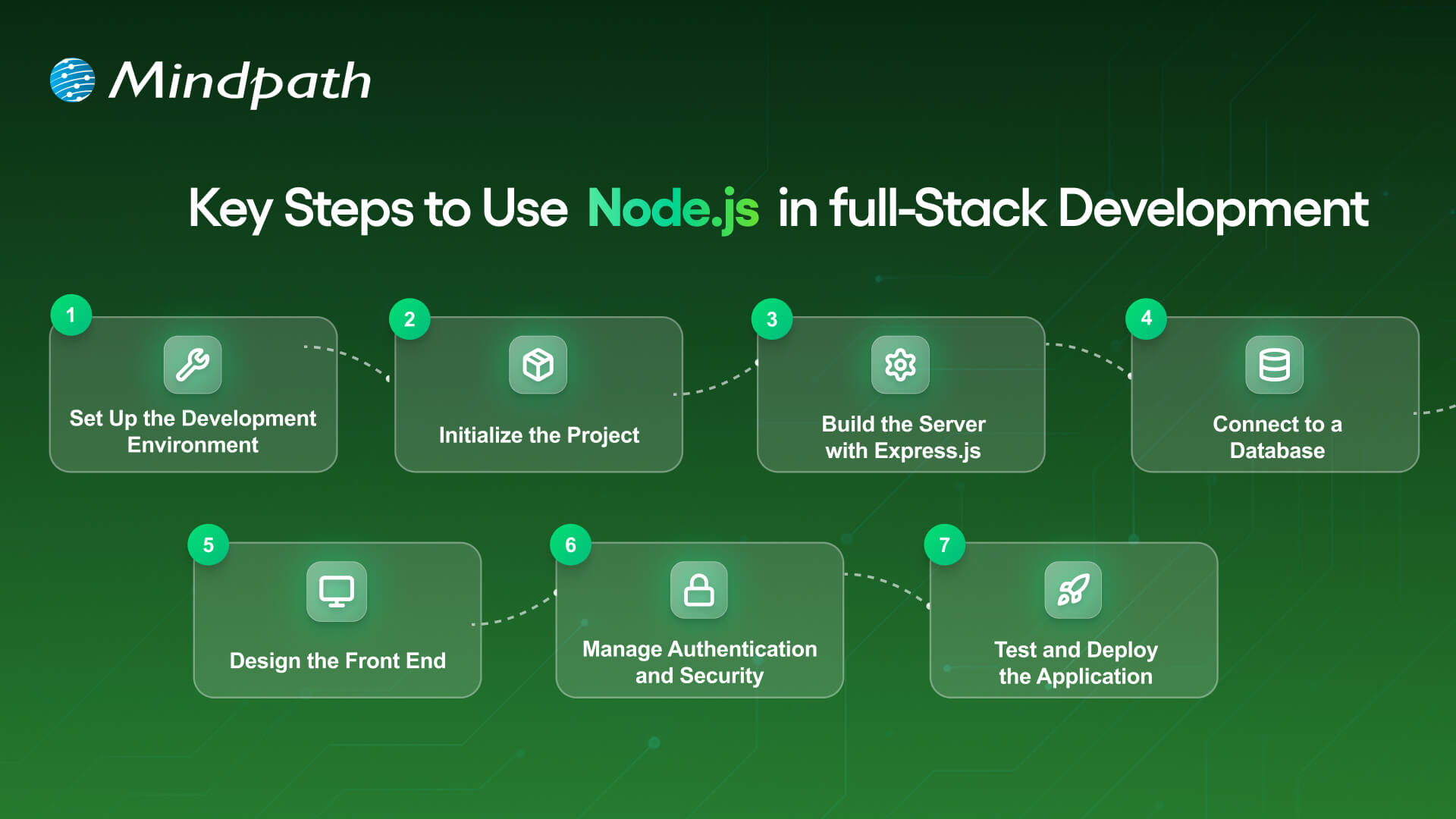
A full-stack Node.js developer is involved in both the front end and the back end of web application development and will work to build complete web applications. Below is a synopsis of the primary steps to utilize Node.js in full-stack development that is easy and productive.

Key Steps to Use nodejs in full stack development

1. Set Up the Development Environment

To begin your application-building experience, you will need to install Node.js and npm (Node Package Manager). These tools will allow you to execute JavaScript beyond the browser, and they will also help manage libraries with ease. Verify the setup by checking versions with simple commands in your terminal.

2. Initialize the Project

Make a new folder for your app, and use ‘npm init’ to create a ‘package.json’ file. A package.json file holds important information, such as your project name, dependencies, and scripts. It will serve as the basis for managing everything in your project.

3. Build the Server with Express.js

Install Express.js so you’ll be able to set up the backend server and handle all of the different routes. Express.js makes handling requests, responses and APIs supposedly easy. This step will ensure the backend runs appropriately with the frontend.

Must Read: Full-stack development trends

4. Connect to a Database

Based on your needs for this project, select a database like MongoDB or PostgreSQL. This should be paired with a Node.js library like Mongoose or Sequelize, which will allow you to connect to and perform both read and write operations on your data. At this point, you will have the ability for your application to persist and retrieve your data.

5. Design the Front-End

Build the front-end using a library such as React, Angular, or Vue. You can link the front-end through RESTful APIs or GraphQL to your Node.js back end. At this point, players will finish the bridge for a Full-stack Node.js application.

6. Manage Authentication and Security

Use libraries like Passport.js or JWT to add secure login and registration. Secure necessary paths so that any authorized user can get to those routes. You should always consider security in any Full-stack Node.js application.

7. Test and Deploy the Application

Create unit and integration tests to ensure that your application does what you intended. Deploy the application to cloud hosting solutions like Google Cloud, AWS, or Heroku. To utilize your Full-stack Node.js application’s performance tool on different scales, you should monitor its performance!

Looking to integrate AI in your Node.js projects? Explore our Ultimate Guide to Node.js Libraries for AI Integration to discover the most effective libraries for building smart, scalable, and future-ready applications.

Ready to Unlock the Power of Full-Stack Node.js?

Full-stack Node.js has proved to be a smart choice for building scalable, high-performing, and real-time applications. It unites front-end and back-end seamlessly, helping developers create complete solutions with speed and flexibility. With its ability to handle microservices, cross-platform apps, and real-time updates, it has become an essential technology for modern web development.

At Mindpath, we provide expert full-stack development services designed to match your business goals. Our skilled Node.js developers bring deep technical knowledge and practical experience to build secure, scalable, and user-friendly applications. If you are looking to transform your digital ideas into reality, hiring a Node.js expert from our team ensures growth and lasting impact.

Master full-stack development with Node.js! Its scalability, performance, and seamless frontend-backend integration.
healthcare software development services

Ever Wondered how technology is really influencing the healthcare sector? From electronic health records and telemedicine to mobile health apps, today healthcare software development plays a great role in changing the way patients receive and providers provide treatment.  

But what exactly are healthcare software development services, and why are they crucial for modern medicine? In this blog we will explore healthcare software development services and how these cutting-edge solutions are going to shape the future of healthcare, improve patient outcomes, and smooth operations. 

What is Healthcare Software?    

Healthcare software development is the process of developing individualistic computer programs designed for hospitals, clinics, and all other types of healthcare organizations. These programs assist in enhancing how healthcare providers render care by making processes more effective, accurate, and oriented towards patients. Healthcare software creates a complete digital system within a healthcare organization.  

This allows medical professionals to offer better and more accurate clinical services. To doctors, this represents an easy way to do follow-ups and monitor the health of their patients, schedule appointments, and get access to medical reports, all from the comfort of managing staff. To patients, it offers online appointment booking, live chat with doctors, sharing of medical reports, and receiving health advice.   

These software solutions come with various benefits associated with the improvement in patient care, efficiency, and reduction in medical errors. They can digitize the traditional paper-based systems and take care that patient care is performed quicker and much more safely. Healthcare software is further creating new sectors, such as patient engagement, clinical robotics, and telehealth, driving a lot of startups to bring ideas into life. 

 Types of Healthcare Software Development Services  

Types of Healthcare Software Development Services - infographic

1. Electronic Health Record (EHR) Software   

EHR software is being used by hospitals and clinics like any CRM, but with a healthcare tune. It contains all the relevant information concerning every patient, among them what medicines they use, the various doctors’ advice, and the medical processes that they have gone through. Many EHRs incorporate mechanisms for billing, collection, and even a patient portal that allows patients to view consultation history, medical records, and prescriptions. There are two types of EHR software: the electronic patient record, which is used in hospitals for management purposes concerning a patient internally, and the electronic medical record, which keeps track of information like medications, past and future procedures, and how well the patient is recovering. 

2. Medical Database Software   

Medical database software can be called a huge library of information about medicine, not according to the profiles of patients but according to diseases. This tool aids doctors in looking through cases like one that is being treated and thus making informed decisions about its cure. It is also used for learning by allowing doctors to know more about certain diseases. For example, a dermatologist using medical database software can view all the patients diagnosed with Atopic Dermatitis, compare their symptoms, treatments, and recovery plans, and find the best approach for their current patients. 

3. Health Tracking Apps 

Health-tracking apps are part of the fast-growing industry called mHealth, which stands for “mobile health.” This industry, valued at $37 billion globally for 2019 alone, allows users to trace and manage their health from their smartphones. Some of the popular health monitoring apps include fitness apps such as 8fit, diet apps such as Fitatu Calorie. For instance, sleeping patterns are monitored by the FitBit wristband, while the Oura Ring is responsible for monitoring several health metrics. Others include glucometers for testing blood sugar levels and, of course, thermometers in general—for instance, tracking menstrual cycles like the Kindara app. All these tools work together to give users a better understanding of their health and wellness. 

4. E-prescribing Software 

The e-prescribing software is becoming a tool that every doctor must have, with countries all over the world rapidly adopting electronic prescriptions. Such software allows doctors to easily manage all prescriptions for all patients by tracking, renewing, and canceling them as need be. It is also connected to national drug reference databases that help in picking up the right medications and making sure there is no error. Examples include MediTab and ScriptSure, two software programs designed to ease e-prescribing and improve the capabilities of health professionals to deliver accurate and effective care. 

5. Appointment Scheduling (booking) Software 

Appointment scheduling software is designed to assist hospitals, clinics, and medical practices in managing their appointments online. This normally allows the provision of a user-friendly platform through which patients can easily book appointments via an app or website without calling up the office. This type of software normally features email notifications and automatically sends reminders to doctors and patients about upcoming appointments. It accommodates multiple doctors’ schedules, cancellations, or rescheduling of appointments, and does much more to provide appointment trend data that helps in bringing efficiency to the practice. Additionally, AI chatbots are integrated into these systems to enhance the booking experience. These chatbots can handle appointment scheduling, provide immediate responses to patient inquiries, and assist with rescheduling or cancellations. 

Looking to boost your healthcare operations with top-tier software solutions?

At Mindpath, we deliver cutting-edge, customized healthcare software to empower efficiency and elevate patient care.

Why Are Healthcare Practitioners Going Digital? 

Health practitioners use digital technologies greatly because of the great advantages they present in improving patient care and practice management. Digital healthcare solutions help doctors in the management of patient information. Therefore, record-keeping becomes more accurate and efficient while diminishing the burdens of paperwork.  

Healthcare IT has been one of the fast-growing markets and is expected to grow further. From $303.4 billion in 2022, this is projected to rise as high as $974.5 billion by 2027 with a good annual growth rate. The market is expected to grow to $728.63 billion by 2029 and even further to $1,069.13 billion by 2032. Healthcare provider solutions take up about 38% of the market, such as those in Electronic Health Records. On the other hand, IT services form 52% of the market, including online payments and cybersecurity. Growth is fueled by new technologies, increased spending by consumers, and government initiatives; however, challenges persist, with the most important ones being related to cybersecurity risks. It has the maximum market share in North America due to its better and advanced infrastructure. The European region is predicted to grow fast with government help and support, adoption of AI soon. Some major players in this field are GE Healthcare and Philips, which are carrying the industry forward. 

Leading Healthcare Software Development Services at Mindpath 

Mindpath offers a full cycle of healthcare software development services that meet all the needs of healthcare providers, patients, and all those concerned. Our offered solutions work toward better patient care while easing operations. Here are the services we provide: 

Leading Healthcare Software Development Services at Mindpath - infographic format

1. Healthcare Software Development Consultation: 

We assist in planning and designing your healthcare software project from an idea to detailed planning. Our advice ensures you will have a clear roadmap for developing effective healthcare solutions.  

2. Healthcare Software Development: 

We develop various healthcare IT software solutions, including Electronic Health Record (EHR) software, practice management systems, patient portals, among others. The solutions are secure, scalable, and well-built according to the industry regulations to ensure better patient care and efficiency. 

3. UI/UX Development: 

We design easy-to-use interfaces that will be convenient and pleasant for the eye. We focus on bringing your healthcare software both functionality and user experience. 

4. AI Chatbot for Healthcare: 

Our AI chatbots for healthcare answer questions, provide appointment scheduling, and disseminate medical information. They help improve interaction with patients and relieve some workload from the health staff. 

5. Modernization of Healthcare Software: 

Legacy system upgrade and migration to state-of-the-art platforms, enrichment of new functionalities, and updating of old technologies to manage your software and keep it relevant. 

6. Maintenance & Support: 

Ongoing support and maintenance are available to make sure that your healthcare software keeps running smoothly and aligns with your changing needs. 

Conclusion  

The huge effects of rapid growth in technology reshaping healthcare to become more effective, accessible, and patient-centered are undeniable. It is evident from the adoption of electronic health records and e-prescribing software at the end of the spectrum to health-tracking apps and AI-driven tools that are revolutionizing how healthcare providers care for patients and their practices.  

Such innovations not only improve the quality of care provided to patients but also the administrative flow, hence making healthcare very responsive and effective. Adopting the newest technology is crucial for healthcare organizations to keep ahead of these trends as the sector continues to change. This is where a holistic approach to healthcare software development is necessary. Healthcare providers may enhance patient outcomes, streamline operations, and more adeptly navigate the digital terrain by incorporating cutting-edge software solutions.  

At Mindpath, we are dedicated to supporting healthcare providers through every step of this transformation. From development and consultation to UI/UX design and modernization—our services cover a large area of needs, all meant to make sure you can drive positive change in healthcare through digital technology. Be it building new systems, updating existing ones, or ensuring ongoing support, Mindpath makes sure that your healthcare software is of the highest quality and effectiveness. 

Are you curious about how cutting-edge medical software might transform your business?

At Mindpath, we develop solutions that improve patient care and expedite operations.

Explore how healthcare software development enhances patient care and operations. Discover services like EHR, medical databases, and more. Transform your practice today!