Key Benefits of Hiring Remote Developers

Join our Newsletter!

Featured Posts

Support Is One Click Away

Home

Key Benefits of Hiring Remote Developers

benefits of hiring remote developers

Key Benefits of Hiring Remote Developers

Understanding the benefits of hiring remote developers can unlock thrilling possibilities for organizations looking to grow faster and smarter. In today’s world, companies tap into skilled workers worldwide instead of relying only on local talent. But how does the shift to remote development impact projects and teams? When organizations hire the right remote developers, they can deal with challenges more effectively, enlist more talent and expertise, and receive additional lateral thinking that may not always be available nearby.

At the same time, it’s not just about broadening the talent pool. Hiring remote developers allows companies to maximize savings, increase performance, and yield faster delivery speed. Isn’t that exactly what companies are looking for as they continue to modernize? With the pace of technology increasing, it’s more important than ever to tap into professionals who can adapt to change quickly and produce results. This is why businesses are employing remote teams as a sound way to grow and remain competitive. In this blog, we will outline some of the benefits that should make remote developers a consideration for any business.

Looking to scale your business that provides growth and innovation? Contact us, and we will help you explore how you can access fast and quick results.

Growing Demand for Remote Developers

The demand for remote developers is increasing rapidly with global hiring and flexible working arrangements. After COVID-19, companies learned that they could function just as well without physical workspaces, and developers discovered the advantages of flexible work. Companies now want specialized skills; they want specialized skills faster and cheaper, developers want remote or hybrid work, and specialized skill developers want fast and cheap work.

Taking everything into account, some of the key factors driving this new reality include shifting cultural dynamics post-COVID, the speed and efficiency of AI and cloud technology, and the ability to pull skills from anywhere in the world. Organizations can now create effective teams independent of place, reduce costs, and maintain a competitive position in an increasingly digital world.

Also Read: Remote Work Tools for Developers

Benefits of Hiring Remote Developers

Understanding the advantages of hiring dedicated developers has shown us how powerful hiring talent remotely has become. Companies can scale at an accelerated pace, reduce costs, and fill unique skills that might not exist locally. When companies find the right remote dedicated team, they can expect a well-thought-out project and long-lasting value.
Benefits of Hiring Remote Developers

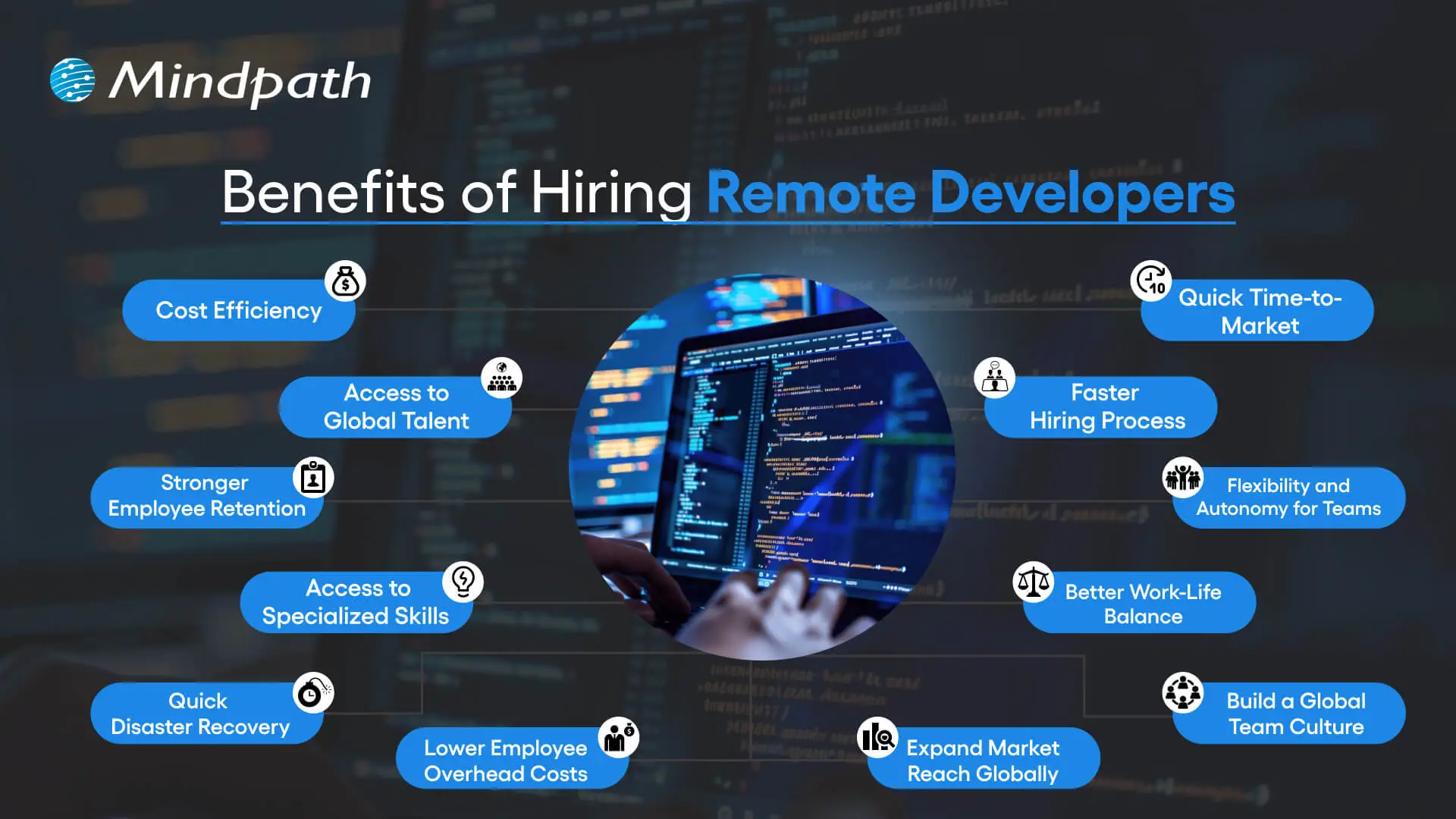
1. Cost Efficiency

Remote hiring can decrease expenses on space, utilities, and other operational costs. When hiring developers from places with lower costs of living, companies save even more on employee salaries and daily overheads, which can then be reinvested into research or innovation or even into paying for employee benefits. This enables companies to experience growth while continuing to be fiscally responsible.

2. Access to Global Talent

One of the major benefits of remote work is the opportunity to recruit talented professionals to join the team from anywhere in the world. Workers and their companies no longer have to feel restricted in the talent they can recruit, and many companies are developing diverse teams together with specialized skills and knowledge. Companies can now combine talent in technical skills, such as machine learning, with more creative areas, such as UI and UX design.

3. Stronger Employee Retention

One of the important benefits of hiring remote developers is increased employee retention, which is important for business stability. Employees have less stress from long commutes and improved work-life balance, which leads to increased job satisfaction. With higher satisfaction comes increased loyalty and lower turnover. This stability provides companies with predictable productivity, more control of expenditures, and longer-term growth.

4. Access to Specialized Skills

Remote hiring allows companies to locate developers and other providers with specialized skills that they may not have locally. Companies can search worldwide for developers skilled in machine learning, React development, healthcare technology, etc.

Even non-technology companies can find programmers and service providers in the specialized pathways without the need for in-house technical capacity. The appropriate specialized talent makes it possible to achieve quality, safety, and reliability standards for projects.

Looking for guidance on hiring specialized developers for your projects? Check out our detailed guide on hiring expert ReactJS developers to find the perfect match.

5. Quick Disaster Recovery

An additional benefit of hiring remote developers is business continuity. When a local office experiences disruption due to power outages or extreme weather, remote teams can maintain the pace of project execution. By engaging in a distributed team model, work is not curtailed at one point in the system. That is, it allows a project to better meet deadlines, reinforces trust with clients, and increases anchoring with the robustness of the overall business model and operations.

6. Lower Employee Overhead Costs

A key advantage of hiring a remote development team is the significant reduction in costs exceeding rent, utilities and office supplies. Onboarding is less expensive with remote developers because they are working off their own setups, so they will utilize minimal in-house resources. Training is also delivered through online modules, which will save costs and help keep teams up to date without wasting time.

7. Quick Time-to-Market

The biggest benefits of hiring remote developers is that it really helps to speed up product launches. As teams are already distributed around the world in different time zones, development, testing, and deployment can continue all day. This Shortens project cycles and allows businesses to meet deadlines in a timely manner. Being able to deliver faster keeps companies agile and gives them a significant competitive advantage.

8. Faster Hiring Process

Remote hiring allows companies to source and onboard the right talent quickly for projects on short notice due to access to a global talent pool. Many recruitment teams know that hiring offshore means you do not have to worry about relocation and cannot be delayed by a lengthy recruitment process. Skilled developers can start working on a project within a week. This speed allows companies more time for development, testing, and entering the market.

Need a faster way to scale your development team without long-term commitments? Discover how staff augmentation enables businesses to add skilled developers quickly while maintaining flexibility and cost efficiency.

9. Flexibility and Autonomy for Teams

One of the key advantages of employing remote developers is that it affords teams higher flexibility and autonomy in how they choose to work. Since developers can work at a time that suits them best, they produce higher-quality work.

Using this flexible work model creates lower stress, higher job satisfaction, and engagement. Businesses with flexible work models not only benefit from motivated teams but also from teams that achieve better results in less time.

10. Better Work-Life Balance

Remote developers benefit from the flexibility to have a day that will fit their personal and professional needs. This flexibility provides remote developers with the opportunity to spend time with family, for fitness, and for personal well-being, without worrying about any impact on their productivity.

As a direct result, mental and physical well-being improve, and performance at work improves as well. The benefits of hiring remote developers result in a happier team that will be focused and more efficient in tackling each project successfully.

11. Build a Global Team Culture

The benefits of hiring remote developers extend to creating a diverse team culture that blends ideas from around the world. Different perspectives and experiences lead to more creativity and stronger problem-solving. Online collaboration tools make it easy for teams to connect, share, and work together across borders. This global culture not only strengthens teamwork but also supports innovation and business growth.

12. Expand Market Reach Globally

With remote developers located across different regions, businesses gain real-time insights into diverse markets. These developers can share valuable knowledge on local consumer preferences, trends, and cultural expectations. This localized input helps tailor products or services for specific audiences more effectively. The benefits of hiring remote developers include faster, smarter market expansion with fewer blind spots.

Want to leverage remote talent for faster product launches worldwide? Explore how custom software development can help your business scale efficiently.

Ready to Experience the Benefits of Remote Working?

The benefits of hiring remote developers clearly show how powerful and practical this model has become for modern businesses. Companies gain access to global skills, improve retention, reduce overhead, and accelerate delivery. By building flexible and resilient teams, organizations can stay ahead of the competition and create sustainable growth in today’s fast-changing digital landscape.

At Mindpath, we make hiring remote developers simple and effective. Our dedicated developers bring specialized skills, innovation, and flexibility to your projects. With a focus on efficiency and quality, we help businesses scale faster, cut costs, and deliver solutions that drive real results. Partner with Mindpath and unlock the true potential of remote working.

Related Post

Discover how Multimodal Generative AI enhance creativity, accessibility, and user experiences across industries.

Related Post

Hiring a full stack developer

Have you thought about how hiring a full-stack developer could impact the success of your digital initiative? In a fast-paced world like technology, companies seek the ability to manage both front-end and back-end development.  What characteristics will define the best developer for your business requirements?

That’s where careful thought comes into play. Every business has its own specific objectives. If you choose a full-stack developer without careful consideration and evaluation can lead to gaps in performance. Avoid making a rushed decision without thinking it through, and taking the time to know what is important will help you move in the right direction. So, while you start planning your next steps, let’s discuss the key things you keep in mind, so that your hiring choice actively supports growth and innovation.

Hiring full-stack developers brings end-to-end technical support to scale your business faster. Mindpath can help you get the best talent that fits your requirements.

Who is a Full-Stack Developer?

A full-stack developer is a person who can work on both the front end and back end of a website or application. The front end comprises everything that the user sees and interacts with, and the back end is part of the app that runs on the server in addition to managing the database and application logic. The combination of this front-end and back-end skill set helps to make full-stack developers more flexible and valuable in creating all types of digital experiences.

Hiring a full-stack developer means hiring a person who knows how to link the design of a site, functionality, and performance. Full-stack developers understand programming languages, frameworks, and server environments. They make sure the design runs smoothly during the entire development process. By being aware of multiple layers of development, full-stack development saves time and money while allowing businesses to deliver a more efficient product.

Responsibilities of a Full-Stack Developer

It’s important to recognize the broad spectrum of responsibility that comes with hiring a full-stack developer. The following responsibilities communicate how they join the layers of development into a smooth-flowing digital solution.

Responsibilities of a Full-Stack Developer

1. Designing User Interfaces

A freelance full-stack developer builds interfaces that have visual appeal and work on any device. They ensure that the website is responsive and works well for the user.

2. Building the Front End

Using HTML, CSS, and JavaScript, they build the experience that the user interacts with and engages with the visual. This allows for seamless movement through the site visually.

3. Collaborating with Teams

They collaborate with designers, managers, and stakeholders to achieve project outcomes. The benefits of collaboration can be easily seen, as it assures the application is built correctly.

4. Developing APIs

Full-stack developers are responsible for the build of APIs to interconnect systems and services. This allows the same data to move between the front end and back end.

5. Writing System Logic

They create a logic that drives the functions within an application. It responds to requests, processes data, and provides accurate results.

6. Managing Databases

A freelance full-stack developer sets up, maintains, and stores data in databases for user information. They secure data management, and they optimize the strategies for saving data.

7. Writing Clean Code

They write code that is maintainable and structured with performance in mind. Clean coding practices support a reduction in error and an increase in ease of modification.

8. Testing and Debugging

A full-stack developer tests an application to look for bugs. They debug the bugs to make sure it runs smoothly and reliably.

If you are planning to hire a full-stack developer, it is essential to understand the impact they can have on your product’s success. Explore our blog on Full Stack Developer Is Key to MVP Success to have a deeper understaning on how a full-stack developer can accelerate your MVP and give your product a competitive edge.

Essential Factors to Consider Before Hiring a Full-Stack Developer

Recruiting a full-stack developer isn’t just about evaluating technical skills. The following is a list of critical factors that will help you recruit a developer who aligns with your project needs and business objectives.

Essential Factors to Consider Before Hiring a Full-Stack Developer

1. Define Your Requirements

It’s important to create a clear document outlining your project needs prior to hiring a full-stack developer. This ensures the full-stack developer understands the features you need and the level of design you are expecting. Clarified requirements can aid in a quicker delivery to you and avoid any confusion.

2. Evaluate Candidate Potential

An experienced full-stack web developer has industry knowledge and experience. They can quickly adapt and move between projects as needed. Their ability to jump between projects can prove valuable when a deadline is around the corner.

3. Check Project Management Skills

When you hire a full-stack developer, you’re also getting a project manager with skills that go beyond simply coding. They have the ability to plan resources, lead teams, and manage the stages of development. Because of these proficiencies, they’re often the ones leading projects.

4. Review Technical Expertise

A good developer will know the languages behind building interfaces, HTML, CSS, and JavaScript. They will also know some back-end language, such as Python, PHP, or Ruby, and database experience with something like MySQL. It is a strong combination for full-stack development.

5. Look for Tech Versatility

Ensure that when hiring a full-stack developer, you validate their experience with multiple technologies. They should have knowledge of front-end frameworks, backend frameworks, and databases. You want real project experience that demonstrates their skills.

6. Check Their Portfolio

Request past work to evaluate their capabilities. A solid portfolio can illustrate how they overcome obstacles and provide solutions. Even newbies will be able to display some ability through sample work.

7. Focus on Soft Skills

A developer should recognize business requirements as well as perform technical tasks. A developer must be able to communicate without barriers to clients and teams. Good soft skills make it easy to comply with authority.

8. Make a Smart Hiring Decision

Finding the appropriate talent for full-stack web developer jobs can be a time-consuming process. Hiring a full-stack developer through a talent agency can help alleviate risk and guarantee that developers know what they are doing.

Want to transform your business inside out? Full-stack development makes it possible by optimizing operations and speeding up product launches. Explore the Benefits of Full-Stack Development every business needs to succeed.

How to Hire a Full-Stack Developer

Selecting a full-stack developer involves an intentional process based on the right talent and your desired project specifications. The following steps will help you make a careful and confident hiring decision.

Process of Hiring a Full-Stack Developer

1. Assess Business Requirements

Prior to hiring a full-stack developer, make sure to define the project’s scope, budget, and timeline. Decide whether you need to hire someone full-time or if your project would require a freelance expert.

2. Select Recruitment Channels

Source candidates from networking sites, freelance platforms, and job boards. You can also connect with a full-stack development company to get the right talent.

3. Craft a Job Description

A good full-stack developer job description is a detailed description of the hard skills and tools, and the responsibilities for the job. A good job description helps you find the right candidates at a much quicker pace.

4. Conduct Skill Assessments

You can assess coding and problem-solving by utilizing structured coding tests or tasks. This method is a better hiring practice for a full-stack developer.

5. Prepare Interview Questions

Assess their familiarity with frontend, backend, and databases. A good candidate will often follow the best full-stack developer practices through good full-stack developer courses.

6. Implement Smooth Onboarding

After hiring a full-stack developer, tell them about their roles and responsibilities, the tools they will use, and the culture of the company. Successful onboarding ensures we’re setting them up for success and justifies their full-stack developer salary.

If you’re unsure whether to hire a full-time developer or a freelancer. Explore our blog on Freelance Full-Stack Developer to determine the best fit for your project’s needs. 

Ready to Hire a Full-Stack Developer for Your Next Project?

Hiring a full-stack developer is a smart decision for businesses aiming to build strong digital solutions. By focusing on skills, experience, and project needs, companies can find the right professional who delivers efficient results. The right choice not only saves time and costs but also ensures long-term success in competitive markets.

At Mindpath, you can hire full-stack developers who combine technical expertise with business understanding. Our developers work on both frontend and backend with precision, helping you achieve faster and smoother project delivery. With a proven track record across industries, Mindpath offers reliable talent that aligns perfectly with your goals and drives real value.

Unlock the secrets to hiring top full-stack developers. Explore key factors like experience, project fit, problem-solving skills, and communication for success.
Low-code No-code Development

The app development arena has been undergoing constant evolution. One of the major developments that has captured the attention of one and all is the Low-Code/ No-Code modular approach. It is a must for modern businesses as well as individual app developers to familiarize themselves with low-code no-code development. It certainly holds the potential to revolutionize the application development process. 

According to the recent report by Future Business Insights, the low-code development platform is expected to grow from $ 37.39 billion in 2025 to $ 264.40 billion by the year 2032. This major jump automatically highlights the growing popularity of low-code platforms. In order to leverage this application development model, it is imperative for businesses to have a clear understanding of what is low-code or no-code development.

Want to take your business to the next level with the use of low-code development services? Contact us and get full guidance and support on how you can implement low code/ no code innovation for your organization.

An Insight into Low-code or No-code Development

In the dynamic digital space, low-code no-code have certainly emerged as a transformative force. It can be defined as the app development process that involves minimal coding. It serves as a visual approach in the app development setting. By adopting such an approach, it is possible for businesses or individuals with minimal coding skills to develop applications. 

The key difference between low-code and no-code development lies in the degree of coding that is necessary.  Low-code platforms act as highly effective tools that can help in creating apps. However, one must possess knowledge relating to coding to a certain degree. No-code platforms act as drag-and-drop platforms that entirely eliminate the need for coding. By leveraging top low-code no-code development services, businesses can develop high-performing applications.

Must Read: Low-Code vs. No-Code Development

Mechanism of Low-Code No-Code Development

In the traditional app development process, app developers or programmers had to engage in highly complex coding processes. Such processes were essential to create the features as well as the functions of the intended apps. As a result, app developers were expected to possess solid skills and expertise relating to coding and computer programming languages. 

However, by using the Low-code No-code Development approach, it is possible to visually choose and connect reusable components. By doing so, app developers and businesses can identify the specific components that represent specific capabilities. Then they can link them together in order to develop the desired workflow. 

Low-code and No-code tools undoubtedly simplify how developers create apps. By using such tools, they can easily develop applications as if they were drafting a flowchart instead of writing code in a detailed manner. Moreover, such platforms come with several features that allow developers to experiment during the app development process. The simple drag-and-drop interfaces of low-code and no-code tools streamline the entire application development process. 

As low-code and no-code solutions continue to grow, it’s helpful to see where they fit among the top web development trends in 2026, shaping the industry.

Benefits of Low-Code No-Code

In the past, the development of software applications was quite time-consuming. Businesses would have to deploy teams that would be responsible for app development. However, today the situation is very different as they have the option to use low-code/no-code tools.  These tools have the potential to simplify how applications are developed. Now that you know the low-code no-code meaning it is time to explore its benefits. 

1. Faster app development process

One of the fundamental benefits of low-code and no-code revolves around a faster development process. By using the best low-code no-code platforms, businesses can certainly speed up their app development process. Such tools create the opportunity for app developers to design apps efficiently without having to do complex coding from scratch. 

2. Lower app development cost

The cost relating to app development can give rise to financial constraints for businesses. In fact, conventional app development processes were quite costly. However, by adopting the low-code no-code model, businesses can develop top-performing apps in an affordable manner. By choosing top tools, the need for high-cost development resources can be reduced considerably.  

3. Ideal tool for non-developers

Non-developers who have limited insight into software development can capitalize on low-code and no-code tools to venture into the development space. These tools can act as the perfect partners that can aid in designing a diverse range of applications. Businesses can utilize the model to democratize app development. As a result, the reliance on IT teams for app development can be reduced considerably. 

4. Higher agility

In the prevailing digital context, the low-code no-code approach enables businesses to undertake diverse processes relating to prototyping and testing. By using low-code or no-code platforms, businesses can modify the workflow, data sources, and user interfaces. Moreover, such modifications can be done in a quick and agile way. 

While low-code/no-code tools offer speed, traditional approaches still have value; learn more about optimising development with Custom Web Development Services.

Drawbacks of the Low-Code No-Code Model

To get a comprehensive insight into low-code and no-code development, it is essential to understand the associated drawbacks. Only by being aware of the shortcomings can businesses decide how they can optimally use low-code or no-code. Some of the major drawbacks of low-code and no-code include:

1. Restricted degree of flexibility

One of the main drawbacks of the low-code no-code approach is that it diminishes flexibility for app developers. This is because their ability to customize their app is reduced to a considerable extent. As low-code and no-code frameworks rely on pre-built components, businesses that wish to develop highly tailored apps may not be happy with the outcome. 

2. Issues relating to performance

Another major drawback of low-code and no-code that businesses need to be aware of revolves around performance concerns. Sometimes, the apps that are developed using low-code or no-code tools may struggle to handle a large volume of data. Similarly, concerns relating to scalability may also arise in case there is a surge in user load. Such concerns may have an adverse impact on the overall satisfaction and experience of users. It may even impact the reputation of businesses. 

3. Challenges relating to integration

A common concern that may arise for businesses centers around integration challenges. It might not be easy to integrate the apps that have been developed using low-code or no-code platforms with the existing systems. Thus, app developers and businesses may require extra time as well as resources to address these integration concerns. 

4. Security issues

The use of no-code platforms may give rise to serious security concerns for businesses. This is because such platforms typically have limited security features. In the highly unpredictable and uncertain digital environment, this drawback has the potential to compromise the quality of an app. Moreover, security-related concerns may give rise to severe consequences for not only businesses but also their customers.   

Final Words

In the technology-driven business world, app development is a must for most businesses. Thus, it is crucial for businesses to broaden their insight relating to low-code and no-code development. By capitalizing on this app development model, businesses can certainly develop top-quality apps in an efficient manner. Before applying the specific model, businesses can surely refer to some real-life low-code no-code development examples.

To make the most of the low-code and no-code approach, it is essential to consider the associated advantages and drawbacks as well. The comprehensive insight can definitely guide modern businesses to develop novel apps with the help of low-code and no-code tools. Mindpath‘s low-code development services help you make the strategic use of such tools can empower businesses and shape the experiences of their target audience.  

Discover how low-code/no-code tools are transforming digital development and enabling faster app creation for businesses.
benefits of ai

Can you envision a world where everyone works better, decisions are easier to make, and your team has more time to concentrate on important work? Well, this is the power behind the benefits of AI. A growing number of companies are discovering how AI can take away the recoil of repetitive, mind-numbing tasks while recognizing patterns of behavior that weren’t on your radar. These companies are now opening new opportunities that once seemed impossible!

This intelligent technology is enabling businesses to improve efficiency, satisfy customers, and keep pace with competition in an evolving marketplace. For large and small companies alike, it’s becoming a real growth engine. In this article, we will review the top 10 AI benefits for business and how they can help you unlock real, lasting growth. So, let us dive in!

Want to take advantage of AI technology to accelerate your business? Discover how Mindpath’s AI development services can help you with customized solutions that will boost the overall performance of the business.

What is Artificial Intelligence?

Artificial Intelligence (AI) is an intelligent technology that can execute tasks that, ideally, you would expect a human to do. Through AI, a system can learn from data, use that data to solve problems, make decisions, and understand and use human language.

AI is used in a wide variety of everyday tools and services today, from voice assistants and chatbots to advanced tools that help organizations analyze trends and automate business processes. One of the most prevalent areas of focus within AI at the moment is generative AI, which refers to the ability for these tools to create new text, images, videos, and more. AI, in its most basic form, is accomplished through the use of various technologies like machine learning and deep learning, which allow these systems to gain expertise while processing greater amounts of information.

Also Read: Gen AI revolution

What are the Benefits of AI for Business?

AI and business are becoming more connected than ever, opening up fresh possibilities for companies of all sizes. Understanding the artificial intelligence business benefits can help you see why so many organizations are investing in this smart technology. Let’s explore how AI helps businesses make the most of these opportunities.

1. Enhanced Customer Experience

One of the biggest advantages of AI in business is making customers happier. AI can give quick answers through chatbots any time of day. AI in customer services also learns what customers like and gives ideas just for them. This is how AI improves customer experience and keeps people coming back.

2. Smarter Business Decisions

A key example of how AI helps businesses is by supporting better decision-making. AI in decision-making can quickly study large amounts of data and find important patterns that people might miss. Teams can use AI tools to get clear answers without spending hours on research. This makes it easier for businesses to make confident, informed choices.

3. Increased Work Efficiency

AI helps teams complete tasks faster by taking care of repetitive work. It can handle things like data entry and report creation with fewer mistakes. This gives employees more time for important and creative tasks. In the end, everyone works more efficiently and gets better results.

4. Boosts Business ROI

One way AI increases ROI is by helping companies save time and money. AI can do tasks faster and with fewer mistakes. This means businesses spend less and earn more money. Over time, AI helps companies grow their profits in smart ways.

5. Improved Team Accessibility

A clear reason why businesses should adopt AI is that it is now easy for everyone to use. Employees do not need coding skills to work with AI tools. They can simply use everyday language to get help from AI. This makes it possible for more people to help improve how work gets done.

Are you missing out on the benefits AI can bring to your business? Learn how the role of an AI consultant helps organizations drive digital transformation and make smarter, faster decisions.

6. Greater Accuracy and Quality

AI helps keep work accurate by doing tasks the same way each time. It handles things like data and numbers without small slip-ups. AI can also catch and fix mistakes before they grow into bigger problems. Over time, it learns and makes work even more reliable.

7. Expanded Business Capabilities

One of the key advantages of AI in business is that it opens up new ways of working. AI can understand complex or messy data that older tools cannot handle. This makes it possible to automate tasks like reading emails and handling customer questions. It helps businesses operate more smoothly and achieve better results.

8. Improved Workplace Environment

AI helps employees by making their daily work easier and smoother. It takes care of boring tasks like data checks or planning work. This gives people more time for important and interesting projects. When work feels better, people stay happier and more engaged.

9. Enhances Innovation and Growth

AI supports teams in developing new ideas for products and services. AI trends can analyze past and current demand patterns to identify future opportunities. This helps companies plan more effectively and stay ahead in their industry. By using AI, businesses can drive continuous innovation and sustainable growth.

10. Scalable Business Operations

Using AI for digital transformation makes it easier for companies to scale their work. Cloud-based AI tools can read, write, and interact to support many tasks. They adjust quickly when business needs or workloads grow. This helps organizations expand without always needing more staff.

Is your business ready for the AI revolution? Explore our blog on AI is transforming the future, to see how AI is reshaping industries and everyday life.

Use Cases of AI in Business

AI is now part of everyday work for many companies. It helps businesses work smarter and stay ahead in a busy market. Here are some practical ways AI is used in business today.

1. Enhanced Customer Engagement

AI helps companies understand and connect with customers in smarter ways. It shares helpful ideas, predicts what people may want, and makes communication smoother. This keeps customers happy and loyal.

2. Employee Skills Development

AI shows what skills employees need and suggests good training options. It helps people learn and grow in their roles. This keeps teams ready for new challenges.

3. Streamlined Operations

AI takes care of repetitive tasks, so employees can focus on more valuable work. It helps use time and resources wisely. This keeps daily work running smoothly.

4. Valuable Market Insights

AI studies large amounts of data to spot what customers like and what trends are changing. It gives useful information for making better business plans. This helps companies stay competitive.

5. Increased Team Productivity

AI handles small, time-consuming tasks so employees can work on bigger projects. It supports tasks like notetaking and email management. This helps teams work better together.

Want to leverage AI in your business but unsure which programming languages make it possible? Read our blog on AI Programming Languages to understand the tools behind AI solutions and how they can drive growth for your company.

6. Support for Creative Work

AI brings fresh ideas for design, writing, and planning. It makes creative tasks faster and easier to manage. This helps teams deliver high-quality work.

7. Improved Data Security

AI monitors online threats and finds problems early. It helps protect important company and customer data. This keeps the business safe every day.

8. Personalized Customer Service

AI learns what people like and offers suggestions tailored to them. It helps match customers with the right products or services. This makes customers feel special and keeps them coming back.

9. Better Strategic Decisions

AI in business strategy reviews lots of information and finds helpful patterns. It supports leaders in making smart choices for the future. This makes business planning stronger and clearer.

10. Stronger Talent Acquisition and Management

AI helps companies find the right people by reviewing resumes and spotting good fits. It also helps keep employees satisfied with their roles. This helps businesses build strong teams.

How is AI reshaping the way websites are built and optimized? Explore our detailed article on AI in Web Development to see how it’s driving smarter design, faster deployment, and better user experiences.

Looking to Unlock the True Benefits of AI?

The benefits of AI are transforming how companies operate, grow, and stay ahead in today’s fast-moving market. From happier customers to smarter choices and better teamwork, AI brings practical advantages that help businesses do more with less effort. By understanding how to use AI well, your company can boost efficiency, spark new ideas, and unlock real growth for the future.

Partner with Mindpath, providing expert AI development services to turn these benefits into reality for your business. Our team designs smart, custom AI solutions that automate work, improve decision-making, and create new ways for you to succeed. Let’s shape the future of your business together with intelligent AI tools built to deliver lasting results.

Discover how AI is transforming the world. Explore the top 10 benefits of artificial intelligence, from solving complex problems to enhancing customer experiences.