Home

Budgeting for AI: What Every Business Owner Should Know

Budgeting for AI: What Every Business Owner Should Know

Join our Newsletter!

AI Budgeting

Artificial intelligence is becoming a strategic investment for businesses seeking better efficiency, faster decisions, and sustainable growth. However, understanding AI costing remains essential before committing resources to an AI initiative. A clear view of development, infrastructure, data, integration, and operational expenses help businesses create realistic budgets and avoid unexpected financial pressure.

Key Takeaways

  • 01AI costing should include development, infrastructure, data, and maintenance.
  • 02Clear objectives help businesses create realistic AI budgets.
  • 03Hidden AI costs can affect long-term investment decisions.
  • 04AI investments should align with measurable business outcomes.
  • 05Regular budget reviews support sustainable AI growth.

Effective AI adoption requires more than allocating funds for technology development. Businesses must evaluate their objectives, expected returns, scalability needs, and ongoing operational requirements before investing. A structured budgeting approach helps decision makers prioritize valuable use cases while controlling unnecessary expenses.

In this blog, we will explore the key costs, planning considerations, hidden expenses, and investment strategies businesses should understand before budgeting for AI.

Ready to turn your AI idea into a cost-effective solution? We offers custom AI development services to help businesses build scalable solutions aligned with your goals and budget.

What Does AI Costing Actually Include?

AI costing covers the full investment required to develop, deploy, and maintain an AI solution, including technology, data, infrastructure, security, integrations, and ongoing maintenance.

Costs vary based on the solution’s complexity, data needs, business goals, and scale. Understanding these factors helps businesses set realistic budgets and make informed AI investment decisions.

Key Factors That Influence AI Costing

  • Business requirements: Complex business objectives usually require more planning and development resources.
  • Data readiness: Poor quality or unstructured data can increase preparation and management costs.
  • Solution complexity: Advanced AI applications often require specialized development and testing.
  • System integration: Connecting AI with existing CRM, ERP, or business applications can add implementation costs.
  • Infrastructure: Computing, storage, APIs, and cloud services contribute to ongoing expenses.
  • Security and compliance: Businesses may need additional controls to protect sensitive information and meet regulatory requirements.
  • Maintenance and scaling: AI systems require monitoring, updates, optimization, and additional resources as usage grows.

What Are the Main Costs of Implementing AI in Business?

The cost of implementing AI in business depends on the solution, technology, data, and resources required. Effective AI budget planning helps businesses account for these expenses before implementation begins.

1. AI Strategy and Planning

Businesses need to identify the right AI use case and define clear objectives. Strategy and feasibility planning help align the investment with business goals.

2. Data Preparation and Management

AI requires clean, structured, and relevant data to deliver reliable results. Data cleaning, labeling, storage, and governance can add to the overall investment, especially when leveraging augmented analytics for deeper insights.

3. AI Development and Customization

Development costs depend on the type and complexity of the AI solution. Custom applications, AI agents, and model customization generally require greater development resources, including hiring specialized developers.

4. Integration With Existing Systems

AI solutions often need to connect with existing business systems and applications. APIs, databases, CRM, ERP, and security integrations can increase implementation costs, particularly when aligning with modern IT infrastructure.

5. Infrastructure and Cloud Services

AI applications require computing power, storage, and other infrastructure resources. Cloud usage and API consumption can also create recurring operational expenses.

6. Maintenance and Optimization

AI systems require continuous monitoring, updates, testing, and performance improvements. Businesses should include these recurring expenses when calculating their overall AI budget.
AI budgeting

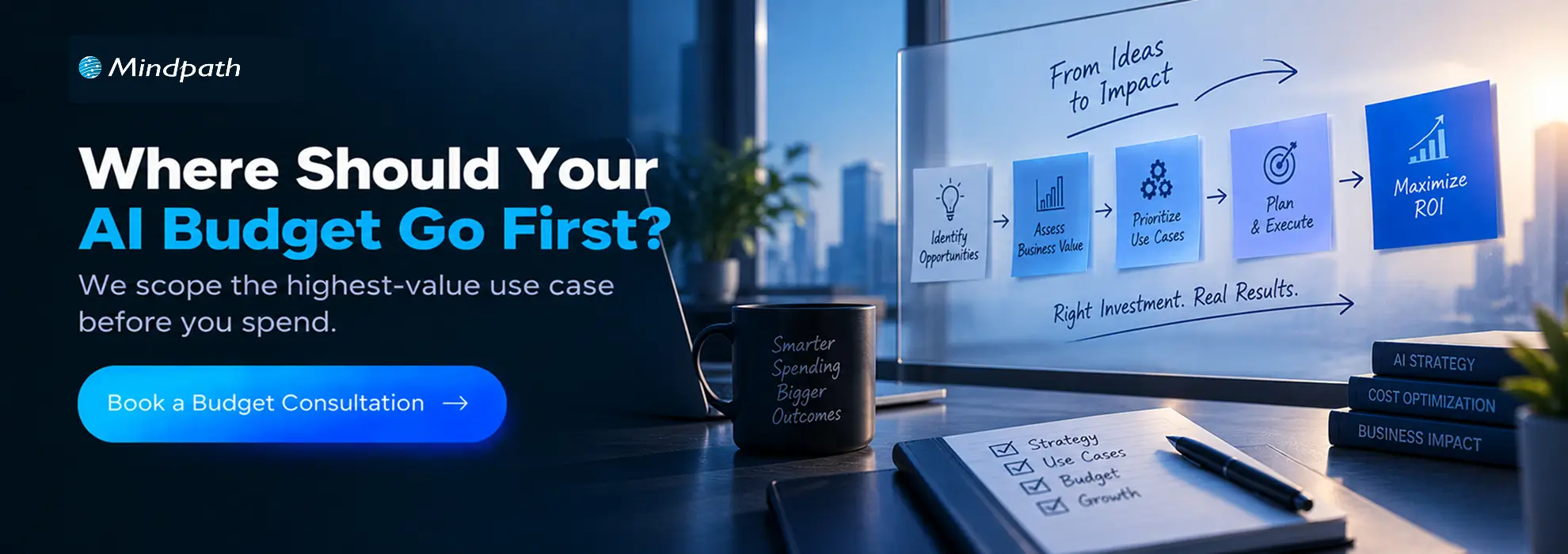
How to Plan an AI Budget for Your Business?

Knowing how to plan an AI budget helps businesses control spending while keeping their AI initiatives aligned with measurable goals. A structured approach also makes AI investment planning easier by showing where resources are needed at each stage.

1. Define Your Business Objective

Start by identifying the specific business problem AI should solve. A clear objective helps determine the right technology and required investment.

2. Choose the Right AI Use Case

Prioritize use cases that offer measurable business value. Starting with a focused use case can help control initial spending and validate results.

3. Assess Your Data Readiness

Evaluate the quality, availability, and structure of your existing data. This helps identify additional data preparation costs before development begins.

4. Estimate Initial and Recurring Costs

Calculate development, integration, infrastructure, and deployment expenses. Also include recurring costs such as cloud usage, maintenance, and support.

5. Set a Realistic Contingency Budget

AI projects can encounter unexpected technical or operational requirements. Keeping a contingency amount helps manage these expenses without disrupting the project.

6. Define Expected ROI

Set measurable outcomes before approving the investment. These can include cost savings, productivity improvements, faster processes, or increased revenue.

7. Plan for Future Scaling

Consider how costs may change as users, data, and AI workloads increase. A scalable budget helps businesses expand their AI capabilities without major financial disruptions.

What Hidden Costs of AI Should Businesses Consider?

AI costing should account for expenses that may appear after implementation. Understanding the hidden costs of AI helps businesses create a more realistic budget.

1. Employee Training

Teams may need training to use new AI tools effectively. This can add training and productivity costs.

2. Data Improvement

Existing business data may require cleaning or restructuring. Additional data work can increase implementation expenses.

3. Security and Compliance

AI systems may require stronger security controls and compliance measures. These requirements can add development and operational costs.

4. Ongoing Maintenance

AI solutions need regular monitoring, updates, and optimization. These recurring expenses should remain part of the long-term budget.

5. Third-Party Services

AI applications may depend on external APIs, models, or cloud platforms. Usage-based charges can increase as adoption grows.

6. Change Management

Employees may need support when workflows change after AI adoption. Proper change management can improve adoption and reduce implementation challenges.

7. Scalability Costs

Growing usage can increase computing, storage, and infrastructure requirements. Businesses should account for these expenses when planning future AI expansion.

How Does AI Investment Planning Support Better Business Decisions?

AI investment planning helps businesses allocate resources based on expected value, business priorities, and long-term requirements. It allows decision makers to evaluate AI opportunities before committing significant resources.

1. Prioritize High Value Use Cases

Invest in AI initiatives that address important business challenges. This helps direct budgets toward measurable outcomes.

2. Start With a Focused Investment

Begin with a manageable AI initiative before expanding across the organization. Early results can guide future investment decisions.

3. Balance Initial and Recurring Costs

Consider development expenses alongside infrastructure, maintenance, and usage costs. This provides a more accurate view of the total investment.

4. Align Investment With Business Goals

AI spending should support clear organizational objectives. This keeps technology investments connected to business growth.

5. Evaluate Scalability

Consider future users, data volumes, and operational requirements before selecting a solution. A scalable approach can reduce the need for costly redevelopment later.

6. Review Investment Performance

Track business outcomes against the original investment goals. Regular reviews help identify where additional funding can create greater value.

AI Budget Planning Across Different Project Stages

AI budgets change as a project moves from initial planning to full-scale deployment. Businesses should review AI costing at every stage to maintain better control over their overall investment.

Project Stage Key Budget Areas Business Focus
Discovery Strategy, research, and feasibility Identify the right AI opportunity
Proof of Concept Development, data, and testing Validate the solution and its potential
Development AI development, integration, and security Build a reliable business solution
Deployment Infrastructure, training, and implementation Introduce AI into daily operations
Scaling Cloud usage, maintenance, and optimization Support growing business requirements
Continuous Improvement Monitoring, updates, and enhancements Improve performance and long-term value

Ready to Build a Smarter AI Budget?

Effective AI budget planning helps businesses control costs, prioritize valuable use cases, and align AI investments with measurable goals for sustainable growth. Mindpath helps businesses build practical, scalable AI solutions aligned with their goals and budgets, from strategy and development to integration, deployment, and optimization.

Frequently Asked Questions

Unsure What Your AI Project Costs?

Get a clear scope and estimate before committing budget.

Frequently Asked Questions

Start with a clear business goal, prioritize valuable use cases, estimate ongoing expenses, and maintain a contingency budget for unexpected requirements.
Solution complexity, data readiness, system integrations, infrastructure requirements, security needs, and ongoing maintenance can significantly influence the overall investment.
Budget reviews should happen throughout the project lifecycle, especially during development, deployment, scaling, and major changes in usage or business requirements.
AI costing provides a clearer view of total expenses, helping businesses compare opportunities, prioritize investments, and plan resources according to expected business value.
Yes. Starting with a focused use case allows smaller businesses to control initial spending, measure results, and gradually expand successful AI initiatives.

Support Is One Click Away

Featured Posts

Related Post

Build MVP

The success of every business revolves around the products and services they offer to their target customers. Do you know what it takes to build a product that your customers will love and recommend to others? This is where every business, especially startups, must build a MVP to create the best products for their target audience. Building a minimum viable product provides a lean and targeted solution to gain market validation.

Many people must not be familiar with the fact that only one out of ten startups survive beyond ten years. The primary reasons for failure of startups include lack of research, presence in the wrong market and shortage of funds. You can leverage a MVP to find the feasibility of your product idea and strategically transform it into sustainable business. An overview of a step-by-step framework to create a MVP will help you see how simple it is to build one. 

Planning to turn your product idea into a testable MVP? Mindpath offers MVP development services to help startup businesses design and develop MVPs that deliver real user insights.

What is a Minimum Viable Product (MVP)?

A Minimum Viable Product (MVP) is the first functional version of a product that includes only its essential features. It allows businesses to validate their product idea, collect real user feedback, reduce development risks, and make informed decisions before investing in a full-scale product.

Why Should You Build a Minimum Viable Product?

The biggest reason for which businesses fail to create a successful product revolves around diving directly into product development. If you invest almost all of your resources in creating a full-fledged product and your customers don’t like it, then you end up with a disaster. Most of the business owners who don’t know the answer to ‘what is an MVP?’ end up facing such situations. The MVP is a primary or the most basic version of the product you want to offer to your customers. It includes only the essential features and functionalities that will help you gain feedback from real users.

Businesses can use their MVP to identify the demand for their product in the target market. The minimum viable product also helps in identifying features that your customers love. As a result, you can ensure that the final product reaches the right market and aligns with your customer’s requirements. Every business owner should create a MVP or minimum viable product to reduce risks and establish the foundation for long-term growth. It not only helps you validate your product ideas but also facilitates efficient resource allocation and earns the trust of investors and stakeholders. 

Ready to launch your MVP without delays? Visit our blog on hiring full-stack developers for MVP to learn how to find developers who can handle both front-end and back-end tasks with ease.

Unraveling the Ideal Framework to Build Your MVP

Any business owner with a product idea must follow a strategic approach to create their minimum viable product. You may assume that developing a MVP might come with a lot of technical complexities that are difficult to navigate. On the contrary, you can use the following steps to find the perfect roadmap to develop a minimum viable product for your business.

1. Identify Your Target Audience and Their Problems

The first step in building your MVP involves knowing your target audience and their requirements. It is important to remember that you are creating an MVP to identify whether your customers will like your product. Therefore, you should start with an understanding of the demographics and pain points of your target customers. 

The insights from market and user research can provide the foundation for developing a product that meets the needs and preferences of your customers. Once you have identified the problems of your target audience, you can decide how you want to solve them with your product. Understanding the requirements of your target customers will help you create a product that provides real value.

2. Leverage the Benefits of Market Research

You can successfully complete the first step of building a MVP by using the most effective approaches for market research. Businesses cannot just guess the problems their target customers might have and build a product based on assumptions. A review of the different examples of minimum viable product will show you that market research is a critical tool in MVP development. Comprehensive market research offers a granular view of the demographics and problems of your target audience. 

The more information you gain from market research, the more accurate your product idea will be. Market research not only helps you come up with the most effective product idea but also shows you what your competitors are offering. As a result, you can find different ways to make your product stand out from the crowd. Business owners should also know that having a strong product idea will help in attracting investors for their product.

3. Establish an Outline of Core Features of Your Product

After finalizing a product idea, you should start defining the core features and functionalities you need in your MVP. All the minimum viable product examples show how you should begin with an outline of basic features that your target market needs. The definition of core features for your MVP provides the ideal start to the process of creating a minimum viable product.

Once you have decided on the core features you want in the MVP, you should think about additional features. At this point of time in MVP development, you must also prioritize the features that you want to include immediately and the ones you can add later. Feature prioritization helps in enhancing the flexibility to define the optimal scope for your MVP development project. 

Must Read: MVP for Startups

4. Develop the Prototype and Your MVP

Many of you might be thinking about the necessity of building a prototype when you can build the MVP directly. The prototype serves as an early version of the minimum viable product and offers a clear impression of how it would work. The basic prototype will help you find how the user interface will look and how users will experience your product. You can also leverage the prototype for early testing and feedback, thereby allowing room for refining the design and functionality of the MVP before full-scale development. 

The successful testing and improvement of the prototype will lead you to your MVP. It is important to ensure that your MVP does not have any bugs and offers the best quality of customer experience. You should know that you have to introduce the MVP to your target users so that they can perceive the core value your product has to offer. During the development of the MVP, you must also specify the timeline and distinct milestones for the project.

5. Introducing Your MVP to Early Adopters

The most crucial step in the process of developing a MVP revolves around introducing it to the target users. Early users of the product can be regular customers or industry experts who represent your target audience and know your target market. Any guide on how to build a minimum viable product emphasizes the need for feedback from early adopters. The feedback from real users helps you determine whether your product is an ideal fit in the target market.

The best approach to ensure that your MVP reaches early adopters is through identifying communities of users. Professional networks, niche forums or social media communities are the top places where you can find the first users for your MVP. You should create open channels, such as dedicated forums or in-app surveys to gain feedback for your minimum viable product.

6. Collecting and Evaluating the Early Feedback

The feedback from early adopters for your MVP serves as a crucial resource to ensure that your product meets the expectations of users. You should use different types of feedback collection methods for your MVP product to obtain qualitative and quantitative data. The notable methods to collect feedback for your minimum viable product include surveys, usability tests and user interviews. 

Once you have collected the feedback, you should categorize it into different aspects of your product. You can use the feedback to learn about usability, performance and functionality of the MVP and identify areas for improvement. Your development team should analyze feedback data comprehensively to understand user preferences and challenges. The insights gained from feedback analysis will guide you through the process of iterative product development.

7. Continuous Iteration and Improvement

Understanding the feedback from early users provides the ideal ground to start refining your MVP according to user expectations. You cannot learn how to build an MVP without focusing on iteration or repeating the development process again. It involves planning, development, testing and reviewing the product repetitively by using feedback from real users. 

Developers can rely on user feedback to address the notable issues in the MVP and enhance its functionality. As a result, iteration serves as a valuable component in the MVP development process to improve the user experience. You should remember that engaging regularly with your target audience and using their feedback can help you achieve the right product-market fit.

Looking to bring your software idea to life without unnecessary delays or costs? Read our blog on MVP in software development to learn how to build, test, and refine your product efficiently.

Final Thoughts

The process to create a minimum viable product for your next big product idea follows a common set of steps. Irrespective of the industry, you can rely on professional MVP development services to translate your ideas into sustainable products. You can start by identifying your target audience and their problems, followed by comprehensive market research, to define the core features of the MVP. Subsequently, your development team can create the MVP and leverage feedback from early users to introduce necessary improvements.

Mindpath is one of the most popular platforms for providing MVP development services, with a successful record in helping various businesses. As a reliable MVP development company, we have helped startups and large corporations test their product ideas before full-scale development. Reach out to us for a free consultation and build your minimum viable product now.

benefits of ai

Can you envision a world where everyone works better, decisions are easier to make, and your team has more time to concentrate on important work? Well, this is the power behind the benefits of AI. A growing number of companies are discovering how AI can take away the recoil of repetitive, mind-numbing tasks while recognizing patterns of behavior that weren’t on your radar. These companies are now opening new opportunities that once seemed impossible!

This intelligent technology is enabling businesses to improve efficiency, satisfy customers, and keep pace with competition in an evolving marketplace. For large and small companies alike, it’s becoming a real growth engine. In this article, we will review the top 10 AI benefits for business and how they can help you unlock real, lasting growth. So, let us dive in!

Want to take advantage of AI technology to accelerate your business? Discover how Mindpath’s AI development services can help you with customized solutions that will boost the overall performance of the business.

What is Artificial Intelligence?

Artificial Intelligence (AI) is an intelligent technology that can execute tasks that, ideally, you would expect a human to do. Through AI, a system can learn from data, use that data to solve problems, make decisions, and understand and use human language.

AI is used in a wide variety of everyday tools and services today, from voice assistants and chatbots to advanced tools that help organizations analyze trends and automate business processes. One of the most prevalent areas of focus within AI at the moment is generative AI, which refers to the ability for these tools to create new text, images, videos, and more. AI, in its most basic form, is accomplished through the use of various technologies like machine learning and deep learning, which allow these systems to gain expertise while processing greater amounts of information.

What are the Benefits of AI for Business?

AI and business are becoming more connected than ever, opening up fresh possibilities for companies of all sizes. Understanding the artificial intelligence business benefits can help you see why so many organizations are investing in this smart technology. Let’s explore how AI helps businesses make the most of these opportunities.

1. Enhanced Customer Experience

One of the biggest advantages of AI in business is making customers happier. AI can give quick answers through chatbots any time of day. AI in customer services also learns what customers like and gives ideas just for them. This is how AI improves customer experience and keeps people coming back.

2. Smarter Business Decisions

A key example of how AI helps businesses is by supporting better decision-making. AI in decision-making can quickly study large amounts of data and find important patterns that people might miss. Teams can use AI tools to get clear answers without spending hours on research. This makes it easier for businesses to make confident, informed choices.

3. Increased Work Efficiency

AI helps teams complete tasks faster by taking care of repetitive work. It can handle things like data entry and report creation with fewer mistakes. This gives employees more time for important and creative tasks. In the end, everyone works more efficiently and gets better results.

4. Boosts Business ROI

One way AI increases ROI is by helping companies save time and money. AI can do tasks faster and with fewer mistakes. This means businesses spend less and earn more money. Over time, AI helps companies grow their profits in smart ways.

5. Improved Team Accessibility

A clear reason why businesses should adopt AI is that it is now easy for everyone to use. Employees do not need coding skills to work with AI tools. They can simply use everyday language to get help from AI. This makes it possible for more people to help improve how work gets done.

Are you missing out on the benefits AI can bring to your business? Learn how the role of an AI consultant helps organizations drive digital transformation and make smarter, faster decisions.

6. Greater Accuracy and Quality

AI helps keep work accurate by doing tasks the same way each time. It handles things like data and numbers without small slip-ups. AI can also catch and fix mistakes before they grow into bigger problems. Over time, it learns and makes work even more reliable.

7. Expanded Business Capabilities

One of the key advantages of AI in business is that it opens up new ways of working. AI can understand complex or messy data that older tools cannot handle. This makes it possible to automate tasks like reading emails and handling customer questions. It helps businesses operate more smoothly and achieve better results.

8. Improved Workplace Environment

AI helps employees by making their daily work easier and smoother. It takes care of boring tasks like data checks or planning work. This gives people more time for important and interesting projects. When work feels better, people stay happier and more engaged.

9. Enhances Innovation and Growth

AI supports teams in developing new ideas for products and services. AI trends can analyze past and current demand patterns to identify future opportunities. This helps companies plan more effectively and stay ahead in their industry. By using AI, businesses can drive continuous innovation and sustainable growth.

10. Scalable Business Operations

Using AI for digital transformation makes it easier for companies to scale their work. Cloud-based AI tools can read, write, and interact to support many tasks. They adjust quickly when business needs or workloads grow. This helps organizations expand without always needing more staff.

Is your business ready for the AI revolution? Explore our blog on AI is transforming the future, to see how AI is reshaping industries and everyday life.

Use Cases of AI in Business

AI is now part of everyday work for many companies. It helps businesses work smarter and stay ahead in a busy market. Here are some practical ways AI is used in business today.

1. Enhanced Customer Engagement

AI helps companies understand and connect with customers in smarter ways. It shares helpful ideas, predicts what people may want, and makes communication smoother. This keeps customers happy and loyal.

2. Employee Skills Development

AI shows what skills employees need and suggests good training options. It helps people learn and grow in their roles. This keeps teams ready for new challenges.

3. Streamlined Operations

AI takes care of repetitive tasks, so employees can focus on more valuable work. It helps use time and resources wisely. This keeps daily work running smoothly.

4. Valuable Market Insights

AI studies large amounts of data to spot what customers like and what trends are changing. It gives useful information for making better business plans. This helps companies stay competitive.

5. Increased Team Productivity

AI handles small, time-consuming tasks so employees can work on bigger projects. It supports tasks like notetaking and email management. This helps teams work better together.

Want to leverage AI in your business but unsure which programming languages make it possible? Read our blog on AI Programming Languages to understand the tools behind AI solutions and how they can drive growth for your company.

6. Support for Creative Work

AI brings fresh ideas for design, writing, and planning. It makes creative tasks faster and easier to manage. This helps teams deliver high-quality work.

7. Improved Data Security

AI monitors online threats and finds problems early. It helps protect important company and customer data. This keeps the business safe every day.

8. Personalized Customer Service

AI learns what people like and offers suggestions tailored to them. It helps match customers with the right products or services. This makes customers feel special and keeps them coming back.

9. Better Strategic Decisions

AI in business strategy reviews lots of information and finds helpful patterns. It supports leaders in making smart choices for the future. This makes business planning stronger and clearer.

10. Stronger Talent Acquisition and Management

AI helps companies find the right people by reviewing resumes and spotting good fits. It also helps keep employees satisfied with their roles. This helps businesses build strong teams.

How is AI reshaping the way websites are built and optimized? Explore our detailed article on AI in Web Development to see how it’s driving smarter design, faster deployment, and better user experiences.

Looking to Unlock the True Benefits of AI?

The benefits of AI are transforming how companies operate, grow, and stay ahead in today’s fast-moving market. From happier customers to smarter choices and better teamwork, AI brings practical advantages that help businesses do more with less effort. By understanding how to use AI well, your company can boost efficiency, spark new ideas, and unlock real growth for the future.

Partner with Mindpath, providing expert AI development services to turn these benefits into reality for your business. Our team designs smart, custom AI solutions that automate work, improve decision-making, and create new ways for you to succeed. Let’s shape the future of your business together with intelligent AI tools built to deliver lasting results.

Discover how AI is transforming the world. Explore the top 10 benefits of artificial intelligence, from solving complex problems to enhancing customer experiences.
how generative AI is transforming business

The generative AI revolution is changing the business landscape. From design automation to optimized operations and improved client experience,  GenAI is enabling new opportunities across the spectrum of industries. Companies now leverage this technology to not only save uptime, but to innovate more rapidly, customize and provide service to their consumers more favorably, and remain competitive in an ever-expanding digital world.

Generative AI allows machines to learn patterns and create new output in a number of ways. Businesses are now adapting to this change and thinking about how they can move forward in a new way. It is gradually becoming a key part of business innovation and digital evolution. In this blog we will discuss the growing influence of GenAI and its role in transforming the modern business environment. To begin with, let us have an understanding of GenAI.

Looking for ideas to reshape your business with generative AI? Unlock smarter growth, faster innovation, and personalized customer experiences with our robuts and scalable Gen AI development services.

What is Generative AI?

Generative AI is a form of artificial intelligence that can generate new things, such as text, images, music, or video, by learning from existing data. For example, if you give 1,000s of product descriptions from an online store, it will generate completely new and unique product descriptions for similar products, all by itself. GenAI does this by looking at patterns and learning about how things can be constructed so it can produce something new that looks very realistic.

This type of technology is spreading and evolving rapidly across the globe. A research from Statista shares that the market size of generative AI is expected to be US$66.89 billion in 2025, with annual growth of 36.99% every year, reaching a market size of US$442.07 billion by the year 2031. Among all countries, the United States is estimated to have the largest market size in 2025 at US$21.65 billion.

How Does Generative AI Work?

Generative AI uses neural networks to examine existing data to identify patterns and create new data that appears to be real. Most generative AI models utilize an unsupervised or semi-supervised learning process that is less of a hurdle, because it tends to require a broad array of unlabeled data. Consequently, it becomes much simpler for organizations to develop more powerful AI systems.

Generative AI examples can be seen in all businesses today. For example, Jasper is a tool that helps marketers create blog posts or advertising copy, and DALL·E creates images based on simple text descriptions. These foundation models make it possible to perform tasks like writing, designing, or summarizing in seconds, improving speed and creativity.

Want to stay ahead in the rapidly evolving world of GenAI? Explore the top Generative AI Trends shaping the future of development and strategy.

How is Generative AI Transforming Business?

The generative AI revolution is changing the way companies operate, innovate, and treat their customers. With generative AI in business, tasks which took hours can now be completed in minutes, increasing speed and creativity for teams. Here’s the way it is changing the business world:

generative ai for business

1. Boost Creativity for Marketing and Innovation

GenAI is changing creative industries by bringing ideas to life faster by offering design concepts and fresh content ideas. This supports quicker campaign launches and product development. It also gives teams more time to focus on refining ideas or exploring new ones. As a result, human creativity grows while the creative process becomes faster and more effective.

2. Enhance Customer Support

The GenAI revolution is helping businesses improve customer service like never before. Instead of making customers wait for answers, generative AI can quickly find the right solution by pulling information from many sources. It also creates clear post-call summaries, making support faster, more accurate, and more personalized, leading to better customer satisfaction and trust.

3. Improve Sales Communication with Smart Insights

The economic potential of generative AI is clear in sales. It can write call summaries and follow-up emails, helping reps spend more time with customers. Sales managers can track how well AI-generated messages perform, like whether they speed up deals or increase order values. This leads to better sales processes and stronger customer communication.

Wondering how GenAI for business can be your key to success? Generative AI for business enhances innovation, and streamlines operations—thus empowers companies to stay competitive and get future-ready.

4. Boost Content Creation for Better Productivity

Generative AI helps businesses create high-quality content quickly by providing first drafts in just a few seconds. This allows teams to produce more sales messages, marketing content, and product documents in less time. As a result, companies can respond faster to customer needs while giving employees more time to focus on building stronger customer connections.

5. Create Personalized Customer Experiences

The role of AI in business growth and human empowerment is very clear when we think of how it can assist businesses in creating personalized customer journeys. By understanding their customer data, likes/dislikes, and behaviors, GenAI makes it easy for businesses to create personalized suggestions and relevant content. AI personalized customer experiences can truly bring better connections, embed customer loyalty, and create a better experience for everyone involved.

6. Speed Up Development with Smarter Coding

Generative AI applications can help developers save time by writing routine code and automating common tasks. The role of GenAI in app development brings unexpected benefits such as boosts productivity, reduces errors, and keeps projects on track. It also supports non-technical teams through no-code and low-code tools, making app creation easier for everyone, not just engineers, and allowing more people to contribute to digital solutions.

Ready to Embrace the Generative AI Revolution in Your Business?

The generative AI revolution is creating exciting new possibilities across industries by helping businesses work faster, smarter, and more creatively. From personalized customer experiences to automated content and improved development, generative AI is no longer a future trend; it’s the present opportunity. Now is the time to explore how it can redefine the way your business operates and grows.

At Mindpath, we offer smart and scalable GenAI solutions that help businesses unlock real value. From custom AI applications to intelligent automation and personalized customer engagement tools, our AI development services help businesses fuel innovation, boost productivity, and empower teams. Let us help you stay ahead in this fast-changing digital world with cutting-edge generative AI services..