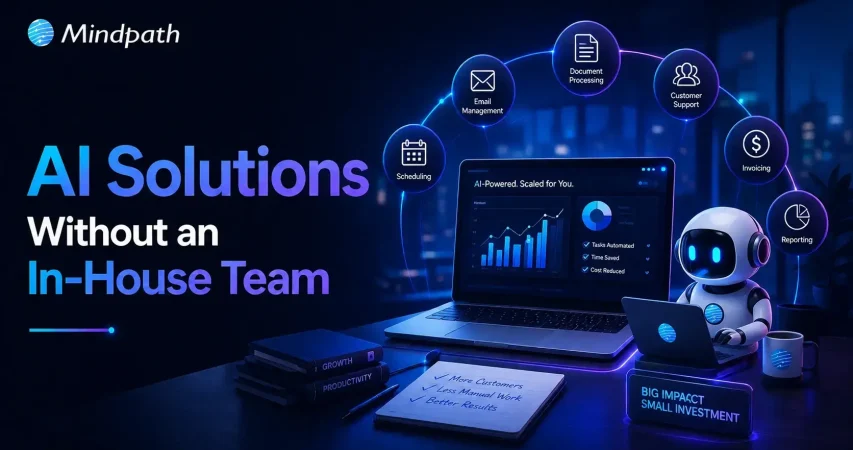
Businesses of every size now recognize artificial intelligence as a practical tool for improving operations and customer experiences. However, many smaller organizations assume successful adoption requires hiring expensive AI specialists and building dedicated internal teams before starting their transformation journey.
Key Takeaways
- 01
SMBs can successfully adopt AI without hiring dedicated in-house AI specialists. - 02
Focusing on one high-impact business challenge delivers faster, measurable AI results. - 03
Experienced AI development partners simplify implementation, deployment, maintenance, and long-term optimization. - 04
Cloud-based AI platforms reduce infrastructure costs while enabling secure and scalable deployments. - 05
Regular monitoring, updates, and optimization ensure AI solutions remain accurate, reliable, and valuable over time.
The reality looks very different today because experienced technology partners, cloud platforms, and ready-to-use AI services simplify implementation. AI for small and medium businesses has become accessible through outsourcing, allowing organizations to deploy practical solutions without maintaining large in-house AI departments.
Need AI expertise without building an in-house team? Mindpath Tech offers AI development services to help SMBs build and deploy scalable AI solutions without the extra hiring costs.
Why are SMBs Investing in AI Today?
Small and medium businesses face increasing pressure to improve productivity while controlling costs and maintaining competitive customer experiences. AI offers practical opportunities to automate repetitive work, analyze business data, and support faster decision-making across different business functions.
Recent advances in cloud computing, large language models, and managed AI platforms have significantly reduced implementation complexity. Instead of building everything internally, businesses can work with specialized development partners that provide technical expertise throughout the project lifecycle.
- 80% to 89% of SMBs use AI daily. (Forbes)
- 50% to 68% of marketing teams automate content creation with AI. (Booth Associates LLC)
- AI software spending continues to grow as SMBs prioritize scalable generative AI solutions. (Gartner)
Why are In-House AI Teams No Longer Essential?
Many organizations believe AI success depends on hiring data scientists, machine learning engineers, and AI architects. While these professionals remain valuable, modern AI development offers alternative approaches that reduce staffing requirements.
1. Cloud AI Platforms Simplify Development
Leading cloud providers offer managed AI services requiring minimal infrastructure management. Businesses can focus on solving operational problems instead of maintaining complex technical environments.
2. Pre-Trained AI Models Reduce Development Time
Modern foundation models already understand language, documents, and business workflows. Developers can customize existing models instead of building entirely new systems.
3. Experienced AI Partners Provide Specialized Expertise
External AI specialists bring proven implementation experience across multiple industries and business environments. This reduces learning curves while improving project quality.
4. Scalable Engagement Lowers Operational Costs
Companies only pay for the expertise they need during planning, development, deployment, and optimization. This eliminates the cost of maintaining a permanent in-house AI team.
5. Faster Deployment Improves Business Value
Established AI development processes shorten implementation timelines while reducing technical risks. Businesses begin seeing measurable improvements much sooner.
6. Ongoing Support Remains Available
Reliable AI development partners continue monitoring, updating, and optimizing AI systems after deployment. This allows internal teams to focus on core business activities instead of managing complex AI maintenance.
What Challenges Do SMBs Face Without AI?
Many businesses delay AI adoption because they believe limited resources prevent successful implementation. Understanding these challenges helps organizations choose practical solutions instead of postponing innovation.
1. Limited Technical Expertise
Most businesses lack experienced AI professionals within their existing technology teams. Recruiting specialized talent often requires significant investment and lengthy hiring processes.
2. Budget Constraints
Building internal AI capabilities involves recruitment, infrastructure, training, and software licensing expenses. Smaller organizations usually prefer predictable project-based investments.
3. Unclear Implementation Strategy
Many businesses understand AI’s potential but struggle to identify suitable business problems. Poor planning often results in delayed projects and limited business outcomes.
4. Data Preparation Challenges
Business information frequently exists across multiple systems with inconsistent formats and quality. Preparing reliable data requires structured planning before implementation begins.
5. Integration with Existing Systems
AI solutions must connect smoothly with existing business applications and operational workflows. Poor integration reduces adoption and overall business value.
6. Long-Term Maintenance Concerns
AI systems require monitoring, updates, and performance improvements after deployment. Many organizations worry about supporting these responsibilities internally.
How Can SMBs Build AI Solutions Without an Internal AI Team?
Building AI successfully starts with solving real business challenges instead of pursuing technology trends. A structured implementation approach helps businesses reduce risks while achieving measurable operational improvements.
1. Identify a High-Value Business Problem
Begin with one operational challenge that creates measurable business impact.
- Focus on Repetitive Tasks
Automation delivers faster improvements with lower implementation complexity. - Measure Business Impact
Select problems affecting costs, productivity, customer service, or revenue. - Avoid Overly Complex Projects
Smaller projects reduce implementation risks and accelerate business learning. - Gather Stakeholder Input
Teams understand existing workflow challenges and improvement opportunities. - Define Success Metrics
Establish measurable business outcomes before development begins.
2. Partner with an Experienced AI Development Company
External expertise reduces technical complexity while accelerating implementation.
- Access Experienced Specialists
Proven experts avoid common implementation mistakes. - Receive Strategic Guidance
Experienced partners recommend practical AI approaches. - Reduce Recruitment Costs
Businesses avoid expensive permanent hiring requirements. - Improve Project Quality
Established development practices deliver reliable business solutions. - Gain Ongoing Technical Support
Expert assistance continues after successful deployment.
3. Start with Cloud-Based AI Services
Cloud platforms simplify deployment while reducing infrastructure investments.
- Lower Initial Costs
Businesses avoid purchasing expensive computing infrastructure. - Scale When Required
Resources increase alongside business growth. - Improve Reliability
Cloud providers maintain secure and highly available environments. - Deploy Faster
Existing AI services significantly shorten implementation timelines. - Simplify Maintenance
Infrastructure management remains largely handled by the cloud provider.
4. Build an MVP Before Expanding
Start small before investing in broader organizational automation.
- Validate Business Value
Early feedback confirms practical business benefits. - Reduce Implementation Risks
Smaller deployments identify improvement opportunities quickly. - Collect Employee Feedback
Users provide valuable recommendations for future enhancements. - Improve Adoption
Teams become comfortable using AI gradually. - Expand Strategically
Successful pilots guide future AI investments confidently.
5. Continuously Optimize AI Performance
AI implementation remains an ongoing business improvement process.
- Monitor Performance Regularly
Review business outcomes using measurable performance indicators. - Update Business Data
Fresh information improves AI accuracy consistently. - Refine Workflows
Operational improvements increase long-term business value. - Strengthen Governance
Maintain responsible AI usage through clear internal policies. - Plan Future Expansion
Successful projects create opportunities across additional departments.
What AI Solutions Deliver the Greatest Value for SMBs?
Not every AI project requires significant investment or complex technical implementation. The best AI solutions for small businesses focus on improving everyday operations while delivering measurable returns within reasonable implementation timelines.
1. Customer Support Chatbots
Automate customer interactions, answer common questions, and provide faster support around the clock.
2. AI Document Processing
Extract, organize, and process invoices, contracts, forms, and business documents with greater accuracy and efficiency.
3. Predictive Analytics
Analyze historical business data to forecast trends, optimize inventory, and support better decision-making.
4. Intelligent Sales and Marketing Automation
Automate lead qualification, personalized campaigns, customer segmentation, and follow-up activities to improve conversions.
5. AI-Powered Knowledge Management
Centralize business information and provide employees with instant access to accurate answers through AI-powered search.
6. Workflow Automation
Streamline repetitive processes across finance, HR, operations, and customer service to improve productivity and reduce manual work.
These AI solutions demonstrate how AI for small and medium businesses delivers measurable business value without requiring extensive in-house technical expertise. Organizations can successfully implement AI by partnering with experienced technology providers that manage planning, development, deployment, and ongoing optimization.
Businesses that choose outsourced AI development gain faster access to specialized expertise while reducing recruitment costs, implementation risks, and project complexity. This approach enables SMBs to adopt AI confidently, even with limited internal resources.
Ready to Build AI Without an Internal AI Team?
Artificial intelligence is no longer limited to large enterprises with dedicated research teams and extensive technology budgets. Today, AI for small and medium businesses enables organizations to automate operations, improve productivity, and deliver better customer experiences by partnering with experienced AI development companies.
Looking to build AI solutions without expanding your internal team? Mindpath offers AI consulting services that help SMBs design, develop, deploy, and optimize customized AI solutions tailored to their business goals. Our experienced AI specialists deliver secure, scalable, and cost-effective AI applications that accelerate innovation while reducing implementation complexity and long-term operational risks.