Agentic AI vs Generative AI – Understanding Key Differences

Join our Newsletter!

Featured Posts

Support Is One Click Away

Home

Agentic AI vs Generative AI – Understanding Key Differences

Agentic ai vs generative ai

Agentic AI vs Generative AI – Understanding Key Differences

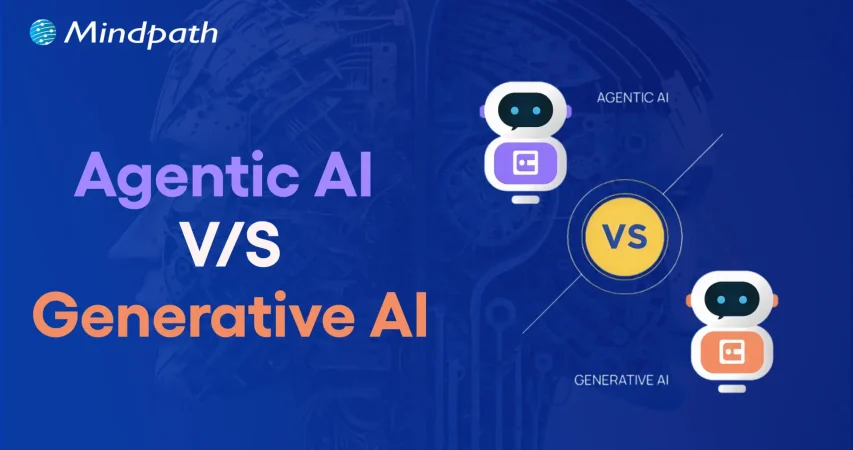
Artificial intelligence created the biggest ripples in the domain of technology in the last decade. Following the adoption of generative AI tools, there is a new type of AI that showcases how artificial intelligence continues evolving. The agentic AI vs generative AI comparison has become a hot topic of discussion for businesses worldwide. Which one do you think delivers the best of AI for your business?

Since the public release of ChatGPT, many businesses have gradually incorporated generative AI in their workflows. However, agentic AI emerged as a practical solution to address the unrealistic expectations users had from generative AI. Is agentic AI better than generative AI? You should know that each one of them has distinct strengths for optimizing professional business practices.

If you are looking to build innovative AI solutions that help enhance your business performance. Explore Mindpath AI development services to see how you can leverage the best through our expertise in agentic and generative AI.

Understanding the Definition of Generative AI

Many people would think of ChatGPT and other tools like Midjourney upon hearing generative AI. How can you define generative AI in the present context? You can assume that generative AI refers to the variant of artificial intelligence that focuses only on creation. Take a generative AI tool and imagine something that you want to create, such as an image or a letter to your friend. All you have to do is offer instructions and it can create your image or letter. 

How does generative AI create something new from your instructions? The core design of generative AI or gen AI revolves around models learning from existing data. Generative AI models use the knowledge gained from their training to create new output that features some elements of human creativity. 

You must have searched for ‘what is gen AI’ after learning about the mainstream adoption of ChatGPT, DALL-E and other generative AI tools. The effectiveness of these tools revolves around advanced machine learning models or neural networks to understand and recreate the patterns from their training dataset.

Even with the widespread adoption, generative AI does not come without limitations. The outputs by generative AI systems are as accurate and relevant as the data used for their training. On top of it, generative AI is not capable of making decisions on its own and just creates from the patterns it has learned.

Wondering how your business can leverage AI to stay competitive? Discover generative AI for business to learn how intelligent systems drive innovation, efficiency, and growth.

Emergence of Agentic AI

The quest to solve the limitations associated with gen AI led to the creation of agentic AI. With the use of smart agents, AI switched to proactive functionality from its traditional reactive nature. You can define agent AI as a new variant of artificial intelligence that focuses on specific tasks and autonomous operation. Smart AI agents will not only generate outputs based on your instructions but also learn in real time, make decisions, and implement actions required to achieve your goals. 

One of the most distinctive highlights of agentic AI, which makes it capable of autonomous decision-making, is adaptability. The best example of agentic AI is evident in agents used for customer support or in the infrastructure of autonomous vehicles. AI agents use sensors and algorithms to understand the environment and process information, followed by executing actions with different degrees of human oversight.

You can understand the answers to “what does agentic AI mean” in the fast-paced digital landscape by identifying how it acts with a purpose. Agentic AI is not only about responding to input like generative AI. On the contrary, AI agents understand the objectives and make informed choices to achieve the specific goals.     

Curious how Agentic AI and Generative AI fit into the broader AI landscape? Explore types of Artificial Intelligence to discover how ANI, AGI, and ASI provide the foundation for advanced AI systems.

Unraveling Key Differences in the Agentic AI vs Generative AI Debate

The arrival of agentic AI represents a major paradigm shift in the domain of artificial intelligence after generative AI. At the same time, you cannot ignore how generative AI is the most effective option for content creation. Therefore, an overview of the differences between agentic and generative AI is essential to pick the right option for your requirements.

1. Core Objectives

The foremost point in any generative AI vs agent AI comparison shall focus on the core purpose of the two types of artificial intelligence. Generative AI emphasizes creation and its core purpose is to create original content from user instructions. You can create images, draft emails or generate marketing materials with generative AI. The primary value proposition offered by generative AI revolves around augmenting the creativity of humans. Generative AI aims to achieve its purpose with the help of pattern matching and linguistic fluency.

Agentic AI works with the core purpose to achieve the goals assigned to it. The primary goal of agentic AI exceeds beyond content creation and aims to achieve a broader set of specific goals. The role of AI agents is to work autonomously without waiting for your prompts, which empowers them to identify opportunities and make relevant decisions. You can find answers to ‘what is agent AI vs generative AI’ in the fact that agentic AI can come up with different strategies and pick the right one to achieve the defined goals. For example, agentic AI use cases in software testing not only focus on writing test cases but also adopt a proactive approach to ensure software quality.

2. Dependence on Prompts

You wouldn’t get any prizes for guessing that generative AI is highly dependent on prompts. Generative AI has been designed to be reactive, which means that it responds only to user queries or prompts. You can have the most sophisticated LLMs in your generative AI systems and they won’t do a thing without human inputs. It clearly shows that generative AI is not capable of identifying problems or initiating conversations on its own. The reliance on prompts creates a significant roadblock for expanding the utility of generative AI. As a result, the most sophisticated generative AI models also need human oversight for every decision.

The difference between generative AI and agentic AI is evident in the fact that agentic AI has been designed for autonomy. AI agents operate within specific constraints to achieve defined goals albeit with complete autonomy. Agentic AI knows exactly when it must execute an action and determines the ideal strategy that can help in achieve the desired goal. You can notice the autonomy of agentic AI in how they leverage adaptive behavior and sophisticate decision trees in their architecture. Upon encountering problems, AI agents know how to solve them independently without human intervention.      

3. Use Cases in Real World

Another point of comparison between agentic AI and generative AI draws attention towards their utility. Generative AI has become the preferred choice for creative and analytical tasks that require human oversight. You can notice most of the use cases of generative AI in content creation and code generation. In addition, it also serves as a promising tool for design and visual creation by translating your ideas into real art. Businesses have also adopted generative AI as a promising solution for complex data analysis tasks to generate valuable insights.

The agentic AI vs generative AI comparison shall also showcase the growing use of AI agents in business functions. Agentic AI can streamline autonomous software testing with its capability to adapt to changes in the software application. Similarly, you can find successful examples of agentic AI applications in supply chain optimization. The other prominent use cases of agentic AI include algorithmic trading and robotic process automation.  

4. Workflow of Agentic and Generative AI

Most of the discussions on differences between agentic and generative AI also emphasize how the two variants of AI work. Generative AI works by providing unidirectional responses according to your input. For example, you provide instructions to generate an image and generative AI will create the image for you. Generative AI does not retain persistent memory or understand the objective you are pursuing as it focuses solely on the immediate instruction. It is one of the reasons for which using generative AI in multi-step processes involves human intervention at every stage.

Agentic AI stands out as the solution where generative AI poses problems. You can understand the difference between generative AI and agentic AI clearly in the various applications of agentic AI. Smart AI agents are capable of handling complex tasks that involve multiple steps and require memory retention. Agentic AI can maintain state across different interactions and track the progress made towards the defined objectives. Subsequently, it can adapt strategies on the basis of results in the intermediate steps to achieve the final goal.  

Looking to leverage the power of both autonomous and creative AI systems? Learn the benefits of AI to explore how Agentic and Generative AI together can transform strategy, operations, and customer engagement.

The following table showcases the notable differences between generative AI and agentic AI.

CriteriaGenerative AIAgentic AI
Core ObjectivesGenerative AI aims to augment the creativity of humans by facilitating faster content creation.Agentic AI aims to achieve the defined goals with autonomous action.
Dependence on PromptsGenerative AI is highly dependent on prompts.Agentic AI can take autonomous decisions without prompts.
Use CasesGenerative AI is useful for content creation and data analysis tasks.Agentic AI is useful for autonomous software testing, algorithmic trading and robotic process automation.
WorkflowGenerative AI works by offering single-shot response to user instructions or queries.Agentic AI works with complex and multi-step workflows by adjusting strategies to achieve defined goals. 

Final Thoughts

The differences between generative and agentic AI reveal how artificial intelligence offers two distinct solutions to achieve different business goals. If you want to create content, generative AI is your best pick. On the other hand, you should choose agentic AI when you need your AI systems to work independently on specific tasks. The overview of the generative AI vs agent AI comparison can help you pick the ideal AI for your business.  

Mindpath is a leading platform to provide AI development services tailored to your business requirements. We also specialize in developing generative AI models to help you achieve promising improvements in productivity. Our ability to identify the pain points of the client and understand their vision helps us create the most relevant solutions. Reach out to us and give your business an additional edge in the AI revolution now.
Related Post

Explore how Generative AI in Human Resources is revolutionizing recruitment, making HR processes smarter and more efficient.
Master full-stack development with Node.js! Its scalability, performance, and seamless frontend-backend integration.

Related Post

Hire education software developers
Are you Looking to hire the best education software developers? The difference between success and failure lies in finding the right talent. This blog will guide you with practical steps and insights into how to hire the right education software developers. Educational software is changing the outlook of learning with the introduction of technology in the classroom. It provides many tools and applications geared toward making learning more fun and effective in a classroom or through online learning. They include interactive games, simulations, and learning management systems, which help to adapt to your individual learning style and keep track of your progress. These may range from cost-effective solutions for schools to the personalization of learning experiences by students. This blog explores different types of educational software, their benefits, and growing importance in modern education. Education software developers are essential in delivering new learning solutions that will suit diversified educational needs. Such developers design exciting, tailored software that will enable institutions to go beyond the barriers of traditional learning and offer more interactive and accessible experiences. With the right team, any educational institution will be updated regarding the evolution of technologies and deliver high-quality education. Let us walk you through expert strategies and essential steps to find and recruit top-tier education software developers. 

Steps to Hire Education Software Developers   

1. Define Clear Needs and Objectives 

Be clear about the needs and goals that your organization wants to fulfill before any hiring. Determine whether you’re looking for web application-oriented developers or a UI designer. Since personalization features in an online learning environment are very important, the requirements should be focused on the position and objectives of your company in the EdTech industry. Define your project scope by determining whether you will create a new web application or improve the user interface of an existing platform to identify necessary skills. 

2. Conduct Rigorous Vetting Process 

Finding the right kind of talent is hard in this busy online world, but Aloa, Google, and LinkedIn will help in this regard. One of the most important decisions for any startup entering the field of EdTech would be whether to build in-house or to outsource. In-house development brings more control directly to the fingertips, thereby providing customization and quicker changes. On the other hand, outsourcing brings outside expertise and can be more cost-effective. 

3. Create A Job Description 

A detailed description of the job is one of the most important aspects in the acquisition of the right candidates. Clearly indicate what kind of responsibilities, skills, and experience will be required, with major emphasis on web application development, UI design, and knowledge of online learning. In such a well-written description of a job, there is an articulate roadmap for potential candidates to evaluate their fit for roles in education software development. 

4. Perform Virtual Interviews 

Virtual interviews provide an efficient way to connect with a global talent pool for education software development. They allow you to evaluate candidates’ understanding of online learning environments, self-education mindset, and potential contributions. This step is crucial for assessing both practical skills and cultural fit. 

5. Reviewing Portfolios and Skills 

In the case of a candidate who has worked on education software creation, this should be evident through their portfolio. The relationship with the candidate’s previous projects shows skills in the development of web applications, UI design, and personalization. Previous work should reflect clearly an understanding of the online learning environment and meet modern learners’ needs. 

6. Ensure Legal Compliance 

Ensuring compliance with legal regulations is essential when hiring educational software developers. This includes clear contracts outlining work scope, intellectual property rights, and confidentiality, to prevent disputes. Protecting user data by adhering to privacy laws like GDPR is crucial, and following employment laws ensures fair treatment of employees. Proper legal compliance safeguards both parties and avoids future legal issues. 

Considerations While hiring Education Software Developers     

1.  Expertise in the Development 

While considering recruiting professionals to education software development, people with a deep understanding of education and technology must be the most prospective candidates. You should seek professionals who have deep expertise in software development and an under­standing of fine details of education. This will enable them to create pedagogically relevant solutions that leverage the best of technology. 

2. Strong Collaboration and Communication Skills 

Seam­less collaboration in the cre­ation of education software so­lu­tions, in­volv­ing de­velopers, educators, de­signers, and other profes­sionals, calls for cross-functional teams. Effective­ commun­i­cation skills play a huge role in trans­lat­ing complex technical te­rms into easily un­der­stand­able language­ for non-technical stake­hold­ers. As­sess peo­ple based on their tech­nical prow­ess and how well they can function in a team that values com­mu­n­i­ca­tion. 

3. Innovations and Adaptability 

Developers in the fast-moving education software field should be abreast of new technologies and trends. Seek those with experience in change and the ability to innovate in fulfilling educational needs. It is precisely this ability to evolve with technology and create new solutions that sets people apart in education software development. 

4. User-Centric Focus 

Education software is aimed at enhancing learning. Hire education software developers for whom this would be the top priority, delivering user experience and learner outcomes with a strong sense of empathy toward educators and learners. This would ensure intuitive and effective software solutions. 

Mindpath has the expertise to help you succeed.

Searching for the best education software developers to transform your e-learning vision into reality?

How can Mindpath Help You Hire the Best Education Development Software? 

Mindpath is here to help in hiring the best developers for creating educational software that will meet your needs. We understand the fact that education is constantly evolving and is changing with the wind; it needs the best technologies to survive the race. That is the reason we offer the facility to hire top developers for creating such software to fulfill your educational goals. Our team connects you to experienced developers who have expertise in developing educational platforms, Learning Management Systems (LMS), and school management software. Such professionals help in designing software that allows both student and educator engagement through the latest technology. 

At Mindpath, we take pride in our educational technology experience. We’re quite sure user-centered software development makes our developed solution intuitive and easy to use. We provide scalable solutions, which will grow with your institution according to your needs. We keep providing technical support and maintenance to the developed software to make it keep upgrading and secure. Choosing Mindpath means you get a partner who is dedicated to making you succeed.  

Conclusion  

It is a fast-changing environment for education software technology, developers become very instrumental in shaping the future of learning. With emerging trends in artificial intelligence, virtual reality, and personalized learning platforms, among others, now more than ever is the need for skilled developers who can bring these innovations to life. Developers are not just writing software; they are building tools that will define a new way of teaching and learning. 

By choosing Mindpath, you tap into a talent network of peer developers who understand the challenges and opportunities that exist in education technology. Our vetting process assures that the developers you intend to hire would be with the right skill set, experience, and mindset moving your projects forward. With our support, you can build a team capable of developing cutting-edge solutions that will enhance learning outcomes, help in positioning your institution as a leader in the education software.

Ready to Transform Your Educational Software?

Mindpath specializes in connecting you with top education software developers who can bring your vision to life.

Discover expert strategies to hire top education software developers and create innovative solutions that enhance learning experiences and adapt to new trends.
react development company

Have you ever pondered why most of the businesses are in search of React development company? Are you curious to know why choosing the right development partner is important? If yes, you’ve reached the right place!

React, a JavaScript library that was developed by Facebook, is very popular for the development of fast and interactive user interfaces. It has a component-based structure and offers flexibility for developers to put out smooth, scalable and high performing web applications. It focuses on creating interactive elements for web applications, particularly single-page applications (SPAs), where content updates dynamically without reloading the page. Due to these benefits, many businesses are relying on React to enhance their digital experience.

But selecting an appropriate React development company is as crucial as the technology itself. The right team can guarantee that your business objectives are met with precision and efficiency. This blog will guide you through the advantages of choosing the right partner for your React needs as well as the factors to look for in a ReactJS development firm. So, let’s explore!

Looking for a reliable ReactJS development company? Mindpath is leading provider of ReactJS development services aimed at creating impactful and scalable applications that deliver concrete business outcomes.

Advantages of Partnering with a React Development Company

Partnering with an appropriate ReactJS development company can offer many benefits and it is very important to know what they bring to the table and how they work. Here are a few benefits you should know before making your choice: 

1. Customized ReactJS Solutions

A dependable ReactJS development company understands that every business has requirements. By offering customized solutions, they guarantee that the final product aligns with your goals. They can adjust features, improve functionality, and design a user-friendly interface to match your business requirements. With customizable ReactJS development services, the company guarantees your web application is not just practical but optimized to support your growth and success. This personalized attention can help in building a product that meets your exact requirements, fostering competence and improving user experience.

2. Faster and Smarter Development

Utilizing ReactJS services can help to speed up the whole development process, so, an expert team follows a clear and organized method that improves how quickly and smoothly the work gets done. With automation and collaboration support tools, they can create your project faster without sacrificing quality. They usually follow agile practices, which include breaking the work into smaller pieces, getting feedback, and adjusting accordingly. This way, your application is delivered in a short time, with fewer bugs, and better results.

Also Read: React Roadmap for 2025

3. Ongoing Support after Development

Reliable ReactJS development companies do not consider their work finished once a project goes live; a good company provides continued assistance and support to ensure the website or application runs smoothly. This means troubleshooting and resolving bugs, implementing minor changes, and providing ongoing maintenance. With good ReactJS services, you receive regular maintenance to ensure your application is performing well and updated. If anything goes wrong, the team will be able to fix it with ease. This type of support fosters trust and ensures that your business remains stable in the long term by keeping your digital solution up to date and trouble-free.

4. Strong Emphasis on Quality

Quality remains a top priority for businesses when building web applications. A React development company with expert teams adheres to strong testing methods to make sure everything works as expected. They check the code, design, and features at every stage of the project. This identifies errors early, corrects them prior to the final delivery and makes the final product smooth, dependable, and ready for actual users. By focusing on quality, ReactJS development agencies ensure that applications delivered are of high standards and work effectively.

Are you missing out on the potential efficiency ReactJS offers for modern web apps? Discover the essential benefits of ReactJS development services to maximize your investment.

Key Factors While Choosing a ReactJS Development Company

While choosing a ReactJS development agency, you must pay attention to a few things. Each company has its own way of working and it’s crucial to know what makes one stand out from the rest. The following are some of the important considerations you must look for: 

Key Factors While Choosing ReactJS Development Company

1. Skilled Team with Strong Background

When selecting a team for your ReactJS application development, it is essential to look at their previous records. A team with good experience and expertise will easily be able to deal with complex tasks. They must have developed various types of web or mobile applications for different companies which indicates that they know what fits best in a situation. Experienced teams can identify and fix problems in less time and develop better apps suitable for your needs.

2. Wide Range of ReactJS Services

It is crucial to select a team that provides a complete spectrum of ReactJS development services. This includes custom ReactJS application development, UI/UX design, and React Native mobile app development. The team should also be able to take care of API integration, backend development, and performance optimization. Also look for those who provide migration services to bring your current system up to date and offer ongoing maintenance and support to make sure your app is running smoothly in the long run.

Must Read: Top ReactJS Trends 

3. Evaluate Portfolio and Reviews

Looking at previous projects and client reviews of a React development company helps you understand their skills and how satisfied their clients are. You can search for reviews on websites like Clutch, GoodFirms, and Trustpilot. These reviews show how well the team communicates, fix issues, and delivers results. A strong portfolio with positive feedback indicates that the team has experience and a good reputation, which gives you confidence in their ability to handle your project successfully.

4. Understand Their Development Approach

One should always know the development process of the team to ensure it suits your business needs. Most developers employ agile practices, which enable them to implement changes easily and remain flexible throughout the project. This implies they can adjust to any issue that comes up. An organized process ensures that the end product is according to your objectives and matches your expectations, especially in the case of ReactJS development, where flexibility and productivity are the key to providing high-quality output on time.

Want to understand how much your business should invest in skilled ReactJS talent? Learn the real cost of hiring ReactJS developers to make informed financial decisions.

Looking for ReactJS Development Services?

Selecting the appropriate React development firm can literally make all the difference in the performance of your application and the success it brings to your business. From customization and speed to quality and maintenance support, every aspect is a crucial consideration for ensuring your success. Investing time to consider experience, services, and working methodologies will guide you to the best team.

At Mindpath, we provide professional ReactJS development services with years of experience and innovation underpinning our work. If you need to hire ReactJS developers who know your needs inside out and can provide you with efficient and scalable solutions, we’re here to assist you in growing. 

Frequently Asked Questions

1. Why should one hire a React development company instead of freelancers?

Hiring a React development company ensures access to a full team of designers, developers, and testers working together. This structured approach improves quality, scalability, and timely delivery. Unlike freelancers, agencies usually offer long-term support, better accountability, and organized project management for complex business applications. 

2. How to measure the expertise of a ReactJS development partner?

You can assess expertise by reviewing technical certifications, case studies, GitHub contributions, and industry experience. Conducting technical interviews and discussing architecture strategies also helps. A strong React development company will confidently explain their approach, performance optimization methods, and scalability planning. 

3. What industries benefit most from ReactJS development services?

Industries such as e-commerce, fintech, healthcare, education, and SaaS benefit greatly from ReactJS development services. React’s flexibility and component-based structure make it ideal for building dynamic dashboards, interactive portals, and scalable single-page applications tailored to diverse business needs. 

4. How important is scalability when choosing a React development company?

Scalability is critical for long-term growth. Your application should handle increasing users, new features, and higher traffic without performance issues. An experienced team designs clean architecture, reusable components, and efficient state management to ensure smooth scaling as your business expands. 

5. What questions should I ask before finalizing a React development company?

Ask about their development methodology, communication process, security practices, post-launch support, and experience with similar projects. Clarify timelines, pricing structure, and technology stack. Clear discussions at the start reduce risks and help build a transparent, productive partnership. 

Discover how to choose the right ReactJS development company with our step-by-step guide and learn about Mindpath’s expert services.
Hire NodeJS Developers in Canada
Hiring a Node.js developer in Canada requires assessing both technical and soft skills while ensuring they fit within the local business environment. A strong candidate must be proficient in Node.js, JavaScript, and frameworks like Express.js while also demonstrating problem-solving abilities and adaptability. Additionally, understanding Canadian regulations such as PIPEDA is essential for compliance. Ensuring a cultural fit within your team can improve collaboration and efficiency. Below are four key considerations to help you hire the best Node.js developer for your business in Canada.

1. Strong Technical Expertise

A skilled Node.js developer should have a deep understanding of asynchronous programming, event-driven architecture, and error handling. Proficiency in JavaScript fundamentals, including object-oriented programming and closures, is essential. Experience with Express.js, NestJS, or Koa is valuable for building efficient applications. Database management using MongoDB, PostgreSQL, or MySQL ensures proper data handling. Familiarity with RESTful API development is crucial for smooth application interactions. Candidates with expertise in microservices architecture and serverless computing can help build scalable and high-performance applications for your business. 

2. Essential Soft Skills

Beyond technical expertise, soft skills play a crucial role in a developer’s success. A Node.js developer must have excellent communication skills to collaborate effectively with teams. Their ability to explain complex concepts clearly ensures smoother teamwork. Problem-solving skills are essential for debugging and optimizing applications efficiently. Adaptability helps developers stay updated with new technologies. Additionally, strong teamwork and collaboration skills ensure they work well within a team. Assessing these qualities through behavioral interviews can help you find a candidate who fits your company’s culture and work environment. 

3. Project-Specific Requirements

Every Node.js project has unique requirements, so hiring developers with relevant experience is essential. If your application needs to handle high traffic or large datasets, ensure candidates understand scalability concepts like load balancing and caching. Security is another key factor—look for experience in data encryption, authentication, and cyber threat protection. Familiarity with DevOps tools and CI/CD pipelines can streamline deployment and monitoring. Hiring a developer who has worked on similar industry projects ensures they understand challenges and can deliver optimized solutions for your business. 

4. Understanding of Canadian Business Practices

Hiring a Node.js developer in Canada requires awareness of local regulations and workplace culture. Ensure your candidate understands Canadian privacy laws like PIPEDA if handling user data. Compliance with these laws is essential for protecting user information and avoiding legal issues. Additionally, consider cultural fit—a developer should be able to adapt to Canadian work environments, follow industry best practices, and align with your company’s values. Time zone compatibility and remote work experience are also factors when hiring internationally. These considerations ensure a smooth hiring process and long-term success. 

Looking to hire top Node.js developers in Canada? Mindpath provides expert developers skilled in building scalable, secure, and high-performance applications. Our team understands Canadian regulations, modern frameworks, and best practices to ensure project success. Whether you need custom development, API integration, or full-stack solutions, we have the right talent for you.  

Partner with Mindpath today and take your Node.js development to the next level!  

Read out next blog:  What Skills to Look for while hiring a NodeJS Developer in Canada? 

Hire skilled Node.js developers in Canada with expertise in scalability, security, and compliance. Find the right talent with Mindpath!