Home

10 Types of Web Development Services: A Business Guide

10 Types of Web Development Services: A Business Guide

Join our Newsletter!

web development services

 It is undeniable that having a robust online presence is essential for any business these days. That presence can be created with the right web development services and it will yield real results. However, there are still many companies that are facing difficulties in selecting a suitable development type for their objectives. Having a good grasp of the options makes a huge difference.

Well, where do you start then? There are many specialties in the field of web development. All perform a different business function. Some emphasize on user experience and design. Others take care of complicated system architecture. Understanding the distinction will help you to invest smarter and grow faster. Let’s dive into this blog to understand 10 major types of web development and their implications for your business. So, keep reading further!

Ready to build a powerful online presence? Explore Mindpath’s web development services and turn your ideas into high-performing digital solutions.

What are Web Development Services? A Quick Glance

Web development services encompasses all aspects of creating a functional website or web app. The developers are responsible for the coding, database design, and bringing it all together. Good development is the process of converting a visual design into actual, working product. It drives all of your clicks, load and interaction online. These services are more than just website development.

These comprise performance tuning, security, updates, and continuous support services. A great web development partner will be able to cover the entire process, from planning to launch. That means your website is not just an online page; it’s a business asset.

What are the Types of Web Development Services?

Web development is a collection of many different specialized services. Each has its own function in making a successful product. Picking the right one brings great benefits: you can save your time, lower the expenses, and get better results at the same time.

However, it’s not that obvious which one to choose without a guide. So, let us show the major types of the website development services your business should be aware of.

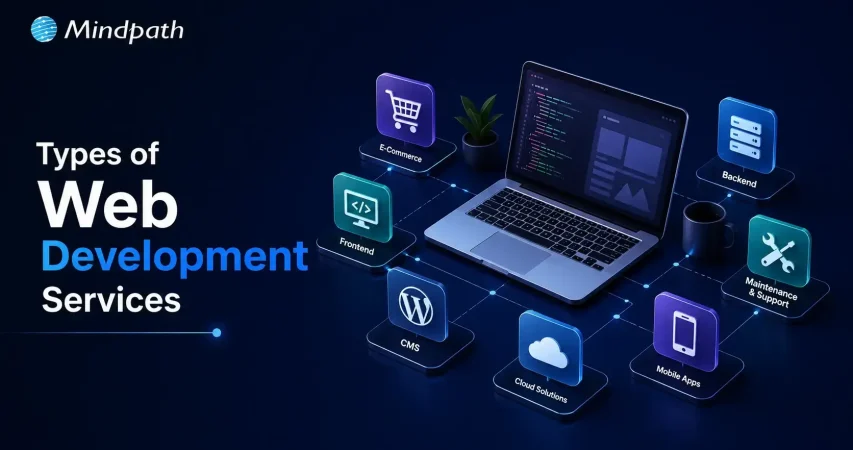
1. Front-end Development

Frontend development is the making of the visual and interactive part of a website or a web app. It includes everything a user sees and interacts with, such as page designs, buttons, and even animations. Frontend developers rely on HTML, CSS, and JavaScript, plus frameworks like React and Vue to design interfaces that are not only fast and responsive but also user-friendly.

Key Features of Frontend Development

Let’s dive into the features of front end development that make a website visually compelling and user-friendly.

  • A good frontend loads quickly, and does not let folks bounce off the page.
  • It provides a pretty appearance that fosters trust on the first impression.
  • Users can move easily from one section to another, thanks to the smooth navigation.
  • All elements are consistent throughout Chrome, Safari, Firefox and other browsers.
  • Performance remains optimized with no lag, no freeze, no slowdowns.
  • User data is secured and the interface is protected against threats.

2. Back-end Development

All backend development work powers the processes that are invisible to users of a website. Users don’t see it; however, they can get to the business success that it facilitates practically each day. It deals with the management of servers, databases, and application logic. Python, PHP, and Node.js are the coding languages that are used to perform these activities. A website without a strong backend cannot really operate well.

Key Features of Back-end Development

Let’s look at the essential elements of back-end development that ensure reliable, secure, and efficient web development services.

  • Data is stored, managed, and accessed from structured databases in backend systems.
  • Core business rules are applied efficiently, by server-side logic.
  • APIs join frontend, backend and third-party tools together.
  • Data of user is always safe with strong authentication and encryption strength.
  • Architecture that can scale, so it won’t slow down with high traffic.
  • Payment gateways and other external integrations smoothly connect your platform.

3. Full-Stack Development

Full-stack development refers to working on both the frontend and backend sides of a website or application. They are capable of managing everything, both the user interface and the data processing backend. They represent the generalists among web development services. A single proficient developer or a developer team is often able to build, operate, and deliver a whole product without the help of others.

Key Features of Full-Stack Development

Let’s take a look at the features that make full-stack development a good business option.

  • Full stack developers take care of the entire development process all by themselves.
  • They have experience in both front end and back end technologies.
  • These popular stacks are used to create dynamic, fast web applications such as MERN.
  • The less team changeovers, the quicker the delivery, the smoother the flow.
  • Better performance and cleaner APIs through deep architectures knowledge.
  • Both sides of the app scale and adapt with ease.

4. CMS Development

CMS development involves creating websites based on platforms that allow you to handle content without the need to write any code at all. WordPress, Shopify, and Drupal are well-known instances. It’s among the most sensible web development services for companies who desire to have complete control over their content. Refresh your pages, include blogs, and modify the content whenever you want.

Key Features of CMS Development

Here are the main points that make CMS development efficient and business-friendly.

  • Intuitive editors make creating and formatting content quick and simple.
  • Everything is stored in one easy to access place.
  • Role Based permissions are used to maintain teamwork and smooth content flow.
  • Schedule and publish content on different websites and social platforms without hassle.
  • Inbuilt Analytics tools enable you to enhance content according to actual data.
  • CMS platforms have a seamless interface with CRM and marketing applications.

5. eCommerce Development

E-commerce development refers to the creation of online stores that are capable of managing product display as well as ensuring payment security. Great ecommerce development services are centered on not only quick loading times and hassle-free checkout procedures, but also on robust security measures. The smallest elements are aligned with the main objective converting visitors into buyers.

Key Features of eCommerce Development

Let’s take a look at the essential components that make any ecommerce development project successful.

  • Always, sensitive user data and payment information are guarded by robust security.
  • The payment gateway integration is seamless, ensuring smooth and reliable transactions.
  • Smart inventory tools are useful in keeping the product management organized and accurate.
  • Order management logic ensures efficient order fulfillment from click to delivery.
  • Scalable architecture helps control traffic surges without impacting performance.
  • In-built analytics makes informed business decisions every day.

6. Mobile App Development

Mobile app development means creating software for smartphones and tablets. It includes designing, programming, and testing for Android and iOS environments. Even though it is a bit different from the usual web development, nowadays mobile apps are mainly connected to web-based backends. A good mobile app delivers your business at the fingertips of the customer.

Key Features of Mobile App Development

These are some of the characteristics of a strong mobile application that will be regarded as the defining features of a well-built mobile app.

  • Smooth performance and speedy load time stop users from dropping off.
  • Offline support allows the app to function without an Internet connection.
  • Timely and personalized push notifications to re-engage users.
  • User trust comes easily with strong encryption and biometric authentication.
  • Every day, AI personalization provides more intelligent and relevant app experiences.
  • Real-time analytics monitor behavior and provide ongoing app enhancements.

7. Progressive App Web Development (PWA)

A Progressive Web App works like a native app but runs directly in a browser. It loads fast, works offline, and feels smooth on any device. PWA development is a smart choice within web development services because one codebase works across all platforms. No app store needed, just a great experience every time.

Key Features of PWA Development

Here are the core features that make PWA development a powerful modern choice.

  • Service workers enable smooth performance even on slow or no network.
  • PWAs deliver native app-like navigation and full-screen experiences seamlessly.
  • Users install PWAs directly from their browser onto any device.
  • Updates happen automatically without any app store downloads needed.
  • Push notifications keep users engaged with real-time personalized messages.
  • HTTPS hosting ensures every PWA stays secure and data stays protected.

8. Web Accessibility Development

Web accessibility development makes sure every user can navigate and use your website, including people with visual, auditory, or cognitive disabilities. It follows standards like WCAG to remove digital barriers. Within web development services, accessibility is not optional. It is a responsibility that also improves usability and expands your audience reach.

Key Features of Web Accessibility Development

Here are the key features that make a website truly accessible for every user.

  • Alt text helps screen readers describe images to visually impaired users.
  • Captions and transcripts make audio and video content fully inclusive.
  • High color contrast ratios improve readability for all users significantly.
  • Every function works smoothly using a keyboard alone.
  • Visible focus indicators show users exactly where they are navigating.
  • Skip navigation links let users jump straight to main content.

9. Web Security Development

Web security development builds protection directly into your website from day one. It covers secure coding, data encryption, and regular vulnerability checks. Cyber threats like SQL injection and data breaches are real risks every business faces. A secure website protects your users, your data, and your business reputation effectively.

Key Features of Web Security Development

Here are the core features that keep a website secure and trustworthy.

  • Multi-factor authentication ensures only authorized users access sensitive areas.
  • SSL/TLS encryption protects data during transit and storage always.
  • Secure coding practices block injection attacks and cross-site scripting effectively.
  • Content security policies prevent malicious scripts from running on your site.
  • Proper session management stops hackers from hijacking active user sessions.
  • Web application firewalls filter and monitor all incoming traffic constantly.

10. API Development and Integration

API development and integration connects your software applications so they talk to each other smoothly. It is a core part of modern web development services. Think of it as a digital bridge between your tools, systems, and platforms. Good API development saves time, reduces manual work, and keeps your entire tech ecosystem running together.

Key features of API Development and Integration

Here are the key features that make API development truly effective.

  • Multi-layer authentication keeps every API interaction fully secure.
  • Cloud-native infrastructure scales smoothly under high traffic.
  • Clear documentation makes third-party integration fast and simple.
  • Rate limiting protects servers from overload and attacks.
  • Versioning ensures updates never break existing integrations.
  • Connectors link payment gateways, CRMs, and platforms effortlessly.

Ready to Build a Website That Works for Your Business?

Web development is not one-size-fits-all. Every business has different goals, and the right web development services help you meet them. Whether you need a fast frontend, a secure backend, or a full e-commerce store, picking the right type makes all the difference.

At Mindpath, we are a web development agency that actually listens. We understand your goals and build solutions around them. Contact us; we offer solid, results-driven development that helps your business grow online and stand out from the crowd.
Frequently Asked Questions

1. Which web development service does a small business actually need?

Start with frontend and CMS development. They cover design, content, and basic functionality. As the business scales, backend and e-commerce development naturally follow.

2. How long does a web development project take?

A simple website takes two to four weeks. A full-scale web application with custom integrations can take three to six months depending on complexity.

3. What is the difference between web design and web development services?

Web design focuses on looks and feel. Web development focuses on functionality. Both work together. Great design without solid development delivers nothing, and vice versa.

4. Do businesses need both frontend and backend development?

Yes. Frontend handles what users see. Backend handles data, logic, and security. Skipping either creates gaps in performance and user experience.

5. How does web development impact business growth?

A well-built website attracts visitors, converts them into customers, and builds trust. Fast speed, mobile responsiveness, and security all contribute directly to revenue growth.

Support Is One Click Away

Featured Posts

Related Post

generative AI trends

The technology world is growing at a quicker pace and 2026 is already proving to be a big year for innovation. Among the most discussed advancements, there are some exciting generative AI trends that are transforming how we produce content, design products and engage with digital tools. From smart video production to sophisticated code composition, generative AI is no longer a notion but is actually transforming the way things are reshaping in the real world.

Generative AI is applied across majority of industries today to facilitate work, enhance individual experiences, and assist individuals in generating more innovative ideas. In 2026, we are seeing a quick surge in adoption in healthcare, marketing, education and entertainment fields. Businesses are also embracing these tools to lead in innovation and customer experience. Intriguing, isn’t it?

Are you interested to know about some generative AI trends for 2026? Well, we have got you covered. This blog will walk you through top gen AI trends shaping 2026 and how they’re influencing the future of technology.

Want to integrate generative AI into your workflows for competitive advantage? At Mindpath, our AI Development Services deliver tailored, scalable AI solutions for your business.

Demystifying Generative AI: The Next-Gen Innovation

Generative AI is an intelligent technology that has the ability to assist in the development of new contents, images, videos or even computer code. It learns from what already exists and then applies what it has learned to create something new. For companies, this means they can utilize AI to create content, create products, or even assist with customers’ questions. It’s similar to having a super useful assistant who always learns and becomes proficient at various tasks. 

Generative AI is assisting companies in so many easy and intelligent ways. It saves time by performing daily tasks such as writing, designing, or responding to messages. So, teams can concentrate on more important things. It also assists organizations in making quicker decisions by getting data interpreted quickly. Customers receive better and more personalized service, which makes them satisfied. Additionally, it helps in creating new ideas and saving costs by doing work faster. Since the market is expanding very quickly, a Statista study approximates that generative AI will reach approximately $66.89 billion in 2026 and increase to $442.07 billion by 2031, demonstrating the growing importance of GenAI for business in driving efficiency, innovation, and customer engagement.

Also Read: Top AI Trends 

Now let us have a look at the generative AI trends for 2026:

Top Generative AI Trends to Look for in 2026

GenAI trends are progressing rapidly in 2026, revolutionizing the way we work and innovate. These trends are enhancing tools to be smarter, quicker, and more useful. Here are the leading GenAI trends that are shaping the future this year: 

1. Hyper-Personalization with GenAI

One of the key current trends in artificial intelligence is hyper-personalization. GenAI helps create content and messages that match each person’s unique needs and interests. It looks at large amounts of data to understand what someone likes, then gives them a more personal and meaningful experience. This makes communication more effective and helps build stronger connections. Hyper-personalization is becoming more important for better results, improved engagement, and customer satisfaction across many different industries. 

2. Multimodal Generative AI

AI is now getting better at understanding many types of information at once, like pictures, text, speech, and even video. This is called multimodal AI. For example, some tools can turn spoken words into text or show pictures based on what you write. New models like GPT-4V and LLaVa are making this possible. They help people talk to AI in smarter ways, using both words and visuals. This makes AI more useful and helpful in many different tasks. 

3. Conversational AI

Conversational AI is getting much better at having real conversations with people. Thanks to new tools like GPT, it can understand what you say, remember past chats, and reply in a way that feels natural. It’s like talking to someone who really listens and gives helpful answers. In 2026, this kind of AI can handle longer and more detailed chats, making it great for customer support, virtual helpers, and more. It feels less like a robot and more like a real helper. 

4. AI-Powered Apps and Services

One of the top ai industry trends is how apps and services are becoming much smarter by adding AI features. These AI-powered tools help people do their work faster and in a more personalized way. For example, writing apps learn your unique style to suggest better words and ideas, while health apps can offer treatment advice based on your personal health data. Shopping apps can recommend products you might like. In 2026, many industries use AI inside their software to make experiences easier, smarter, and more helpful for users every day. 

If you’re planning to integrate generative AI into your business strategy. Check out generative AI use cases to learn how companies are leveraging this technology to boost innovation and gain a competitive edge.

5. AI Boosting Creativity

AI is making creativity easier and more exciting for everyone. Tools like Dall-E can turn simple ideas into pictures, music, animations, and sounds, helping artists and creators bring their visions to life quickly. These AI tools keep getting better, allowing people to explore new ways to create art and express themselves. This technology is changing how creative work happens, giving both professionals and hobbyists fresh opportunities to make unique and interesting content in many different fields. 

6. AI Helping in Scientific Research

Generative AI predictions show that AI is making big changes in scientific research. It helps by quickly summarizing long and complex research papers, especially in medicine and pharma. This means researchers can understand important information faster without reading everything. These AI tools save time and make it easier to find key facts, helping scientists work better and faster. This leads to smarter decisions and faster progress in creating new treatments and improving healthcare for patients. 

7. Open Source and Generative AI

Open source is playing a big role in the growth of generative AI. It lets many people from different places work together to improve AI tools and make them better. This teamwork helps find and fix problems faster while making sure AI is fair and trustworthy. Open-source projects also share knowledge and resources, making AI development more open and honest. According to the McKinsey generative AI report, companies that see AI as key to their success are over 40% more likely to use open-source AI tools. In the tech industry, 72% of companies use open-source AI models, showing how important this approach is for advancing AI. 

8. Human in the Generative AI Loop

In 2026, a growing trend is people working closely with AI, called Human-in-the-Loop. This means humans help guide and check AI to make sure it follows rules and fits real-life needs. This teamwork makes AI results more accurate and reliable. By combining human skills with AI’s power, companies can get smart and creative results while keeping control over what the AI produces. This helps AI work better for many different uses. 

Looking to leverage generative AI for smarter, more adaptive app solutions? Explore our blog on Generative AI in App Development highlights practical applications, transformative benefits, and strategies to stay ahead in the digital landscape.

Ready to Embrace GenAI Trends for 2026?

The generative AI trends of 2026 are already changing how we create, communicate, and solve problems. From boosting creativity to transforming research and business services, these trends are making technology smarter and more helpful than ever. As industries keep exploring AI’s possibilities, it’s clear that generative AI will keep shaping the future in exciting and meaningful ways. 

If you’re looking to stay ahead in this fast-changing landscape, Mindpath’s GenAI solutions are here to help. Our expert team builds powerful and easy-to-use AI development services tailored to your business needs. Whether it’s integrating generative AI tools or developing custom applications, Mindpath ensures you get innovative, ethical, and result-driven AI experiences that truly make a difference. 

Frequently Asked Questions

1. How can businesses start adopting generative AI trends in 2026?

Businesses can begin by identifying repetitive or creative tasks that can benefit from automation. Adopting tools aligned with current generative AI trends such as content creation, analytics, or personalization is a good first step. A pilot project helps measure ROI before scaling across departments.

2. Will generative AI replace creative professionals?

No, generative AI is designed to assist, not replace, creative professionals. It speeds up brainstorming, drafting, and design processes, but human creativity, emotional understanding, and strategic thinking remain essential for producing meaningful and high-quality work.

3. Is generative AI expensive to implement?

The cost depends on the scale and complexity of implementation. Many cloud-based AI tools offer flexible pricing models, making them accessible even for small businesses. Starting small and scaling gradually can help manage costs effectively while still benefiting from innovation.

4. How do generative AI trends impact data privacy and security?

As generative AI trends grow, businesses must prioritize strong data governance. Secure APIs, encrypted storage, and compliance with regulations are essential. Organizations should also ensure transparency in how AI models use data to maintain customer trust and avoid legal risks.

5. What skills are important for working with generative AI tools?

Key skills include data literacy, prompt engineering, critical thinking, and understanding AI ethics. While technical knowledge is helpful, many modern tools are user-friendly. Professionals who can combine domain expertise with AI capabilities will have a strong advantage in 2026 and beyond.

AR and VR in Education

Student engagement is a critical factor when it comes to effective education. While curriculum and subjects might differ globally, engagement remains the cornerstone of learning. Today’s learners are valuing the essentiality of more interactive and practical experiences. This is where the relevance of AR and VR in education makes a real impact.

Starting from virtual science labs to 3D anatomy lessons and skill training, these technologies are changing how students learn. This also impacts the teaching methods of educators. As per the reports, the AR and VR education market is going to reach USD 28.70 billion by 2030. In fact, it is quickly turning into a powerful tool that can serve proper engagement.

Looking to enhance learning and boost student engagement in a digital world? Contact us to discover how we help deliver immersive experiences with AR and VR solutions.

What are AR and VR in Education?

Before you go through the impact of these technologies, it is necessary to understand the critical difference between the two.

  • Augmented Reality adds digital elements like animation, 3D models, labels, and audio to the real world. It takes the help of devices like tablets, smartphones, or AR glasses. So, when it comes to a classroom setting, AR can turn your printed diagram into an interactive visual while putting life into the pages.
  • On the other hand, virtual reality places learners inside a complete digital environment using a headset. So, students can easily conduct experiments or walk through historic civilizations.

Together, these AR and VR technologies can generate more active and student-specific learning environments for the best results.

Why are AR and VR important in Today’s Modern Education?

No doubt traditional learning methods have relevance in the market. But they often struggle to keep students completely engaged. This gap has become significant in this digital-first world. So, you need to understand that learners need to understand concepts better. So, this is possible when they see, explore, and interact with information instead of only reading and hearing about it.

  • This is where the impact of augmented reality in education and the values of virtual reality come into the picture.
  • These valuable tools can make your learning more effective.
  • Further, they value multiple learning styles to help fill in the gap between theory and practical understanding.
  • Whether it is a school classroom or a corporate training session, AR and the impact of virtual reality in education can make information easier to absorb.

What are the Essential Benefits of AR and VR in Education?

There is a series of benefits of AR and VR in education that you can go through in this section. However, these technologies need to be used strategically for the best results.

1. Improved Understanding

Core subjects like science, engineering, and medicine generally include complicated concepts. So, AR and VR can easily simplify such topics by visualizing them in ways that are easier to understand.

For example, instead of looking at a flat image of the human heart, you can assess the rotating model while observing the functions of each section. This is one of the major benefits of augmented reality in education.

2. Personalized Learning

Every student has their own learning capabilities. Some might be visual learners, and some might need repetition or practical examples. AR and VR can help you understand such differences by offering adaptable learning experiences.

3. Better Knowledge Retention

Students will be able to remember what they actively experience through these valuable technologies. Immersive learning can boost your memory by including a participatory approach.

So, when the learners can interact with the concept more effectively, their learning becomes more successful.

4. Safe Practice Environments

One of the most practical benefits of VR in education is that it allows you to practice without any real-world challenges and risks. As a medical student, you can easily simulate surgeries, and engineering students can easily interact with machinery.

Major Examples of AR and VR

To better value the core of immersive learning, here are some major examples of AR and VR in education.

  • Virtual field trips can allow you to visit museums and historical sites right from the same location.
  • You can easily perform experiments in virtual science labs.
  • AR-enriched textbooks can easily turn printed pages into essential interactive learning tools.
  • You can experience technical and vocational training modules for machinery, construction, and equipment handling.

These real-life applications show that AR and VR are not limited anymore. Moreover, they are already solving real educational challenges.

Challenges of Adopting AR and VR

No doubt the use of AR and VR in education offers a series of benefits. However, successful implementation needs proper planning. Some of the major ones have been listed in this section.

  • Teacher training and onboarding process.
  • The high cost of hardware and software.
  • Technical maintenance and support.

These challenges are becoming easier to manage as the technologies have become more affordable. So, institutions that invest thoughtfully can seek long-term values.

Conclusion

The role of AR and VR in education has been drastically changing with a series of features. These technologies are helping educators generate more engaging lessons while enabling you to understand more complex topics. From better retention to higher engagement, the benefits of AR and VR remain effective.

So, if your business is looking forward to building future-ready learning experiences, the right technology partner can make all the difference. Mindpath can be your ultimate partner that can create and innovate impactful learning environments customized for your modern needs. We can offer you user-centric digital products that align with your needs.

FAQs

1. What is the Major Difference Between AR and VR in Education?

AR can add digital elements to the real-world environment, whereas VR generates a completely immersive digital space for better learning.

2. What are Some Essential Benefits of AR and VR in Education?

The major benefits include better engagement, improved understanding, and safe skill practice while helping you get more interactive learning experiences.

3. How to Use AR and VR in Classrooms?

You can use AR and VR for your virtual field trips, 3D visual learning, and even for lab practice. People also use it for language training and interactive lesson delivery.

4. Can AR and VR Improve My Learning Outcomes?

AR and VR can easily encourage your learning outcomes by making your lessons more interactive and visually practical.

5. Which Subjects Mainly Use AR and VR for Better Understanding?

AR and VR are majorly effective in subjects like science, medicine, engineering, and mathematics.

Legacy Modernization Services

Out-dated systems retard development and cause wastage. Most of the teams are struggling with increasing maintenance expenses and unseen threats. That is where the legacy modernization services come in. They assist business reduce technical debt and to enable real value. You want one that is faster and more powerful, do you? Now is time to reconsider the way your core systems will serve your objectives.

Modernization, however, does not just concern the upgrade of technology. It is a question of maximizing ROI with a well thought out strategy and intelligent choices. The less simple you make something, the more budget and innovation you liberate. Consequently, teams are developmental rather than rehabilitating past problems. This blog will cover the topic of how modernization leads to a decrease in technical debt and bring about quantifiable returns.

Looking to simplify operations and lower technical debt? Mindpath offers legacy modernization services make it easier to upgrade and optimize systems without disrupting your business.

Understanding Technical Debt in Legacy Systems

Technical debt in legacy systems is the accumulating cost of outdated technologies, past architectural compromises, and quick fixes applied in place of long-term solutions. As companies postpone upgrades, this burden compounds much like financial interest, making legacy modernisation services increasingly essential to restore system health.

Like financial debt, technical debt generates compounding interest; every shortcut taken today inflates tomorrow’s maintenance costs, complicates integrations, and introduces critical security vulnerabilities. What begins as minor inefficiencies gradually accumulates into significant operational barriers.

The following are some of the effects of not taking technical debt into consideration:

  • Old and unprotected systems enhance security risks and vulnerability of sensitive data to cyber threats.
  • The high maintenance costs leave the IT budgets with minimal scope of growth and innovation.
  • Hard systems are barriers to cloud, AI, and modern technology installation.
  • Without legacy modernization services, systems become too complex to manage and require costly full replacement.

Looking to improve system performance and reduce long-term operational costs by upgrading outdated technology? Discover the benefits of modernizing legacy systems to explore how it enhances scalability, security, and overall ROI.

How Legacy Modernization Services Reduce Technical Debt?

Technical debt delays the development and adds expenses. Legacy modernization services help reduce this burden and create a stronger, more efficient technology foundation.

1. Smart Code Refinement

The teams are used to clean and refactor available code in order to enhance clarity and stability. They eliminate repetitions and complicated reasoning. This makes optimizing legacy applications easier and reduces future maintenance effort.

2. Cloud Enablement Strategy

Organizations transfer the workloads to the cloud or container environments to enhance scalability. This measure eliminates the reliance on old hardware. Legacy modernization services help teams control infrastructure costs and improve performance.

Also Read: Legacy Application Modernization in 2026

3. Microservices Transformation

Professionals subdivide monolithic systems into smaller and modular services. All the components are independent and promote quicker updates. This approach reduces risk and improves flexibility in evolving legacy applications.

4. API Driven Integration

Teams eliminate the stiff interfaces with protective and adaptable APIs. This enhances the connection of the systems to new platforms and tools. Consequently, companies make integrations easier and less technical.

Planning to modernize your legacy systems but unsure about the right approach and sequence to follow? Explore our guide on legacy modernization roadmap to explore the key steps for a smooth and successful transformation.

5. Automated Testing and CI/CD

The modern pipelines encourage automated testing at development stages. The teams identify problems at an early stage and publish updates without any hesitation. Legacy modernization services strengthen delivery speed and improve software reliability.

6. Application Portfolio Cleanup

Organizations check through applications and eliminate unutilized or duplicated systems. This reduces the cost of maintenance and operational clutter. Strong legacy application modernization services create a leaner and more focused IT landscape.

Must Read: AI-driven Legacy System Modernization

7. Documentation and Knowledge Alignment

Modernization teams revise system documentations and develop knowledge bases. This minimizes reliance on the individual professionals. Clear documentation facilitates the process of upgrading and being stable in the long term.

8. AI Driven Code Intelligence

The sophisticated tools are used to analyze the dependencies and identify performance gaps in a short time. Teams use AI to accelerate code improvements and support data modernization initiatives. This will enhance precision and accelerate the process of transformation.

Want to ensure your legacy system upgrades align with long-term business goals and deliver maximum value? Explore our guide on legacy modernization strategy to discover the best approaches for a successful and future-ready transformation.

Ready to Reduce Technical Debt and Improve ROI?

Technical debt is a source of slow growth and risk. Legacy modernization services help businesses regain control and improve long term ROI. By updating systems to have a clear strategy, teams reduce costs in maintenance and increase agility. Therefore, organizations become more innovative, secure, and develop technology that will support future objectives with assurance.

At Mindpath, our legacy modernization services are based on alignment of technology with business vision. Our performance, scalability, and quantifiable returns also serve as the basis of our legacy system modernization services. We evaluate holes, update buildings and enhance integration. With the appropriate approach, companies become simpler and establish resilient online platforms to build sustainable growth.

FAQs

1. How does technical debt directly impact business growth? 

Technical debt reduces agility and increases operational strain. As discussed in the blog, rising maintenance costs limit innovation budgets and slow strategic initiatives. Over time, this weakens competitive position and delays digital transformation efforts that support revenue growth.

2. How do Legacy modernization services reduce technical debt strategically?

Legacy modernization services address root causes instead of temporary fixes. They improve architecture, streamline integrations, and strengthen scalability. This structured effort lowers maintenance pressure and supports better ROI, as explained throughout the blog.

3. Can modernization improve both performance and financial returns?

Yes. When businesses simplify systems and reduce complexity, teams release features faster and lower operational costs. This balance between efficiency and innovation improves measurable ROI and supports long-term digital stability.

4. What technical factors determine the right modernization path?

Architecture complexity, integration dependencies, data structure quality, and infrastructure limitations shape the strategy. A deep technical review ensures the modernization plan aligns with business goals and avoids unnecessary disruption.

5. How do Mindpath’s legacy modernization services support controlled transformation?

Mindpath’s legacy modernization services follow a structured roadmap with phased execution and validation cycles. This approach minimizes risk while delivering sustainable improvement. Through focused Legacy modernization services, Mindpath helps businesses reduce debt and build resilient digital foundations.