Home

Cursor vs GitHub Copilot: Which AI Coding Tool is Better?

Cursor vs GitHub Copilot: Which AI Coding Tool is Better?

Join our Newsletter!

Cursor vs GitHub Copilot

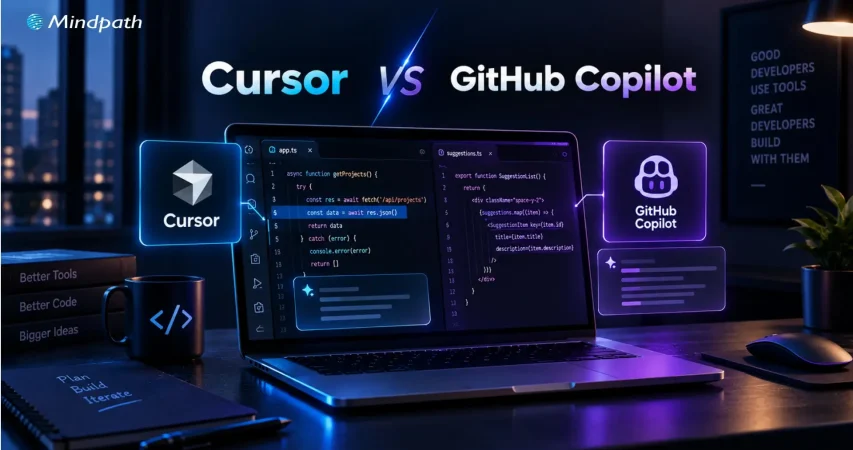
Choosing between Cursor vs GitHub Copilot is becoming less straightforward as AI coding tools take on larger parts of the development workflow. Developers are no longer comparing simple autocomplete features. They are evaluating how effectively an AI tool can understand a codebase, modify multiple files, reason through problems, and support day-to-day engineering work.

Key Takeaways

  • 01
    Cursor focuses on an AI-first coding environment, while Copilot integrates AI into existing development environments.
  • 02
    Both tools now support code generation, editing, chat, debugging, and agentic development workflows.
  • 03
    Cursor suits developers seeking deeper codebase interaction and multi-file AI-assisted development.
  • 04
    GitHub Copilot fits teams wanting AI assistance within familiar IDEs and GitHub workflows.
  • 05
    Security, usage, project complexity, and team adoption matter when selecting an AI coding tool.

The real distinction now lies in how AI fits into the development environment. Cursor takes an AI-first approach, while GitHub Copilot brings AI capabilities into familiar editors and the broader GitHub ecosystem. Both support code generation, chat, editing, and agentic workflows, but they shape the developer experience differently. In this blog, we compare their capabilities, workflows, pricing, limitations, and practical use cases to help you understand which approach fits your development environment.

Looking for the right AI coding workflow?

We help teams evaluate AI development tools and build practical workflows around their engineering needs.

Talk to Our AI Experts →

How Cursor and GitHub Copilot Approach AI-Assisted Development?

The biggest difference between these two AI coding tools is how deeply AI is embedded into the development environment. Both can generate code, explain functions, suggest fixes, and work across larger development tasks, but the surrounding workflow is different.

1. Cursor: An AI-First Development Environment

Cursor is built around the idea that AI should be a core part of the coding environment rather than an additional assistant. Developers can use its agent capabilities to understand a repository, plan changes, edit multiple files, run commands, and iterate on the result.

This approach becomes particularly useful when a task involves several connected parts of a codebase. Instead of asking for individual code snippets, developers can give the agent a broader objective and let it work across relevant files while maintaining repository context. Developers still need to review the generated changes, especially when the task involves business logic, dependencies, or production-critical code.

2. GitHub Copilot: AI Within Existing Development Environments

GitHub Copilot takes a more integrated approach. It brings AI assistance into established development environments, including VS Code, Visual Studio, JetBrains IDEs, and other supported editors.

Its capabilities extend well beyond inline suggestions. Developers can use Copilot for coding assistance, chat, code edits, debugging, code review, and agentic tasks. Its connection with GitHub also makes it a natural fit for teams already managing repositories, pull requests, issues, and development workflows within the GitHub ecosystem.

The distinction, therefore, is less about which tool has AI capabilities and more about where AI sits in the developer’s workflow. Cursor makes AI the center of the coding environment, while Copilot embeds AI into an environment many teams already use.

Cursor vs GitHub Copilot: Key Differences at a Glance

The differences become clearer when the tools are compared across the tasks developers handle every day. Cursor AI and GitHub Copilot overlap in code generation, chat, editing, and agentic development, but their approach to context, IDE integration, repository work, and developer interaction varies.

Feature Cursor GitHub Copilot
Development environment AI-first code editor AI assistant integrated into existing IDEs
Codebase context Designed for deep repository-level context Provides workspace and repository context across supported environments
Agentic workflows Agents can plan, edit files, run commands, and iterate Agent mode can analyze tasks, make changes, run commands, and iterate
Multi-file editing Strong focus on coordinated changes across files Supported through editing and agent workflows
Model selection Offers access to multiple AI models Provides model options depending on plan and feature
GitHub integration Supports GitHub alongside other development tools Deep integration with GitHub repositories and workflows
Code review Supports AI-powered code review through its development tools Provides Copilot code review capabilities
IDE flexibility Primarily centered around the Cursor editor Available across several established IDEs
Team management Team and enterprise administration features Business and Enterprise administration features
Workflow approach AI is deeply embedded into the coding experience AI is layered into an existing development workflow

Where Cursor and GitHub Copilot Fit in the Development Workflow?

Feature lists rarely show how an AI coding tool performs during actual development. The better comparison is how each fits into common engineering tasks, especially when the work moves beyond generating individual code snippets.

1. Code Completion and Routine Coding

GitHub Copilot can provide inline suggestions while developers work in their existing IDE. Cursor offers similar assistance, with AI deeply integrated into its editor and surrounding workflow.

2. Refactoring and Multi-File Changes

Cursor is designed for tasks that require broader codebase interaction, including coordinated changes across multiple files. Copilot’s agent mode can also handle multi-step coding tasks within supported environments.

3. Debugging and Testing

Both tools can explain errors, suggest fixes, generate tests, and assist with debugging. Developers still need to validate changes because AI-generated fixes can introduce incorrect assumptions or unexpected behavior.

4. Greenfield Development

Cursor can support building a new application through agent-driven planning, file creation, and implementation. Copilot can assist throughout the same process while keeping developers within their preferred IDE and GitHub workflow.

5. Working With Existing Codebases

For unfamiliar or complex repositories, context becomes critical. Cursor emphasizes repository-level understanding, while Copilot can use workspace and repository context to assist with existing projects.

Pricing, Security, and Team Adoption

When evaluating Cursor vs GitHub Copilot, teams should look beyond subscription costs. Usage, security, existing workflows, and adoption effort can all affect the decision.

1. Pricing

Both offer individual, team, and enterprise plans, with costs varying based on usage and available AI features.

Factor Cursor GitHub Copilot
Starting approach AI-first editor AI inside existing IDEs
Individual use Free and paid plans Free and paid plans
Team use Team and Enterprise plans Business and Enterprise plans
AI usage Varies by plan and model usage Varies by plan and AI credits
Security controls Team and Enterprise controls Business and Enterprise controls
Workflow adoption May require switching editors Works with supported existing IDEs

2. Security

Teams should review data handling, retention, access controls, and governance before using either tool with proprietary code. These considerations are also relevant when applying AI safety and alignment principles to development workflows.

3. Team Adoption

Copilot can fit naturally into existing IDE and GitHub workflows. Cursor may require a shift toward an AI-first coding environment.

Strengths and Limitations of Cursor and GitHub Copilot

Both tools can accelerate development, but AI-generated code still needs developer review. Their strengths become clearer when looking at control, context, reliability, and everyday usability.

1. Cursor AI Strengths

  • Strong codebase context
  • Multi-file editing
  • Agent-driven workflows
  • Flexible model selection
  • AI-first developer experience

2. Cursor AI Limitations

  • Requires adopting its editor
  • Higher usage can increase costs
  • Complex changes still need careful review

3. GitHub Copilot Strengths

  • Works across popular IDEs
  • Strong GitHub integration
  • Easy workflow adoption
  • Code completion and chat
  • Agentic development support

4. GitHub Copilot Limitations

  • Capabilities vary across IDEs
  • Usage limits depend on the plan
  • Generated code still requires validation

For both tools, productivity gains depend heavily on task complexity, codebase quality, and how effectively developers review AI-generated changes. This broader role of AI in engineering is also reflected in AI in software engineering.

Which AI Coding Tool Is Better?

The right choice depends on how your team already builds, reviews, and maintains software. Key factors include the development environment, project complexity, team workflow, and level of AI involvement.

1. Cursor May Fit Teams That:

  • Prefer an AI-first coding environment
  • Work frequently across multiple files
  • Need deeper codebase interaction
  • Want flexible model choices
  • Use agentic workflows extensively

2. GitHub Copilot May Fit Teams That:

  • Prefer their existing IDE
  • Already rely heavily on GitHub
  • Need broad IDE support
  • Want minimal workflow disruption
  • Need AI assistance across established development processes

Need the Right AI Coding Workflow for Your Team?

Cursor vs GitHub Copilot comes down to how developers want AI integrated into their daily work. Cursor centers the experience around an AI-first editor, while Copilot brings AI into established development environments. Project complexity, existing tools, security needs, and team preferences should guide the final decision.

Mindpath helps businesses evaluate and implement AI-driven development workflows aligned with their engineering goals. Our AI development services cover AI strategy, development, model integration, fine-tuning, and AI agent development to help teams build practical, scalable solutions.


Build Faster With AI-Powered Development

Accelerate software development with AI tools built around your workflow.

Frequently Asked Questions

Both can handle multi-step coding tasks, but their workflows differ based on the editor, available context, tools, and level of AI integration.
No. Both offer advanced AI features. The bigger difference is how deeply those capabilities are integrated into the developer’s existing workflow.
IDE preferences, GitHub usage, security requirements, project complexity, AI usage, and developer adoption can all affect implementation across a team.
Yes. Both support workflows that can modify multiple files, although the experience depends on the task, repository context, and agent capabilities being used.
No. Subscription costs should be considered alongside usage, security controls, existing development tools, workflow changes, and the team’s actual AI requirements.

Support Is One Click Away

Featured Posts

Related Post

Hire ReactJS Developers in New Jersey

Are you searching for skilled ReactJS developers in New Jersey to build a high-performance web application? Do you need experts who can create fast, scalable, and interactive user interfaces? Finding the right talent can be challenging, but with the right team, your project can thrive.

In today’s fast-paced digital surroundings, a dynamic and flexible web application is essential for business success. ReactJS, which is recognized for its quickness and versatility, has become the ideal tool for developing modern web applications. If you’re seeking talented ReactJS developers in New Jersey, hiring the right professionals can make all the difference. Experienced ReactJS developers, with their knowledge in generating high-performance applications, can assist you in developing scalable, user-friendly, and creative digital solutions customized to your company’s demands.

Let’s explore how hiring top ReactJS developers in New Jersey can bring your vision to life!

Steps to Hire ReactJS Developers in New Jersey

1. Define Your Project Requirements

The first step in hiring a ReactJS developer in New Jersey is to outline your project’s needs explicitly. Determine the scope of your project, including essential features, functions, and projected timetable. Understanding your requirements can assist you in determining the suitable experience level—whether a junior, mid-level, or senior developer is most suited. Consider the React frameworks and technologies unique to your project, such as Redux for state management, Material-UI for UI components, or Next.js for server-side rendering. Outlining these technical criteria can make your hiring process more efficient since you will be able to filter individuals who are knowledgeable about the essential technologies. Proper planning also ensures that you hire a developer who can deliver exactly what your project demands, reducing the risk of misalignment. By defining your needs upfront, you set a strong foundation for finding the right ReactJS talent in New Jersey.

2. Source Qualified Candidates

Once you’ve determined your project’s requirements, the following step is to aggressively seek skilled ReactJS developers in NJ. Use several hiring channels to improve your chances of discovering the perfect candidate. Online employment platforms such as LinkedIn, Indeed, and Glassdoor provide a vast pool of individuals with ReactJS experience. You may also look at specialized tech employment sites like AngelList or Toptal for highly competent developers. Furthermore, use your professional network to request references from colleagues or industry contacts. Another useful technique is to join local tech meetings and events in New Jersey, where you can meet experienced developers and find possible candidates in person. Engaging with different sourcing methods ensures that you reach top-tier talent who may not be actively searching for jobs but are open to new opportunities. A diverse sourcing approach increases the likelihood of finding the ideal developer for your project.

3. Screen Candidates Based on Skills and Experience

After sourcing individuals, the next stage is to test them for technical proficiency, experience, and problem-solving ability. Begin by reading their credentials and portfolios to determine their experience with ReactJS, JavaScript, HTML, CSS, and front-end frameworks. Pay particular attention to their prior projects and see if they have worked on applications comparable to yours. Conduct a technical evaluation to determine their practical coding abilities. This can be an online coding test, or a take-home project centered on React development. Ask specific questions during the first screening to assess their comprehension of React’s key principles, state management (Redux or Context API), component lifecycle, and recommended practices. By thoroughly evaluating each candidate’s skills and hands-on experience, you can filter out unqualified applicants and focus on those who have the necessary expertise to contribute effectively to your project’s success.

4. Conduct a Thorough Interview Process

A systematic interview process is essential for finding the ideal ReactJS developer. Begin with an initial phone screen to confirm the candidate’s qualifications, background, and interest in the position. If they pass the screening, they will proceed to a technical interview where they will exhibit their problem-solving abilities and ReactJS expertise. During this step, ask detailed questions about their expertise with React Hooks, Redux, testing frameworks like Jest, and deployment methods. You can also offer a live coding session to test their ability to develop clean, efficient code. After assessing technical capabilities, do a behavioral interview to identify soft skills like communication, teamwork, and flexibility. Understanding how they collaborate with others and handle challenges is essential for ensuring they fit well within your team. A well-structured interview process helps you identify not only technically skilled developers but also those who align with your company culture.

5. Make the Hiring Decision and Finalize Terms

After you’ve interviewed candidates and evaluated their talents, it’s time to make your final recruiting choice. Compare their technical knowledge, problem-solving methodology, and capacity to collaborate with your team. Consider their ReactJS experience, previous project success, and adaptability to new technologies. After you’ve chosen the best applicant, discuss compensation, benefits, and work arrangements (remote or on-site). To minimize future misunderstandings, be transparent when addressing employment requirements, contract conditions, and any additional benefits. Once everything has been agreed upon, create an onboarding procedure that involves providing access to project tools, scheduling team meetings, and establishing starting duties. A smooth onboarding experience helps new hires integrate quickly and contribute effectively. By carefully evaluating and finalizing the hiring process, you ensure a successful partnership with a skilled ReactJS developer who can drive your project forward.

Looking for expert ReactJS developers in New Jersey to bring your vision to life? At Mindpath we provide highly skilled ReactJS professionals who specialize in building scalable, high-performance web applications tailored to your business needs. Whether you need a dedicated developer or a full development team, we have the expertise to deliver top-notch solutions.
Let’s turn your ideas into reality! Contact Mindpath today. to hire the best ReactJS developers and take your project to the next level.

Read our next blog: Factors to Consider While Hiring Expert ReactJS Developers in New Jersey

Discover the ultimate guide to hiring Node.js developers in London. Learn about the skills, benefits, and cost factors involved in finding the right talent for your project.
freelance full stack developer

In the current business landscape, business entities are engaging in a wide range of projects. Due to the high diversity coupled with the complexity of projects, many companies are hiring the best freelance full-stack developers for their projects. According to the reports, full-stack developer jobs are one of the most in-demand jobs since their year-over-year postings are rising by more than 35 %.

Key Takeaways

  • 01
    Freelance full-stack developers handle both front-end and back-end work independently.
  • 02
    Hiring freelancers cuts costs by avoiding employee benefits and long contracts.
  • 03
    Their agility helps businesses launch web apps with shorter delivery timelines.
  • 04
    Strong cloud and testing skills ensure scalable and reliable applications.
  • 05
    Growing demand makes freelance full-stack developers valuable for future projects.

As the reliance of companies across industries on digital technologies rises, the demand for full-stack development freelance services is likely to surge. Businesses that prioritise their digital transformation journey have been considering freelance full-stack developers. If you wish to excel in your tech projects, you must definitely consider the best freelance full-stack developer for hire.

If you’re looking to hire full-stack developers who see beyond code and focus on your future transformation, Full Stack Development Services will provide you with forward-thinking professionals who deliver innovative solutions that drive business growth.

Who is a Freelance Full-Stack Developer?

Before deciding whether a freelance full-stack developer is an ideal choice for your project or not, you must familiarise yourself with the particular role. A Freelance Full-Stack Developer is a professional who is proficient in the front-end and backend components of a web application. These developers have solid expertise in a broad range of technologies such as CSS, HTML, React, JavaScript, and many more. As in recent years, a greater number of businesses are integrating digital technologies into their processes, and the reliance on capable freelance full-stack developers has skyrocketed. 

The high versatility of these professionals while building entire web apps from scratch gives rise to benefits for businesses. Apart from their prowess to create apps, these professionals are capable of managing databases and deploying and maintaining software in a cloud environment. Thus, businesses that decide to hire a freelance full-stack developer can succeed in their technology-driven projects. 

Looking for the best way to scale? Explore how full-stack development for web projects improves flexibility and long-term growth. 

Skills of a Freelance Full-Stack Developer

Businesses need to familiarise themselves with the top skills and expertise of a Freelance and remote full-stack developer. The insight in this specific area can certainly help you understand the true potential of these professionals. The top skills that these professionals leverage in order to help business firms excel in their web development projects are:

1. High proficiency in front-end technologies

A capable Freelance Full-Stack Developer is proficient in popular front-end languages such as Angular, React, and CSS. 

2. Expertise in backend aspects

A highly skilled Freelance Full-Stack Developer has immense knowledge relating to database management, along with popular languages Python and Node.js. The professional also has expertise in API development, which equips them to handle backend operations flawlessly.

Also Read: Full-stack Development with Node.js

3. Solid foundation in cloud technologies

Talented Freelance Full-Stack Developers possess solid insight into cloud technologies. The rich insight empowers them to design highly scalable and secure applications for businesses. 

4. Testing and debugging skills

The skills relating to testing and debugging processes enable these professionals to develop robust and well-functioning applications. By conducting rigorous testing, they are able to locate flaws or vulnerabilities in web apps and adopt appropriate remedial measures in a prompt manner. 

5. Robust version control

Freelance Full-Stack Developers are capable of tracking changes to code. The skill pertaining to version control ensures that the quality of code can be maintained throughout the app development process. Furthermore, these developers focus on collaborating with others to ensure the success of projects. 

Want to gain deeper insight into which development role best suits your business needs? Explore our blog – Front-End vs Back-End vs Full-Stack Developer.

How Can a Freelance Full-Stack Developer Add Value to Your Project?

In the digitalised business realm, it is a necessity for businesses to consider partnering with the best freelance full-stack developers. Businesses can derive immense value if they decide to partner with a top Freelance Full-Stack Developer or hire a remote full-stack developer.

1. Expertise to handle end-to-end projects

By hiring the best Freelance Full-Stack Developers, you can rest assured about the entire web development lifecycle. These professionals will capitalise on their skills and expertise to handle a diverse range of projects efficiently. As they can work on the entire project lifecycle in an independent manner, you do not have to rely on other teams or professionals. 

2. Cost-effective solutions

Hiring the best Freelance Full-Stack Developers is undoubtedly a highly cost-effective solution for businesses. By choosing freelance full-stack developers, you can eliminate unnecessary costs relating to employee benefits or long-term contracts. Additionally, you do not have to hire entire project management teams to work on your web development projects. Moreover, by leveraging the expertise of these professionals, you can surely excel in your project in an efficient manner. 

3. High agility

Generally, Freelance Full-Stack Developers are highly agile as well as adaptable when it comes to handling web app development projects. As a result, they can deliver results for businesses with shorter delivery timelines. Furthermore, their ability to work in an independent manner can decrease the overall time taken to work on projects for businesses. Businesses can certainly derive immense value from their ability to launch their web apps in the market successfully. 

4. Flexible way of handling projects

By joining hands with Freelance Full-Stack Developers, businesses can handle their projects in a flexible manner. As these professionals work as freelancers, they offer flexible options for their business clients. Based on your exact project needs, these web developers can deliver tailored solutions to meet your specific project objectives. 

5. Capitalising on transferable abilities

Freelance Full-Stack Developers have highly transferable abilities thanks to their comprehensive knowledge of web development. As a result, business entities can take advantage of full-stack developers to take care of their varying needs relating to web design and web app development. The transferable abilities of these professionals undoubtedly empower businesses to reduce the overall complexity of their projects. 

Planning to validate your product idea quickly? Discover how hiring a full-stack developer for MVP accelerates product validation.

Promising Future of Freelance Full-Stack Developers

The future of Freelance Full-Stack Developers is full of possibilities in the current times. This is mainly because of the rising demand for these professionals in the contemporary business world. The skills that Freelance Full-Stack Developers possess make them highly dependable professionals. Furthermore, their proficiency makes them capable of tech agility and working on complete projects independently. 

The future-proof skills and prowess of full-stack developers increase their worth for companies. In the future, as more businesses engage in web development projects, the dependence on these developers may further increase. Such a trend is likely to increase the full-stack developer’s salary significantly in the long run.

Some of the chief reasons for the bright and prosperous future of freelance full-stack developers include:

  1. The growing demand for flexible web app development solutions in the business world.
  2. The ability of these professionals to offer end-to-end web app development solutions to businesses. 
  3. The flexible nature of solutions that are offered by full-stack developers in the evolving business climate.
  4. The updated knowledge of these developers about the latest industry trends, as well as the latest technology tools. 
  5. The ability to solve diverse web app projects with varying levels of complexity.     

Also Read: Full-stack Development Trends

Final Words

The emergence of the role of freelance full-stack developers has been a boon for modern business entities. In order to thrive in the tech-driven business landscape, a majority of businesses are hiring full-stack developers who can handle their web development projects efficiently. These professionals are undoubtedly playing a catalytic role in helping firms excel in their development projects. 

If you wish to capitalise on the skills of the best freelance full-stack developers, you must consider partnering with Mindpath. By leveraging its staff augmentation services, you can hire full-stack developers who can drive your projects towards success. Therefore, by integrating highly skilled professionals, your business can boost its project management capabilities.  

Frequently Asked Questions

1. How does a business find a reliable freelance full-stack developer for a long-term project?

Look for proven experience across front-end and back-end technologies, along with a strong portfolio. Checking past client feedback and conducting a small trial task can help verify reliability before committing to a longer engagement or a larger, more complex project.

2. What is the difference between hiring a freelance full-stack developer and a full development agency?

A freelance developer typically works independently and offers more flexibility and lower costs. An agency provides a larger team with broader resources but often comes at a higher price. The right choice depends on project size, budget, and timeline requirements.

3. Can a freelance full-stack developer handle an entire project without additional support?

For most small to mid-sized projects, yes. Their end-to-end expertise allows them to manage design, development, and deployment independently. Larger or highly complex projects may still benefit from additional specialists, but a skilled freelancer can cover most core requirements.

4. How do businesses ensure smooth communication when working with a freelance full-stack developer remotely?

Setting clear expectations early, using shared project management tools, and scheduling regular check-ins helps maintain alignment. Most experienced freelancers are comfortable working across time zones and adapt well to a client’s preferred communication style and reporting frequency.

5. Is hiring a freelance full-stack developer a cost-effective option for short-term projects?

Yes, especially for short-term or one-time projects. Businesses avoid the overhead of full-time hiring while still gaining access to specialized skills. This makes freelance developers a practical choice for startups or companies testing new product ideas quickly.

Discover why hiring a freelance full-stack developer in 2024 can boost your project’s efficiency, quality, and cost-effectiveness. Learn more with Mindpath!
DevOps vs. Traditional IT

Are you wondering how DevOps compares to traditional IT? What makes one approach more efficient or suitable for today’s fast-paced tech world? Whether you’re a business owner, a tech enthusiast, or just curious about modern IT practices, understanding the differences between DevOps and traditional IT models can help you make the best decision for your needs. Let’s dive in and explore how these two approaches stack up!

What is DevOps?

DevOps is a fundamental idea that tries to bring together two key teams: development and operations. Previously, these teams operated independently, which sometimes resulted in miscommunication and delays. DevOps addresses this by fostering a more collaborative environment.

The term DevOps is derived from “development” and “operations.” It’s all about making it easier for these two teams to collaborate on software development, testing, and delivery. When development and operations collaborate, it is simpler to address challenges such as delayed software upgrades, poor coordination, and feature delivery delays.

Companies can employ DevOps to speed up their software development process. It involves leveraging tools, automating activities, and enhancing team communication, all of which contribute to faster, more efficient product releases for clients.

Advantages of DevOps

1. Cost Effective

DevOps saves businesses money by automating various procedures, reducing the need for additional human resources and accelerating software development. Developers can create more effective code, identify errors early, and make changes more quickly by utilizing DevOps principles like continuous integration and delivery, which reduces total expenses. Automation also lowers mistakes, delays, and increases the quality of the finished product. DevOps enables firms to generate high-quality software at a lower cost, helping them remain competitive in the market.

2. Security

Security is an essential concern for most firms, and DevOps helps by incorporating security into every stage of the development process. DevOps automates the development and deployment processes, enabling developers to work swiftly and safely. DevOps employs continuous testing and feedback to automatically detect problems and vulnerabilities as software is produced, resulting in high-quality and secure code. Automated technologies also aid in the early detection of security concerns, making them easier to resolve before they grow into larger difficulties. Companies can employ DevOps to reliably release updates and safeguard their software throughout its lifecycle.

3. Increased Flexibility

DevOps provides developers more freedom by allowing them to distribute new features or upgrades fast and effectively. The development team can quickly implement changes due to continuous delivery and testing, allowing organizations to respond to market needs and customer feedback. This agility enables businesses to remain ahead of the competition and get the first-mover advantage by being the first to provide new goods or improvements. Faster releases not only make customers happier, but they also allow organizations to innovate more frequently and adapt quickly to changing demands, making the entire development process more dynamic and flexible.

4. Fosters Communication

Implementing DevOps methods improves communication inside an organization. DevOps fosters collaboration between development and operations teams, directing everyone towards similar business objectives and supporting a united approach to goal achievement. This practice successfully removes communication obstacles, resulting in a smoother workflow and ensuring that both teams collaborate effortlessly. As a consequence, organizations can offer higher-quality goods that better fulfil the expectations of their customers. Superior communication and cooperation not only drive project success but also help to create a more productive and profitable corporate environment.

What is Traditional IT?

Traditional IT is the old technique of handling technology in enterprises. It makes use of real equipment like servers, computers, and network equipment to store data and operate programs. This system requires a significant amount of room, electricity, and money to put up and maintain. It also necessitates the usage of an in-house IT team to oversee everything, from hardware installation and configuration to problem resolution and overall operation. Because the infrastructure is built from physical components, it can be rather expensive, especially when it comes to upgrading or replacing obsolete gear. Businesses must also prepare for data storage, security, and backups, which can require additional time and resources. Furthermore, scaling up operations or introducing additional services can be cumbersome and expensive, as it often requires more hardware and manual setup.

Advantages of Traditional IT

1. Data privacy

One significant advantage of traditional IT is data privacy. Traditional IT gives you complete control over where your data is stored, generally on your own servers or hardware. This means that you can control who gets access to your data and how it is safeguarded. Because the data remains within your organization, you do not have to be concerned about third-party firms gaining access to it, which can provide you with peace of mind. Furthermore, storing data locally allows you to implement unique security measures tailored to your company’s specific requirements. To safeguard sensitive information, you can use firewalls, encryption, and other techniques. For firms that manage sensitive data, having direct control over it can be a significant advantage since it decreases the chance of breaches or unauthorized access.

2. Consistent data access

Traditional IT has a significant edge in terms of constant data access. By keeping data on premises, or on your own servers or hardware, you can ensure that it is always accessible, even if there are network or internet outages. Because the data is kept locally, you do not need an external internet connection to access it, making it more dependable during internet outages or disturbances. This is especially valuable for firms that require immediate and ongoing access to essential data, such as financial records or client information. Even if the internet goes down, conventional IT allows employees to view and work with data stored on the company’s servers. Additionally, local storage allows businesses to customize their access and backup strategies, ensuring data is always available when needed.

3. Security

Improved security is one of the most significant advantages of traditional IT. Data and apps are stored on your own servers, so you have complete control over who can access them. This makes it easy to restrict access to just authorized staff, ensuring sensitive information is safeguarded. You can use security measures such as firewalls, encryption, and access restrictions to guarantee that only authorized people have access to sensitive data. Traditional IT allows you to monitor and trace who accesses what data, providing you with greater management and control over your security. If your company handles sensitive or secret information, having this degree of control is essential for avoiding unauthorized access or data breaches.

4. Reliability

Traditional IT is highly reliable since it is not dependent on internet access. Because data is kept on your own servers, it is always available, even during internet outages or disturbances. This decreases the likelihood of service disruptions, which can harm cloud-based services. In the case of traditional IT, all apps and data are available locally, allowing your firm to continue operations without the need for an external network connection. This makes traditional IT a more dependable alternative for organizations that want regular access to their data, particularly in places where internet connectivity is unpredictable. Furthermore, because the infrastructure is managed internally, firms can set up their own backup systems and disaster recovery plans, lowering the chance of data loss or interruption.

DevOps vs. Traditional IT: A Comparison Table

Aspect Traditional IT DevOps
Development & Operations Work in silos, lack of collaboration Integrated teams, continuous communication
Delivery Methodology Waterfall, long development cycles Continuous Integration/Continuous Delivery (CI/CD)
Process Management Manual processes, prone to errors Automated processes, faster and more reliable
Incident Management Reactive, issues fixed after they occur Proactive, issues identified and resolved early
Flexibility Rigid, difficult to adapt Agile, quick to respond to changes and feedback
Testing Testing after development, delayed bug discovery Shift-left testing, bugs detected early
Feedback Loops Delayed feedback after release Continuous, real-time feedback from users and teams

DevOps Services at Mindpath

Mindpath offers full DevOps services to optimize your software development and delivery operations. By combining development and operations teams, we encourage seamless cooperation and quicker, more dependable releases. Our emphasis on automation, continuous integration, and real-time monitoring helps to eliminate manual mistakes while maintaining consistency across environments. We also prioritize proactive issue identification, which enables teams to handle possible issues before they affect your systems. With Mindpath’s DevOps services, you can expect shorter development cycles, faster updates, and higher software quality, all while increasing team efficiency and cooperation.

Final Thought!

Whether you choose DevOps or traditional IT depends on your business needs and priorities. DevOps offers agility, automation, and faster, more efficient software delivery, making it ideal for businesses aiming to stay competitive in a fast-moving tech landscape. On the other hand, traditional IT provides control over data, security, and reliability, which may suit businesses with specific data privacy concerns or those in less connected environments. At Mindpath, we help you navigate these options, offering tailored solutions to enhance your development processes and deliver high-quality, secure software.

Discover the key differences between DevOps and traditional IT. Explore which approach suits your business needs.