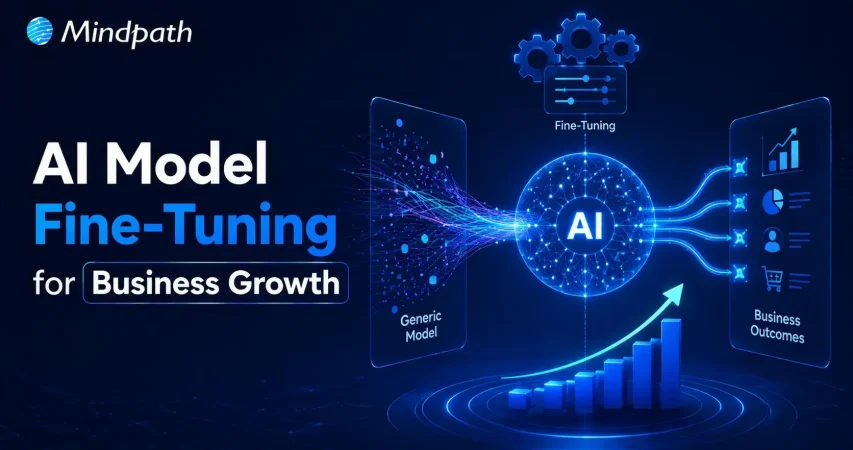
Artificial intelligence is reshaping modern businesses across every industry. Yet generic models often fail to understand company-specific knowledge and business processes. To fine-tune AI model performance, organizations need a focused customization strategy. This approach improves accuracy, consistency, and relevance for real business applications.
Key Takeaways
- 01
Fine-tuning transforms general AI models into specialized business solutions with greater accuracy. - 02
High-quality training data directly impacts model performance, consistency, and long-term reliability. - 03
Fine-tuning delivers faster implementation and lower costs than building models from scratch. - 04
Continuous evaluation and optimization keep AI models accurate, scalable, and business-ready. - 05
The right customization strategy helps businesses maximize long-term value from AI investments.
Fine-tuning allows businesses to adapt AI without building an entirely new model. It also helps improve performance for specialized tasks and enterprise workflows. In this blog, you’ll learn what fine-tuning is, when businesses should use it, how the process works, and the best practices for building reliable enterprise AI solutions. So, let’s keep reading further!
Looking for a customized AI model that delivers better results? Discover Mindpath’s AI Model Fine-Tuning Services to optimize model accuracy, efficiency, and domain-specific performance.
What Does It Mean to Fine-Tune an AI Model?
Fine tuning large language models helps businesses adapt pre-trained AI for specific tasks and industry needs. Instead of creating a model from the beginning, organizations refine an existing one using relevant business data. This process improves response quality, accuracy, and consistency across specialized use cases.
Pre-trained models understand general language but often miss company context and domain knowledge. Fine-tuning teaches the model using carefully prepared business datasets and real examples. As a result, it delivers more relevant responses, follows organizational standards, and performs better in practical business environments.
Core Components At a Glance
- 01
Foundation Model: Select a pre-trained model suited to your business objectives. - 02
Domain-Specific Data: Train using clean, accurate, and relevant business datasets. - 03
Supervised Fine-Tuning: Refine model behavior with labeled examples and expected outputs. - 04
Parameter-Efficient Fine-Tuning: Reduce training costs by updating only selected model parameters. - 05
Training Hyperparameters: Configure learning settings to improve model performance and stability. - 06
Evaluation and Validation: Test accuracy and prevent overfitting before production deployment.
Fine-Tuning vs Training an AI Model from Scratch
Businesses often compare building a new AI model with choosing to fine-tune AI model performance. Both approaches improve AI capabilities, but they differ significantly in cost, time, resources, and business outcomes.
Understanding these differences helps organizations choose the right strategy for their goals. The right decision depends on data availability, project complexity, budget, and long-term scalability.
| Category | Training an AI Model from Scratch | Fine-Tuning an AI Model |
| Definition | Builds a completely new AI model using large-scale datasets. | Customizes a pre-trained model for specific business requirements. |
| Data Requirements | Requires enormous volumes of diverse training data. | Uses smaller, high-quality, domain-specific datasets. |
| Development Time | Typically takes several months or longer. | Usually completes within days or a few weeks. |
| Development Cost | Involves substantial investment in infrastructure and AI expertise. | Significantly lowers development and operational costs. |
| Computing Resources | Requires powerful GPU clusters and extensive computing capacity. | Needs fewer computational resources for efficient training. |
| Customization | Offers complete control but demands significant development effort. | Delivers targeted customization with faster implementation. |
| Business Use Cases | Suitable for creating entirely new AI models or research projects. | Best for industry-specific applications, enterprise workflows, and AI assistants. |
| Best Choice | Large enterprises with extensive budgets, proprietary data, and research teams. | Businesses seeking faster deployment, lower costs, and measurable business value. |
When Should Your Business Fine-Tune an AI Model?
Not every business needs to customize an AI model from the beginning. AI model customization for enterprise becomes valuable when generic models cannot meet specific business requirements or performance expectations.
1. Specialized Business Knowledge: Fine-tune AI model capabilities for industry-specific tasks and terminology.
2. Consistent Brand Responses: Ensure outputs match your company’s tone, style, and standards.
3. Complex Business Workflows: Handle specialized processes beyond basic prompt-based instructions.
4. High-Quality Training Data: Use curated datasets to improve accuracy and task performance.
5. Lower Operational Costs: Reduce prompt complexity while improving response efficiency and consistency.
How to Fine-Tune an LLM: Step-by-Step Process?
Understanding how to fine tune an LLM helps businesses build AI solutions that deliver better results. A structured process improves model accuracy, reliability, and long-term performance.
Step 1: Select Base Model
Choose a pre-trained model that aligns with your business objectives and use case. Selecting the right foundation improves AI model optimization and overall model performance.
Step 2: Prepare Training Data
Collect clean, relevant, and high-quality datasets for your specific business requirements. Well-structured data helps the model learn accurate patterns and produce reliable outputs.
Step 3: Process Data
Convert the dataset into a format the model can understand during training. Proper preprocessing improves learning efficiency and reduces errors throughout the fine-tuning process.
Step 4: Configure Model
Load the base model and define settings based on your intended task. Correct configuration ensures the model learns effectively from your specialized business data.
Step 5: Validate Performance
Measure model accuracy using evaluation datasets before final deployment. Regular testing identifies weaknesses and helps improve response quality and reliability.
Step 6: Train and Deploy
Train the model with optimized parameters and monitor its performance continuously. Deploy only after verifying consistent, accurate, and business-ready results.
What are the Best Practices to Fine-Tune AI Model?
Successful fine-tuning depends on more than selecting the right model and dataset. Knowing how to train an AI model using proven practices improves performance, reduces errors, and delivers better business outcomes.
1. Clean Training Data
Remove duplicate, outdated, and incorrect records. Clean data improves learning accuracy and consistency.
2. Prevent Overfitting
Reserve unseen data for performance evaluation. Test generalization before deploying the fine-tuned model.
3. Start with Small Datasets
Begin training using limited sample data. Verify results before scaling the complete dataset.
4. Optimize Learning Rate
Choose balanced training settings for stable learning. Avoid values that reduce model performance.
5. Use Efficient Training Methods
Apply lightweight techniques like LoRA whenever possible. Reduce computational costs without sacrificing model quality.
Common Challenges to Watch for
- 01
Poor Data Quality: Inaccurate datasets reduce model performance and response reliability. - 02
Overfitting: Excessive learning limits performance on new, unseen business scenarios. - 03
Knowledge Retention: Fine-tuning may reduce previously learned general model capabilities. - 04
High Computing Costs: Training large models requires significant computational resources and infrastructure. - 05
Performance Evaluation: Measuring response quality consistently remains challenging across complex business tasks.
Ready to Fine-Tune Your AI for Better Business Results?
Fine-tuning helps businesses transform general AI models into solutions built for their unique goals and workflows. With the right strategy, quality data, and continuous optimization, organizations can improve accuracy, deliver more relevant responses, and maximize the value of their AI investments.
At Mindpath, we provide end-to-end AI development services, including AI model fine-tuning, to help businesses build AI solutions that align with their unique requirements. Our team works closely with you to create scalable, reliable, and business-focused AI applications that