Home

 How Custom Web Development Services Can Streamline Your Business Operations 

 How Custom Web Development Services Can Streamline Your Business Operations 

Join our Newsletter!

custom website development services

Companies consistently wrestle with the challenge of maintaining a smooth operation and competing in an ever-changing world. Custom website development services provide the missing link to develop a platform that matches your exact needs and workflows. When a website is built around a real process that matches a real workflow, the company will improve efficiency, and simplify tasks. This simplifies how teams work faster and will improve the extent customers interact on your website. A good website becomes a tool for growth to enable outcomes without adding more work.

Many businesses have adopted custom website development because of the time-saving nature of routine work automation, greater collaboration, and more rapid responses to shifting needs. When technology is a partner with a skilled web design company to streamline operations to connect people across different teams and functions, its powers can enhance overall productivity. A business’s online presence can become a powerful accelerator of success when a company can tie it to real business goals. In this blog, we will detail how these services can modernize and streamline your business.

Must Read

Want to build a website that not just exists but also gives your brand a great online presence? Mindpath offers web development services to ensure responsive designs and smooth performance, which makes every click an opportunity for the business.

Understanding Custom Website Development Services

Custom web development means creating a website from the ground up to fit the needs of a business. Rather than just using templates or a cloned website, a custom website development company will build your platforms to express the brand’s identity, work with existing systems, and provide a uniquely personalized experience for users. Every aspect of the site is built to serve the company’s needs and enables the site to be fully functional and engaging.

By taking this approach, businesses will also have the flexibility to add features that are appropriate for their business and will help make the website easier to manage as the business grows. Additionally, there is the ability to know their site will be secure and have capacity for more users or more content over time. For companies, custom web development offers a website that looks professional, works well, and can grow with their businesses.

How are Custom Web Development Services Streamlining Business Operations?

Custom web development services are primarily concerned with designing a website that reflects a business’s unique goals and key strategies. These services ensure an online presence that is at once professional and trustworthy, and sufficiently adaptable for use as a tool for the business’s development and other operational needs, both now and in the future.
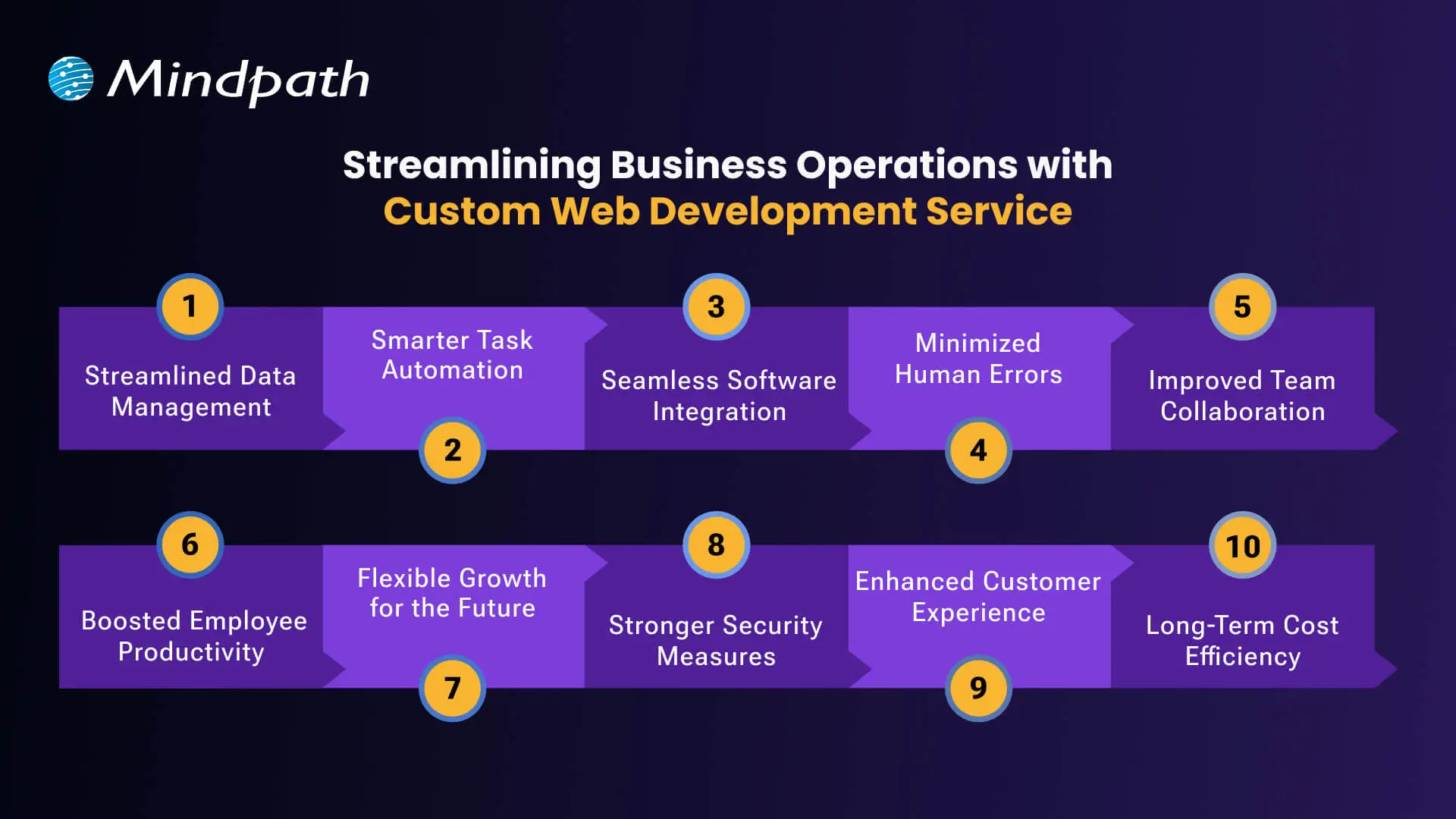
Streamlining Business Operations with Custom Web Development Service

1. Streamlined Data Management

A custom web application enables the collection of information from multiple locations, thus ensuring that each department has the same up-to-the-minute information. Dashboards and reporting functions pull together the information to enable visual, timely, better decision making, and it increase overall efficiency.

2. Smarter Task Automation

Custom web development services enable automation of repetitive tasks such as order processing, invoicing, and inventory management. Minimally, this frees up the time of employees to focus on more strategic objectives and accelerate the pace of operations and thus total productivity.

3. Seamless Software Integration

A custom web development company can design applications that integrate smoothly with your existing systems like CRM or ERP tools. It is a way that frees people from the heavy work of manual data transfer in different applications and at the same time, enables the seamless integration of workflows and processes. The result is a more efficient and cohesive operational environment.

4. Minimized Human Errors

Custom-built applications incorporate highly developed validation and error-checking mechanisms. Businesses save time and avoid mistakes, improve accuracy, and reduce costs by removing the risk of human error in data entry or repetitive processes. Employees can focus on actual work and add value instead of fixing an error.

5. Improved Team Collaboration

A custom web application provides a centralized platform for sharing documents, tracking progress, and communicating in real-time. Teams can coordinate tasks more effectively, reducing misunderstandings. This enhances inter-departmental collaboration and streamlines daily workflows.

Curious how artificial intelligence can transform the way websites are built and managed? Explore our article on AI in web development to discover how AI can enhance your site’s efficiency, usability, and performance.

6. Boosted Employee Productivity

With a custom web application, teams can share documents, track progress, and communicate in real-time all in one location. This increased coordination among team members leads to a better understanding of tasks, which improves departmental collaborations and caters to their day-to-day duties better.

7. Flexible Growth for the Future

Custom web development provides businesses with solutions that expand with them. This means that the platform can accommodate more users, storage of larger datasets, and use cases when the business expands, and all without a complete redesign. This level of flexibility is important for maintaining a valuable website as a tool over time.

8. Stronger Security Measures

Custom solutions enable developers to incorporate tailored security protocols to safeguard sensitive data. Unlike generic software, custom applications can include encryption, authentication, and enhanced security measures tailored to your firm. Organizations at least know that their customer and operational data are of the highest security.

9. Enhanced Customer Experience

Custom web development services play an important role in elevating customer engagement and communication. Just to illustrate, an automated follow-up or a tracking system for orders can be a way of informing your customers at each step, thus attracting them. Consequently, it becomes a cycle of strengthening your relationships and building trust with your clients over time.

10. Long-Term Cost Efficiency

Custom website developers may have a higher upfront cost, but the ROI can be huge over time. Eliminating continuing software fees and inefficient processes can ultimately save the business money. Custom software solutions create well-performing, reliable systems that promote growth and success.

Want to build a complete website without coordinating with multiple developers? Explore our post on full-stack development for web projects to discover how a full-stack approach simplifies your workflow and accelerates delivery.

Ready to Streamline Your Business with Custom Web Development Services?

Custom web development services help businesses improve efficiency, strengthen teamwork, and enhance customer interactions. By creating websites that match real business goals, companies can save time, reduce errors, and manage operations with ease. A well-designed website acts as a strong foundation for growth and lasting success.

At Mindpath, our expert team delivers professional website development services that align with your business goals. Each custom web development service is designed to create fast, secure, and scalable websites that enhance performance and user engagement. We focus on crafting digital solutions that simplify operations and help your business grow with confidence.
Need a Website Built Around Your Business?

Create a custom website designed to strengthen your brand, engage users, and drive business growth.

Frequently Asked Questions

Support Is One Click Away

Featured Posts

Related Post

Build MVP

The success of every business revolves around the products and services they offer to their target customers. Do you know what it takes to build a product that your customers will love and recommend to others? This is where every business, especially startups, must build a MVP to create the best products for their target audience. Building a minimum viable product provides a lean and targeted solution to gain market validation.

Many people must not be familiar with the fact that only one out of ten startups survive beyond ten years. The primary reasons for failure of startups include lack of research, presence in the wrong market and shortage of funds. You can leverage a MVP to find the feasibility of your product idea and strategically transform it into sustainable business. An overview of a step-by-step framework to create a MVP will help you see how simple it is to build one. 

Planning to turn your product idea into a testable MVP? Mindpath offers MVP development services to help startup businesses design and develop MVPs that deliver real user insights.

What is a Minimum Viable Product (MVP)?

A Minimum Viable Product (MVP) is the first functional version of a product that includes only its essential features. It allows businesses to validate their product idea, collect real user feedback, reduce development risks, and make informed decisions before investing in a full-scale product.

Why Should You Build a Minimum Viable Product?

The biggest reason for which businesses fail to create a successful product revolves around diving directly into product development. If you invest almost all of your resources in creating a full-fledged product and your customers don’t like it, then you end up with a disaster. Most of the business owners who don’t know the answer to ‘what is an MVP?’ end up facing such situations. The MVP is a primary or the most basic version of the product you want to offer to your customers. It includes only the essential features and functionalities that will help you gain feedback from real users.

Businesses can use their MVP to identify the demand for their product in the target market. The minimum viable product also helps in identifying features that your customers love. As a result, you can ensure that the final product reaches the right market and aligns with your customer’s requirements. Every business owner should create a MVP or minimum viable product to reduce risks and establish the foundation for long-term growth. It not only helps you validate your product ideas but also facilitates efficient resource allocation and earns the trust of investors and stakeholders. 

Ready to launch your MVP without delays? Visit our blog on hiring full-stack developers for MVP to learn how to find developers who can handle both front-end and back-end tasks with ease.

Unraveling the Ideal Framework to Build Your MVP

Any business owner with a product idea must follow a strategic approach to create their minimum viable product. You may assume that developing a MVP might come with a lot of technical complexities that are difficult to navigate. On the contrary, you can use the following steps to find the perfect roadmap to develop a minimum viable product for your business.

1. Identify Your Target Audience and Their Problems

The first step in building your MVP involves knowing your target audience and their requirements. It is important to remember that you are creating an MVP to identify whether your customers will like your product. Therefore, you should start with an understanding of the demographics and pain points of your target customers. 

The insights from market and user research can provide the foundation for developing a product that meets the needs and preferences of your customers. Once you have identified the problems of your target audience, you can decide how you want to solve them with your product. Understanding the requirements of your target customers will help you create a product that provides real value.

2. Leverage the Benefits of Market Research

You can successfully complete the first step of building a MVP by using the most effective approaches for market research. Businesses cannot just guess the problems their target customers might have and build a product based on assumptions. A review of the different examples of minimum viable product will show you that market research is a critical tool in MVP development. Comprehensive market research offers a granular view of the demographics and problems of your target audience. 

The more information you gain from market research, the more accurate your product idea will be. Market research not only helps you come up with the most effective product idea but also shows you what your competitors are offering. As a result, you can find different ways to make your product stand out from the crowd. Business owners should also know that having a strong product idea will help in attracting investors for their product.

3. Establish an Outline of Core Features of Your Product

After finalizing a product idea, you should start defining the core features and functionalities you need in your MVP. All the minimum viable product examples show how you should begin with an outline of basic features that your target market needs. The definition of core features for your MVP provides the ideal start to the process of creating a minimum viable product.

Once you have decided on the core features you want in the MVP, you should think about additional features. At this point of time in MVP development, you must also prioritize the features that you want to include immediately and the ones you can add later. Feature prioritization helps in enhancing the flexibility to define the optimal scope for your MVP development project. 

Must Read: MVP for Startups

4. Develop the Prototype and Your MVP

Many of you might be thinking about the necessity of building a prototype when you can build the MVP directly. The prototype serves as an early version of the minimum viable product and offers a clear impression of how it would work. The basic prototype will help you find how the user interface will look and how users will experience your product. You can also leverage the prototype for early testing and feedback, thereby allowing room for refining the design and functionality of the MVP before full-scale development. 

The successful testing and improvement of the prototype will lead you to your MVP. It is important to ensure that your MVP does not have any bugs and offers the best quality of customer experience. You should know that you have to introduce the MVP to your target users so that they can perceive the core value your product has to offer. During the development of the MVP, you must also specify the timeline and distinct milestones for the project.

5. Introducing Your MVP to Early Adopters

The most crucial step in the process of developing a MVP revolves around introducing it to the target users. Early users of the product can be regular customers or industry experts who represent your target audience and know your target market. Any guide on how to build a minimum viable product emphasizes the need for feedback from early adopters. The feedback from real users helps you determine whether your product is an ideal fit in the target market.

The best approach to ensure that your MVP reaches early adopters is through identifying communities of users. Professional networks, niche forums or social media communities are the top places where you can find the first users for your MVP. You should create open channels, such as dedicated forums or in-app surveys to gain feedback for your minimum viable product.

6. Collecting and Evaluating the Early Feedback

The feedback from early adopters for your MVP serves as a crucial resource to ensure that your product meets the expectations of users. You should use different types of feedback collection methods for your MVP product to obtain qualitative and quantitative data. The notable methods to collect feedback for your minimum viable product include surveys, usability tests and user interviews. 

Once you have collected the feedback, you should categorize it into different aspects of your product. You can use the feedback to learn about usability, performance and functionality of the MVP and identify areas for improvement. Your development team should analyze feedback data comprehensively to understand user preferences and challenges. The insights gained from feedback analysis will guide you through the process of iterative product development.

7. Continuous Iteration and Improvement

Understanding the feedback from early users provides the ideal ground to start refining your MVP according to user expectations. You cannot learn how to build an MVP without focusing on iteration or repeating the development process again. It involves planning, development, testing and reviewing the product repetitively by using feedback from real users. 

Developers can rely on user feedback to address the notable issues in the MVP and enhance its functionality. As a result, iteration serves as a valuable component in the MVP development process to improve the user experience. You should remember that engaging regularly with your target audience and using their feedback can help you achieve the right product-market fit.

Looking to bring your software idea to life without unnecessary delays or costs? Read our blog on MVP in software development to learn how to build, test, and refine your product efficiently.

Final Thoughts

The process to create a minimum viable product for your next big product idea follows a common set of steps. Irrespective of the industry, you can rely on professional MVP development services to translate your ideas into sustainable products. You can start by identifying your target audience and their problems, followed by comprehensive market research, to define the core features of the MVP. Subsequently, your development team can create the MVP and leverage feedback from early users to introduce necessary improvements.

Mindpath is one of the most popular platforms for providing MVP development services, with a successful record in helping various businesses. As a reliable MVP development company, we have helped startups and large corporations test their product ideas before full-scale development. Reach out to us for a free consultation and build your minimum viable product now.

custom software development process

Whenever you are creating a tailored solution for your business, it is very important to clearly understand how the development process will be structured. The custom software development process clearly guides you in turning your ideas into a usable working solution. Every step matters – from understanding the requirements, conceptualizing the software, determining the specifications, and creating software that supports your goals. You will get to know what is to come, how teams will work together, and what to expect at every step as your project moves forward in purpose and clarity.

A thorough comprehension of how this process works gives you a better sense of clarity and confidence as you engage with the project. You will be able to understand each phase clearly and watch your vision come together step by step. Upon having this understanding, it is very easy and clear to collaborate with your development team. In this blog, you’ll go through the whole process and will understand how the custom software will come to life, step by step.

At Mindpath, we offer custom software development services to turn your vision into reality by guiding you through every step. Contact us today for a solution that turns your ideas into real-world project.

Importance of Custom Software Development for Businesses

Custom software development is valuable because it provides businesses with tools made solely for them. Unlike off-the-shelf software, custom software solutions fit unique business requirements and methods. This leads to improved performance, increased efficiencies, and better results. It also minimizes unnecessary rework, saving time and money, and allowing companies to be more efficient overall.

Custom software is scalable with your business. You will be able to add features or alter functionality based on your requirements. This adjustable system uniquely supports a company’s long-term goals and puts you ahead of your competitors. Custom software solutions offer a better experience for both the user and employees, which supports increased productivity and satisfaction.

Understanding the Custom Software Development Process

It is essential to know about the process to be followed prior to starting a software project. By getting familiar with the software development process steps, you can be an active participant and an advantageous decision-maker throughout the project. By understanding the process, you will also ensure value delivery by building software with clear goals, planning, and execution.

Custom Software Development Process

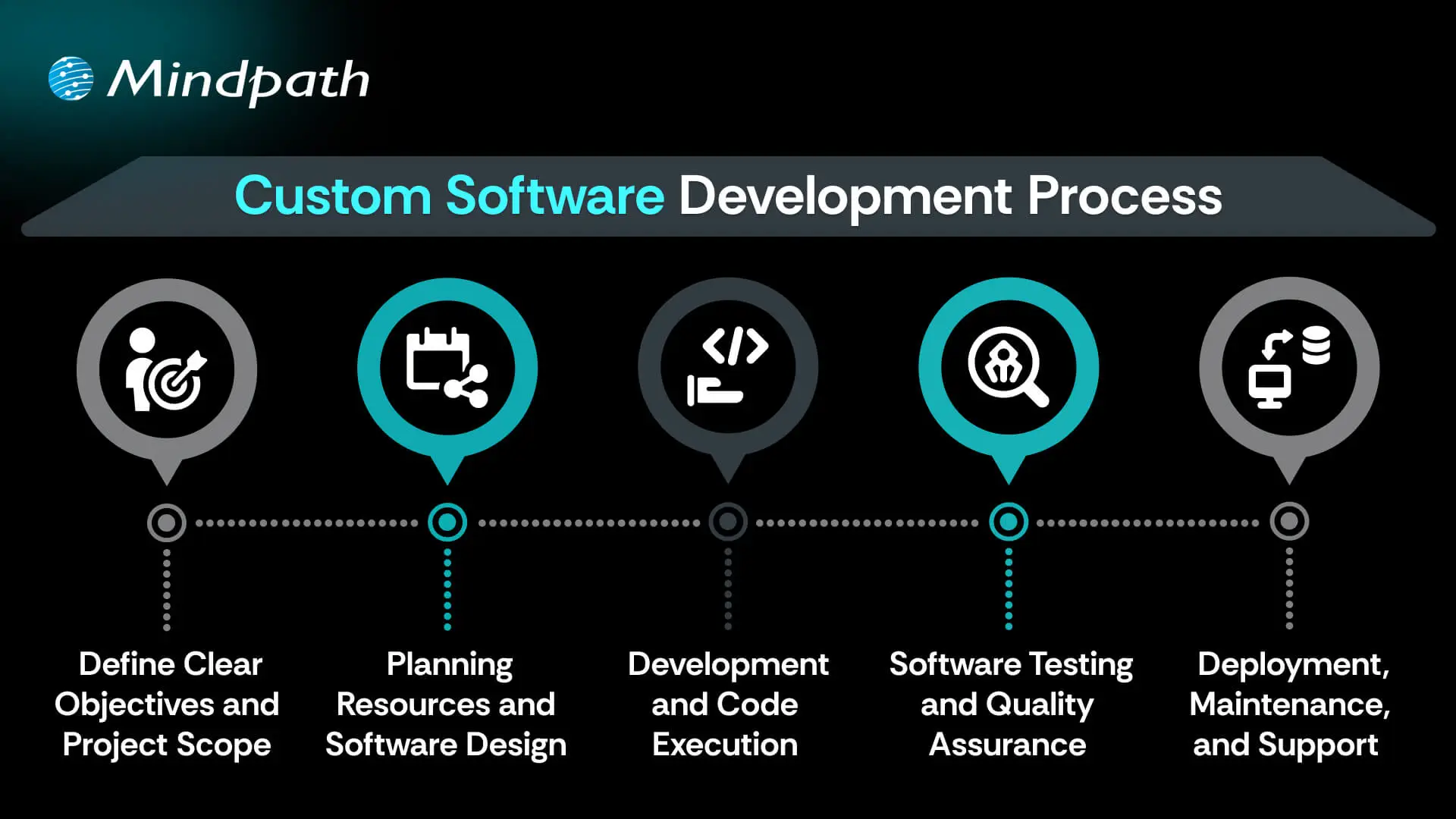
1. Define Clear Objectives and Project Scope

The custom software development process begins by defining your goals and understanding what the software must achieve. This includes identifying the target users, the problem it solves, and how it should perform differently from existing tools. A detailed list of features and expected outcomes is prepared. Both functional and non-functional requirements are clearly documented. This step sets the direction and purpose for everything that follows.

2. Planning Resources and Software Design

Planning involves creating a detailed timeline, setting milestones, and organizing resources for development. Budgets, risks, and deliverables are clearly outlined to avoid delays or extra costs. During software development design, wireframes and prototypes are created to visualize the interface and user flow. The architecture is also planned, including system components and how they will interact. Technologies such as programming languages, frameworks, and databases are chosen here.

3. Development and Code Execution

At this point in the custom software development process, the programmers will begin the actual coding based on the approved designs. The developers will prepare technical infrastructure with tools, servers, and version control. The front-end, back-end, and database modules are built and integrated together. Each piece of software functionality is developed based on the description created in the design documents. The functionality is translated into active, live software with working features to start testing.

Curious how software functions seamlessly from the user interface to the server? Explore the role of frontend and backend to understand how both sides work together to deliver smooth, secure, and engaging digital experiences.

4. Software Testing and Quality Assurance

After the software is developed, it will go through a series of testing strategies to check for quality and reliability. The first step, or unit testing, will cover each feature and try to eliminate some early problems. Then the following step, called integration testing, will check the work of modules and ensure they work as a system. Once that’s complete, the next phase is system testing, which ensures all performance, security, usability, and reliability aspects are achieved and validated prior to the release of the product.

5. Deployment, Maintenance, and Support

In the final step of the custom software development process, the solution moves to a live environment for end users. The deployment may include installing the software on servers, setting up databases, and giving users access. After launch, the software is continuously monitored for issues. Maintenance includes fixing bugs, adding new features, and updating it for better performance. Ongoing support keeps the software running smoothly over time.

Concerned about risks that could slow down your custom software build? Explore the major custom software development mistakes that can disrupt progress and find out how to avoid them.

Real-World Examples of Customized Software

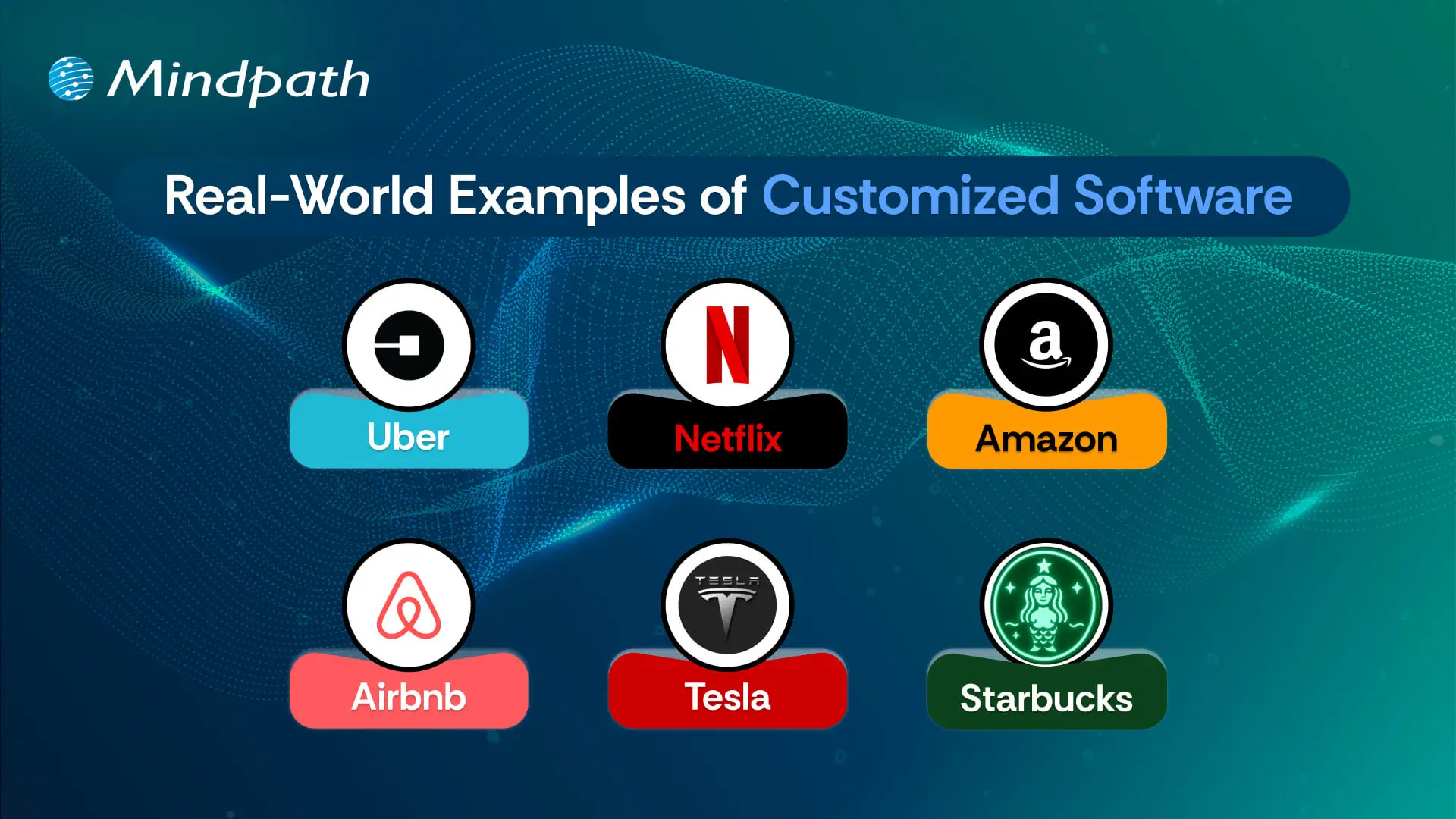
Below are six real-world customized software examples that demonstrate how businesses are navigating unique challenges by investing in custom software to create a digital solution. These tools have been developed to improve usability, performance, and long-term sustainability.

Real-World Examples of Customized Software

1. Uber

Uber constructed a custom ride-booking system complete with GPS tracking, so you know where your ride is located, secure payment options, and updates on the driver’s progression. The app shifted transportation in cities globally.

2. Netflix

Netflix utilizes AI-based recommendation engines and adaptive streaming systems to provide an overall personalized viewing experience through a fully custom platform.

3. Amazon

Amazon uses custom software to manage inventory, predict customer preferences, and allow one-click ordering for a fast and reliable purchasing experience.

4. Airbnb

Airbnb built a custom platform for travelers to pay securely, check real-time availability, and search by location for hosted accommodations around the globe.

5. Tesla

Tesla uses customized software for its smart vehicles to drive the autopilot capabilities, over-the-air updates, and real-time diagnostics to enable sophisticated performance.

6. Starbucks

Starbucks utilizes a custom application to allow customers to mobile order, encrypt reward tracking, and offer options for contactless payments, making the product experience more convenient and helping to cultivate loyalty.

Curious how different kinds of software are built to serve unique business and user needs? Discover the various types of software development to understand how each one contributes to creating powerful digital solutions.

Ready to Create Software That Aligns with Your Business?

Custom software development is the process of creating digital solutions that fulfill your specific business goals. From clarifying your vision to deploying the software and providing ongoing support, every step of the official custom software development process undergoes proper plan and execution. The final outcome of custom software typically entails better efficiency, enhanced experiences for users, and long-term growth through technology that suits your needs.

As a premier custom software development company, we at Mindpath specialize in providing full-spectrum custom software development services that suit your specific business. Our team expertly develops scalable, secure, and simple solutions that integrate well into your workflows and future goals. Partner with us to turn your ideas into powerful, high-performance software built for results.

full stack vs traditional web development

The dynamic digital landscape calls for new approaches to traditional tasks such as web development. Is full-stack development the ideal alternative to traditional web development? Interestingly, the answers to such questions will paint full-stack development as the right choice. However, it is important to know that a full-stack vs traditional web development comparison also highlights their individual strengths.

Experts have pointed out that web development will not rely on one specific approach replacing the other. The full-stack approach has gained popularity for its efficiency and versatility, while traditional web development is useful for specific projects. Let us learn more about the differences between full-stack and traditional web development.

Curious about how full-stack development can elevate your projects? Explore our full stack development services to get guidance and support across every layer of the application development.

Fundamental Difference between Full Stack and Traditional Development

The best way to draw predictions about the future of web development starts with an understanding of the two predominant approaches. Traditional web development has been the fortress of specialists and focuses on two distinct domains, frontend and backend development.

1. Frontend Development

The primary focus of frontend development for a web application is the visual appeal of the application. Frontend developers create aesthetically appealing designs and responsive layouts for the web application interface. The skills required to become a frontend developer include knowledge of HTML, CSS, and JavaScript. Each tool serves a distinct functionality in the web development process.

For instance, HTML helps in structuring web content while CSS is useful for styling. Frontend developers must also know how to use frameworks like React and Vue.js for creating functional interfaces from design ideas.

2. Backend Development

The traditional web development process is incomplete without backend development, which deals with the server-side operations. Backend developers create the foundation for the frontend of the web applications with the help of logic and database management.

Developers can write backend logic with languages like Java, Ruby, Python, PHP, and Node.js. The notable tools for database management include MongoDB, MySQL, and PostgreSQL. Some of the other notable responsibilities of backend developers include API creation, data storage, and security of web applications.

3. Full Stack Software Development

The full-stack approach to web development follows a holistic approach that combines frontend and backend development. Every full-stack development specialist can manage the complete web development process, starting from ideation to creating the server logic and deploying the application.

Full-stack developers use their comprehensive set of skills to contribute value in projects that demand resource optimization. The most noticeable advantage of full-stack development is the ability to bridge the gap between functionality and design.

Why is the Full Stack Approach Becoming Popular?

The review of differences between full-stack and traditional development can start with an impression of the advantages of full-stack development. The full-stack vs traditional development debate emphasizes how full-stack enhances efficiency, speed, versatility, and cost-efficiency.

Businesses can complete full-stack projects with a single developer managing different aspects of the project. Full-stack developers can use their broad skill set to adapt to different project requirements and add value in different stages of the development process.

Another prominent highlight of the full-stack approach to web development is the holistic understanding of the project. Full-stack developers don’t view a project from distinct client-side and server-side perspectives.

On the contrary, they know how the client-side and server-side work, which helps them make better architectural decisions. The holistic understanding of the project also helps full-stack developers achieve seamless integration and troubleshoot issues with ease.

Is Traditional Web Development Still Relevant?

Although full-stack development offers several advantages, traditional web development remains valuable for projects requiring deep specialization. It allows developers to focus on specific areas, such as frontend or backend development, and deliver high-quality results.

Traditional development is ideal for complex architectures, specialized performance requirements, and large-scale projects. By assigning dedicated specialists to different application components, organizations can establish clear responsibilities, improve efficiency, and scale development more effectively.

Planning to validate your product idea quickly? Learn how hiring a full-stack developer for MVP accelerates development and increases success rates.

Unraveling the Negative Aspects of Frontend and Backend Development

Almost every discussion on the differences between full-stack and traditional web development emphasizes their advantages. However, the frontend vs backend vs full stack debate must also focus on the negative aspects to draw a balanced comparison. The following sections describe the prominent setbacks of full-stack and traditional web development.

1. Full Stack Development

The foremost setback of the full-stack approach to web development is the lack of specialized expertise in a specific area, such as complex database optimization. As a result, full-stack developers might struggle to manage different elements of a project simultaneously.

The complex coding processes in the full-stack approach might require a high level of expertise for effective coordination between different stacks. Most important of all, juggling between frontend and backend development responsibilities can be a significantly challenging task.

2. Traditional Development

The disadvantages of the conventional web development approach include slower development cycles and higher costs. Businesses that choose traditional approaches to build web applications will have to hire multiple specialists, which can be expensive. The development speed also decreases in traditional web development due to the need for handoffs between teams and multiple dependencies. Furthermore, the need for seamless coordination also creates more communication overhead that may ultimately lead to potential misunderstandings and bottlenecks.

Looking for a cost-effective way to build your next web project? Explore how hiring a freelance full-stack developer benefits your business and enhances your digital presence.

Will the Future Rely on Full Stack or Traditional Web Development?

The full-stack and traditional web development comparison reveals that each approach has distinct strengths and setbacks. Many people think that full-stack will ultimately replace traditional web development for good. On the contrary, the future of web and software development is more likely to embrace a hybrid model. The hybrid model will blend the best of full-stack and traditional web development to make web development more efficient.

The web development industry will look for full-stack developers to manage end-to-end solutions, streamline development processes, and reduce overheads. On the other hand, specialization from dedicated frontend and backend developers will remain crucial for highly complex applications.

Trends in the Future of Web Application Development

The future of web application development will also embrace many other trends that will shape new avenues for developing applications. One of the most prominent additions among modern web development trends is the potential for including AI and machine learning in web development workflows. The two technologies can help in generating code automatically, integrating smart features in applications, and enhancing the UI/UX designs.

Low-code or no-code platforms can be the ideal alternative to full-stack or traditional development for simpler projects. These platforms can help professional developers reduce the need for extensive manual coding and emphasize strategic tasks such as API integration or creating custom features.

Ready to modernize your development approach for competitive advantage? Discover how full-stack development for web projects accelerates delivery and improves performance.

Which Web Development Approach Is Right for Your Next Project?

The insights on the differences between full-stack web development and traditional development reveal that both of them are essential for web development. Contrary to common assumptions, the future of web application development will not prefer a full-stack approach over traditional web development. As a matter of fact, businesses will choose the hybrid approach that offers the best of both web development approaches.

At Mindpath, our expertise in full-stack development has helped us serve multiple clients. We can claim to serve our clients with excellence in every stage of the web development process. Our vision to serve end-to-end IT solutions with complete transparency helps us earn the trust of our clients. Reach out to our consultants and discover the ideal solution to develop your next web project.