



Choosing the Right ReactJS Development Company for Your Business

Join our Newsletter!

Featured Posts

Support Is One Click Away

Home

Choosing the Right ReactJS Development Company for Your Business

AI in e-commerce

Choosing the Right ReactJS Development Company for Your Business

React, a JavaScript library originally created by Facebook, is extremely common for developing interactive and fast user interfaces. It has a component-based architecture and provides developers with flexibility to release smooth, scalable and high-performing web applications. It aims at developing interactive web app parts, specifically SPAs, in which content keeps changing dynamically without page reloads. Because of these advantages, numerous companies are counting on React to boost their online experience. 

But choosing a suitable React development company is as important as the technology itself. The ideal team can ensure that your business goals are achieved with accuracy and speed. This blog will take you through the benefits of opting for the correct partner for your React requirements and what to search for in a ReactJS development firm. So, let’s explore! 

Advantages of Partnering with a React Development Company

Partnering with an appropriate ReactJS development company can offer many benefits and it is very important to know what they bring to the table and how they work. Here are a few benefits you should know before making your choice: 

1. Customized ReactJS Solutions

A dependable ReactJS development company understands that every business has requirements. By offering customized solutions, they guarantee that the final product aligns with your goals. They can adjust features, improve functionality, and design a user-friendly interface to match your business requirements. With customizable ReactJS development services, the company guarantees your web application is not just practical but optimized to support your growth and success. This personalized attention can help in building a product that meets your exact requirements, fostering competence and improving user experience.  

2. Faster and Smarter Development

Utilizing ReactJS services can help to speed up the whole development process, so, an expert team follows a clear and organized method that improves how quickly and smoothly the work gets done. With automation and collaboration support tools, they can create your project faster without sacrificing quality. They usually follow agile practices, which include breaking the work into smaller pieces, getting feedback, and adjusting accordingly. This way, your application is delivered in a short time, with fewer bugs, and better results. 

3. Ongoing Support after Development 

Reliable ReactJS development companies do not consider their work finished once a project goes live; a good company provides continued assistance and support to ensure the website or application runs smoothly. This means troubleshooting and resolving bugs, implementing minor changes, and providing ongoing maintenance. With good ReactJS services, you receive regular maintenance to ensure your application is performing well and updated. If anything goes wrong, the team will be able to fix it with ease. This type of support fosters trust and ensures that your business remains stable in the long term by keeping your digital solution up to date and trouble-free.  

4. Strong Emphasis on Quality

Quality is also a priority for companies when developing web applications. A React development firm with experienced teams follows rigorous testing practices to ensure everything is in order. They test the code, design, and features throughout the project stages. This identifies errors early, corrects them prior to the final delivery and makes the final product smooth, dependable, and ready for actual users. By focusing on quality, ReactJS development agencies ensure that applications delivered are of high standards and work effectively. 

Now that you have an idea about the benefits, let us learn what factors to consider while choosing ReactJS development agency: 

Key Considerations While Choosing ReactJS Development Company

While choosing a ReactJS development agency, you must pay attention to a few things. Each company has its own way of working and it’s crucial to know what makes one stand out from the rest. Following are some of the important considerations you must look for: 

1. Skilled Team with Strong Background

When selecting a team for your ReactJS application development, it is essential to look at their previous records. A team with good experience and expertise will easily be able to deal with complex tasks. They must have developed various types of web or mobile applications for different companies which indicates that they know what fits best in a situation. Experienced teams can identify and fix problems in less time and develop better apps suitable for your needs. 

2. Wide Range of ReactJS Services

It is crucial to select a team that provides a complete spectrum of ReactJS development services. This includes custom ReactJS application development, UI/UX design, and React Native mobile app development. The team should also be able to take care of API integration, backend development, and performance optimization. Also look for those who provide migration services to bring your current system up to date and offer ongoing maintenance and support to make sure your app is running smoothly in the long run. 

3. Evaluate Portfolio and Reviews

Browsing through past experience and client feedback of a React development company speaks volumes about their potential and clients’ satisfaction. You can find feedback on pages such as Clutch, GoodFirms, and Trustpilot. Testimonials depict whether the team effectively communicates, overcomes challenges, and provides quality output. Good feedback along with a quality portfolio indicates that the team is competent and enjoys a good reputation, due to which you can trust them with your project to be done effectively. 

4. Understand Their Development Approach

One should always know the development process of the team to ensure it suits your business needs. The majority of the developers use agile practices, and these allow them to easily incorporate changes and remain flexible during the project. It means they are able to adapt to any problem that arises. A well-planned process guarantees that the final product is as per your goal and is aligned with your expectation, particularly for ReactJS development, where adaptability and productivity are the backbone to delivering high-quality output within time. 

Ready to Build Smarter with the Right ReactJS Partner?

Selecting the appropriate React development firm can literally make all the difference in the performance of your application and the success it brings to your business. From customization and speed to quality and maintenance support, every aspect is a crucial consideration for ensuring your success. Investing time to consider experience, services, and working methodologies will guide you to the best team.

At Mindpath, we provide professional ReactJS development services with years of experience and innovation underpinning our work. If you need to hire ReactJS developers who know your needs inside out and can provide you with efficient and scalable solutions, we’re here to assist you in growing. 

Get in touch with us! 

Need a reliable ReactJS development company? Work with Mindpath to create impactful and scalable applications that deliver concrete business outcomes.


Related Post

Discover 10 ways ReactJS can elevate your web project. Learn about its origins, key features, and why developers choose it. Boost your web development today!
Discover the ultimate guide to hiring Node.js developers in London. Learn about the skills, benefits, and cost factors involved in finding the right talent for your project.

Related Post

low code platforms

The application development space has undergone a revolutionary change recently. As the need for developing novel applications in the business world is on the rise, businesses are looking for effective ways to build their applications. This has undoubtedly magnified the popularity of low-code platforms. By leveraging such platforms, modern businesses have the opportunity to develop top-notch apps that can facilitate digital transformation.

The global Low-code development platform market is expected to touch USD 167 billion in the year 2030. It reflects that businesses are leveraging the concept of Low-code for digital transformation. Now is the perfect time for businesses to understand Low-code and no-code meaning so that they can advance towards digital transformation.

If you’re thinking about using low-code or no-code platforms, but want professional help with the problems and getting the most out of the benefits. Contact us to discuss how we can support your digital transformation journey.

An Understanding of Low-code or No-code Development

A common question that many people may have in their mind is – ‘What is Low-code or no-code development?’ Low-code or no-code development refers to the approach that intends to simplify the process of developing applications. By adopting such frameworks, app developers and businesses can reduce or entirely eliminate the reliance on conventional handwritten coding practices.

A Low-code platform provides a visual development setting that comes with drag-and-drop interfaces. Moreover, the existence of pre-built components helps application developers to create software applications with minimal coding. A no-code platform is a similar tool; however, it entirely eliminates the need for coding while developing apps. By choosing the best low-code and no-code platforms, businesses have the opportunity to accelerate digital transformation like never before.

Revolutionary Power of Low-Code Platforms

At present, low-code/no-code tools have been acting as the ultimate instrument that business entities can leverage for digital transformation. Low-code platforms are revolutionizing the space of application development by empowering businesses and developers with limited or no coding prowess. In order to understand the revolutionary nature of Low-code no-code development services, you need to look at their chief capabilities:

1. Efficient app-building process

The emergence of Low-code and no-code development concepts has been transformational since it has made the app development process highly efficient.  By utilizing Low-code or no-code tools, businesses can develop top-quality applications in a limited time, thereby fueling digital transformation. Moreover, by utilizing such tools, business owners with limited coding skills can develop advanced apps that can enhance the overall experience of their target customers.

2. Radical decline in development cost

Generally, the traditional development of a software application is a costly affair. However, thanks to Low-code and no-code platforms, it is possible for businesses to significantly curb their app development costs. By capitalizing on drag-and-drop interfaces as well as pre-built components, they can develop high-performing apps. Furthermore, there is no need for business enterprises to dedicate a separate team to develop apps.

Must Read: Low-Code vs No-Code

3. Fostering agility and speed

In the fast-paced digital space, businesses need to be agile so that they can stay ahead of their competitors. By prioritizing Low-code digital transformation, business entities can act in an agile and responsive manner. Low-code tools or no-code tools can act as ultimate game-changers that can help you integrate innovation into your business apps. Through prompt app development processes, you can develop quality apps within a limited period of time.

4. Simplified app development

The app development process is typically quite complex in nature. Businesses have to rely on professionals from technical backgrounds to create well-functioning and high-performing apps. Thanks to Low-code and no-code development, the app development process has become much simpler today. Even with limited coding skills, businesses can efficiently do prototyping, testing, and other complex tasks. As a result, businesses can move ahead in their digital transformation journey without having to rely on technical experts.

Wondering which digital transformation trends are driving the biggest impact in organizations today? Explore more insights on emerging digital transformation trends to stay ahead in your innovation journey.

Main Challenges Hindering the Adoption of Low-Code Development

It is true that the Low-code development approach has the potential to act as the pathway to digital transformation. However, businesses encounter a number of obstacles in their path that impede their ability to leverage this novel app development approach. Some of the most common challenges that hinder the adoption of Low-code development for businesses include:

1. Vendor Lock-in

A common concern revolves around vendor lock-in. Such a situation may arise if businesses become highly dependent on the vendors of Low-code platforms. Due to this challenge, it may become difficult or costly for businesses to switch between vendors of Low-code platforms.

2. Need for Governance

As Low-code or no-code platforms enable non-IT users to develop software applications, they give rise to governance concerns. Their limited insight into app development may give rise to issues like security vulnerabilities and data management. Similarly, other quality management issues may also arise. Thus, there is a need to deploy a foolproof governance framework so that such concerns can be effectively addressed.

3. Scalability Concerns

A key issue that may arise while progressing towards digital transformation with low-code development is related to scalability. Although such tools are useful for building apps, they may not be ideal for scaling them. As a result, by using these app development tools, the ability of businesses to flexibly design their apps may shrink significantly.

4. Limitations relating to customization

Generally, businesses try to customize their apps so that they can provide a unique experience to their target users. However, by using low-code or no-code tools, the ability to customize applications gets significantly restricted. Although such platforms can speed up app development, the ability of businesses to apply specific requirements may be affected. Thus, this challenge may discourage business firms from leveraging low-code or no-code platforms while developing their apps.

Curious how emerging web development trends are shaping digital transformation strategies? Discover key insights on current web development trends to enhance your low-code initiatives.

Future of Low-Code No-Code Development

The future of the low-code, no-code development model is full of possibilities and opportunities. This is because this innovative app development approach is poised to grow in the contemporary business world. As a greater number of business enterprises are moving towards digital transformation, there is a high possibility that the use of Low-code tools or no-code tools may increase in the future.

A broad range of factors may come into play and contribute to its bright future. Some of the chief factors are the need for an efficient development cycle and a high shortage of skilled developers. Similarly, the growing need to create apps that perfectly align with customer demands may play a catalytic role. To derive the optimum value from such novel tools, businesses need to have a holistic insight into their capabilities and weaknesses.

Ready to Accelerate Your Digital Transformation with Low-Code Solutions?

Low-code and no-code platforms are reshaping application development by enabling faster, cost-effective, and agile app creation. Businesses can simplify complex processes, innovate rapidly, and deliver high-performing applications that enhance customer experiences and drive digital transformation for businesses.

At Mindpath, we provide expert Low-code and no-code development services tailored to your business needs. Our team helps organizations overcome adoption challenges, build scalable applications, and leverage innovative solutions efficiently. Partner with us to unlock the full potential of Low-code platforms for digital transformation for businesses.

tech stack for web app success

Have you ever asked yourself what makes a web application run perfectly while another one continues to crash, raise issues, or slow down? The answer often relates to tech stack alternatives. Think of technology stack choices as the foundation and building blocks of your project. They can make your web application more robust or scalable, and easier or harder to maintain. So, how do you know which technologies should run your next big idea? It’s a decision that impacts the success of your project.

The options can seem endless, but if you understand your desired outcomes and the function of every piece of the technology stack, then this decision doesn’t need to feel too overwhelming. When you pick the right combination of tools, you could save yourself a lot of time and money. In this blog, we are going to explain the basics/fundamentals for web application tech stacks, highlight important considerations, and hopefully help you feel confident in regard to choosing the right technology stack for your web application project. So, let’s explore!

Planning to build a new web application? Mindpath’s web development services will help you in choosing the right tech stack and developing applications as per your business needs.

What is a Technology Stack?

A technology stack, or tech stack, is a combination of tools, frameworks, and programming languages that work together to build and run a web application. It serves as the base for your project. Each part of the stack reflects a specific function. Whether handling user actions or managing data behind the scenes, and effectively, they all need to work together if your application is going to function well.

Finding the right combination will have a significant effect on how your application performs and compounds. A prudent choice will allow you to build an organized, flexible, and scalable web application that you can easily maintain and grow as your needs change.

To understand how technology choices fit into the complete development journey, explore our detailed guide on the web application development process.

Key Factors to Consider While Choosing the Right Tech Stack

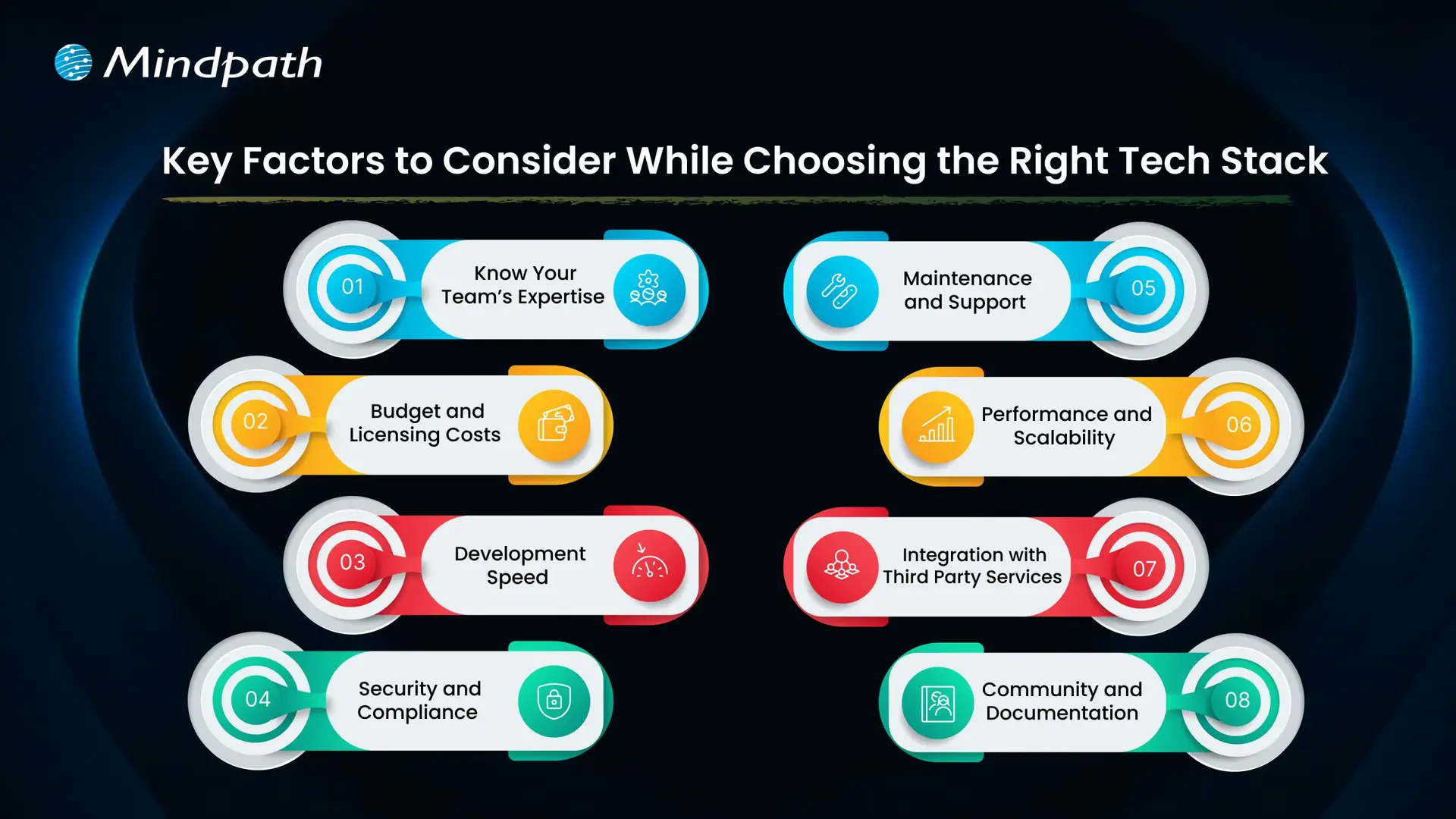
Choosing the right tech stack for web development is one of the most important things you’ll do to ensure the success of your project. The tools and technologies you decide to use will dictate how your application performs, scales, and is kept secure. Here are some key factors to keep in mind while selecting the best tech stack for web development.

Key Factors to Consider While Choosing the Right Tech Stack

1. Know Your Team’s Expertise

Look at what technologies your team already knows well. Using familiar tools can help you develop faster and avoid extra training costs. Make sure the tech stack matches your team’s size and experience to keep the project on track.

2. Budget and Licensing Costs

Think about any licensing fees for paid tools and compare them with free, open-source options. Remember to plan for costs related to maintenance, updates, and security. Also, include cloud service expenses that may grow as your project expands.

3. Development Speed

Getting your product ready fast can be a big advantage, especially for new businesses. Choosing proven frameworks and useful libraries can help your team build features quickly. This saves time and lets you focus on improving your web app for users.

4. Security and Compliance

Prioritizing security is essential, especially if your application handles sensitive data. Choose a tech stack that supports robust security features and aligns with industry regulations. This will help protect user information and maintain compliance as your project grows.

Must Read: Application Security Best Practices 

5. Maintenance and Support

Choose technologies that have strong community or vendor support so you can get help when needed. A reliable tech stack with regular updates will make it easier to fix issues and improve your application over time. This helps you avoid unexpected costs and keeps your project stable in the long run.

6. Performance and Scalability

Make sure your tech stack can handle the speed and load your application needs. If you expect real-time processing or heavy traffic, choose tools that keep response times fast. This helps your web app run smoothly as more users come on board.

7. Integration with Third-Party Services

Check that your tech stack works well with the third-party services your app needs. Good API compatibility makes it easier to connect features like payments, analytics, or social media. This saves time and helps your app deliver a smooth user experience.

8. Community and Documentation

Choose technologies with an active developer community and plenty of shared resources. Strong documentation makes it easier for your team to build, test, and maintain your web application. This support can save time and help solve issues more quickly.

Wondering how your tech stack fits into the bigger picture of web app development? Explore our comprehensive Web App Development Roadmap for 2026 to see how each decision impacts your project’s success.

Top 8 Tech Stack Examples

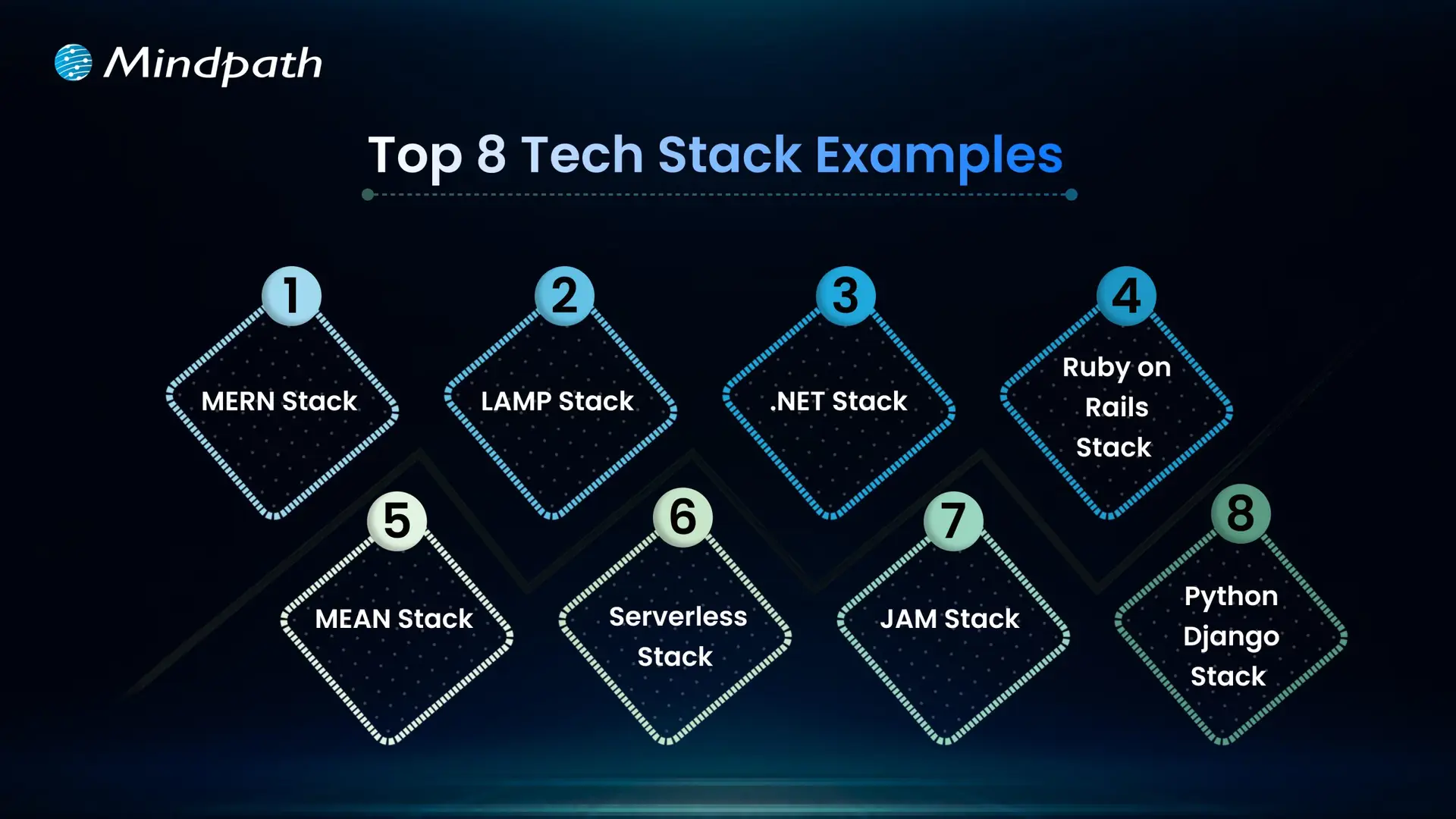
Exploring technology stack examples can help you see what works best for different types of projects. Here are some of the most popular examples to consider in 2026.

Top 8 Tech Stack Examples  

1. MERN Stack

MERN includes MongoDB, Express.js, React, and Node.js for flexible, dynamic sites. It’s widely chosen as a modern web application stack for responsive interfaces.

2. LAMP Stack

The LAMP stack combines Linux, Apache, MySQL, and PHP to build reliable, cost-effective websites. It is one of the oldest and most trusted web stacks in use today.

3. .NET Stack

The .NET stack is known for secure, large-scale enterprise applications. Many companies choose this web dev stack for its strong integration with Microsoft tools.

4. MEAN Stack

The MEAN stack uses JavaScript across MongoDB, Express.js, Angular, and Node.js. This tech stack for web development is popular for real-time and single-page apps.

5. Ruby on Rails Stack

Ruby on Rails offers a simple, clean approach for rapid web projects. This technology stack example is still a favorite for startups and MVPs.

6. Python-Django Stack

The Python-Django stack helps developers build powerful sites quickly. Many prefer this as a flexible web development stack with great community support.

7. JAM stack

JAM stack uses JavaScript, APIs, and Markup to deliver fast static sites. It is considered one of the best tech stacks for web development for content-heavy projects.

8. Serverless Stack

Serverless architecture removes the need to manage servers directly. It’s a growing example of a tech stack that cuts costs and improves scalability.

Not sure if your business really needs a custom web application? Discover the key signs that your business needs a custom web application that indicate it’s time to invest in a tailored solution for your needs.

Need Help Choosing the Right Tech Stack for Your Web Project?

Selecting the right tech stack for web development shapes how well your application performs, scales, and adapts over time. By knowing your goals, team strengths, and key factors like security, costs, and integrations, you can make informed choices that save you time and money. A thoughtful approach will help you build a reliable, future-ready web application that supports your business growth.

At Mindpath, we help you build secure, high-performing web applications with the best-fit tech stack for your needs. Our experts offer end-to-end web application development services, covering design, development, testing, and support. We make sure your solution stays flexible, scalable, and easy to maintain as your business grows. Let’s create a web app that works for you.

Frequently Asked Questions

1. How do you choose the right tech stack for a web application without overcomplicating the decision?

Start with three clear questions: What does the application need to do, who will build it, and what is the budget? Matching the tech stack to team expertise, project complexity, and long-term scalability requirements eliminates most confusion. Overthinking the decision often leads to choosing unnecessarily complex technologies that slow development considerably.

2. Can switching tech stacks midway through a web project cause serious problems?

Significantly yes. Changing the tech stack mid-development typically means rebuilding foundational components, retraining the team, and resetting timelines entirely. The cost and disruption are rarely justified unless the original choice was fundamentally flawed. Making a thoroughly researched decision before development begins is always far more efficient than course-correcting later.

3. Is an open-source tech stack always better than a paid licensed one?

Not necessarily. Open-source stacks eliminate licensing fees but may require more internal expertise for maintenance, security patching, and troubleshooting. Paid stacks often include vendor support and compliance features that save time in regulated industries. The right choice depends entirely on team capability, budget structure, and specific application requirements.

4. How does the tech stack choice directly affect a web application’s long-term scalability?

Certain technologies handle growing traffic and expanding features far more gracefully than others. A stack chosen purely for rapid initial development may create serious performance bottlenecks as user numbers increase. Evaluating scalability requirements honestly at the planning stage prevents expensive infrastructure overhauls that become necessary when applications grow beyond their original technical foundations.

5. Does the size of a developer community really matter when selecting a technology stack?

Considerably more than most people initially expect. An active community means readily available documentation, faster bug fixes, regular framework updates, and easier access to experienced developers when hiring. Technologies with shrinking or inactive communities gradually become liabilities, making maintenance harder and recruitment significantly more difficult as fewer developers maintain proficiency in them.

challenges of AI adoption

The potential of artificial intelligence to revolutionize business processes revolves around enhancing efficiency, driving smarter decision-making, and fostering innovation. According to Forbes, generative AI can add $4.4 trillion to the global economy, which is hard to ignore for any business (Source). However, the challenges of AI adoption have held back many businesses from tapping into the full potential of AI.

With AI becoming a hot topic in team chats and boardroom meetings, it is reasonable to wonder why business owners think twice before AI adoption. The problem is that around 74% of businesses struggle to achieve anything of value from their AI initiatives (Source). Many organizations encounter different types of challenges during AI adoption, and understanding them can help in finding the ideal solutions.

Handling the challenges of AI Adoption can be complex, but technical expertise can help you overcome hurdles. Our AI development services help businesses overcome challenges and provide tailored solutions.

Unravelling the Common Challenges for AI Adoption

The utility of artificial intelligence for businesses and predictions regarding its value in the future encourage business leaders to think about AI adoption. At the same time, many businesses that have implemented AI in their processes and systems have not captured value from their AI projects.

The journey of AI adoption in business presents formidable challenges, which businesses must understand before implementing artificial intelligence. The following challenges for AI adoption serve as the biggest roadblocks in making the most of the capabilities of artificial intelligence.

1. No Strategy or Vision

The biggest barrier to successful AI implementation is the lack of strategy and vision. If your organisation doesn’t have a well-defined AI strategy, the risks of misalignment grow stronger, especially when considering the future of AI. Without a strategy, businesses might begin their AI initiatives without understanding how AI will align with business goals. The outcome of ignoring strategy manifests in the form of disjointed pilot projects and a lack of quantifiable goals.

Strategy and vision are the foremost AI implementation challenges that organizations should focus on to capture tangible value from AI. The lack of these two things will turn any AI adoption project into an expensive experiment. Furthermore, leaders without a vision and understanding of how AI will contribute to strategic goals can fail after the initial excitement fades away.

2. Lack of AI Expertise

One of the formidable challenges to the success of AI projects is the lack of AI experts. The skill gap in the AI landscape is extremely huge as demand for AI talent outweighs the supply by significant margins, with AI redefining job roles in tech. Many companies don’t have the professionals with technical expertise required for developing, deploying, and managing AI solutions. Some of the notable AI jobs, including data scientists, AI ethicists, and machine learning engineers, have been gaining a lot of attention. However, businesses have to struggle a lot to find the right professional for such jobs.

The list of artificial intelligence challenges will also shed light on the fact that existing IT teams may not have the knowledge to incorporate AI in legacy systems. On top of it, everyone in the workforce cannot understand the nuances of deploying AI models and maintaining them. The talent deficit drives companies to invest heavily in training their existing employees, thereby imposing the burden of time and training costs.

3. Upfront Costs and ROI Uncertainty

Speaking of the burden of costs, business owners must know that the initial investment for AI projects can be huge. The massive upfront costs for AI initiatives include costs of technology infrastructure, software licenses, maintenance costs, and talent acquisition. While enterprise AI adoption offers promising results in the long run, the initial investment is difficult to procure for many businesses. In addition, many businesses could not come up with a justification for the huge upfront investment in specific business use cases of AI.

The uncertainty regarding ROI expected from AI projects can create difficulties in measuring potential cost savings, competitive advantage, or expected revenue growth. As a result, the business leadership might not buy into the project, ultimately leading to difficulties in funding. Such types of AI projects generally fail to move beyond the pilot phase, and some never see the light of day.

Looking to turn AI from an experiment into a strategic advantage? Explore AI in business strategy to understand how the right approach drives measurable impact.

4. Cultural Resistance

Cultural resistance from employees of an organization is obviously one of the most prominent challenges for AI adoption. It provides a clear explanation of why AI projects fail, as disgruntled employees can be the biggest roadblock for an organization’s growth. Employees are likely to harbor fears that AI will replace them, thereby making them more resistant to AI tools and technologies.

Without understanding the purpose and benefits of AI, employees will become more critical of AI and create new challenges. The fear of losing their jobs can make employees more resistant to training, which will result in a lack of enthusiasm for AI projects. On top of it, lower user adoption due to cultural resistance can have a negative impact on the most carefully planned AI projects.

6. Blending with Legacy Systems

Another formidable challenge for AI adoption is the integration with legacy systems. The line of difference between modern AI tools and the outdated legacy systems and the need for modernizing legacy systems can be the biggest headache for business owners. Existing legacy systems might not have the flexibility, interoperability, or scalability to work with new AI platforms. It is one of the common AI integration issues that results in operational inefficiencies, technical complexities, and data silos.

Some businesses might assume that forced integration of AI with legacy systems can solve the problem. However, it would lead to consequences like unexpected costs, project delays, and large amounts of technical debt. Many businesses have failed in their AI initiatives due to the inability to map system connections and facilitate seamless data flow across different platforms.

7. Data Quality and Governance

The effectiveness of AI models depends significantly on the quality of data used to train them. Data quality and governance also take a top spot among the challenges in AI adoption as businesses struggle to find the ideal data for their AI systems across different types of AI. For example, businesses have massive collections of data, plagued by the issues of accessibility, governance, and quality. Businesses have to struggle with issues due to inaccurate, inaccessible, biased, or incomplete data, as they cannot be used in training AI models.

Almost every business that aims to adopt AI cites data accuracy and bias as major challenges. On top of it, the lack of proprietary data for customizing models can restrict the possibilities of effective AI implementation. It is also important to note that data privacy and confidentiality also emerge as prominent challenges for AI projects that deal with sensitive information.

Wondering if your organization is truly ready to adopt AI? Check out our AI readiness checklist to see how businesses can align strategy, data, and technology for successful AI adoption.

How Can Businesses Overcome the Challenges to AI Adoption?

The best way to address the challenges for AI adoption in business involves a strategic and multi-faceted approach. Businesses must aim to fight against the challenges with technology, processes, and people rather than focusing on a specific domain. The following sections offer some valuable recommendations to overcome the challenges in adopting AI for businesses.

1. Develop an AI Strategy

Before starting any AI project, businesses must have a clear and actionable AI strategy that aligns with business goals. The strategy will help you identify the use cases that deliver the most significant impact by addressing specific pain points. Business leaders must focus on projects that promise measurable value advantages in different business operations. Another suggestion to address such challenges involves explaining AI risks and limitations to business leaders. On top of it, businesses must establish an AI governance team, a clear AI roadmap, and measurable KPIs for AI initiatives.

2. Bridging the Skill Gap

Business owners should adopt an innovative approach to address the challenge of skill deficit for AI projects. As AI trends continue to evolve, the approach should begin with training the existing workforce through internal training programs, online learning platforms, and workshops. Apart from promoting AI literacy, businesses should also bring in AI specialists or collaborate with AI vendors when required. Another crucial aspect of the upskilling initiatives for AI projects focuses on AI ethics training to ensure responsible AI development.

3. Show Clear Business Value

The strategic approach to resolving AI adoption challenges must also focus on creating a clear business case for AI. Smaller pilot projects that showcase measurable business value can be the best place to begin. Most important of all, business leaders must also establish benchmarks for success before implementation and track the progress of projects. Quantified impression of benefits, including revenue growth, cost savings, and customer engagement, can provide a clear idea of project success.

4. Seamless Integration and Data Governance

Integration with legacy systems does not have to be a challenge in AI projects, as foresight can solve the problem. Businesses can integrate IT teams in AI initiatives to map out system connections and prepare for integration challenges. Leaders should also take the initiative to foster collaboration between IT and business teams to ensure alignment with business needs. Furthermore, implementing data governance helps in avoiding conflicts during integration while ensuring privacy and quality training of AI models.

Struggling to turn AI strategies into real business outcomes? Explore our AI consulting guide to learn how expert guidance helps organizations overcome adoption challenges and implement AI successfully.

Final Thoughts

The challenges in the journey to adopt AI create huge roadblocks for any type of business trying to embrace AI. However, the solution to prominent business challenges in implementing AI revolves around identifying and understanding the challenges. For instance, business owners must learn how the lack of a clear strategy can affect AI adoption. As a result, business owners will pay attention to developing a well-defined AI roadmap.

We at Mindpath will help you find the ideal solution to overcome AI adoption challenges in any industry. Our years of experience in implementing end-to-end AI solutions have empowered us to address any problem in implementing AI. Reach out to our consultants and figure out the best strategic approach to embrace AI in your organization right now.