

Top ReactJS Developers in Canada: Find the Right Talent for Your Project

Join our Newsletter!

Featured Posts

Support Is One Click Away

Home

Top ReactJS Developers in Canada: Find the Right Talent for Your Project

Top ReactJS Developers in Canada: Find the Right Talent for Your Project

Are you looking for skilled ReactJS developers in Canada to build a modern, high-performing web application? Do you need experts who can turn your ideas into reality with seamless, scalable solutions? Finding the right developers can be challenging, but with the right approach, you can hire top ReactJS talent in Canada to elevate your project.
Hiring ReactJS developers in Canada is a strategic decision for businesses looking to build fast, scalable, and user-friendly web applications. With a strong tech industry and a growing pool of experienced developers, Canada offers access to top-tier talent specializing in ReactJS development. Whether you’re looking for a dedicated developer or an entire team, choosing skilled professionals ensures smooth project execution, high-quality code, and seamless user experience. Investing in expert ReactJS developers will help you stay ahead in the competitive digital landscape.

Let’s explore how you can find and hire the best developers for your needs!

Steps to Hire ReactJS Developers in Canada

1. Define Your Project Requirements Clearly

Before hiring a ReactJS developer in Canada, it’s essential to define your project needs. Clearly outline the scope, technical requirements, and desired functionalities of your web application. Identify whether you need a simple front-end development service or a full-stack ReactJS expert who can manage backend integrations. Also, determine the experience level—junior developers are great for smaller tasks, while mid-level and senior developers handle complex applications. Understanding your project’s technical needs helps in shortlisting candidates with the right expertise. A well-defined job description attracts qualified professionals and streamlines the hiring process. Consider scalability, performance optimization, and integration needs to ensure the selected developer can meet long-term business goals. Proper planning at this stage avoids hiring mismatches and ensures a smooth development journey.

2. Search on Relevant Job Boards and Networks

To find the best ReactJS developers in Canada, leverage multiple hiring platforms. Popular job boards like LinkedIn, Indeed, Glassdoor, and AngelList are excellent for connecting with skilled professionals. Additionally, specialized platforms like Toptal, Upwork, and Stack Overflow Jobs offer access to freelance and contract developers. Engaging with local tech communities, attending ReactJS meetups, and networking on developer forums can also help you discover top talent. Many experienced developers participate in open-source projects, so reviewing GitHub profiles can provide insights into their coding expertise. Recruitment agencies and staffing firms specializing in tech hiring can further simplify the search. A multi-channel approach increases your chances of finding a developer with the right skills and experience. Since Canada has a competitive tech market, actively sourcing candidates through various platforms ensures a more efficient hiring process and better access to top-tier ReactJS developers.

3. Screen Resumes and Portfolios for Technical Expertise

Once you have a pool of potential candidates, the next step is resume and portfolio screening. Focus on developers with strong experience in ReactJS fundamentals, including JSX, components, hooks, and lifecycle methods. Assess their familiarity with related technologies like JavaScript, HTML, CSS, TypeScript, and state management libraries such as Redux or Context API. For full-stack roles, check their proficiency in Node.js, databases, and RESTful APIs. A candidate’s portfolio is equally important—it provides real-world examples of their skills and problem-solving abilities. Look for projects that demonstrate responsiveness, performance optimization, and clean code structure. Open-source contributions and side projects can indicate passion and expertise. Beyond technical skills, ensure their past work aligns with your project needs. A structured resume and well-documented portfolio reflect a professional approach, making it easier to identify the most qualified developers for the next stage of evaluation.

4. Conduct Technical Assessments and Interviews

To ensure a candidate’s practical skills, conduct a technical assessment before hiring. Start with a coding challenge that tests problem-solving abilities, React component structuring, state management, and API handling. Online coding platforms like HackerRank, Codility, or LeetCode can help streamline this process. During the technical interview, dive deeper into React best practices, performance optimization techniques, debugging strategies, and security considerations. Ask candidates about their experience with responsive design, testing frameworks (Jest, React Testing Library), and DevOps deployment workflows. Apart from coding skills, a behavioral interview helps assess soft skills such as communication, teamwork, and adaptability. Understanding how a developer approaches problem-solving, and collaboration ensures they align with your work culture. A well-rounded evaluation process guarantees you hire someone with the right mix of technical expertise and interpersonal skills, making them a valuable asset to your development team.

5. Consider Location, Salary Expectations, and Hiring Model

When hiring a ReactJS developer in Canada, consider regional salary variations and the hiring model that best suits your business needs. Salaries differ based on location—developers in Toronto, Vancouver, and Montreal tend to have higher salary expectations due to the competitive job market, while smaller cities may offer cost-effective hiring options. Define whether you need a full-time, contract, freelance, or remote developer, as each model impacts cost and availability. Discuss salary expectations early to avoid misalignment. The average salary for a ReactJS developer in Canada ranges between CAD 80,000 to CAD 120,000 per year, depending on experience. If hiring remotely, factor in time zones and work flexibility. For startups and small businesses, outsourcing or hiring through IT staff augmentation firms can be a cost-effective alternative. Considering these factors ensures a smooth hiring process and helps you secure the right ReactJS developer within your budget and project requirements.

Looking for skilled ReactJS developers in Canada? At Mindpath, we provide top-tier ReactJS experts to build scalable and high-performance web applications. Whether you need a dedicated developer or a full development team, we ensure a seamless hiring process tailored to your project needs. Partner with Mindpath today and accelerate your digital success!

Contact Us Now!

Related Post

Discover how AI is transforming the world. Explore the top 10 benefits of artificial intelligence, from solving complex problems to enhancing customer experiences.
Discover how Decision Intelligence transforms businesses by improving efficiency, reducing risks and driving smarter decision-making.
NodeJS developer costs vary based on experience, project complexity, and location. Read to find out more about it.

Related Post

full stack development trends

The full-stack development landscape is changing rapidly, and 2026 is already showing great possibilities for new ideas and better tools. Getting familiar with the newest full-stack development trends can help developers, startups, and businesses create smarter solutions. User needs are increasing, along with the requirement for flexible and efficient development solutions, which means teams are taking a fresh look at how they build, test, and scale applications. Knowing how to navigate these changes can have a significant impact next time whenever you develop a new item or launch a new product.

With speed, scalability, and seamless user experience as the new focus, developers are integrating advanced front-end technologies with back-end solutions to develop modern digital products. With cloud platforms available everywhere and low-code solutions evolving more rapidly, full-stack development is moving to a whole new level.  These solutions are transforming processes that not only save time but also improve quality and naturally foster greater teamwork. In this blog, we will provide further insight into the most important trends shaping full-stack development in 2026.

Looking to implement the advantages of full-stack development in your next project? Take a look at our full-stack development services, where our team will support and guide you to bring those benefits to the real world.

Understanding Full-Stack Development

Full-stack development refers to building both the front-end and back-end of a software application. Let’s dive in to understand! Every application has two main sections. The front-end is what users see and interact with, like buttons, images, and forms. The backend encompasses all the activities that take place in the background – saving data, running logic, interacting with other systems, etc.

Each side requires different skill sets and tool sets. Full-stack development combines both sides into one process. Full-stack development enables developers to create complete applications and allows us to develop the application seamlessly from the user interface through the server and database. This means that the application includes both of those components as one shared system, which makes development more efficient and organized.

Some advantages of full-stack development include:

  1. A full-stack developer saves money by doing both front-end and back-end work, minimizing the need for multiple specialists.
  2. They speed-up the development process by working across the entire tech stack, ensuring faster delivery and smooth collaboration.
  3. With strong knowledge of current tools and trends, they support modern full-stack development by integrating advanced features like AI and responsive design.
  4. Full-stack developers take full ownership of the codebase, simplifying responsibility and streamlining debugging.
  5. They deliver well-rounded, quality solutions by working across the UI, backend logic and business processes, database activities and data expansion, and testing.
  6. They even provide ongoing support and maintenance, which ensures long-term stability, security, and enhancement.

Read in detail: Full-stack development benefits.

Full-Stack Development Trends 2026

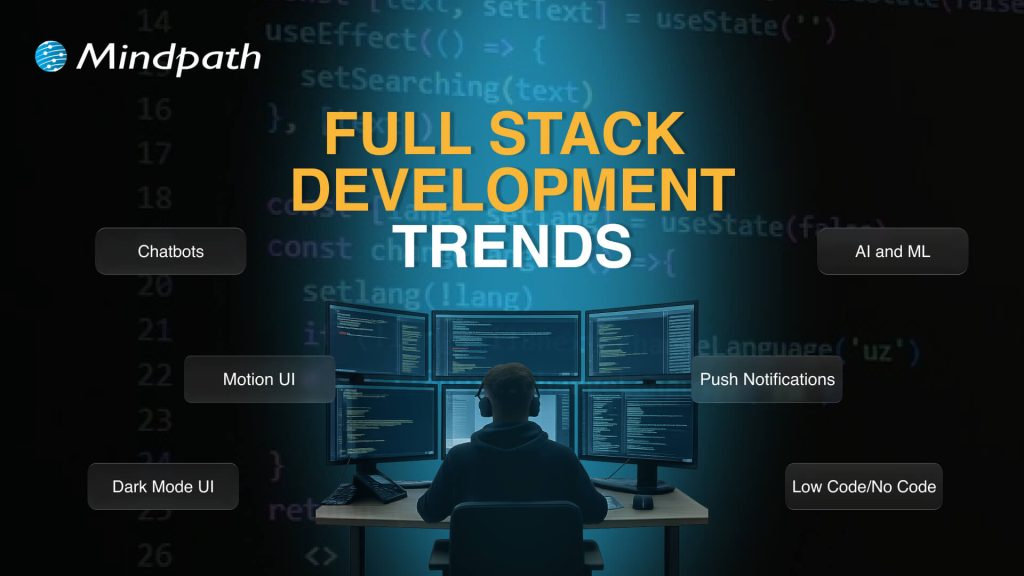
As technology continues to grow, developers are embracing smarter tools and faster methods to build complete applications. The emerging trends in full-stack development are shaping how teams work, improve performance, and deliver better user experiences in 2026. Here are the top trends to watch:

full-stack development trends


1. Artificial Intelligence

Artificial Intelligence is one of the key full-stack development trends shaping how modern applications are built. It helps solve complex problems faster and allows systems to work without human interruption. Full-stack developers are well-suited for AI roles because they understand both design and logic, making it easier to build intelligent solutions. As the future of full-stack development evolves, AI will play a major role in improving performance and user experience.

2. Cloud Computing

Cloud computing is a fast-growing technology that allows access to data storage, processing power, and other resources over the internet. It supports the future tech stack for developers by offering flexibility, easy scaling, and pay-as-you-go pricing. Full-stack cloud developers are in demand to build and manage cloud-based applications that support collaboration and performance. To grow in this area, developers should understand IaaS, PaaS, SaaS and gain hands-on experience with platforms like AWS, Azure, and Google Cloud.

Also Read: Cloud Computing Trends

3. DevOps

DevOps is a practice that combines development and operations to improve how software is built, tested, and deployed. It helps teams work better together and use tools like continuous integration and delivery to release updates faster. DevOps plays an important role in improving application speed, quality, and reliability. As part of full-stack development trends, it supports the demand for efficient workflows and strong collaboration in building modern applications.

4. Progressive Web Apps

Progressive Web Apps (PWAs) are web applications that offer an app-like experience using modern browser features. They work offline, load quickly, send push notifications, and can be installed on devices without using much storage. As part of web development trends 2026, PWAs help businesses reach more users, especially on mobile, while keeping development simple and cost-effective. Their flexibility and performance make them a smart choice for companies looking to improve user experience.

5. Blockchain

Blockchain is a secure and transparent technology that stores data across a network of computers, making it difficult to change or hack. It is widely used in industries like finance and healthcare to protect transactions and manage decentralized systems. As part of full-stack development trends and the latest trends in web development, blockchain allows developers to build safer and more reliable applications. To work in this area, full-stack developers need skills in decentralized tools, enterprise systems, and Web3 architecture.

Must Read: AI in Cybersecurity

6. Cybersecurity

Cybersecurity is the practice of protecting systems, networks, and applications from online threats like malware, phishing, and DDoS attacks. It has become a key part of full-stack development trends as developers need to build secure applications from the ground up. Companies are now including cybersecurity in their future tech stack for developers to keep data and systems safe. Full-stack developers aiming to work in this field should learn network security, web application security, cryptography, and secure coding practices.

7. Low-Code and No-Code Development

Low-code and no-code development platforms allow users to build websites and apps with minimal or no programming skills. These tools are growing as part of full-stack development trends because they save time, reduce costs, and make development accessible to more people. While they are great for simple projects, they may not be suitable for complex or large-scale solutions. As part of the trends in software development, LCNC tools offer fast results and full-stack capabilities for quick product launches.

Looking for the best way to scale your digital growth? Discover why full stack development for web projects is becoming the smart choice for businesses.

Ready to Leverage Full-Stack Development Trends for Your Next Project?

Full-stack development trends are shaping how modern applications are built, improved, and maintained. With advancements like AI, cloud, DevOps, and PWAs, developers and businesses can achieve faster, smarter, and more secure results. Staying updated with these trends will help you build stronger digital products that meet the growing demands of users in 2026 and beyond.

At Mindpath, we offer expert full-stack development services tailored to your business goals. Our skilled developers handle everything from front-end design to back-end logic, delivering complete, scalable solutions. If you’re looking to hire full-stack developers who understand the latest tools and technologies, our team is here to help you build your web and mobile applications with confidence and efficiency.

Tech Trends

Curious about what’s going to be big in tech this year? Want to know the trends that will shape our world in 2024? In this blog we will explore the latest technology trends that are set to shape the future. 

The world today is fast-moving and changing constantly; hence, businesses and professionals need to keep up with the latest technologies.  Be it learning new skills to get ahead in your career or just knowing what’s happening around you to effectively communicate in your workplace, knowing the changes in technology makes all the difference.  It would make the workflow easier, save much time, and increase productivity.  Much of today’s job search is conducted through digital tools and platforms, so keeping ahead of the game to ensure you present yourself in the best light possible is highly important. In addition, updated technology has made it possible for businesses to better reach their potential customers with very relevant content across social media, apps, and blogs. Staying ahead of the technology curve better engages and understands your audience, establishes stronger relationships, and helps to differentiate you in the marketplace. 

So, let’s dive into the latest technology trends that can help you stay updated as well as transform the future! 

Top 10 Technology Trends 2024  

1.  AI-Generated Content   

One of the major tech trends of 2024 should be AI-created content. Artificial intelligence is capable of creating high-quality content in textual, visual, video, and even musical formats. For example, tools like GPT can write articles or help with education-related materials, such as generating summaries for textbooks or creating engaging blog posts. DALL-E will produce unique and different images based on simple descriptions, like custom illustration designs for a website or to use for adding visuals to a social media campaign. It eases and speeds content creation, especially for small businesses or individuals with meager budgets. For example, a small online shop could use AI to create promotional graphics for a sale or quickly generate product descriptions. AI-generated content saves time and money, giving more opportunities to let their ideas be heard on a greater scale. 

2. Quantum Computing   

Quantum computing is one of the most exciting technology trends that will make a difference in 2024. A quantum computer avails itself of the law of quantum mechanics to deal with information much more quickly compared to traditional computers, especially for specific tasks. This could be applied to cryptography: quantum computers would resolve cryptographic codes and change the idea of securing data. The quantum computer can accelerate the process of drug discovery by emulating a complex structure of molecules precisely, and thus aid in the development of new medicines. Though still in its infant stage, quantum computing is sure to be a game-changer in different industries; it gives solutions to problems that ordinary computers cannot solve. It stands on the verge of reshaping everything about how complications are handled and can be of vital importance in domains such as cybersecurity or pharmaceuticals. 

3. 5G Expansion   

Compared to previous generations, 5G offers much greater data speed, far superior coverage, and connections more reliable. This huge growth in 5G has spurred the development of technologies that are considered transforming—for example, the Internet of Things, augmented reality, and autonomous vehicles. 5G underpins the very fast and efficient communication among many IoT devices leading to smart homes and cities. Augmented reality experiences, like interactive games or virtual training, require ultra-low-latency connections of 5G. In the same way, the quick data interchange feature and high-speed data processing ability of 5G technology are applied in autonomous vehicles for safe and very accurate self-driving capability. 

4. Virtual Reality (VR) 2.0   

Virtual Reality 2.0 provides even more realistic and engaging experiences. Improved VR technologies enhance display resolution, motion tracking, and interaction features, giving a world that is brimming with activity and character. For instance, in gaming, next-generation VR provides highly detailed graphics and motion tracking to give users the impression of complete immersion into their video game environments. In training, it is used in simulating scenarios of the real world for effective learning. Moreover, VR also brings benefits in therapeutic settings where controlled virtual environments can treat a wide range of anxiety or PTSD cases. Recent improvements are also geared toward making VR more user-friendly, with lighter headsets and longer battery life that may see more people using VR in daily life.  

5. Augmented Reality (AR) in Retail   

Augmented Reality (AR), in the retail sector, created something different this 2024 by providing consumers with new ways of shopping. In other words, AR technology really makes it possible for shoppers to see products in their real-world environment right on their smartphones or tablets. For instance, AR applications that will let you have a virtual trial of specific attire, showing you how you are likely to look in it. Likewise, AR can show furniture fitting and appearance in a room prior to one making a purchase. Such kinds of interactions provide more than better customer satisfaction since people can make better decisions. Rather, they increase sales and reduce return rates. By providing customers with a better feel for how products are going to work in their lives, AR is revolutionizing the retail experience to make it not only more fun, but more convenient. 

6. Internet of Things (IoT) in Smart Cities   

Smart cities are being implemented in 2024 through the power of the Internet of Things. IoT technology interlinks a variety of sensors and devices involved in running the resources and services of cities for easy gathering and analysis of data. For example, it can monitor traffic patterns and public transport systems to bring about ease in congestion and reduce travel time. On the other hand, smart grids make use of IoT to optimize energy consumption and, hence, make cities more energy-efficient and cost-effective. IoT facilitates public safety by interconnecting various emergency services and monitoring public places against incidents to enable quicker responses. As cities continue to grow in population, IoT helps deal with the increasingly complex management of urban areas to ensure an improved quality of life through responsive and sustainable cities. 

7. Blockchain Beyond Crypto   

This blockchain technology, first developed for Bitcoin, is making waves way beyond just cryptocurrency in 2024. It’s very unique features are harnessed across a plethora of industries: transparency, security, and reduction of fraud. For example, blockchain will track where something came from and its journey in supply chains to ensure authenticity and prevent counterfeiting. In voting systems, blockchain provides a tamper-proof way of recording votes, hence making elections safer and more trustworthy. Moreover, blockchain is useful in managing secure medical records and thus in safeguarding sensitive health information against unwarranted access. These new applications underline blockchain’s potential for improving transparency and security within different fields, stretching its benefits far from the world of digital currency. 

8. Neuromorphic Computing   

Neuromorphic computing is one of the most exciting tech trends looking forward to 2024, which is basically a kind of computing intended to develop computer chips like the neural structure of the human brain. In contrast to traditional computers, chips process information like our brains. This approach improves efficiency, especially in tasks like pattern recognition and sensory data processing. It can make Technologies that require real-time learning and adaptation—in terms of advanced robotics or AI systems that work in interaction with their environment—much better. Such chips offer enormous gains in energy efficiency and computational power, hence making them ideal for uses where quick, adaptive responses are needed. When completely developed, this technology has the potential to cause revolutions in how we look at complex computing tasks. 

9. Autonomous Vehicles   

Autonomous vehicles are among the top tech trends for 2024. These are cars that use AI, sensors, and machine learning to drive on roads and navigate without human intervention. Even though a completely self-driving car has not yet been developed, remarkable development has happened in having different degrees of autonomy within public transport and freight logistics. For example, cities are testing autonomous buses to make public transport more efficient and safer. In freight logistics, self-driving trucks are already applied to facilitate deliveries, reducing traffic accidents by ensuring that the right routes are followed while lowering emissions. The further development of these technologies will provide higher road safety, reduce congestion, and contribute to cleaner air. 

10. Edge Computing 

Edge computing is another leading technology trend. It deals with processing data closer to its source and thus does not have any central data center. This is quite critical for applications requiring real-time processing and quick decision-making, which was hitherto faced with latency in the case of cloud computing. For example, edge computing in autonomous vehicles performs instantaneous processing of sensor data to support quick driving decisions. In industrial IoT, it helps real-time monitoring and control of machinery for increased efficiency and safety. Moreover, edge computing supports local data processing in remote areas where internet connectivity may be poor, hence ensuring that crucial data is well processed and acted on. This technology enhances performance and lowers latency across a wide variety of applications. 

Ready to Transform Your Future?

At Mindpath, our expert team is here to guide you through modernization, digitization, and innovation, ensuring you stay ahead of the curve.

Lead the Way in Technology with Mindpath 

In the fast-changing technological world today, one needs innovation, expertise, and strategic planning to be ahead. Mindpath empowers your business to lead in this by offering cutting-edge IT services that are tailor-made for you. Our team works hard to ensure you leverage new technologies, optimize your processes, and drive growth to be competitive and successful in a changing digital world. Here are the services we offer: 

1. Modernization 

Bring your business up to speed with legacy system upgrades, process optimization, and state-of-the-art technologies. We provide modernization services to help you keep up with the ever-changing world of business. 

2. Digitization 

Get proper visibility online through our all-rounded Web Development and App solutions. We give you the tools and strategies to help your business remain relevant and competitive across the digital space. 

3. Innovation Hub 

Our Innovation Hub is where creativity meets implementation. We are an innovative, collaborative space for ideas, project development, and making things happen. From an initial concept to the final execution, we will guide you through your innovation journey. 

4. Custom Chatbot Development 

Take user experience to another level by our bespoke chatbot solutions. Our intelligent, conversational chatbots will smooth interactions and great insights that improve customer engagement and support. 

5. Artificial Intelligence Development 

Leverage AI to unlock new insights to do what really matters, automate processes, and predict trends. Tailored AI solutions will let you drive efficiency and foster innovation while lining them up with your business goals. 

6. Staff Augmentation 

Make use of our skilled professionals in aiding you to achieve your project objectives—short- or long-term. Experts integrate into your team to raise your business to the next level with exceptional results. 

Conclusion 

2024 is the handiwork of innovation that will change our world in immense ways. From AI-generated content to quantum computing, the very pervasiveness of 5G, and the transformative power of augmented and virtual reality, keeping ourselves conversant and adaptable becomes imperative. These trends call for more innovation than ever but equally demand readiness to tap their full potential. The reason for embracing these technologies is threefold: efficiency, growth, and new opportunities within many industries.   In this age of rapidly changing technology, Mindpath stands ready to guide and lead you in the digital age. Our suite of expertise in IT services is crafted for you and your specific needs to move your business forward. From modernizing systems to digitizing an online presence or innovation in our collaborative hub, Mindpath is equipping businesses like yours for success. Our services are developed in the belief in the easy integration of bespoke chatbot development, advanced AI solutions, and skilled staff augmentation, giving wings to your goals and elevating your projects. 

Ready to Embrace the Future?

Dive into the latest tech trends with Mindpath and explore how our tailored IT solutions can transform your business!

Discover the top tech trends for 2024 and how Mindpath’s cutting-edge IT services, from modernization to AI, can help you stay ahead and drive innovation.
how generative ai work in creative industry

In a digital environment where GenAI is emerging as a new place to start innovating, we are often faced with questions like, can AI be creative? Have you ever thought about how generative AI work in creative industry today? Well, generative AI is no longer just technology; it is a creative partner. It can assist with day-to-day entries to concepts, to producing full designs or content. GenAI solutions are beginning to change how professionals will manage their work moving forward. It is creating new opportunities to bring imagination together with intelligent automation. How exciting is that, right?

As more professionals utilize AI to support their creative processes, the impact is becoming apparent across multiple industries. According to a study by The Business Research Company, the generative AI market in creative industries grew from $3.08 billion in 2024 to an expected $4.09 billion in 2025, and it’s projected to reach $12.61 billion by 2029. With open-source tools, rising interest, and cross-industry use, the landscape is evolving fast. Want to know about this in depth? In this blog, we’ll be taking a closer look at how generative AI is changing creative work and the impact it will have on the future of the industry.

Looking for ideas to reshape your business with generative AI? Unlock smarter growth, faster innovation, and personalized customer experiences with our AI-powered solutions.

What is Generative AI?

Generative AI is a type of technology that enables computers to produce new content such as text, images, music, or even computer code. Instead of just producing answers or analyzing data, generative AI will generate new content on its own by analyzing a data set or learning from examples. For companies, this opens the door for them to use generative AI to save time, produce content faster, and create even more personalized experiences for their customers. It allows teams to be more productive collaboratively and be more creatively enabled.

How does Generative AI Work?

Generative AI works by learning from large amounts of data like text, images, or audio, and then creating something new based on that learning. It uses neural networks, which are computer systems designed to understand patterns, such as how sentences are written or how pictures are formed.

These systems are trained using different types of learning methods, often with very little labeled data. This helps build foundation models that can do many tasks. Generative AI examples include tools like ChatGPT, which can write stories or articles from short prompts, and DALL·E, which creates simple images from written descriptions.

How Generative AI Work in Creative Industry?

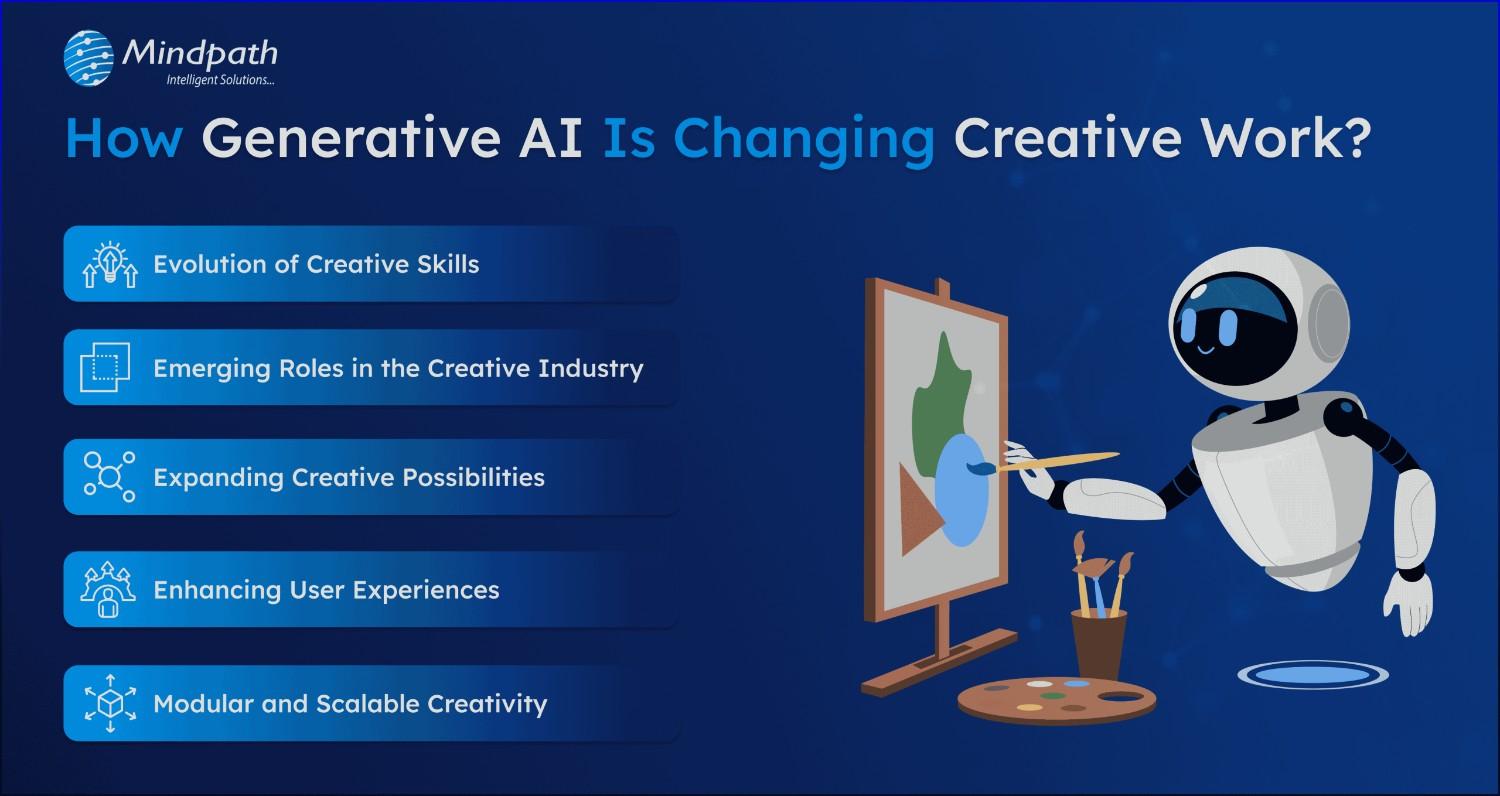
Creative work is changing in many exciting ways with the help of GenAI. It’s helping people come up with new ideas, save time, and try things that were not possible before. If you’re curious about how does generative AI affect creativity, here are the ways it’s making the creative process easier, faster, and more inspiring.

how-genAI-is-changing-creative-work-scale

1. Evolution of Creative Skills

Today’s creative professionals need more than just talent. They also need to understand how to use generative AI tools wisely and make thoughtful, responsible choices. Skills like curation help them pick and improve AI-generated ideas, while AI fluency means knowing how to use tools like ChatGPT or DALL·E. Most importantly, they must think ethically to ensure their work respects people and values.

2. Emerging Roles in the Creative Industry

As AI becomes a regular part of creative work, new types of roles are starting to appear. These jobs mix creative thinking with technical skills, showing how generative AI work in creative industry. For example, Prompt Engineers write clear instructions to help AI create content, while AI Art Directors use AI tools to design visuals quickly. There are also roles like Synthetic Media Producers and AI UX Designers who focus on virtual content and improving user experiences.

How are different industries leveraging Generative AI today? Find out in our blog on Generative AI Use Cases across Industries—from content creation to customer service and beyond.

3. Expanding Creative Possibilities

Generative AI is removing many of the limits that once held creative ideas back. Now, artists, marketers, and musicians can quickly try out new concepts without worrying about time or cost. They can test visuals, messages, sounds, and styles almost instantly. This freedom encourages bold thinking and opens the door to more creative experiments than ever before.

4. Enhancing User Experiences

Creative work is becoming more interactive and personalized, thanks to the use of generative AI. Brands and creators are now building experiences that adapt in real time, giving users a chance to take part in the creative process. From custom storylines to co-designed fashion and dynamic game worlds, AI is adding a new layer of engagement. Rather than replacing creativity, it’s helping people bring their ideas to life in exciting new ways.

5. Modular and Scalable Creativity

Generative AI is making it easier to create content in parts, or modules, that can be reused and adapted for different needs. This helps teams customize content for various platforms and audiences without starting from scratch each time. Marketing teams can turn one idea into ads, videos, or social posts quickly. Designers and writers are now building flexible templates that save time and boost creativity.

Also Read: Top GenAI Tools Shaping the Future of AI Development

Real-World Examples of GenAI Transforming Creative Industries

Generative AI is making a real difference in how creative work happens across different industries. Many companies and creators are already using it in ways that are smart, fast, and effective. Here are a few real-world examples showing its growing impact.

1. Entertainment Industry

GenAI is helping creators in entertainment and gaming bring stories and virtual worlds to life more quickly and creatively. Game developers are using AI to design characters, build game levels, and create realistic dialogue. It also supports features like deepfake voices and more dynamic non-player characters. In filmmaking, tools like Runway ML make it easier to edit videos and add visual effects in real time.

2. Writing and Publishing Industry

Writers are now using generative AI to boost both creativity and productivity. From coming up with ideas to drafting and editing, AI tools help simplify the writing process. Platforms like ChatGPT offer support when writers face blocks or need quick content suggestions. Publishers are also using AI to create short stories, newsletters, and SEO content at a larger scale.

3. Advertising and Sales Industry

Generative AI supports sales teams by helping them write personalized emails, prepare reports, and test different sales pitches more efficiently. It also assists in understanding products, markets, and risks by analyzing use cases and offering clear insights. Tools like ChatGPT and Gemini can explain complex visuals and data, making it easier to make informed decisions. Platforms like Jasper even help sales teams expand globally by translating content into multiple languages.

4. Marketing Industry

Marketing is one of the industries seeing the biggest impact from generative AI. It allows companies to personalize content at scale, create high-quality visuals and videos quickly, and manage large volumes of work in less time. Tools like ChatGPT, Jasper, and Einstein Copilot help with ad optimization, brand design, and social media content. These tools also support strategy by building customer profiles, analyzing competitors, and predicting market trends.

5. Media Industry

GenAI is helping media industries create content faster by assisting with writing, editing, and transcribing. News outlets use it for generating headlines, interview questions, and social media posts. Some broadcasters also use AI anchors and tools to automate simple news stories. While a few bold moves faced setbacks, many media groups now rely on AI to improve efficiency and scale content production.

Curious about where Generative AI is headed next? Explore the top Generative AI Trends for 2025 and stay ahead of the innovation curve.

Ready to Transform Your Creative Process with Generative AI?

Generative AI is transforming how creative professionals work by making tasks faster, smarter, and more flexible. It supports everything from writing and design to marketing and media. By understanding how generative AI work in creative industry, teams can unlock new levels of innovation, improve productivity, and explore fresh ideas without limits.

At Mindpath, we offer advanced Generative AI development services that help businesses simplify creative work and scale innovation with unexpected solutions. Whether you’re looking to generate content, design visuals, or build engaging user experiences, our expert team and tools are ready to support your goals. We work closely with you to deliver practical, AI-powered solutions that drive results. With Mindpath, your ideas turn into impact—faster, smarter, and with creative confidence.

Ready to Elevate Your Creativity? Dive into Mindpath’s generative AI solutions for faster, smarter, and more effective creative work. Contact Us

Discover how is generative AI changing creative work by boosting efficiency and making tools more accessible for all creators.