Why Outsource Web Development to Scale Your Business Efficiently?

Join our Newsletter!

Featured Posts

Support Is One Click Away

Home

Why Outsource Web Development to Scale Your Business Efficiently?

outsource web development

Why Outsource Web Development to Scale Your Business Efficiently?

In the current hyper-computing and changing digital environment, a scalable and user-friendly web presence has become a basic necessity. However, it requires a strategic approach along with creative thinking. And this is where you can outsource web development to enjoy the desired results.

Today, outsourcing web development has become a profitable solution for companies. After all, it helps them innovate and efficiently scale in this expanding digital world. Furthermore, when you outsource web development to external experts, you will be able to witness distinct advantages. In this detailed blog, we will explore some primary reasons why you should outsource website development. Besides, you will also get to know how to select the right partner to enjoy long-term success. So, keep reading further!

Struggling to scale your digital presence while keeping development costs and timelines under control? Our web development services provide scalable solutions that help your business grow faster.

Scaling a Business Begins with Smarter Strategies

Scaling a business goes beyond just increasing revenue or expanding your team. It involves scaling strategically and at the same time being profitable and productive. However, when a company grows, it can face a few serious issues, which can impede its growth.

1. Resource Constraints

Rapid growth may create considerable pressure on internal teams. Besides, it may put a strain on your budget. As a result, you may suffer from inefficiencies and burnout.

2. Skill Gaps

New technologies and project demand expertise and experienced professionals. And your team might not have them yet.

3. Rising Operational Costs

Budget allocation can be affected by Infrastructure improvements, regulatory compliance, and employee training.

Outsourcing offers businesses a smart way of overcoming the scaling challenges. Through collaboration with an external service provider, businesses will be able to re-distribute their resources efficiently.

Want to scale your business efficiently through outsourcing? Discover web development technologies that help you build faster and more scalable digital solutions.

In-House Web Development- Complexity and Costs

It is crucial to understand the pitfalls of managing an in-house team before delving into  reasons to outsource web development projects. Well, the following are some common pitfalls you may encounter.

1. Recruitment and Training

Recruiting, training, and retaining talented employees is a costly and time-consuming process.  For instance, it can take weeks to hire a senior web developer. Moreover, you will have to offer competitive salary to retain him/her.

2. Heavy Overhead Costs

Besides salaries, you can face heavy overhead costs if you create an in-house team. You will have to pay for equipment, office room, training, HR resources, etc.

3. Limited Skill Set

In case a project requires a new framework, some design aesthetics, and niche technology, then your internal team might not have that. And it can lead to delays and poor results. On the other hand, it can be time-consuming and costly to train your own team.

All these things make outsourcing web development services an ideal solution for every business.

Curious how leading brands stay ahead while outsourcing their web projects? Check out the latest web development trends to learn what is driving innovation and long term growth.

Why Outsource Web Development- Strategic Benefits

Outsourced web development doesn’t just help companies offload their problems. It also helps them attain growth more efficiently and effectively.

1. Access to Global Talent

When you hire web development outsourcing companies, you get to access a wide pool of global talent. You can be sure of getting highly talented and specialized professionals for the work.

You can easily find proficient web developers with vast experience in any framework, technology stack, AI, etc. Whether you need a Django or Python expert, a React.js specialist, or a professional UI designer, you can recruit one easily through the outsourced company.

2. Affordable

You can lower operational costs without compromising project quality when you outsource web development. It helps you take advantage of their latest infrastructure as well as expertise.

Moreover, with an outsourced web development company, you no longer have to stress about maintaining the expensive software, hardware, or in-house IT teams. You can invest the saved money in other crucial aspects that support business expansion.

Must Read: Web Development Cost

3. Flexibility and Scalability

A majority of businesses experience a linear growth. They have new product launches, strategic realignment, and peak seasons. Well, outsourcing provides businesses with the required flexibility to scale their growth as required.

4. More Focus on Core Organizational Functions

Every hour you spend on hiring, managing, or training is an hour not invested in what makes your organization unique. When you outsource web development, you can free up your team and concentrate on the core competencies.

You will get sufficient time for strategy, product innovation, market expansion, customer relationships, sales, and more. All these things will support the overall business growth.

5. Better Security and Compliance

Trusted web development services always prioritize and focus on industry-leading compliance and security practices, with a strong emphasis on web application security. Furthermore, they follow established project management methodologies, such as Scrum or Agile.

With this, businesses can enhance their data security measures and ensure compliance with necessary regulatory standards while reducing the risk of security vulnerabilities.

Must Read: Web Development Roadmap

6. Faster Time to Market

Web development companies function with established, proven methodologies, dedicated development teams, etc. They can start a project more quickly and complete it on time.

A faster time to market means you can capture market share and meet the demands of customers in a more efficient and effective manner.

7. Access to New Technologies

Web development is evolving rapidly. Keeping your in-house team updated on new security protocols, best methods, and new frameworks can be a significant challenge. However, an outsourcing web development firm specializes in these.

They have protected experience, dedicated R&D, and continuous training programs to keep their team updated. Besides, with them, you will get access to the latest methodologies, technologies, and tools without spending a lot of money.

In short, outsourcing web development can strategically support your business growth by offering cost efficiency, global talent, flexibility, and security, allowing you to concentrate on core activities.

Planning to outsource your web projects for better scalability? Check out web development tools that enhance collaboration and improve project outcomes.

When Can You Opt for In-House Development?

Well, outsourcing web development can offer a lot of benefits. But in some cases, in-house development will be a perfect solution.

For example, if your project is based on proprietary information and sensitive data, then you may opt to use in-house development in order to have better control of security practices.

When your projects are aligned with the business strategy, then in-house development may be able to provide you with better integration.

Major Considerations for Successful Outsourcing

While the business benefits of outsourcing web development are quite clear, successful outsourcing partnerships require a thoughtful approach. Consider these tips and proceed with care.

1. Understand What You Need

It is crucial to be clear about your expectations and goals. In the absence of clear requirements, you may face delays.

2. Choose the Right Partner

Remember that it is not always bout the price. When looking for an agency, check their experience in the industry. Besides, ensure that the agency has a proven track record.

3. Effective Communication

Have effective communication protocols and channels. The use of modern project management systems, and elaborate reporting are important to ensure effective communication.

4. Keep a Track

Monitor your outsourced web development projects on a regular basis and also collect relevant feedback. You should have a transparent communication with your service provider to ensure lasting success.

Looking to scale your business faster with smarter digital solutions? Discover AI in web development to learn how automation and intelligent features can enhance your outsourcing strategy.

Want to Grow Your Business With Outsource Web Development?

Professional web development is a strategic investment that drives business growth. It helps create high-performing, secure, and user-friendly websites, boosts customer engagement, improves search visibility, and ensures your brand stands out in a competitive digital landscape.

At Mindpath, we understand that every business has unique needs, goals, and challenges. Our professional web development services deliver tailored, scalable, and high-quality solutions designed to enhance user experience, strengthen your digital presence, and give your business a competitive edge.

Related Post

Related Post

role of vector database in ai application

Have you ever thought to yourself about how AI can interpret images, voices, or texts so accurately? Well, it is due to the rapid growth of the role of vector databases in AI applications. Standard databases do a good job of storing structured data, while much of AI work involves dealing with complex and unstructured information. Vector databases provide methods for storing and comparing information which allow machines to recognize patterns, context, and meaning much faster and with higher accuracy.

As AI systems become more intelligent, the demand for methods to support thinking beyond the simple data is also increasing. Vector databases provide that opportunity for AI to correlate information, learn from it, and generate more impactful results. They are quickly becoming the framework of modern AI innovation. In this blog, we will take a look at the power of vector databases in AI applications and why they are a necessary future element of intelligent systems.

Looking for a way to enhance personalization with the help of AI in your apps using a vector database? Explore Mindpath’s AI development services, which provide expert guidance and knowledge on how to maximize the value of the vector database to elevate your AI capabilities.

What is a Vector Database for AI?

A vector database is a specific type of database that enables storing and searching for data represented as vectors. Vectors are sets of numbers that represent the meaning or features of data such as text, images, and audio. Instead of searching for exact matches of data, a vector database searches for similar items, based on the context, illuminating AI’s capacity to perform at a more intelligent level based on context.

In basic terms, it works like the brain of AI systems that require memory and comparison. A vector database in AI enables quick and accurate data searches among very large and complex datasets. They are often used in applications such as chatbots, recommendation engines, and image searches where the response time and clearly related results mean everything.

Curious how AI chatbots can boost engagement and revenue? Discover AI Chatbot examples to learn how vector database-driven intelligence improves customer interactions.

How Does a Vector Database Work?

Vector databases assist artificial intelligence to comprehend and look through data in terms of meaning rather than precise words. Data is stored as numbers that illustrate what the data depicts. This helps AI connect ideas, find similarities, and give more accurate and useful results.

1. Creating vector embeddings

AI models process raw data to create vectors, which are sets of numbers that represent the meaning of the data. Vectors are mechanisms for AI to understand the connections among different data points.

2. Storing and indexing vectors

The vectors are kept within a vector database, which can be indexed with smart indexing methods, such as HNSW (Hierarchical Navigable Small World) or IVF (Inverted File Index). The role of vector databases in AI applications here is to store, group, and quickly find similar data when needed.

3. Performing similarity search

When the search begins, it will convert the query into a vector, which it begins to compare to other stored vectors. The database returns the closest elements based on meaning, so the AI can accurately and relevantly respond to the user.

Looking to optimize AI models without heavy computational costs? Explore Low-Rank Adaptation (LoRA) to discover techniques that improve vector database-powered AI efficiently.

Role of Vector Database in AI Application

The importance of the vector database for the AI application is becoming more necessary and prevalent as AI works with larger and more complicated data. Below are the main ways in which it helps and enhances the AI systems.

1. Smarter Search with Meaning

An AI application that utilizes a vector database can perform searches on meaning, rather than just a specific word. It finds things that are contextually similar in vector space; this is a lot more precise and much more human-like. This is incredibly useful, because the AI system can determine what users mean, not simply what they type.

2. Supporting Retrieval-Augmented Generation (RAG)

Vector databases provide large language models with access to current facts, knowledge, and data points from the public domain. The user’s inquiry is converted to a vector, which retrieves information from data similar to that represented in the user’s question. The information and materials retrieved help the AI provide responses that are elevated in relevance and made to be factually accurate.

3. Managing Complex Data Types

The role of vector database in AI application is to be able to manage unstructured data including images, text, and audio. A vector database does this by representing the unstructured data as numerical vectors that convey meaning. This allows AI to be able to compare unstructured data types more easily.

4. Enabling Fast Similarity Search

Vector databases leverage novel algorithms to identify similar items quickly, even among massive datasets. This capability is crucial for a number of artificial intelligence (AI) applications that depend on real-time results. The vector database in the AI application in this case is to return results quickly and still maintain precision.

 Also Read: AI Models

5. Improving Recommendations

Recommendation systems utilized vector databases to recommend similar attributes to items or products that users had liked before. AI uses patterns in the vectors and can customize content for each individual. This leads to a more meaningful and engaging experience for the user.

6. Powering Computer Vision

In computer vision, a vector database in AI helps identify and compare images or videos efficiently. It supports tasks like face recognition, image search, and visual content filtering. By finding visually similar vectors in AI systems it improves speed and accuracy.

7. Building AI Memory

The role of the vector database in AI applications is that it is a dependable memory mechanism for the AI agents. It strengthens the AI agent’s ability to store and retrieve information in support of reasoning and decision-making. Thus, vector capacity increases the multi-step capabilities of AI agents when solving complex tasks.

8. Hybrid and Refined Search

Vector databases have the ability to merge traditional filters like date or category with similarity search. This hybrid effort increases the precision and relevance of a search result. Users can quickly and clearly find exactly what they are looking for.

Wondering how AI systems focus on the most important information in complex datasets? Discover the Attention Mechanism to learn how it enhances AI performance in combination with vector databases.

Ready to Build Smarter AI Solutions with Vector Databases?

Vector databases are transforming how AI systems process and understand information. They enable faster searches, handle complex data, and make AI responses more meaningful and accurate. As technology continues to advance, the role of vector databases in AI applications will remain central to building intelligent and scalable solutions across industries.

At Mindpath, our AI development services combine the power of vector databases with advanced machine learning models to build smarter and more efficient systems. We help businesses create intelligent applications that learn, adapt, and deliver real results. Partner with us to design AI solutions that drive innovation and long-term success.

Data-Driven Decision Making

In current business practices, smart choices enable success. Data-driven decision-making protects organizations from using assumptions only and enables them to act with clarity and confidence. When organizations pay close attention to what the data articulates, they will create strategies that are more accurate and outcome oriented. In many ways, the evolution of technology has made informed decisions necessary to stay ahead in a competitive field.

Due to increasing access to digital tools and analytics, data has become the most priceless asset a business can possess. With data, businesses can anticipate trends, monitor risk, and develop opportunities for expansion based on sound data. This is the difference between guessing what will work and knowing what will work. In this blog, we will discuss how data-driven decision-making enables businesses to make better decisions and ensure lasting success.

Ready to strengthen your data-driven decision-making strategy? Our AI development services help you build intelligent systems that convert complex data into a clear business direction.

What is Data-Driven Decision-Making?

Data-driven decision-making refers to the practice of using data and measurable results to inform business decisions. It means collecting data from key performance indicators, analyzing it, and then making it into usable insights to influence strategically better planning. This methodology allows companies to make decisions on quantitative data rather than instinct and intuition. By relying on accurate data, businesses will improve performance, identify new opportunities, and with greater accuracy achieve their goals.

What are Data-Driven Decisions?

Data-driven decisions are decisions based on factual information, data and analysis, rather than gut feelings. These data-based decisions will help companies to understand trends, measure performance, and select the best next steps. With factual data, companies can make better decisions that improve outcomes and can reduce uncertainty.

Importance of Data-Driven Decision-Making

DDDM is more than simply using numbers. It is a solid foundation for more intelligent business planning that allows organizations to act with clear and confident decision-making.

1. Making decisions based on data improves accuracy by grounding decisions in real facts which also leads to more reliable decision-making and reduced risk.

2. It enhances efficiency and profits by detecting waste, optimizing available resources, and enhancing overall performance.

3. When relating to planning and forecasting, data provides insights into potential patterns that enable more intelligent approaches.

4. Data supports enhanced customer knowledge, which helps businesses determine which personalized services provide the best levels of satisfaction.

5. Businesses can use data insights to engage in continual innovation and improvement of business strategy.

6. Data provides a competitive advantage by allowing businesses to undertake strategies faster and stay ahead of competitors.

7. Data-driven decision-making supports transparency and accountability when businesses set targets and make decisions based on measured facts.

Want to know more in detail? Explore our blog on the importance of data-driven decision-making to understand how data insights lead to smarter and more impactful business decisions.

Benefits of Data-Driven Decision Making

Organizations that embed data in decision-making empower themselves to move with certainty and confidence. Data turns information into a meaningful and actionable outcome that enhances strategy and improves decision-making.

1. Smarter Decisions That Save Time and Resources

Using data-driven decision-making, businesses can move quicker and make smarter decisions. It creates efficiencies in processes, decreases waste, and allocates resources where most needed or impactful. For instance, analyzing sales data and patterns allow businesses to manage inventories more effectively and decrease costs that aren’t necessary, and have efficiency improvements.

2. Stronger Market Alignment and Competitive Growth

Businesses benefit from data analytics in relation to market trends and shifts in customer needs. By tracking changes early, businesses can make adjustments to their strategy or develop a new offering that meets consumer needs. In turn, they can build a favorable market position that keeps them ahead of the competition.

3. Clear Accountability Across Teams

Using data to inform decisions makes it much easier to track results and see what worked. This increased clarity allows for accountability and transparency in every aspect of the work. The team will learn from both successes and failures and will create more enhanced results from the learnings.

4. Continuous Improvement Through Data Insights

Analyzing what has been successful before gives organizations an understanding of success factors. Additionally, conducting regular data analyses will identify inefficiencies and allow organizations to make better decisions in the future. This cyclical process keeps businesses flexible, creative, and committed to continuous growth.

5. Confident and Faster Decision Making

Data-driven decision making provides assurance by removing ambiguity, making things more factual. Leadership can act faster with confidence, knowing that their decision is based on workable data. This fast, assured decision making allows companies to take advantage of looking after positively into opportunities and challenges.

Wondering how businesses turn raw data into smarter and faster decisions? Explore AI in decision making to discover how artificial intelligence enhances data-driven strategies.

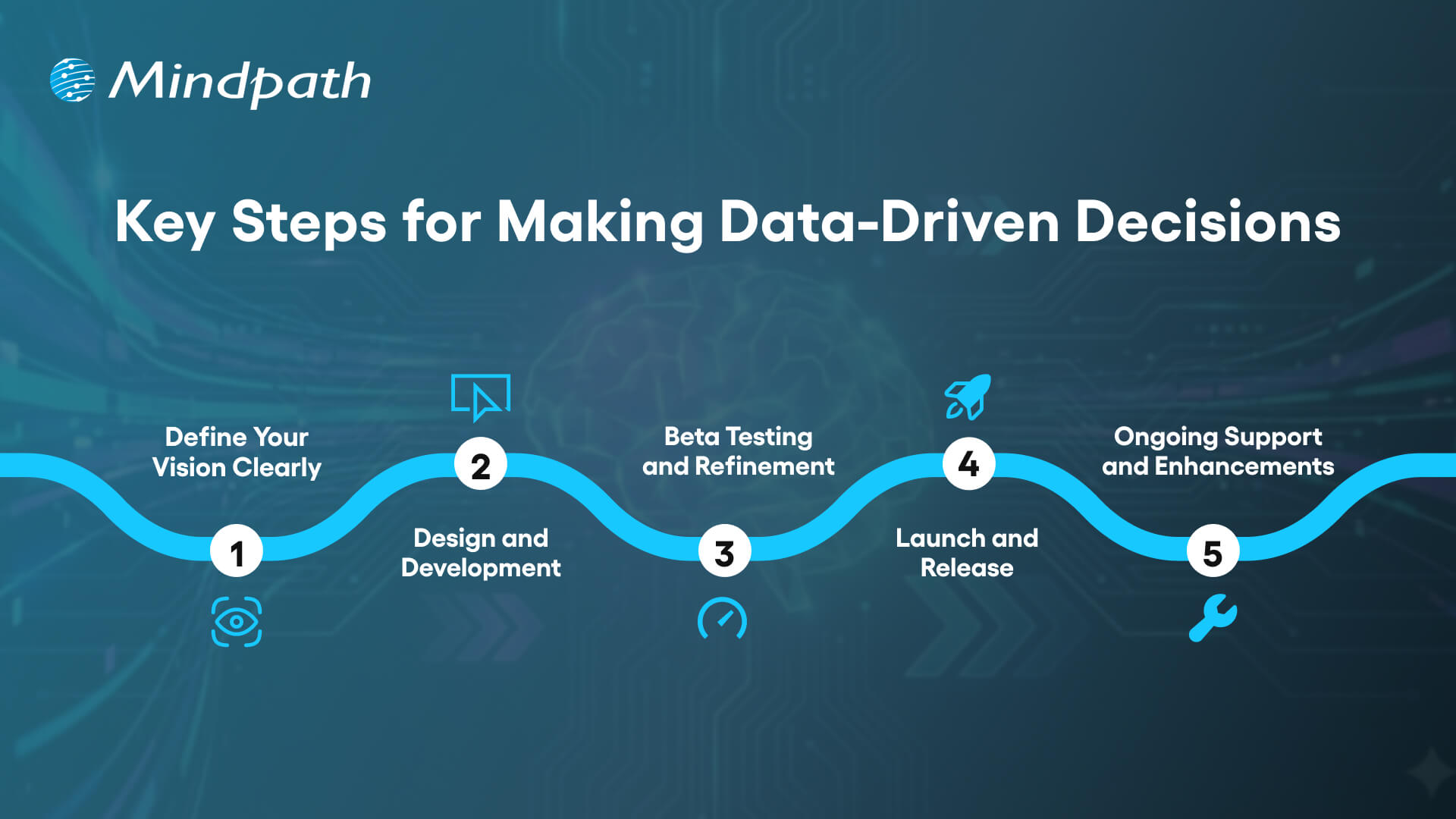
Key Steps for Making Data-Driven Decisions

Using data properly begins with a clear and structured process. Thoughtfully adhering to the necessary steps allows a business to convert raw data into valuable intelligence, which can inform better decisions.

Key Steps for Making Data-Driven Decisions

1. Define Your Vision Clearly

Start by understanding your company’s main goals and direction before diving into the data. If you have a direction, that gives you an idea of how you can utilize the insights coming from the analysis as part of your overall business strategy. Data driven decision making is effective when each data point will drive measurable and long-lasting goals.

2. Identify Reliable Data Sources

After you’ve established your vision, it’s time to determine which tools and platforms are best suited to collect your data. Use sources that best match your business objectives: internal reports, customer analytics, market trends, etc. Having trustworthy data ensures that your data-driven decisions remain accurate and relevant.

3. Organize and Visualize Your Data

Consolidating key information into a clear and predetermined structure provides insight. Dashboards or reporting tools make visualization and a higher level of understanding simpler. Organized data allows for more timely and confident business decision-making, and teams can start to see connections.

4. Analyze to Discover Insights

Carefully analyze the information you’ve compiled for trends, opportunities, and challenges. Use your performance data along with genuine customer feedback to develop an even clearer picture. When you are analyzing data together with others, you can be confident that decisions represent a more comprehensive and accurate picture of your business.

5. Act on Your Conclusions

Following analysis, you should outline specific conclusions that summarize what the data is telling you, and what actions to take next. You will want to focus on linking conclusions to realizable goals and measurable results. Making conclusions and creating action steps develops from raw data to actionable steps and infers an ongoing step you will take in their continuous growth and improvement.

How can data-driven insights shape long-term business strategy? Read our blog on AI in business strategy to take a deeper understanding of how intelligent decisions fuel competitive advantage.

Tools and Technologies for Data-Driven Decision Making

Using the right tools and technology can speed up, simplify, and substantiate data-driven decision making. Beneficial technology allows organizations to collect, analyze, and visualize data to give investigators the tools to convert complicated information into digestible information in the form of insights for decision making.

1. Business Intelligence Platforms

Business‌‍ intelligence tools such as Tableau, Power BI, and Qlik Sense are utilized by businesses to display their data visually and to develop interactive dashboards. They break down complicated data sets into simple insights that can be quickly acted upon by the business. These platforms are instrumental in opening up and involving more people in the process of making decisions based on ‍‌data.

2. Programming Languages for Data Analysis

Massive datasets and high-level analytics are unimaginable without the use of programming languages like Python and R. In general, Python is the tool of choice when it comes to statistical modeling and automation, whereas R is more effective when the focus is on data visualization and statistical computing. Together they are a force to reckon with for all those professionals that solve problems and make decisions on the basis of ‍‌data.

3. Data Management and Manipulation Tools

SQL and Microsoft Excel are still the main tools used for organizing and analyzing data. SQL is used for managing and querying relational databases in an efficient manner, whereas Excel is utilized for carrying out quick analysis and generating reports. Combined, they are the means to keep data accurate and make it accessible for decisions to be taken at any level of the business.

4. Data Collection and Integration Tools

Google Analytics, Apache Airflow, and SQL databases are examples of platforms that retrieve and integrate data from various sources. They are instrumental in measuring the performance of a website, keeping an eye on the progression of tasks, and maintaining the data exchange between systems in a trouble-free manner. Such instruments provide a convenient way to obtain trustworthy data that can be used as a basis for making decisions.

5. Advanced Analytics and Machine Learning Tools

Information technologies such as SAS and Apache Spark are employed to handle massive data collections and to produce resulting projections. These tools enable businesses to foresee changes in the market and to tailor their tactics accordingly for maximum advantage. The use of machine learning in analytics further enhances the basis of data-driven decision-making.

6. Generative AI for Data Insights

Generative AI is changing the way companies understand and utilize their data. They get it done at much faster speeds with the help of AI, where it can also unveil the hidden patterns, and use predictive modeling to get the best results. This innovative technology is like an extra layer of depth and brains in the whole data-driven decision‌‍ ‍‌process.

Curious about how data-driven insights power real-world AI solutions? Discover generative AI use cases in diverse industries to explore how organizations leverage data for innovation.

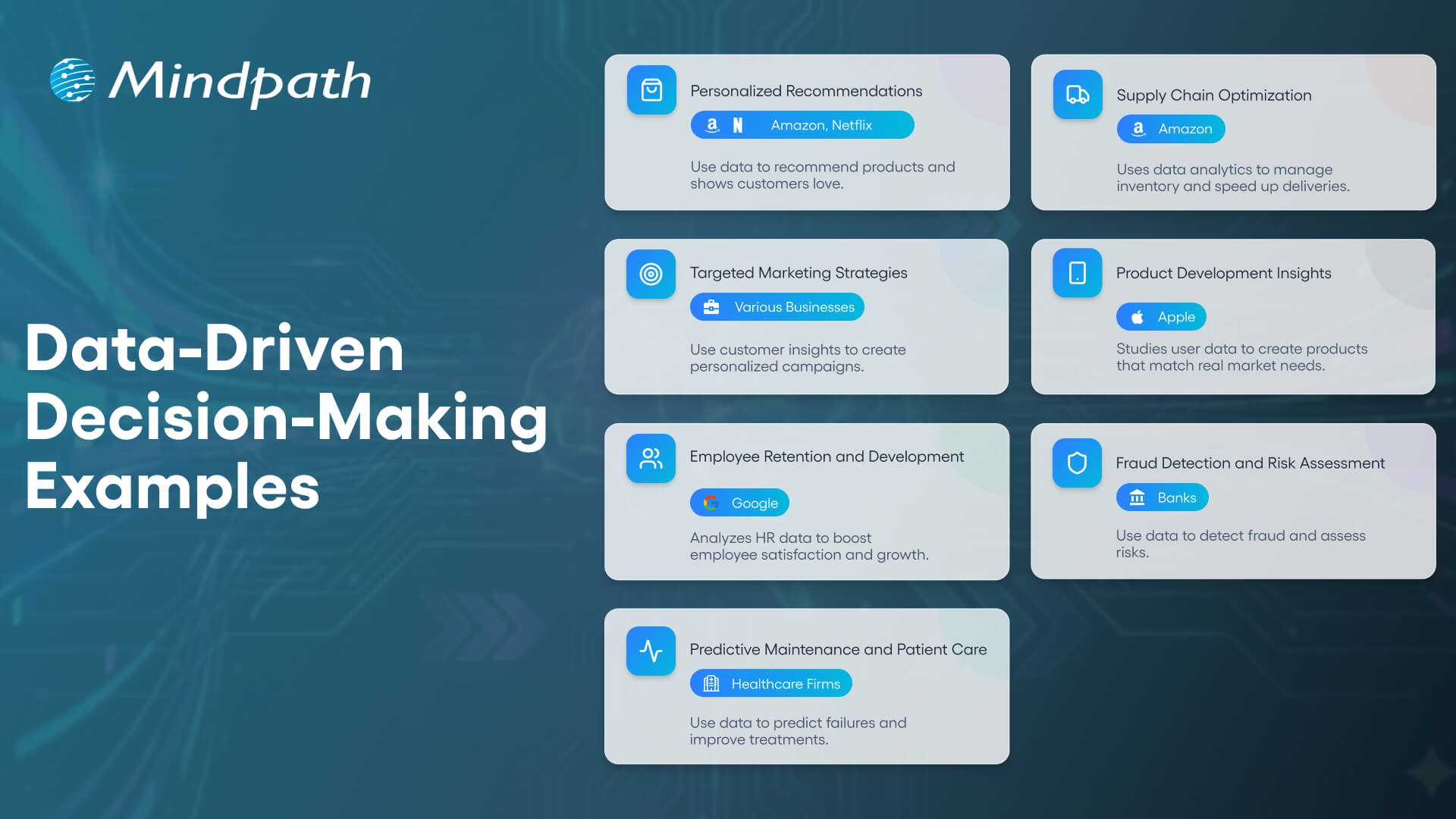
Data-Driven Decision-Making Examples

Decision-making based on data is changing how companies manage strategies, operations, and growth, as it aids organizations to leverage real insights to make more intelligent and effective business decisions.

Data-Driven Decision-Making Examples

1. Personalized Recommendations

Interactive ‍data is a valuable source of information for online retailers like Amazon and for streaming services like Netflix. Based on this data, these companies suggest products or content that the customers might be interested in. As a result, customers become more engaged, produce more sales and have a better experience of the‍‌ service.

2. Supply Chain Optimization

Companies like Amazon evaluate stock levels, consumer need, and delivery time to achieve optimal efficiency in logistics while minimizing delay and cost, and ultimately completing orders faster and more efficiently.

3. Targeted Marketing Strategies

Companies look into customer data to predict buying habits and carry out an intelligent and personalized marketing campaign. The use of empirical methods has been demonstrated to be effective in raising brand awareness and increasing the conversion rate through the use of ‍‍‌data.

4. Product Development Insights

Companies such as Apple analyze data to identify user needs and market trends. This insight fosters innovation, allowing companies to create products that truly align with consumer needs.

5. Employee Retention and Development

The HR teams analyze survey data, along with performance data, to examine root causes of turnover and ways to increase employee satisfaction. Insights are also used to develop targeted training programs that can close gaps in knowledge or training to further their own career advancement.

6. Fraud Detection and Risk Assessment

Banks and other financial services organizations deploy data analytics to identify unusual behavior and reduce fraud. They also analyze customer data for risk assessment and improved product development.

7. Predictive Maintenance and Patient Care

Manufacturers use sensor data to catch and resolve a potential failure in the machinery early to mitigate down-time and related costs of maintenance. In the health care sector, using data from a patient’s medical chart will improve the quality of care by creating a more proactive treatment plan.

Looking to improve healthcare outcomes through better decision-making? Explore hospital management system insights to discover how real-time data drives operational and clinical efficiency.

Common Challenge While Implementing Data-Driven Decision Making

Without the right strategy and systems to properly execute data-driven decision-making, it can be complicated. Many organizations face challenges, often slowing their ability to adopt data-driven decision-making and, as a result, impacting the accuracy or impact of their decisions.

1. Poor data quality can lead to wrong insights and poor outcomes, making it vital to maintain accurate, consistent, and complete data.

2. Protecting sensitive information is essential, and organizations must ensure strong security measures and compliance with data privacy regulations.

3. Resistance to change can slow progress, so clear communication and proper training help employees adapt to data-driven decision-making.

4. Managing large datasets requires modern tools like cloud platforms and data lakes to ensure efficiency and accessibility.

5. Limited data skills can hold back growth, making it important to train teams and build confidence in using data effectively.

Looking to see data-driven decision-making in action? Discover AI chatbot examples that increased conversions to understand how insights improve customer engagement and sales.

Ready to Turn Data into Smarter Business Decisions?

Data-driven decision making helps businesses act with precision, clarity, and confidence. It turns raw information into actionable insights that lead to better strategies, improved performance, and stronger growth. By trusting data over assumptions, organizations can make choices that truly create impact and drive long-term success.

At Mindpath, we provide advanced AI development services that help businesses harness the full potential of data. From predictive analytics to intelligent automation, our AI solutions empower smarter, faster, and more informed decisions. Partner with Mindpath to transform your business insights into measurable outcomes and achieve sustainable success in a data-driven world.

Discover how data-driven decision-making enhances business strategies, improves outcomes, and fosters accountability for long-term success.
Digital Twin technology

Manufacturers all over the world have been under pressure to meet emerging challenges in an environment with limited resources. The prominent setbacks for the manufacturing industry include supply chain shortages and talent gaps. However, the advent of digital twin technology serves as the best example of how technological innovation can shape the future of manufacturing. Digital twins can not only enhance capacity but also ensure more efficiency and resiliency in manufacturing operations.

The growing demand for fast-paced and continuous operations in manufacturing creates various limitations. Digital twins offer virtual representations of production lines, equipment or the whole factory to help manufacturers with more effective decision-making. Manufacturers must know about the utility of digital twins and how they can unlock untapped value to prepare factories of the future.

Looking to harness digital twin technology to gain deeper insights and future-proof your business? Contact us for expert guidance and tailored solutions that help turn digital twin innovation into real-world impact.

Understanding the Digital Twin Technology

The foremost highlight in any introduction to digital twins will focus on their definition. The most common answers to ‘what is digital twin technology’ paint them as virtual representations of physical objects or systems. Digital twins use real-time data to imitate the behavior, conditions and performance of their physical counterparts. Digital twins help with continuous monitoring and analysis of objects, systems or products throughout their complete lifecycle. In addition, digital twins can also feature external processes and crucial variables that can influence the performance of real-world assets.

One of the significant highlights of digital twins is that they work with data flowing between the object and its virtual representation in real-time. The two-way flow of data ensures the most accurate simulations of the physical world. Businesses can also use multiple digital twins together to create models for more complex systems, aimed at a larger digital transformation strategy.

Digital twins provide a clear impression of how something works and predicts its behavior in future scenarios. As a result, they can help in accelerating innovation and improving efficiency along with making well informed decisions. You can come across use cases of digital twins in predictive maintenance, product development, supply chain optimization and process optimization.

Breaking Down the Architecture of Digital Twins

If you want to capitalize on the power of digital twins in diverse use cases, then it is important to know their architecture. You can find digital twin providers like IBM, Microsoft, General Electric and Siemens with solutions that provide a comprehensive suite of services. The digital twin examples may feature hardware layers, synchronization services, data processors and other tools to draw the most accurate simulations of real objects and processes. However, awareness of the architecture of digital twins can help you figure out exactly what you need to make the most of the innovative technology.

1. Physical Asset

The physical asset in digital twins can be any real-world object, process or system that you want to study or monitor within virtual environments.

2. Virtual Model

The virtual model in digital twins is the digital representation of the physical asset that you want to know more about.

3. Data Sources

One of the notable highlights in the answers to ‘what is a digital twin’ points at the two-way flow of data between the physical asset and the virtual model. Data sources are an integral component in digital twin architecture as they ensure accuracy in virtual representations. Internet of Things or IoT devices serve as data sources by recording relevant metrics for creating digital twins.

4. Data Pipelines

Data pipelines are used for transmitting sensor data to the virtual model in real time. They play a vital role in ensuring that the digital twin is synchronized with the physical asset.

5. Feedback Loop

The feedback loop helps in sending control signals or insights from the virtual model to the physical asset. It serves as a promising component for optimizing performance and efficiency alongside enhancing decision-making.

6. Analytics Engine

Digital twins needs an analytics engine running on AI or machine learning to detect patterns and facilitate predictive analytics. The functionalities of the analytics engine helps in drawing accurate simulations alongside offering support for effective asset tracking.

7. Visualization Dashboard

The visualization dashboard is another crucial component that completes the digital twin definition by providing access to the virtual representation. You can use the visualization dashboard to interact with the two-dimensional or 3D representation of the physical asset.

Breaking Down the Working Mechanism of Digital Twins

The uses of digital twins can vary by huge margins across different industries and applications. You must also know that digital twins follow some common steps that you will find in every example.

1. Data Collection

Organizations can start their digital twin projects by embedding sensors on a physical object to capture its performance, operating environment and condition. The digital twin meaning in case of IoT applications revolves around using smart objects that feature in-built sensors to collect and share data continuously. In the case of IT environments, teams can create digital representations of computers, applications and software with virtualization technologies. Subsequently, the teams can use software agents to collect data from the digital asset for supporting the digital twin.

2. Creation of the Virtual Model

The primary focus of digital twins aligns with the creation of digital replicas of certain objects or systems. Virtual modeling involves using the data collected from the physical asset to create a digital model. It is important to define digital twins with key attributes that help them offer realistic reactions to variables. The variables can refer to interactions with the physical asset or its environmental conditions. The attention to virtual modeling ensures that digital twins can offer reliable and accurate simulation of the responses of the physical assets in different conditions.

3. Real-Time Data Integration

You cannot think of a digital twin without live data integration as it ensures continuous communication between the digital twin and physical asset in real time. Live data integration offers a dynamic feedback loop that can help organizations with performance optimization and enhancements in system reliability. The two-way data exchange also helps in efficient predictive maintenance by anticipating issues ahead of time. Most of the organizations automate the real-time data exchange process to focus on more critical and strategic tasks.

4. Analysis and Decision-Making

Digital twins offer the most promising solutions to experiment safely within virtual environments. You find better answers to ‘how do digital twins work’ in manufacturing plants where digital twins can help in finding out how an upgrade may affect efficiency and performance. The best thing here is that manufacturers don’t have to implement the upgrade directly to measure its impact. On top of it, analytics engines used in digital twins can recommend operational changes to make the changes more cost-effective.

Variants of Digital Twins

Most of the discussions about digital twins don’t emphasize the fact that you can find different types of digital twins. Organizations can deploy different variants of digital twins in one production environment with the advantage of learning from different levels of physical assets.

1. Product Twins

Product twins refer to the virtual representations of products after the ideation stage or throughout the complete lifecycle. You can use product digital twins for design improvements, enhancing service satisfaction and manufacturing efficiency.

2. Process Twins

The variety of digital twin applications also draws attention towards the use of process twins that help in understanding how different systems work with each other. Process twins offer visualization of the interactions between systems and suggest actionable feedback to improve quality standard or process speed.

3. Part Twins

Part twins or component twins focus on the most granular level of larger systems. The primary goal of part twins revolves around measuring the insights from basic components of larger systems. Component twins serve a promising role in understanding the performance of certain components and identifying larger problems before they happen.

4. Place Twins

The largest deployment of digital twins can happen in the form of place twins. You can find examples of place twins in factory twins, which simulate a complete physical location or place. In some cases, you may assume similarities between process twins and place twins. However, place twins also include spatial data, such as climate, context and temperature of the physical location.

Unraveling the Use Cases of Digital Twins

Organizations in different industries leverage digital models to understand complex systems and promote innovation. Digital models have also proved as the most useful tools for efficient optimization and predictive equipment maintenance. You can find a digital twin use case in almost every major industry with widespread applications.

1. Construction of Physical Structures

Digital twins can prove to be the most useful tools for engineers to design durable and safe physical structures, such as buildings, bridges and dams. For example, digital twins can help engineers determine whether a specific design for a bridge can enhance its durability. As a result, engineers can identify any setbacks and make changes in the design before starting construction.

2. Healthcare

Another promising area where digital twins can offer significant advantages is in the domain of healthcare. Digital twins can come up with crucial insights from forecasts of disease progression to identify how patients will respond to different treatment options. Furthermore, healthcare professionals can use digital twins to enhance diagnosis through detailed modeling that helps in understanding how interactions between organs can affect health.

3. Urban Planning

You can also notice the benefits of digital twins in urban planning applications, especially for traffic supervision. City models use spatial data, IoT object data and AI analytics to determine how new transportation systems or infrastructure upgrades will affect the city’s environment and traffic. Digital twins serve a pivotal role in planning for smart cities and urban planning experts aim to tap into their power to enhance sustainability and quality of life.

Identifying the Advantages of Digital Twin Technology

The use cases of digital twins across different industries reveal their potential to revolutionize digital transformation. You can notice how digital twins offer more visibility into complex systems while opening doors for experimentation without real-world changes. An overview of their advantages can help you understand how they can unlock the future.

1. Faster Research and Development

How do you think a business can step into the future ahead of time? Without research and development, companies cannot experiment with new product designs, manufacturing processes or workflows. The advantages of digital twins make it easier to experiment within a virtual environment, thereby opening the doors for accelerated innovation. Digital twins offer a more cost-effective and safer approach to research and development without the need for real tests.

2. Scalability

Companies can stay competitive in the modern business landscape only by adapting to changes in product demand, customer priorities and economic conditions. Digital twins offer virtual environments where you can adjust parameters and test configurations safely before full-scale deployment. You can also connect digital twins to live systems and ensure that they can continuously transmit their scaling adjustments in real time to the physical asset.

3. Operational Efficiency

The next crucial outcome of digital twin technology is the assurance of enhanced operational efficiency. Digital twins can provide the insights required to achieve operational efficiencies throughout the value chain. Organizations can use different datasets to collect real-time data on physical asset and production performance. With more visibility into the asset or process bottlenecks, digital twins can help in crafting potential solutions.

Final Thoughts

The progressive use of digital twins is a perfect example of how the world is welcoming innovation and preparing for the future. Digital twins provide the easiest solution to multiple problems that affect efficiency, cost-effectiveness and productivity in different industries. With the help of virtual models that mimic real-world assets, companies can reinvent their manufacturing, services and internal management.

Mindpath is one of the leading destinations for digital twin app development with years of expertise in end-to-end IT solution development. We are proud to have team members who are eager to learn and specialize in new technologies, including digital twins. Our experts are familiar with the use of popular tech stacks for digital twin development in alignment with your business goals. Consult with our team and build your first digital twin right now.

Discover how digital twin technology boosts efficiency, enhances product quality, and supports sustainability. Learn its impact on modern businesses and industry sectors.