Home

Conversational AI Trends for 2026: 7 Developments Businesses Should Know

Conversational AI Trends for 2026: 7 Developments Businesses Should Know

Join our Newsletter!

Conversational AI Trends

Businesses are constantly looking for smarter ways to improve customer experience, reduce operational costs, and deliver faster services. This is where conversational AI is becoming increasingly important. From answering customer questions to automating business workflows, AI-powered conversations are changing how companies interact with customers.

Key Takeaways

  • 01
    Agentic AI is helping businesses automate multi-step tasks beyond answering questions.
  • 02
    AI chatbots are becoming more personalized and context-aware.
  • 03
    Voice AI and multilingual assistants are improving customer communication.
  • 04
    Multimodal AI enables systems to understand text, voice, images, and documents.
  • 05
    Data privacy, human supervision, and reliable responses remain essential for successful AI adoption.

The conversational AI trends for 2026 focus on more intelligent, personalized, and action-oriented experiences. Unlike traditional chatbots that follow predefined scripts, modern conversational AI solutions can understand natural language, use business information, and support more complex requests.

Want to automate workflows, improve decision-making, and accelerate business growth with AI? At Mindpath, our AI development services help businesses build intelligent, scalable solutions aligned with their goals.

For example, an AI assistant can help a customer compare products, check an order status, and initiate a support request within the same conversation.

Let’s explore seven conversational AI trends businesses should understand in 2026.

7 Major Conversational AI Trends for 2026

1. Agentic AI Is Moving Beyond Traditional Chatbots

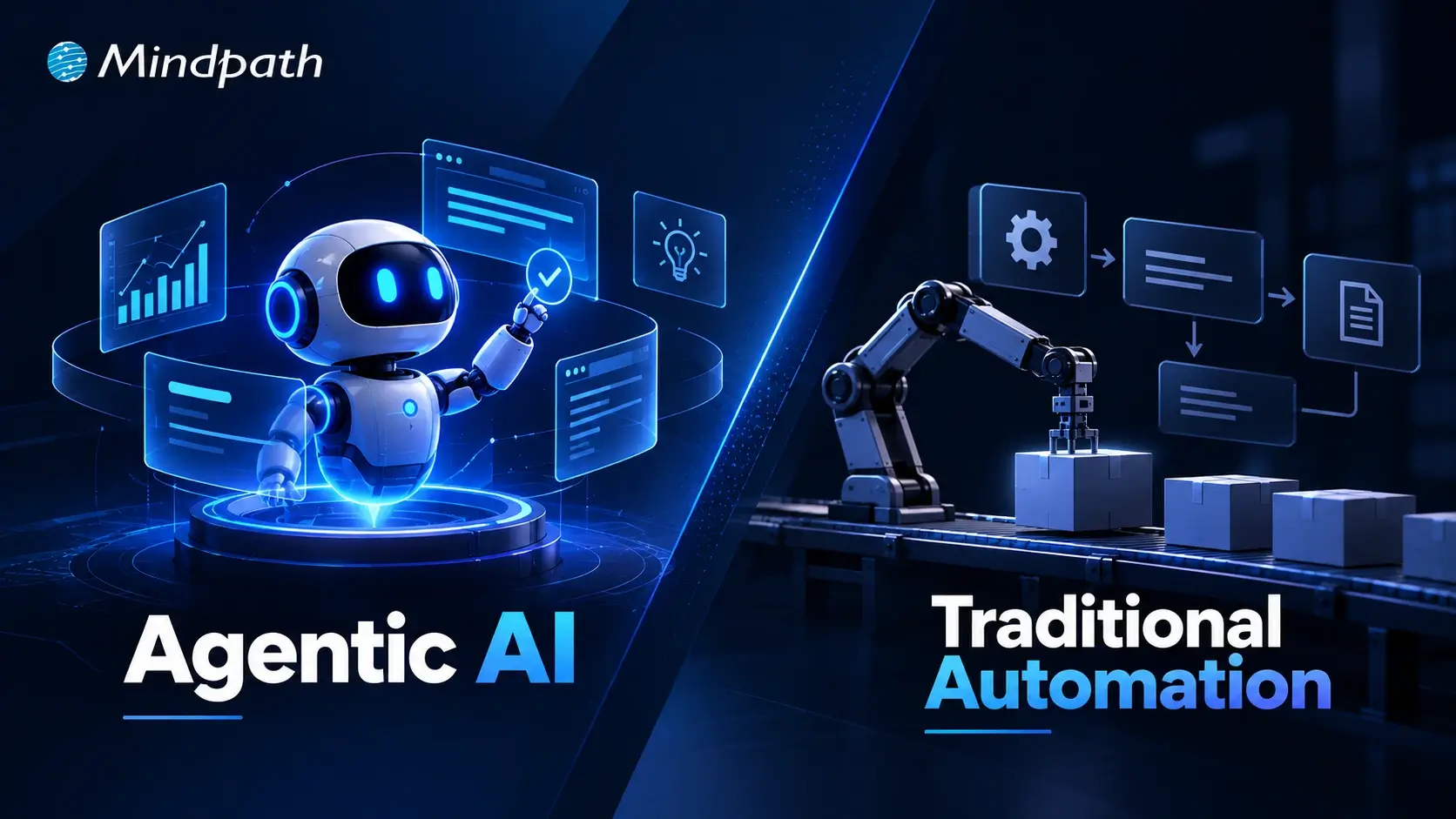
One of the biggest conversational AI trends in 2026 is the growing use of agentic AI. Traditional chatbots mainly answer questions, while AI agents can work toward a goal by completing multiple connected tasks.

For example, an AI agent in an e-commerce business could check product availability, recommend alternatives, retrieve order information, and initiate a return request.

Businesses can use agentic AI to automate customer support, sales assistance, appointment scheduling, and internal operations. However, sensitive actions should include appropriate permissions, verification, and human approval.

2. Personalized AI Conversations Are Becoming More Important

Customers expect businesses to understand their needs instead of providing generic responses. AI-powered virtual assistants can use permitted customer information, conversation history, and preferences to deliver more relevant support.

For example, an online shopping assistant can recommend products based on a customer’s stated budget and preferences. A banking assistant can explain relevant account services after securely verifying the customer.

This trend can improve customer engagement, satisfaction, and conversion opportunities. Businesses should use personalization responsibly, follow data protection requirements, and avoid collecting unnecessary personal information.

3. Voice AI Assistants Are Improving Customer Support

Voice AI assistants are making it easier for customers to interact with businesses without typing messages or navigating complicated menus.

Modern voice AI can recognize spoken language, understand requests, and generate spoken responses. Depending on the system, it can also transfer conversations to human agents when necessary.

Businesses can use voice AI for appointment booking, frequently asked questions, order updates, and after-hours customer support.

As speech recognition and response generation improve, companies can create more natural voice experiences. However, accuracy, background noise, accents, and response delays still need careful testing.

4. Multimodal Conversational AI Is Expanding

Multimodal AI allows systems to process different types of information, including text, voice, images, and documents. This makes conversational AI more useful for situations where customers need to share more than a written question.

For example, a customer can upload a product image and ask for similar items. A technical support assistant could analyze a screenshot of an error message and suggest troubleshooting steps.

These conversational AI applications can support retail, healthcare administration, education, manufacturing, and IT services.

Businesses adopting multimodal AI should evaluate data accuracy, file security, accessibility, and the limitations of AI-generated answers before deploying it at scale.

5. Generative AI Chatbots Are Becoming More Context-Aware

Generative AI chatbots use large language models (LLMs) to understand questions and produce natural-language responses. In 2026, businesses are increasingly interested in connecting these systems to approved company information.

One useful approach is retrieval-augmented generation (RAG). It retrieves relevant information from trusted sources before generating an answer.

For example, a customer support chatbot can use a company’s product documentation, return policies, and FAQs to answer questions more accurately.

This approach can reduce unsupported answers, provided the underlying information is reliable and the system retrieves the correct sources. Regular content updates, testing, and monitoring remain essential.

6. Multilingual Conversational AI Is Supporting Global Businesses

Businesses serving international customers need to communicate across different languages and regions. Multilingual conversational AI can help customers receive support in their preferred language.

For example, an online service provider can use an AI assistant to answer common questions in English, Hindi, Spanish, or other supported languages.

This can improve accessibility and help businesses provide consistent support across markets.

However, translation quality, cultural context, regional terminology, and language-specific testing are important. Human review may be necessary for legal, financial, medical, or other high-impact conversations.

7. AI Security and Human-AI Collaboration Are Becoming Priorities

As conversational AI becomes more closely connected to business systems, security and accountability become increasingly important.

Organizations need to protect customer data, control system access, monitor AI responses, and establish clear escalation processes. Human supervision is especially important when an AI system handles sensitive information or makes decisions that could significantly affect customers.

For example, a customer service chatbot can answer routine questions automatically while transferring billing disputes or unusual requests to a human representative.

The most effective conversational AI strategy is not always full automation. It is a balanced approach that combines AI efficiency with human judgment, transparent processes, and measurable business outcomes.

How Can Businesses Prepare for Conversational AI in 2026?

Businesses should begin by identifying repetitive customer interactions and workflows that could benefit from automation.

A practical implementation approach includes:

  • Identify use cases: Start with FAQs, lead qualification, appointment booking, or order tracking.
  • Choose the right technology: Evaluate conversational AI platforms based on integration, accuracy, scalability, and cost.
  • Connect reliable data: Use approved company information to provide relevant answers.
  • Protect customer information: Implement access controls, privacy safeguards, and appropriate human oversight.
  • Measure performance: Track resolution rate, response time, customer satisfaction, qualified leads, and cost per interaction.

Starting with a focused use case makes it easier to measure results before expanding conversational AI across the organization.

Conclusion

The conversational AI trends for 2026 highlight a shift from simple question-answering chatbots toward intelligent assistants that understand context, support multiple communication channels, and help complete business tasks.

Agentic AI, voice assistants, personalization, multimodal capabilities, and secure AI integration offer businesses new opportunities to improve customer experiences and operational efficiency.

However, successful implementation depends on more than choosing an advanced AI model. Businesses also need reliable data, thoughtful workflows, strong security, and clear performance goals.

Ready to Transform Your Business with Conversational AI?

Ready to get started? Contact Mindpath to discuss your requirements and explore how conversational AI can support your business growth.

Frequently Asked Questions

Major trends include agentic AI, voice AI, multimodal interactions, personalized conversations, omnichannel experiences, customer service automation, and stronger AI security and governance.
Traditional chatbots often follow predefined rules or answer limited questions. Conversational AI can use natural language processing, contextual information, and generative AI to handle more flexible conversations. Advanced AI agents can also perform specific tasks through connected systems.
Conversational AI can answer customer questions, qualify leads, schedule appointments, provide product recommendations, and automate repetitive support requests. Its actual impact depends on implementation quality and the use case.
Yes. Small businesses can begin with affordable chatbot solutions for frequently asked questions, lead capture, and appointment scheduling. They should choose tools based on their budget, customer needs, and integration requirements.
Common challenges include inaccurate responses, data privacy risks, integration complexity, implementation costs, and difficulty handling sensitive or unusual requests. Testing, access controls, monitoring, and human escalation can help address these issues.

Support Is One Click Away

Featured Posts

Related Post

Generative AI Use Cases in Diverse Industries

“Necessity is the mother of invention.” We have all encountered this phrase in our science textbooks or while reading about most scientific innovations. Be it the invention of the cell phone, the internet, or the World Wide Web, each of these has brought a paradigm shift in the world of technology.  

While technology is rapidly expanding its horizon, Artificial Intelligence remains the buzzword that every business can’t stop gushing about. Generative AI, a subfield of artificial intelligence, has gained massive momentum post the launch of ChatGPT by OpenAI in 2022. Since then, generative AI use cases have found their way in some of the major industries, including healthcare, banking & finance, gaming, and supply chain, to name a few, marking the beginning of the Gen AI revolution.

But what is Generative AI? Is it only limited to text or image generation, or can it help in other fields as well? In this blog, we will be answering some of the burning questions around Generative AI and generative AI use cases across industries.  

Want to implement cutting-edge GenAI solutions in your company? Mindpath offers end-to-end Generative AI Development Services for deploying generative AI applications efficiently.

Introduction to Generative AI 

Let’s start with the basics: what is Generative AI? Generative AI is a subset of artificial intelligence that creates novel content, such as text, images, audio, video, and code, in response to user prompts. Rather than merely analyzing existing data, it uses deep learning models to predict and generate entirely new outputs based on patterns learned from vast training datasets.

Think of it as a magic lamp that fulfils many of your creative and analytical needs! With the help of machine learning models and neural networks, large volumes of data are analyzed, patterns are discovered, and new content is generated.

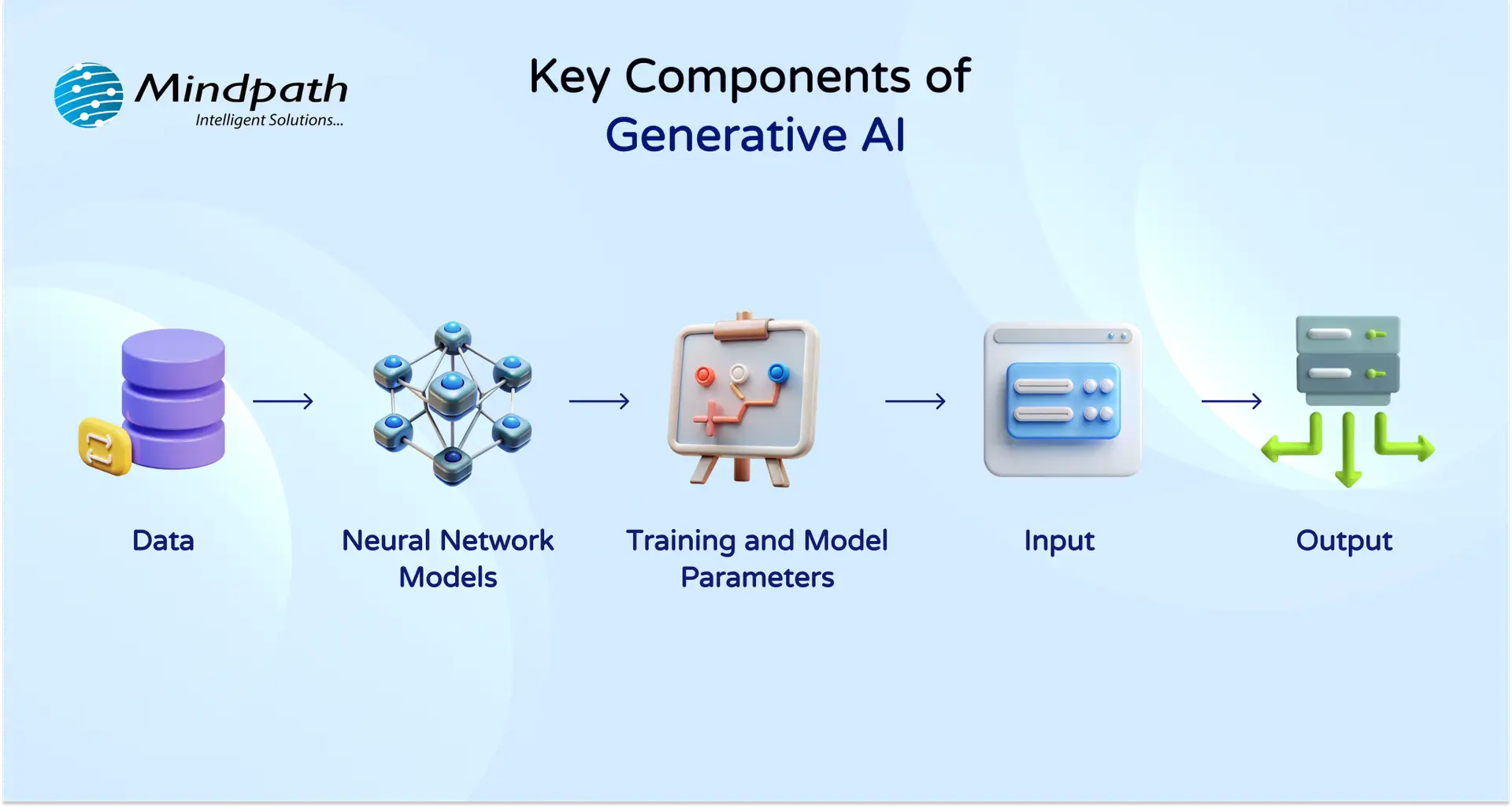
Here are some of the key components of Generative AI:  

key components of Generative AI

  1. Data: Raw data such as documents, eBooks, ledgers, images, videos, codes and a lot more that Generative AI uses to learn.  
  2. Neural Network Models: They work just like a human brain; they help AI models to make sense of all the raw data we have put in the model.  
  3. Training and Model Parameters: There are some parameters that help AI models fine-tune the information, cut the noise and generate accurate output.  
  4. Input: When you ask a Gen AI model to create a cover letter for a job, create a report based on Excel data, generate a Ghibli image to roll with the current trends, that’s categorized as an “input”.  
  5. Output: Whatever results a Gen AI model, such as ChatGPT, MidJourney, Bart, delivers for your query is the output.  

Generative AI is gaining momentum, with a global market valued at USD 37.89 billion in 2025 which is projected to reach USD 1,005.07 billion by 2034 at a CAGR of 44.20%. (Source: Precedence Research)

Generative AI Use Cases Across Industries 

While Gen AI is growing, curating a business-first roadmap for its adoption is important for those seeking to leverage it to its fullest advantage.  Now that we have explored what Generative AI is, let’s move on to some prominent generative AI use cases in different industries, proving that it’s more versatile than we know!  

1. Healthcare 

According to a recent survey by Deloitte Center for Health Solutions, 75% of leading healthcare companies across the globe are either currently experimenting with generative AI or planning to scale Gen AI in the near future.  

In what area, you may wonder? Generative AI healthcare is being used to maintain patient records, drug discovery, interpreting and analyzing medical images such as X-rays, CT scans, MRIS, to mention a few.  

Scientist are using generative AI for modelling molecular structures that can help not just in creating new drug compounds but also in predicting their effectiveness.  

92% of healthcare leaders see a promising future of generative AI in improving efficiency as well as speeding the decision-making in critical scenarios.  

2. Banking  

Next up is the banking and finance industry. Generative AI in banking is fueling the fintech revolution in more ways than one. Generative AI is currently being leveraged for detecting fraud, assessing the credit score or credit risk based on the creditworthiness of an individual or an entity, customer support, automating routine tasks and compliance checks, creating investment strategies, among others.  

A recent report by KPMG revealed that around 76% of banking executives in the United States are planning to implement Gen AI for fraud detection and prevention, while 62% want to leverage it to improve their customer service, followed by 68% of professionals that believe Gen AI can be best used for regulatory compliance.  

3. Gaming  

One of the most exciting areas for generative AI applications could be gaming. According to Statista, over one-third of game developers across the globe are already using Gen AI tools in their studios. PCG, which stands for Procedural Content Generation, is the largest segment of the gaming industry where almost 30% gen AI is being used currently. PCG helps game developers create larger than life game world, environment and universe that intrigues the players and gives them a more immersive experience.  

Other than PCG, some other significant generative AI use cases in gaming include developing characters, detecting bugs, generating real-time content like new levels and challenges, and detecting any kind of irregularities or security breaches or threats.  

Wondering how AI can help your business to reach the exceptional level of growth? Read our blog to learn about the importance of generative AI for business.

4. Supply Chain 

When it comes to adopting Gen AI, the supply chain industry is no stranger to it. In fact, McKinsey’s survey revealed that a third of global businesses are effectively using generative AI in business areas, including operation processes automation (66%), production planning and scheduling (47%), quality control and inspection (44%), and inventory management (43%).  

Gen AI can support the supply chain industry with better demand forecasting, optimizing day-to-day operations, assessing and controlling supplier risks,  quality control, fraud detection, and much more!  

 5. Other Industries 

Apart from the above-mentioned industries, use cases of generative AI are prevalent in other industries such as sales and marketing, insurance, legal and compliance, human resources, product development, and many more.  

While many still utilize gen AI for content, image and code generation, the applications are certainly above and beyond. However, leveraging gen AI comes with its own set of challenges. Being AI-ready is in demand for every industry and business seeking to adapt and leverage AI to its advantage. There’s no one-size-fits-all guidebook or roadmap for AI adoption; rather, each business and industry needs to understand its niche and create a roadmap that generates true value.  

Wondering how generative AI is influencing content creation and design strategies? Check out our blog generative AI changing creative industries  to see how AI-driven creativity is shaping the future of industries.

Ready to Embrace Innovation with Generative AI?

Generative AI is expanding its horizon, and businesses have started to realize its true potential. While Gen AI continues to grow, it’s critical to assess all of its aspects that involve data security, lack of information, and overdependence.  

Businesses looking to adapt AI must look beyond the hype and create a strategy that works for them. At Mindpath, we help businesses create solutions that are based on their real pain points rather than creating just another software. When you talk to us, we attempt to understand your operations and what may work to make them more efficient.  

Our customer-first approach helps us identify gaps and curate a solution that works for you. Thus, if you’ve been wanting to adopt AI, the right time is now! Let’s discuss how our AI development services can help you make the best of up-and-coming technologies and get your business future-ready!  

AI in Education
Have you ever wondered about how AI is revolutionizing education? How can AI make lessons more personalized for each student? What can be the benefits of implementing AI in education? If you are intrigued by these questions, you have arrived at the right place. In this blog, we are going to explore the key benefits as well as the use cases of AI in education.   The education system has changed from the traditional classroom setup. We are no longer limited to a physical room full of books and a blackboard to learn. Nowadays, education is easily accessible and flexible, with personalization at the tip of our fingers as AI is changing the education sector by offering tailored, adaptive learning experiences. It is making learning inclusive, supporting teachers in their tasks, and personalizing learning for everyone. This technology is going to turn conventional models of education and offer more personalized support to students in accordance with their needs, learning styles, and abilities.   Let us dive deep to explore the key benefits as well as the use cases of Artificial Intelligence in education! 

Benefits of AI in Education

1. Customized Learning

The greatest advantage of AI in education is that it offers personalized learning. With AI, learning becomes much more likely to be tailored to each student’s needs. If one student is weak in reading, AI can provide extra support by way of practice and activities. At the same time, another student who excels in reading can be given more challenging materials to engage their interest. This way, each student is presented with material that suits their levels best, making their work more effective and enjoyable. 

2. Expanded Accessibility and Inclusion

AI is overcoming distance and physical limitations in education. Students in remote places or with physical constraints may now access high-quality educational resources using AI-powered solutions such as virtual instructors, interactive course materials, and language translation services. This technology contributes to a more inclusive educational environment in which all students, regardless of location, have equal opportunities to learn and develop. 

3. Adaptive Assessments and Feedback

AI improves evaluations by employing exams, assignments, and even analyzing pupils’ facial expressions or posture to measure their development. This enables rapid feedback, indicating exactly where a learner requires further assistance and giving resources that will help them understand. This strategy not only improves academic achievement, but it also promotes students’ general well-being and trust regarding their learning journey. 

4. Streamlined Administrative Tasks

AI is excellent at both creating personalized teaching and performing administrative work. It can handle student information, organize lessons, and grade multiple-choice tests. This automation allows teachers to devote more time to what is most important: crafting interesting classes, developing strong connections with students, and providing useful feedback. 

5. Enhanced Student Engagement

AI is altering student engagement by offering fascinating new ways to study. Gamification, interactive simulations, and personalized learning plans provide students with dynamic educational experiences. Tools such as interactive classrooms and immersive platforms make learning more fun, allowing students to engage with one another and enthusiastically explore new topics. 

Use-cases of AI in Education

1. Advanced Tutoring Systems

Tutoring programs driven by AI provide pupils individualized support. As students work in classes, AI examines their responses, identifies areas where they may be suffering, and provides personalized explanations to make things simpler. This manner, the learning tempo is tailored to each student’s needs. These systems improve students’ understanding of difficult topics by providing rapid support and a learning style that is tailored to each learner. The continual contact with AI improves learning outcomes and raises students’ confidence and performance. 

2. Automated Grading and Evaluation

Grading is made easier by artificial intelligence, which evaluates student work rapidly and uniformly. This minimizes instructors’ burden, allowing them to focus on providing personalized help. By detecting patterns in pupil performance, AI can identify individuals who require further support and direct focused assistance. Additionally, AI delivers quick feedback, which improves the learning process. Automated grading and assessment improve teaching quality, assure fair assessments, and foster interaction among students and teachers. 

3. AI-Powered Chatbots and Assistants

AI-powered chatbots and virtual assistants play an important role in improving students’ educational experiences. They offer immediate assistance by walking students through assignments, answering problems, and providing comments. These resources are available 24 hours a day, seven days a week, and satisfy the demands of students at any time. Their personalized guidance promotes autonomous learning and helps students actively participate in their studies, hence enhancing academic progress and achievement. 

4. Educational Entertainment and Gamification

Edutainment and gamification make learning more enjoyable and engaging by incorporating artificial intelligence. By developing instructional games and simulations, AI transforms standard teachings into interactive experiences. Including game aspects such as prizes and competitiveness keeps students interested and engaged in their study. These gamified technologies not only capture students’ interest, but they also help them grasp and recall complicated concepts better. AI-driven edutainment and gamification mix education and entertainment to create a dynamic learning environment with thrilling gaming and interactive challenges. 

5. Interactive and Educational Games

Artificial intelligence improves interactive and educational games by providing interesting learning experiences. These games integrate AI algorithms, natural language processing, and machine learning to create interesting tales, react to player activities, and provide personalized insights. This technique encourages students to become more interested, creative, and deliberate in their learning. AI-powered learning systems use challenges, simulations, and virtual worlds to encourage active learning, improve problem-solving abilities, and foster collaboration among students. 

6. Smart Curriculum Planning

AI helps with creating curriculum by analyzing educational data to identify patterns or weaknesses in student learning. It can propose curriculum modifications and revisions based on current research and new standards of learning. AI may also assist in matching curricula with specific goals for learning, keeping the information relevant and up to date. This enhances curriculum design efficiency, allowing educators to make informed decisions and make better use of resources, ultimately improving educational quality and relevance. 

Mindpath’s AI Development Services for Education

AI development services at Mindpath are changing the face of learning in educational institutions with advanced technology. We utilize sophisticated algorithms and machine learning techniques in providing smart solutions for enhancing learning and process streamlining in education.  Our Predictive Analytics service examines educational data to forecast trends, identify learning gaps, and provide actionable insights, helping educators and institutions make better decisions. We apply machine learning to enable personalized, dynamic learning processes attuned to the needs of each student, increasing engagement and performance.  We have data-driven insights that provide detailed analysis and support for curriculum planning, progress monitoring of students, and optimal structuring of teaching strategies. Our automation solutions will make administrative tasks related to grading and scheduling easier, freeing educators to teach and engage with students more. 

Wrapping-Up

AI is revolutionizing the learning process with in-depth, personalized, and truly innovative experiences. From personalized lesson plans and adaptive feedback—reducing administrative burden—to interactive educational games, AI finds ways to make the learning process more efficient and accessible. These developments do not clearly indicate how students will learn better but arm educators with more focused support and lively classrooms. 

Mindpath is on the cutting edge of this revolution in education. Our AI development services enable powerful new levels of personalization in learning, the automation of administrative tasks, and insight-driven solutions. We empower institutions of education to make use of AI for better learning outcomes, teaching strategies, and, in fact, the educational environment. 

Curious how AI can revolutionize your classroom?

Explore Mindpath’s cutting-edge AI solutions and transform your educational experience today.

AI Roadmap

Companies are pressured to adapt, innovate, and make faster decisions. Rapid changes in markets and increased competition mean that traditional approaches are not effective enough now.

This is the role that an AI roadmap will serve. It provides leaders with a framework to use AI in ways that allow them to be more efficient, more innovative, and provide meaningful value to the business.

However, developing one requires an appropriate balance of vision and pragmatic planning.

Rather than following fragmented opportunities, leaders need to craft a plan with steps that link AI to business objectives. The real power lies in asking the right questions, assessing their resources, and establishing priorities before starting execution.

With a map pointing in the right direction, the AI effort becomes a coordinated effort with measurable influence. Now, let us consider how businesses can develop this map with confidence and clarity.

Do you want to adopt the AI roadmap in your business? Then you need to get the right expertise that can navigate you through the process. Our AI development services will deliver full support from planning to execution to help you attain real and measurable outcomes.

What is an AI Roadmap?

An AI roadmap for business offers a systematic approach for describing how a business plans to leverage Artificial Intelligence to meet its aims. It allows teams to create specific and manageable goals, outline the best potential use cases, allocate resources, and plan timelines.

With an AI roadmap, managers can explain how the employees will move toward the longer-term strategy while providing confidence to the employee base.

A roadmap is a great tool for helping teams create the right skills and focus on the priorities they should be focusing on. It helps connect every AI project directly back to the AI in business strategy to ensure that your team’s work creates actual value and is not just a random attempt to test out AI.

Companies can use it for an organization-wide adoption, or they can focus on those specific aspects of the business. In either case, the roadmap makes AI a viable contributor to your growth and success.

Advantages of Having a Roadmap for AI

Developing an AI roadmap gives businesses clarity and helps eliminate uncertainty in the implementation stage.

Rather than jumping to general-purpose AI without a clear structure, a roadmap ensures every action you take is aligned to your real goal with measurable results. Here are the primary benefits of having an AI roadmap.

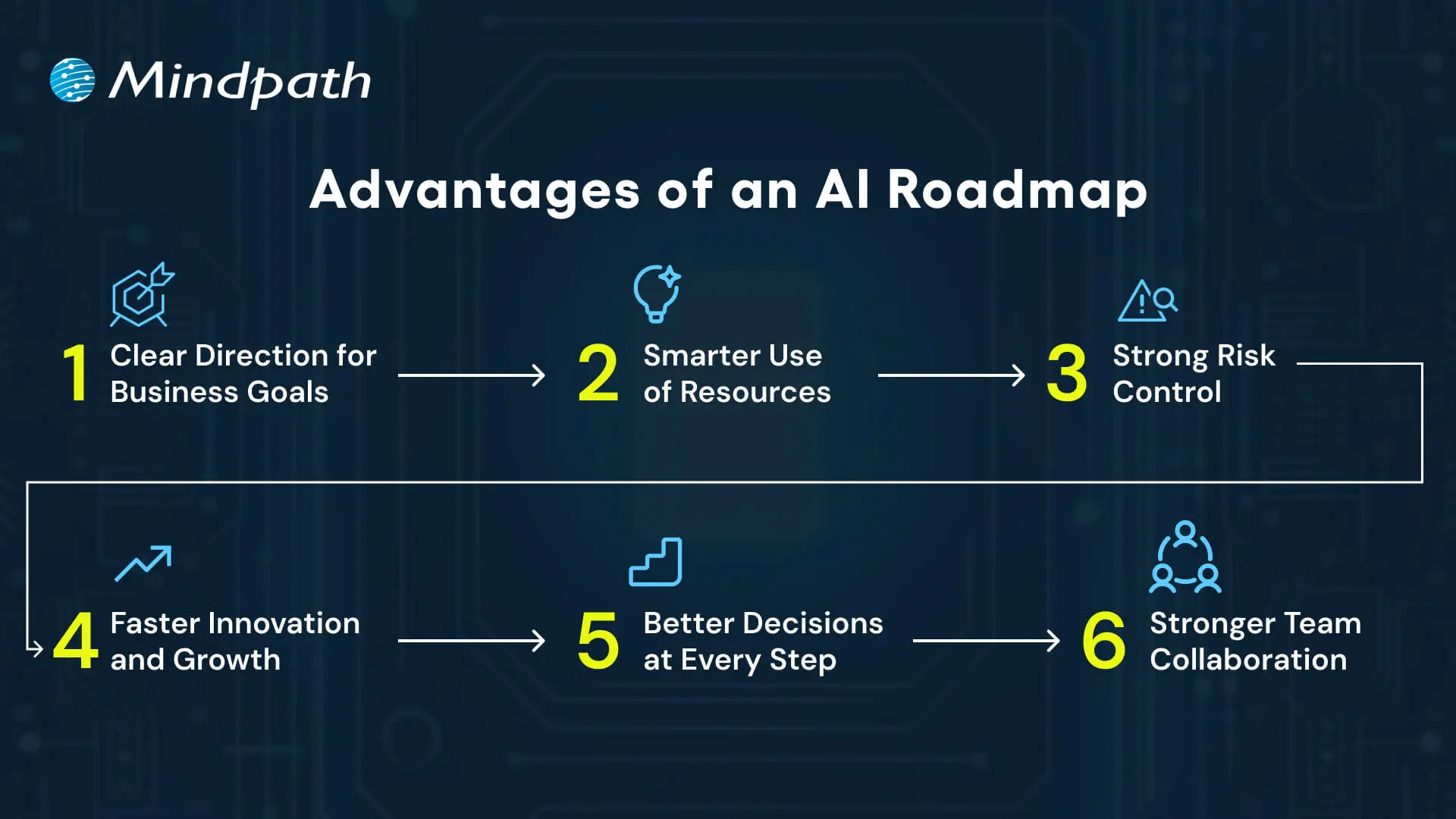
Advantages of an AI Roadmap

1. Clear Direction for Business Goals

An AI roadmap links all work to the company’s longer-term vision. This keeps both leaders and teams aligned and working towards the same purpose, minimizing any confusion or delays.

2. Smarter Use of Resources

Make each business plan deliberate and focused, so budget, skills, and tools are applied to the most impactful projects.

An AI roadmap generator can help you do this faster and with more precision.

3. Strong Risk Control

An AI roadmap allows organizations to tackle any aspects of security, compliance, or data quality up front.

Having a plan reduces risk for organizations and ensures a more streamlined implementation.

4. Faster Innovation and Growth

A roadmap allows organizations to have agility and the ability to experiment and scale solutions.

Even a beginner-friendly AI roadmap can outline the first steps that will lead to innovation and growth.

5. Better Decisions at Every Step

Leaders use the roadmap to select the appropriate use cases and monitor progress.

With this practical approach, it resembles an AI developer roadmap in which each step takes you to the next level of value.

6. Stronger Team Collaboration

An explicit roadmap promotes better communication across departments.

It builds teamwork and supports everyone in contributing to developing and using AI in the way it is most useful.

Struggling to make AI work for your business? Explore AI solutions for small businesses to discover practical, scalable solutions.

Key Steps to Build an AI Roadmap 2026

Constructing an AI roadmap in 2026 necessitates a defined plan that relates AI projects to real business objectives.

Companies must assess their focus on strategy, resources, and measurable outcomes in order to ensure the AI investments add value. Here are the key steps for building an effective roadmap.

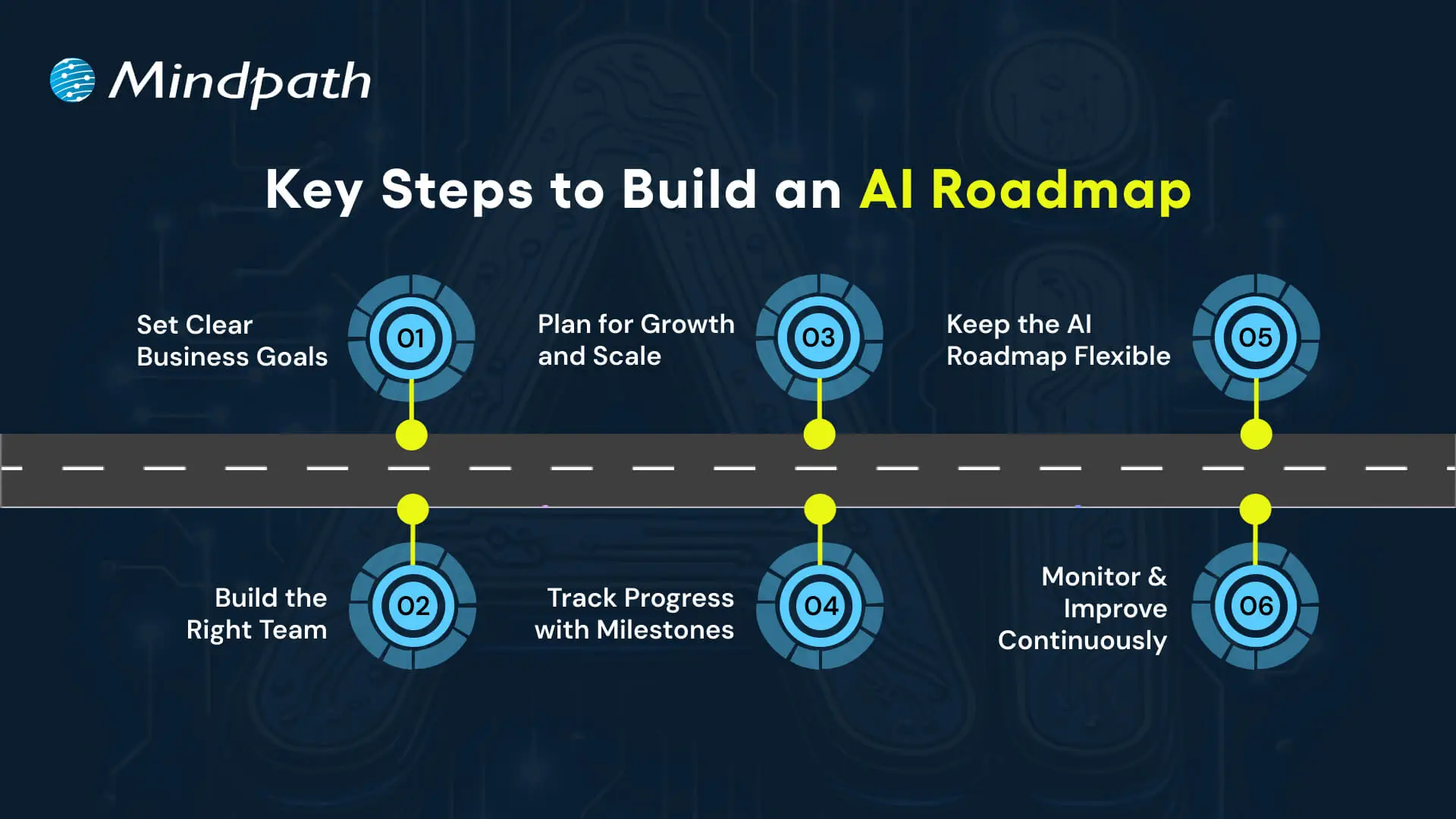
Key Steps to Build an AI Roadmap

1. Set Clear Business Goals

Every successful AI roadmap begins with a definitive goal. Set the desired outcomes that are most important.

Simply articulate it so everyone understands what it means to them. This clarity likewise connects each project to real business value.

2. Build the Right Team

A roadmap is only effective if the correct drivers are behind the wheel. Organize your engineers, strategists, and experts in the domain who can operate at the intersection of technology and business.

Taking a look at an AI engineer’s roadmap may help you frame up the skills you need to develop as a team.

3. Plan for Growth and Scale

A successful strategy looks to the future. Creating systems for larger datasets with multiple models and interconnected data with business apps.

It translates minor pilots into a comprehensive AI roadmap, facilitating ongoing growth.

Want to make faster and smarter business decisions? Discover how AI in decision-making enables leaders to transform data into actionable insights.

4. Track Progress with Milestones

Break the journey into smaller, actionable segments. Start with a pilot, grow to teams, and then link to enterprise systems.

As they reach a milestone, they will be able to see their progress and also validate that the roadmap is indeed compliant.

5. Keep the AI Roadmap Flexible

As the market landscape evolves, priorities shift.

Consistently update your AI roadmap to reflect new goals and possibilities. The adaptability within your roadmap will allow AI to remain relevant as your business develops.

6. Monitor and Improve Continuously

AI models must receive ongoing maintenance to remain valuable.

Form an AI team to monitor precision, solicit user feedback, and update models when the data or needs change.

Researching a generative AI roadmap can also help in developing new capabilities.

Wondering how your AI roadmap can go beyond automation to deliver smarter outcomes? Explore how Large Language Models (LLMs) can streamline operations and unlock new business value.

How will You Shape Your AI Roadmap for Success?

An AI roadmap provides businesses that want to adopt Artificial Intelligence with structure, direction, and confidence on their journey.

It allows business leaders to set and achieve organizational objectives, manage and allocate resources, reduce risk, and scale innovation with measurable outcomes.

With a flexible and constantly evolving AI roadmap, organizations can adapt their actions to changes in the market and continue to reap value from AI initiatives.

A solid plan will use a shared vision for long-term success.

At Mindpath, we are experts in conceptualizing and executing custom AI solutions, providing end-to-end AI consulting services, aligned with your business goals.

Throughout the entire process, from strategy & roadmap planning to development and scaling, our specialists will assist you.

Our passion for innovation and growth allows us to harness the real power of AI and transform complex problems into quantified outcomes.