Building a Cloud-Ready Workspace: The Essential Steps

Join our Newsletter!

Featured Posts

Support Is One Click Away

Home

Building a Cloud-Ready Workspace: The Essential Steps

Cloud-Ready Workspace

Building a Cloud-Ready Workspace: The Essential Steps

Are you ready to take your workspace to the next level? Imagine having all your tools, files, and communication channels accessible from anywhere, anytime. Sounds like the future, right? The good news is, building a cloud-ready workspace can turn that vision into reality. But where do you start? What are the essential steps to create a seamless, efficient, and secure cloud-based environment for your team? Let’s explore how you can set up a cloud-ready workspace that boosts collaboration and productivity.  

What is a Cloud-Ready Workspace?

A cloud-ready workspace is a system or program that was not initially developed for the cloud but can be modified to function in one. These systems can be deployed on cloud platforms such as AWS, Azure, and Google Cloud, which offer significant resources to enterprises. Using cloud-ready systems offers various benefits, including simple scaling, increased flexibility, and cost savings. You can customize the resources you utilize based on your requirements, and you only pay for what you really use. However, migrating these systems to the cloud frequently necessitates substantial IT labor and expense. Upgrading and linking them to other tools might take some time, but the long-term benefits, such as increased productivity and access to sophisticated cloud services, can be worthwhile. 

Why is Cloud- Ready Workspace Important?

As organizations progressively migrate to the cloud, having a workforce prepared to function in this environment is crucial. The transition to cloud-based technologies has been ongoing for some years, and it is now an integral component of how businesses work. 

Knowing how to use cloud services is becoming increasingly important as more work is done remotely and digitally. However, not all employees may be prepared for the transition. Businesses can prepare their teams to prosper in a cloud-driven environment by focusing on training, employing the appropriate personnel, and cultivating a cloud-friendly culture. 

Steps to Create Cloud-Ready Workspace

1. Build Cloud Fluency Across Your Team

To prepare your team for cloud-based work, you will need to make certain adjustments to the way your firm functions. Leadership frequently sets the example, but everyone must be involved in the process. Many businesses use core values to drive decision-making, and these values should support the transition to cloud-based work. 

The epidemic has made everyone more acclimated to change, and as we adjust, it is essential that we focus on how we handle these adjustments. As corporations face new difficulties like the Great Resignation, there is an increased emphasis on equity and inclusiveness. Moving away from focusing just on efficiency and towards increasing staff resilience might provide your organization with a significant competitive advantage. Creating a cloud-ready workspace requires a fresh perspective and listening to your team’s input. 

2. Use Inclusive Strategies for Lasting Change

Regardless of the structure of your business, it is crucial to include everyone to  bring about long-lasting change. Whether your culture is hierarchical, flat, or matrixed, use its strengths to help the transition. This makes the transition feel more natural and long-lasting. A useful starting point is Kotter’s 8-Step Process for Leading Change, which has been revised to meet today’s difficulties, especially those caused by COVID-19. Begin by instilling a feeling of urgency, then bring together a varied collection of people from various jobs to assist with the planning and implementation of the change. 

3. Offer and Require Cloud Training

Create a learning plan for different positions to help your company adapt to the cloud. Begin with leadership, then expand to departments and individuals. If necessary, work with a cloud professional to guide training. Mandatory training at all levels guarantees that the cloud initiative reaches everyone. Leaders who invest in acquiring new skills inspire the rest of their teams to do the same. An good strategy should emphasize the benefits of cloud computing for both the business and the employees, therefore motivating the workforce. 

4. Encourage and Reward Cloud Adoption

Employees who are recognized and rewarded for using cloud technology are more likely to follow suit. Leadership can recognize cloud adopters for completing training, obtaining certifications, or promoting the move. Simple acknowledgements, such as “kudos” in meetings or emails, can go a long way. Monetary incentives and promotions are also beneficial. 

Gamifying the process, such as awarding internal badges for completing training milestones, adds enjoyment and competitiveness to the learning experience. A knowledgeable cloud partner can help in the development of these incentive programs and collaborate with management or human resources to guarantee widespread adoption. 

5. Keep Cloud-Adopting Employees

After investing in cloud training, it is essential to maintain employee engagement and commitment to your firm. Employee retention is vital, particularly in today’s competitive labour market, where turnover is costly. Retaining cloud-skilled people increases productivity, morale, and corporate performance while lowering the cost of acquiring new workers. 

Employees are more likely to depart if they feel underpaid or have limited options to advance their careers. Providing ongoing learning opportunities in the cloud is crucial but retention extends beyond training. To retain cloud adopters, make sure they feel valued, are adequately compensated, have job stability, and can use their abilities. Promotions and increases are crucial for top performers to prevent them from pursuing other possibilities. 

6. Hire Cloud-Ready Talent

To create a cloud-ready workforce, consider employing new workers who already have the required cloud capabilities. Because these abilities are in great demand, ensure sure your hiring process is well-planned and provides competitive remuneration. To attract individuals who want to work with current technology, mention cloud-based abilities in job descriptions, even if the role isn’t entirely cloud-focused. You can also boost your company’s reputation as a technologically advanced organization by providing cloud-related information on networks such as LinkedIn, highlighting your cloud projects and innovation. 

7. Partner with Experts to Strengthen Your Cloud Workforce

If your organization lacks the means to acquire new employees or conduct elaborate training programs, collaborating with a cloud specialist can give vital assistance. A qualified cloud partner can design a bespoke training roadmap that offers rapid gains while also addressing your team’s individual needs. They can help in managing and accelerating your cloud adoption process, helping you to complete cloud-based initiatives more quickly and efficiently. 

A technology partner can assist in design, execute, and manage the installation of bigger, more complicated cloud initiatives, minimizing the pressure on your own team. This technique allows you to grow swiftly without having to hire full-time IT staff, saving you time and money. An experienced cloud partner provides technical expertise and helps your team via best practices, guaranteeing a seamless and successful transition to the cloud. 

Also Read: The Synergy of AI and Cloud Computing

Build a Coud-Ready Workspace at Mindpath

At Mindpath, we assist organizations in developing cloud-ready workspaces that are efficient, adaptable, and future-focused. A cloud-ready workplace enables teams to work from any location, access tools effortlessly, and adapt to new business requirements.  Our approach is straightforward and suited to your objectives. We examine your present systems to determine what is required for a successful transfer to the cloud. Whether you’re modernizing your infrastructure, integrating secure cloud platforms, or training your workforce, we’ll walk you through every step. With our knowledge, your workplace will be ready to meet the demands of today’s fast-paced digital environment. 

Wrapping Note!

Creating a cloud-ready workspace is no longer a choice but a necessity for businesses aiming to thrive in today’s dynamic environment. By adopting the right strategies, providing training, rewarding adoption, and partnering with experts, your organization can transition seamlessly to the cloud. Mindpath is here to simplify this journey for you. With our tailored solutions and expert guidance, we empower your team to embrace the cloud confidently, ensuring your workspace is not only ready for today but also for the challenges of tomorrow. Transform your workplace with Mindpath and stay ahead in a digital-first world.  

Ready to transform your business with a cloud-ready workspace?

Partner with Mindpath for expert solutions tailored to your needs.

Related Post

Discover top machine learning applications in 2025 and how businesses can leverage them to innovate and stay ahead in a data-driven world.
Explore top projects built with ReactJS, from personal websites to SaaS apps. Learn why ReactJS is ideal for scalable, high-performance web solutions.
How much does hiring a ReactJS developer cost? Learn about factors affecting rates, and how to find the best talent within your budget.

Related Post

Hire node js developers

Recruiting the right talent is the backbone of every successful digital project. That is why many businesses hire Node.js developers to build fast, scalable, and modern applications. Node.js is so popular right now that it’s powering websites and apps around the world, which is a great sign of how trusted and reliable it has become in the tech marketplace. According to recent report by W3Techs, Node.js powers 4.9% of all known websites that are identifiable as running on a web server. Isn’t it exciting to see how the runtime continues to evolve while we get more adoption and verified efficiencies in performance-centric applications?

The gradual rise in Node.js usage clearly indicates just how much impact it makes in the current web development landscape. The capacity to provide reliable and fast applications while being able to handle high volumes of traffic is a strong source of support for businesses looking to grow sustainably. With the right Node.js developers, organizations can convert ideas into reality and create valuable experiences for users. In this blog, we will explore why this is a meaningful choice.

Want to leverage the power of a fast and scalable web application in your next project? Mindpath’s Node.js development services focus on developing reliable and future-ready applications to acheive considerable business growth.

Why Choose Node.js for Your Dream Project?

Node.js is an open-source, cross-platform JavaScript runtime environment that enables developers to run JavaScript on the server-side. It is extremely fast and efficient, and it is a popular way to build modern applications that require high performance. When companies look to hire Node.js developers, they probably need a scalable, reliable, future-ready solution; one that could meet a growing user base with a fast and seamless digital experience.

Node.js delivers strong benefits through its powerful features. Based on Google’s V8 engine, it can deliver real-time, high-performance applications, such as chats, live updates, and streaming. It offers scalability to allow you to handle large amounts of traffic as well as ease of use so that cross-team members can collaborate using the same language, JavaScript. With npm’s large ecosystem, ease of development, and support for microservices, Node.js services provide plenty of flexibility for companies to enable faster innovation and faster time to market with reliable applications.

Want to take your Node.js application to the next level, but don’t know how? Learn how AI can help you transform your app with our ultimate guide to Node.js Libraries for AI Integration.

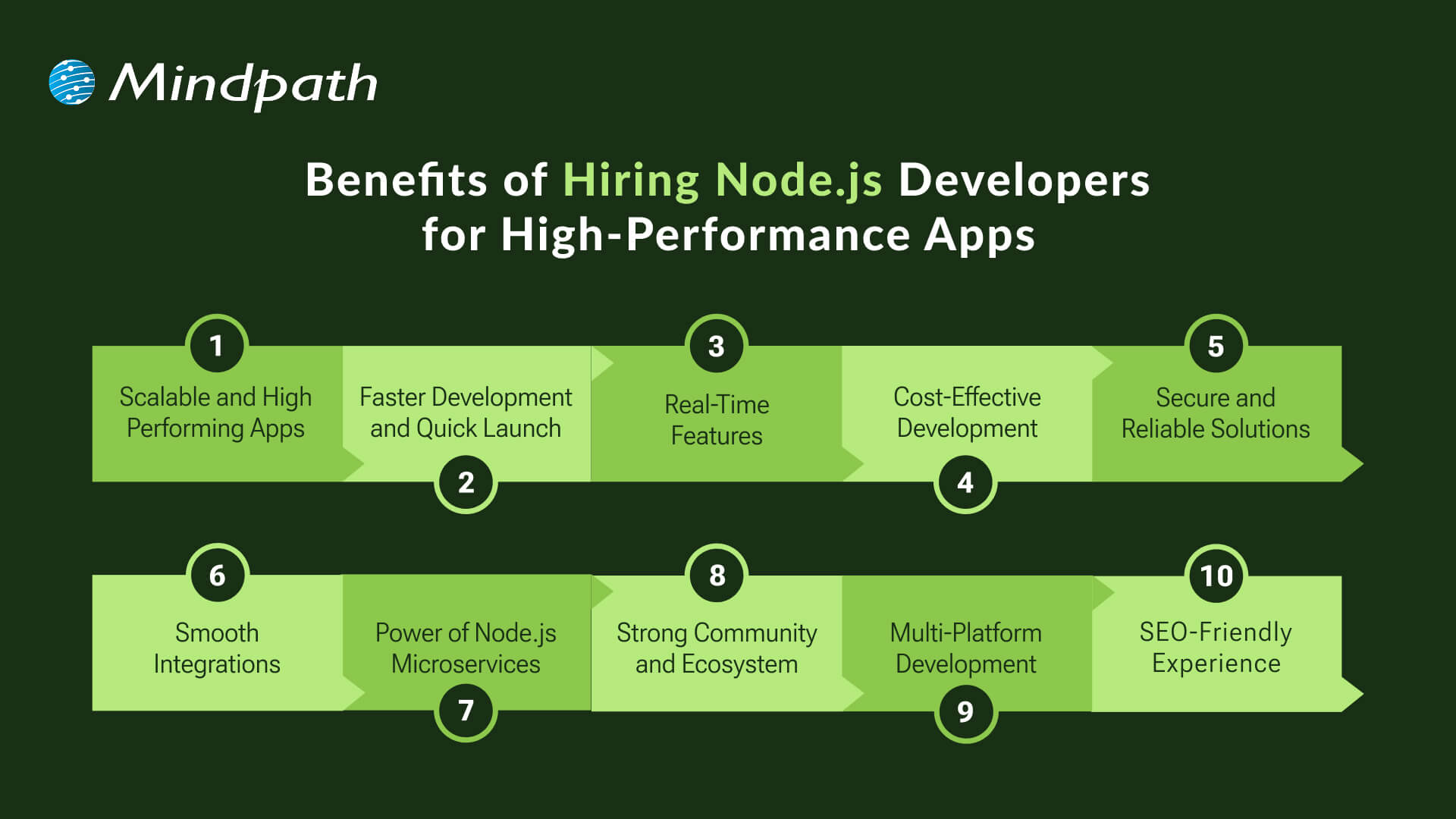
Benefits of Hiring Node.js Developers for High-Performance Apps

To build high-performance applications, developers need expertise, and Node.js has emerged as a top choice for today’s development projects for many reasons. Here are some principal reasons why businesses choose to hire dedicated Node.js developers for their projects.

Benefits of Hiring Node.js Developers for High-Performance Apps

1. Scalable and High-Performing Apps

Node.js is able to process multiple requests at once using an event-driven and non-blocking model. This makes applications fast and reliable, while also ensuring that they can support high traffic without losing speed. Businesses that hire Node.js developers will be able to make sure that their apps can scale with user demand.

2. Faster Development and Quick Launch

The lightweight structure of Node.js gives the programmer the option of using reusable modules, which allows them to code faster. With npm, programmers have access to thousands of open-source libraries ready to use for database, authentication, and security. Companies that hire expert Node.js developers save time and get products to market faster.

3. Real-Time Features

Node.js makes building real-time applications easy, including chat, notifications, and live updates. With WebSockets, developers can create real-time movement of data between users and servers. When businesses bring in Node.js Developers with some real-time experience, they can provide users with more interactive and engaging experiences.

4. Cost-Effective Development

Because Node.js employs JavaScript on both the front end and back end, one developer can support the entire application with relative ease. Since Node.js applications run easily on a single server, there is less reliance on costly infrastructure. Startups and small businesses benefit the most when they hire Node.js developers to build their applications and grow within a budget.

5. Secure and Reliable Solutions

Node.js can provide a strong security practice, encryption, and authentication for applications and safe API functionality. Skilled coders also work to update applications constantly to protect against breaches and unauthorized development. By getting the right group together, a company will be able to sustain and protect applications over time.

Also Read: Advantages of NodeJS for Your Business

6. Smooth Integrations

Node.js integrates seamlessly with databases like MongoDB, MySQL, and PostgreSQL. It can also easily integrate with front-end frameworks such as MongoDB, MySQL, and Postgres. Cloud makes it easy for Node.js to integrate into AWS or Azure. Node.js removes the technical barriers, allowing developers to develop powerful solutions.

7. Power of Node.js Microservices

Node.js is ideal for modular architectures, where a service operates independently from others. Therefore, developers can scale or upgrade a part of their application independently. With a Node.js microservices approach, businesses benefit from speed, flexibility, and easier maintenance. 8

8. Strong Community and Ecosystem

Node.js is a development community that is increasingly active and improving its ecosystem with more updates and tools. Developers can find quick solutions through community-shared libraries, tutorials, and forums. This means that companies that hire Node.js developers are always relevant and evolving according to modern trends and practices.

9. Multi-Platform Development

Node.js is used by developers to build web, desktop, and mobile application projects (from the same codebase). For instance, Electron is a simple and easy-to-use Node.js-based framework that can run the same code in the same runtime performance consistently across web, desktop, and mobile applications.

10. SEO-Friendly Experience

Node.js, through server-side rendering, allows applications to load faster and be searchable. Improvements in load speed improve user experience and increase visibility on the web. Server-side rendering makes it easier for developers to enjoy the performance and increases search visibility for their applications.

Not sure which development partner is right for your project? Explore our expert insights on choosing NodeJS Development Company to make the right decision with confidence.

Ready to Build High-Performance Apps with Node.js?

Node.js is still emerging as a dependable technology for building fast, scalable, and modern applications. Given its strong features, flexibility, and vast ecosystem, Node.js is undoubtedly one of the top choices in the market for companies that want to provide high-performing digital solutions. By hiring professional Node.js developers, companies get the expertise required to enable developers to bring ideas to life while considering user experience and developing sustainable applications.

Partnering with Mindpath gives you access to trusted Node.js development services tailored to your business goals. You can easily hire remote Node.js developer teams who bring proven expertise and adaptability to every project. With the right talent by your side, you gain the power to innovate faster, scale smarter, and deliver applications that perform at every level.

How much does hiring a ReactJS developer cost? Learn about factors affecting rates, and how to find the best talent within your budget.
DevOps for businesses

Managing the challenge of digital transformation in a rapidly evolving business landscape has become significantly difficult for every business owner. The necessity of DevOps for businesses is clearly visible in the fact that businesses must embrace adaptability and innovation to deliver value to their customers. DevOps aims to address the inefficiencies associated with traditional methodologies for software development and IT operations.

The biggest problem with the conventional approaches to software development and IT operations was that both of them were isolated from each other. DevOps offered a solution to the problem by promoting collaboration between the two teams. An overview of DevOps fundamentals and its benefits can help you learn about its actual potential.

Unlock the full potential of your software development in your business with Mindpath’s DevOps service. Contact us to get expertise on how to optimize development workflows and enhance collaboration between your teams.

Understanding the Basics of DevOps

Before discovering the utility of DevOps for business, it is important to understand its meaning and fundamental concepts. The adoption of DevOps for enterprise applications has become a necessity for every business owner due to the setbacks of the old ways. The traditional approach invited conflicts between the software development and IT operations teams, which had different priorities. While the development team focused on faster release of new features, the operations team emphasized reliability and stability.

DevOps helped in bridging the gap between the development and IT operations teams by ensuring alignment of their goals. How does DevOps achieve such an impressive feat? DevOps is more than just an amalgamation of ‘development’ and ‘operations’ as it represents a cultural philosophy that helps in streamlining and automation of software delivery. The distinctive collection of tools and set of practices followed in DevOps make it different from other approaches to software development.

You can notice the direct impact of DevOps business benefits through the example of an orchestra. What will happen if every musician in the orchestra is a specialist and works independently? On the contrary, an orchestra where collaboration is the norm will encourage musicians to share notes and work with each other to deliver their best performance. DevOps also aims to bring software developers and operations engineers on the same page in a similar manner to ensure that businesses deliver high-quality and reliable software.

Looking to optimize your CI/CD pipeline with smarter automation and streamlined processes? Visit our blog on DevOps Best Practices to discover the strategies high-performing teams use to achieve consistent, stable releases.

Foundations of DevOps

The best way to measure the significance of DevOps in the modern technological landscape involves understanding its core principles. Interestingly, every successful DevOps transformation initiative showcases the impact of the CALMS principles. CALMS stands for culture, automation, lean, measurement, and sharing, all of which represent the core principles of DevOps. The following sections will help you discover the significance of each principle in the world of DevOps.

1. Culture

Culture is undoubtedly the most crucial aspect in DevOps as it fosters a culture of collaboration, shared responsibility, communication, and empathy. The principle promotes an environment where team members don’t blame and learn from failures.

2. Automation

The second principle, i.e., automation, aims to address the issues emerging from repetitive manual tasks that are prone to errors. Automation in DevOps encompasses automated builds, testing, infrastructure provisioning, deployment, and monitoring.

3. Lean Principles

DevOps also adopts lean principles to reduce waste and enhance the value of every project. The common approaches to align with lean principles include streamlining all workflows, reducing bottlenecks, and ensuring continuous process improvement with data and feedback.

4. Measurement

Measurement is a crucial principle in every DevOps strategy for business applications as it offers comprehensible insights into performance. DevOps needs metrics and data not only to track performance but also to identify potential areas for improvement. Some of the notable metrics used in DevOps include mean time to recovery, change failure rate, lead time for changes, and deployment frequency.

5. Sharing

The final addition among DevOps principles, which showcases why it is important for businesses, is sharing. DevOps calls for real-time knowledge sharing and transparency between development and IT operations teams. Sharing in DevOps entails the use of shared tools, collective problem-solving, and open communication to foster collective intelligence.

Aiming to reduce risks while accelerating releases through automation? Explore our DevSecOps Guide to discover practical strategies that combine automated security with efficiency and collaboration.

Is DevOps Beneficial for Businesses?

Any business owner reading about DevOps right now is likely to be worried about the benefits it will bring to their business. Once you find out how DevOps helps businesses, you can discover why it is a productive approach to stay relevant in the digital landscape. DevOps can unlock new avenues for the success of businesses with the following benefits.

1. Faster Software Delivery

Speed is the key differentiator between successful and failed businesses in the era of digital transformation. DevOps accelerates the complete software delivery pipeline from conceptualization to production by leveraging continuous integration and continuous delivery practices. The CI/CD practices help in automatically building, testing, and releasing code changes more frequently. As a result, DevOps can ensure that new features, updates, and bug fixes can reach customers in a few hours or days. Businesses can rely on DevOps practices to achieve a competitive edge and adapt quickly to market changes.

2. Better Product Quality

The strategic benefits of DevOps for businesses also focus on enhancing product quality and reliability. DevOps combines continuous monitoring with automated testing and deployment to create high-quality software. Most of the business use cases of DevOps benefit from the proactive identification of issues in the early phases of development. Businesses can also rely on continuous feedback loops that empower teams to identify and address problems quickly, thereby ensuring more stable applications.

3. Efficiency and Cost Reduction

You can notice how early identification of errors in the development phase can help a business reduce costs with DevOps. At the same time, you must know that DevOps automation helps in reducing the workload on human resources. Business owners can use their valuable personnel to focus on more strategic and innovative work rather than wasting time on repetitive tasks. On top of it, streamlined processes also help in reducing waste and optimizing the allocation of resources. The outcomes of these changes will translate into huge amounts of savings in the long run.

4. Enhanced Security and Compliance

Security and compliance are the key requirements to become a trustworthy business in the eyes of customers and governments. Interestingly, the benefits of DevOps for startups and giant corporations emphasize how security has become an integral component of DevOps. The seamless integration of security practices in all stages of the development lifecycle, including coding, testing, and deployment, strengthens security. Some of the notable security practices integrated with DevOps include vulnerability scanning, compliance policies and automated security checks. The security measures not only reduce risks but also help in maintaining compliance with relevant regulations.

5. Collaboration and Agility

The most noticeable benefit of DevOps is the unification of software development and IT operations teams. Developers and operations engineers work in collaboration and share knowledge and tools, thereby reducing friction, blame games, and misunderstandings. As a result, DevOps creates a more productive and cohesive work environment. The advantages of collaboration, complemented with DevOps practices like containerization, help in enhancing the scalability of infrastructure and applications. Therefore, DevOps can allow a business to adapt quickly to changing demands, such as entry into new markets or a sudden rise in user traffic.

Aiming to optimize your DevOps strategy this year? Explore our blog on DevOps Trends to see which practices and technologies are helping organizations accelerate releases and reduce risks.

Identifying the Challenges for DevOps Adoption

The advantages of DevOps for businesses have provided a clear glimpse of its potential to drive a business towards success. On the other hand, adopting DevOps also brings some formidable challenges to the table. DevOps is not only about adopting new tools, practices, or methodologies but also a strategic shift for the whole organization. Some of the common challenges for DevOps include cultural resistance, lack of clear vision, legacy systems, and lack of skills.

Each challenge presents distinct setbacks and demands unique solutions with a carefully planned strategy. For instance, cultural resistance is the biggest obstacle that can create further problems without training and upskilling employees. Similarly, the lack of a clear vision for adopting DevOps will create difficulties in identifying the ideal metrics for success. On top of it, legacy systems will not welcome DevOps instantly, and the integration of DevOps practices in such systems will take a lot of time.

Business owners can address these challenges by fostering a culture of continuous learning and improvement. Investments in training and upskilling employees with the necessary skills and knowledge can pay off in the long run. In addition, the success of DevOps solutions for business growth depends significantly on the selection of the right tools. Most important of all, business leaders must also showcase active interest in driving cultural change and allocating relevant resources for DevOps projects.

Looking to combine fast DevOps practices with automated security checks? Check out our blog on DevOps vs DevSecOps to understand how DevSecOps adds proactive, automated safeguards to every stage of your pipeline.

Final Thoughts

The examples of businesses that have successfully adopted DevOps can provide a clear impression of the utility of DevOps. Many readers might have assumed that DevOps is a recent technological innovation due to its futuristic vision. As a matter of fact, the outline of DevOps business benefits is long enough for any business owner to ignore. The principles of DevOps not only improve the quality of software development but also the agility of a business.

Do you want to stay ahead of your competition in embracing DevOps? We at Mindpath help businesses streamline their software development pipelines with automation and collaboration without an extensive overhaul. Our world-class DevOps services offer a promising solution to every business owner seeking a reliable platform to capitalize on an innovative approach to software delivery. Consult with our experts and discover the best strategy to adopt DevOps advantages in your organization now.

Discover DevOps for businesses – enhancing collaboration, reducing costs, and driving innovation for faster, high-quality software delivery.

Hiring the right ReactJS developer is essential for building a high-quality online application. A talented developer should have a solid JavaScript background, knowledge of React ideas, and front-end programming experience. They must also be skilled in state management, user interface creation, testing, debugging, and version control to guarantee that the program runs smoothly. Aside from technical capabilities, problem-solving ability and collaboration are equally crucial. The following are the main abilities to look for when hiring a ReactJS developer in New Jersey

1. Strong JavaScript and React Fundamentals

A skilled ReactJS developer should have a solid grasp of JavaScript fundamentals, including ES6+ features like arrow functions, promises, and async/await. They must also be proficient in React concepts such as JSX, components, props, state management, and lifecycle methods. A deep understanding of rendering optimization ensures smooth application performance. Since React is built on JavaScript, hiring a developer with strong expertise in both JavaScript and React ensures they can efficiently build dynamic and responsive user interfaces tailored to your project’s needs.

2. State Management and Component-Based Architecture

Efficient state management is essential for handling complex applications. Look for developers with experience in Redux, Context API, or MobX to manage app-wide state effectively. They should also understand component-based architecture, which helps in building reusable, scalable, and maintainable UI components. A developer with expertise in React hooks and modular design can streamline development, reduce redundancy, and improve overall application performance, making your web solution more efficient and easier to scale.

3. Proficiency in HTML, CSS, and UI Development

A ReactJS developer should have strong HTML and CSS skills to create well-structured, visually appealing, and responsive user interfaces. Knowledge of CSS frameworks like Tailwind, Bootstrap, or Material-UI is a plus. They should also understand flexbox, grid layouts, and media queries to ensure the application works seamlessly across different devices. Well-structured UI components enhance user experience and performance, so hiring a developer who excels in front-end development is crucial for a successful project.

4. Testing, Debugging, and Version Control

Testing is key to building error-free applications, so ensure the developer is familiar with Jest, React Testing Library, or Enzyme for unit and integration testing. Strong debugging skills help identify and resolve issues quickly. Additionally, expertise in Git and GitHub is essential for version control, collaboration, and managing code changes efficiently. A developer with these skills can ensure a smooth workflow, minimize bugs, and maintain high-quality code throughout the development process.

Finding the right ReactJS developer can be challenging, but Mindpath makes it easy! Our expert developers have strong JavaScript skills, deep React knowledge, and experience with state management, UI development, testing, and debugging. Whether you need a junior, mid-level, or senior developer, we help you find the perfect fit for your project.
Let’s build something great together! Contact Mindpath today to hire top ReactJS developers in New Jersey!

Discover the ultimate guide to hiring Node.js developers in London. Learn about the skills, benefits, and cost factors involved in finding the right talent for your project.