

Companies are pressured to adapt, innovate, and make faster decisions. Rapid changes in markets and increased competition mean that traditional approaches are not effective enough now. This is the role that an AI roadmap will serve. It provides leaders with a framework to use AI in ways that allow them to be more efficient, more innovative, and provide meaningful value to the business. However, developing one requires an appropriate balance of vision and pragmatic planning.
Rather than following fragmented opportunities, leaders need to craft a plan with steps that link AI to business objectives. The real power lies in asking the right questions, assessing their resources, and establishing priorities before starting execution. With a map pointing in the right direction, the AI effort becomes a coordinated effort with measurable influence. Now, let us consider how businesses can develop this map with confidence and clarity.
Do you want to adopt the AI roadmap in your business? Then you need to get the right expertise that can navigate you through the process. Our AI development services will deliver full support from planning to execution to help you attain real and measurable outcomes.
What is an AI Roadmap?
An AI roadmap for business offers a systematic approach for describing how a business plans to leverage Artificial Intelligence to meet its aims. It allows teams to create specific and manageable goals, outline the best potential use cases, allocate resources, and plan timelines. With an AI roadmap, managers can explain how the employees will move toward the longer-term strategy while providing confidence to the employee base.
A roadmap is a great tool for helping teams create the right skills and focus on the priorities they should be focusing on. It helps connect every AI project directly back to the business strategy to ensure that your team’s work creates actual value and is not just a random attempt to test out AI. Companies can use it for an organization-wide adoption, or they can focus on those specific aspects of the business, but in either case, the roadmap makes AI a viable contributor to your growth and success.
Advantages of Having a Roadmap for AI
Developing an AI roadmap gives businesses clarity and helps eliminate uncertainty in the implementation stage. Rather than jumping to general-purpose AI without a clear structure, a roadmap ensures every action you take is aligned to your real goal with measurable results. Here are the primary benefits of having an AI roadmap.
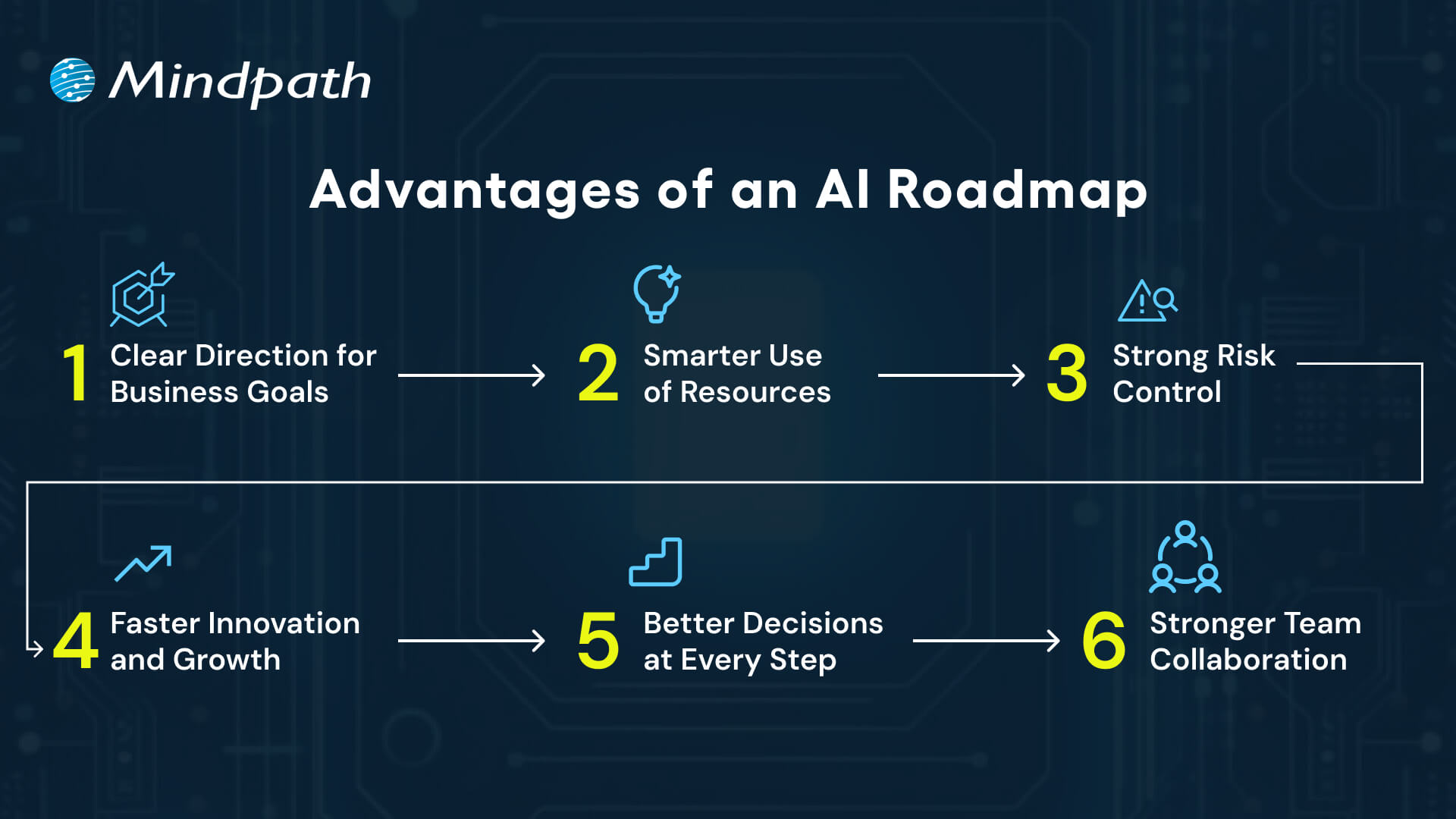
1. Clear Direction for Business Goals
An AI roadmap links all work to the company’s longer-term vision. This keeps both leaders and teams aligned and working towards the same purpose, minimizing any confusion or delays.
2. Smarter Use of Resources
Make each business plan deliberate and focused, so budget, skills, and tools are applied to the most impactful projects. An AI roadmap generator can help you do this faster and with more precision.
3. Strong Risk Control
An AI roadmap allows organizations to tackle any aspects of security, compliance, or data quality up front. Having a plan reduces risk for organizations and ensures a more streamlined implementation.
4. Faster Innovation and Growth
A roadmap allows organizations to have agility and the ability to experiment and scale solutions. Even a beginner-friendly AI roadmap can outline the first steps that will lead to innovation and growth.
5. Better Decisions at Every Step
Leaders use the roadmap to select the appropriate use cases and monitor progress. With this practical approach, it resembles an AI developer roadmap in which each step takes you to the next level of value.
6. Stronger Team Collaboration
An explicit roadmap promotes better communication across departments. It builds teamwork and supports everyone in contributing to developing and using AI in the way it is most useful.
Key Steps to Build an AI Roadmap 2025
Constructing an AI roadmap in 2025 necessitates a defined plan that relates AI projects to real business objectives. Companies must assess their focus on strategy, resources, and measurable outcomes in order to ensure the AI investments add value. Here are the key steps for building an effective roadmap.
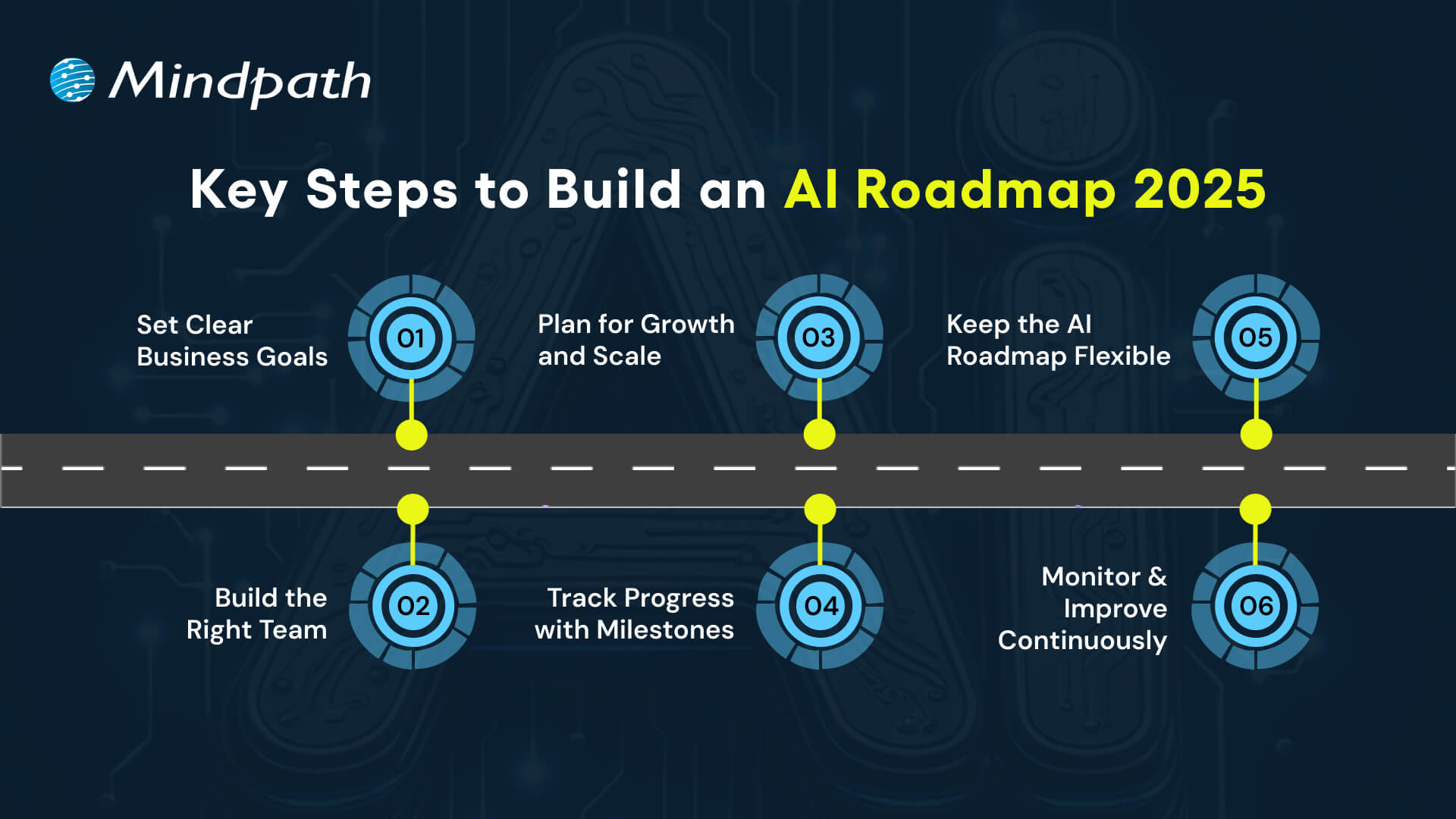
1. Set Clear Business Goals
Every successful AI roadmap begins with a definitive goal. Set the desired outcomes that are most important. Simply articulate it so everyone understands what it means to them. This clarity likewise connects each project to real business value.
2. Build the Right Team
A roadmap is only effective if the correct drivers are behind the wheel. Organize your engineers, strategists, and experts in the domain who can operate at the intersection of technology and business. Taking a look at an AI engineer’s roadmap may help you frame up the skills you need to develop as a team.
3. Plan for Growth and Scale
A successful strategy looks to the future. Creating systems for larger datasets with multiple models and interconnected data with business apps. It translates minor pilots into a comprehensive AI roadmap, facilitating ongoing growth.
4. Track Progress with Milestones
Break the journey into smaller, actionable segments. Start with a pilot, grow to teams, and then link to enterprise systems. As they reach a milestone, they will be able to see their progress and also validate that the roadmap is indeed compliant.
5. Keep the AI Roadmap Flexible
As the market landscape evolves, priorities shift. Consistently update your AI roadmap to reflect new goals and possibilities. The adaptability within your roadmap will allow AI to remain relevant as your business develops.
6. Monitor and Improve Continuously
AI models must receive ongoing maintenance to remain valuable. Form an AI team to monitor precision, solicit user feedback, and update models when the data or needs change. Researching a generative AI roadmap can also help in developing new capabilities.
How will You Shape Your AI Roadmap for Success?
An AI roadmap provides businesses that want to adopt Artificial Intelligence with structure, direction, and confidence on their journey. It allows business leaders to set and achieve organizational objectives, manage and allocate resources, reduce risk, and scale innovation with measurable outcomes. With a flexible and constantly evolving AI roadmap, organizations can adapt their actions to changes in the market and continue to reap value from AI initiatives. A solid plan will use a shared vision for long-term success.
At Mindpath, we are experts in conceptualizing and executing custom AI solutions, providing end-to-end AI development services, aligned with your business goals. Throughout the entire process, from strategy & roadmap planning to development and scaling, our specialists will assist you. Our passion for innovation and growth allows us to harness the real power of AI and transform complex problems into quantified outcomes.