
AI in Business Strategy: Driving Growth and Innovation

Join our Newsletter!

Featured Posts

Support Is One Click Away

Home

AI in Business Strategy: Driving Growth and Innovation

AI in business strategy

AI in Business Strategy: Driving Growth and Innovation

Think about the potential of AI in business strategy, accelerating your organization with enhanced insights and improved decisions. Imagine having intelligent tools to assess complex data, identify unseen patterns, and let your team have more freedom to genuinely innovate and grow. By adopting the right mindset, companies today are giving themselves a true competitive advantage with AI and changing every aspect of their operations daily.

This intelligent technology is helping companies find new opportunities, create more relevant customer experiences, and briskly adapt to changes in market needs. Embedding artificial intelligence benefits organizations to yield positive results. When used prudently, AI becomes a trusted partner in increasing efficiencies and establishing long-term, viable success.

In this article, you will learn about how AI can transform your strategy and scale your business. Let’s dive in!

Want to enhance your business strategy with artificial intelligence? Mindpath AI development services have a combination of providing strategic insights with hands-on expertise to provide intelligent growth across your organization.

What is an AI Business Strategy?

A business strategy is like an explicit blueprint that directs a company toward its goals. It answers important questions about where a business wants to go, how it plans to get there, and what makes it different from the rest of the marketplace. A clear strategy helps everyone understand the overall objective of the business and keeps colleagues headed in the right direction while working together.

Bringing AI into the plan strengthens the marketing strategy. An artificial intelligence strategy or AI strategy for business growth means using artificial intelligence to better facilitate your business objectives. This could mean improving customer service, making more effective decisions with your data, or even many other entirely distinct initiatives. The aim is to leverage smart tools to execute better, smarter, faster, while staying ahead of your competition.

Also Read: AI in E-Commerce

Benefits of an AI Business Strategy

Having an AI business strategy can open up new opportunities and make your company more competitive. Here are some key benefits that show why investing in AI is worth it:

benefits of an ai business strategy

1. Maximized Efficiency and Productivity

AI can take care of repetitive work, so teams can spend more time on creative ideas and solving problems. It makes daily tasks easier and quicker, which improves workflow in every department. By spotting delays and gaps in processes, AI helps companies get things done faster. This boost in productivity helps businesses stay competitive. Companies can do more with less time and effort when using AI in business.

2. Smarter Data-Driven Decision Making

Using AI in business helps leaders make better decisions based on real data. AI tools can study huge amounts of information and find trends or risks that people might miss. This means managers can act faster and with more confidence. Predictive tools even help businesses see what customers might want next. Smart decision-making is key to staying ahead in a changing market.

You can learn more about how AI can transform decision-making in our guide, Power of AI in Decision-Making.

3. New Opportunities and Innovation

AI encourages companies to try new ideas and find fresh ways to earn money. It supports innovation by helping teams develop new products or enter new markets. With AI, companies can test different ways to work and reach more people. This can create new income streams and keep a business strong in tough markets. Staying open to new ways of working keeps the company growing.

4. Superior Customer Experience

AI for customer service makes it easier to understand what customers like and want. Businesses can offer more personal services, like tailored suggestions or special offers. Chatbots and AI tools give customers quick answers, anytime they need help. This keeps people happy and more likely to come back. Good customer service is always important, and digital transformation with AI makes it even better.

5. Clearer Strategic Direction

AI business strategies help companies plan for the future with clear data. Teams can set better goals because they know what is working and what needs to be changed. AI tools keep an eye on the market and help businesses adjust plans when needed. This makes it easier to stay on track even if things shift. A strong strategy backed by AI keeps everyone moving in the same direction.

Want to know if your business is ready to implement AI in the right way? Explore our blog – AI Readiness Checklist.

How to Build an AI Business Strategy?

Building an AI business strategy takes careful planning and clear goals. Here are some practical steps to help you get started the right way:
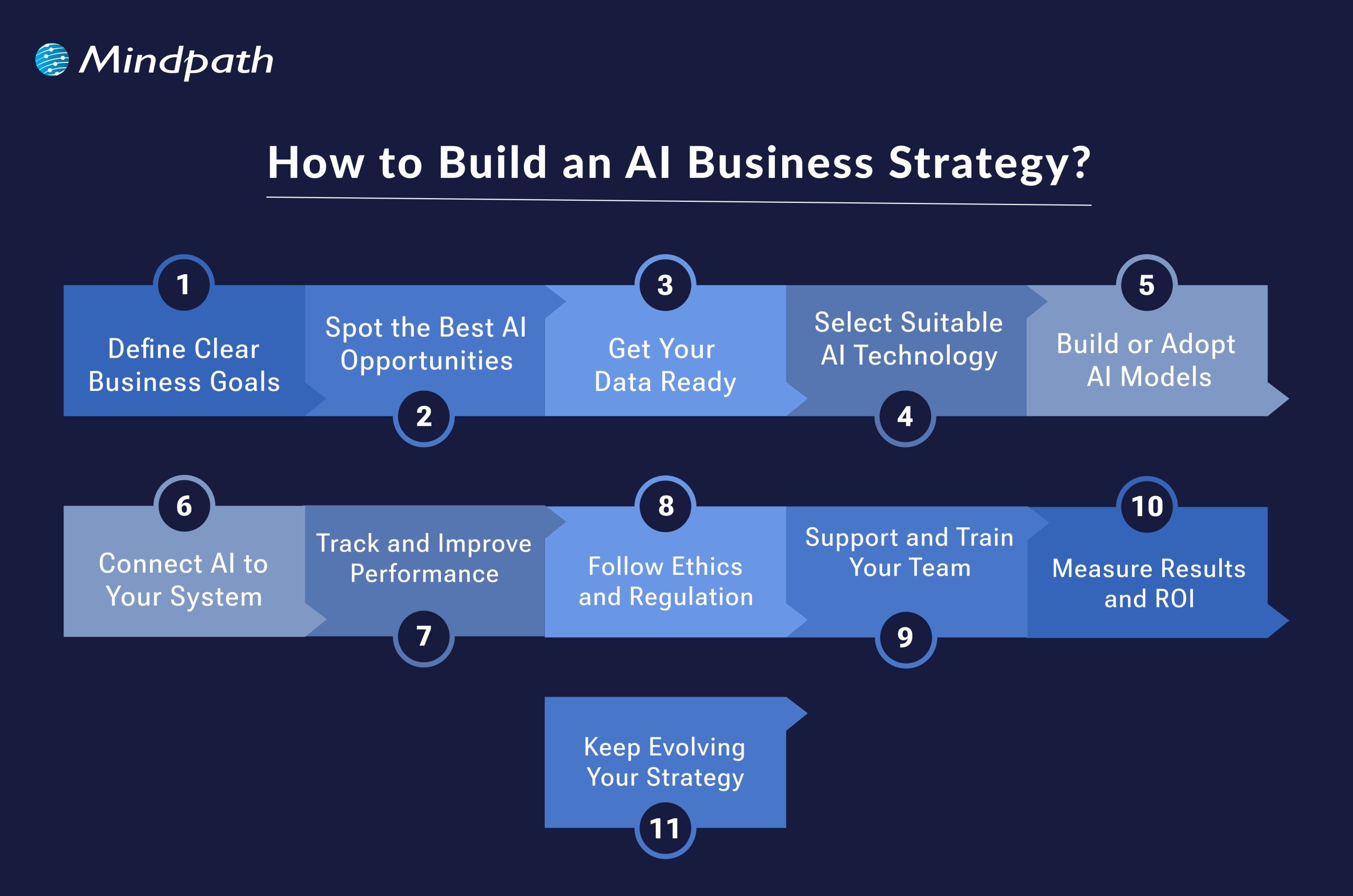
How to Build an AI Business Strategy

1. Define Clear Business Goals

Start by deciding what you want to achieve with AI, like increasing sales, lowering costs, or improving customer service. Clear goals strategized by the expert AI consultant help you focus your efforts where they matter most. Knowing what you want makes it easier to pick the right AI tools later. A strong direction keeps your entire team aligned and motivated.

2. Spot the Best AI Opportunities

Look at your daily operations and see where AI can add the most value. This might be in customer support, marketing, supply chain, or product development. Finding the right areas will help you get quick wins and build confidence. Prioritizing these areas makes your investment more effective.

3. Get Your Data Ready

Good data is the foundation for AI success. Collect useful data from different parts of your business and make sure it’s accurate and well-organized. Clean and reliable data will help your AI tools work properly. Better data means better insights and fewer errors down the road.

4. Select Suitable AI Technologies

Explore the AI tools that match your goals and the type of data you have. This could include machine learning, chatbots, or automation software. Choose technologies that are practical and align with your strategy. Pick tools that your team can actually use and manage well.

5. Build or Adopt AI Models

Develop AI models that fit your business needs, either with your own experts or trusted partners. Some companies build custom models, while others use ready-made solutions. Test your models to make sure they perform well in real-world situations. Good models help you solve problems faster and smarter.

Ready to adopt the recent AI trends into your business? Read our detailed blog on Top AI trends, which provides a deeper understanding of how to implement AI into your business for future growth.

6. Connect AI to Your Systems

Make sure your new AI tools work smoothly with your current software and workflows. This may need teamwork between IT, data, and business teams. Good integration helps people use AI with less hassle. Seamless systems keep operations running without major disruptions.

7. Track and Improve Performance

Keep an eye on how your AI strategy is working post-implementation. Use regular checks to fix any issues and update the system with fresh data. A little maintenance keeps your strategy useful and accurate over time. Monitoring helps you spot new opportunities for improvement too.

8. Follow Ethics and Regulations

Think about the rules and responsibilities that come with using AI. Protect customer privacy and make sure your AI solution doesn’t create unfair bias. Stay up to date with local and international laws. Acting responsibly builds trust with customers and partners.

9. Support and Train Your Team

Help your team learn how AI fits into their work. Offer training so they feel comfortable using new tools and workflows. Encourage them to ask questions and share feedback. Well-trained employees make AI adoption smoother and more effective.

10. Measure Results and ROI

Decide which numbers will show if AI is really helping your business. This might be cost savings, higher sales, or better customer feedback. Keep tracking these results over time to see progress. Proving ROI makes it easier to get support for future AI projects.

11. Keep Evolving Your Strategy

Treat your AI business strategy as a work in progress. Keep testing, learning, and improving how you use AI as your goals change. Regular updates keep you competitive in a fast-changing market. A flexible approach helps you make the most of every opportunity.

Planning to leverage the power of artificial intelligence, understanding the technologies that drive it has become a crucial advantage. To dive deeper into the tools and technologies behind AI innovation, explore our detailed guide on the AI programming languages.

Ready to Transform Your Business with AI?

Adopting AI in business strategy helps your company make smarter choices, improve operations, and deliver better customer experiences. By understanding your goals and using AI wisely, you can drive innovation and stay ahead of the competition. Start with clear steps, keep learning, and stay flexible. This approach ensures that AI becomes a real advantage for your business growth.

At Mindpath, our AI development services are designed to help you unlock real results with confidence. We create solutions that match your unique needs, from custom AI models to smooth system integration. Our team works closely with you to ensure your strategy delivers value today and in the future. Let’s build an AI-powered roadmap for your success.
Related Post

Explore the impact of Generative AI in retail and e-commerce, enhancing customer experiences, streamlining operations, and driving engagement.
Hiring ReactJS developers? Follow our expert tips to find the right talent and build a strong development team.
Discover the ultimate guide to hiring Node.js developers in London. Learn about the skills, benefits, and cost factors involved in finding the right talent for your project.

Related Post

AI in e-commerce

React, a JavaScript library originally created by Facebook, is extremely common for developing interactive and fast user interfaces. It has a component-based architecture and provides developers with flexibility to release smooth, scalable and high-performing web applications. It aims at developing interactive web app parts, specifically SPAs, in which content keeps changing dynamically without page reloads. Because of these advantages, numerous companies are counting on React to boost their online experience. 

But choosing a suitable React development company is as important as the technology itself. The ideal team can ensure that your business goals are achieved with accuracy and speed. This blog will take you through the benefits of opting for the correct partner for your React requirements and what to search for in a ReactJS development firm. So, let’s explore! 

Advantages of Partnering with a React Development Company

Partnering with an appropriate ReactJS development company can offer many benefits and it is very important to know what they bring to the table and how they work. Here are a few benefits you should know before making your choice: 

1. Customized ReactJS Solutions

A dependable ReactJS development company understands that every business has requirements. By offering customized solutions, they guarantee that the final product aligns with your goals. They can adjust features, improve functionality, and design a user-friendly interface to match your business requirements. With customizable ReactJS development services, the company guarantees your web application is not just practical but optimized to support your growth and success. This personalized attention can help in building a product that meets your exact requirements, fostering competence and improving user experience.  

2. Faster and Smarter Development

Utilizing ReactJS services can help to speed up the whole development process, so, an expert team follows a clear and organized method that improves how quickly and smoothly the work gets done. With automation and collaboration support tools, they can create your project faster without sacrificing quality. They usually follow agile practices, which include breaking the work into smaller pieces, getting feedback, and adjusting accordingly. This way, your application is delivered in a short time, with fewer bugs, and better results. 

3. Ongoing Support after Development 

Reliable ReactJS development companies do not consider their work finished once a project goes live; a good company provides continued assistance and support to ensure the website or application runs smoothly. This means troubleshooting and resolving bugs, implementing minor changes, and providing ongoing maintenance. With good ReactJS services, you receive regular maintenance to ensure your application is performing well and updated. If anything goes wrong, the team will be able to fix it with ease. This type of support fosters trust and ensures that your business remains stable in the long term by keeping your digital solution up to date and trouble-free.  

4. Strong Emphasis on Quality

Quality is also a priority for companies when developing web applications. A React development firm with experienced teams follows rigorous testing practices to ensure everything is in order. They test the code, design, and features throughout the project stages. This identifies errors early, corrects them prior to the final delivery and makes the final product smooth, dependable, and ready for actual users. By focusing on quality, ReactJS development agencies ensure that applications delivered are of high standards and work effectively. 

Now that you have an idea about the benefits, let us learn what factors to consider while choosing ReactJS development agency: 

Key Considerations While Choosing ReactJS Development Company

While choosing a ReactJS development agency, you must pay attention to a few things. Each company has its own way of working and it’s crucial to know what makes one stand out from the rest. Following are some of the important considerations you must look for: 

1. Skilled Team with Strong Background

When selecting a team for your ReactJS application development, it is essential to look at their previous records. A team with good experience and expertise will easily be able to deal with complex tasks. They must have developed various types of web or mobile applications for different companies which indicates that they know what fits best in a situation. Experienced teams can identify and fix problems in less time and develop better apps suitable for your needs. 

2. Wide Range of ReactJS Services

It is crucial to select a team that provides a complete spectrum of ReactJS development services. This includes custom ReactJS application development, UI/UX design, and React Native mobile app development. The team should also be able to take care of API integration, backend development, and performance optimization. Also look for those who provide migration services to bring your current system up to date and offer ongoing maintenance and support to make sure your app is running smoothly in the long run. 

3. Evaluate Portfolio and Reviews

Browsing through past experience and client feedback of a React development company speaks volumes about their potential and clients’ satisfaction. You can find feedback on pages such as Clutch, GoodFirms, and Trustpilot. Testimonials depict whether the team effectively communicates, overcomes challenges, and provides quality output. Good feedback along with a quality portfolio indicates that the team is competent and enjoys a good reputation, due to which you can trust them with your project to be done effectively. 

4. Understand Their Development Approach

One should always know the development process of the team to ensure it suits your business needs. The majority of the developers use agile practices, and these allow them to easily incorporate changes and remain flexible during the project. It means they are able to adapt to any problem that arises. A well-planned process guarantees that the final product is as per your goal and is aligned with your expectation, particularly for ReactJS development, where adaptability and productivity are the backbone to delivering high-quality output within time. 

Ready to Build Smarter with the Right ReactJS Partner?

Selecting the appropriate React development firm can literally make all the difference in the performance of your application and the success it brings to your business. From customization and speed to quality and maintenance support, every aspect is a crucial consideration for ensuring your success. Investing time to consider experience, services, and working methodologies will guide you to the best team.

At Mindpath, we provide professional ReactJS development services with years of experience and innovation underpinning our work. If you need to hire ReactJS developers who know your needs inside out and can provide you with efficient and scalable solutions, we’re here to assist you in growing. 

Get in touch with us! 

Need a reliable ReactJS development company? Work with Mindpath to create impactful and scalable applications that deliver concrete business outcomes.

top AI trends

AI trends are growing at an accelerated rate, creating new opportunities and challenges for leaders in today’s workforce. From intelligent automation to advanced data analysis, AI is delivering smarter and leaner business processes, and playing a critical role in AI in decision-making. Fascinating, isn’t it? AI now permeates companies of all sizes for improving decision-making and performance. These transitions are already contributing to how businesses will operate and compete across every industry in 2026!

It is vital to keep up with the trends in AI because they are directly relevant to how businesses grow, change, and ultimately fulfill growing expectations. The faster leaders recognize trends, the smarter they can invest and prepare their teams, in order to gain an advantage over their competitors. If you do not pay attention to these trends, you may run the risk of missing advancements in tools, significant improvements in workflows, and smart strategies.

Want to know what are the top AI trends for 2026? This blog will provide you with all the AI trends business leaders will want to be aware of and should pay particular attention to in 2026.

Wondering how to get started with AI development the right way? Our AI Development Services can help you build impactful solutions from concept to deployment.

What is Artificial Intelligence (AI)?

Artificial Intelligence (AI) is a type of technology that helps computers in thinking, learning, and making choices like people. It allows machines to use language, read information, and analyze data to give helpful responses. In business, AI is primarily being utilized to make workflow quicker and smarter.

For example, AI allows an organization to better appreciate the needs of its customers, and provide its products or services to them, when they need them, in a timelier manner. AI functions for businesses efficiently by helping cut down the time taken for a task that people typically take a lot longer to do. AI can minimize errors, take care of repeated and tedious work, and it can operate indefinitely without breaks.

It means that an organization can receive a product quicker, save time to increase productivity, and use their time to pursue other important goals. AI can also help organizations improve the quality of their products and services by being able to produce and share insights derived from their data, helping ensure smarter, and more informed decisions.

Let us know about some AI statistics that highlight how organizations are adopting and managing AI technologies in 2026:

  • According to Statista, the AI market is expected to reach US$244.22 billion in 2026 and grow to US$1.01 trillion by 2031, with a CAGR of 26.60%.
  • As per McKinsey AI report, more than three-quarters of organizations now use AI in at least one business function.
  • An artificial intelligence survey from Forbes reveals that 25% of enterprises will deploy AI agents in 2026 to handle complex, multi-step tasks.
  • Analytics Insight states that 80% of retail executives plan to accelerate AI adoption through automation by the end of 2026.

Is your business missing out on the advantages AI can offer? Explore the benefits of AI from increasing efficiency and cutting costs to making smarter, data-driven decisions that drive growth.

Top AI Trends for 2026

Trends in artificial intelligence are shaping how businesses operate, innovate, and grow in 2026. As more companies start using AI to improve workflows and decision-making, these key developments are driving real impact across industries.

1. AI Reasoning Gets Smarter

Among the latest developments in AI, one major shift is its growing ability to reason and make sense of complex situations. In 2026, large language models can think more like humans, helping businesses go beyond basic insights. They now support smarter planning and stronger decision-making. This means companies are using AI not just to understand data, but to act on it more confidently.

2. Generative AI Reshaping Content Strategy

The best artificial intelligence trend in 2026 is the rise of generative AI in content creation. It allows businesses to create text, visuals, and videos instantly from basic prompts. This helps teams produce more personalized content at scale without extra effort. It’s making content strategies faster, smarter, and more effective across industries.

Also Read: Top GenAI Trends 

3. AI Agents Redefining Business Efficiency

One exciting use of AI in business is the rise of intelligent AI agents that act like real team members. These smart tools handle tasks like finding new leads, managing admin work, and analyzing data in real time. By doing this, they help teams work faster and focus on bigger goals. Companies are now seeing lower costs and fewer errors due to these advanced AI systems.

4. Multi-Agent Systems Streamlining Workflows

A new shift in AI is the use of multiple agents working as a team to handle complex business tasks. Each AI agent focuses on a specific job, like customer service or finance, and they all work together smoothly. This makes it easier to automate detailed processes that once needed people to manage them. The result is faster work, better accuracy, and stronger connections between business systems.

5. Industry-Driven AI in Action

Different industries are now using AI in ways that fit their unique needs. Sectors like finance, healthcare, insurance, and manufacturing are leading the way because they already follow strong rules around data and systems. These fields need custom AI tools for tasks like managing claims, tracking supply chains, or handling appointments. Tailored AI solutions are helping these industries work faster, meet rules, and serve people better.

How is AI reshaping the way websites are built and optimized? Explore our detailed article on AI in Web Development to see how it’s driving smarter design, faster deployment, and better user experiences.

6. GPUs Powering the Future of AI

A key new technology in AI is the growing use of GPUs to run advanced models. These powerful chips help process large amounts of data quickly, which is essential for AI tasks. As AI adoption grows, the demand for GPUs is rising across both cloud and on-premise systems. They now play a central role in building fast, efficient, and scalable AI infrastructure.

7. A Shift Towards Small Language Models (SLMs)

One trend catching the eye of artificial intelligence companies to invest in is the move from large to small language models. These smaller models, called SLMs, can do many of the same tasks as LLMs but use fewer resources. They are faster, cheaper to run, and easier to manage, making them a smart choice for everyday use. With techniques like pruning and knowledge sharing, SLMs are becoming more efficient without losing quality.

8. Businesses Turn to Open-Source AI

Open-source AI is becoming a strong choice for businesses that want more freedom and flexibility. Unlike closed systems, open-source models let companies build and manage AI tools on their own, keeping data private and costs lower. They can also fine-tune models using their own data to get better results. This shift is helping more businesses create powerful AI solutions without relying on big tech providers.

9. RAG Brings More Accuracy

One growing method to reduce wrong answers from AI is called Retrieval-Augmented Generation, or RAG. It helps AI pull information from reliable and current sources, making responses more accurate. While it improves relevance, it doesn’t always provide personalized answers without added context. Still, RAG is becoming a valuable tool for businesses looking to make AI more useful and trustworthy.

10. Swarm Learning Driving AI Progress

Swarm learning is a new way for AI systems to grow by sharing what they learn with each other. Instead of learning alone, connected AIs exchange knowledge in real time. This helps them improve faster and solve problems more efficiently. It’s a smart way to build stronger AI by working as a team.

Looking for smarter ways to handle customer queries and optimize workflows? Explore our blog to see how conversational AI chatbots can transform your business.

Is Your Business Aligned with the Top AI Trends?

AI trends are reshaping how businesses grow, compete, and deliver value across every industry. From reasoning models to open-source tools and AI agents, these trends are helping companies simplify operations, improve decision-making, and stay ahead. By understanding what’s emerging in 2026, leaders can better prepare for new opportunities and future success.

At Mindpath, we offer AI development services that align with the latest AI trends and business goals. We create intelligent tools, automation systems, and custom AI models that improve decision-making and increase efficiency. Our solutions are built to fit your operations, boost productivity, and support long-term growth. With Mindpath, businesses gain reliable and future-focused AI support.

Frequently Asked Questions

1. How can businesses practically start adopting the top AI trends without major disruption?

Businesses can begin by identifying small use cases like automation or data analysis and gradually scaling. Starting with pilot projects helps test results without risk. With proper planning and training, teams can smoothly adopt new technologies while maintaining daily operations and minimizing disruption.

2. Why are the top AI trends important for long-term business growth?

The top AI trends help businesses stay competitive by improving efficiency, reducing costs, and enabling smarter decisions. Companies that adopt these trends early can respond faster to market changes, improve customer experiences, and build stronger strategies for sustainable long-term growth.

3. How do AI agents differ from traditional automation tools in real business scenarios?

AI agents go beyond simple automation by making decisions, learning from data, and handling multi-step tasks independently. Unlike traditional tools, they adapt to situations and improve over time. This makes them more useful for complex workflows that require intelligence and flexibility.

4. What challenges should leaders consider before implementing AI trends in their organization?

Leaders should consider data quality, integration with existing systems, team readiness, and ethical concerns. Proper planning, clear goals, and employee training are essential. Addressing these challenges early ensures smoother adoption and helps businesses gain maximum value from AI investments.

5. How are the top AI trends influencing everyday employee roles and responsibilities?

The top AI trends are shifting employee roles toward more strategic and creative tasks. Routine work is increasingly automated, allowing teams to focus on problem-solving and innovation. Employees also need to learn new skills to work effectively alongside AI-powered tools and systems.

MLOps essentials

The global artificial intelligence market size is expected to reach USD 2480.05 billion by 2034. Yet many organisations fail to translate such huge investments in favour of their business values. Many generative AI projects are going to lose their efficiency recently due to challenges like poor data quality.

Further, inadequate risk controls have been increasing the costs. So, the major issue lies in filling the gap between predictive models and implementing them into your business workflows. This is where the relevance of MLOps essentials comes into the picture. MLOps have the capacity to align the life cycle of machine learning while incorporating continuous monitoring.

Looking to integrate AI into your existing systems without disrupting operations? At Mindpath, we offer AI development services that ensure smooth implementation and measurable results.

What is MLOps?

If we simply define what is MLOps, then it generally stands for Machine Learning Operations. Moreover, it’s a set of technologies and practices that bring software engineering principles into the world of machine learning. Additionally, it streamlines the way you test, deploy and maintain the models for clarity and efficient results.

Unlike traditional ML development, where models were often operated in a single system, MLOps treats the complete lifecycle of ML as a software product lifecycle. This means you can be assured of better collaboration, reproducibility, scalability and automation.

  • MLOps can help your team take ML models from experimentation to production level safely and quickly.
  • It manages the models reliably over time and collaborates across engineering, data science and operations teams.

How MLOps Essentials Overpowers the Traditional DevOps while Solving Leading ML Challenges?

MLOps and DevOps take complete responsibility for automating processes while encouraging collaboration between teams. But MLOps is capable of tackling unique challenges of machine learning that DevOps can’t necessarily address.

  • In traditional software systems, once you deploy your app, it is mandatory to work within a stable environment with minimal challenges.
  • However, ML models heavily depend on data and need continuous updates and validation when new data enters.
  • DevOps prioritises managing the software code and the infrastructure. On the other hand, MLOps essentials include handling the lifecycle of models that can degrade over time.
  • This involves addressing many major issues like data drift, model degradation, and model performance. All of these risks need periodic retraining and real-time assessment.

Planning AI initiatives but unsure where to start? Explore the complete AI roadmap guide to understand how to structure, prioritize, and scale your AI initiatives effectively.

What are Some Core Components of an MLOps Architecture?

The MLOps architecture can differ as per your organisational requirements. Some of the major components are here in this section for a complete reference.

1. Data Layer

This involves storage, data ingestion, preprocessing and versioning. As your models completely depend on data, tracking and handling their quality is necessary.

2. Development Environment

This is where the data scientists create and train models using their notebooks or integrated development environments. So, your experiments must be reproducible. This means the data, code and the environment settings are versioned.

3. Model Registry

This works as the main repository where the trained models are stored along with the metadata like deployment status. This feature can ensure you of data governance.

4. Monitoring

Once you complete the deployment process, your models must offer you accurate predictions. Moreover, precise and continuous assessment can offer you better performance while predicting potential defects. So, your model can also be relevant in the real-world usage.

5. Data Regulations

The regulatory efforts have been broadening due to major AI usage. So, your organization must prioritize relevant rules. Following the relevant practices can help your model serve trustworthiness.

Facing challenges in optimizing large models for scalable deployment? Learn how Low-Rank Adaptation streamlines fine-tuning with minimal resource overhead. 

List of Top MLOps Tools You Should Adopt in 2026

Let us further highlight some of the best MLOps tools for your model development and monitoring. All these tools have the ability to simplify and streamline the ecosystem of your machine learning.

1. LangChain

It is a versatile and effective framework developers use to initiate apps powered by language models. It leverages several components that enable you to build, deploy and monitor context-rich applications. The following framework consists of some major components like libraries, templates, LangServe and LangSmith.

2. Qdrant

This is one of the best MLOps tools in 2026 that is taking the market by storm. It is an open-source search engine that offers a production-ready service with a viable API. Moreover, it allows you to store, manage and search the vector embeddings. As it is written by Rust, it remains extremely quick and efficient even you work with it under high load.

3. MLFlow

MLFlow is an open-source tool that enables you to handle the core parts of the ML lifecycle. Developers majorly use it for experiment tracking. However, you can also utilise it for deployment, reproducibility, and model registry.

4. Prefect

When talking about MLOps essentials, this tool leads the competitive edge. This is a modern data stack, people use for coordinating and monitoring the workflows across multiple applications. It is a light-weight and open-source tool created for an end-to-end MLOps pipeline.

Must Read: Low Code Developement 

What are Some Benefits of MLOps Service?

The MLOps market size is going to extend to USD 25.93 billion by 2034. So, the adoption of MLOps has been increasing efficiently while fueling model deployment and automating monitoring. Businesses now understand that adopting MLOps can bring them a series of benefits, as given below.

1. Better ROI

As per the reports from Deloitte, organisations using MLOps technology claim an average ROI of 28% with better returns. This remains consistent with the growing demand of the market trends, where AI and ML are going to drive business value.

2. Increases Efficiency

Around 94% of companies initiate time-consuming and repetitive tasks. So, MLOps service can automate such processes while boosting your job satisfaction level. Further, this allows your team to prioritise strategic activities while improving your operational efficiency.

3. Faster Delivery

MLOps essentials allow you to lessen the deployment times by automating your CI/CD pipelines. This enables your business to adapt quickly as per the market changes and use AI-driven insights without any delays.

4. Serves Cost-Effective Results

Automating the manual tasks through MLOps architecture, you can minimise the chances of human error and high operational charges. Additionally, it allows your business to simplify the workflows while allocating the resources in a better way.

Want to make your model deployment process more environmentally responsible? Explore how energy-efficient computing drives sustainable innovation.

How to Implement MLOps Seamlessly?

You need to value a structured approach when it comes to MLOps implementation. Here, you can go through some major steps that serve efficiency.

1. Get Your Data Prepared.

Before anything else, you need to prioritise the quality of your data. Start by gathering, cleaning and organising data to make them ready for action.

2. Create Your ML Model

Now that you have the best shape for your data, it’s time for you to leverage a model. So, prefer your features, algorithms and fine-tune the hyperparameters to gather the best results.

3. Deploy Your Model

Deployment is all about leveraging your model in the real world for a service or business application.

4. Assess the Performance

ML models might differ in their performance when the conditions change. So, you need to continuously monitor its accuracy.

5. Retrain for the best Results

Retraining your model time to time can help you get accurate and relevant data that can fulfil your current customers ‘requirements.

Curious about which AI models can accelerate your machine learning workflows? Learn more about the top AI models and how they fit into effective MLOps practices.

Conclusion

Whether you are looking to automate the process or to enhance your model’s governance, MLOps essentials remain the major aspect to stay competitive in the current scenario. Further, MLOps can improve your time to market. However, you need to prefer the right approach and mindset to leverage the best of MLOps.

If you are looking for expert support that can optimise your MLOps strategy and implementation, Mindpath can be your perfect pick. This company can help your machine learning management turn into production-rich success.

FAQs

1. What is MLOps in simple terms?

MLOps is the convenient practice of applying software engineering principles to your machine learning workflows.

2. How can an MLOps pipeline uplift my model deployment?

An MLOps pipeline can streamline the steps of data validation, testing and deployment. This approach reduces manual errors while speeding up your delivery.

3. What are some common MLOps tools in the recent scenario?

Some of the efficient MLOps tools include Qdrant, LangChain and MLFlow. These tools are capable of making your models work precisely.

4. Why you should monitor consistently in MLOps?

Monitoring ensures your model is continuously performing as per the real-world data. It detects issues like degraded accuracy and data quality problems.

5. Is MLOps only reliable for large-scale organisations?

While large businesses benefit effectively, small and medium businesses can also adopt MLOps practices to upgrade their needs.

Learn how automating model deployment with MLOps strategies improves efficiency, security and performance for machine learning models.