Implementing AI: Transforming Your Business with Smart Solutions

Join our Newsletter!

Featured Posts

Support Is One Click Away

Home

Implementing AI: Transforming Your Business with Smart Solutions

AI implementation

Implementing AI: Transforming Your Business with Smart Solutions

Have you ever wondered how companies such as Amazon or Google come to decisions quickly and easily, and how they use technology to simplify complex tasks? The answer lies in Artificial Intelligence (AI). But how can you harness this powerful technology to transform your own business? In this blog we will explore the implementation of Artificial Intelligence which can be the solution for you. So, let us dive in! 

What is AI Implementation?   

AI implementation makes use of smart technology in making your business function better. It simply embeds AI tools into your daily activities to make them easier and more efficient. This could be anything from responding to customer inquiries to analyzing massive data or even predicting what the next possible sale to a given customer would be. Basically, this is meant to save time and improve customer service and think smarter. This way, your business will be able to grow and make your goals a reality very fast due to working smarter, not harder.  Artificial Intelligence is important in today’s world because it makes life and working procedures easy. It helps organizations in automating tasks, analyzing data, and making speedy decisions. AI improves healthcare by supporting doctors in the diagnoses of diseases and improves the customer experience within retail shops through the personalization of shopping activities. As technology grows, AI becomes even more vital in helping us innovate and stay competitive. 

AI Implementation Strategy    

1. Data Type   

If you really want to start leveraging the power of AI properly, then it becomes quite important to use the right model for your data type. Use models that treat pictures well for image data, those that understand the language for text, and those that track changes over time for time-based information such as stock prices. Using the appropriate AI model according to your data makes it work better and gives you more accurate results. 

2. Problem Complexity   

Keep in mind how complex your problem will be when using AI. Easy problems likely can be satisfactorily solved with some pre-trained model that has been set up for common issues. For more unique or complex problems, you will want an AI tailor-made for your requirements. Matching an AI model with your problem’s complexity enables much better results and effective solutions. 

3. Labeled Data  

Deep learning requires a lot of labeled data—information that has been tagged with correct answers. Check whether you have enough labeled data for the project to be executed; otherwise, you can use techniques such as transfer learning, where you get a model that is already trained on similar data. In that case, you can still have good results with limited labeled data. 

4. Managing Computational Resources  

While using AI, do not forget to think about what kind of computing power you have. Big models, like GPT-3, really eat through resources—of course, not all companies will have these resources. Therefore, ensure that your infrastructure can sustain the computing burden for the kind of AI model you intend to use. This way, it will align the needs of the model with your computing means, thus implementing both smoothly and effectively. 

5. Interpretability  

Consider the interpretability at which you need to understand how your AI model works. In domains like healthcare or finance—where models must explain their decisions to be compliant and build trust—choose AI models that are transparent enough to interpret and justify their outputs. 

Step For Successful AI Implementation   

1. Set Clear Goals and Objectives  

Clearly define what you want to achieve before implementing AI in business. Be specific on the problems that must be solved, the gains to be achieved, improve customer satisfaction, or boost productivity. Knowing the target will help in choosing the correct tools and technologies of AI for you. 

2. Find the Best Data Sources  

AI’s ability to work correctly depends on the use of relevant data sources. This can involve using either internally generated data, like customer information or financial information, or even external sources such as social media and news feeds. Ensure that data used is relevant, accurate, and up to date. 

3. Pick the Right AI Tools  

With the plethora of tools in artificial intelligence at your fingertips, select only those that work for your business. These could be machine learning, language processing, or even analytic tools. Consider things like cost, scalability, and usability in finding the right fit for your business. 

4. Create a Solid Data Plan  

AI systems require enormous amounts of data to perform well. Build a robust data plan indicating how you will collect, store, process, and analyze your data. This includes setting up data management policies, ensuring the security and privacy of your data, and architecting a data system that works for your AI needs. 

5. Invest in Training and Skill Development  

An AI business can only succeed past the tools if equipped with the right people for the job. Invest in training and education for workers so that they develop appropriate skills for working with AI. The upskilling may entail learning more about data science, machine learning, or other skills that are relevant in AI. This will equip your team to effectively use the AI system to maximize its benefits. 

6. Start with Small Projects and Expand  

AI implementations can be very complex and time-consuming. Start small, engage in doable tasks that will yield some sense of how AI works for you in business. Test it in only one area or department of your business. From the experience and confidence, you will build from these first projects, over time, you can spread AI to other areas of your business. 

7. Monitor and Adjust 

Once your AI system is in place, monitor its performance. Key metrics should be observed, which include accuracy, speed, and efficiency. Monitor user feedback and adjust your AI algorithms or data strategy accordingly. Regular adjustments help ensure that your AI will continue working effectively for you.

Ready to take your business to the next level with AI?

At Mindpath, we offer cutting-edge AI development services designed to enhance efficiency and drive innovation.

AI Development Services at Mindpath    

Enrich your business with cutting-edge AI development services at Mindpath. We deal in predictive analytics, helping you foresee future trends and make decisions in advance. Machine learning applications will let you create automated decision-making for the enhancement of operational efficiency in your business. Additionally, data-driven insights are delivered to let your business understand and act upon the data appropriately. Our Business Intelligence services turn raw data into insightful visualizations and comprehensive reports so that you have a view of the performance of your business from a bird’s eye perspective. You could, therefore, make informed decisions that would drive strategic planning and make processes optimized with data-driven intelligence.  We also offer conversational AI services in developing smart chatbots and virtual assistants that increase engagement, provide real-time support, and automate tasks to create a seamless, highly personalized experience for users. At Mindpath, our AI development services are designed to innovate efficiency in your business to make it thrive in the rapidly changing digital landscape. 

Conclusion 

Artificial Intelligence offers transformative power to any business that can innovate and adapt. It aids in understanding and implementation of artificial intelligence at each level of your journey—from defining clear goals and selecting the right tools for your job through managing data—so that you unlock new levels of efficiency and insight. The AI development services offered at Mindpath will help you harness this power by turning complex data into actionable intelligence and automating processes for fueling growth. Embrace the future of technology with AI and see your business not only competing but leading in today’s dynamic market. 

Want to see how AI can revolutionize your business?

Mindpath’s expert team is here to help you leverage advanced AI technologies for smarter decision-making and greater success.

Related Post

Optimize your React app for better speed and scalability. Explore advanced performance techniques, including virtualization and useMemo.
Discover how data-driven decision-making enhances business strategies, improves outcomes, and fosters accountability for long-term success.

Related Post

AI and Cloud Computing
Ever wondered how combining AI with cloud computing can transform your business? What if you could harness these technologies to boost efficiency, security, and innovation? Curious? In this blog, we will explore the powerful synergy of AI and cloud computing, uncovering the key benefits, best practices, and how Mindpath’s solutions can drive your success.  Artificial Intelligence and cloud computing are very much interlinked, not least because cloud companies were among the first to make significant use of AI to research ways of improving their services. AI works well through making enlightened decisions based on the rules laid down within an IT system. This means cloud providers can easily automate lots of activities inside their big data centers: management of services, detection of errors by watching patterns, cyberattacks, and fraud. These AI capabilities can enable cloud companies to efficiently deliver services to thousands or millions of customers at this enormous scale. Cloud providers automate systems for delivering IT services and software applications efficiently and at low cost using Artificial Intelligence. Artificial intelligence sets up, manages, and optimizes large cloud systems. As more businesses want to use AI, especially new tools like generative AI, cloud companies are ready to support them.   Let us dive deep to explore the benefits of Artificial Intelligence in cloud computing, some best practices as well as how Mindpath can help accelerate AI in cloud computing! 

Benefits of AI in Cloud Computing

1. Scalability

AI enhances scalability by automating a variety of processes, allowing cloud providers to operate huge data centers with flexible scalability that would be difficult to achieve if everything was manually managed. This implies that cloud providers may easily scale capacity up or down to meet demand, all without requiring human interaction. Cloud users across various industries, including marketing, shipping, and healthcare, benefit from this efficiency too. AI enables these organizations to easily scale up their operations with fewer workers, making it simpler to handle rising workloads or extend services as needed. This enables firms to expand and adapt more quickly and efficiently. 

2. Improved Security

AI plays an important role in improving security by constantly monitoring networks and users inside a well-designed data security architecture. It looks for changes that might suggest a concern, such as possible threats or unusual conduct. Unlike humans, AI can quickly and completely analyze massive volumes of network data, discovering problems faster and more efficiently.

3. Enhanced Productivity and Efficiency

AI excels at dealing with complex or time-consuming activities that humans struggle with. Businesses may use AI-powered systems to do tasks such as document management, package sorting, invoice matching, and document summarization (such as legal briefs) far quicker and more accurately than people can. This increase in efficiency enables employees to focus on more difficult activities that need human judgment, creativity, and relationship-building, so increasing total productivity. 

4. Cost Effective

AI reduces expenses by completing complicated jobs faster and with fewer people engaged. This encompasses IT administration, data security, and commercial operations such as automated help desks. Customers may use AI to modify their cloud use based on their changing demands, which saves them money. Customers may grow more loyal when they see these savings, particularly to cloud providers who provide clear and transparent invoicing. When current customers utilize more cloud services, suppliers may make more money than if they were continuously recruiting and onboarding new consumers. 

5. Cloud Management

AI allows cloud services to run more efficiently at scale by automating numerous IT administration chores. For example, AI can handle service provisioning and scalability, detect and avoid errors, and protect against cyberattacks, all with minimum human intervention. Additionally, AI simplifies tracking service consumption and billing, as well as workload monitoring and management for clients, making these procedures more scalable and manageable. 

6. Personalization

AI’s powerful pattern recognition and observational capabilities help businesses, particularly cloud providers, to obtain a better understanding of their customers’ behavior and preferences. This enables organizations to provide more personalized services and suggestions, improving client happiness, retention, and income. 

Curious how AI can transform your cloud strategy?

With Mindpath’s expertise, we turn your vision into reality, optimizing your systems for exceptional results. 

Choose Mindpath for Accelerating AI in Cloud Computing

When it comes to integrating AI and cloud computing, Mindpath stands out as a top alternative for companies looking for ways to unlock the potential of these powerful technologies. Here’s why Mindpath is the best partner for boosting AI in cloud computing: 

1. Experience in AI and Cloud Integration

Mindpath has years of expertise in both AI and cloud technologies, allowing a smooth integration that leverages on the strengths of both domains. Our team excels at implementing powerful AI algorithms and machine learning models in cloud environments, hence improving performance and driving innovation.

2. Improved Security and Compliance

Security is a significant priority for Mindpath. We use strong cloud security methods to secure your data and AI models. From identity and access control to continuous monitoring, our security methods guarantee your cloud environment is secure and meets industry requirements.

3. Flexible Solutions for Growth

Your demands will change as the company expands. Mindpath’s AI and cloud solutions are designed to expand with your company, allowing you to modify resources and capabilities as needed. This scalability enables you to manage larger workloads and grow your operations while maintaining performance.

4. Established Track Record

Mindpath has a proven track record of successfully completing AI and cloud projects. Our case studies and customer testimonials show our ability to deliver major gains in efficiency, productivity, and creativity for firms across various sectors.

End Note

As AI and cloud computing grow, their synergy transforms company operations, resulting in unparalleled levels of efficiency, security, and creativity. Embracing this strong mix enables businesses to effortlessly grow operations, increase efficiency, and cut costs, all while providing personalized experiences to customers. At Mindpath, we recognize the enormous potential of combining AI with cloud technologies. Our knowledge guarantees that you not only make use of AI’s full potential but also apply them safely and effectively in the cloud. Partnering with us allows you to seize new chances for growth and stay ahead in an increasingly competitive market. 

Ready to see AI and cloud computing revolutionize your business?

At Mindpath, we specialize in turning complex challenges into innovative solutions, driving efficiency and growth. 

generative ai for business

Ever imagined a machine that could produce articles, logos, and new content to power your business? Sounds intriguing, isn’t it? Well, that is what generative AI can do for your business. This new-generation artificial intelligence is transforming future of businesses by generating new content, images, product designs and even strategy concepts from patterns it has acquired by analyzing the existing data. In this blog, we are going to discuss how generative AI for business can create innovation and give a competitive advantage.

So, before we learn about how generative AI can transform businesses, let’s understand what is generative AI.

Looking for ideas to reshape your business with generative AI? Unlock smarter growth, faster innovation, and personalized customer experiences with Mindpath’s AI-powered solutions

What is Generative AI?  

In simple terms, generative AI is an artificial intelligence that takes huge datasets and algorithms to learn the pattern and then generates new outputs based on its understanding. While AI is all about recognizing data, classifying it, or predicting, generative AI takes it a step further—it produces new content. For instance, it can author customer emails, create social media posts, produce product descriptions, and even assist in designing user experiences. 

Generative AI has the ability to provide enterprises with numerous benefits like enhancing innovation and creativity, enhancing productivity and reducing expenses. Generative AI also facilitates original idea creation, speed in product development, and custom-built customer experiences. In addition, it has the potential to enable workers to focus on more critical activities and reinforce security and raise the satisfaction levels of customers. 

Also Read: Generative AI Revolution

Let’s dive in how generative AI can drive business innovation and creativity for businesses. But before that have a quick look at the Google Trends for Generative AI for Business.

generative ai for business trends

How does Generative AI Drive Innovation for Businesses? 

In today’s fast-moving digital world, innovation is the key to staying ahead. Generative AI in business is assisting companies in igniting new ideas, enhancing content, and accelerating processes. Let us see how generative AI for innovation is changing the way companies think and create. 

1. Personalization Fuels Innovation 

Building a strong customer connection helps in driving business growth and personalization plays a major role in it. Companies can deliver tailored content and better user experiences with the help of smart tools that can understand customer behavior. This is precisely where generative AI for innovation can make a huge difference by helping businesses personalize at a scale which is much faster and more accurate than manual efforts.  

2. AI Creativity and Human Creativity: A New Partnership 

There is much discussion circulating about AI creativity vs. human creativity. It shouldn’t be about who is superior, but how they can both contribute to success. Humans can provide emotion, context and novel ideas to which AI can provide structure and new insights based on data. Merging the two can assist businesses to work more smartly. For example, how generative AI can augment human creativity is seen when it rapidly produces ideas or content, and humans are able to edit and make them work for the brand’s voice and objectives. This also ties into how AI is redefining job roles in tech, showing the evolving collaboration between human expertise and AI capabilities.

3. Unlocking Potential through Data-Driven Creativity 

Generative AI for business enables companies to convert information into intelligent ideas through analysis of customer behaviors, market patterns, and performance outcomes to develop valuable content, product layouts, or advertising campaigns. Humans contribute creativity, passion, and profound meaning, while AI contributes pace, logic, and the capacity to process vast volumes of data rapidly. When combined both, companies are able to develop meaningful experiences that connect with people and result in improved outcomes. aligning with the latest Gen AI trends in business intelligence.

4. Streamlining Operations 

When used properly, Generative AI in business enables companies to save time by automating routine work and processing large sets of data. This allows teams more time to come up with new ideas and more efficient ways of working. When businesses apply this type of thinking, they can grow more quickly, plan more smartly, and stay ahead of market change. That’s how generative thinking helps businesses innovate smarter because it provides them with the space, tools, and insights to grow more smartly. 

5. Securing Financial Transactions 

Generative AI is becoming a necessity for securing financial systems and mitigating risks. It enables companies to identify potential financial risks by processing vast amounts of data efficiently and accurately. The technology also helps in forecasting market trends, enhancing decision-making. Additionally, generative AI is improving fraud and suspicious activity detection in real-time. It’s transforming trading by offering insights from enormous data sets, ensuring smarter and safer transactions. 

Wondering how generative AI is influencing content creation and design strategies? Check out our blog generative AI changing creative industries  to see how AI-driven creativity is shaping the future of industries.

Use Cases of Generative AI for Business Growth 

Generative AI for business is revolutionizing the way companies develop by enhancing customer experience, increasing productivity of employees, and accelerating innovation. From conversational tools like ChatGPT, Bard, and Midjourney to live business applications, the effects are tangible. Here are some simple yet impactful generative AI use cases that fuel business growth today:

Use Cases of Generative AI for Business Growth 

1. AI-Driven Product Ideas

With tools such as Midjourney, businesses are able to create product ideas, packaging, and graphics. It illustrates how AI can be applied in innovation, by assisting teams to come up with creative ideas quicker and validate what is effective with actual audiences.

2. Smarter Customer Support

Tools like ChatGPT help companies create AI-powered chatbots that answer customer questions instantly. This improves response time and frees up human agents to focus on complex issues. It’s a simple way to offer 24/7 support and boost customer satisfaction.

3. Streamlining Employee Workflows

According to the McKinsey Generative AI Report, generative AI can automate tasks that take up 60–70% of employees’ time today. This includes writing emails, summarizing reports, and generating presentations—especially helpful for knowledge workers and high-skill roles.

4. Personalized Marketing Campaigns

Generative AI technology assists companies in crafting customized ads and suggestions based on user data. This renders marketing more precise and efficient, enabling more engagement and sales while saving time for marketers.

5. Fast Content Generation

With platforms like Bard, teams can quickly write blogs, product descriptions, and emails. This saves time and allows employees to focus on strategy. It’s one of the most practical generative AI examples used daily across industries. 

Looking to leverage generative AI for smarter, more adaptive app solutions? Explore our blog on Generative AI in App Development highlights practical applications, transformative benefits, and strategies to stay ahead in the digital landscape.

Ready to Make Your Business AI-Ready? 

Generative AI is changing the way businesses work, think, and grow. It’s not just about automation, it’s about helping teams be more creative, make faster decisions, and offer better experiences to customers. Be it creating content, improving support, or building new ideas, generative AI for business is making every day work smarter and more efficient. 

At Mindpath, we specialize in delivering cutting-edge AI development services tailored to meet the unique needs of modern businesses. Our expertise in generative AI enables companies to streamline operations, boost productivity, and create intelligent solutions that drive real value. Whether you’re looking to implement AI-powered automation, enhance customer engagement, or accelerate innovation, Mindpath is your trusted technology partner for consistent business growth! 

full-stack development for web projects 

Building a website today is about combining design, speed, and performance, all in one place. That’s where full-stack development for web projects plays a big role, as it encompasses everything from the look of a site to how it performs. As websites grow bigger and more complex, the full-stack development approach allows teams to work smarter rather than harder and deliver stronger solutions without any delay or confusion. This is why full-stack development is an increasingly popular way to develop truly distinct web projects.

By managing the front-end and back-end together, teams can react more quickly to updates and allow them to maintain their website without interruptions. In addition, it allows for greater control of the entire process, which leads to much better user experiences. Many companies are adopting this approach to develop websites that will grow and improve over time. Curious to know more? Well, in this blog, we will discuss how full-stack development is going to shape the future of web projects in detail.

Want to bring future-ready development to your business? Explore how Mindpath’s full-stack development services can help you stay ahead and provide end-to-end support.

Fundamentals of Full-Stack Development

Full-stack development means building both the front-end and the back-end of a website or app. The front part is what we interact with and see, such as buttons, images, menus, and links. The back part is what is going on behind the screen to make everything work: saving things, logging in, sending emails, etc. A full-stack developer knows how to build and manage both parts of a project, so it all works properly from beginning to end.

Companies want websites that are visually appealing, load quickly, and are easy to navigate. Most companies prefer hiring one full-stack developer rather than two separate developers (one for front-end and one for back-end) because this saves time and avoids paying for two separate developers. Full-stack developers can build complete web projects on their own. That’s why companies continue to search for strong full-stack developers that can do the full job and help make better websites quicker.

Planning to scale quickly? Learn why hiring a freelancer full-stack developer boosts your project.

Reasons Why Full-Stack Development is the Future of Web Projects

Full-stack development makes end-to-end web development more effective by combining both the visual design and the behind-the-scenes logic into one smooth process. As we move toward full-stack development in 2025, more businesses are choosing this method for its flexibility, speed, and complete control over web projects. Here are some key reasons why:

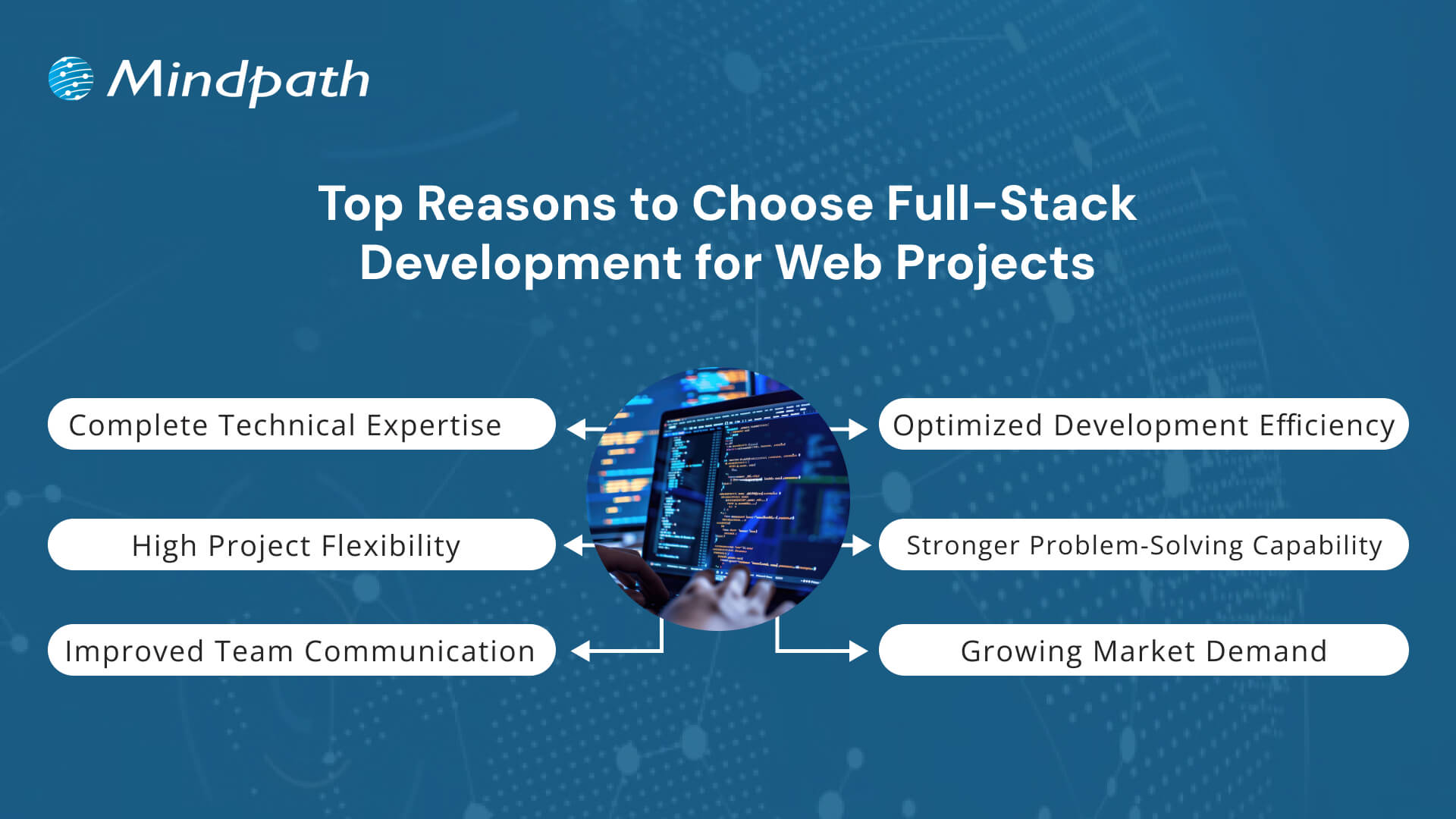
Top Reasons to choose full-stack development for web projects

1. Complete Technical Expertise

Full-stack development for web projects requires knowledge of both front-end and back-end technologies. Developers in this field work with HTML, CSS, and JavaScript for user interfaces and use tools like Node.js or Python for server-side logic. They also manage databases such as MySQL or MongoDB to store and retrieve data efficiently. This complete skill set makes full-stack development for businesses highly practical and reliable.

2. Optimized Development Efficiency

One of the key advantages of full-stack development for web projects is the ability to complete tasks faster without needing multiple specialized developers. It reduces development time, lowers project costs, and helps deliver results more quickly. Teams can avoid delays caused by handovers between front-end and back-end teams. That’s why many companies now prefer full-stack development to keep their projects on track and within budget.

3. High Project Flexibility

Developers skilled in full-stack development can switch between tasks easily based on what the project needs. They are comfortable using different tools and frameworks and can adjust to changes without slowing down progress. This flexibility is valuable when requirements evolve or when rapid updates are needed. It also supports the use of the best tech stack for web projects tailored to each client’s goals.

Also Read: Full-stack Development Benefits

4. Stronger Problem-Solving Capability

A full-stack developer understands how both the client-facing side and the server work together. This broad view helps in identifying issues quickly and finding effective solutions without back-and-forth between teams. It leads to fewer errors and a more stable final product. As a result, full-stack development for web projects brings stronger control and problem-solving to the entire build process.

5. Improved Team Communication

Fewer handoffs mean fewer communication gaps between developers and project managers. In full-stack development for web projects, one person or a small team handles most of the workflow, which keeps messaging clear and consistent. This improves team collaboration and speeds up approvals and fixes. It also supports better planning throughout the stages of full-stack web development.

6. Growing Market Demand

With digital needs growing, full-stack development has become one of the most valuable skills in the tech world. Companies are hiring developers who can handle everything from front-end to database, increasing demand across industries. It also offers room to grow in multiple areas, including project leadership and architecture, through understanding full-stack development trends. This rise is a direct result of businesses investing more in full-stack development for modern digital solutions.

Key Skills Required in a Full-Stack Web Project Team

A successful full-stack web project relies on more than just writing code. It needs the right mix of skills across the team, covering everything from design to database management for smooth and efficient web solutions. Let’s have a quick look at the skills:

1. Front-End Development

Developers need strong skills in HTML, CSS, and JavaScript to build the structure and style of web pages. Frameworks like React, Angular, or Vue.js help create dynamic and responsive user interfaces.

2. Back-End Development

Understanding server-side languages such as Node.js, Python, or Java is essential for creating logic and functionality. Frameworks like Express.js or Django support faster and more organized development.

Planning to build smarter web solutions? Discover how full-stack development with Node.js can streamline your digital growth.

3. Database Management

Developers should know how to use both SQL and NoSQL databases like MySQL, PostgreSQL, or MongoDB. Good database skills help manage, store, and retrieve data efficiently.

4. API Development

Designing RESTful APIs is important for connecting front-end and back-end systems. APIs must be secure, scalable, and easy to maintain in web projects.

5. DevOps and Deployment

Version control with Git and CI/CD tools helps automate code testing and deployment. Cloud platforms like AWS or Azure make it easier to launch and scale applications smoothly.

6. Soft Skills for Team Performance

Effective communication, adaptability, and time management help teams meet deadlines and solve problems together. These qualities support a smooth workflow in full-stack development for web projects.

Confused between full stack and traditional web development? Discover how smart businesses choose from full-stack vs traditional web development for the success of project. 

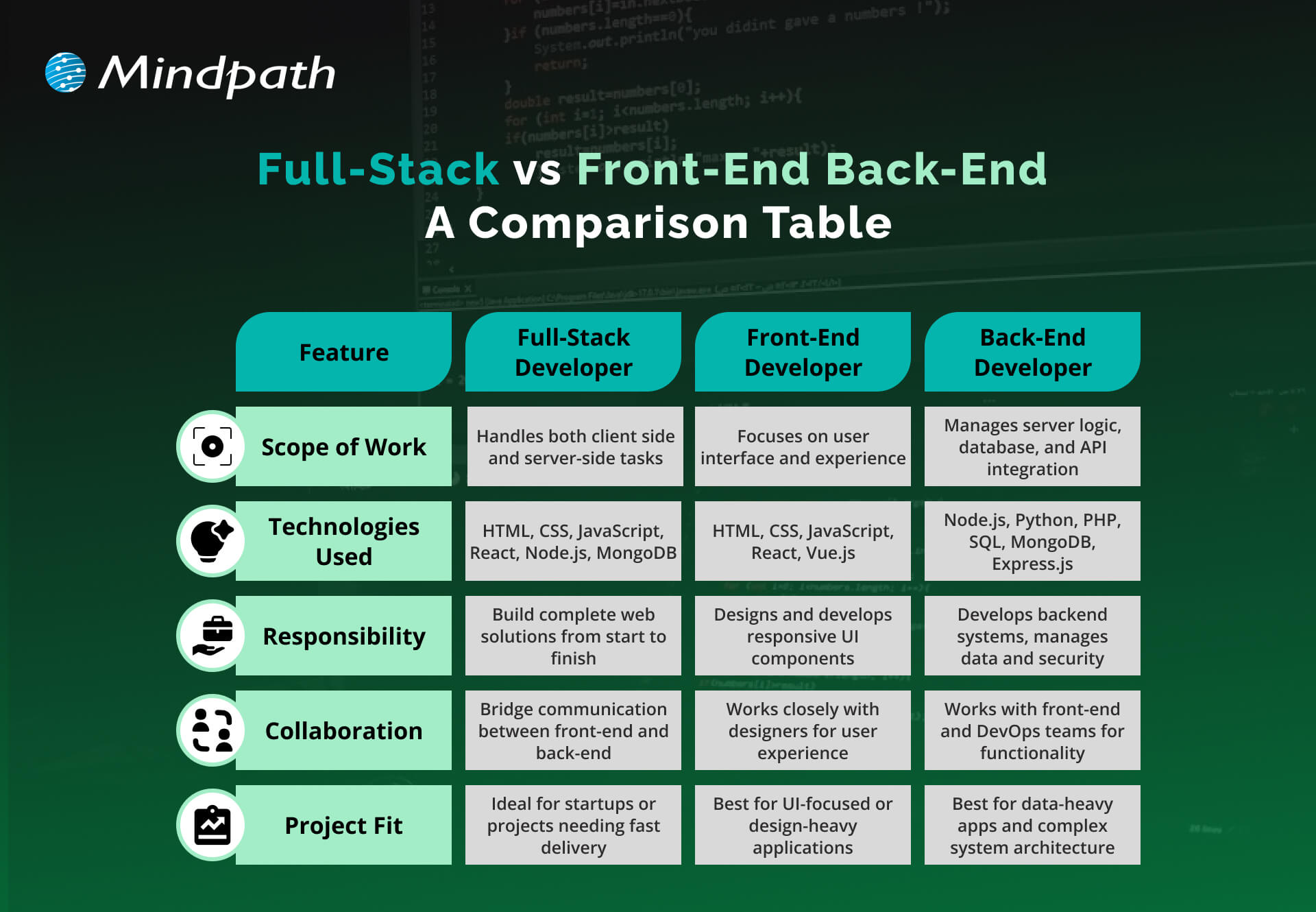
Full-Stack vs Front-End and Back-End: A Comparison Table

Understanding the difference between full-stack vs front-end and back-end roles helps in choosing the right approach for a web project. Below is a comparison table that highlights their core responsibilities and capabilities.

Full-Stack vs Front-End and Back-End A Comparison Table

Ready to Elevate Your Next Web Project with Full-Stack Development?

Full-stack development for web projects offers a balanced, future-ready approach that blends front-end creativity with back-end power. It simplifies workflows, speeds up launches, and ensures better user experiences. As digital needs continue to evolve, adopting full-stack practices gives businesses the edge to build smarter and scale faster with fewer roadblocks.

At Mindpath, we offer full-stack development services tailored to support your business growth. Our expert full-stack developers handle everything from user interface to server-side logic, ensuring smooth performance and cohesive functionality. With deep technical knowledge and a collaborative mindset, we deliver reliable, scalable, and efficient digital solutions that meet your unique project needs.