

The AI App Development Playbook: From Idea to Execution 

Join our Newsletter!

Featured Posts

Support Is One Click Away

Home

The AI App Development Playbook: From Idea to Execution 

ai app development playbook

The AI App Development Playbook: From Idea to Execution 

Have you ever wondered how AI app development can take a basic idea and create something that is smart, user-friendly, and helpful? Imagine an app that learns, impacts your activities, and improves your life without cognitive load! By developing an appropriate strategy, businesses can build apps that make a difference. A well-thought-out strategy will position you to create something that adds real value to users every day.

That’s why an AI app development playbook is necessary. A good playbook maps out the process into actionable steps, so it doesn’t feel overwhelming. A playbook will guide you through the process of validating your idea, selecting the right tools, developing your app, testing it, and launching it. The playbook provides a roadmap to work from, which can save time, reduce risk, and set you apart from the competition. In this blog, you will learn more about how this playbook can help you succeed. So let’s dive in!

Looking for a way to adopt an AI-powered application? Our AI development services help businesses and teams to build intelligent apps that are secure, scalable, and relevant to the needs of the user.

What does AI App Development Mean?

AI app development refers to the development of applications that use artificial intelligence to achieve tasks that typically require human-like thinking. AI functionality in applications includes understanding human language, recognizing images, making recommendations, or learning users’ preferences over time. Developers can have these applications learn and improve infinitely by using sophisticated algorithms, machine learning models, and large data samples, which allow applications to provide the most relevant and valuable experiences for the user, improving continuously.

In contrast to traditional app development, which has fixed rules and stagnant workflows, AI app development allows apps to update, evolve, and respond in real time. AI development uses data processing, pattern recognition, and predictions to be presented in a flexible state and to solve more complex problems. With the right strategy, app development with AI can equip businesses with solutions that differentiate them from competitors and adapt to new user demands.

Must Read: Role of Gen AI in app development

What is an AI App Development Playbook?

An AI app development playbook is a structured guide that helps teams and businesses create applications powered by artificial intelligence. It brings together proven methods, industry best practices, and practical tips to manage the unique challenges of building AI solutions.

Instead of approaching development without direction, a playbook provides clarity and keeps everyone aligned with the same vision and goals. It helps you make better decisions, avoid common mistakes, and use resources more effectively. Having an AI app development playbook means you have a clear plan to turn an innovative idea into an intelligent, successful application.

Looking to leverage artificial intelligence to make your mobile apps smarter and more user-friendly? Discover how AI in mobile apps can enhance functionality, personalization, and overall user experience.

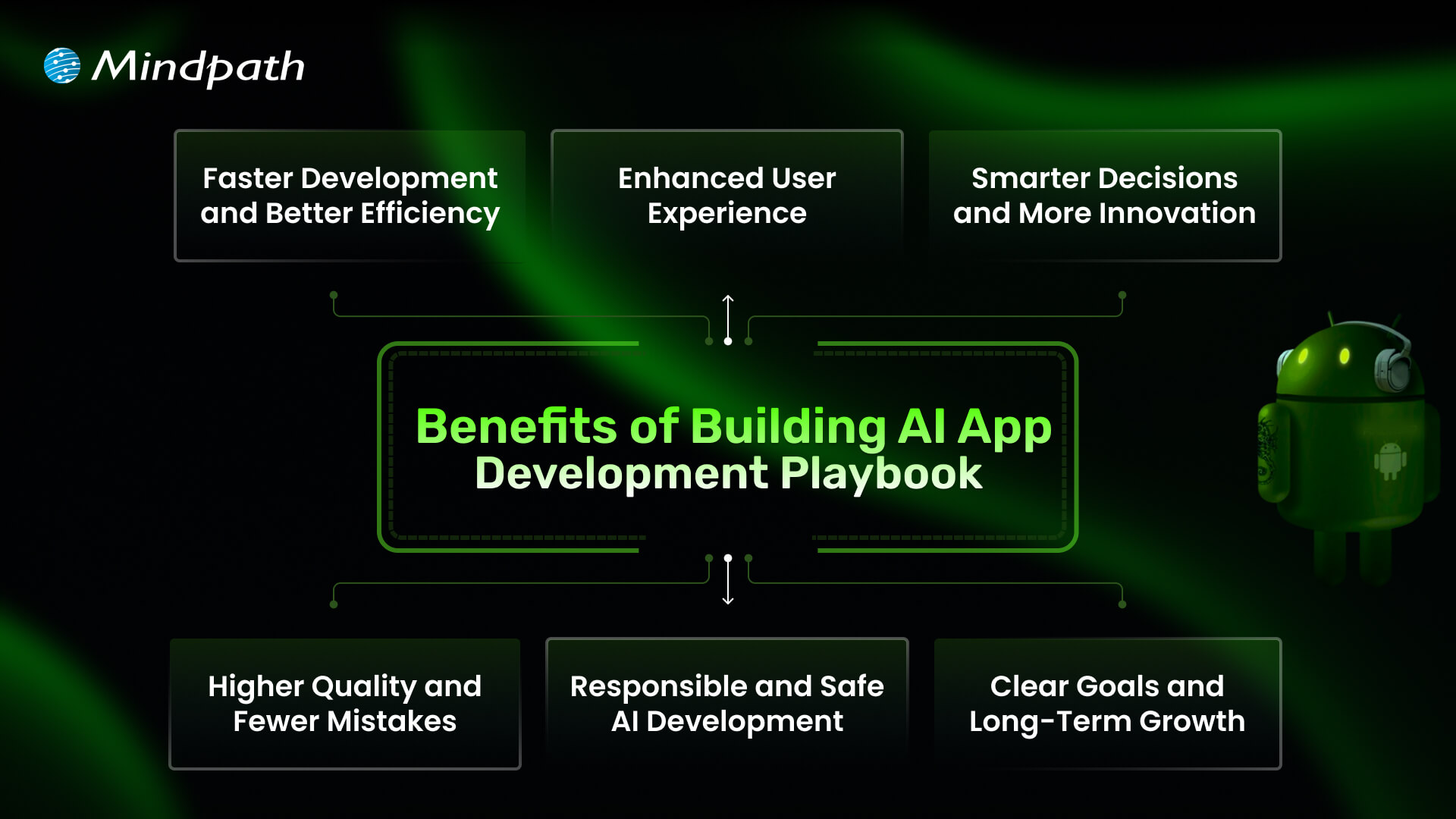
Benefits of Building AI App Development Playbook

A well-crafted playbook does more than just outline steps; it brings clarity to every decision you make during AI app development. It helps you build with confidence and turn innovative ideas into real, valuable solutions. Let’s dive into some of its benefits:
Benefits of Building AI App Development Playbook

1. Faster Development and Better Efficiency

A well-structured playbook helps teams work smarter and avoid wastage of time. By following proven steps and using the right AI development tools, you can speed up tasks like coding and testing. This leads to faster delivery and more efficient use of resources.

2. Enhanced User Experience

A clear plan helps you build apps that feel more personal and easier to use. Smart features like chatbots and recommendations keep users engaged and satisfied. With the right approach, your app becomes something people enjoy using every day.

3. Smarter Decisions and More Innovation

A playbook supports better choices by using data and clear workflows. Teams can experiment and improve quickly, turning ideas into working features faster. This creates an environment where new ideas thrive.

Also Read: AI in Business Strategy

4. Higher Quality and Fewer Mistakes

When you follow a playbook, your team knows when and how to test and debug. This helps catch issues early and maintain a higher standard. In the end, users get a stable app that works as expected.

5. Responsible and Safe AI Development

A strong guide ensures your team builds solutions that are fair, secure, and trustworthy. It helps address risks like bias or privacy concerns early on. This makes your AI software development more reliable and compliant with industry rules.

6. Clear Goals and Long-Term Growth

A playbook aligns your team with clear objectives that support your business goals. It helps you plan where AI fits best, including when to add features like AI chatbot development services that bring real value. This approach keeps you competitive and ready for steady growth.

Want to enhance user engagement and automate interactions in your AI applications? Discover how lead generation chatbot strategies can streamline customer interactions and boost conversions.

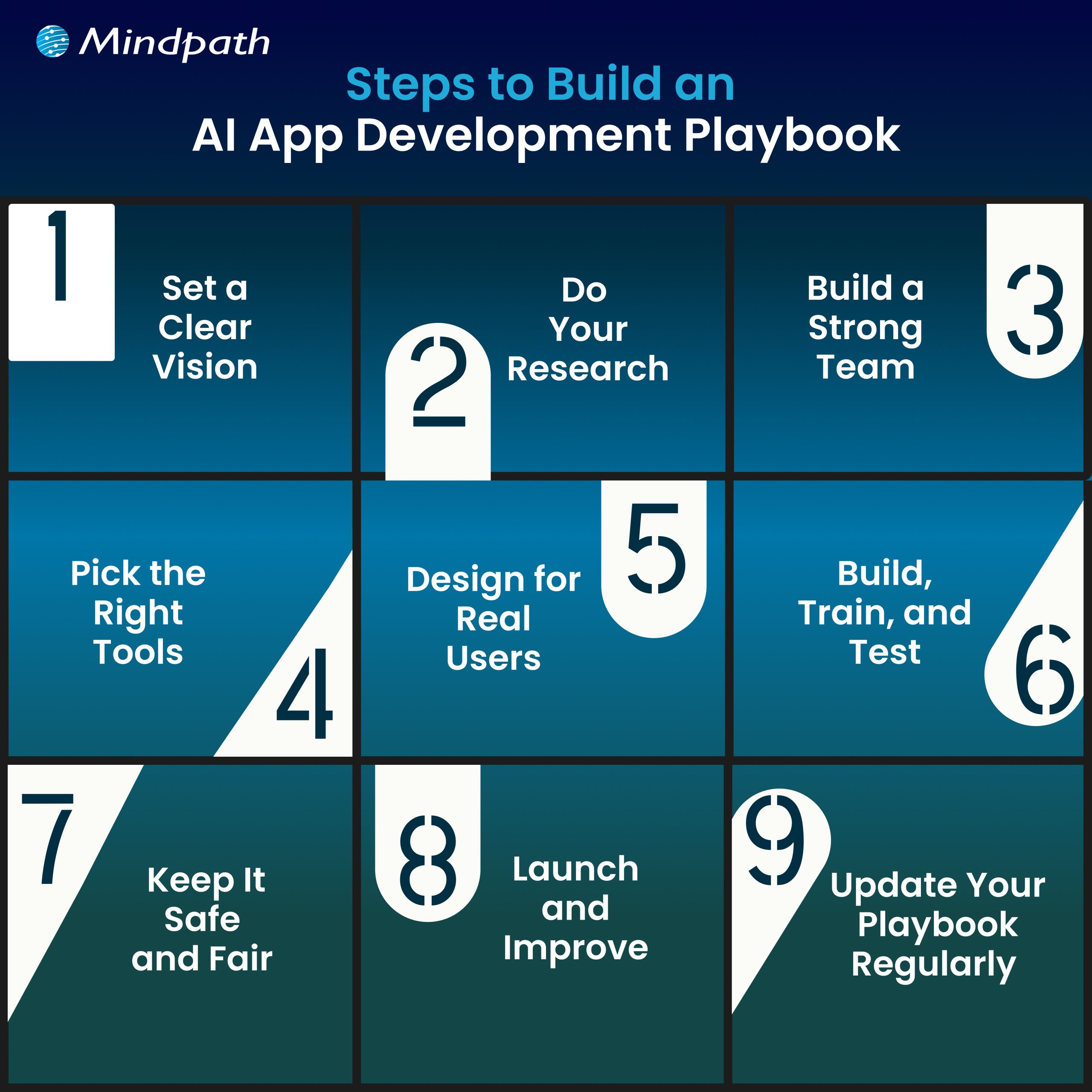
Steps to Build an AI App Development Playbook

Creating an AI app development Playbook gives your team a clear roadmap to build smarter, more reliable applications. It helps you plan each stage carefully, avoid common mistakes, and deliver real value to users. Use these practical steps to shape a playbook that keeps your AI projects focused and successful.
Steps to Build an AI App Development Playbook

1. Set a Clear Vision

Begin by defining exactly what your AI app should achieve and why it matters. Know the specific problem you’re solving and the audience it will help. Make sure your vision is realistic and tied to your broader business goals. A clear vision gives your team direction and purpose. It sets the tone for every decision you make during development.

2. Do Your Research

Spend time understanding your market, target users, and any competitors. Identify the data you’ll need and check if you can access it responsibly. Look into what AI features will add the most real value. Planning for data privacy and quality early helps you avoid problems later. Good research lays the groundwork for a stronger build.

3. Build a Strong Team

Bring together people with the right mix of skills in AI, design, development, and testing. Make sure everyone understands their role and how they’ll work together. Clear communication and teamwork keep the project on track. A well-prepared team can solve challenges faster. This creates a smoother workflow and better results.

4. Pick the Right Tools

Choose AI development tools, frameworks, and cloud platforms that fit your app’s goals and budget. Look for trusted solutions that make it easier to train, test, and update your AI models. Make sure your tech stack supports scaling as your app grows. Keep your tools flexible so you can adapt to new trends and needs. The right setup saves you time and keeps development efficient.

Want to stay ahead in the rapidly evolving world of artificial intelligence? Discover the latest AI trends that are shaping applications, development, and business strategies for the future.

5. Design for Real Users

Think about how people will actually use your app in daily life. Keep the design simple, clear, and focused on solving user problems. Test early designs with real users to spot areas that need improvement. A smooth experience builds trust in your AI features. The best AI apps feel helpful and natural, not confusing or intrusive.

6. Build, Train, and Test

Start with a minimum viable product that gets the basics right. Train your AI models using clean, reliable data to get accurate results. Test often to catch problems early, rather than fixing big issues later. Use real user feedback to improve your app’s performance. A strong cycle of training and testing keeps your app working well over time

7. Keep It Safe and Fair

Map out how you will securely and responsibly handle user data. You should address any possible biases in your AI models to ensure your app is fair to all users. Stay on top of current data protection practices and regulations. Establish guidelines for your team to follow for every engagement. Following these steps will help you establish trust and remain ethical with your AI solutions.

8. Launch and Improve

Prepare to launch by testing your app in a real-world environment. Observe the ways your app works and the way users will interact with it. Explore what aspects work well and what aspects need improvement. Record these notations for use very soon after launch. Consistent updates allow you to keep your AI app up to date and trustworthy.

9. Update Your Playbook Regularly

Treat your playbook as a living document that grows with every project. After each launch, review what went well and what you could do better. Add lessons learned, updated tools, and new best practices. This keeps your team ready for future AI projects. A well-maintained playbook is an investment in long-term success.

Looking to ensure that your AI applications are secure and reliable for users? Discover essential strategies for protecting your apps by exploring web application security guide.

Want to Turn Your Smart Ideas into a Powerful AI App?

Creating an AI app development playbook helps you move an idea forward with structure, focus, and confidence. It guides your team through clear steps that save time, reduce mistakes, and make the most of available resources. With a practical playbook, you can deliver apps that adapt, solve real problems, and keep users engaged. It’s the smartest way to stand out.

Mindpath is a renowned AI development company that helps businesses build solutions that work in the real world. Our AI development services cover everything you need to plan, develop, test, and grow your app responsibly. We bring trusted strategies and proven tools to your project. Let’s work together to turn your AI app vision into a successful story.

Related Post

Discover the key factors influencing software development costs and how to optimize your budget. Learn how Mindpath can help.
Discover the transformative power of conversational AI chatbots. From cost savings to increased sales, learn how chatbots can drive growth.

Related Post

AI consulting services

In today’s competitive environment, organizations are consistently searching for more intelligent ways to grow, innovate, and differentiate themselves. AI consulting services support organizations to seize the opportunities that become realizable by developing distinct ways to harness data and technology as opportunities. As the velocity of digital innovation changes radically for organizations, it is clear that we can no longer take the same approaches. Why not explore the tools and experience that enable organizations to remain fluid and agile?

While organizations continue to embrace new technologies, the challenge comes in figuring out how to apply them effectively. The value of having expert advice is where the innovation matches business objectives, ultimately with measurable outcomes. Instead of being confused when adopting new technology, organizations are provided with clarity and direction as a result of skilled consultants. The right balance between strategy and technology allows organizations to leverage their growth journey with smarter decisions and sustainable results. This blog will explore why today’s organizations should consider AI consulting services as their path forward.

Want to lead the future with the use of AI in your organization, but don’t know where to begin? Our AI consulting services will guide you at every step to stay ahead and unlock measurable growth.

The Growing Demand for AI Consulting Services

Future Market Insights projects that the global AI consulting services market will grow from USD 11.07 billion in 2025 to USD 90.99 billion in 2035, representing a CAGR of 26.2% during this period. This increase represents a substantial business demand for specialist expertise as businesses look to consulting firms to navigate the additional complexities around AI adoption.

Among various industries, such as finance, healthcare, retail, and manufacturing, are generating demand from their businesses through their significant investments in AI-driven transformation. Many industries have developed into vastly different businesses fueled by big data, cloud computing, and advanced analytics, and companies are seeking AI consulting firms to provide clout to their AI strategy, system integration, governance, and security. As the use of digital technology expands through adoption, consulting firms help ensure the efficiency, ethics, and scale of innovation.

Also Read: AI in Healthcare.

Why Modern Businesses Need AI Consulting Services?

A powerful AI strategy for business growth will help organizations remain competitive in a digital world. Here are the key points to illustrate the significance of AI consulting services for contemporary businesses.

1. Expertise That Drives Value

AI consulting services give businesses the opportunity to have professionals who understand machine learning, natural language processing, and data analytics review the work. Their job is to take complex technology and make it into solutions that provide measurable outcomes. This prevents companies from spending time on unscheduled or misguided AI initiatives.

2. Building the Right Strategy

Building an AI business strategy necessitates linking technology to the company’s goals. AI consultants collaborate with the leadership teams of the companies to develop a strategy that places short-term wins and the ultimate goal into context. Understanding that context to forge the innovation pathway creates more informed decisions than through deliberations without a guide, which highlights the value of AI consulting services.

3. Assessing AI Readiness

An effective AI readiness assessment enables organizations to determine where they have gaps in data, infrastructure, and skills. Before deploying a project, AI experts from consulting firms will assess these aspects to mitigate risks and adopt AI with far fewer hurdles. This preparation will allow organizations to take advantage of the potential upside expected from their AI investment, with support from AI consulting services.

4. Guiding Through Adoption

Companies using AI adoption consulting move faster from experimentation to actual production performance. The consultant will work to apply these frameworks and best practices in a manner that creates successful adoption of AI within the company’s workflow, while avoiding disruption to current operations. The consultants direct what companies should be doing to innovate at a reasonable execution speed that allows safe scaling of that innovation.

5. Risk and Compliance Management

AI raises ethical, fairness, and compliance issues. AI consulting services provide a risk management set of capabilities that will enable organizations first to satisfy impending laws, second to safeguard their reputation, and third to make sure that every AI solution that is implemented is fair, transparent, and trusted.

Curious about what the actual benefit of AI consulting provides to your business in managing complex operations? Discover our blog on the benefits of AI consulting to understand how AI expertise and guidance can help business growth.

6. Cost-Effective Solutions

To pursue an AI consultant for businesses is likely cheaper than assembling a large internal AI team. The consultant already has the knowledge and reuses it. This minimizes time spent building knowledge and making mistakes. As such, companies are spending their time and money growing rather than waiting for long training cycles, which is why many turn to AI consulting services.

7. Driving Innovation Across Industries

Artificial Intelligence consulting companies are experts in new technology. They bring businesses new opportunities that leverage predictive analytics, computer vision, and automation that the in-house team may not even be aware of. This engages the workforce to think innovatively and keeps the enterprise ahead of the competition.

8. Tailored Support for Smaller Enterprises

AI consulting for small businesses ensures that even the smallest of businesses have access to cutting-edge expertise. The consultants are used to delivering tailored and scalable solutions that meet the budget but still provide excellent value. It allows start-ups and SMEs to compete using AI.

9. Creating a Practical Guide

An AI Consulting guide developed by consultants helps organizations understand the steps from planning to deployment. This guide covers tools, talent, risks, and governance practices tailored to the company. It acts as a reference point for making confident AI decisions.

10. Partnering With AI Consulting Firms for Growth

The biggest reason for hiring AI consulting firms is that they can integrate strategy, technology, and execution. The consultants help customers accelerate projects, reduce risks, and build systems that yield predictable business outcomes. Therefore, consultants become trusted partners under long-term digital transformation.

Many businesses have successfully driven digital transformation with the help of AI consultants. Learn more about this in our blog on the role of AI consultant.

Ready to Unlock Your Business Potential with AI?

AI consulting services enable organizations to use technology to improve processes, facilitate innovation, and demonstrate value. With the help of professional advice, organizations can navigate their AI adoption, mitigate risks, and scale their efforts and solutions. This can help align the use of AI to specific business goals and generate demonstration efficiencies, growth, and long-term value amid a rapidly changing digital and competitive landscape.

At Mindpath, we offer customized consulting services for AI that help organizations develop actionable plans, realize more advanced solutions, and optimize outcomes. Mindpath experts assist organizations with AI readiness, AI adoption, and AI innovation. They ensure that the technology aligns with unique business objectives. Mindpath focuses on measurable impact to enable enterprises to speed up growth, lower risks, and achieve ongoing success.

custom software development process

Whenever you are creating a tailored solution for your business, it is very important to clearly understand how the development process will be structured. The custom software development process clearly guides you in turning your ideas into a usable working solution. Every step matters – from understanding the requirements, conceptualizing the software, determining the specifications, and creating software that supports your goals. You will get to know what is to come, how teams will work together, and what to expect at every step as your project moves forward in purpose and clarity.

A thorough comprehension of how this process works gives you a better sense of clarity and confidence as you engage with the project. You will be able to understand each phase clearly and watch your vision come together step by step. Upon having this understanding, it is very easy and clear to collaborate with your development team. In this blog, you’ll go through the whole process and will understand how the custom software will come to life, step by step.

At Mindpath, we offer custom software development services to turn your vision into reality by guiding you through every step. Contact us today for a solution that turns your ideas into real-world project.

Importance of Custom Software Development for Businesses

Custom software development is valuable because it provides businesses with tools made solely for them. Unlike off-the-shelf software, custom software solutions fit unique business requirements and methods. This leads to improved performance, increased efficiencies, and better results. It also minimizes unnecessary rework, saving time and money, and allowing companies to be more efficient overall.

Custom software is scalable with your business. You will be able to add features or alter functionality based on your requirements. This adjustable system uniquely supports a company’s long-term goals and puts you ahead of your competitors. Custom software solutions offer a better experience for both the user and employees, which supports increased productivity and satisfaction.

Also Read: Custom Software Development Benefits

Understanding the Custom Software Development Process

It is essential to know about the process to be followed prior to starting a software project. By getting familiar with the software development process steps, you can be an active participant and an advantageous decision-maker throughout the project. By understanding the process, you will also ensure value delivery by building software with clear goals, planning, and execution.

Custom Software Development Process

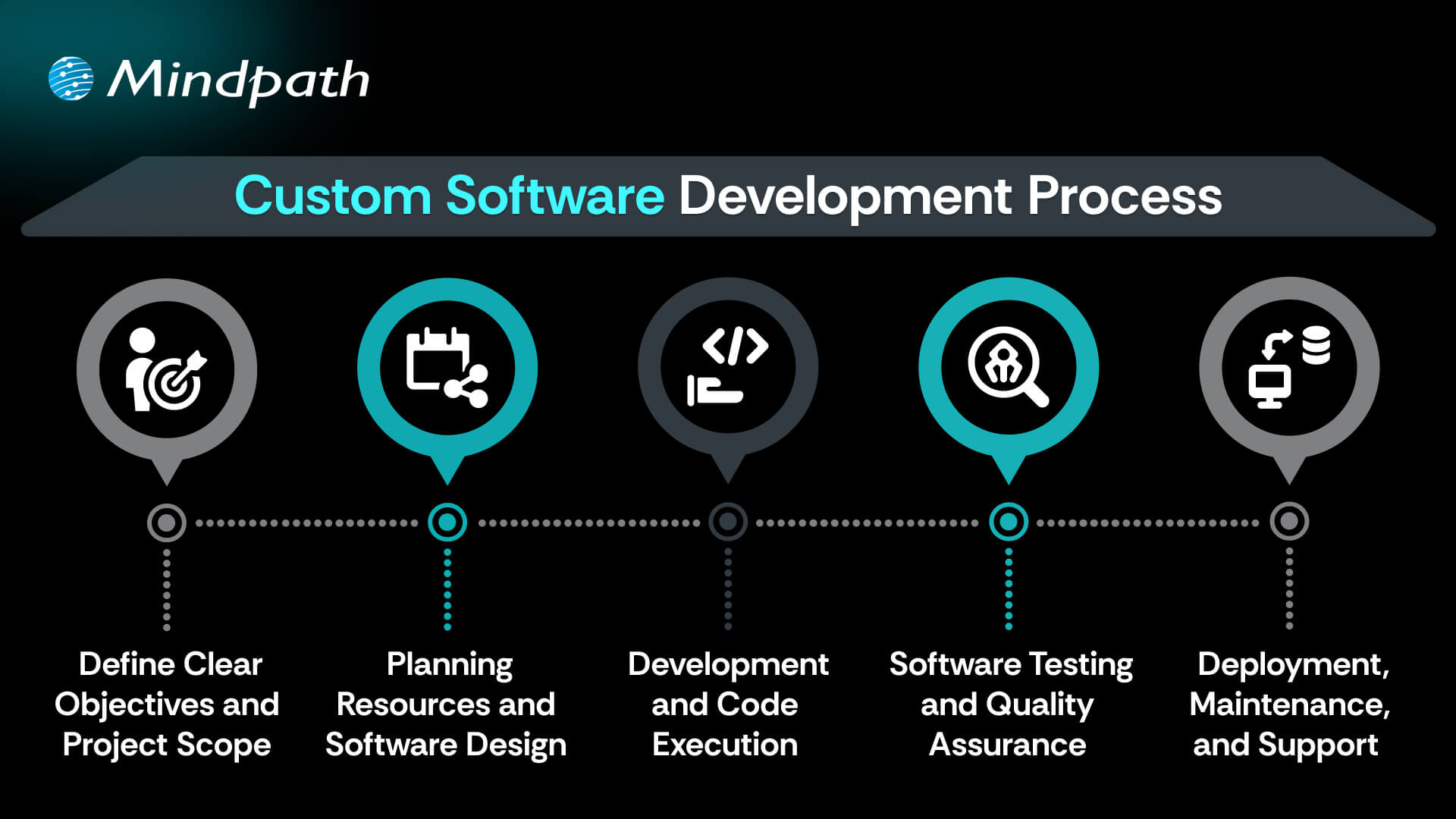
1. Define Clear Objectives and Project Scope

The custom software development process begins by defining your goals and understanding what the software must achieve. This includes identifying the target users, the problem it solves, and how it should perform differently from existing tools. A detailed list of features and expected outcomes is prepared. Both functional and non-functional requirements are clearly documented. This step sets the direction and purpose for everything that follows.

2. Planning Resources and Software Design

Planning involves creating a detailed timeline, setting milestones, and organizing resources for development. Budgets, risks, and deliverables are clearly outlined to avoid delays or extra costs. During software development design, wireframes and prototypes are created to visualize the interface and user flow. The architecture is also planned, including system components and how they will interact. Technologies such as programming languages, frameworks, and databases are chosen here.

3. Development and Code Execution

At this point in the custom software development process, the programmers will begin the actual coding based on the approved designs. The developers will prepare technical infrastructure with tools, servers, and version control. The front-end, back-end, and database modules are built and integrated together. Each piece of software functionality is developed based on the description created in the design documents. The functionality is translated into active, live software with working features to start testing.

Curious how software functions seamlessly from the user interface to the server? Explore the role of frontend and backend to understand how both sides work together to deliver smooth, secure, and engaging digital experiences.

4. Software Testing and Quality Assurance

After the software is developed, it will go through a series of testing strategies to check for quality and reliability. The first step, or unit testing, will cover each feature and try to eliminate some early problems. Then the following step, called integration testing, will check the work of modules and ensure they work as a system. Once that’s complete, the next phase is system testing, which ensures all performance, security, usability, and reliability aspects are achieved and validated prior to the release of the product.

5. Deployment, Maintenance, and Support

In the final step of the custom software development process, the solution moves to a live environment for end users. The deployment may include installing the software on servers, setting up databases, and giving users access. After launch, the software is continuously monitored for issues. Maintenance includes fixing bugs, adding new features, and updating it for better performance. Ongoing support keeps the software running smoothly over time.

Concerned about risks that could slow down your custom software build? Explore the major custom software development mistakes that can disrupt progress and find out how to avoid them.

Real-World Examples of Customized Software

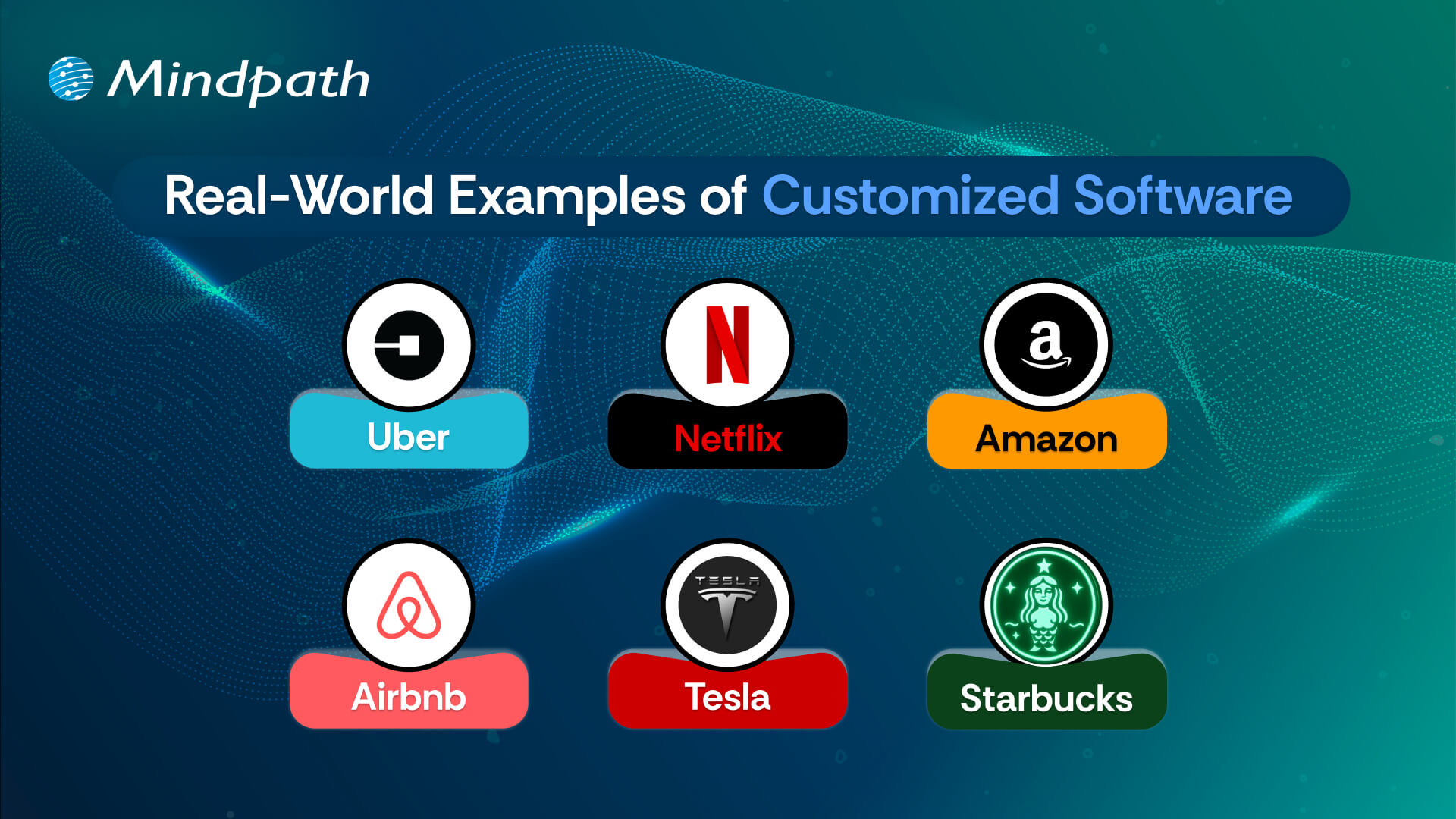
Below are six real-world customized software examples that demonstrate how businesses are navigating unique challenges by investing in custom software to create a digital solution. These tools have been developed to improve usability, performance, and long-term sustainability.

Real-World Examples of Customized Software

1. Uber

Uber constructed a custom ride-booking system complete with GPS tracking, so you know where your ride is located, secure payment options, and updates on the driver’s progression. The app shifted transportation in cities globally.

2. Netflix

Netflix utilizes AI-based recommendation engines and adaptive streaming systems to provide an overall personalized viewing experience through a fully custom platform.

3. Amazon

Amazon uses custom software to manage inventory, predict customer preferences, and allow one-click ordering for a fast and reliable purchasing experience.

4. Airbnb

Airbnb built a custom platform for travelers to pay securely, check real-time availability, and search by location for hosted accommodations around the globe.

5. Tesla

Tesla uses customized software for its smart vehicles to drive the autopilot capabilities, over-the-air updates, and real-time diagnostics to enable sophisticated performance.

6. Starbucks

Starbucks utilizes a custom application to allow customers to mobile order, encrypt reward tracking, and offer options for contactless payments, making the product experience more convenient and helping to cultivate loyalty.

Curious how different kinds of software are built to serve unique business and user needs? Discover the various types of software development to understand how each one contributes to creating powerful digital solutions.

Ready to Create Software That Aligns with Your Business?

Custom software development is the process of creating digital solutions that fulfill your specific business goals. From clarifying your vision to deploying the software and providing ongoing support, every step of the official custom software development process undergoes proper plan and execution. The final outcome of custom software typically entails better efficiency, enhanced experiences for users, and long-term growth through technology that suits your needs.

As a premier custom software development company, we at Mindpath specialize in providing full-spectrum custom software development services that suit your specific business. Our team expertly develops scalable, secure, and simple solutions that integrate well into your workflows and future goals. Partner with us to turn your ideas into powerful, high-performance software built for results.

AR and VR in Education

Imagine a classroom where history lessons transport you to ancient Rome, science experiments happen in a virtual lab, and geography lessons let you explore the Amazon rainforest from your desk. Sounds exciting, right? This is the power of Augmented Reality (AR) and Virtual Reality (VR) in education. T But how exactly do AR and VR reshape education? What benefits do they bring to students and teachers alike? Let’s explore how these innovative tools are transforming the way we learn and teach. 

What is Augmented Reality (AR)?

Augmented Reality (AR) is a technology that integrates digital content, such as images, sounds, or animations, into the physical environment. Instead of replacing the actual world, like Virtual Reality (VR) does, AR improves what you see and feel by mixing virtual features into your surroundings. AR works with smartphones, tablets, AR glasses, and headsets. For example, you might use your phone’s camera to display a map on the ground in front of you or a 3D model on a table. This makes the actual world more engaging and thrilling. Augmented Reality can be used for a variety of purposes, including learning and decision-making as well as producing enjoyable and engaging entertainment. It enables users to experience situations in new ways, supplementing what they perceive with useful or intriguing information. AR, which combines the actual and digital worlds, provides a new and immersive method to engage with our surroundings.  

What is Virtual Reality (VR)?

Virtual Reality (VR) is a technology that generates a fully digital environment in which users can explore and interact as if they were real. Instead of viewing your real surroundings, you are immersed in a 3D virtual environment that feels like you’ve entered another universe. To enjoy VR, you often require specialized equipment such as VR goggles, headsets, or even suits. These technologies help you shut out your actual surroundings while increasing the immersion in the virtual one. For example, you might find yourself walking on a virtual beach, floating through space, or playing games in an extraordinary place. The purpose of VR is to make you feel as if you are actually “inside” the virtual environment, regardless of how realistic or fictional it is. It is used for entertainment, training, education, and many more purposes, providing limitless opportunities to explore and experience things in completely new ways.

Benefits of AR and VR in Education

1. Cost Effective

One of the primary advantages of AR and VR in education is their cost-effectiveness. Traditional training approaches can include large investments in classroom layouts, resources, and instructors, which can be costly. In contrast, AR and VR lower these expenses by providing a more efficient method of training delivery. These technologies minimize the requirement for physical resources and decrease the need for expert trainers. AR and VR dramatically reduce training time by allowing learners to practice and repeat tasks at their own speed without continual observation. This allows for faster skill development, lower training expenses, and the opportunity to train more people in less time. Furthermore, AR and VR training programs are scalable, which means they can be utilized to teach a big number of people in several places without requiring expensive travel or equipment. This allows organizations to swiftly onboard new staff and upskill existing ones. AR and VR minimize both direct and indirect expenses by providing an interactive and efficient learning environment, making them an important answer for current education and training programs. 

2. Enhanced Immersive Learning

AR and VR training provide levels of immersion and engagement that traditional techniques cannot match. These technologies enable students to engage in realistic simulations, which increases memory and comprehension of the information. AR and VR, by immersing students in lifelike situations, help to strengthen links between the learner and the subject, resulting in improved knowledge retention and engagement. This immersive experience allows trainees to practice real-world events in a secure and controlled setting, increasing their confidence and readiness for genuine circumstances. As a result, AR and VR training frequently leads to increased expertise and better performance. The capacity to mimic difficult activities or high-pressure scenarios makes these technologies especially useful in businesses that need specialized skills or rapid decision-making. 

3. Building Essential Skills

In several industries, individuals operate in hazardous conditions where safety is essential. Traditional training for such high-risk employment is frequently time-consuming, costly, and can include hands-on experience in dangerous environments. AR and VR, on the other hand, allow workers to learn the essential skills in a safe, regulated, and realistic virtual environment. Virtual reality simulations, for example, allow trainees to practice operating equipment and managing operations in places such as refineries or chemical plants. These simulations replicate real-world situations, including realistic sounds and images, giving trainees the impression that they are on-site but without the hazards. This immersive training strategy guarantees that personnel obtain the expertise and competences required to properly operate complicated machinery and high-pressure circumstances. Additionally, VR training does not disrupt existing operations and allows staff to be job-ready upon completion, reducing the time and cost of traditional training methods. 

4. Mastering High-Risk Tasks Safely

Certain professions, particularly in healthcare, aviation, and manufacturing, need precise execution of high-risk operations. In healthcare, for example, medical treatments must be executed with extreme precision to achieve beneficial results. AR and VR are revolutionizing this process by allowing experts to practice and improve their abilities in a safe, virtual environment. For example, doctors can utilize virtual reality training to mimic complicated surgery, such as spine operations, on virtual patients. This allows them to practice each phase of the treatment and acquire confidence before attempting it on a real patient. Furthermore, AR can overlay important data right in the surgeon’s field of view, offering real-time advice during surgeries. This form of training improves accuracy, minimizes the likelihood of mistakes, and ultimately results in improved patient outcomes. It also reduces the danger of malpractice disputes, which benefits both healthcare providers and institutions. 

5. Tailored Training Solutions

AR and VR training allows you to personalize learning experiences based on the unique needs of each individual. These technologies enable training programs to be customized, allowing students to advance at their own speed and in a way that best matches their learning style. For example, in industries such as automobile production, firms may utilize augmented reality to tailor assembly line instruction to each technician’s skill level. This method guarantees that each worker receives the proper teaching degree, leading to faster learning, fewer mistakes, and better performance. By providing personalized training, AR and VR assist learners in developing the skills they require more effectively, saving time and money while increasing overall productivity. This customized approach guarantees that training is not just effective but also aligned with the learner’s unique needs and abilities. 

AR and VR Services at Mindpath

Mindpath provides innovative Augmented Reality (AR) and Virtual Reality (VR) technologies that enhance learning and training experiences. Our AR and VR services assist companies and educational institutions in creating realistic, interactive environments for their teams and students to practice skills safely and successfully. Our AR services provide immersive experiences by superimposing digital information over the actual environment, allowing users to interact with virtual content in real time. Whether for training or product presentations, augmented reality makes learning more interesting and practical. With our VR services, we provide completely simulated settings in which customers can practice high-risk activities or complex processes with no real-world implications. This helps students to acquire confidence, enhance their abilities, and carry out tasks with accuracy. Mindpath’s AR and VR solutions are customizable to fit your specific training needs. Whether you’re in healthcare, manufacturing, or education, we provide tailored services that help individuals learn faster, retain information longer, and perform with accuracy.  

Wrapping Up!

Mindpath is at the forefront of revolutionizing learning and training experiences with new AR and VR technology. By providing customized, immersive solutions, we assist companies and educational institutions in improving skill development, retention, and training costs. Whether you work in healthcare, manufacturing, or education, our AR and VR services offer a secure and effective approach to master complicated jobs and high-risk processes. Our custom solutions are tailored to your individual requirements, ensuring that learners get the confidence and competence they need to succeed. Partner with Mindpath to unlock the future of training and learning by leveraging cutting-edge technologies that not only produce results but also pave the road for smarter, more effective training.  

Ready to transform your training and education with AR and VR?

Partner with Mindpath today to discover customized solutions that enhance learning and boost performance.

Discover how AR and VR are transforming education with immersive, cost-effective, and tailored training solutions that enhance learning.