Home

Prompt Engineering vs Context Engineering: What’s the Difference?

Prompt Engineering vs Context Engineering: What’s the Difference?

Join our Newsletter!

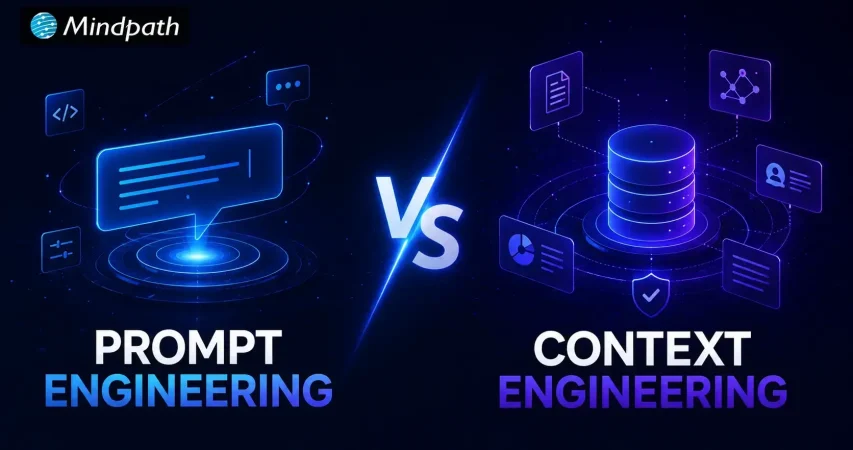
Prompt Engineering vs Context Engineering

What happens when an AI model has the right instructions but lacks the information needed to act on them? This is where Context Engineering becomes important. As AI systems take on complex tasks, developers need to think beyond prompts and focus on what information models receive.

Key Takeaways

  • 01
    Prompt engineering improves AI responses by providing clear, specific, and well-structured instructions.
  • 02
    Context engineering gives models relevant information needed to understand tasks and situations better.
  • 03
    Prompt and context engineering work together to improve accuracy across complex AI workflows.
  • 04
    MCP can connect AI applications with external tools, systems, and relevant business information.
  • 05
    The right approach depends on data needs, task complexity, security, scalability, and maintenance requirements.

Prompt engineering still plays an important role in shaping AI responses, but modern systems need deeper context to make informed decisions. This shift is especially important for AI agents working with business data, tools, and changing information. In this blog, we will explore how both approaches differ and work together. Let’s keep reading further!

Ready to build AI systems that can work with reliable business context? Mindpath offers RAG Development Services to help businesses connect AI applications with relevant data and deliver more context-aware responses.

Understanding Both Approaches

Both approaches help developers get better results from AI, but they solve different problems. One improves the instructions, while the other improves the information available to the model.

1. Prompt Engineering

Prompt engineering is about writing clear instructions that guide an AI model toward the desired response. It involves choosing the right wording, adding useful constraints, setting expectations, and giving examples when needed. A well-crafted prompt helps the model understand the task, follow the intended direction, and produce more consistent results.

Here are the benefits it offers:

  • Clear Instructions: Gives models a direct understanding of what needs completing.
  • Better Outputs: Reduces vague responses by setting specific expectations upfront.
  • Greater Control: Helps developers guide tone, format, reasoning, and response style.
  • Faster Iterations: Makes it easier to test, refine, and improve outputs.
  • Task Specific: Works well for focused tasks with clearly defined goals.
  • Easy Adoption: Requires minimal changes to existing AI development workflows.

Challenges To Watch For

  • Maintaining consistent outputs across different model versions.
  • Managing complex instructions without making prompts overly lengthy.
  • Preventing ambiguous wording from producing unexpected responses.
  • Testing prompts across varied inputs and edge cases.
  • Updating instructions when business requirements or workflows change.

2. Context Engineering

Context engineering focuses on selecting and organizing the information an AI model needs before responding. This can include documents, conversation history, business data, tools, user details, and retrieved information. The goal is to give the model relevant context at the right time, helping it respond with greater awareness.

Here are the benefits it offers:

  • Relevant Knowledge: Provides information directly connected to the current task.
  • Better Decisions: Gives AI systems stronger grounds for making informed decisions.
  • Fewer Hallucinations: Reduces unsupported responses by supplying reliable information.
  • Dynamic Responses: Allows models to work with changing information and situations.
  • Agent Support: Helps AI agents understand tasks, tools, users, and environments.
  • Scalable Workflows: Supports complex systems that depend on multiple information sources.

Challenges To Watch For

  • Selecting relevant information from multiple available data sources.
  • Keeping retrieved information accurate, current, and properly structured.
  • Managing token limits while preserving essential context.
  • Preventing sensitive information from entering unintended model interactions.
  • Maintaining retrieval systems as business data continuously evolves.
Prompt vs Context Engineering: A Key Difference

The difference becomes clearer when we look at how AI context shapes the model’s understanding. While prompts guide the response, context gives the model the information it needs to respond appropriately.

Comparison Point Prompt Engineering Context Engineering
Primary Focus Shapes instructions given to the AI model Shapes information available to the AI model
Main Purpose Guides the model toward a specific response Helps the model understand the situation
Information Used Instructions, examples, rules, and constraints Data, documents, memory, history, tools, and APIs
Scope Usually focused on a specific task Often supports entire workflows and systems
Data Dependency Can work with limited external information Often depends on relevant external information
Information Retrieval Information is usually provided within prompts Information can be retrieved dynamically when needed
Role in AI Agents Defines tasks, goals, and expected behavior Provides knowledge, state, tools, and situational awareness
Maintenance Requires refining instructions as needs change Requires managing sources, retrieval, memory, and context quality
Best For Content generation, classification, summarization, and focused tasks Customer support, knowledge systems, RAG pipelines, and AI agents

Where Each Approach Fit in AI Workflows?

Both approaches have a place in modern AI workflows, but their roles are different. The right approach depends on what the system needs to understand, produce, or act on.

1. Where Prompt Engineering Fits?

Prompt engineering works best when the task is clearly defined and the desired output can be guided through instructions.

  • Content Creation: Guides AI to follow a specific tone, structure, format, or writing style.
  • Task Automation: Gives models clear steps for completing repetitive and predictable tasks.
  • Data Analysis: Directs AI to identify patterns, summarize findings, or explain results.
  • Customer Queries: Helps define how AI should respond to common and straightforward questions.
  • Creative Work: Controls ideas, language, tone, and presentation across different creative tasks.

2. Where Context Engineering Fits?

Context engineering becomes valuable when AI needs information from different sources to understand the situation before responding.

  • Customer Support: Combines customer history, product information, and previous interactions for relevant responses.
  • Knowledge Retrieval: Supplies models with relevant documents instead of relying on general model knowledge.
  • AI Agents: Gives agents access to business data, tools, memory, and information needed for decisions.
  • Business Workflows: Connects AI with relevant systems, records, policies, and operational information.
  • Dynamic Tasks: Provides updated information when decisions depend on changing business conditions.

Key Implementation Considerations

Choosing between prompt and context engineering depends on how your AI system handles information, tasks, and changing requirements. A practical implementation should consider the following factors before deciding how much weight to give each approach.

1. Token Limits

Prompts need to stay focused because unnecessary instructions can consume valuable tokens. Context also needs careful filtering, since sending too much information can increase costs and distract the model from relevant details.

2. Data Freshness

Prompts may need regular updates when instructions, rules, or business requirements change. Context engineering can pull fresher information from connected sources, but those sources must remain accurate and up to date.

3. Retrieval Accuracy

Prompt engineering can specify exactly what information the model should consider during a task. Context engineering depends on retrieving the right information, making search quality and retrieval accuracy important for reliable results.

4. System Integration

Prompts can define how an AI system should interact with connected applications and tools. Context engineering can bring information from those systems into the workflow, with protocols such as MCP helping AI applications connect with external tools and data.

5. Security and Access

Prompts should avoid exposing sensitive information unnecessarily and should clearly define permitted actions. Context engineering requires stronger controls around which users, systems, and agents can access specific data.

6. Maintenance

Prompt based systems often require ongoing testing and refinement as model behavior or requirements change. Context based systems also require maintaining data sources, retrieval pipelines, memory, and connected tools.

7. Latency and Cost

Well-structured prompts can reduce unnecessary processing by keeping instructions concise and focused. Context engineering may increase processing requirements when systems retrieve, filter, and pass additional information to the model.

Ready to Build AI Systems That Understand More?

Prompt engineering and context engineering solve different parts of the AI development challenge. Prompts shape how models respond, while context gives them the information needed to understand each situation. As AI workflows become more complex, combining both approaches can improve accuracy, consistency, and decision making across modern applications and AI agents.

Mindpath helps businesses build AI solutions that combine intelligent prompts with reliable context, connected data, and practical workflows. Our AI development services support RAG, AI agents, MCP integrations, and custom AI systems designed for real business needs. Partner with us if you are looking to build an AI solution that can understand your data and act with confidence. Contact Mindpath to discuss your AI requirements.
Frequently Asked Questions

It can become complex with multiple data sources, but structured retrieval, clear access controls, and suitable tools can simplify implementation.
Better prompts work well when tasks are focused and predictable. Additional context becomes important when responses depend on changing or external information.
It can increase infrastructure and maintenance costs, especially with large data sources. However, better context can reduce errors and unnecessary model interactions.
MCP helps applications connect models with external tools and information sources, making it easier to access relevant data during different tasks.
Yes. Combining precise instructions with relevant information often creates more reliable responses and supports workflows that require greater understanding.

Support Is One Click Away

Featured Posts

Related Post

web design and development services

In an increasingly competitive digital landscape, businesses cannot settle for mediocre or average online presences. This is where the need for web design and development services matters. A well-designed, well-conceived website not only invites new visitors and clients; it also establishes the credibility required to enhance brand and organizational value and to create real engagement. Each click and scroll is a reflection of how users view your business, so design and functionality are equally significant to ensure continuity.

As online behavior evolves, organizations must remain in alignment with user expectations and technology trends. Choosing an experienced web design company will allow your organization to create websites that are aesthetically pleasing, quick, and easy to use. Every aspect of the website, from visual to responsiveness, influences customer experience and brand trust. In this blog, let’s discuss and reveal the top benefits of choosing a professional web design and development service for your organization.

If you are looking to take full advantage of modern web designs, it’s important to work with professionals who understand both aesthetics and functionality. Mindpath offers web development services that will provide your brand with a distinctive digital presence.

What is Website Design and Development?

Website design and development is the end-to-end process of building, programming, and maintaining websites and web applications. Web design covers the visual aesthetics, layout, color, graphics, and user experience (UX), ensuring every page feels intuitive and engaging across all devices. Web development is the technical side of things, where coding and programming bring those designs to life. Developers handle everything from site structure and loading speed to interactive features.

Developers can create and maintain the structure and function of the site. The developers can help to keep everything running smoothly, from loading speed to interactive aspects. Together, website design and website development services create a strong online presence that enhances business and user satisfaction.

Key Fundamentals of Web Design and Development Services

It’s important for businesses to understand the principles of web development and website design in order to develop digital experiences that resonate with users. Companies that are leading in web design and development tend to focus on the fusion of technology and creative thinking to develop beautiful, fast, and intuitive experiences for their users.

1. Interactive User Experience

Interactivity elements such as micro-interactions, gamification, and social sharing can make engagement increase, and users continue to discover your site. These characteristics bring user experience to the level of fun and unforgettable, which is a clear indication of the use of custom website design services for proper implementation.

2. Intuitive Layout and Navigation

An effective layout that is properly organized directs the users in an effortless manner to the different pages of your site, thus enabling them to locate the needed data in a short time span. Besides, the use of grids, wireframes, and adaptable menus guarantees the good and easy accessibility of your website, which is the main factor in the provision of successful custom website development services.

3. Engaging Content Design

Your brand story, which is interesting and informative, should be the main focus of the content. Incorporating visitor-specific settings, easy navigability, and the ability to interact with the site through the intuitive CTA of each page not only ensures customer engagement but also contributes to the achievement of professional web development services.

4. Visual Appeal and Consistency

The use of high-quality images, readable typography, and a clear visual hierarchy are what will make your website visually attractive and easy to navigate. Besides that, the consistent design systems and 3D elements not only evoke your brand on each page but also go with your professional web development services.

5. Seamless Functionality

Users expect a website to be fast, compatible with all devices, and meet their accessibility requirements. Embracing fast loading times, mobile-friendly websites, and standards-compliant accessibility are three ways to make easy navigation the major user experience, and here is where professional custom web design development services offerings become crucial.

Curious how artificial intelligence can transform the way websites are built and managed? Explore our article on AI in web development to discover how AI-driven tools and techniques can enhance your site’s efficiency, usability, and performance.

Benefits of Professional Web Design and Development Services

A seasoned web design and development company specializes in helping organizations design a website that will leave an indelible impression on visitors. Thoughtful design meets optimal performance, with your site looking good and performing even better on behalf of your business goals.

1. Personalized User Experience

Customized websites allow users to have useful and significant interactions. The memorable experiences that users return to are created by the adaptive interfaces, custom content delivery, and easy navigation.

2. Scalable Digital Solutions

Custom web design and development services enable you to grow your business and have a website that supports this growth. The use of flexible architectures and adaptable features is one way to make sure that your investment continues to deliver value as your business evolves.

3. Optimized Performance

Fast and efficient websites are the ones which not only keep users interested but also make them take the desired action. These web design and development services guarantee that every user will have smooth working, quick loading, and effortless navigation.

4. Enhanced Security

Professional and creative web design and development services are equipped with security features that are tailored to the specific needs of your business. Through encryption, surveillance, and anticipatory security, there is no threat to your site and user data.

5. Seamless Integration

Custom solutions can enable your site to operate smoothly with other internal programs as well as with any external applications. Linking your enterprise with CRMs, APIs, payment gateways, etc., not only makes your activities more efficient but also saves your valuable time.

6. Improved Revenue Potential

Expertly designed and developed websites will positively influence the user experience and, as a result, business expansion. The easy-to-navigate designs, well-defined Calls-to-Action, and quick interactions lead to increased conversions and customer loyalty.

7. Unique Brand Identity

Implementing custom solutions will enable your company to stand out with a one-of-a-kind web presence that is not shared with anyone else. Every element, from visuals to interactions, can be tailored to reflect the personality and the values of your brand.

Looking to build an end-to-end website without managing multiple specialists? Explore our blog on full‑stack development for web projects to see how a full‑stack approach streamlines your development process and boosts efficiency.

Looking to Boost Your Business with Custom Web Development Services?

Web design and development services of high-end quality will not only make your website look good but will also ensure that it is fast, secure, and easy to use. The use of tailored solutions for a website will increase interaction, promote your brand, and become the source for your business’s expansion. A properly designed website enables customer interaction, makes the transaction simple, and efficiently contributes to your business objectives.

Mindpath is where you can get website development services tailored to your business needs. We create stylish, functional, high-performance websites that can be scaled up or down as per the client’s needs. We aim to produce customer-centric digital experiences that not only draw, interact with and maintain users but also improve your virtual presence by blending art and technology.

Frequently Asked Questions

AI agents for small businesses

A scrappy 5-person start-up just secured its first client, one that was previously reserved for a corporation with thousands of workers. How did that happen? AI agents for small businesses are now filling in this void by taking care of customer support, sales follow-up, or general day-to-day tasks without requiring a large workforce. Owners are now investing in strategy and growth, while relieving themselves of the grunt work. In this rapidly changing landscape, smaller players have a fighting chance at the big leagues.

Key Takeaways

  • 01
    AI agents help small businesses operate efficiently without expanding their workforce.
  • 02
    Routine tasks can be automated, giving teams more time for growth.
  • 03
    Small businesses can compete with larger companies through smarter operations.
  • 04
    AI improves customer service, marketing, sales, and daily business management.
  • 05
    Affordable tools make AI adoption easier for businesses of all sizes.

It’s not that they’re looking to replace people. It’s all about providing small teams the firepower that larger teams have been using for years. The tasks that used to take whole departments are now accomplished in the background quietly, thus freeing up time for what matters. Owners are not bogged down with repetitive work and can concentrate on relationships, creativity and large decisions. In this blog, we’ll explore in depth how it works and what it means to businesses that are ready to compete smarter, not harder. So, let’s keep reading further!

Want to level the playing field with larger competitors? Discover how our AI development services can help you leverage AI for faster growth and efficiency.

Why Small Businesses Are Adopting AI Agents Faster Than Ever?

AI agents for small businesses are becoming more cost-effective and user-friendly, accelerating the adoption of AI agents among small businesses. They are user-friendly and can be used by the owners to automate the scheduling, invoicing, and customer service tasks without hiring additional employees or experts.

Small business AI automation also creates equality in the competitive landscape, enabling smaller teams to compete with larger ones. Today, this is accelerating quickly and across industries, as owners save time, reduce expenses and concentrate on growth by letting computers handle the repetitive tasks.

Key Factors Driving the Adoption of AI Agents for Small Businesses

1. Instant Scalability

Quickly and effortlessly increase your capacity as your business grows without adding new staff.

2. 24/7 Customer Engagement

Always available to your customers while providing fast, on-point answers.

3. Data-Driven Decision Support

Provides analytical information that subsequently helps in better decision-making.

4. Hyper-Efficiency and Cost Savings

Getting rid of monotonous tasks through automation and cutting down on the overall expenses.

5. No-Code Accessibility

Enables straightforward AI integration without needing any technical knowledge.

How Small Businesses Are Using AI Agents to Compete with Larger Enterprises?

The rise in adoption has led businesses to leverage AI agents in innovative ways to boost productivity, enhance customer experiences, and accelerate growth. Here are some of the most helpful applications of AI agents in small businesses today.

1. Always-On Support

AI agents for small businesses can handle customer inquiries, order updates, and support requests on various channels without delay. This enables small businesses to provide a credible service level at all times, with no compromise on customer satisfaction.

2. Smart Lead Generation

Businesses can leverage autonomous AI agents to help them find leads, validate contact details, and tailor outreach efforts, saving hours of manual research. This helps smaller sales teams produce more opportunities and compete with larger sales teams.

3. Personalized Marketing

AI-powered tools look at customer behavior, preferences, and buying history to craft highly relevant marketing campaigns. Businesses can use AI for small businesses to provide personalized experiences, leading to better engagement, conversion rates, and customer loyalty.

4. Content Scaling

It can be difficult to produce content regularly when you’re working with limited resources and a small team. AI agents can generate blog posts, social media posts, emails, and promotions from just one piece, ensuring businesses stay active on various platforms.

5. Predictive Planning

AI agents continually assess sales trends, seasonal demand, and business metrics, helping to guide more intelligent decision-making. This allows businesses to minimize waste, prevent stock shortages and make better financial decisions.

6. Smarter Hiring

The process of recruiting can be a time-consuming task, including resume screening, candidate evaluation, and onboarding. AI automation for small businesses streamlines these processes, making it easier to hire the right people and concentrate on creating better experiences in the workplace.

7. Rapid Execution

In most cases, small businesses realize an edge when they are able to start following up on new opportunities quickly. By streamlining repetitive tasks, AI agents can lower operational delays, allowing businesses to navigate market shifts and customer expectations more quickly.

8. Financial Automation

Manual handling of invoices, payments, and financial records can lead to unwarranted administration. AI agents perform these tasks in the background, increasing accuracy and freeing up business owners’ time for growth-focused initiatives.

Must-Know Insights

  • 38% to 78% of small and medium businesses (SMBs) use or are trying out AI tools and autonomous agents.
  • According to businesses, there has been a 133% rise in productivity as a result of AI-led automation.
  • The use of AI can lead to a 25%-30% decrease in the costs of running a business.
  • AI support available 24/7 helps attract more sales and enhance the level of customer satisfaction.
  • On average, companies make $3.70 for every dollar they invest in AI.

Popular AI Agent Examples Small Businesses Are Using Today

The growing popularity of AI agents for small businesses comes from their ability to solve real business challenges without adding complexity. Here are some popular AI agent examples that small businesses are using today to save time, improve efficiency, and stay competitive in a fast-moving market.

1. Sales & Outreach

These AI-powered business tools help businesses find potential customers and manage outreach more efficiently. Small teams can spend less time prospecting and more time closing deals.

2. Customer Support

Customer inquiries can be handled quickly and consistently throughout the day. This improves customer satisfaction while reducing pressure on support teams.

3. Admin & Scheduling

Daily tasks like scheduling meetings and managing emails become easier to handle. Teams stay organized and can focus on higher-value work.

4. Content Marketing

One piece of content can be turned into multiple formats for different channels. This helps businesses maintain a strong online presence with less effort.

5. Finance & Invoicing

Routine financial tasks such as invoicing and payment tracking can be managed automatically. This saves time and helps keep business records accurate.

Ready to Give Your Small Business a Competitive Edge?

The adoption of AI agents for small businesses is changing how companies operate, grow, and compete. By automating routine work, improving customer experiences, and supporting smarter decisions, small teams can achieve more while focusing their energy on strategic business goals.

At Mindpath, we provide AI development services that help businesses build practical and scalable solutions tailored to their needs. Whether you want to automate workflows, improve customer engagement, or increase operational efficiency, our team can help you turn AI opportunities into measurable business results.

Frequently Asked Questions

Decision Intelligence

Have you ever wondered how top companies make quick, informed decisions that keep them ahead of the competition? That’s where decision intelligence comes in! But what does this mean for businesses like yours? How can harnessing decision intelligence help you navigate uncertainty and drive success? In this blog, we will explore the fascinating world of decision intelligence and uncover its potential. So, let’s dive in!

What is Decision Intelligence?

Decision Intelligence (DI) is the way organizations utilize artificial intelligence (AI) to make smarter decisions. It focusses on achieving results that assist the organization to achieve its objectives. Companies can employ Decision Intelligence to improve the efficiency of each department and increase overall performance. A firm, for example, can utilize DI to analyze sales data, better understand client preferences, and develop new methods to generate profit. Businesses can become more efficient and productive by leveraging smart technology to support their choices.

Why is Decision Intelligence Important for Businesses?

Decision intelligence is important because it enables businesses to make rapid and precise decisions by combining AI and data. This implies that firms can resolve problems more quickly and better satisfy their customers’ requirements. Companies that use Decision Intelligence can collect and analyze data using smart technologies to predict the best results for their decisions. However, Decision Intelligence does not replace people in decision-making processes. Instead, it empowers people by improving their access to all corporate data. This allows them to comprehend the full picture and make the best decisions possible. Businesses can use Decision Intelligence to make data-driven choices at all levels. Additionally, it improves their operational visibility, which can offer thrilling outcomes that could revolutionize their success!

Benefits of Decision Intelligence (DI)

1. Better efficiency

One of the primary advantages of Decision Intelligence is its capacity to increase organizational efficiency. Decision Intelligence allows leaders to make faster and more informed decisions by delivering the relevant information at the right time. When leaders have access to real-time data, they can quickly analyze circumstances and comprehend the consequences of their decisions. This urgency is essential in today’s fast-paced corporate climate, when delays can result in missed opportunities or bad consequences. For example, if a corporation observes a rapid shift in client behavior, Decision Intelligence can assist executives in immediately analyzing the data, allowing them to adjust their strategy without wasting time.

Furthermore, Decision Intelligence enables organizations to simplify their operations. When executives have easy access to important insights, they can eliminate superfluous processes in the decision-making process. This not only saves time, but also allows teams to focus on what is genuinely important, resulting in improved cooperation and more successful outcomes. As a result, businesses using Decision Intelligence become more responsive. They can adjust to market developments, client requirements, and internal issues more quickly and adaptably.

2. Lower risks and uncertainty

Another significant benefit of Decision Intelligence is its capacity to assist organizations in reducing risks and uncertainties. While risks are always there in business, Decision Intelligence enables businesses to detect possible dangers earlier. Organizations can detect warning indicators, such as diminishing customer satisfaction, and take proactive efforts to resolve issues before they worsen.

In addition to recognizing risks, Decision Intelligence enables firms to investigate several potential consequences of their actions. Organizations can utilize predictive analytics to model numerous scenarios and better understand the possible consequences of their decisions. This competence allows leaders to balance the benefits and drawbacks of many alternatives, making it simpler to select the best course forward while minimizing unwanted consequences. Furthermore, decision intelligence enables organizations to design effective risk management methods. Companies that anticipate possible issues might develop plans to limit their effect. For example, if a company expects supply chain interruptions, it might seek alternate suppliers ahead of time.

3. Stronger teamwork

Improved teamwork is another significant advantage of Decision Intelligence. Decision Intelligence helps stakeholders align throughout the organization by providing a single source of truth for data and analytics. When everyone has access to the same correct information, it is simpler for teams to communicate effectively and collaborate on common goals.

With Decision Intelligence, different departments can turn to the same data, minimizing misconceptions and promoting a cohesive strategy. This transparency guarantees that everyone understands the same thing, whether it’s about sales objectives, customer feedback, or operational issues. When teams understand their common goals and have accurate facts to back up their talks, they can work more effectively. Furthermore, Decision Intelligence promotes collaboration by breaking down the barriers between departments. When individuals from several departments exchange thoughts and data, it results in improved problem-solving and new solutions.

4. Smarter decision-making

Improved decision-making is a major advantage of Decision Intelligence. Executives can more effectively recognize and analyze distinct scenarios by utilizing analytics in key moments. This helps people to better assess the probable repercussions of their choices, resulting in more informed judgements.

When leaders use data-driven insights, they can consider the benefits and drawbacks of several solutions before making a decision. For example, if a firm is thinking about releasing a new product, Decision Intelligence can help executives evaluate market trends and client preferences. This thorough examination enables them to make the best choice that matches the company’s objectives.

Also Read: 5 Conversational AI Trends To Watch Out For In 2024

Decision Intelligence Services at Mindpath

Mindpath’s Decision Intelligence services help organizations make informed choices by integrating advanced analytics with human insights. Unlike traditional artificial intelligence, which mostly automates processes and makes predictions, our methodology assists executives in evaluating many scenarios and outcomes, ensuring they have a comprehensive perspective of their corporate objectives.
By offering a single source of truth for data, we encourage stakeholder engagement and minimize divisions between departments. This alignment enables everyone to work towards shared goals, resulting in better informed, effective decision-making throughout the organization.

Wrapping Note!

In today’s fast-paced corporate environment, decision intelligence is essential for organizations attempting to succeed in the face of uncertainty. Companies can make better, quicker choices by integrating modern analytics and human insights. The benefits like increased efficiency, lower risks, stronger cooperation, and better decision-making, show how Decision Intelligence can alter operations and drive performance.

At Mindpath, we are dedicated to assisting organizations in achieving their objectives by using decision intelligence. By offering a single source of truth and encouraging cooperation, we enable organizations to successfully handle problems and grasp opportunities. Mindpath’s Decision Intelligence services can help you unleash your organization’s full potential.

Ready to transform your business with smarter decision-making?

Partner with Mindpath’s Decision Intelligence services for data-driven success.


Contact Us!

Discover how Decision Intelligence transforms businesses by improving efficiency, reducing risks and driving smarter decision-making.