From Chatbots to Agentic AI: Why Your SMB Needs to Make the Switch in 2026 

Home

From Chatbots to Agentic AI: Why Your SMB Needs to Make the Switch in 2026 

From Chatbots to Agentic AI: Why Your SMB Needs to Make the Switch in 2026 

Join our Newsletter!

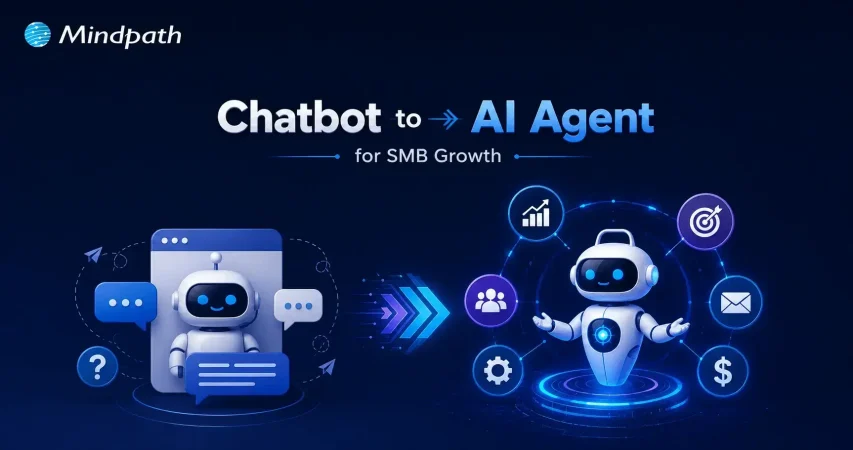
Chatbots to Agentic AI

Businesses today move fast. Customer expectations move even faster. The old model of deploying a simple chatbot to handle FAQs and call it “AI adoption” no longer cuts it in 2026. The real shift happening right now is the leap from chatbots to agentic AI, and it is reshaping how small and mid-sized businesses operate, compete, and grow. This is no longer a futuristic concept. It is an active, measurable business decision.

Key Takeaways

  • 01
    Agentic AI executes complete workflows autonomously, while chatbots only answer questions.
  • 02
    SMBs adopting agentic AI gain a measurable competitive edge over slower-moving peers.
  • 03
    Agents integrate directly with your existing tools, eliminating manual hand-offs entirely.
  • 04
    No-code platforms make agentic AI deployment accessible for non-technical SMB founders today.
  • 05
    Starting with one repetitive task is the smartest and fastest path to implementation.

So, think about this for a moment. Your competitors are not just automating conversations anymore. They are automating decisions, workflows, and outcomes. Agentic AI does not wait for instructions at every step. It reasons, plans, and acts autonomously across your entire business stack. SMBs that recognize this shift early will set the pace. Those that wait will spend the next few years catching up. In this blog, we break down exactly what this transition means, why it matters deeply for your business, and how you can start making it work today.

Looking to move beyond basic chatbots? Our AI development services help businesses build intelligent AI agents that deliver real business value.

How Does Agentic AI Differ from a Chatbot?

A chatbot is a rule-based conversational tool. It responds to queries, retrieves information, and operates within predefined boundaries. Agentic AI is an autonomous intelligence system. It receives a high-level goal, reasons through complexity, and executes multi-step tasks across tools, APIs, and workflows independently.

Consequently, the evolution from chatbots to agentic AI represents a fundamental shift in capability. A chatbot delivers an answer. An agent delivers an outcome. It plans, decides, coordinates across systems, and completes entire business processes without requiring human intervention at each step.

Let’s have a glance at the key difference through this table:

Category  Agentic AI  Chatbot 
Primary Purpose Works toward a goal and completes tasks from start to finish. Answers questions and responds to user messages.
Autonomy Can make decisions, plan actions, and work with minimal human input. Requires continuous user prompts and instructions.
Task Execution Handles complex, multi-step workflows and can adapt when situations change. Typically manages simple conversations or predefined tasks.
Tool & System Access Uses APIs, databases, business software, browsers, and other tools to perform actions. Mostly provides information; limited ability to take real actions.
Memory & Context Maintains task history, user preferences, and long-term context across interactions. Usually remembers only the current conversation session.
Outcome Delivers completed results (e.g., creates reports, books meetings, processes requests). Delivers responses, suggestions, or information only.

Why are SMBs Choosing Agentic AI Over Traditional Chatbots in 2026?

SMBs are not adopting agentic AI out of curiosity. They are doing it because the gap between a chatbot to AI agent is now a gap between falling behind and staying competitive. The business case is clear, measurable, and growing stronger every quarter. Here are the reasons why SMBs are making the switch right now.

1. Always-On Execution

Agentic AI operates continuously across time zones without failing. It handles complex, multi-threaded tasks around the clock, functioning truly as a 24/7 digital employee for your business.

2. End-to-End Automation

Unlike AI chatbots for customer service that stop at answering queries, agents take direct action. One agent can check inventory, process a return, and update your CRM automatically without a single human hand-off.

3. Autonomous Problem Solving

Agents use a built-in reasoning layer to break high-level goals into actionable steps. They analyze context in real time and respond decisively without waiting for human instruction at every turn.

4. Deep System Integration

Agents connect directly via API to your existing tech stack, including Slack, Google Drive, and inventory systems. They pull data, update records, and execute changes securely across your entire business infrastructure.

5. Real Cost Savings

Running an agentic workflow costs a fraction of a full-time employee’s salary. SMBs consistently recover significant operating capital monthly while eliminating the inefficiencies tied to manual staff time.

6. Dynamic Adaptability

Traditional chatbot flows break the moment a variable changes. The shift from chatbots to agentic AI means your system now adapts in real time, handles ambiguity, and course-corrects when processes go wrong.

7. No-Code Deployment

Advanced no-code platforms allow non-technical SMB founders to build and launch role-specialized agents quickly. You do not need a large in-house IT team to start seeing immediate, measurable value.

8. Scalability Without Hiring

Agentic workflows allow SMBs to handle sudden spikes in traffic or rapid business expansion confidently. You scale operations without the immediate pressure to hire, onboard, and train new employees.

Must-Know Insights on SMBs Using AI

  • Over 75% of SMBs actively use or experiment with AI today.
  • 97% of SMBs using voice AI agents report direct revenue increases.
  • Gartner predicts 25% of all IT work will run on AI agents by 2030.
  • 91% of SMBs adopting AI report measurable revenue gains consistently.
  • Growing SMBs lead AI adoption at 83%, far ahead of stagnant peers.

How to Transition Your SMB from a Chatbot to Agentic AI in 2026?

Making the switch sounds complex, but it does not have to be. Most SMBs already have the tools and workflows needed to start deploying conversational AI agents today. Here is exactly how you move from intention to implementation.

1. Start Small

Identify one high-value, repetitive task your team handles manually every day. Build your first agent around that single workflow before expanding further.

2. Map the Workflow

Write down every trigger, system, and decision rule a human follows to complete the task. This plain-language process becomes the core instruction set for your agent.

3. Connect Your Stack

A customer service agentic AI chatbot without tool access is simply a smarter chatbot. Equip your agent with API connections to the software your team already uses daily.

4. Set Human Guardrails

Identify every point in the workflow where an agent mistake would carry significant cost. Program the agent to pause and request human approval at each of those critical steps.

5. Pick Your Platform

The transition from chatbots to agentic AI no longer requires a large technical team. Explore no-code and low-code visual builder platforms to design and deploy workflows without writing a single line of code.

Is Your Business Ready to Move Beyond the Chatbot?

The shift from chatbots to agentic AI is not a distant trend. It is happening right now, and SMBs that act early will hold a serious competitive edge. The technology is accessible, the results are proven, and the window to move first is still open.

At Mindpath, we provide AI development services that help SMBs make this transition confidently. We build, integrate, and deploy agentic solutions tailored to your exact business needs. Let us help you move from conversation to action, starting today.
Frequently Asked Questions

Q1. Are chatbots still worth using in 2026?

Chatbots still serve a purpose for simple, single-step queries. However, businesses that rely solely on them are leaving significant efficiency gains on the table. The real value today sits in tools that go beyond answering and start executing.

Q2. How long does it take an SMB to transition from chatbots to agentic AI?

The timeline depends on workflow complexity and platform choice. With no-code builder tools, most SMBs deploy their first working agent within a few weeks. Starting with one focused use case significantly shortens the transition period.

Q3. Does agentic AI require technical expertise to manage?

Not anymore. Modern no-code and low-code platforms allow non-technical founders and managers to build, deploy, and monitor agents independently. The barrier to entry has dropped considerably, making adoption realistic for SMBs of every size.

Q4. What business functions benefit most from agentic AI?

Customer support, lead qualification, inventory management, and marketing automation deliver the strongest early results. These functions involve repetitive, multi-step workflows that agents handle faster, more accurately, and at a fraction of the operational cost.

Q5. Is the shift from chatbots to agentic AI expensive for small businesses?

The initial investment varies by platform and complexity. However, most SMBs recover costs quickly through reduced manual hours and improved operational output. The long-term savings consistently outweigh the upfront deployment investment by a significant margin.

Related Post

AI Redefining Job Roles in Tech

Artificial intelligence is rapidly transforming how the tech world operates, bringing a wave of changes that are reshaping the ways in which professionals work and innovate. The influence of AI redefining job roles in tech can be seen across every corner of the tech industry, where automation and human creativity are coming together to drive smarter, faster, and more efficient ways of building the future. This isn’t about replacing talent; it’s about enabling talent to reach new heights of access and productivity.

Organizations are changing rapidly, and traditional job roles are being redefined. Developers have become strategists, data analysts have become decision-makers, and engineers are collaborating more closely with advanced intelligent systems, leveraging AI in decision-making to drive smarter business outcomes. The pace of change will accelerate, and those who can adapt will lead the next generation of digital expansion. Let’s dive in and examine the impact of AI on the future of work and how it is changing the technology landscape like never before.

As AI transforms the tech workforce, businesses have more ways than ever to scale and innovate. Want to know how? Explore our AI development services to elevate productivity and stay competitive.

The Growing Influence of AI in Today’s Tech Industry

Artificial Intelligence is evolving into a transformational force in the contemporary technology sector. It will alter the ways businesses design products, optimize resource allocation for applications, and provide digital experiences. Companies are utilizing AI to not only automate tasks but also to make informed decisions and create new innovation opportunities. With the rise of AI in business strategy, organizations are now integrating intelligent systems to strengthen planning, improve efficiency, and gain a competitive edge. AI’s influence is extending into every dimension of technology.

A report published by McKinsey stated that the adoption of AI in IT functions increased from 27% to 36% in six months. The report also showed that 71% of organizations that use AI employ generative AI for at least one business function. Additionally, 38% of companies that use AI anticipate their overall workforce to remain the same over the next three years, while IT and product development teams are expected to see growth. This demonstrates the benefits of AI not just in operational efficiency but also in creating new skill-based jobs and redefining job roles in the tech sector, helping humans work more intelligently and strategically.

How is AI Changing Job Roles?

The impact of artificial intelligence on employment is changing how people do their jobs and how organizations staff their teams. It’s creating new types of opportunities, and it is changing the types of skills that matter the most in today’s tech world. Here are the differences AI is making in job roles across the industry.

1. New Opportunities in AI-Driven Careers

As artificial intelligence expands, the emergence of new specialized careers in technology is beginning to take shape. People are now working as AI trainers, data scientists, and ethics officers, among other roles. These new job roles will be open for a workforce to be smarter and more resourceful going forward.

2. Smarter Work with Automation

AI is taking over repetitive work like data entry, research, and customer support. That frees up professionals to spend more time in the day on creativity, innovation, and decision-making. The trend of AI redefining job roles in tech captures the reshaping of work toward strategic and value-added work.

3. Shifting Skills and Smarter Roles

As AI tools are getting integrated into daily operations, workers are now the ones who supervise, analyze, and enhance the results provided by AI. They are acquiring skills in data interpretation, problem-solving, and collaboration. Their changing duties, thus, emphasize the impact of technology on the restructuring of the old job models.

4. Boosting Productivity Across Teams

AI tools increase both accuracy and speed with tasks like analysis of data and performance management of systems. Teams are now able to work more successfully and with higher levels of accuracy and speed. AI redefining job roles in tech is making the workplace more task efficient and performance focused, a sign of AI transforming the future of work.

5. Growing Value of Human Skills

With AI, handling most of the technical and monotonous tasks, the qualities of creativeness and emotional intelligence have become very important. Essentially, traits such as empathy, communication, and leadership have become the main factors in one’s professional development. These proficiencies are what make it possible for people to be leaders of innovation; thus, they are‌ indispensable.

6. A Changing Job Market Landscape

Artificial ‍intelligence is changing the way companies hire employees and how the workforce is managed. With the help of AI, recruiters can find the right candidates in less time and then focus on valuable interaction with the candidates. The AI redefining job roles in tech trend is an indication that the two, people and technology, are evolving hand in hand to build up the future workforce that will be more ‌‍ ‍‌powerful.

Wondering how your business can actually implement these AI capabilities without overwhelming your team? Explore our detailed guide on AI consulting services explains how expert support can simplify adoption and accelerate results.

AI Job Roles in Tech

The increase of AI job opportunities in technology is changing how workers build careers and how innovation will occur. AI continues to expand and is also creating jobs that integrate technology, creativity, and human thinking.

1. Building Smarter Systems

Artificial intelligence (AI) engineers develop smart systems that enable businesses to become more efficient and intelligent in their processes. They build responsive solutions using machine learning and automation that will evolve and get better with time.

2. Turning Data into Decisions

Researchers and analysts work on research and analyze information gathered through AI tools. They provide companies with better decisions by leading them from complex data to business insights. Their work is essential across sectors, from finance to AI for customer services, where data-driven insights improve customer interactions.

3. Training the Machines

AI teachers and trainers help create guidelines for learning for AI systems. Their work guarantees that every algorithm works perfectly and aids actual applications.

4. Designing Better Algorithms

Algorithm engineers develop and improve algorithms that power features such as recommendations and predictions. They partner with software engineers and data scientists to implement efficient and precise models.

5. Leading AI Product Development

AI product managers handle the end-to-end development of AI solutions. They ensure those solutions support user needs, can scale across an organization’s technology stack, and support business objectives, demonstrating how AI is redefining job roles in tech and advancing growth across fields. Their contributions help drive advancements in multiple industries, including AI in e-commerce, where product managers shape smarter and more personalized shopping experiences.

Want to see how AI is reshaping not just tech jobs but also the way websites are built? Our blog on AI in Web Development breaks down how intelligent automation is transforming the entire development workflow.

Ready to Embrace the Future of AI in Tech?

Artificial intelligence has a vital role in changing the way we work, learn, and develop in the technology space. The trend of AI redefining job roles in technology shows how human creativity and machine intelligence can work together to build a smarter future. The individuals who adapt and retrain today will confidently participate in tomorrow’s digital transformation.

At Mindpath, we develop cutting-edge AI development solutions that help businesses grow faster and work smarter. Our skilled team focuses on developing intelligent systems that automate processes, apply data analysis, and improve decision-making. We help our clients leverage AI technology, allowing them to remain competitive in an ever-evolving technology-based world while achieving digital success that will last for a long time.

Need Expert Legal Software Solutions

Looking for that one legal software developer who will turn your idea into a real project? Choosing a partner may seem truly overwhelming, but it doesn’t have to be. In this blog we will know about the factors to consider while hiring legal software developers. 

The legal tech market is growing beyond walled gardens, with newly built tools fueled by demand from law firms, corporate legal departments, and individual practitioners. Legal software is specialized to be applied in managing specific legal tasks such as secure electronic signatures and contract reviews; it’s not quite like the general genre of technological tools illustrated by email systems or file-sharing services. This can take the form of tools for in-house legal departments that streamline internal processes, such as document management and compliance; law firm management software for keeping cases, billing, and client communications in check; and consumer applications to help them with personal legal problems, whether concerning bankruptcy or parking tickets. 

Hiring legal software developers becomes essential to ensure that your legal software development services runs effectively and does everything that you would want it to do. The developers working on this legal software specialize in creating and customizing solutions regarding case file management, deadline tracking, document management, and more. They help build tools that better law firms by handling tasks such as searching case files, running calendars, following tasks, even access to information on-the-go through their mobile features. By hiring skilled legal software developers, you get the assurance that your software will be well-designed and secure, coupled with features tailored to meet your specific requirements, making the task of managing legal cases and firm operations much smoother and efficient. 

Let us dive deep into this blog to know about the factors to consider before hiring legal software developers. 

Factors To Consider Before Hiring Legal Software Developers   

Factors To Consider Before Hiring Legal Software Developers

1. Define Needs  

Before you hire legal software developers, the needs must be clearly defined. It means determining what one wants the developers to be able to do. Consider the integration of the software with other systems in use like email and file storage for perfect workflow. This includes setting a budget, which will serve as a guideline regarding priorities and finding a developer or developers to deliver what you will need within your financial limits. Defining your needs will allow you to communicate your needs to the developers, hence bridging to a more successful, tailor-made software solution. 

2. Evaluating Developer Expertise   

Before hiring, critically evaluate the expertise of legal software developers. Are they technically competent? Do they have the skill sets and experience using their tools? Engage developers who have experience in working with legal software. After all, their better understanding of the unique needs of law firms and legal departments is good enough for saying so. Just look at all the client testimonials that app developers have gotten to understand that they do quality work. Make sure they are good at communication and that they are responsive, friendly developers. That way, by appraising their expertise, you can find developers who would be well equipped to build the software for you. 

3. Reviewing Past Projects and Client Testimonials 

Before you start hiring legal software developers, view their past projects; what kind of work they have done, how many projects they have handled. See if they have done any similar projects as you want. They can deliver qualitative software related to the legal field. Moreover, you can look over the client testimonials and reviews to know how the previous clients feel about their experience. It will provide you with positive feedback, thereby giving you confidence in their ability and reliability. This step helps in choosing a developer who has the potential to prove his results and satisfy your needs accordingly. 

4. Communication and Collaboration Skills   

When looking to hire legal software developers, try and pay attention to their communication and collaboration skills. Pick the ones you can talk with easily and hear you out. They should be responsive, updating you on the progress of their work. Good collaboration means they can work well with your team, share ideas, and solve problems together. Effective communication means everyone is on the same page, thus leading to a smoother development process toward a successful software solution. 

5. Cost and Budget Considerations   

The cost or budget for hiring a legal software developer should be considered. It will be important for you to decide just how much you are prepared to pay for your project and then compare legal software developers who can work within your budget. Different pricing models—like fixed price or hourly rate—might suit your needs better. Be sure to discuss extra costs that may arise. This will help you to understand better the financial aspects of the matter and find out the developers who offer maximum value for your money.

Looking for Expert Legal Software Development?

At Mindpath, we offer comprehensive legal software development services to meet your unique needs.

Legal software development services at Mindpath    

We have a variety of legal software development services designed to make your life simple and give you more time. Our solutions improve client service, streamline operations, and help remain compliant with regulations. 

legal software development services designed

1. Legal Website Development 

We provide law firms with professional websites that are attractive, user-friendly, and search engine friendly, so you will have an excellent online presence that really attracts potential clients. 

2. Legal Chatbot Development 

Our chatbots automate client interactions through answering questions, setting up appointments, and providing updates. They offer support 24/7 to help reduce the admin workload and increase client satisfaction. 

3. Legal Case Management Software 

Our software simplifies case management by providing real-time data and automated tasks so you will be able to have full control over your cases and gain valuable insights into their progress. 

4. Legal App Development 

We create user-friendly apps on iOS and Android to handle client interactions and case information from anywhere, creating a better experience for the client. 

5. Compliance Management Software 

This software takes extra care to keep you compliant with the legal framework and provides automated tracking of risk management to keep your practice updated. 

6. Cloud Migration 

We ensure the safe transfer of your data to the cloud so that flexibility and security are enhanced with easy access anywhere, along with system performance during cloud optimization. 

Conclusion 

The fast-changing legal technology landscape dictates that law firms and legal departments should catch up. In the modern world, technology is the way to achieve efficiency, better customer service, and compliance. While hiring a legal software developer, due consideration of things such as defining your needs, evaluating experience, and good communication can result in successful partnering and effective software solutions. 

At Mindpath, we look to simply your process and introduce you to innovation that will automate your legal practice. By choosing Mindpath, you’re putting your money into innovation and expertise to drive your success against competition in the legal arena. Stay ahead with Mindpath and focus on what you do best by providing exceptional legal services.  

Looking to Revolutionize Your Legal Practice?

At Mindpath, we build custom legal software websites, chatbots, and case management systems just for you.

Discover essential factors for hiring legal software developers and see how Mindpath’s custom solutions like websites and chatbots can transform your practice.

Support Is One Click Away

Featured Posts

Related Post

Discover how ReactJS development enables scalable, high-performance applications with benefits like optimized routing, state management, etc.
Discover the ultimate guide to hiring Node.js developers in London. Learn about the skills, benefits, and cost factors involved in finding the right talent for your project.