Home

Skills to Look for While Hiring NodeJS Developers

Skills to Look for While Hiring NodeJS Developers

Join our Newsletter!

nodejs developer skills

In today’s fast-paced digital world, businesses need apps that can grow and work well to stay ahead of the competition. It’s more important than ever to have skilled backend developers because of technologies like real-time systems, microservices, and cloud-based platforms. A lot of people want to hire Node.js developers because they can make event-driven apps that work well.

When you want to hire NodeJS developers, it’s not enough to just find someone who knows how to code in JavaScript. It needs to know more about both technical skills and real-world experience. Companies that want to hire nodejs developers should look for people who have a mix of core programming skills, backend knowledge, and the ability to solve problems.

Planning to find skilled NodeJS developers who can deliver high-quality applications? Mindpath provides professional services where you can hire expert NodeJS developers tailored to your business needs.

This guide talks about the most important skills that NodeJS developers need to have and helps you find the right person for your job.

Why NodeJS Developers are in High Demand?

Node.js has changed how backend development works by allowing developers to write code for the server in JavaScript. It can handle a lot of requests at once because it doesn’t block and is event-driven. This is why it’s so good for systems that need to work in real time and grow.

Because of this, businesses in a lot of different fields are actively looking for NodeJS developers to make modern apps like APIs, streaming services, and tools for working together. Because of this growing need, it’s important to be very clear about what you want from node js developers before you start looking for them.

Understanding Node.js Developer Job Requirements

Before looking for Node.js developers, companies should know what their project needs are.

These are the requirements most of the time:

  • Experience with server-side development
  • Knowledge of APIs and database integration
  • Familiarity with modern development tools and frameworks
  • Understanding of scalability and performance optimization

Clearly stating these needs will help you find people who are a good fit for both your business and technical needs.

Core NodeJS Developer Skills to Look For

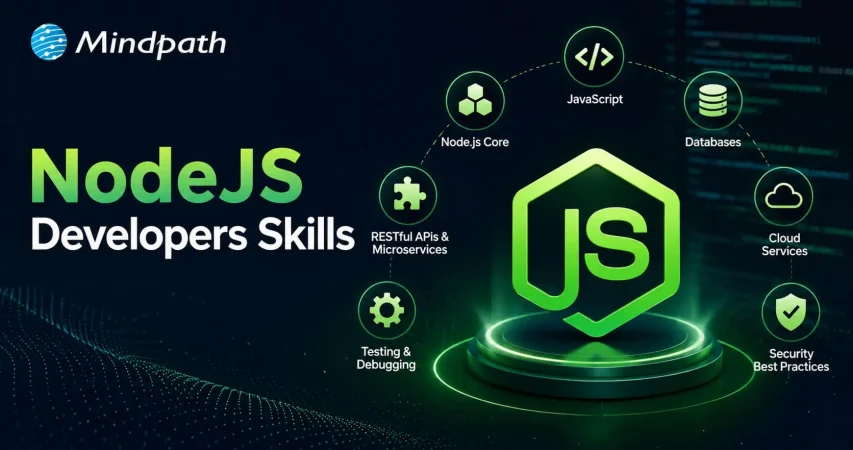
The most important thing for any developer to know is how to do their job. You need to know how to use NodeJS well to make apps that work well and can grow.

1. Proficiency in JavaScript

Because Node.js is built on JavaScript, programmers need to know a lot about basic ideas like callbacks, promises, closures, and how to write code that runs at the same time as other code.

2. Knowledge of Node.js Frameworks

Developers should be familiar with popular frameworks like Express.js, which help them build APIs and backends more quickly.

3. API Development and Integration

A good developer should be able to make and use RESTful APIs that let the front-end and back-end systems talk to each other without any problems.

4. Database Management

To handle data well, you need to know how to use databases like MySQL, MongoDB, or PostgreSQL.

5. Version Control Systems

You need to know how to use tools like Git if you want to work with other people and manage code.

These are some of the most important things that a Node.js developer should be able to do.

Node.js Backend Developer Skills

You need to know more when you work on backend development. Strong Node.js backend developer skills make sure that apps are safe, can grow, and work well.

Key backend skills include:

  • Server-side architecture design
  • Performance optimization
  • Security implementation (authentication, authorization)
  • Handling asynchronous operations
  • Error handling and debugging

You need these skills to build strong backend systems that can deal with problems in the real world.

Technical and Soft Skills for NodeJS Developers

NodeJS developers need to know a lot about technology and have good people skills.

  • Technical Skills

Knowing how to program, use frameworks, and development tools are all examples of technical skills. These skills help developers make apps that work and are useful.

  • Soft Skills

Soft skills play a crucial role in team collaboration and overall project success. Important soft skills include communication, problem-solving, adaptability, and time management. These abilities help developers effectively collaborate with team members, understand project requirements, adjust to changing needs, and manage tasks efficiently. A developer with strong soft skills can contribute to a smoother workflow and deliver high-quality results.

Advanced Skills That Add Value

  • Beyond the basics, advanced skills can significantly enhance a developer’s capabilities.
  • Knowledge of microservices architecture
  • Experience with cloud platforms like AWS or Azure
  • Familiarity with containerization tools like Docker
  • Understanding of CI/CD pipelines

These advanced capabilities are often preferred when businesses hire dedicated Node.js developers for complex projects.

Evaluating Candidates During Hiring

Businesses need to use a structured evaluation process to hire Node.js developers successfully.

1. Technical Assessment

Test candidates on JavaScript concepts, API development, and problem-solving skills.

2. Portfolio Review

Examine previous projects to understand their experience with real-world applications.

3. Practical Assignments

Assign tasks that reflect actual project requirements to evaluate their performance.

4. Communication Evaluation

Assess how well candidates communicate ideas and collaborate with teams.

Hiring Models to Consider

1. In-House Developers

Best for projects where a lot of people need to work together for a long time.

2. Freelancers

Good for small projects or ones that don’t take long to finish.

3. Dedicated Developers

Dedicated nodejs developers will only work on your project when you hire them.

4. Development Companies

When you hire a nodejs development company, you get teams with a lot of experience and all the development services you need.

Common Mistakes to Avoid

Companies often make mistakes when they hire people that can affect how well the project goes.

  • Paying attention only to hard skills and not soft skills
  • Not being clear about what the project needs
  • Not doing tests in real life
  • Picking workers based on price instead of quality

Future of NodeJS Developer Skills

As more companies start to use new technologies, the demand for Node.js developers will likely rise. Knowing how to use cloud computing, microservices, and real-time apps will become more and more important.

Because technology changes all the time, NodeJS developers will always be in demand.

Ready to Hire the Right NodeJS Developer?

Hiring the right NodeJS developer is one of the most important decisions for building scalable and high-performing applications.
Want Node.js Engineers Who Fit?

We match developers to your codebase, not just your job title.

Frequently Asked Questions

Key skills include JavaScript proficiency, API development, database management, and knowledge of Node.js frameworks.
They help build scalable, high-performance applications using modern backend technologies.
Skills include asynchronous programming, backend development, database handling, and problem-solving abilities.
Dedicated developers are ideal for focused projects, while a NodeJS development company offers complete solutions.
Communication, teamwork, adaptability, and time management are essential soft skills.

Support Is One Click Away

Featured Posts

Related Post

Web Development Costs

Understanding the web development costs is a significant question many businesses struggle with before initiating a project. Web development is the easiest way to make your products and services connect with global audiences. In fact, entrepreneurs are well aware of the profitable aspects and booming growth they can adopt through the online market. Talking about the trends, progressive web applications are growing fastest at a CAGR of 14.00%. Moreover, around 71% of businesses already have a website.

So, it becomes necessary for you to understand how much a web development costs. For your information, there are numerous factors that influence the cost of web development. This guide can help you with a complete breakdown, no matter if you are starting from scratch or have a small budget.

Web development costs are the total expenses involved in planning, designing, developing, testing, launching, and maintaining a website or web application.

Planning to build a website and need a clear cost roadmap? Mindpath delivers scalable web development services designed to fit your business goals.

What Does the Web Development Cost Include?

Before you get into the web development costs, it is necessary to research your competitors and how uniquely you need to develop your site. Moreover, developing a good and reliable website is not just about writing code or initiating good designs. The total website development cost breakdown is dependent on your website’s structure.

Further, you need to be considerate about the functionality, technology stack, and the requirements for post-launch support. Here are some quick factors that influence the web development prices.

1. Type of website

A static website might cost you less than an interactive SaaS project.

2. Technology Stack

Use of leading frameworks like Laravel, React, or Next.js can increase the development timeline along with their charges.

3. Customization Values

If your website is developed with a pre-built template, the cost will be much lower. On the other hand, custom approaches can heighten the price range.

4. Development Approach

If you are valuing the expertise of a professional web development company, the development charges will be higher than those for a freelancer. However, the projects from a certified company always win in the competitive edge.

Curious why some web projects cost more than others? Discover web development tools and see how technology choices influence productivity and expenses.

What are the Average Web Development Costs for Multiple Industries?

The average web development cost majorly depends on the type of website you are relying on. Further, it also depends on the way you are creating and launching it.

1. Small Business

A small website development cost generally falls between USD 1000 and USD 10,000. Basically, it will include 5 to 10 pages, including content management systems such as WordPress. Moreover, there will be some useful features like service pages, contact forms for reaching the business, along with mobile responsiveness.

So, if you are serving locally or a startup business, this web development pricing can be useful.

2. Corporate Operations

A corporate website will include some good features like ERP integrations and scalable architecture. So, for such a business, the web development costs will be around USD 10,000 to USD 50,000.

Such a price range offers proper performance optimization and user engagement. Further, it also enhances a business’s reach on global platforms while including many advanced options in it.

3. E-commerce Sites

When it comes to e-commerce sites, the cost of web page development automatically heightens. Further, the cost breakdown depends on your catalog size, custom product pages, payment gateway integration, and shipping management systems.

Many users also consider building their entry-level store through platforms like WooCommerce and Shopify. However, a completely customized e-commerce website can range up to USD 50,000. This will cover all types of essentials, such as automating the inventory management and multi-vendor benefits. To enhance your customer experience, you should be careful about the project’s security.

4. Custom Web Applications

The overall cost of custom web development will fall in the range of USD 25,000 to USD 160,000. Your web application will include several important platforms like booking engines, SaaS products, real-time dashboards, and internal management systems.

These are some custom solutions that need to be built from scratch and require advanced backend architecture, API integration, scalable database, etc. The web application development is comparatively challenging and requires the involvement of experts.

This is the general idea about the average web development costs for multiple business types. So, the costs might vary depending on the various requirements of your projects.

Looking to understand how emerging trends affect web development costs? Check out the latest web development trends to see how new technologies and practices influence project scope.

Website Development Cost Breakdown as Per the Types

You must be aware of the fact that every website has its unique development scope. So, the web development prices generally depend on your site’s functionality, complexity, and the intended need of the project. Here, you can go through the expected cost of web page development.

Web Development Type Key Functions Development Phase Estimated Cost

Basic Clean and understandable UI, contact forms, page navigation, search tools, etc., 6 to 12 weeks, USD 10,000 to USD 20,000.

Standard User interaction, seamless content management, API usage, database support, etc., 3 to 6 months USD 20,000 to USD 45,000.

Advanced High-level data flow, custom modules, real-time functionality, etc., 12 months plus. Starts at USD 50,000 and increases with custom inclusions.

Planning your web development budget more effectively? Explore web development technologies to see how choosing the right stack affects cost and performance.

Website Development Cost As Per the Chosen Experts

There are multiple options available in the market to personalize your web development. Let us explore some valuable vendor types that have been offering the best web development costs while enhancing the facilities through viable inclusions.

1. Team of Expert Web Developers

Hiring a professional web development team can be the best option available in the market. However, you might think it is an expensive investment. But remember that this option offers the highest level of security.

Apart from this, these agencies consist of experienced people who can easily customize your projects as per your business goals. Such companies can help you with an accelerated web development process. Apart from leveraging design and developmental solutions, they also ensure website maintenance while developing a marketing strategy. The web development pricing of the full-fledged agencies will be around USD 15000 to USD 150,000 and more.

2. In-house Development Team

Creating your own web development team offers you the advantage of having dedicated professionals at your fingertips. However, the process can be resource-intensive and time-consuming. You need to be assured of effective management and create a positive work environment. Other than this, it can be challenging for you to find candidates who match your required skills and budget.

Remember that an in-house web development team is necessary if the website is essential to your business. The average web development cost of these experts can be between USD 80,000 and USD 200,000 per year.

3. Freelance Developers

Freelancers will charge you around USD 15 to USD 80 per hour. They are the only viable options that come within a small budget. They are best suited for your small websites, MVPs, or any budget-centric projects. Further, they offer flexibility with the contracts and easily scale the tasks.

4. DIY Efforts

Many businesses just take the challenge to create their website on their own. However, it takes high skills and commitment. The process remains slower, and you might commit mistakes that your business can’t bear at all.

Curious how web development costs compare to full-scale software projects? Discover software development cost insights to understand long-term budgeting and investment planning.

How to Pick the Best Web Development Partner?

If you require your development process to be effective enough, only prioritizing the website development cost breakdown is not enough. You need to prefer the right development team or company that can make your project a success. Moreover, they should satiate your budget without being a burden on your pockets.

A right development partner should meet your budget, business requirements, and technical needs. So, you should look for experts who have good experience with your project type and industry. The experts should follow clear communication while being transparent regarding their process and charges. They should offer a detailed proposal regarding their web development pricing. So, no matter if you are choosing a professional agency or a freelancer, just be assured of their support and clarity.

What are Some Ongoing Costs that you might experience after a Website Launch?

Launching a site is just half of your journey. There are other elements related to it that can proceed with ongoing costs. Some of the major ones have been listed below.

1. Hosting Charges

Hosting charges usually come on an annual or a monthly basis. Shared hosting can be a bit approachable, while cloud hosting might hamper your budget.

2. Maintenance Efforts

To let your website offer desirable results, you need to continuously test its performance and fix bugs when required.

3. Support Packages

Your company might require support packages from web developers to keep the website performance-oriented.

Want to avoid unexpected web development costs? Check out the web development roadmap to understand project milestones and cost drivers.

Conclusion

It is a great thing to understand the website development cost breakdown before you think about any project. This can help you set clear goals while maintaining your budget. On the other hand, costs differ as per your goals, industry, requirements, and complexity of your projects. Breakdowns available in this guide can help you plan your projects with clarity. A well-defined budget with a solid plan can help you prevent your company from costly surprises and help your website to fulfil your business goals precisely.

So, if you are ready to experience the next step with a personalized cost estimation and strategy customized specifically for your business needs, consider the excellence of Mindpath’s web development services. Here, the team can help you build a website that can match your vision while pushing you ahead in the market.

AI Budgeting

Artificial intelligence is becoming a strategic investment for businesses seeking better efficiency, faster decisions, and sustainable growth. However, understanding AI costing remains essential before committing resources to an AI initiative. A clear view of development, infrastructure, data, integration, and operational expenses help businesses create realistic budgets and avoid unexpected financial pressure.

Key Takeaways

  • 01AI costing should include development, infrastructure, data, and maintenance.
  • 02Clear objectives help businesses create realistic AI budgets.
  • 03Hidden AI costs can affect long-term investment decisions.
  • 04AI investments should align with measurable business outcomes.
  • 05Regular budget reviews support sustainable AI growth.

Effective AI adoption requires more than allocating funds for technology development. Businesses must evaluate their objectives, expected returns, scalability needs, and ongoing operational requirements before investing. A structured budgeting approach helps decision makers prioritize valuable use cases while controlling unnecessary expenses. In this blog, we will explore the key costs, planning considerations, hidden expenses, and investment strategies businesses should understand before budgeting for AI.

Ready to turn your AI idea into a cost-effective solution? We offers custom AI development services to help businesses build scalable solutions aligned with your goals and budget.

What Does AI Costing Actually Include?

AI costing refers to the complete financial assessment required to plan, develop, deploy, and maintain an AI solution. It covers far more than the initial development expenses. Businesses need to consider technology, data, infrastructure, integrations, security, employee adoption, and ongoing maintenance when estimating their overall AI investment.

The total cost can vary significantly based on the business objective, solution complexity, data requirements, and expected scale. A simple AI automation may require limited resources, while an enterprise AI platform can involve extensive development and infrastructure. Understanding these factors helps businesses create realistic budgets and make informed investment decisions.

Key Factors That Influence AI Costing

  • Business requirements: Complex business objectives usually require more planning and development resources.
  • Data readiness: Poor quality or unstructured data can increase preparation and management costs.
  • Solution complexity: Advanced AI applications often require specialized development and testing.
  • System integration: Connecting AI with existing CRM, ERP, or business applications can add implementation costs.
  • Infrastructure: Computing, storage, APIs, and cloud services contribute to ongoing expenses.
  • Security and compliance: Businesses may need additional controls to protect sensitive information and meet regulatory requirements.
  • Maintenance and scaling: AI systems require monitoring, updates, optimization, and additional resources as usage grows.

What Are the Main Costs of Implementing AI in Business?

The cost of implementing AI in business depends on the solution, technology, data, and resources required. Effective AI budget planning helps businesses account for these expenses before implementation begins.

1. AI Strategy and Planning

Businesses need to identify the right AI use case and define clear objectives. Strategy and feasibility planning help align the investment with business goals.

2. Data Preparation and Management

AI requires clean, structured, and relevant data to deliver reliable results. Data cleaning, labeling, storage, and governance can add to the overall investment, especially when leveraging augmented analytics for deeper insights.

3. AI Development and Customization

Development costs depend on the type and complexity of the AI solution. Custom applications, AI agents, and model customization generally require greater development resources, including hiring specialized developers.

4. Integration With Existing Systems

AI solutions often need to connect with existing business systems and applications. APIs, databases, CRM, ERP, and security integrations can increase implementation costs, particularly when aligning with modern IT infrastructure.

5. Infrastructure and Cloud Services

AI applications require computing power, storage, and other infrastructure resources. Cloud usage and API consumption can also create recurring operational expenses.

6. Maintenance and Optimization

AI systems require continuous monitoring, updates, testing, and performance improvements. Businesses should include these recurring expenses when calculating their overall AI budget.

How to Plan an AI Budget for Your Business?

Knowing how to plan an AI budget helps businesses control spending while keeping their AI initiatives aligned with measurable goals. A structured approach also makes AI investment planning easier by showing where resources are needed at each stage.

1. Define Your Business Objective

Start by identifying the specific business problem AI should solve. A clear objective helps determine the right technology and required investment.

2. Choose the Right AI Use Case

Prioritize use cases that offer measurable business value. Starting with a focused use case can help control initial spending and validate results.

3. Assess Your Data Readiness

Evaluate the quality, availability, and structure of your existing data. This helps identify additional data preparation costs before development begins.

4. Estimate Initial and Recurring Costs

Calculate development, integration, infrastructure, and deployment expenses. Also include recurring costs such as cloud usage, maintenance, and support.

5. Set a Realistic Contingency Budget

AI projects can encounter unexpected technical or operational requirements. Keeping a contingency amount helps manage these expenses without disrupting the project.

6. Define Expected ROI

Set measurable outcomes before approving the investment. These can include cost savings, productivity improvements, faster processes, or increased revenue.

7. Plan for Future Scaling

Consider how costs may change as users, data, and AI workloads increase. A scalable budget helps businesses expand their AI capabilities without major financial disruptions.

What Hidden Costs of AI Should Businesses Consider?

AI costing should account for expenses that may appear after implementation. Understanding the hidden costs of AI helps businesses create a more realistic budget.

1. Employee Training

Teams may need training to use new AI tools effectively. This can add training and productivity costs.

2. Data Improvement

Existing business data may require cleaning or restructuring. Additional data work can increase implementation expenses.

3. Security and Compliance

AI systems may require stronger security controls and compliance measures. These requirements can add development and operational costs.

4. Ongoing Maintenance

AI solutions need regular monitoring, updates, and optimization. These recurring expenses should remain part of the long-term budget.

5. Third-Party Services

AI applications may depend on external APIs, models, or cloud platforms. Usage-based charges can increase as adoption grows.

6. Change Management

Employees may need support when workflows change after AI adoption. Proper change management can improve adoption and reduce implementation challenges.

7. Scalability Costs

Growing usage can increase computing, storage, and infrastructure requirements. Businesses should account for these expenses when planning future AI expansion.

How Does AI Investment Planning Support Better Business Decisions?

AI investment planning helps businesses allocate resources based on expected value, business priorities, and long-term requirements. It allows decision makers to evaluate AI opportunities before committing significant resources.

1. Prioritize High Value Use Cases

Invest in AI initiatives that address important business challenges. This helps direct budgets toward measurable outcomes.

2. Start With a Focused Investment

Begin with a manageable AI initiative before expanding across the organization. Early results can guide future investment decisions.

3. Balance Initial and Recurring Costs

Consider development expenses alongside infrastructure, maintenance, and usage costs. This provides a more accurate view of the total investment.

4. Align Investment With Business Goals

AI spending should support clear organizational objectives. This keeps technology investments connected to business growth.

5. Evaluate Scalability

Consider future users, data volumes, and operational requirements before selecting a solution. A scalable approach can reduce the need for costly redevelopment later.

6. Review Investment Performance

Track business outcomes against the original investment goals. Regular reviews help identify where additional funding can create greater value.

AI Budget Planning Across Different Project Stages

AI budgets change as a project moves from initial planning to full-scale deployment. Businesses should review AI costing at every stage to maintain better control over their overall investment.

Project Stage Key Budget Areas Business Focus
Discovery Strategy, research, and feasibility Identify the right AI opportunity
Proof of Concept Development, data, and testing Validate the solution and its potential
Development AI development, integration, and security Build a reliable business solution
Deployment Infrastructure, training, and implementation Introduce AI into daily operations
Scaling Cloud usage, maintenance, and optimization Support growing business requirements
Continuous Improvement Monitoring, updates, and enhancements Improve performance and long-term value

Ready to Build a Smarter AI Budget?

Effective AI budget planning helps businesses understand total costs, prioritize valuable use cases, and prepare for ongoing expenses. A well-structured budget reduces financial uncertainty while keeping AI investments aligned with measurable business goals. Businesses that plan carefully can scale AI with greater confidence and achieve sustainable long-term value.

Mindpath helps businesses turn AI opportunities into practical, scalable solutions aligned with their goals and budgets. Our AI development expertise supports strategy, solution development, integration, deployment, and optimization. With the right technical guidance, businesses can invest in AI confidently while building solutions designed for measurable performance and sustainable growth.

Frequently Asked Questions

Custom Wordpress development

A website truly reflects your business motive and what it offers to its targeted audiences. Without a proper website, your organization can’t stand in this massive digital world. However, if you think your website is just to highlight your business, then you are misguided. As per a statistic of Stanford University, around 75% users judge the credibility of a business through their website design. So, for your long-term success, you must adopt a well-optimized website. 

This is where custom WordPress development serves uniqueness. Being the most popular software for creating websites, it powers over 43% of the internet. (Source: Click) Instead of limiting your vision to a similar theme, custom development accesses your site to be curated from the core. 

Ready to turn your website into a powerful business asset? Mindpath offers expert WordPress development services to create scalable and high-performance solutions built for your business growth.

What is Custom WordPress Development?

Custom WordPress development is the practice of building tailor-made websites, bespoke themes, and custom plugins from scratch, using WordPress as the foundation. Unlike relying on pre-existing themes that hundreds of other sites use, a custom website is architected specifically to align with your unique business workflows, design needs, and system integrations. This means every element, from backend frameworks to front-end features, is precisely crafted around your preferences, requirements, and values.

  • Pre-existing themes might be convenient for many users as they are a bit affordable. However, they come with certain risks of flexibility and generic layout. 
  • On the other hand, a custom WordPress website leverages creative freedom. You can develop your own layouts and include features that suit your interests.

How Adopting Custom WordPress Development Services Can Be Beneficial for Your Business?

Let us go through some major benefits that you can discover by choosing the custom WordPress development services

1. Seamless and Faster Development

You don’t require a backend in WordPress website development. Unlike traditional website creation, where every element is generated individually, WordPress sites allow you to choose a framework as per your business requirements and preferences. This enables you to quickly develop your site. With rapid development, you can also save your time and resources. 

2. Custom Theme Creation

In custom WordPress development, you can’t only transform the tagline but also change the overall appearance and functionality of your site. You can decide the changes as per the growing demand of your business. You can transform all such things by shifting the color palette, layout design, and widgets. Moreover, WordPress delivers a wide range of layouts that support multiple levels of business objectives. 

3. User-Friendly Web Designs

Ease of use is another significant factor that makes businesses prefer custom WordPress development services. It offers intuitive and straightforward operations. So, you don’t require any coding expertise to operate your business site effectively. The availability of multiple customizable plugins and themes can help you create a business site that meets your business expectations widely. 

4. Adopt Scalability

Getting a WordPress website developer can assist you in scaling your website as your company scales. You can also discover flexibility with custom WordPress development as per the dynamic nature of your company. So, be it an e-commerce or an advanced site, WordPress can help you effortlessly scale without compromising on quality. This offers you the benefit of staying relevant in such a digital era. 

5. Wonderful Designs

A pleasing, satisfying design can help your site attract prominent prospects while making your website look more professional. So, with the help of WordPress custom website design, you can easily enhance its reach while making its user interface valuable. Moreover, it puts a valuable first impression while converting your visitors into loyal customers. 

6. Social Media Handle Integrations

This is one such major value of a custom WordPress development, where your site can adopt social media implementation into your feed. This feature allows you to highlight your social accounts on your site. The valuable addition of the accounts can help you attract a larger number of visitors to your page without utilizing several media handles for your organization. 

7. Long-Term Support and Maintenance

One such overlooked advantage of a WordPress custom website is the seamless partnership and assistance you leverage. With the evolving nature of your business, your team can integrate new features and redesign without initiating it from scratch. This ensures quick integration and minimal downtime.

Looking to make your custom WordPress site usable for everyone? Explore our guide on web accessibility guidelines to learn practical ways to enhance your WordPress site and improve user experience.

What are Some Common Misconceptions People Have Regarding Custom WordPress Development?

WordPress comes with a series of features that remain unmatched. Further, a WordPress website developer can help you design a site that truly reflects your authenticity. However, there are some misconceptions that people have regarding this platform, as follows. 

1. Security Lapses

Many people consider that plugin incorporation can give rise to security threats in WordPress. However, the platform is extremely secure. Further, the platform has started investing in security releases. 

2. The Platform Is Solely for Blogs

WordPress generally powers around half of all the sites available on the internet. So, it has much more to offer beyond serving only as a blogging platform. 

3. Limited Support

This is another piece of misinformation that is spreading over the market. For your information, WordPress has a dedicated and active community of contributors who introduce new features and themes. Moreover, this community offers significant help to user challenges and fixes bugs rigorously. 

Concerned about security risks in custom WordPress development? Check out our blog on safeguarding common WordPress vulnerabilities to understand how to prevent attacks and data loss.

Who Should Opt for Custom WordPress Development Services?

A WordPress custom website is not only for tech influencers and huge corporations. It can be a smart strategy for many businesses that want to strengthen their online presence. Custom development delivers flexibility while keeping you aware of long-term values. 

1. Small Businesses

It is essential for a small business to stand out in a competitive market. So, a template website might make you go live quickly, but it doesn’t reflect any professionalism or significance. So, you should stay true to the business goals that can help you build trust while maximizing the conversion rate. 

With custom WordPress development, you can get a real and purpose-efficient site that matches your customers’ expectations. Accordingly, local SEO efforts can be included directly into your site structure. Most importantly, you can avoid the risks of basic themes along with other features.

2. E-commerce Businesses

E-commerce websites always come with complex requirements, starting from product page handling to up-to-date inventory management. So, a pre-existing layout can’t offer your customers a seamless shopping experience. But custom WordPress development can eliminate such issues with the right solutions. 

You can customize your checkout strategies and customer experience for better conversion. Further, you can integrate your site with other necessary tools. 

3. Startups

Startups always require scalability and agility. So, with your audience growth and offering shift, your website should be ready to evolve. Here, it is essential to get a flexible backend that gives you access for easy scaling and feature additions. In order to do that, you can build a site that highlights credibility and innovations. 

4. Content-oriented Platforms

Media brands, agencies, and bloggers mostly prefer publishing bulk content while handling their consistency and site performance. This is where a WordPress website developer can be your ultimate help. You can design a secure workflow that excels your editorial practices. 

Looking to get the most out of custom WordPress development for your website? Explore our guide to hire a WordPress developer and ensure your site is built for performance, security, and scalability.

Conclusion

Your site is generally the foremost impression users have of your brand. So, it shouldn’t be ordinary at all. In today’s quick digital world, where user experience, speed, and site design decide the conversions, custom WordPress development is a necessity. So, by hiring a WordPress developer and  prioritizing a custom WordPress site, you can discover a platform that understands your business terms and goals. 

If you are ready to proceed towards the next step of building a site that fuels results, it’s time for you to partner with experts who breathe WordPress. Mindpath specializes in excellent custom WordPress site development services and ultimate support. Starting from custom functionality to precise optimization, it ensures your website is up to the mark.

Frequently Asked Questions 

Discover the top benefits of custom WordPress development, easy maintenance, SEO-friendly, quick launch, and more. Transform your website today with Mindpath!