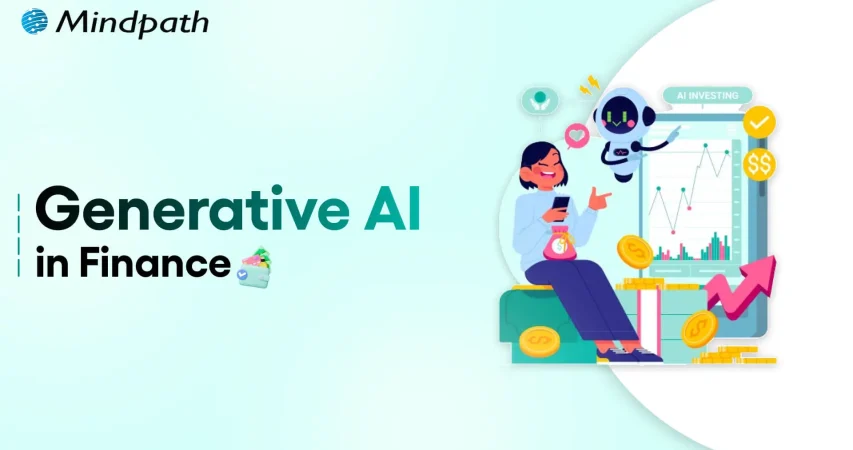
Generative AI in Finance: Unlocking New Opportunities and Innovations

Join our Newsletter!

Featured Posts

Support Is One Click Away

Home

Generative AI in Finance: Unlocking New Opportunities and Innovations

AI in finance

Generative AI in Finance: Unlocking New Opportunities and Innovations

Generative AI revolution is the biggest force of transformation in the financial services industry right now. The capabilities of generative AI mark a significant leap for practical applications of AI in the real world across various sectors. You can find different examples of AI in finance that have been setting new benchmarks for innovation. Banking and financial services companies perceive generative AI as something more than a prevailing technology trend.

A report by McKinsey reveals that generative AI will have a significant impact on the banking and financial services sector. The report mentions that generative AI can deliver additional value of almost $240 billion to $340 billion every year in the banking industry. Companies in the financial services industry must know how generative AI can unlock new opportunities and prepare the foundation for innovation in finance.

Planning to integrate AI into your finance strategy to drive smarter decisions and growth? Mindpath’s AI Development Services provides customized AI solutions that turn data into actionable insights and innovation.

Is Generative AI Right for the Financial Services Sector?

Business leaders in the financial services industry know the challenges and complexities that come in the way of business growth. Starting from the intricacies of digital transformation to the continuous changes in customer habits, finance leaders have to deal with multiple responsibilities. You must know that the adoption of Generative AI for Business in finance creates new opportunities to achieve better efficiency.

You will find many examples of banking and finance companies that have adopted AI and transformed the way they work. Financial service providers have achieved faster budget cycle times and reduction in uncollectible balances with artificial intelligence. As the complexity of financial operations continues growing, companies look up to generative AI for various reasons. Companies in the banking and finance industry can use generative AI to find new opportunities for streamlining workflows with automation.

Planning to deliver highly customized financial services using AI? Learn about AI in personalized banking experiences to discover strategies that improve customer satisfaction and operational efficiency.

Does Generative AI Offer Any Benefits to the Financial Services Industry?

The interplay between AI and finance has created the foundation to achieve many new benchmarks in the industry. With the help of AI, financial institutions can meet emerging expectations of customers and resolve inefficiencies across various financial operations. The applications of generative AI in the domain of financial services offer more than just automation.

1. Enhancing Accuracy

One of the prominent reasons to rely on AI revolves around the assurance of freedom from human errors. The use cases of AI in compliance checks, financial reporting and audits provide the advantage of reduced errors. Artificial intelligence takes care of such tasks where attention to detail is extremely crucial and helps in reducing inconsistencies that may manifest due to human error. AI models can analyze large datasets and find anomalies to ensure strict regulatory compliance. As a result, all stakeholders can fulfill compliance requirements while ensuring better performance.

2. Introducing Hyper-Personalization

Personalization of products and services is one of the crucial measures to improve customer engagement in any industry. Generative AI finance applications can provide hyper-personalized solutions that deliver exactly what customers want. Generative AI can help in obtaining valuable and relevant insights from the financial history, spending patterns and risk profiles of customers. With the help of those insights, financial institutions can offer highly personalized recommendations to customers. For example, AI systems can recommend the ideal investment strategy depending on the portfolio and risk appetite of customers.

Must Read: Generative AI for Customer Service

The biggest strength of artificial intelligence is the capability for real-time data analysis. Financial institutions can leverage this facility to make well informed decisions at a faster pace, using AI in decision making to guide strategy and reduce errors. The use of artificial intelligence for finance helps in navigating volatile markets with more efficiency, where companies have to respond to sudden changes and take decisions instantly. You can find the best example of using AI for improved decision-making in systems that identify early signals of market instability. The ability to identify flaws earlier helps financial institutions follow preventive measures without discrepancies.

4. Optimizing Operational Costs

Cost optimization is a major advantage of applying artificial intelligence in the financial services sector. By automating repetitive and time-consuming tasks, generative AI offers the ideal instrument for cutting operating costs. Generative AI can be used by financial institutions to generate documents, answers common customer service questions and process insurance claims. AI systems also help in reducing costs through automation of mundane tasks that can be completed without human intervention. One of the best examples of cost optimization with AI is visible in the use of AI chatbots for customer service.

Ready to upgrade customer interactions using AI in finance? Discover conversational AI chatbot to learn how intelligent assistants improve efficiency and deliver tailored support.

Unraveling the Use Cases of AI in Financial Services

Many organizations believe that adopting artificial intelligence in financial services is a daunting challenge. Generative AI is a game-changer for many functions in financial institutions with proven and tested use cases. Understanding the use cases of generative AI across different financial operations can help you get a better idea of how to make the most of the technology in practical scenarios.

1. Risk Management

Artificial intelligence delivers the power to create tools that can evaluate market volatility, operational threats and credit risks. The ability to simulate various scenarios with artificial intelligence can help in creating synthetic datasets which provide the foundation for robust risk management strategies.

2. Customer Experience

Generative AI is already playing a vital role in transforming customer experiences with the help of virtual assistants. These assistants leverage artificial intelligence to provide personalized financial advice and resolve the queries of customers. Artificial intelligence is capable of analyzing customer profiles in real-time and offering personalized solutions that guarantee seamless service delivery.

3. Portfolio Optimization

You can also notice the growing influence of AI in financial industry for the use cases in investment. Generative AI can help you created advanced predictive models that provide asset performance analysis and portfolio diversification. Financial advisors can use generative AI to draw simulations of investment outcomes, thereby offering better and more accurate recommendations.

4. Fraud Prevention

The financial services industry is plagued by cases of fraud that lead to losses worth billions of dollars annually. Financial institutions can leverage generative AI to learn from large datasets of transactions to identify anomalies in transaction patterns. It provides the ideal tool for real-time fraud detection, thereby providing a heads up before malicious agents make their move. Generative AI also helps in simulation of different fraud scenarios and fine-tuning algorithms to detect emerging threats.

Want to stay ahead of the curve in AI-driven finance? Discover Gen AI trends to learn how emerging technologies are shaping smarter strategies and innovative solutions.

Success Stories of Generative AI in the World of Finance

The best way to learn how artificial intelligence has revolutionized finance would involve a review of some success stories. The advantages of AI in financial services have garnered the attention of numerous top companies. Companies in the domain of banking and finance need to take inspiration from institutions that have successfully used generative AI to address critical concerns.

Quest IndexGPT, an innovative generative AI solution developed by JP Morgan, has revolutionized the creation of investment indices.

JP Morgan created Quest IndexGPT, a revolutionary tool for creating investment indices by using generative AI. On the other hand, MasterCard leveraged generative AI for creating a proactive fraud detection system. The fraud detection technology helped MasterCard reduce false positives, thereby ensuring seamless customer experiences.

Ready to adopt the latest AI technologies for finance innovation? Explore Generative AI tools to check out how these platforms are reshaping analytics, automation, and personalized services.

Final Thoughts

You can notice the transformative impact of artificial intelligence in the domain of financial services across various areas. The growing use of AI in banking and finance has created new opportunities for transforming the way financial institutions work. In addition, artificial intelligence revolutionizes customer experience and risk management in the finance industry.

Mindpath is one of the leading providers of AI solutions tailored to client expectations. We have been delivering end-to-end generative AI development services for different industries, including the financial services sector. Our experience speaks for itself in the success stories shared by our clients. Book your first consultation with us and achieve new levels of efficiency in the financial services industry.

Related Post

Discover why ReactJS is perfect for Progressive Web App (PWA) development. Learn how Mindpath can help you build high-quality PWAs.
Discover how Multimodal Generative AI enhance creativity, accessibility, and user experiences across industries.
Discover how hiring remote developers can drive startup success by tapping into global talent, enhancing productivity, and reducing costs.

Related Post

Digital Twin in Healthcare

Have you ever wondered how technology can create a virtual copy of your body to improve your health? Imagine a digital version of you that helps doctors predict, diagnose, and treat diseases more effectively. Sounds fascinating, right? This is exactly what Digital Twin technology is achieving in medicine today. But how does it work, and why is it so revolutionary? Let’s explore!  

What Is a Digital Twin?

A digital twin is a virtual representation of a real object, such as a machine, a structure, or even a human body. It is created on a computer and has the same structure and performance as the genuine thing. The digital twin can give insights into how the thing is performing, discover faults, and propose methods to improve by gathering real-time data from sensors linked to the device. For example, a sensor-equipped machine provides data to its digital twin such as energy use, temperature, and performance. This virtual model can then simulate various situations, test solutions, and forecast results without harming the actual equipment. This mix of real-world data and digital technologies enables smarter decision-making, faster issue solving, and improved performance.  

Importance of Digital Twin in Medicine

Digital twin technology is becoming increasingly essential in medicine because it allows doctors and researchers to better comprehend the human body. Doctors can test medications, anticipate how illnesses will proceed, and even schedule surgery more precisely by generating a virtual representation of the patient. This lowers risks and improves outcomes for patients. For example, digital twins can be used to replicate a person’s heart in order to determine the best strategy to treat cardiac disease or to simulate how a new medicine can function without endangering the patient. It also enables healthcare practitioners to personalize therapies, increasing their effectiveness. This unique approach is revolutionizing the way care is given, making it safer and more precise.

Implementations of Digital Twin in Medicine

1. Cancer Care

Digital twin technology is transforming cancer care by allowing physicians to build highly personalized therapies. These virtual models blend a patient’s unique genetic and medical information with the data from other patients. Digital twins can change treatment regimens based on real-time updates and treatment decisions. This is especially effective when cancer returns or does not respond to conventional therapy. A digital twin, for example, can forecast when a tumor will resist a particular medicine and provide other treatments based on the tumor’s unique genetic composition. It can also assist in building treatment strategies that minimize negative side effects by taking into account how a patient’s body absorbs the medications. Digital twins have already demonstrated the effectiveness in predicting treatment results for difficult-to-treat cancer such as triple-negative breast cancer. They can even identify cancer spread (metastasis) by analyzing trends in radiography data over time. This method is laying the groundwork for better, safer, and more successful cancer therapies. 

2. Tracking Immune Health

Digital twin technology is transforming how we understand and regulate immune responses. These virtual models can provide comprehensive insights into autoimmune illnesses and infectious diseases by combining precise information from numerous levels, including molecular, cellular, tissue, organ, and whole-body data. For example, digital twins can predict if a patient’s body would reject a donated organ, allowing doctors to tailor immunosuppressive therapies to lessen the likelihood of rejection. In the event of infectious diseases, particularly during pandemics, digital twins can aid in identifying individuals who are more vulnerable to infections or at risk of serious consequences such as cytokine storms, which can be fatal. Furthermore, digital twins can model how the immune system reacts to immunizations, anticipating both short-term protective effects and long-term immunological memory. This capacity to model immune system behavior makes it simpler to personalize treatment approaches, improve vaccination efficiency, and better manage chronic illnesses. Digital twins are paving the path for more accurate diagnosis and better patient treatment in the future by improving our understanding of immune responses.  

3. Hospital Management

Digital twin technology is also having a big influence on the management of hospitals and nursing homes, enhancing efficiency and patient outcomes. Digital twin systems, which combine data from electronic medical records and wearable devices, can assist healthcare practitioners in providing more personalized and optimized treatment. For example, the Verto Flow platform employs artificial intelligence to collect patient data from numerous sources and assist healthcare practitioners in adjusting treatment regimens in real time. The ThoughtWire platform goes a step further by replicating a patient’s health condition and notifying doctors when a patient is at risk of a life-threatening issue. It can also recommend measures based on these forecasts, so assisting in the prevention of emergencies before they occur. Furthermore, digital twins are being utilized to optimize healthcare workflows. Companies such as GE and Siemens Healthcare are developing digital twins of whole hospital operations, which will allow them to optimize surgical schedules and personnel requirements, perhaps leading to lower patient wait times and improved overall efficiency.  

4. Designing Biological Systems

Synthetic biology is an interesting and quickly evolving science that has enormous promise, especially when paired with digital twin digital twin technology. Advances in DNA synthesis and sequencing have reduced the cost and ease of producing synthetic DNA, while microfluidics allows for the generation of cell-free biological components. These discoveries are consistent with the concept of digital twins, in which virtual models can represent and regulate biological systems. For example, the development of an artificial human heart required considerable input from digital twin technology, which helped design and test the heart before it was manufactured. By merging digital twins with synthetic biology, we can generate autonomic biological modules for a variety of applications, such as smart organs, medicine manufacture, and renewable energy solutions. These biological modules can collaborate with virtual entities on a medical digital twin platform, leveraging methods such as synthetic genetic circuits and optogenetics. The concept of biological computers, in which virtual and physical systems are connected and operated jointly, is becoming increasingly plausible. As we gain a better knowledge of and control over cellular processes, the potential for intelligent biological designs grows, leading to game-changing solutions in healthcare and beyond.  

5. Improving Surgeries

Surgery is an important part of treating many disorders, particularly when there are no viable pharmacological therapies. However, surgical methods and some post-operative therapies can occasionally result in problems and have an impact on patient outcomes. This is where digital twin technology can turn out quite useful. Digital twins can be used in the planning and simulation stages of surgery to anticipate results and prepare for probable complications. For example, in complex procedures such as transcatheter aortic valve replacements, a digital twin can assist determine how minor alterations throughout the treatment can impact the patient’s response. This enables surgeons to anticipate issues and modify the procedure for better results. In the field of orthopedics, digital twins are used to produce 3D models of body components such as the foot and ankle, allowing doctors to simulate procedures and determine the optimal strategy before doing the procedure. This optimizes the process and improves patient recovery, making procedures safer and more efficient. 

Digital Twin Technology at Mindpath

Mindpath utilizes Digital Twin technology to enhance healthcare and other sectors. A digital twin is a virtual copy of a real-world item or system made from data. In healthcare, it assists clinicians in planning procedures, personalizing treatments, and predicting patient reactions to various medicines. By merging real-time data from medical records and wearable devices, digital twins provide improved decision-making and safer treatment. We also use DT technology to improve hospital administration, boost immunological health, and promote synthetic biology research. This contributes to the development of smarter, more efficient systems, which result in improved outcomes in a variety of sectors. 

Wrapping Thought!

Digital Twin technology is changing the landscape of healthcare by allowing for more personalized, efficient, and accurate treatment options. From cancer treatment and immune system control to hospital administration and surgical results, digital twins are assisting physicians and healthcare professionals in making more informed decisions, eventually leading to better patient care. As this technology advances, its potential to transform medicine and other sectors will only increase. At Mindpath, we are happy to include Digital Twin technology into our services, which drives innovation and improves outcomes for healthcare systems globally. With its capacity to model, forecast, and optimize, Digital Twin technology is transforming the future of medicine. 

Ready to innovate with Digital Twin technology?

Partner with Mindpath to enhance healthcare solutions and achieve smarter, safer outcomes.

Explore how Digital Twin technology is revolutionizing healthcare, from personalized treatments to improved surgeries.
web application security

In the fast-paced digital era, a secure web application is the foundation of a reliable online business. Web application security ensures sensitive data remains protected, prevents cyber threats, and supports uninterrupted operations. Without robust protection measures, even high-performing applications are vulnerable to breaches that can disrupt business continuity and compromise user trust.

The importance of web application security goes far beyond preventing attacks. It supports compliance with regulations, protects brand reputation, and ensures consistent user experiences. Without it, businesses risk downtime, financial losses, and reputational harm. By prioritizing robust security strategies, companies position themselves for long-term success in an environment where trust and reliability define competitiveness. Are you interested in knowing more? In this blog, we will walk you through how you can protect your web application while, at the same time, building stronger trust with your customers. Keep reading to explore!

Looking for a web application that prioritizes both performance and security? Our web development services can help you explore how we can help you achieve your business goals.

What is Web Application Security?

When we talk about the definition of application security, we simply mean protecting your web applications from unwanted threats, attacks, and misuse. In other words, it focuses on keeping your applications safe. It guarantees that your data is safe, hackers are kept out of reach, and your online platforms run smoothly without any difficulty or fear. These protections start during the design and development stages of your application and continues even after the application goes live so that it is kept secure over time.

Interestingly, a report from Fortune Business Insights shows that the global application security market was valued at USD 8.86 billion in 2022 and is forecasted to reach USD 25.30 30 billion by 2030. The continued increase shows that the business community is increasingly coming to terms with security as a necessity to protect its operations, to protect sensitive information, and to protect the trust of customers in an online space.

Concerned about rising threats and how AI can help your security strategy? Explore our blog on AI in cybersecurity to discover AI‑driven approaches that boost threat detection and resilience.

Most Common Web Application Threats

Let us have a clear look at some of the most common web application security risks that each and every business should have an idea of, to keep their online platforms safe:

Most Common Web Application Threats

1. Security Misconfiguration

This usually occurs when your web application security settings are wrong or incomplete, leaving the app open to attacks.

2. Broken Access Control

This happens when users can access data or features they should not be allowed to see or use.

3. Cryptographic Failures

This occurs when sensitive data is not encrypted properly, making it easier for attackers to steal.

4. Injection Attacks

This occurs only when attackers insert malicious code into your application through the input fields or forms.

Can a better user interface design also improve security awareness in apps? Discover UI/UX design trends in web application development to learn how thoughtful design can enhance both usability and security.

5. Insecure Design

This usually means that your app’s basic design has weak points that can be easily exploited by hackers.

6. Failures in Logging and Monitoring

When you have security issues that are not logged and monitored, your attacks will go unnoticed.

7. Vulnerable and Outdated Components

This is when your apps use old or unsafe software parts that hackers can target easily.

8. Identification and Authentication Failures

This happens when you have weak login systems, which make it much easier for an attacker to steal your user accounts.

Unsure how the technology you pick affects your application’s security posture? Read our guide on choosing the right tech stack to discover how secure, scalable technologies support safer web app development.

The Importance of Web Application Security

Robust web app protection is absolutely vital to protect your organization from online attacks and data loss. When you pay for your web app security, you are protecting sensitive information and building trust with your customers, while ensuring your operations are running smoothly.

The Importance of Web Application Security

1. Safeguarding Valuable Information

Web applications collect sensitive information such as customer data, payment information, and company documentation. Any exposed information by attackers can be stolen and improperly used. Good web application security utilizes encryption, secure storage, and restricted access to protect the information.

2. Building and Keeping Customer Trust

When people use your online services, they trust you with their private information. A breach of security can cause that trust to break and hurt your business’s reputation. By focusing on web application security, you contribute to two goals: to show the customer that privacy and safety are important to you.

3. Protecting Against Financial Loss

Cyberattacks can cause massive damage to finances, from stolen funds to expensive recovery steps to legal fees, and also regulatory fines. A proper investment in web app security protects those risks and your profits.

4. Meeting Legal and Industry Standards

Numerous sectors must comply with strict data protection requirements. Failing to meet these requirements can result in costly fines and a loss of reputation. The web security basics and continual assurance will demonstrate that your web secure application meets these requirements..

5. Preserving Your Brand Reputation

A single security incident can tarnish your brand identity for years. Once lost, customers may not trust your company again, and negative word of mouth spreads quickly. By prioritizing web application security, you can avoid this type of loss and continue to preserve brand integrity.

6. Staying Ahead of Cyber Threats

Cybercriminals are always trying to exploit any weaknesses in an application. Regular web application scanning and updates may close off the weaknesses before an attacker finds them. Using a trusted web application vulnerability scanner allows you to improve your system.

7. Ensuring Service Continuity

Some ransomware and malware attacks are meant to stop or disrupt your online services. DDoS protection, load balancing, and secure configuration can keep your platform running. There are reliable web security applications to protect against these problems and keep your business producing.

Want to make sure security is built into every phase of your web development process? Explore our web app development roadmap for 2026 to discover how planning with security in mind improves reliability and trust.

Essential Best Practices for Strong Web Application Security

Securing your online properties requires more than basic protection. By implementing web application security best practices, organizations can reduce risks, better protect sensitive data, and provide a safer, trusted experience for each user.

Best Practices for Strong Web Application Security

1. Strong API Gateway Controls

APIs should be protected with advanced rate limiting that adapts to user behavior, not just request counts. Tools like Kong or Envoy help apply different limits per endpoint while blocking abusive traffic patterns without slowing legitimate users.

2. Robust Input Validation

Validation must match the exact place where data is used, such as in SQL, HTML, or JavaScript. This means building rules for each context and scanning all inputs like headers, cookies, and hidden fields to block malicious payloads.

3. Layered SSRF Protection

SSRF attacks can trick servers into accessing internal systems or cloud metadata. Use strict allowlists, block private IP ranges, and inspect resolved IPs to prevent bypass tricks hidden in DNS lookups.

4. Dependency Risk Management

Not all vulnerabilities in dependencies are equally dangerous. Context-aware scanners like OSV or npm-audit help you find and fix the risks that truly matter to your application’s security.

5. Implement Zero Trust Access

Never assume a request inside your network is safe. Segment services, enforce mutual TLS, and verify identity for every request to reduce the risk of internal compromise.

Concerned about app vulnerabilities? Read application security best practices to learn proven ways to strengthen security across platforms.

Are You Ready to Strengthen Your Web Application Security?

In today’s digital world, investing in strong web application security is no longer optional. By understanding common threats and implementing proven best practices, you protect sensitive data, maintain customer trust, and keep your online services running without disruption. The earlier you act, the stronger your defense against costly cyberattacks will be.

At Mindpath, we create secure, high-performing web applications designed to withstand evolving cyber threats. Our web application development process integrates advanced web application security measures from planning to deployment, ensuring your platform is protected and reliable. With a tailored approach, we help your business deliver safe, seamless user experiences while meeting compliance and performance goals.

ReactJS in Social Media

Are you wondering how social media platforms manage to stay fast, interactive, and user-friendly? The secret often lies in the powerful framework behind them—ReactJS. With its ability to build dynamic and responsive user interfaces, ReactJS has become a top choice for developers creating social media apps. But how exactly does it help?  

In today’s fast-paced digital environment, social media platforms must provide smooth, responsive, and engaging user experiences to remain competitive. ReactJS  has emerged as an essential tool for constructing such platforms, providing a robust foundation for developing dynamic, high-performance apps. With its component-based design and quick rendering capabilities, ReactJS allows developers to create dynamic user interfaces that can manage enormous amounts of data and advanced functionality without sacrificing speed. This makes it an excellent alternative for social media sites that want to create a seamless and engaging user experience. 

So, let’s dive into how ReactJS is a game-changer in social media platform development. 

Guide to Build Social Media Platform Development Using ReactJS

1. Project Setup

When launching your social media platform, it’s essential to first determine what makes your network unique. Consider the type of interactions you wish to emphasize and the audience you are trying to reach. This will help you select which features to implement and will steer the general path of your project. Next, you’ll need to create your React project. Tools like Create React project can make this easier by offering a pre-built structure for your project, allowing you to focus on creating rather than setting things up from the beginning. Social media sites require a system to handle the vast amounts of data that are constantly changing, such as user profiles, postings, and comments. Using state management tools such as Redux or the Context API will help you keep everything organized and running smoothly as your platform grows. 

2. Creating UI Components

When developing the user interface for your social media platform, begin by creating components that can be utilized across the program. Examples include user profiles, post cards, and the feed display. Breaking down the UI into these modular components will ensure consistency and make future changes easy. Reusable components improve productivity by allowing you to make changes without impacting the entire project. 

Next, prioritize adding the key functionality that any social network needs, such as user registration, login, and profile editing. These are necessary for users to establish accounts and engage with the platform. Furthermore, combining password recovery and email verification guarantees customers have a smooth and safe experience. Once these foundational functions are in place, you can add more complex features such as friend requests or messaging to increase user engagement. 

3. Handling Data & APIs

When developing a social media site using ReactJS, it is crucial to address the backend. While ReactJS handles the front-end, your platform will require a powerful backend to store user data, manage features such as image uploads, and deliver alerts. Using Node.js and a database like MongoDB offers the infrastructure required to implement these functions. 

API integration is required to connect the frontend and backend. These APIs will enable your app to collect user data, create posts, and manage user interactions. Tools like Axios and Fetch make it simple to connect with these APIs and ensure smooth communication between the front and backend. Security is an important feature of every social media platform. To safeguard user information and guarantee a safe environment, secure authentication methods, the encryption of sensitive data, and the establishment of correct authorization processes must be implemented. 

4. Adding Social Features

Adding the social elements that set your platform apart is now the perfect way to make it come to life. Begin by providing key interactions such as post creation and display, comment and like functionality, and the ability to follow or connect with others. These essential elements are at the core of each social media network, driving user engagement. 

To take things a step further, you can offer real-time updates. You can employ tools like Socket.io or WebSockets to give rapid alerts for actions such as comments, likes, and messages. This keeps users interested and makes the site appear active and alive. If you want a more sophisticated experience, think about including elements that promote deeper inquiry and connections. You can establish user groups or communities, add search features to locate content and individuals, or enable direct messaging for private chats. These features improve user engagement, making your platform more engaging and interactive. 

5. Testing & Launching

To guarantee that your social media network functions effectively, conduct thorough testing. Check every area of your application, from the user interface to data flow and API connection, to ensure that users have a smooth experience. Using tools such as Jest or React Testing Library can assist you quickly find and resolve issues, making the testing process more dependable and organized. When your software is polished and ready, it’s time to release it to the public. Deployment platforms such as Netlify or Heroku provide easy and effective ways to host your application, allowing your users to access it easily. With thorough testing and deployment, your social network will be ready to provide an excellent experience to its users. 

Also Read: ReactJS – Best Choice for Progressive Web App Development

How Can Mindpath Help?

At Mindpath, we specialize in building powerful and scalable web applications, including social media platforms, using ReactJS. Our experienced team of developers can help you design and develop a feature-rich, user-friendly platform tailored to your unique needs. Whether it’s creating reusable UI components, implementing secure backend integration, or adding advanced social features like real-time updates and messaging, we’ve got you covered. We also ensure rigorous testing and seamless deployment, so your platform is reliable and ready to impress your audience. 

Wrapping Note!

ReactJS is a game-changer for social media platform development, offering speed, scalability, and flexibility to create dynamic and engaging user experiences. Its powerful tools make it easier to design user-friendly interfaces, integrate robust backend systems, and implement essential social features. If you’re ready to turn your vision into reality, Mindpath is here to help. With our ReactJS expertise, we’ll create a feature-rich, high-performance platform tailored to your needs. Let’s build something exceptional together! 

Ready to Build Your Social Media Platform?

Partner with Mindpath to create a scalable, feature-rich platform powered by ReactJS.

Discover how ReactJS powers dynamic social media platforms with seamless UI, real-time updates, and scalability.