How Custom Mobile Application Development Drive Digital Transformation?

Join our Newsletter!

Featured Posts

Support Is One Click Away

Home

How Custom Mobile Application Development Drive Digital Transformation?

Custom mobile application development

How Custom Mobile Application Development Drive Digital Transformation?

Businesses today, in a fast-moving digital world, are always trying to innovate so they can stay ahead. Custom mobile application development helps drive the change in how companies interact with their customers and improve internal operations. Try to imagine having a solution that is just for your business and will improve efficiency, engagement, and accelerate growth. Developing an app with a solution for the goals of your business has become a strategic need for any business wanting to be an industry leader.

As technology develops, the demand for personalized digital experiences grows, and the expectations of customers rise. If organizations want to provide authentic value, they can no longer select a generic approach. With custom mobile application development services, organizations gain the ability to adjust quickly, have deep functionality, and create seamless experiences that genuinely resonate. In this blog, we will discuss how those applications form the basis of digital transformation and change the way businesses are operating in a connected world.

Unlock new ways of connecting with users that help your business reach greater heights with Mindpath’s mobile app development services, which provide solutions according to the individual business demands.

Overview of Custom Mobile Application Development

Custom mobile app development means developing customized mobile applications that align with the company’s unique goals and workflow. A custom mobile app development company constructs your app from the ground up, giving you total control of features, design, and experience, while they supply the solutions to maximize efficiency and growth.

The process enables organizations to provide seamless integration of the app with their current systems with full confidence in security and scalability. Throughout the process, from planning and designing to developing and supporting, every phase of the app is managed to achieve business requirements and provide a smooth, entertaining experience for users.

How Does Custom Mobile Application Development Drive Digital Transformation?

Custom mobile app development is changing the way businesses think about tech and growth. It allows organizations to embrace newer solutions to replace their technologies that serve the company’s individual goals and strategies in this digital age.

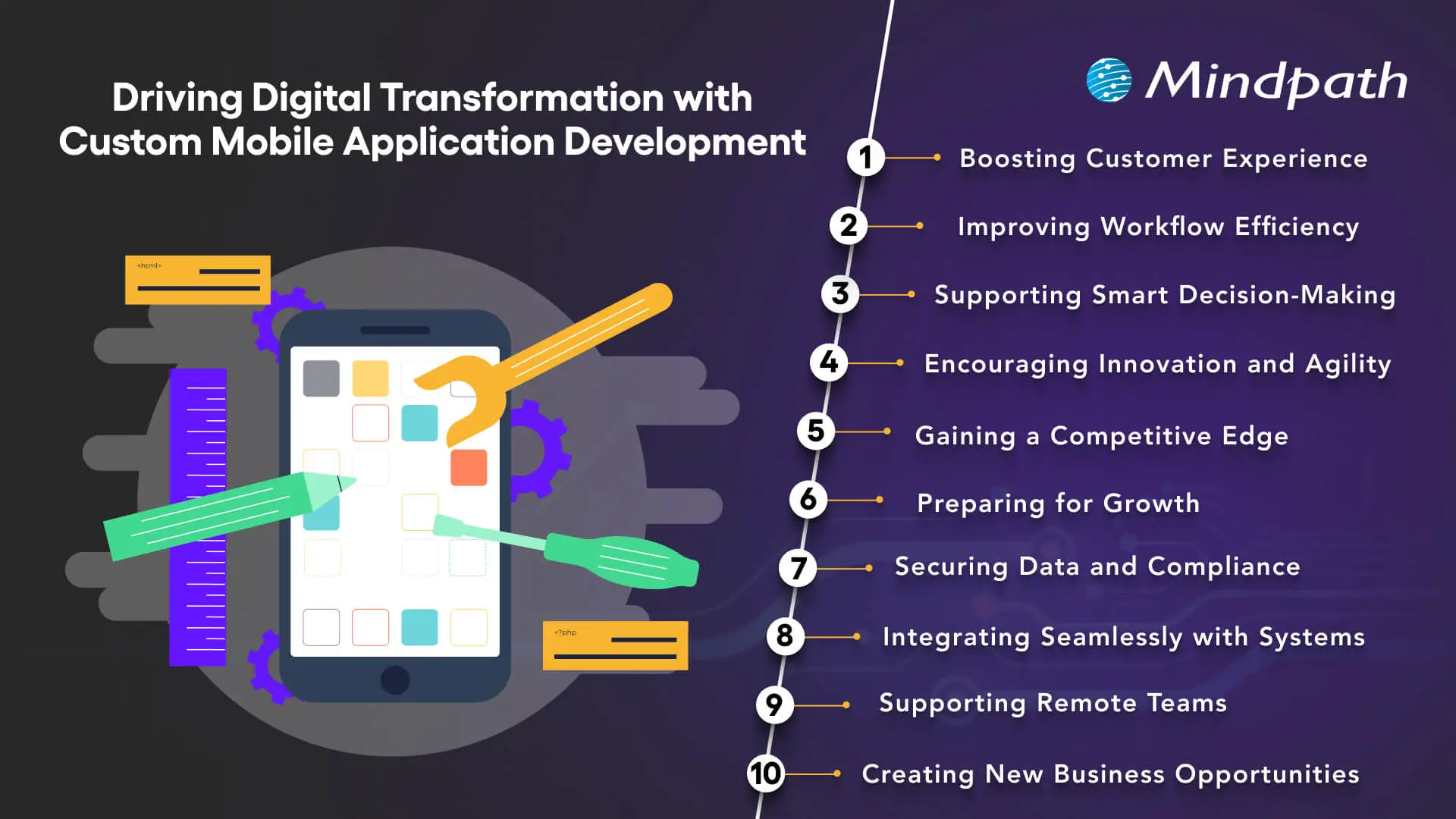
Driving Digital Transformation with Custom Mobile Application Development

1. Boosting Customer Experience

By using custom mobile application development, a company can have an app that is unique and offers a different experience for the users. These applications are the most convenient way for the customers to interact with the company, get a response, and receive the service. If a business adopts a user-centric design, it is only a matter of time before they will see their customers being more loyal and having a stronger bond with them.

2. Improving Workflow Efficiency

Personalized applications simplify core business operations through the automation of monotonous tasks and the minimization of errors. As a result, the company productivity is elevated and operational expenses are lowered. Enterprises thus become winners of facilitated work processes and a better structured system.

3. Supporting Smart Decision-Making

Custom app development enables real-time data collection and analysis. Companies have the ability to monitor consumer behavior, industry trends, and their own performance in an easy way. Such a data-driven strategy is a great source of power for decision-makers, as it enables them to take correct and prompt decisions.

Want to understand which tools and frameworks power successful mobile apps and accelerate digital transformation? Explore our detailed guide on mobile app development technologies to discover the platforms and tech stacks driving innovation.

4. Encouraging Innovation and Agility

By using tailored solutions, businesses have the possibility to create exclusive features that tackle issues directly. Such freedom from constraints promotes creativity and makes it possible for the company to adjust to the changes in the market swiftly. In other words, companies have the opportunity to be ahead of their competitors in the sense that they can try out new things and make their moves faster.

5. Gaining a Competitive Edge

Custom applications are a great way for companies to be different from the rest of the businesses by giving them exclusive features and a better user experience. Such differentiation leads to a powerful market presence. A good app is the company’s strongest weapon in the battle for customers against competitors.

6. Preparing for Growth

Custom mobile application development is a wise decision when considering business growth because it guarantees that the app will be scalable. It is very easy to add new features or make a service available to more users. The company can grow with no problem of performance or user experience being compromised.

Must Read: AI in Mobile Apps

7. Securing Data and Compliance

Custom apps may have the most sophisticated security features that are specifically tailored to meet the needs of different industries. Such features not only secure sensitive information but also help in maintaining compliance with the set regulations. Companies can go about their operations without any worries that their data is secure.

8. Integrating Seamlessly with Systems

Custom apps built using the right mobile app development tools can be linked to existing corporate software and platforms without any problems. As a result, this leads to the creation of a single digital ecosystem that spans across different tools. Information exchange between various systems becomes very easy. Hence, the mistake rate is reduced, and the speed of work is increased.

9. Supporting Remote Teams

With the help of mobile application development platforms, employees get access to tools and information from anywhere. This provision of remote access is a great boost to collaboration, which can now happen across different locations. It also allows work arrangements to be flexible. Teams are thus not being unproductive as they are not bound to a single office.

10. Creating New Business Opportunities

The creation of custom apps may result in a business gaining revenue streams through subscription fees, in-app purchases, or new digital models. Companies can now dig into newer ways of monetizing their services. By means of website and mobile app development, the business can ensure that these opportunities are indeed going in line with their overall strategy.

Looking to future-proof your mobile app strategy? Discover the latest insights in our blog on mobile app development trends to see how emerging technologies are redefining digital experiences.

Want to Drive Growth with Custom Mobile Apps?

Custom mobile application development is a powerful tool for businesses looking to innovate and stay competitive. Tailored apps improve efficiency, enhance customer experience, and provide data-driven insights that guide smarter decisions. By adopting custom solutions, organizations can drive growth, strengthen their market presence, and create seamless digital experiences that truly align with their goals.

At Mindpath, we offer professional custom mobile application development services to help businesses achieve these results. Our team builds scalable, secure, and feature-rich mobile applications that integrate smoothly with existing systems. We focus on delivering solutions that match your business needs and foster innovation. We provide a superior user experience across all platforms.

Related Post

How much does hiring a ReactJS developer cost? Learn about factors affecting rates, and how to find the best talent within your budget.

Related Post

Node.js Developers in Canada

Are you looking for a skilled Node.js developer in Canada to bring your project to life? Do you need a reliable expert who can build fast, scalable, and high-performing applications? Finding the right developer can be challenging, but with the right approach, you can hire a top Node.js professional who fits your needs perfectly.  

Hiring a skilled Node.js developer in Canada is essential for businesses looking to build fast, scalable, and efficient applications. With its non-blocking architecture and real-time capabilities, Node.js is a powerful choice for web and software development. Whether you’re developing a dynamic website, an API-driven platform, or a complex enterprise solution, finding the right developer ensures seamless performance and long-term success. Understanding the key factors in hiring a Node.js expert will help you make an informed decision and achieve the best results for your project. 

Let’s explore how you can make the best choice! 

Steps to Hire Node.js Developers in Canada

1. Define Your Project Requirements

To hire the right Node.js developer, you must first define your project’s technical and business needs. Outline the core functionalities, expected performance, and scalability requirements of your application. Identify the frameworks and tools you want to use, such as Express.js, Nest.js, or MongoDB, and specify whether the role requires front-end expertise alongside back-end development. Additionally, determine the level of experience required—junior developers handle basic tasks, mid-level developers work on feature-rich applications, while senior developers manage architecture and complex integrations. Having a well-documented project scope ensures that candidates understand your expectations from the start. A detailed job description outlining skills, responsibilities, and project goals will help attract the right talent. Without clarity, the hiring process can become inefficient, leading to mismatches in skills and expectations. A structured approach helps filter candidates early and ensures that only those with relevant expertise apply.

2. Source Qualified Candidates

Finding skilled Node.js developers in Canada requires using multiple recruitment channels. Start by posting job listings on platforms like LinkedIn, Indeed, and Glassdoor, which are popular among Canadian job seekers. Consider using tech-specific job boards such as Stack Overflow Jobs or GitHub Jobs to target professionals with strong development experience. Additionally, networking within Canada’s growing tech community can help you connect with skilled developers—attend industry conferences, local meetups, and online forums to discover potential candidates. If you prefer a more streamlined approach, working with tech recruitment agencies can save time by providing pre-screened candidates. Another option is hiring freelancers through platforms like Toptal or Upwork but ensure that remote hiring aligns with your business needs and legal considerations. A strong sourcing strategy increases the likelihood of finding a developer who meets both your technical and cultural requirements, ensuring a smoother hiring process. 

3. Conduct Technical Screening

After gathering applications, the next step is to assess candidates based on their technical skills and experience. Start with a resume review, focusing on past projects, relevant experience, and familiarity with the required Node.js frameworks. Candidates should demonstrate hands-on experience in building scalable applications, working with APIs, and optimizing back-end performance. To ensure technical proficiency, conduct coding assessments through platforms like HackerRank or Codility. These tests evaluate problem-solving abilities, efficiency in writing clean code, and understanding of Node.js fundamentals. Additionally, assess candidates’ experience with database management, security best practices, and cloud-based deployments. An effective screening process filters out underqualified applicants early, allowing only the most capable developers to move forward. By implementing structured assessments, you can streamline hiring and ensure that your chosen developer has the technical expertise necessary to contribute effectively to your project. 

4. Assess Technical and Problem-Solving Skills

Once candidates pass the initial screening, conduct in-depth technical interviews to evaluate their problem-solving abilities. Ask questions about key Node.js concepts such as asynchronous programming, event-driven architecture, API development, and database management. Provide real-world scenarios related to your project and assess how they would approach challenges. A practical coding exercise or take-home assignment can help evaluate their thought process and coding efficiency. In addition to technical expertise, consider their ability to design scalable solutions and optimize application performance. Discuss their experience with DevOps practices, cloud computing, and microservices architecture if relevant to your project. Soft skills are equally important—effective communication, adaptability, and teamwork play a significant role in long-term success. The goal is to hire a developer who not only writes efficient code but also collaborates well with your team and adapts to evolving project needs. 

5. Make the Right Hiring Decision

After evaluating technical skills, problem-solving abilities, and soft skills, the final step is making an informed hiring decision. Compare candidates based on performance in technical interviews, problem-solving assessments, and cultural fit. Strong communication and teamwork are crucial, as developers often collaborate with designers, project managers, and other team members. Additionally, check references to validate past work experience and reliability. When making an offer, consider industry-standard salaries in Canada and ensure compliance with local labor laws. Offering a competitive package, including professional development opportunities and flexible work arrangements, can help attract top talent. If hiring full-time isn’t feasible, explore freelance or contract-based options. A well-structured hiring process ensures you bring in a skilled Node.js developer who aligns with your technical needs and business goals, setting your project up for long-term success. 

Looking to hire top Node.js developers in Canada? At Mindpath, we provide skilled developers who specialize in building high-performance, scalable applications tailored to your business needs. Whether you need full-time developers or project-based support, our experts ensure seamless development with industry-leading technologies. 

Let’s bring your vision to life! Contact Mindpath today to hire the best Node.js talent for your next project. 

Read our next blog: Factors to Consider While Hiring NodeJS Developers in Canada 


Hire skilled Node.js developers in Canada with our step-by-step guide. Learn how to source, screen, and hire top talent for your project.
ai solutions for small businesses

Some business owners still think artificial intelligence, or AI, is only for big tech companies. Maybe it is true. But it has also become a crucial element for startups and small businesses. In fact, AI solutions for small businesses are helping them work faster, efficiently and smarter.

With this, you can easily use AI for customer service, simplify operations and scale faster. This blog will decode the AI solutions for business and answer the important question of how it can be used in startups. Besides, you will also get to know how to get started with this. 

Want to use AI more effectively but don’t know how to implement it affordably? Mindpath’s AI development services build practical, budget-friendly AI solutions that fit your business goals and accelerate your growth.

What are AI Solutions for Small Businesses?

Artificial intelligence may sound complex, but for startups and small businesses, it is surprisingly very practical. AI solutions for small businesses are truly a game-changer. These tools combine language processing and machine learning to help in business operations.  These tools can greatly streamline your workflows, improve communication with customers and offer detailed reports. Most importantly, they automate various tasks. Different from massive enterprise systems, AI tools for small businesses are generally affordable, accessible, and scalable. That’s why more small business owners are using AI tools to attain more with fewer resources. As per a study by Entrepreneur.com, nearly 68 per cent of small businesses have deployed AI to manage their daily business operations. 

Curious about the technology behind modern AI solutions? Explore top AI Models to understand which models power today’s most effective business applications.

Benefits of AI Solutions for Small Businesses and Startups

Small businesses generally experience a shortage of resources, such as insufficient personnel and a limited budget. The introduction of AI became an excellent solution. Read on to understand the benefits it offers. 

1. Increased productivity

AI tools reduce manual errors and streamline workflows. Besides, the support for smarter task management. This, in turn, helps a team to focus on other important tasks. 

2. Enhanced Engagement

With the help of responsive support, personalised marketing and smarter chatbots, you can create meaningful interactions. It will lead to higher satisfaction and increased loyalty. 

3. Task Automation

You can easily automate various repetitive tasks such as scheduling, invoicing, data entry and more. Your team can invest more time in customer relationships and strategy. 

4. Improved Decision Making

AI in decision-making helps provide you with predictive analytics and detailed insights. Based on these reports, you can come up with informed decisions with maximum clarity. 

By using modern AI solutions, small businesses can operate like a large business. And handling complex tasks would be easier for them. 

Wondering how AI can impact small business growth? Read detailed benefits of AI to discover how AI improves efficiency, productivity, and decision-making.

Best AI Solutions Small Businesses Can Use

No matter whether you have an e-commerce store or a small boutique, if you are using the right AI solutions or tools, you can scale faster. Let us guide you with this by suggesting some of the best tools you can opt for. 

1. ChatGPT

We are all well aware of this tool. It helps businesses generate content and automate customer service. You can deploy it to draft tailored emails and write blogs. Furthermore, it can be trained to answer common FAQs. By lowering workload and enhancing communication, this tool can help your team to offer consistent and quick support. 

Curious how tools like ChatGPT work? Discover our Large Language Models (LLMs) blog to learn how LLMs help automate content, communication, and workflows.

2. Microsoft 365 Copilot

It is designed to add the functionalities of generative AI into various Office applications. The tool supports MS Outlook, Word, Teams, etc. Using this, startups can efficiently automate various tasks, including data analysis, content generation and email drafting. When used with Excel, it can detect business trends by analysing data. This saves time and increases productivity. 

3. HubSpot AI

It is designed to help businesses streamline their marketing operations. For example, it can automate customer segmentation, email campaigns, and lead scoring. Furthermore, the tool can analyse the behaviour of customers and generate tailored content. On the other hand, its marketing and CRM platform can help small businesses simplify outreach and scale easily. 

4. Shopify Sidekick

Shopify Sidekick is a powerful AI assistant that can automate customer queries and store management. Besides, it can help in analytics reporting. By deploying this for your online store, you can answer common customer questions and detect popular products. 

5. Grammarly and Superhuman Go

Grammarly is a popular AI writing assistant that works well in checking style, clarity and grammar across documents, blogs, emails and more. Superhuman Go, a part of Grammarly, can suggest replies, summarise reports or threads and speed up email writing. Using these tools, small businesses can write professional business proposals, emails as well as marketing copy. 

Looking to go beyond writing assistance and create content? Explore generative AI tools for content creation to see how small businesses use AI to generate high-quality content.

6. Canva Magic Studio

This AI-powered solution can generate various marketing content based on your inputs. It helps in creating social media posts, videos, graphics and more. You can also use it to create logos, promotional flyers, invitations, etc. It’s simple to use, and you can create stunning graphics without the help of professional designers. 

7. Bookkeeping.ai

Managing invoicing and bookkeeping is a complex and time-consuming task. What if you can automate these tasks? Well, this is possible through Bookkeeping.ai. The tools can reconcile various accounts, categorise transactions and create detailed reports. With this tool, you can lower the risk of errors and avoid financial losses. Without hiring a dedicated accountant, you can make financial management easier for your small business. 

8. Zendesk AI

You all know that customer experience is vital for every business. If you are looking for an ideal AI solution for this, give Zendesk AI a try. It offers customer chatbots, automated ticketing and human-like responses. Apart from this, it can categorize as well as prioritize support tickets, detect trends and offer data-driven recommendations. All these things will lead to increased customer satisfaction. 

9. Tableau Pulse

Data-driven decision-making has become a new standard for every business. Small businesses can use Tableau Pulse to visualize key trends, and project demand. Besides, it helps interpret complex marketing and financial data. Your marketing team can use it to analyze multiple KPIs, driving growth and engagement. Tableau Pulse has simplified business intelligence for non-technical users. 

10. Buffer

Buffer has made social media management simple and efficient. It allows businesses to post on different social media platforms from a single dashboard. Buffer comes equipped with a built-in AI assistant that can produce engaging content and help your team brainstorm new ideas. It is an excellent option for lean teams that want to ensure a consistent online presence. 

Curious about the different forms of artificial intelligence behind such tools? Read types of AI to understand ANI, AGI, and ASI and how each powers modern business applications.

11. Lumen 5

AI solutions for small businesses like Lumen 5 have significantly reduced the obstacle to video creation. Video is an effective way to reach target customer, and small businesses can use it to promote their brands using engaging videos. It comes with a text-to-video tool, and you can generate a video from your scripts or blog posts. Besides, it has a huge media library as well as voiceover options. Within a few minutes, you can create a short professional video for your brand. 

With the right AI tools for small businesses, you will be able to automate, scale, and optimize workflows. In fact, these tools are your secret weapon for managing tasks smarter.

The Future of AI Solutions for Small Businesses

It can be said that AI solutions for small businesses are getting more accessible and powerful. The more advanced models are unlocking new opportunities for startups and businesses. With time, pre-trained models will become common in different industries. What’s more? Edge AI will facilitate offline functionalities. 

Experts have also predicted that chatbots and voice assistants will behave more naturally. That means users will enjoy human-like interactions. We may also see massive integration of artificial intelligence with low-code platforms. Small businesses that adopt AI solutions early will surely enjoy a competitive edge in innovation, as well as efficiency. 

Want to improve real-time customer interactions? Explore conversational AI to learn how AI-powered chat and voice assistants help businesses deliver faster and more personalised conversations.

AI Solutions- Supporting Small Businesses to Expand

AI solutions for small businesses and startups are truly reshaping how they compete, operate and grow. On the other hand, AI solutions startups are supporting innovation by offering intelligent and scalable tools that can help these businesses achieve their desired goals. 

Are you thinking about deploying these modern tools to support your business operations? Well, you have made an excellent decision. But to leverage the full power of AI tools, you need to choose a trusted partner like Mindpath. We are here to assist businesses in choosing the right tools. With our tailored AI development services, you can easily unlock new levels of efficiency and impact.  

What if you could manage your IT infrastructure with the same ease and precision as writing code? Imagine deploying servers, configuring networks, and managing resources through a few lines of code instead of manual processes. Sounds revolutionary, right? This is exactly what Infrastructure as Code (IaC) brings to the table. But how does it work? Why is it transforming the way we handle IT operations? In this blog, let’s explore the fundamentals of IaC, its benefits, and why it’s becoming a cornerstone of modern DevOps practices. So, let’s dive in! 

What is Infrastructure as Code (IaC)?

Infrastructure as Code (IaC) is a method of configuring and managing your IT infrastructure, such as servers, databases, and storage, using code rather than doing everything manually. It’s similar to sending directions to a computer so it can complete the setup for you. When creating and running applications, developers use a variety of tools and mechanisms to collaborate. This encompasses operating systems, databases, and storage. Normally, putting things up manually takes a long time and can lead to errors, especially when working on large projects. With IaC, you just create a code file that explains how your system should appear and function. The tools will then create and manage everything for you. This saves time, reduces mistakes, and facilitates rapid updates or fixes. Businesses utilize IaC to save money, prevent risks, and respond quickly to new possibilities.  

Advantages of Infrastructure as Code (IaC)

1. Speedy Deployments

Infrastructure as Code (IaC) makes deployment quicker and easier. Instead of manually configuring systems, you can use a single command to create the full environment in a few minutes. This is especially useful for startups and small enterprises that need to move quickly while staying under budget. 

Fast deployment is also vital for testing and development. Developers can rapidly construct test environments that seem identical to the real system. This allows them to devote more time to essential responsibilities such as detecting and fixing problems, evaluating how the system manages high traffic, and enhancing security. By reducing time and effort, IaC allows teams to focus on developing better apps and delivering them faster. It keeps projects on track, increases productivity, and allows firms to adapt swiftly to changes or new possibilities. Whether you’re creating a small app or managing a massive system, IaC makes it easier and faster to complete tasks.  

2. Reduced Risks

Manually configuring and administering systems can give rise to errors since it depends primarily on human labor. Repeating the same procedure increases the likelihood of mistakes and adds additional workload to engineering teams. It can also make addressing or debugging problems more difficult and time-consuming. 

Infrastructure as Code (IaC) reduces these risks by automating the process and ensuring consistency. Instead of depending on a single person’s knowledge to handle crucial systems, IaC keeps all of the relevant facts in code that is accessible to the whole team. This makes infrastructure easier to understand, share, and administer, even if team members leave the organization. Companies can use IaC to reduce mistakes, boost cooperation, and guarantee their systems are always dependable and secure. This not only saves time and effort, but also instills trust in the infrastructure, making it easier to adapt and develop as needed.  

3. Enhanced Security and Quick Recovery

Infrastructure as Code (IaC) improves system security and recoverability. Security measures can be included directly into the system setup process when utilizing code. This guarantees that every deployment is protected without requiring additional evaluations or permissions. If a company’s security standards are updated, the changes can be immediately deployed across all systems via code, ensuring that everything remains consistent and secure. IaC also helps with recovery planning by making it easier to reconstruct systems in the event of a failure. While this strategy may take somewhat longer than other ways, it assures that systems are rebuilt safely and correctly. Businesses can apply IaC to build a solid security foundation and prepare for situations of crisis, all while lowering risks and saving time. 

4. Boosted Operational Efficiency

Infrastructure as Code (IaC) increases the efficiency and productivity of developers, architects, and administrators. Complex cloud systems can be deployed significantly faster using pre-configured IaC components, reducing total development time. One of the primary advantages of IaC is that it provides uniform conditions across several teams. Multiple teams, including development, security, QA, and user testing, can collaborate in synchronized environments using a simple script. This allows everyone to make progress simultaneously, rather than waiting for one phase to finish before going on to the next.  

IaC also promotes continuous integration and continuous delivery (CI/CD) processes, which enable teams to deploy new features or upgrades more rapidly and efficiently. Additionally, IaC makes it simple to automatically shut down environments that are no longer in use, lowering wasteful expenditures and keeping the cloud infrastructure lean. This enables firms to expand and manage their systems more efficiently, while preserving efficiency and lowering operating costs. Ultimately, IaC simplifies procedures, lowers human mistakes, and allows teams to operate more quickly, intelligently, and cooperatively. 

5. Greater Accountability

In the past, engineering teams had to manually record their work for a long period in order to guarantee seamless communication, prevent delays, and handle issues like errors and staff turnover. With Infrastructure as Code (IaC), this is no longer required. Instead of depending on elaborate documentation, all changes are recorded immediately in the source code repository. 

Every modification is explicitly tracked using version control, which shows who made the change and when. This makes it simple to track changes, identify issues, and comprehend the context around them. If an issue emerges, it is straightforward to identify the cause of the problem and who should be approached for clarification. IaC enhances accountability by making all activities public and traceable, ensuring that everyone on the team is on the same page, and enabling teams to collaborate more effectively. 

How Can Mindpath Help in Infrastructure as Code (IaC)?

At Mindpath, we can assist you with leveraging Infrastructure as Code (IaC) to streamline and protect your IT processes. We use IaC to automate system setup and administration, resulting in a more consistent, dependable, and manageable infrastructure. Our staff can create and manage the code that specifies your infrastructure, eliminating the need for time-consuming manual configurations. With IaC, we ensure that your systems are swiftly installed, updated, and fully protected, while minimizing risks and human error. We help you design environments that are simple to reproduce and scale, allowing your development, security, and testing teams to collaborate effortlessly. 

Wrapping Note!

Infrastructure as Code (IaC) is revolutionizing the way IT infrastructure is managed by automating processes, reducing human errors, and enabling faster, more secure deployments. By adopting IaC, organizations can achieve greater operational efficiency, boost security, and ensure better collaboration among teams, all while minimizing risks. As businesses continue to scale and adapt to new challenges, IaC is becoming an essential practice in modern DevOps strategies. At Mindpath, we are dedicated to helping you implement IaC effectively, making your infrastructure more streamlined, reliable, and scalable. 

Ready to streamline your IT infrastructure with Infrastructure as Code?

Let Mindpath help you optimize efficiency, security, and scalability.

Discover how Infrastructure as Code (IaC) improves IT operations with faster deployments, enhanced security, and increased efficiency.