React Roadmap for 2026: Beginner to Advanced Level 

Join our Newsletter!

Featured Posts

Support Is One Click Away

Home

React Roadmap for 2026: Beginner to Advanced Level 

React Roadmap

React Roadmap for 2026: Beginner to Advanced Level 

React is one of the most powerful and useful JavaScript libraries that developers around the world are using to build amazing web applications. ReactJS allows developers to create fast, interactive user interfaces for websites and apps, and has even improved their workflows. When you have the intention to progress your skills or improve your existing projects, a React roadmap can help you navigate what to learn next. Rather than blindly choosing where to begin and what is most important, a roadmap allows you to advance in your learning with confidence and real intent.

React trends in 2026 are expanding forward with new capabilities such as server components, rendering methods, and development tools, to make learning React more valuable for new and expert users. Seeing how to use your time wisely and knowing what you may look at for a specific reason helps to save you time, but also helps to make modern applications. In this blog, you will discover a step-by-step process of learning, which can simplify mastering and using React in a project. Let’s get started!

If you’re planning to leverage React in your next project, our ReactJS development services can help you in creating modern, scalable web applications meeting your business goals.

Need for React Roadmap

It’s essential to have a clear learning plan when starting with React. A ReactJS roadmap for beginners allows you to learn complex subjects such as JSX, components, state, and hooks by breaking these subjects down into smaller, more manageable pieces. Having step-by-step tasks gives you a foundation and keeps a focus on what matters. Instead of doing random tutorials every day, you have a learning path that makes sense and keeps your learning organized and flowing.

With new features and developments coming in the future of React, it’s good to be prepared. Having a React developer roadmap can give you a path of what you can learn and when you can learn it. This can help you eliminate confusion and wasted time. Roadmaps can often have actual projects where you actually perform them as a learning experience. This kind of experience will only help you to grow and develop your learning experience and skills, but it will also keep you motivated because you are able to see your progress clearly on your journey!

Planning to improve user engagement and deliver smoother interactions on your platform? Learn how the benefits of ReactJS development services help businesses create more responsive apps.

Key Concepts to Master Before Learning ReactJS

Before diving into React, it’s helpful to understand some core web development concepts that make learning smoother and more effective. These basics form the starting point of any React roadmap and give you the confidence to build with React efficiently.
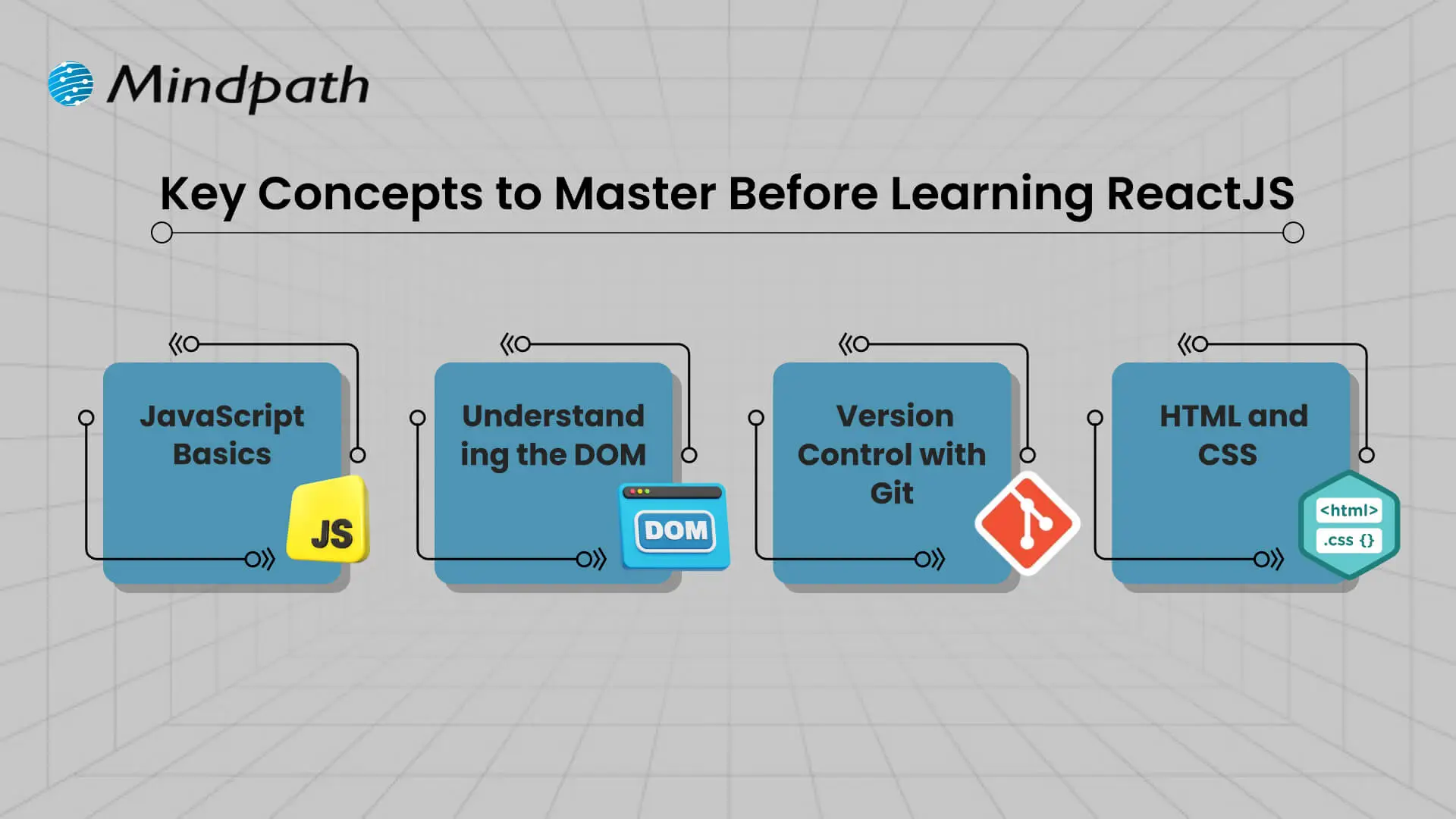
Key Concepts to Master Before Learning ReactJS

1. JavaScript Basics

It is important for you to understand variables, functions, arrays, and objects in JavaScript. These are the building blocks for the logic and data in React.

2. Understanding the DOM

It is important for you to understand what the browser is doing in terms of displaying things and changing things via the DOM. React uses the DOM structure to show on the screen and make changes to it easily and efficiently.

3. Version Control with Git

It is important for you to understand how to track and manage your changes in your projects, via version control, specifically with Git. It is a vital part of a real-world React application, especially when working with a team.

4. HTML and CSS

Learning the fundamentals of HTML for structuring web pages and CSS for styling them is important. Understanding layouts related to flexbox or grids is necessary for developing responsive user interfaces in React. 

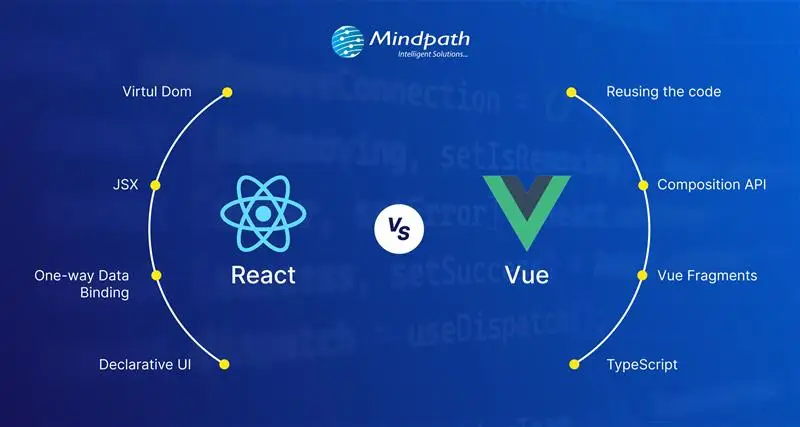
Curious to identify which technology aligns best with your development team’s strengths? Read about the practical implications of choosing React vs Vue for your business projects.

ReactJS Roadmap 2026

To become a skilled React developer in 2026, it’s important to follow a clear and practical learning path. This React tutorial, based on the latest ReactJS roadmap 2026, will guide you through the key topics to focus on at each stage of your journey.
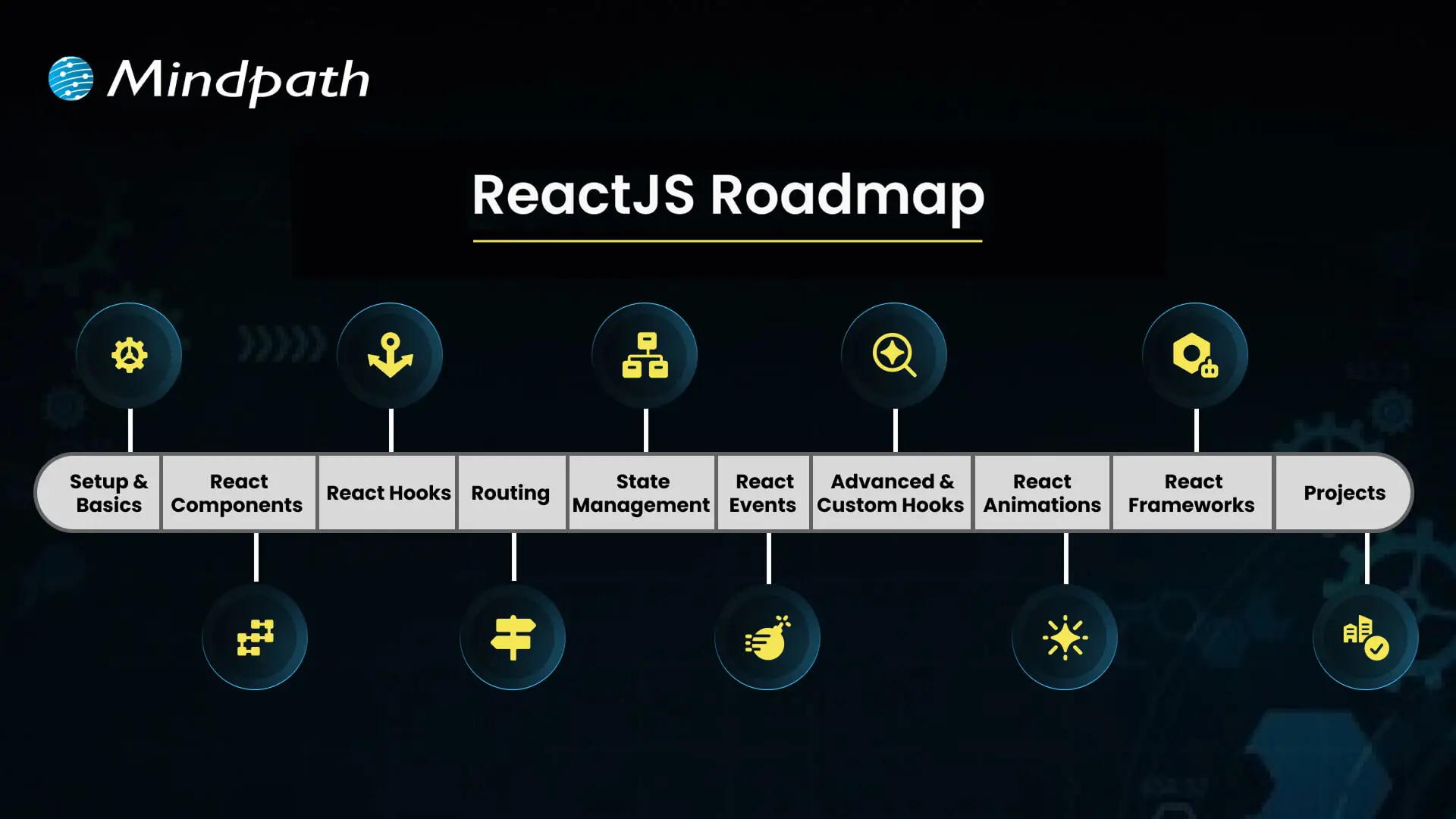
ReactJS Roadmap

1. Setup & Basics

Start by setting up your environment with tools like Node.js and npm to begin working with React. Learn how JSX works and how it allows writing HTML-like code inside JavaScript, which is essential in any React roadmap.

2. React Components

Understand the structure and role of components, which form the UI of any React application. Functional components, props, and state are core parts of this architecture, making them a key focus in the front-end roadmap.

3. React Hooks

Hooks let you use features like state and lifecycle in functional components without writing classes. Mastering built-in hooks such as useState, useEffect, and useContext is crucial in any modern React Roadmap.

4. Routing

Routing allows smooth navigation between pages in single-page applications using tools like React Router. It enhances user experience by loading components based on the URL, as commonly seen in apps.

5. State Management

State holds the data that drives your UI and updates the app when changes. Techniques like React Context API and Redux help manage local and global states effectively within your project.

Also Read: Techniques to Optimize ReactJS Performance

6. Event Handling

React handles user actions such as clicks, form submissions, and scrolls through event handlers. Learning how to work with these events improves interactivity and responsiveness in your application.

7. Advanced & Custom Hooks

Explore patterns like component composition, higher-order components, and custom hooks to reuse complex logic. These advanced topics align with current React trends and best practices.

8. React Animations

Animations create smooth transitions and improve the user experience using tools like Framer Motion or React Spring. These libraries offer a flexible way to add motion to your interface.

9. React Frameworks

Explore frameworks built on top of React, such as Next.js and Gatsby, that enhance app performance and SEO. These tools are often mentioned in ReactJS blogs for speeding up development.

10. Projects

Apply what you learn by building real-world applications that solve problems and test your skills. Project-based learning is a major part of the React tutorial approach and strengthens your understanding of concepts in the JavaScript roadmap.

Looking for ways to improve user engagement and overall app performance? Read the top reasons to choose ReactJS for app development and see why it’s preferred by many leading businesses.

Ready to Start Your React Journey?

Following a structured React roadmap helps you learn React with purpose and confidence. This blog covered everything from the basics to advanced tools and trends that matter in 2026. By focusing on key concepts, building projects, and staying updated, you’ll be better prepared to grow as a skilled React developer in today’s fast-moving web world.

This React roadmap is just the beginning. At Mindpath, we bring these React concepts to life through modern and scalable solutions built by expert developers. Our ReactJS development services align perfectly with what you’ve explored in this blog, delivering clean architecture, smart component reuse, and performance-focused interfaces that work seamlessly across devices. Let us help you turn learning into real results through expert-driven development.

Frequently Asked Questions

1. How long does it realistically take to follow a React roadmap completely?

It depends on your current skill level and daily learning commitment. Most beginners take six to twelve months to move from basics to advanced concepts. Consistent practice, building real projects, and staying updated with React trends 2026 will accelerate your progress far more than just watching tutorials passively.

2. Is JavaScript expertise necessary before starting with React?

A solid understanding of JavaScript fundamentals is strongly recommended before touching React. Concepts like functions, arrays, objects, and DOM manipulation appear constantly throughout React development. Jumping into React without this foundation often leads to confusion and slower progress, making the overall learning experience frustrating rather than rewarding.

3. What is the best way to practice React skills beyond tutorials?

Building real projects is the most effective way to solidify React knowledge. Start with simple apps like to-do lists or weather dashboards, then move toward more complex builds. Real projects force you to solve actual problems, which builds the kind of confidence and muscle memory that tutorials alone cannot provide.

4. Do developers still need to learn Redux in 2026 with React Context available?

Both still have their place depending on project scale. React Context works well for simpler state needs, while Redux handles complex, large-scale applications more predictably. Understanding both is part of a well-rounded React roadmap for 2026 and makes developers more versatile across different project types and team environments.

5. Should beginners learn Next.js alongside React or wait until React is fully mastered?

It is better to get comfortable with core React concepts first before moving to Next.js. Rushing into frameworks too early creates gaps in foundational understanding. Once routing, hooks, and state management feel natural, exploring Next.js becomes significantly easier and more productive as a next step in the learning journey.
Related Post

Related Post

WordPress maintenance
Is your WordPress site running as smoothly as possible? Do you know what kind of essential maintenance activities should be done on your website to keep it secure and running well? In this blog, we will explore the essential maintenance tasks that will keep your WordPress site in top shape. So, let’s dive in! 

Importance Of Website Maintenance   

Routine WordPress maintenance will help your website to be stable, secure, with better loading speed, and compatible with different browsers and devices. Regular backups guarantee that there is no loss of data in case of website crashing or malware attacks. Up-to-date plugins will ensure that slowdowns and security risks are prevented. Monitoring and analytics on user behavior help you make informed decisions and optimize your content. This provides better maintenance of your website, thus keeping it in top shape, and gives a better experience to the visitor. 

How Much Does WordPress Maintenance Cost?  

The cost of maintaining a WordPress site will be based on the size and complexity of the website. Routine maintenance in 2024 can range from as low as $5 a month to $120 per month or $40 a year to $1,200 a year. For a personal site, maintenance might be as low as $4 a month or $40 annually. Business sites usually start at about $8 per month or $80 per year. The pricing for running corporate websites is usually in the region of $12 a month or $120 yearly. The websites related to entertainment and eCommerce usually cost more, with the former starting at $16 per month and the latter at $20 a month. Routine maintenance includes updating plugins, themes, and WordPress core, managing backups, ensuring security, and keeping up performance. 

The Complete Checklist of Monthly WordPress Maintenance Tasks   

1. Optimize Your Database   

Over time, your WordPress database can become bloated with extraneous data from things like old post revisions, spammy comments, and deleted items, which slow down your site. To clean up your database, first back it up using a tool like Solid Backups to ensure all your data is safe. Then use a plugin such as WP Optimize to clear out any unnecessary data and boost database performance. Alternatively, if you know how to manipulate a database, you can clean up manually with phpMyAdmin. This method is useful when custom settings must be considered, and in all probability, it would be good to talk this over with a developer in case you are unsure. 

2. Manage Backups   

Backing up your website is something you should do regularly for safety against losses and quick recoveries in case of issues. Besides, with Solid Backups, you can configure backups automatically by using the plug-in known as UpdraftPlus. Schedule the backups frequently and let them be safely kept in the cloud, optimally. Moreover, review the process of restoration month by month to confirm that your backup procedure is working well, and in case of need, you will be in a good position to recover your site. 

3. Update WordPress Core, Plugins, And Themes   

WordPress core, theme, and plugin updating have implications for security, compatibility, and accessing new features. According to the Wordfence 2022 State of WordPress Security report, plugins in particular are a weak point, so keeping them up to date is very important. Keep checking for updates, and when found, update them one after the other. Begin with the WordPress core and then proceed to plugins and themes. Remember to always back up before doing any big update and update on a staging site so you can be sure everything works well with your current setup. 

4. Perform Security Scans   

Security scans to vulnerabilities, malware, and unauthorized access should be regularly scheduled. Run full site scans with a plugin like Shield Security, check the logs for any suspicious activity, and configure settings. You should, however, schedule these scans to run periodically, but at least revise them once a month. 

5. Analyze Site Speed   

A website’s speed has a massive impact on user experience and SEO. Among others, you can use Google PageSpeed Insights, GTmetrix, or Pingdom to check how fast your website loads. After testing, fix performance issues of your website against the results. If the speed problems continue, see if there’s a need to review and upgrade your hosting plan. 

6. Check For Broken Links   

Checking for broken links is important both for delivering a good user experience and SEO. Broken links may make visitors and search engines end up in so-called ‘dead ends,’ harming your site’s rankings and authority. Run a check using a plugin such as Broken Link Checker. Thereafter, repair or remove broken links upon finding them, possibly looking into scheduling automated checks to help identify new broken links in the future. 

7. Optimize Images   

Optimizing images will help to increase your site speed and performance radically, particularly when you have a heavy share of images on the site. Tools like Smush or ShortPixel do really well when it comes to compressing existing images. Remember the right formats—JPEG for photos and PNG for graphics where the requirement is transparency. Enable lazy loading; this defers the loading of off-screen images to further speed up page load times. 

8. Submit Your Sitemap   

Making sure that you are regularly submitting your sitemap to search engines will let them index your website in a better way and give you more exposure. Use a plugin such as Yoast SEO to create an updated sitemap, then take the time to manually submit this to search engines via their webmaster tools—like Google Search Console—to check that all your pages are correctly crawled and indexed for maximum search engine visibility. 

9. Monitor Site Performance   

Monitoring your site’s performance frequently will let you know when there is a problem. It helps in making informed decisions and will let you act swiftly. Use tools like Google Analytics and Jetpack to look through key metrics such as page views, bounce rate, and conversion rates. This setting of performance alerts about major changes or problems will let action be taken in time and thus your site runs smoothly. 

10. Test Your Forms   

Testing of forms at regular intervals is paramount to ensure that they work right and harvest data from users effectively. All forms should work well, and process input correctly. Check that email notifications are going to the right addresses, then test for user experience to make sure forms are usable, accessible, and responsive on different browsers and devices. 

11. Clear Site Cache 

It ensures that your site visitors have the most recent content. In addition, it will boost your website’s performance. Sometimes, cached data can become corrupt or outdated, causing display issues and slowing download time. Flush the server cache, then reset any plugin-built caches. Test your site for improved performance after flushing the cache. This can also be done in many ways depending on your unique setup. If you are not comfortable doing it yourself, use something like WP Super Cache and W3 Total Cache

Ready to optimize Your WordPress Experience?

Learn More About Mindpath’s Maintenance Services!

WordPress Development Services at Mindpath   

At Mindpath, we ensure your WordPress website runs at its best with comprehensive maintenance services. This includes regular updates to WordPress Core, plugins, and themes; daily backups for data security; and optimization of the performance of the site so that it loads faster. Our team conducts security scanning to save from threats, monitors and fixes broken links, and looks through analytics to bring about better user engagement. We test forms to make sure they are working well. You just focus on your business while we keep your site secure and efficient with our expert maintenance. 

Conclusion 

Maintenance, on the other hand, will ensure your WordPress site is not only smooth, safe, and high performing, but it will also be defended from many problems for the best user experience. From checking for broken links to analyzing site speed or running security scans, every step is important in keeping your website at its best. 

At Mindpath, we cut down the complexity of WordPress maintenance by offering every necessary service in one place to keep your site in top condition. Let our team take care of updates, backups, performance optimization, security checks, and more, so you can focus on growing your business while we work on keeping your website reliable and engaging. Our expert team at Mindpath makes sure your WordPress site is running at peak performance, ensuring you can get on with business and not worry about it. 

Want to achieve a Faster, Safer WordPress Site?

Find Out More About Mindpath’s Maintenance Solutions!

Ensure your WordPress site runs smoothly with essential maintenance tasks like updates, backups, security scans, and performance optimization.
ai in mobile apps

Every day, AI in mobile apps revolutionizes user interaction with technology. Just think of a single application that understands your behavior, foresees your requirements, and adjusts its capabilities for a smooth and unique experience. Enterprises are equipped with smart features such as conversational agents, personalized algorithms, and speech assistants to attract user interaction in a better way. This transformation is making regular applications become intelligent friends that facilitate actions and offer answers that are convenient and timely.

Beyond convenience, AI in application development brings innovation and returns efficiency. In a nutshell, developers can analyze real-time data, discover patterns, and tailor personalized experiences for users, keeping them more engaged for longer periods. Companies can gain insight into users through actionable data, and users enjoy quicker, seamless, and more meaningful interactions. As the future of AI continues to unfold, this new progress opens the doors to new opportunities in retailing, healthcare, education, and entertainment. This article shall delve into the positive impacts, utilization, and practical scenarios of AI in mobile apps. So, keep reading further!

Ready to bring AI into your mobile app development, but confused about where to start? Mindpath provides full guidance on mobile app development services to help you gain user attraction and create powerful digital experiences.

Evolution of AI in Mobile App Development

AI in mobile app evolution has changed the design of the same user simple tools into smart, user-engagement-focused experiences. The earliest examples of AI in mobile applications were predictive text and basic speech recognition, while mid-level AI brought in personalized recommendations, more intelligent search functions, and AI-enabled chatbots. All these technological innovations enabled the most efficient user-behavior apps to comprehend and reply to users without wasting time.

Currently, artificial intelligence in mobile applications powers advanced features such as real-time analytics, augmented reality, and the ability for apps to operate autonomously. Besides, AI dramatically simplifies the development process by automatic testing, code generation, and cross-platform integration. These innovations reflect the consistent trend of AI eventually transforming mobile into more intelligent, rapid, and personalized user experiences, hence driving app usage to be a natural daily occurrence.

Looking to understand how mobile apps can enhance the impact of AI and unlock greater value for your business? Discover more insights in our blog on the Mobile App Development, which benefits your business by improving customer engagement and driving measurable growth.

Benefits of Artificial Intelligence in Mobile Apps

AI-enabled mobile app development is a game-changer as it opens opportunities for intuitive, personalized and efficient apps. Developers can thus use smart features to build apps that not only attract users but also make their routine tasks effortless.

1. Tailored Experiences for Users

Mobile applications powered by Artificial Intelligence will eventually have the capability to study user behavior and preferences so as to offer customized content and recommendations. This means that the applications will be more engaging, and the users will have a custom-made experience which gives them the impression that the entire thing is just for them.

2. Stronger Security Measures

AI is one of the factors that revolutionize the environment of mobile applications to uncover unconventional user behaviour patterns with the aid of artificial intelligence technology, to prevent unauthorized access, and ensure the safety of the data. If you associate with a firm that is proficient in AI app development, then you will definitely have security protocols being implemented in a proper way.

3. Instant Customer Support

AI-driven virtual assistants solve problems right away, thus increasing user delight. Consequently, the need for human support is made smaller although the speed and correctness of the answers are maintained.

Also Read: AI for Customer Services 

4. Smarter Search and Navigation

The power of AI allows applications to interpret voice inputs, pictures and even the users’ thoughts in order to deliver more accurate search results. Thus, users are able to locate their desired items in less time, which means the experience is more fluid and user-friendly.

5. Predicting Trends and Behavior

The AI in mobile apps is capable of studying user actions which were done in the past to predict their future inclinations and the general trend of the market. Thus, enterprises will be able to have a clearer vision of the suitable decisions to take, which will further promote the involvement of clients.

6. Streamlined Tasks and Efficiency

Artificial intelligence can automate the execution of monotonous operations that include scheduling, setting of reminders, data handling, and so on, thereby saving valuable time and eliminating errors. A company can utilize AI app ideas to create apps that are both quality-excellence and user-friendly.

Curious how mobile apps can leverage AI to transform your business and stay ahead in 2025? Explore our blog on Mobile App Development Trends to discover how these innovations can enhance user experiences.

Use Cases of AI in Mobile App Development

Artificial Intelligence is transforming how mobile applications function and enabling them to become smarter, faster, and more adaptable. The use of artificial intelligence in mobile application development is progressing and promotes opportunities for interesting new applications across industries.

1. Personalized Content and Recommendations

AI in mobile apps can use advanced data analytics of users’ intent and behaviors to formulate personalized content and product recommendations and offerings. By suggesting items or services they might like, apps proactively enhance user engagement and satisfaction, and they also help businesses utilize data to make informed decisions.

2. Intelligent Virtual Assistants

Applications incorporate artificial intelligence technology for mobile app development, and voice assistants now exist that can take user directions. These voice assistants can help navigate tasks quickly, without even using your hands, allowing access to information obtained faster and can speed up your daily tasks.

3. Automated Task Management

AI takes over basic responsibilities, such as scheduling and reminders, or the organization of emails from mobile applications. This increases efficiency and minimizes the time a user will spend on monotonous tasks.

4. Enhanced Security and Fraud Detection

AI in mobile apps identifies unusual patterns of user behaviour and prevents fraud from happening right away. Businesses can leverage advanced monitoring and threat detection functionality to safeguard sensitive information and ensure user safety.

5. Industry-Specific Smart Solutions

Artificial intelligence powers the development of applications in the healthcare, finance, and e-commerce arenas which can provide personalized services, forecasts, and automation. Working with an AI application development company can help ensure applications comply with industry standards, while also improving the user experience.

Want to make sure that your applications are not only functional but also secure, compliant, and trustworthy for your users? Discover our blog on application security best practices to explore essential techniques for protecting your software and building trust.

Real-World AI in Mobile Application Examples

AI in mobile apps is transforming everyday interactions by making them smarter, faster, and more intuitive. Real-world examples show how AI improves user experiences, streamlines tasks, and delivers personalized solutions across different industries.

Real-World AI in Mobile Application Examples

1. Voice Control with Siri, Google Assistant, and Alexa

These virtual assistants use artificial intelligence in mobile applications to understand voice commands and perform tasks like setting reminders or controlling smart home devices.

2. Personalized Streaming on Netflix and Spotify

Streaming apps use AI in mobile apps to analyze user behavior and recommend movies, shows, or music that match individual preferences.

3. Smart Social Feeds on Facebook and Instagram

Social media platforms use AI mobile app development to personalize news feeds and suggest relevant content, friends, and groups for each user.

4. Tailored Shopping on Amazon

Amazon uses AI in mobile apps to recommend products based on browsing history and past purchases, creating a personalized shopping experience.

5. Visual Search with Google Lens

Google Lens uses AI technology for mobile app development to recognize images and provide instant results through photo-based searches.

Want to build a mobile app but don’t know which technology to use for better execution? Learn from the mobile app development technologies blog to understand what suits best for your business.

Ready to Build Smarter Mobile Apps with AI?

The use of AI in mobile apps introduces new opportunities for businesses and users. This advancement creates great user experiences, strengthens security, and provides more effective daily interaction. As industries pursue innovation, apps will work smarter, adapt more quickly, and become infinitely personal, helping brands engage with users, in meaningful and authentic ways.

Working with Mindpath gives organizations access to superior AI mobile application development services built for measurement. We build intelligent, fast, and user-friendly applications to support your organizational priorities. We provide a blend of strategy, innovation, and technology to design digital solutions that drive growth and maintain user engagement.

hiring full stack developer for MVP

The scale of innovation in the modern business landscape is growing consistently, calling for more efficient approaches to create digital solutions. Businesses choose to build MVPs or Minimum Viable Products before investing a huge amount in production. The benefits of hiring full-stack developer for MVP development have been drawing the limelight towards full-stack development services. 

Some business owners think about the possible ways in which full-stack developers can help with MVP development. With full-stack developers, businesses don’t have to hire multiple developers or set up a perfect team to create their MVP. Let us learn about the different ways in which full-stack development services contribute to the success of MVP.

Are you looking to turn your MVP idea into a market-ready product? Mindpath’s Full Stack Development Services will give you access to versatile developers who can handle both front-end and back-end seamlessly.

The Rise of Full Stack Developers

Full-stack development has emerged as one of the prominent alternatives to traditional development approaches. Businesses that have to hire full-stack developer for MVP development must know what a full-stack developer brings to the table. You must notice the term “full-stack” to understand the role of full-stack developers. It represents the complete technology stack or collection of technologies used to create a functional application. Full-stack developers are professionals who have expertise in frontend and backend development.

The versatility of full-stack developers empowers them to bridge the gap between what users see in an application and the underlying infrastructure that powers the application. On top of it, full-stack development also requires knowledge of other aspects such as version control, API integration, and database management. Businesses can find different technology stacks for full-stack development, like MERN, MEAN, LAMP, and Python-based stacks. Every technology stack offers a combination of powerful technologies used to create intuitive applications. 

Advantages of Creating a Minimum Viable Product (MVP)

The Minimum Viable Product or MVP is a trending buzzword in the digital landscape and a strategic solution for efficient product development. Imagine a situation in which a business has invested thousands of dollars in developing an app without a MVP. What will the business do if the target customer base of the organization does not like the app? The business would end up losing the money it invested in the app. 

Let us assume another scenario in which companies hire full-stack developer to create an MVP before rolling an app into production. The MVP is a minimal version of the software or application with limited features for the early adopters. Businesses create MVPs to test their digital products in the early stages of development and learn from the feedback of users to create effective solutions. The following advantages of a MVP will help you understand its significance in the dynamic business landscape.

1. Faster and Cost-Effective Development

One of the prominent advantages of MVPs is the assurance of faster time to market for new digital products and services. MVP focuses on achieving rapid deployment with essential features to gain an early advantage in the target market. 

Businesses can create MVPs without spending a lot on developing a product with full features and gather user feedback. As a result, the MVP can help in testing concepts and identifying the strengths and weaknesses of the application without unwanted expenses.

2. Risk Mitigation from User Feedback

The most distinctive highlight of MVP app development is the opportunity to interact directly with early adopters. Their feedback can help a business find valuable insights into the preferences, pain points, and requirements of users. Developers can use the feedback to ensure that the final product meets user expectations. Interestingly, MVP development involves continuous testing, feedback, and refinement to create more user-friendly and robust applications.

Feedback from users with a minimalistic version of the final product helps in reducing risks for businesses. For instance, business owners don’t have to invest extensively in concepts that their target audience does not like. Early feedback from users helps in identifying potential issues and implementing necessary modifications to reduce risks. 

3. Competitive Edge in the Market

The Minimum Viable Product also helps a business measure market interest and demand for their digital product. It can validate innovative ideas, while negative feedback opens new possibilities for timely modifications before investing a lot in app development. 

The ability to introduce a unique product in the market with limited features allows a business to gain a competitive advantage. Businesses can leverage MVPs to showcase their presence and build brand awareness before competitors jump in. On top of it, the MVP also offers an easy way to generate initial revenue that can be used to support product enhancements and development costs.

Want to stay ahead of the competition and build a truly impactful MVP? Discover the latest Full Stack Development Trends to leverage cutting-edge technologies, streamline development, and maximize your product’s success

Why Should You Hire Full Stack Developers for MVPs?

If the MVP is an important concern for businesses, then they might need specialists for the same. Is MVP development with full-stack developers a feasible choice for your business? The following benefits of working with full-stack developers will help you understand why they are the ideal choices for MVP projects. 

1. Cost Reduction

The cost of a MVP project is significantly less than that of a full-fledged development project. Interestingly, full-stack developers can reduce the cost of MVP development further with their versatility in frontend and backend technologies. Businesses don’t have to hire multiple specialists, thereby reducing the overall development costs. Startups and small enterprises can make the most of this advantage to create impactful MVPs with limited resources.

2. Faster Development

Hiring a full-stack developer is also a proven solution for accelerating the development process. Full-stack developers can contribute to the MVP success strategy with their expertise in frontend and backend domains to ensure seamless integration of all essential components. The streamlined development process supports faster iterations and offers flexibility for refining the product on the basis of users’ feedback. The speed of MVP development helps companies in validating innovative ideas and approving them for production to gain a competitive advantage.

3. Versatile Skillset

Full-stack developers are the ideal picks for MVP development due to their ability to make informed decisions according to the complete development stack and business goals. You can rely on them for end-to-end implementation, starting from creating interactive user interfaces to designing robust server-side architectures. The versatility of full-stack developers also empowers them to switch roles in the MVP development project without conflicts.

4. Lesser Communication Overhead

The next prominent advantage of hiring a full-stack developer for MVP is the assurance of efficient communication. Businesses don’t have to invest a lot of time in communicating with multiple specialists for a MVP project. If a business hires specialists for frontend and backend development, then it will have to monitor their work. On the contrary, full-stack development requires communicating only with a single person. The straightforward communication helps in reducing the possibilities of errors and increases the chances of overall success of the MVP project.

5. Easier Maintenance

With full-stack developers, businesses can avoid all worries about maintenance of the MVP project. Full-stack developers can leverage their expertise in different technologies to address the maintenance requirements, such as bug fixes, updates, and enhancements. On top of it, full-stack developers can implement changes quickly while ensuring compatibility and consistency between different development phases. 

6. Quicker Prototyping

If you have an innovative idea for an app and fail to develop it before your competitor, then you might lose the competitive edge. The value of full-stack development for startups, especially in the case of MVP development, is visible in faster prototyping. Businesses could build working prototypes for their innovative ideas and allow stakeholders to interact with the product. Faster prototyping helps in making necessary changes in the early stages of development and gives opportunities to outsmart the competition.

If you’re not sure what skills to look for in a full-stack developer, start by understanding the key factors that make one successful. Discover Things to Consider Before Hiring a Full Stack Developer to see what expertise can help your MVP stand out.

Challenges of Hiring Full Stack Developers for MVP Projects

The advantages of working with full-stack developers on MVP projects showcase why you need one right now. At the same time, business owners must pay attention to the challenges of hiring full-stack developers. For instance, it is difficult to find full-stack developers with the exact skills required for your MVP development projects. 

Businesses can capitalize on all the benefits of full-stack development only if they hire developers with experience in handling frontend and backend development. It is also important to know that full-stack developers are better picks for small and medium-sized projects. However, hiring only one full-stack developer for large and complex projects may not be the best choice for a business owner.         

Ready to Build Your MVP with the Right Full-Stack Team?

The decision to bring a full-stack developer into your workforce for MVP development is right for many reasons. For starters, you can build the Minimum Viable Product quickly and obtain user feedback to implement relevant modifications in the early stages. On the other hand, choosing a full-stack developer may be one of the toughest challenges for business owners.

At Mindpath, we offer full-stack development services personalized to align with client requirements and vision. We have helped multiple clients bring their vision to reality in the form of intuitive, user-friendly, and robust applications. Our experience and commitment to serving the best results in MVP development make us the best pick for startups and big corporations. Find the ideal resources to create your next MVP project right now.

Frequently Asked Questions

1. When is the right time to hire a full-stack developer for an MVP project?

The ideal time is during the early planning or prototype stage. Bringing in a full-stack developer early helps shape the product architecture, avoid rework, and ensure smooth development from the start, leading to faster validation and more efficient use of resources.

2. How can a full-stack developer support better product decisions during MVP development?

A full-stack developer understands both user-facing features and backend logic, which helps in making balanced decisions. This ensures that features are not only functional but also scalable, improving the overall quality and usability of the MVP from the beginning.

3. What should be evaluated before selecting a full-stack developer for an MVP?

It is important to assess practical experience, familiarity with relevant technology stacks, and the ability to handle end-to-end development. Strong problem-solving skills and an understanding of business goals also play a key role in ensuring successful MVP delivery.

4. How does working with a full-stack developer impact long-term product growth?

A well-built MVP creates a strong foundation for future development. A full-stack developer ensures clean architecture and scalable code, making it easier to expand features, handle increased users, and adapt to changing business needs without major redevelopment.

5. Can a full-stack developer manage changes effectively during MVP iterations?

Yes, full-stack developers are well-equipped to handle frequent changes during MVP cycles. Their ability to work across different layers of the application allows quicker updates, smoother adjustments, and better alignment with user feedback throughout the development process.